
Chapter 7 Sharpen the Focus Target Marketing Strategies







- Slides: 39
Chapter 7 Sharpen the Focus: Target Marketing Strategies and Customer Relationship Management Copyright 2009 Pearson Education, Inc. Publishing as Prentice Hall
Chapter Objectives § Identify the steps in the target marketing process § Understand the need for market segmentation § § § 2 and the segmentation approaches available Explain how marketers evaluate segments and how to choose a targeting strategy Understand how marketers develop and implement a positioning strategy Explain how marketers increase long-term success and profits by practicing customer relationship management Copyright 2009 Pearson Education, Inc. Publishing as Prentice Hall
Real People, Real Choices: Decision Time at Nutri. System, Inc. § Which strategy should Nutri. System implement: – Option 1: Air testimonial ads from men who tried the 28 -day weight loss program on cable – Option 2: Don’t enter the men’s market – Option 3: Develop a men’s program and launch it with a big splash on national television 3 Copyright 2009 Pearson Education, Inc. Publishing as Prentice Hall
Target Marketing Strategy: Selecting and Entering a Market § Market fragmentation: – The creation of many consumer groups due to the diversity of their needs and wants § Target marketing strategy: – Dividing the total market into different segments based on customer characteristics, selecting one or more segments, and developing products to meet those segments’ needs 4 Copyright 2009 Pearson Education, Inc. Publishing as Prentice Hall
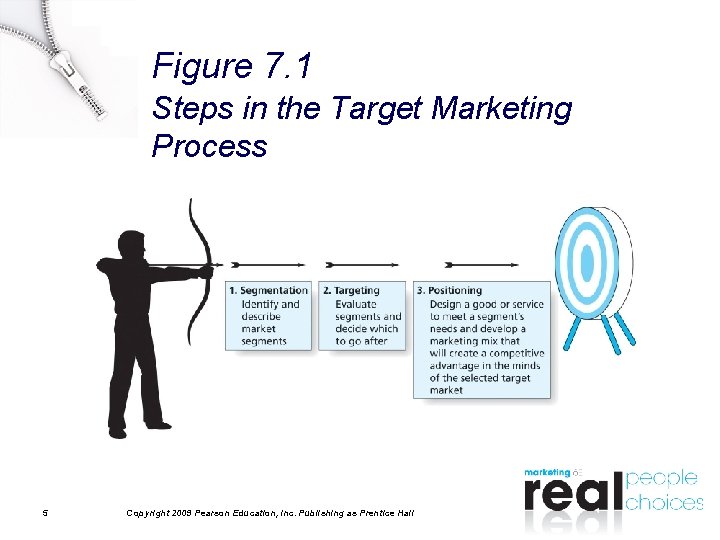
Figure 7. 1 Steps in the Target Marketing Process 5 Copyright 2009 Pearson Education, Inc. Publishing as Prentice Hall
Steps in the Target Marketing Process Step 1: Segmentation § Segmentation: – The process of dividing a larger market into smaller pieces based on one or more meaningful shared characteristics § Segmentation variables: – Dimensions that divide the total market into fairly homogeneous groups, each with different needs and preferences 6 Copyright 2009 Pearson Education, Inc. Publishing as Prentice Hall
Steps in the Target Marketing Process Step 1: Segmentation § Segmentation variables include: – Demographics—size, age, gender, ethnic group, income, education, occupation, family structure • Generational marketing – Psychographics—psychological, sociological, and anthropological factors – Behavioral characteristics 7 Copyright 2009 Pearson Education, Inc. Publishing as Prentice Hall
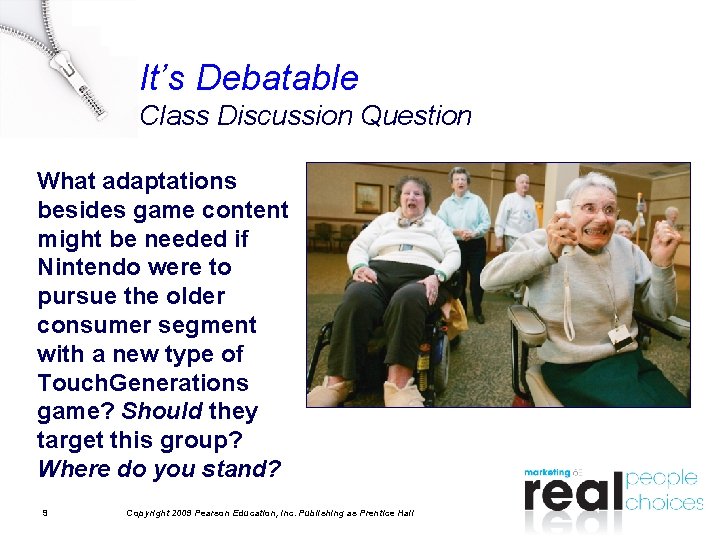
Segmenting by Demographics: Age and Generational Marketing § Children § Teens § Tweens § Generation Y: born between 1977 and 1994 § Generation X: § § born between 1965 and 1976 Baby boomers: born between 1946 and 1964 Older consumers Visit Nintendo 8 Copyright 2009 Pearson Education, Inc. Publishing as Prentice Hall
It’s Debatable Class Discussion Question What adaptations besides game content might be needed if Nintendo were to pursue the older consumer segment with a new type of Touch. Generations game? Should they target this group? Where do you stand? 9 Copyright 2009 Pearson Education, Inc. Publishing as Prentice Hall
Segmenting by Demographics: Gender § Many products appeal to one sex or the other § Metrosexual: A straight, urban male who is keenly interested in fashion, home design, gourmet cooking, and personal care 10 Copyright 2009 Pearson Education, Inc. Publishing as Prentice Hall
Family Life Cycle Targeting Family needs change dramatically for many products over time, creating the opportunity to segment by family life cycle This ad targets young mothers who have to make many decisions about babyrelated products 11 Copyright 2009 Pearson Education, Inc. Publishing as Prentice Hall
Segmenting by Demographics: Other Variables § Family life cycle: – Family needs change over time § Income – Strongly correlated with buying power § Social Class – Consumers buy according to image they wish to portray 12 § Race and ethnicity – African Americans – Asian Americans – Hispanic Americans § Place of residence – Geographic regions – Geodemography – Geocoding Copyright 2009 Pearson Education, Inc. Publishing as Prentice Hall
Segmenting by. . . ? ? Many products use multiple segmentation variables This ad for student loans specifically targets students who want to attend college. While it would be natural to think that this ad uses education as a segmentation variable, income level and age could also come into play. 13 Copyright 2009 Pearson Education, Inc. Publishing as Prentice Hall
Segmenting by Place of Residence § Geodemography: – Combines geography with demographics Learn more about PRYSM § Geocoding: – Customizes Web advertising so people who log on in different places see ad banners for local businesses Visit Reach. Local. com 14 Copyright 2009 Pearson Education, Inc. Publishing as Prentice Hall
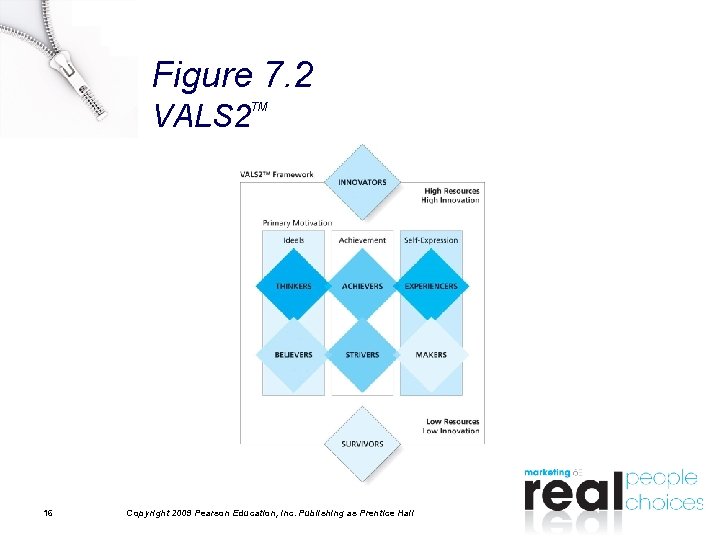
Segmenting by Psychographics § Psychographics: The use of psychological, sociological, and anthropological factors to construct market segments – Members of psychographic segments typically share activities, interests, and opinions, or AIOS – The VALS 2 system segments U. S. consumers into eight unique groups 15 Copyright 2009 Pearson Education, Inc. Publishing as Prentice Hall
Figure 7. 2 VALS 2 16 TM Copyright 2009 Pearson Education, Inc. Publishing as Prentice Hall
Segmenting by Behavior § Behavioral segmentation: – Segments consumers based on how they act toward, feel about, or use a product § 80/20 rule: – 20% of purchasers account for 80% of a product’s sales 17 Copyright 2009 Pearson Education, Inc. Publishing as Prentice Hall
Segmenting by Behavior § Long tail concept: – Firms CAN make money selling small amounts of items IF they sell enough different items § User status: – Heavy, medium, and light users and nonusers of a product § Usage occasions 18 Copyright 2009 Pearson Education, Inc. Publishing as Prentice Hall
Segmenting B 2 B Markets § Segmentation helps B 2 B firms understand § the needs and characteristics of potential customers Firms can be segmented by: – – 19 Organizational demographics Production technology used Whether customer is a user/nonuser of product North American Industry Classification System (NAICS) Copyright 2009 Pearson Education, Inc. Publishing as Prentice Hall
Steps in the Target Marketing Process Step 2: Targeting § Targeting: – A strategy in which marketers evaluate the attractiveness of each potential segment and decide in which segment they will invest resources to try to turn them into customers – The customer group(s) selected are referred to as the target market 20 Copyright 2009 Pearson Education, Inc. Publishing as Prentice Hall
Evaluation of Market Segments § A viable target segment should: – Have members with similar product needs/wants – Be measurable in size and purchasing power – Be large enough to be profitable – Be reachable by marketing communications – Have needs the marketer can adequately serve 21 Copyright 2009 Pearson Education, Inc. Publishing as Prentice Hall
Developing Segment Profiles § After segments are identified, profiles or descriptions of the “typical” customer in a segment are developed – Segment profiles might include demographics, location, lifestyle, and productusage characteristics 22 Copyright 2009 Pearson Education, Inc. Publishing as Prentice Hall
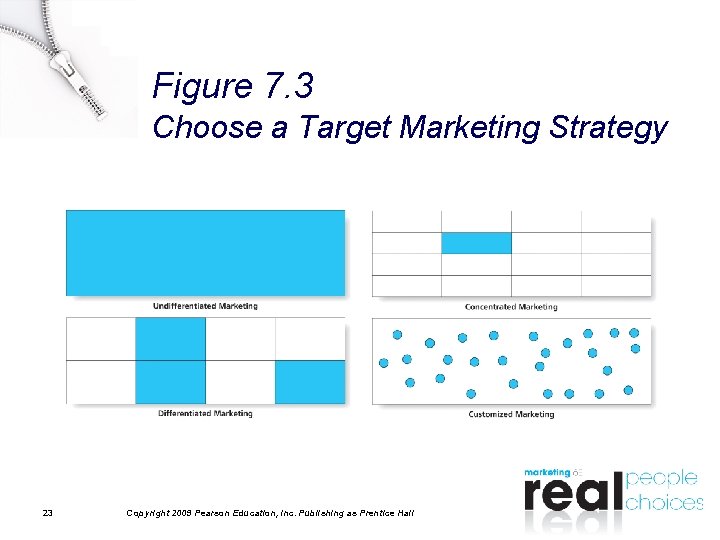
Figure 7. 3 Choose a Target Marketing Strategy 23 Copyright 2009 Pearson Education, Inc. Publishing as Prentice Hall
Choosing a Targeting Strategy § Undifferentiated targeting strategy – Appealing to a broad spectrum of people § Differentiated targeting strategy – Developing one or more products for each of several customer groups § Concentrated targeting strategy – Offering one or more products to a single segment 24 Copyright 2009 Pearson Education, Inc. Publishing as Prentice Hall
Choosing a Targeting Strategy § Custom marketing strategy – Tailoring specific products to individual customers – Common in personal and professional services, and in industrial marketing § Mass customization – Modifying a basic good or service to meet the needs of an individual 25 Copyright 2009 Pearson Education, Inc. Publishing as Prentice Hall
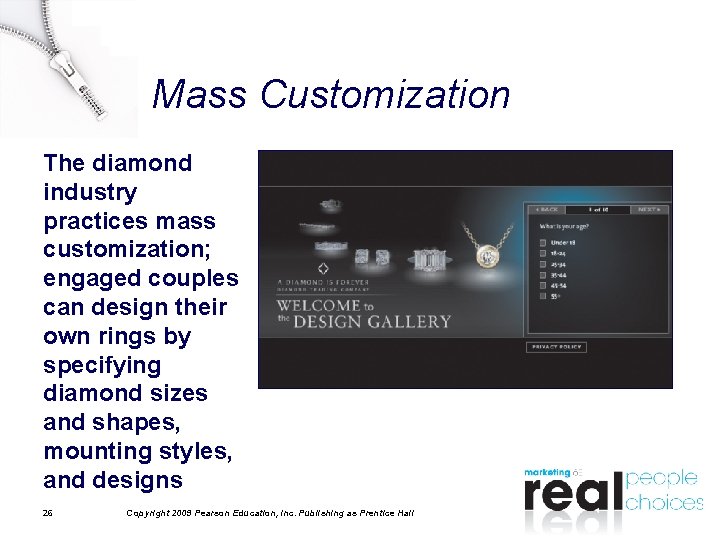
Mass Customization The diamond industry practices mass customization; engaged couples can design their own rings by specifying diamond sizes and shapes, mounting styles, and designs 26 Copyright 2009 Pearson Education, Inc. Publishing as Prentice Hall
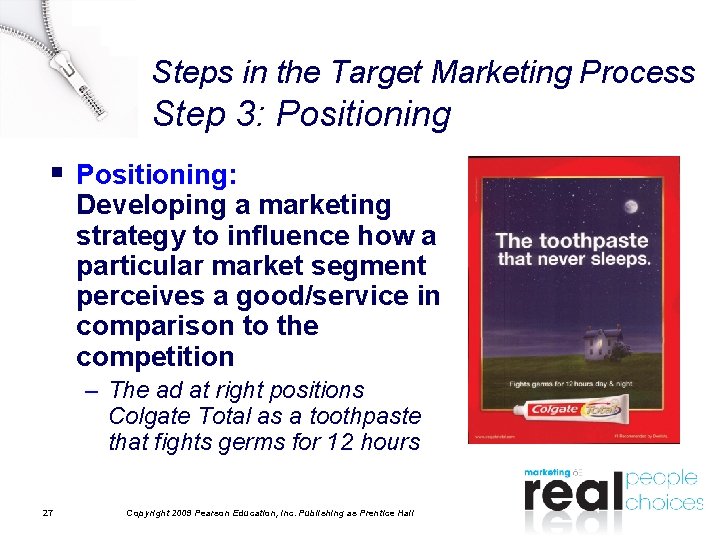
Steps in the Target Marketing Process Step 3: Positioning § Positioning: Developing a marketing strategy to influence how a particular market segment perceives a good/service in comparison to the competition – The ad at right positions Colgate Total as a toothpaste that fights germs for 12 hours 27 Copyright 2009 Pearson Education, Inc. Publishing as Prentice Hall
Steps in Developing a Positioning Strategy § Analyze competitors’ positions § Offer a good or service with a competitive advantage § Finalize the marketing mix by matching mix elements to the selected segment § Evaluate target market’s responses and modify strategies as needed 28 Copyright 2009 Pearson Education, Inc. Publishing as Prentice Hall
Modifying Positioning Strategies § Repositioning is commonly used to change the brand image – Requires redoing a product’s position in response to marketplace changes § Repositioning may breathe life into Retro brands – A once-popular brand that has been revived to experience a popularity comeback, often by riding a wave of nostalgia 29 Copyright 2009 Pearson Education, Inc. Publishing as Prentice Hall
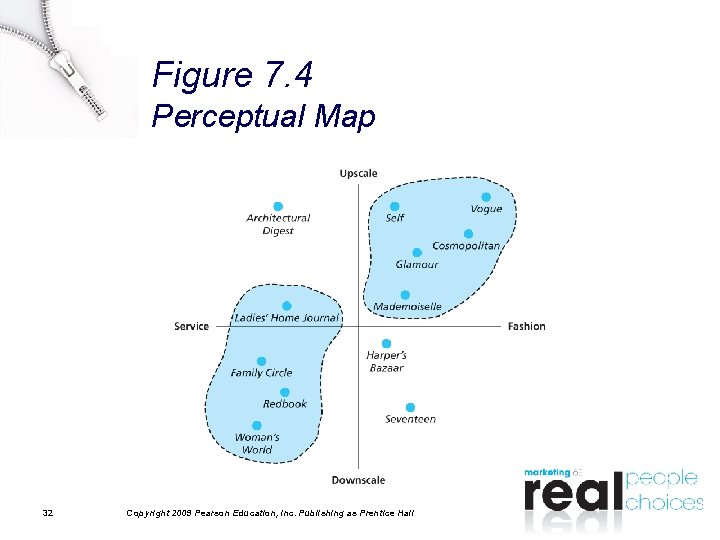
The Brand Personality § Brand personality: A distinctive image that captures the brand’s character and benefits § Perceptual map: – A technique used to visually describe where products/brands are “located” in consumers’ minds relative to competing brands 30 Copyright 2009 Pearson Education, Inc. Publishing as Prentice Hall
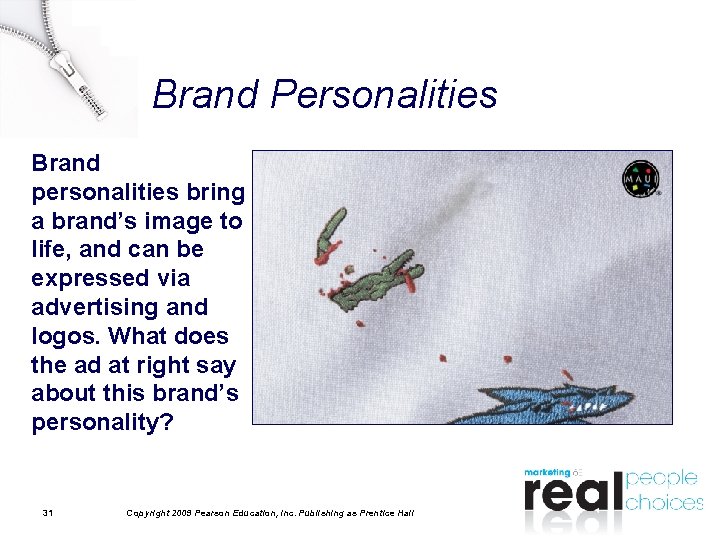
Brand Personalities Brand personalities bring a brand’s image to life, and can be expressed via advertising and logos. What does the ad at right say about this brand’s personality? 31 Copyright 2009 Pearson Education, Inc. Publishing as Prentice Hall
Figure 7. 4 Perceptual Map 32 Copyright 2009 Pearson Education, Inc. Publishing as Prentice Hall
Customer Relationship Management (CRM) § Customer relationship management: – A systematic tracking of consumers’ preferences and behaviors over time in order to tailor the value proposition as closely as possible to each individual’s unique wants and needs § CRM facilitates one-to-one marketing Philadelphia 76 ers Video 33 Copyright 2009 Pearson Education, Inc. Publishing as Prentice Hall
Four Steps in One-to-One Marketing § Identify customers and get to know them in § § § 34 as much detail as possible Differentiate customers by their needs and value to the company Interact with customers; find ways to improve cost efficiency and the effectiveness of the interaction Customize some aspect of the products you offer each customer Copyright 2009 Pearson Education, Inc. Publishing as Prentice Hall
CRM: A New Perspective on an Old Problem § CRM systems use computers, software, databases, and the Internet to capture information at each touchpoint – Touchpoints are any direct interface between customers and a company (online, by phone, in person, etc. ) § CRM proposes that customers are relationship partners, with each partner learning from the other every time they interact 35 Copyright 2009 Pearson Education, Inc. Publishing as Prentice Hall
CRM vs. CEM § Customer Relationship Management characteristics: – Share of customer (vs. share of market) – Lifetime value of the customer – Customer equity – Focus on high-value customers 36 § Customer Experience Management (CEM): – Concept of holistically aligning a firm’s people, processes, systems, and strategies to maximize the customer’s experience with all aspects of your firm and its brands Copyright 2009 Pearson Education, Inc. Publishing as Prentice Hall
Real People, Real Choices: Decision Made at Nutri. Systems, Inc. § Tom chose option 1 – No one felt that marketing weight loss to men would result in a successful campaign, so the firm minimized marketing costs by limiting the campaign to cable ads featuring testimonials – Implementation: Ads were run on Bravo, Discovery, FX, National Geographic, Outdoor Life, Spike TV, Sci-Fi and Speed channels – Measuring success: Media acquisition cost and length of stay per customer 37 Copyright 2009 Pearson Education, Inc. Publishing as Prentice Hall
Keeping It Real: Fast-Forward to Next Class Decision Time at Bossa Nova Beverage Company § Meet Palo Hawken, co-founder and VP of research and innovation at Bossa Nova Beverage Company § Firm markets premium guarana flavored carbonated energy drinks § The decision to be made: How to fit the new açai juice into current product line 38 Copyright 2009 Pearson Education, Inc. Publishing as Prentice Hall
All rights reserved. No part of this publication may be reproduced, stored in a retrieval system, or transmitted, in any form or by any means, electronic, mechanical, photocopying, recording, or otherwise, without the prior written permission. Copyright © 2009 Pearson Education, Inc. of the publisher. Printed in the United States of America. Copyright © 2009 Pearson Education, Inc. Publishing as Prentice Hall 39 Copyright 2009 Pearson Education, Inc. Publishing as Prentice Hall