
Chapter 7 Segmentation Targeting and Positioning Power Point

- Slides: 33
Chapter 7 Segmentation, Targeting, and Positioning Power Point by Kristopher Blanchard North Central University © 2005 Prentice Hall 7 -1
Market Segmentation Represents an effort to identify and categorize groups of customers and countries according to common characteristics © 2005 Prentice Hall 2
Targeting The process of evaluating segments and focusing marketing efforts on a country, region, or group of people that has significant potential to respond © 2005 Prentice Hall 3
Global Market Segmentation Defined as the process of identifying specific segments—whether they be country groups or individual consumer groups—of potential customers with homogeneous attributes who are likely to exhibit similar responses to a company’s marketing mix. © 2005 Prentice Hall 4
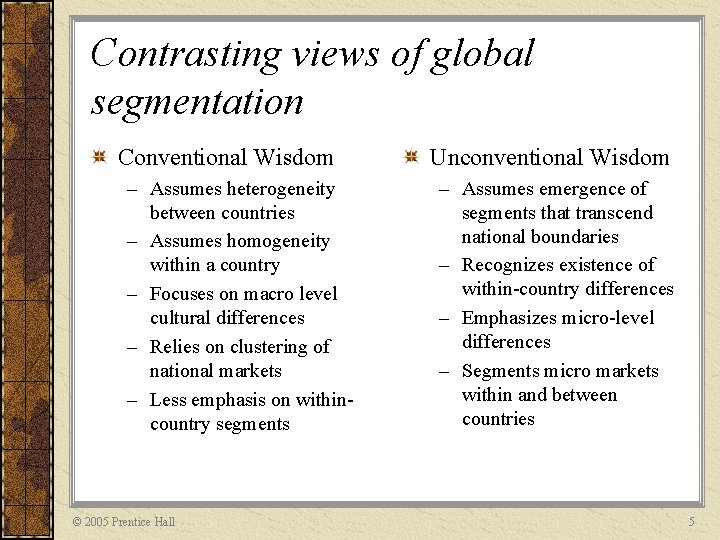
Contrasting views of global segmentation Conventional Wisdom – Assumes heterogeneity between countries – Assumes homogeneity within a country – Focuses on macro level cultural differences – Relies on clustering of national markets – Less emphasis on withincountry segments © 2005 Prentice Hall Unconventional Wisdom – Assumes emergence of segments that transcend national boundaries – Recognizes existence of within-country differences – Emphasizes micro-level differences – Segments micro markets within and between countries 5
Global Market Segmentation Demographics Psychographics Behavioral Characteristics Benefits sought © 2005 Prentice Hall 6
Demographic Segmentation Income Populations Age distribution Gender Education Occupation What are the trends? © 2005 Prentice Hall 7
Demographic facts and trends A widening age gap exists between the older populations in the West and the large working-age populations in developing countries In the European Union, the number of consumers aged 16 and under is rapidly approaching the number of consumers aged 60 -plus Asia is home to 500 million consumers aged 16 and under Half of Japan’s population will be age 50 or older by 2025 © 2005 Prentice Hall 8
Demographic facts and trends America’s three main ethnic groups—African/Black Americans, Hispanic Americans, and Asian Americans— represent a combined annual buying power of $1 trillion The United States is home to 28. 4 million foreign-born residents with a combined income of $233 billion By 2030, 20 percent of the U. S. population— 70 million Americans—will be 65 or older versus 13 percent (36 million) today India has the youngest demographic profile among the world’s large nations: More than half its population is under the age of 25 © 2005 Prentice Hall 9
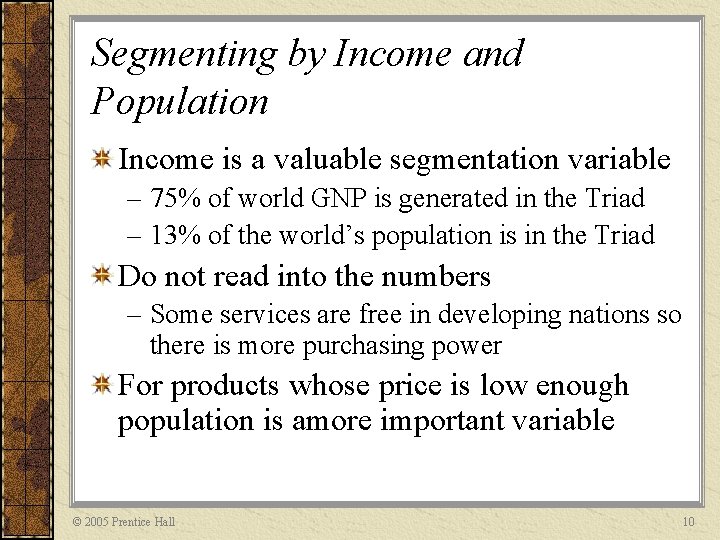
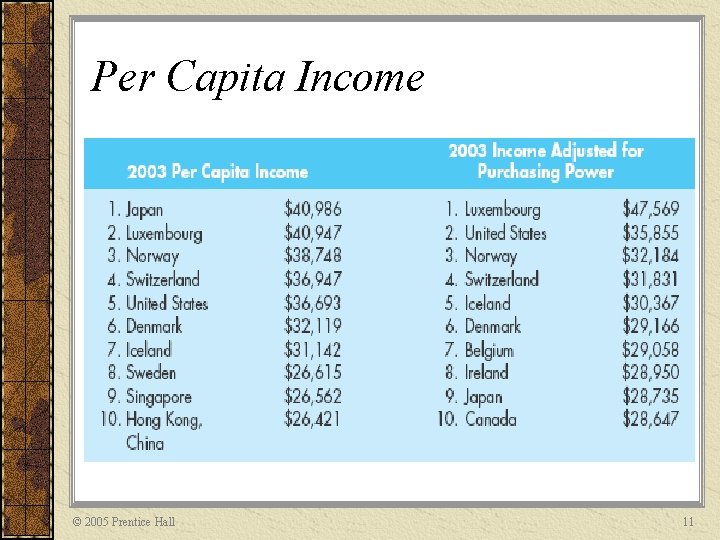
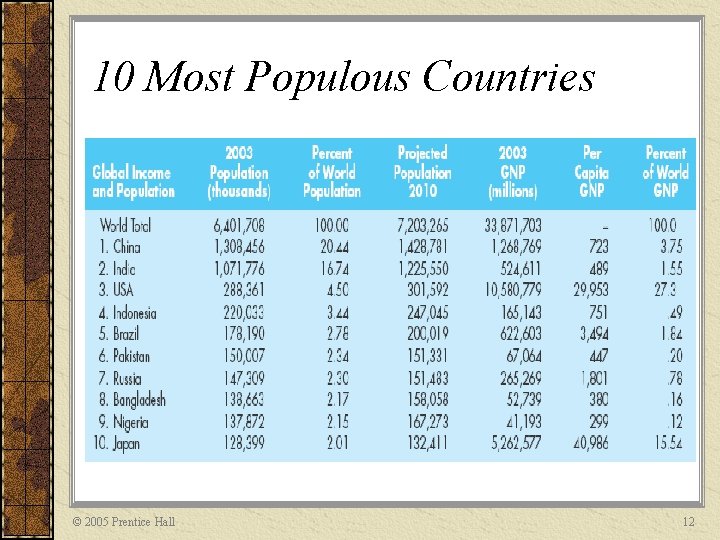
Segmenting by Income and Population Income is a valuable segmentation variable – 75% of world GNP is generated in the Triad – 13% of the world’s population is in the Triad Do not read into the numbers – Some services are free in developing nations so there is more purchasing power For products whose price is low enough population is amore important variable © 2005 Prentice Hall 10
Per Capita Income © 2005 Prentice Hall 11
10 Most Populous Countries © 2005 Prentice Hall 12
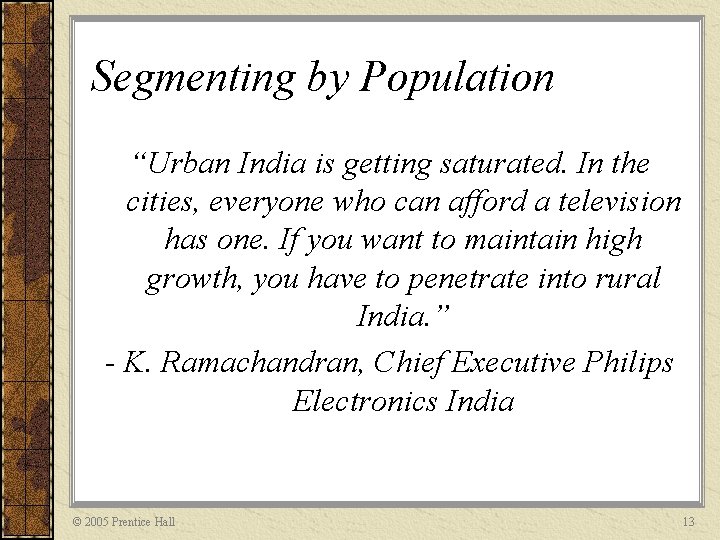
Segmenting by Population “Urban India is getting saturated. In the cities, everyone who can afford a television has one. If you want to maintain high growth, you have to penetrate into rural India. ” - K. Ramachandran, Chief Executive Philips Electronics India © 2005 Prentice Hall 13
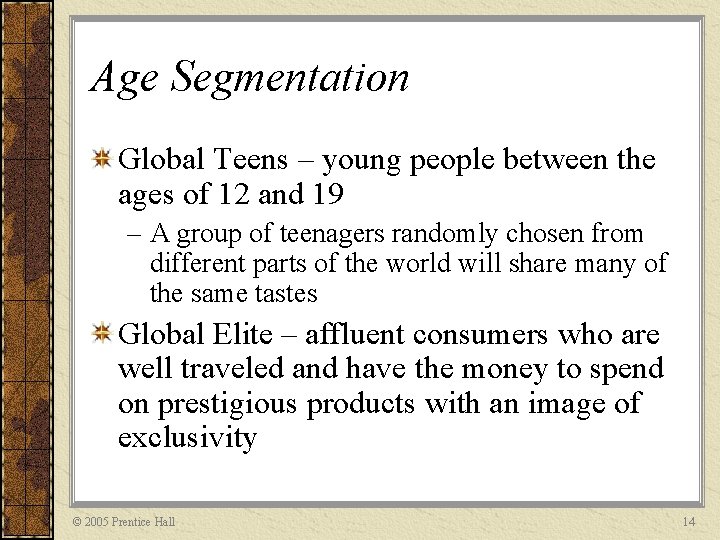
Age Segmentation Global Teens – young people between the ages of 12 and 19 – A group of teenagers randomly chosen from different parts of the world will share many of the same tastes Global Elite – affluent consumers who are well traveled and have the money to spend on prestigious products with an image of exclusivity © 2005 Prentice Hall 14
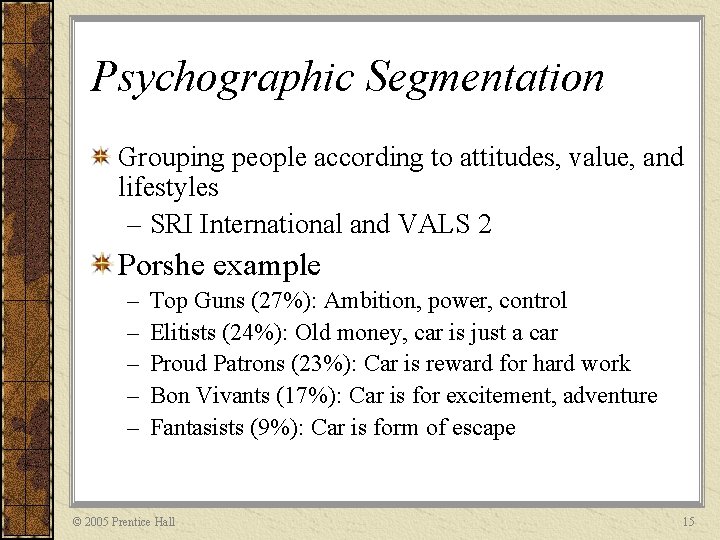
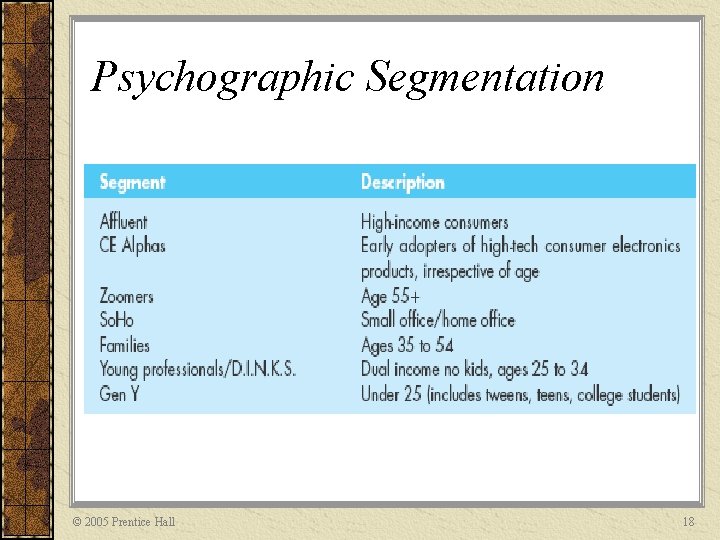
Psychographic Segmentation Grouping people according to attitudes, value, and lifestyles – SRI International and VALS 2 Porshe example – – – Top Guns (27%): Ambition, power, control Elitists (24%): Old money, car is just a car Proud Patrons (23%): Car is reward for hard work Bon Vivants (17%): Car is for excitement, adventure Fantasists (9%): Car is form of escape © 2005 Prentice Hall 15
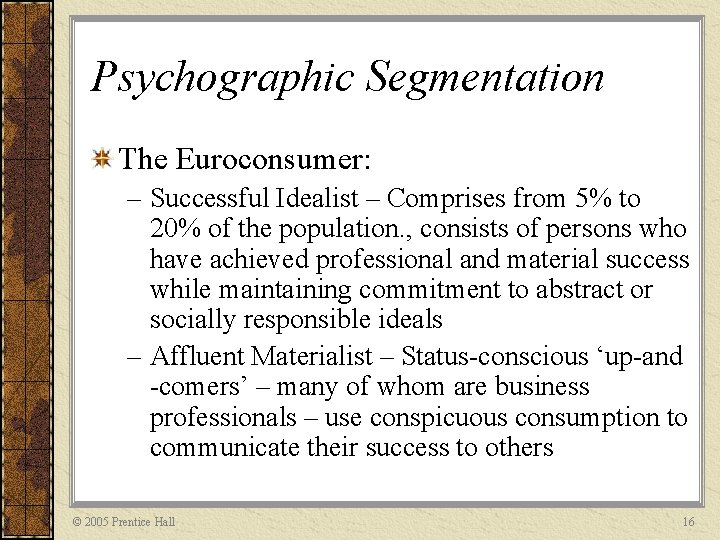
Psychographic Segmentation The Euroconsumer: – Successful Idealist – Comprises from 5% to 20% of the population. , consists of persons who have achieved professional and material success while maintaining commitment to abstract or socially responsible ideals – Affluent Materialist – Status-conscious ‘up-and -comers’ – many of whom are business professionals – use conspicuous consumption to communicate their success to others © 2005 Prentice Hall 16
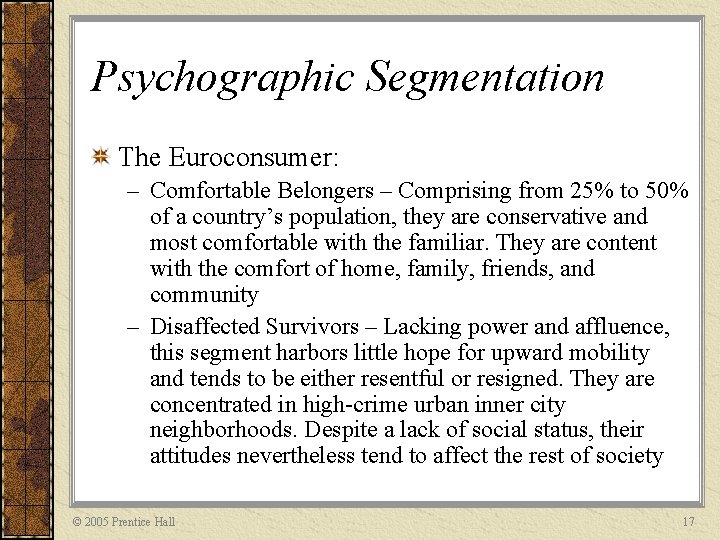
Psychographic Segmentation The Euroconsumer: – Comfortable Belongers – Comprising from 25% to 50% of a country’s population, they are conservative and most comfortable with the familiar. They are content with the comfort of home, family, friends, and community – Disaffected Survivors – Lacking power and affluence, this segment harbors little hope for upward mobility and tends to be either resentful or resigned. They are concentrated in high-crime urban inner city neighborhoods. Despite a lack of social status, their attitudes nevertheless tend to affect the rest of society © 2005 Prentice Hall 17
Psychographic Segmentation © 2005 Prentice Hall 18
Behavior Segmentation How much they use it How often they use it User status Law of disproportionality/Pareto’s Law – 80% of a company’s revenues are accounted for by 20% of the customers © 2005 Prentice Hall 19
Benefit Segmentation Benefit segmentation focuses on the value equation – Value = Benefits / Price Based on understanding the problem a product solves, the benefit it offers, or the issue it addresses © 2005 Prentice Hall 20
Ethnic Segmentation The population of many countries includes ethnic groups of significant size 3 main groups in the US include: African. Americans, Asian-Americans, and Hispanic Americans – Mexican households in California have after-tax income of $100 billion, half the total of all Mexican Americans. – The number of Hispanic teens is projected to swell from 12 percent of the U. S. teen population to 18 percent in the next decade. © 2005 Prentice Hall 21
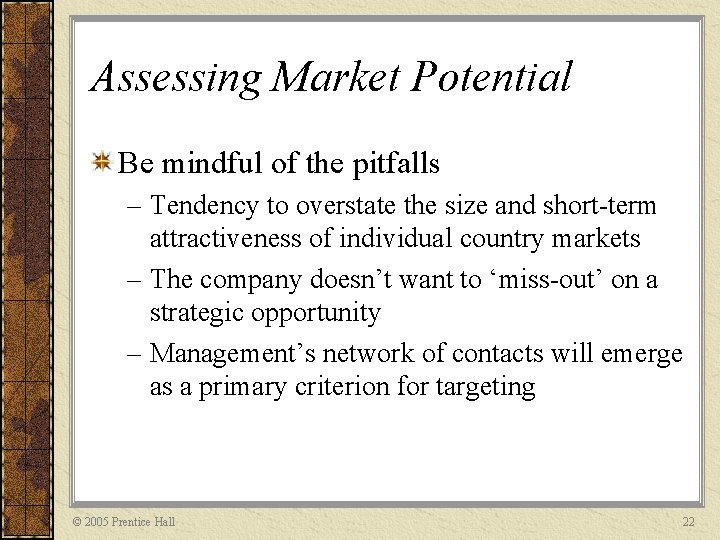
Assessing Market Potential Be mindful of the pitfalls – Tendency to overstate the size and short-term attractiveness of individual country markets – The company doesn’t want to ‘miss-out’ on a strategic opportunity – Management’s network of contacts will emerge as a primary criterion for targeting © 2005 Prentice Hall 22
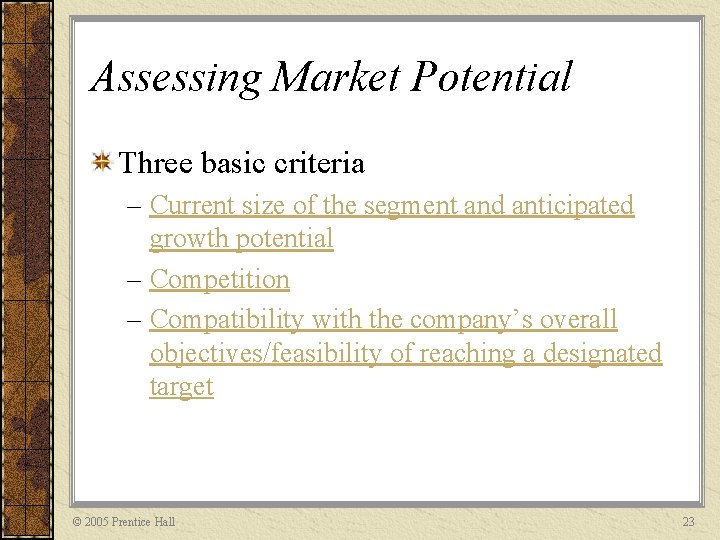
Assessing Market Potential Three basic criteria – Current size of the segment and anticipated growth potential – Competition – Compatibility with the company’s overall objectives/feasibility of reaching a designated target © 2005 Prentice Hall 23
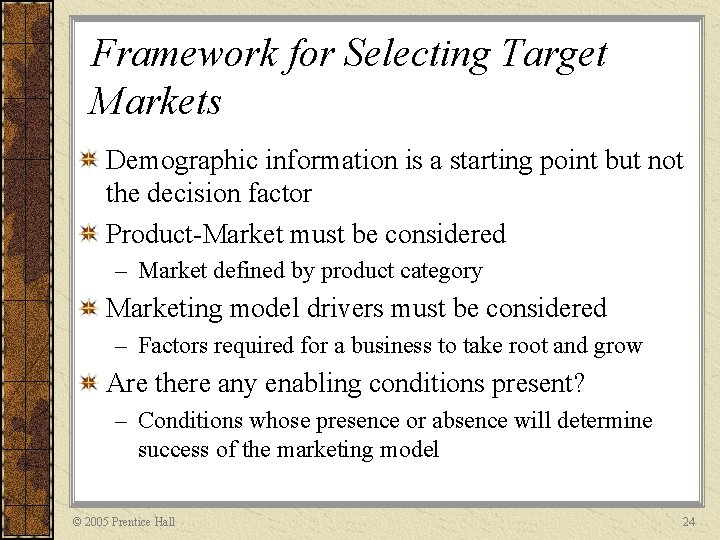
Framework for Selecting Target Markets Demographic information is a starting point but not the decision factor Product-Market must be considered – Market defined by product category Marketing model drivers must be considered – Factors required for a business to take root and grow Are there any enabling conditions present? – Conditions whose presence or absence will determine success of the marketing model © 2005 Prentice Hall 24
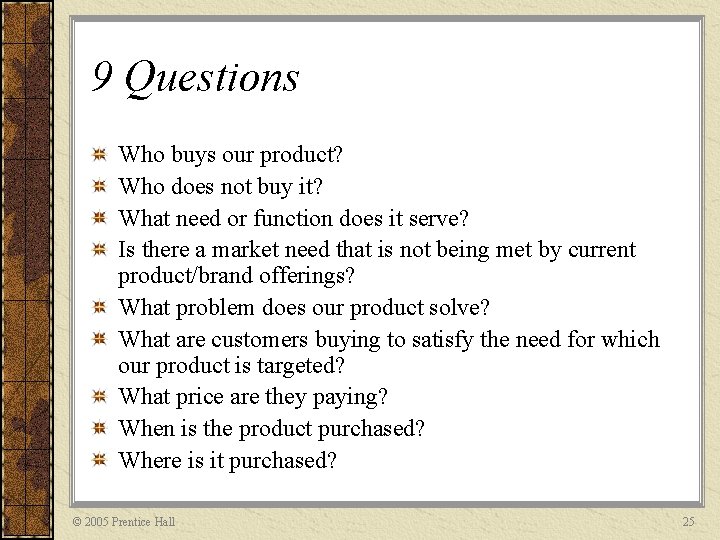
9 Questions Who buys our product? Who does not buy it? What need or function does it serve? Is there a market need that is not being met by current product/brand offerings? What problem does our product solve? What are customers buying to satisfy the need for which our product is targeted? What price are they paying? When is the product purchased? Where is it purchased? © 2005 Prentice Hall 25
Target Market Strategy Options Standardized global marketing – Mass marketing on a global scale – Undifferentiated target marketing Concentrated global marketing – Niche marketing – Single segment of global market Differentiated global marketing – Multi-segment targeting – Two or more distinct markets © 2005 Prentice Hall 26
Positioning Locating a brand in consumers’ minds over and against competitors in terms of attributes and benefits that the brand does not offer – Attribute or Benefit – Quality and Price – Use or User – Competition © 2005 Prentice Hall 27
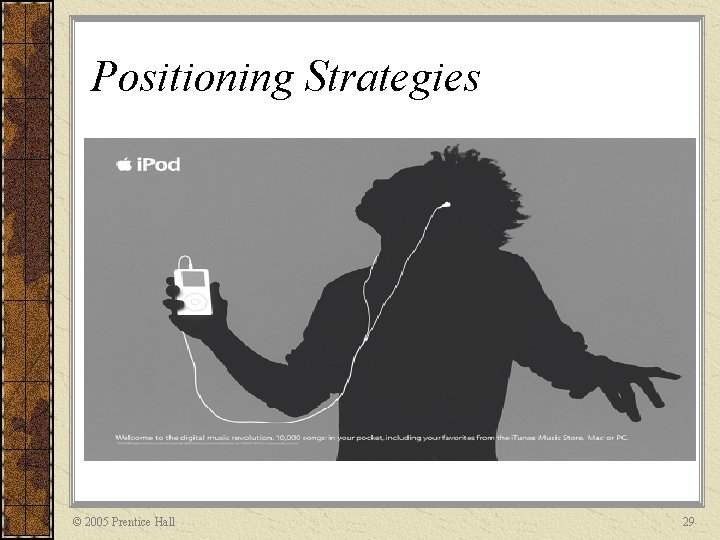
Positioning Strategies Global consumer culture positioning – Identifies the brand as a symbol of a particular global culture or segment Foreign consumer culture positioning – Associates the brand’s users, use occasions, or product origins with a foreign country or culture © 2005 Prentice Hall 28
Positioning Strategies © 2005 Prentice Hall 29
Looking Ahead Chapter 8 Importing, Exporting and Sourcing © 2005 Prentice Hall 30
Current Segment Size and Growth Is the market segment currently large enough to present a company with the opportunity to make a profit? If the answer is ‘no’, does it have significant growth potential to make it attractive in terms of a company’s long-term strategy? Return © 2005 Prentice Hall 31
Potential Competition Is there strong competition in the market segment currently? Is the competition vulnerable in terms of price or quality? Return © 2005 Prentice Hall 32
Feasibility and Compatibility Will adaptation be required? If so, is this economically justifiable in terms of expected sales? Will import restrictions, high tariffs, or a strong home country currency drive up the price of the product in the target market currency and effectively dampen demand? Is it advisable to source locally? Would it make sense to source products in the country for export elsewhere in the region? Return © 2005 Prentice Hall 33