
Chapter 7 Section 6 7 6 Variation Objectives
Chapter 7 Section 6
7. 6 Variation Objectives 1 Write an equation expressing direct variation. 2 Find the constant of variation, and solve direct variation problems. 3 Solve inverse variation problems. 4 Solve joint variation problems. 5 Solve combined variation problems. Copyright © 2012, 2008, 2004 Pearson Education, Inc.
Objective 1 Write an equation expressing direct variation. Copyright © 2012, 2008, 2004 Pearson Education, Inc. Slide 7. 6 - 3
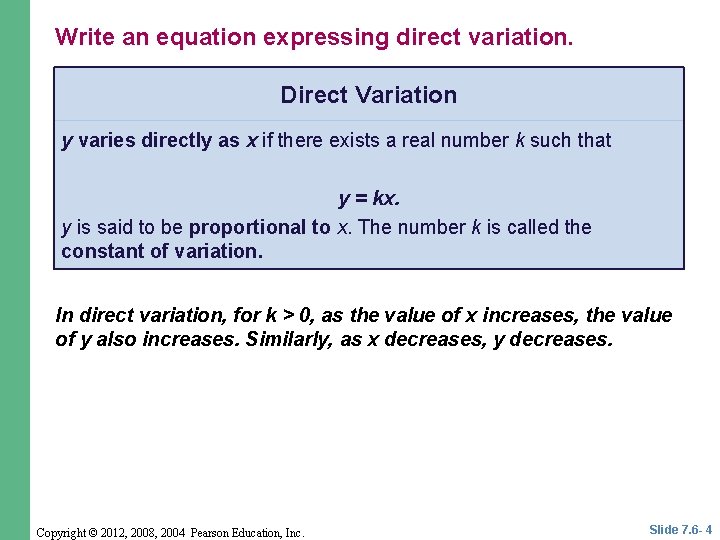
Write an equation expressing direct variation. Direct Variation y varies directly as x if there exists a real number k such that y = kx. y is said to be proportional to x. The number k is called the constant of variation. In direct variation, for k > 0, as the value of x increases, the value of y also increases. Similarly, as x decreases, y decreases. Copyright © 2012, 2008, 2004 Pearson Education, Inc. Slide 7. 6 - 4
Objective 2 Find the constant of variation, and solve direct variation problems. Copyright © 2012, 2008, 2004 Pearson Education, Inc. Slide 7. 6 - 5
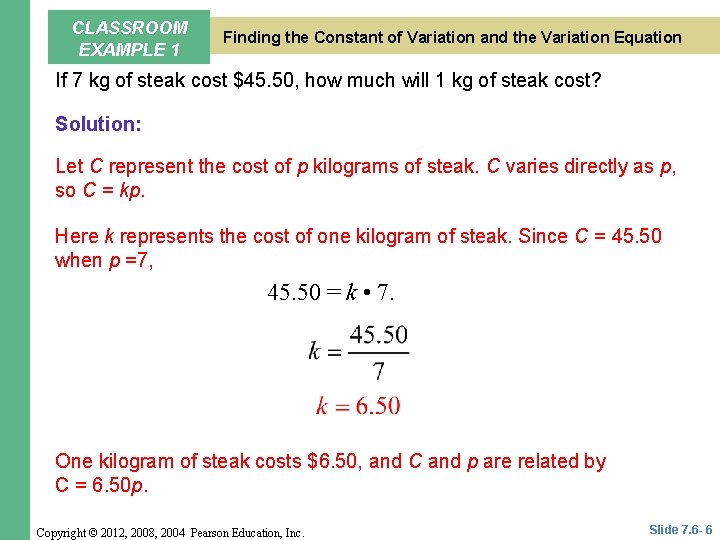
CLASSROOM EXAMPLE 1 Finding the Constant of Variation and the Variation Equation If 7 kg of steak cost $45. 50, how much will 1 kg of steak cost? Solution: Let C represent the cost of p kilograms of steak. C varies directly as p, so C = kp. Here k represents the cost of one kilogram of steak. Since C = 45. 50 when p =7, 45. 50 = k • 7. One kilogram of steak costs $6. 50, and C and p are related by C = 6. 50 p. Copyright © 2012, 2008, 2004 Pearson Education, Inc. Slide 7. 6 - 6
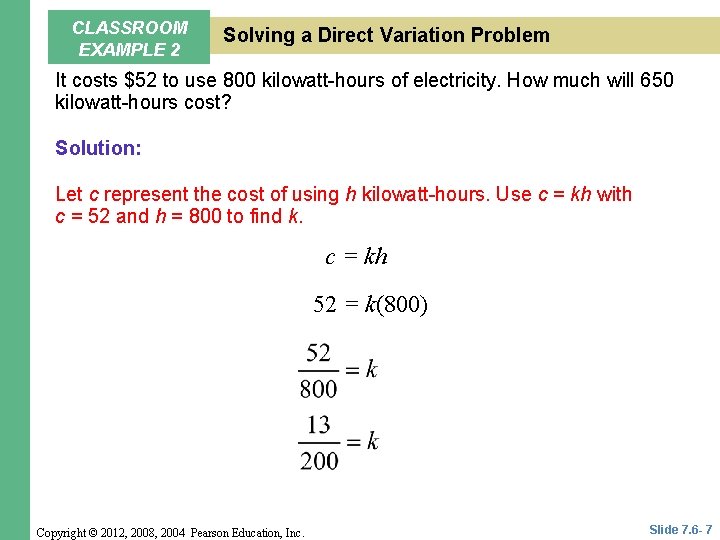
CLASSROOM EXAMPLE 2 Solving a Direct Variation Problem It costs $52 to use 800 kilowatt-hours of electricity. How much will 650 kilowatt-hours cost? Solution: Let c represent the cost of using h kilowatt-hours. Use c = kh with c = 52 and h = 800 to find k. c = kh 52 = k(800) Copyright © 2012, 2008, 2004 Pearson Education, Inc. Slide 7. 6 - 7
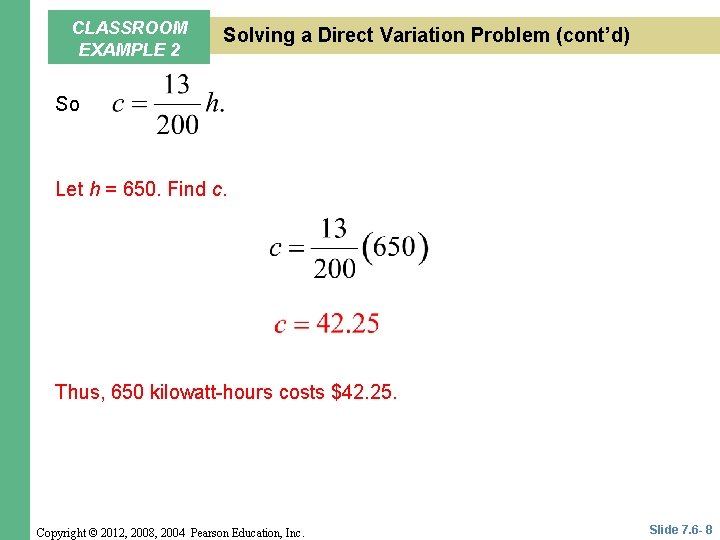
CLASSROOM EXAMPLE 2 Solving a Direct Variation Problem (cont’d) So Let h = 650. Find c. Thus, 650 kilowatt-hours costs $42. 25. Copyright © 2012, 2008, 2004 Pearson Education, Inc. Slide 7. 6 - 8
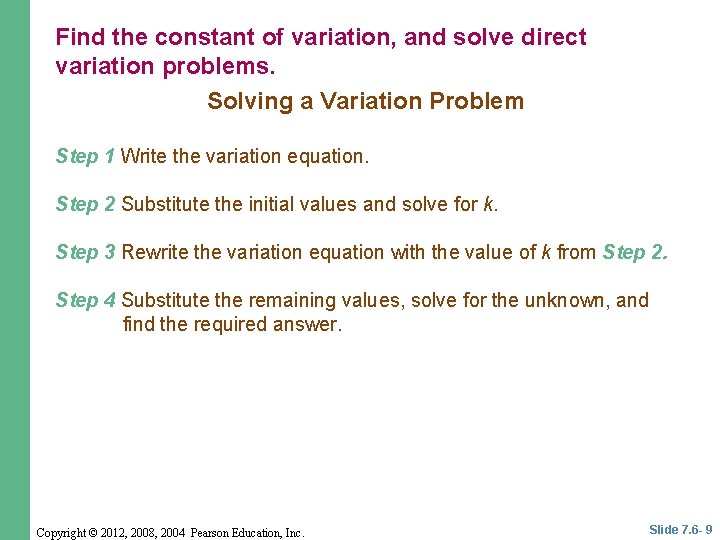
Find the constant of variation, and solve direct variation problems. Solving a Variation Problem Step 1 Write the variation equation. Step 2 Substitute the initial values and solve for k. Step 3 Rewrite the variation equation with the value of k from Step 2. Step 4 Substitute the remaining values, solve for the unknown, and find the required answer. Copyright © 2012, 2008, 2004 Pearson Education, Inc. Slide 7. 6 - 9

Find the constant of variation, and solve direct variation problems. Direct Variation as a Power y varies directly as the nth power of x if there exists a real number k such that y = kxn. Copyright © 2012, 2008, 2004 Pearson Education, Inc. Slide 7. 6 - 10
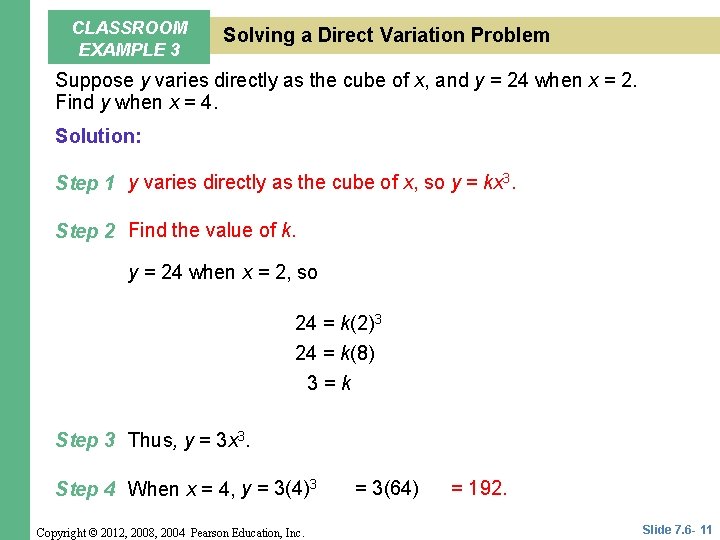
CLASSROOM EXAMPLE 3 Solving a Direct Variation Problem Suppose y varies directly as the cube of x, and y = 24 when x = 2. Find y when x = 4. Solution: Step 1 y varies directly as the cube of x, so y = kx 3. Step 2 Find the value of k. y = 24 when x = 2, so 24 = k(2)3 24 = k(8) 3=k Step 3 Thus, y = 3 x 3. Step 4 When x = 4, y = 3(4)3 Copyright © 2012, 2008, 2004 Pearson Education, Inc. = 3(64) = 192. Slide 7. 6 - 11
Objective 3 Solve inverse variation problems. Copyright © 2012, 2008, 2004 Pearson Education, Inc. Slide 7. 6 - 12
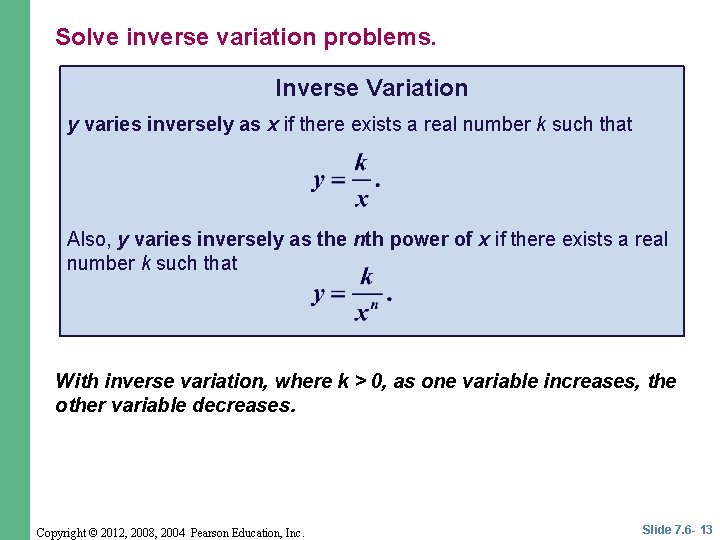
Solve inverse variation problems. Inverse Variation y varies inversely as x if there exists a real number k such that Also, y varies inversely as the nth power of x if there exists a real number k such that With inverse variation, where k > 0, as one variable increases, the other variable decreases. Copyright © 2012, 2008, 2004 Pearson Education, Inc. Slide 7. 6 - 13
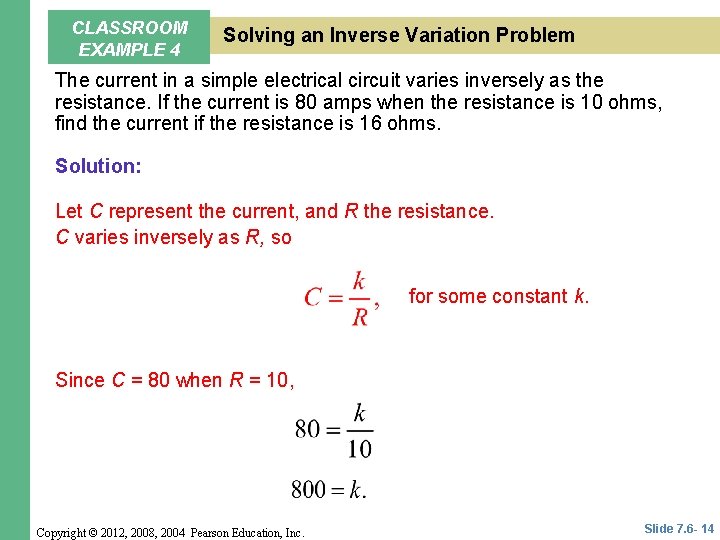
CLASSROOM EXAMPLE 4 Solving an Inverse Variation Problem The current in a simple electrical circuit varies inversely as the resistance. If the current is 80 amps when the resistance is 10 ohms, find the current if the resistance is 16 ohms. Solution: Let C represent the current, and R the resistance. C varies inversely as R, so for some constant k. Since C = 80 when R = 10, Copyright © 2012, 2008, 2004 Pearson Education, Inc. Slide 7. 6 - 14
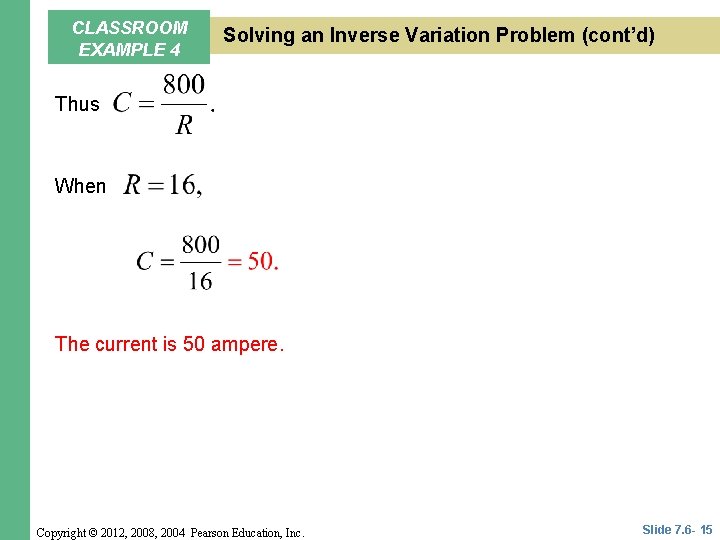
CLASSROOM EXAMPLE 4 Solving an Inverse Variation Problem (cont’d) Thus When The current is 50 ampere. Copyright © 2012, 2008, 2004 Pearson Education, Inc. Slide 7. 6 - 15
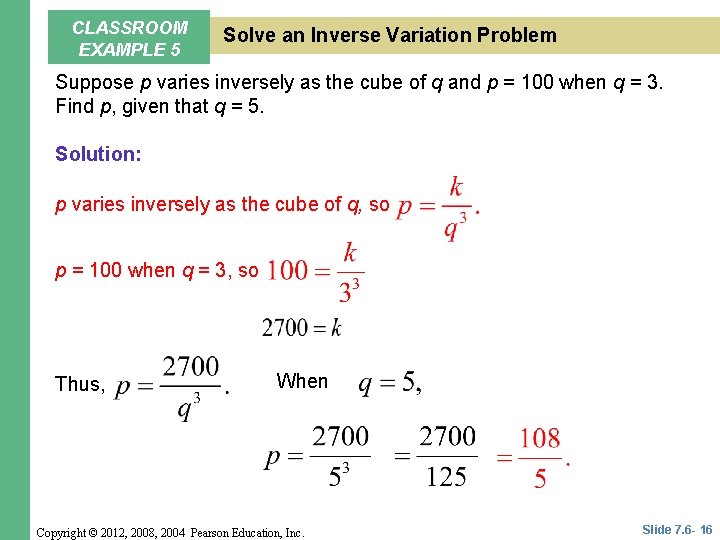
CLASSROOM EXAMPLE 5 Solve an Inverse Variation Problem Suppose p varies inversely as the cube of q and p = 100 when q = 3. Find p, given that q = 5. Solution: p varies inversely as the cube of q, so p = 100 when q = 3, so Thus, When Copyright © 2012, 2008, 2004 Pearson Education, Inc. Slide 7. 6 - 16
Objective 4 Solve joint variation problems. Copyright © 2012, 2008, 2004 Pearson Education, Inc. Slide 7. 6 - 17
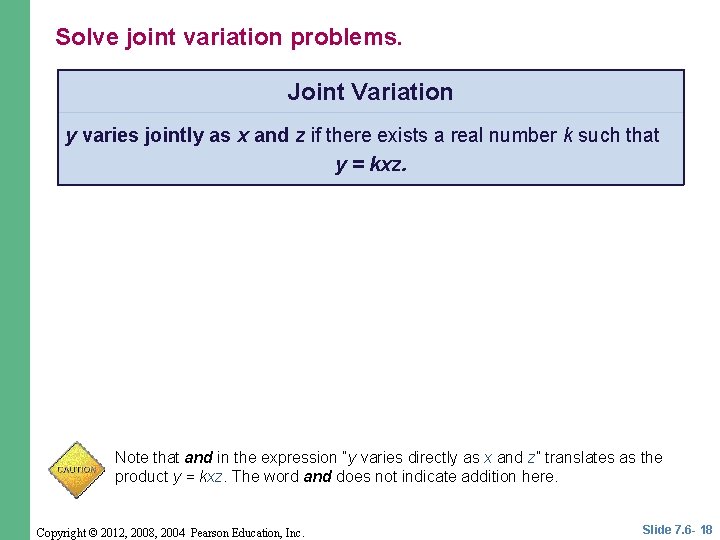
Solve joint variation problems. Joint Variation y varies jointly as x and z if there exists a real number k such that y = kxz. Note that and in the expression “y varies directly as x and z” translates as the product y = kxz. The word and does not indicate addition here. Copyright © 2012, 2008, 2004 Pearson Education, Inc. Slide 7. 6 - 18
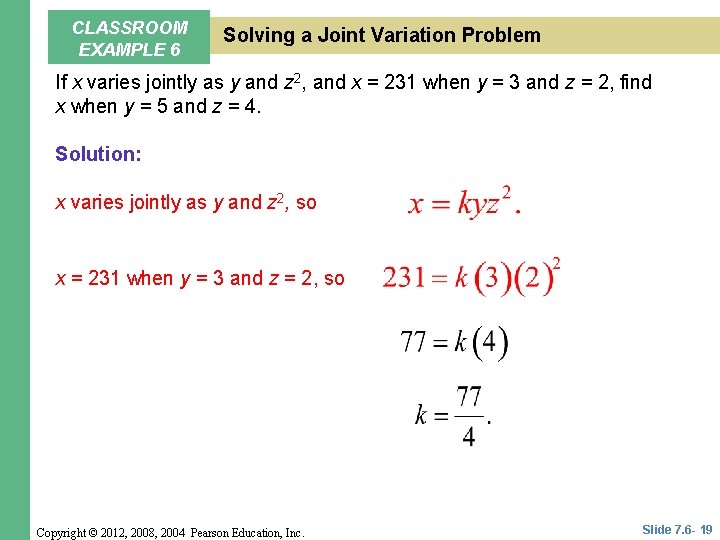
CLASSROOM EXAMPLE 6 Solving a Joint Variation Problem If x varies jointly as y and z 2, and x = 231 when y = 3 and z = 2, find x when y = 5 and z = 4. Solution: x varies jointly as y and z 2, so x = 231 when y = 3 and z = 2, so Copyright © 2012, 2008, 2004 Pearson Education, Inc. Slide 7. 6 - 19
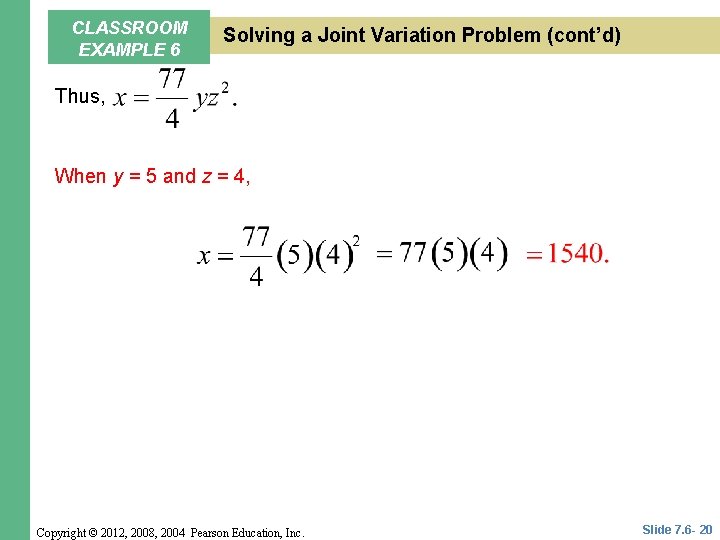
CLASSROOM EXAMPLE 6 Solving a Joint Variation Problem (cont’d) Thus, When y = 5 and z = 4, Copyright © 2012, 2008, 2004 Pearson Education, Inc. Slide 7. 6 - 20
Objective 5 Solve combined variation problems. Copyright © 2012, 2008, 2004 Pearson Education, Inc. Slide 7. 6 - 21
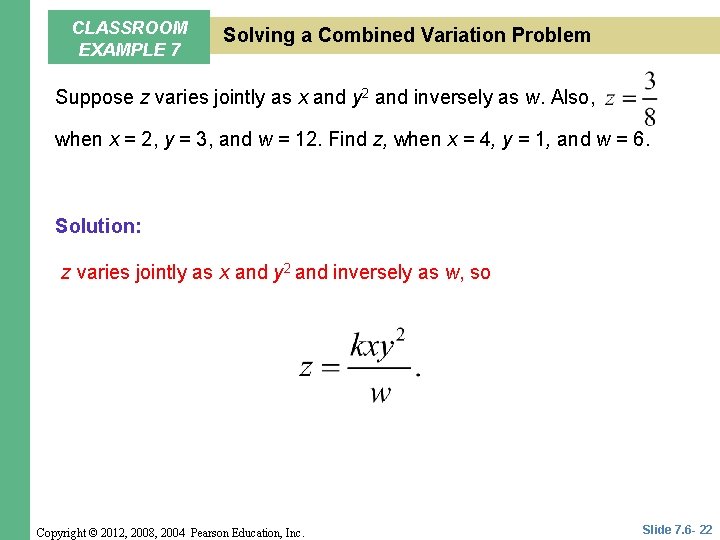
CLASSROOM EXAMPLE 7 Solving a Combined Variation Problem Suppose z varies jointly as x and y 2 and inversely as w. Also, when x = 2, y = 3, and w = 12. Find z, when x = 4, y = 1, and w = 6. Solution: z varies jointly as x and y 2 and inversely as w, so Copyright © 2012, 2008, 2004 Pearson Education, Inc. Slide 7. 6 - 22
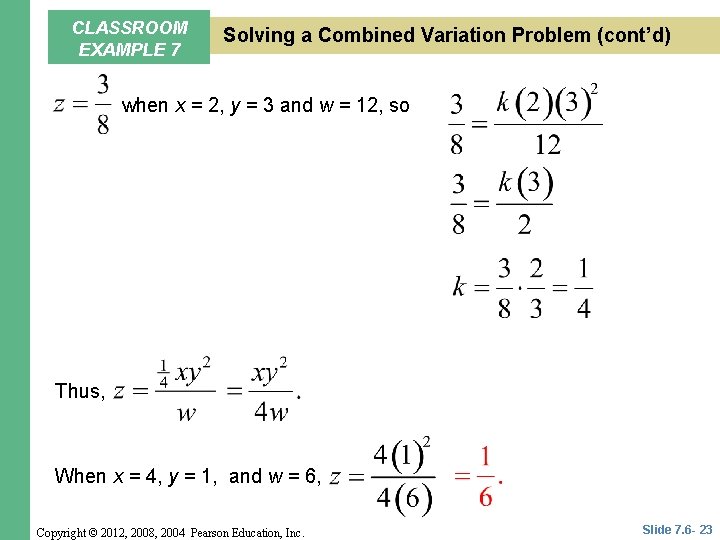
CLASSROOM EXAMPLE 7 Solving a Combined Variation Problem (cont’d) when x = 2, y = 3 and w = 12, so Thus, When x = 4, y = 1, and w = 6, Copyright © 2012, 2008, 2004 Pearson Education, Inc. Slide 7. 6 - 23
- Slides: 23