
Chapter 7 Section 3 Using Chemical Formulas Formula
- Slides: 13
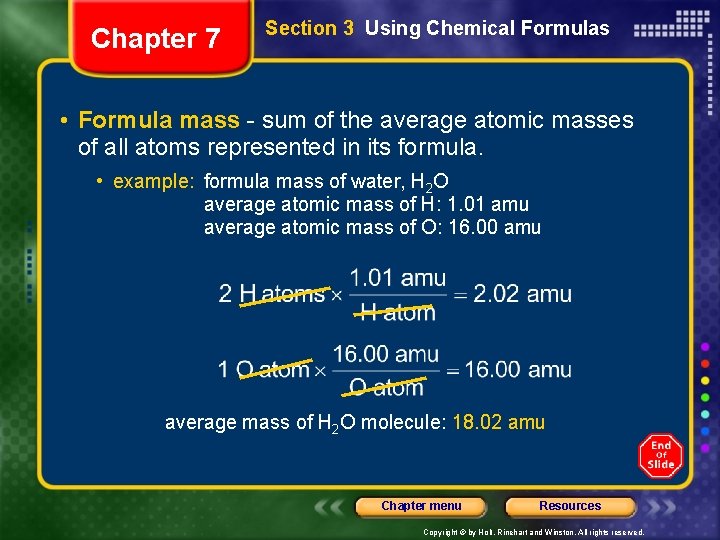
Chapter 7 Section 3 Using Chemical Formulas • Formula mass - sum of the average atomic masses of all atoms represented in its formula. • example: formula mass of water, H 2 O average atomic mass of H: 1. 01 amu average atomic mass of O: 16. 00 amu average mass of H 2 O molecule: 18. 02 amu Chapter menu Resources Copyright © by Holt, Rinehart and Winston. All rights reserved.
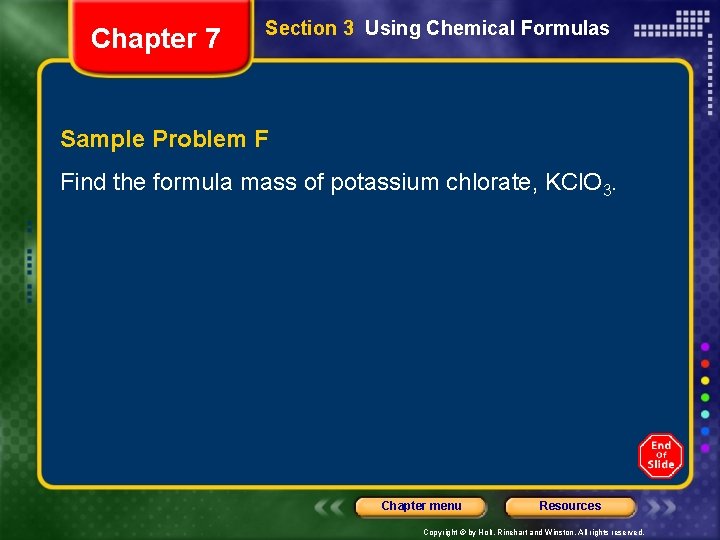
Chapter 7 Section 3 Using Chemical Formulas Sample Problem F Find the formula mass of potassium chlorate, KCl. O 3. Chapter menu Resources Copyright © by Holt, Rinehart and Winston. All rights reserved.
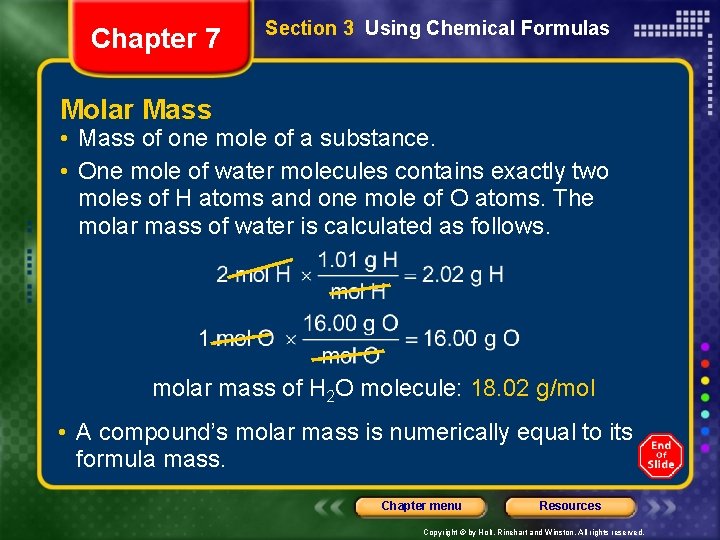
Chapter 7 Section 3 Using Chemical Formulas Molar Mass • Mass of one mole of a substance. • One mole of water molecules contains exactly two moles of H atoms and one mole of O atoms. The molar mass of water is calculated as follows. molar mass of H 2 O molecule: 18. 02 g/mol • A compound’s molar mass is numerically equal to its formula mass. Chapter menu Resources Copyright © by Holt, Rinehart and Winston. All rights reserved.
Chapter 7 Visual Concepts Molar Mass Click below to watch the Visual Concept Chapter menu Resources Copyright © by Holt, Rinehart and Winston. All rights reserved.
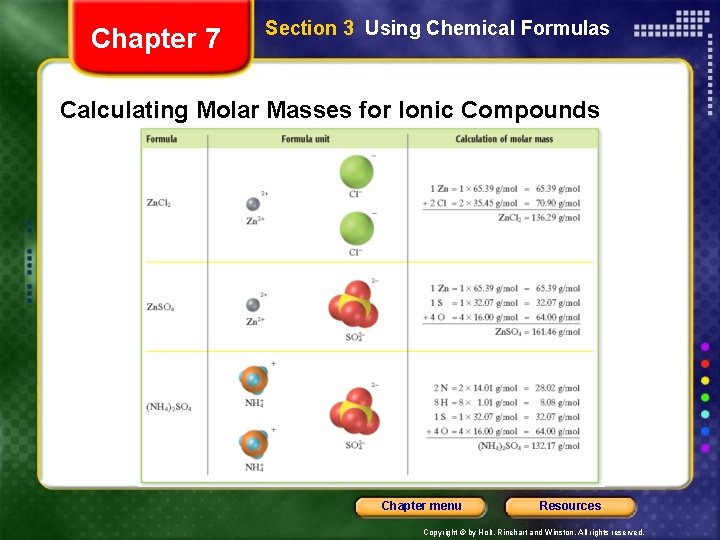
Chapter 7 Section 3 Using Chemical Formulas Calculating Molar Masses for Ionic Compounds Chapter menu Resources Copyright © by Holt, Rinehart and Winston. All rights reserved.
Chapter 7 Section 3 Using Chemical Formulas Molar Masses Sample Problem G What is the molar mass of barium nitrate, Ba(NO 3)2? Chapter menu Resources Copyright © by Holt, Rinehart and Winston. All rights reserved.
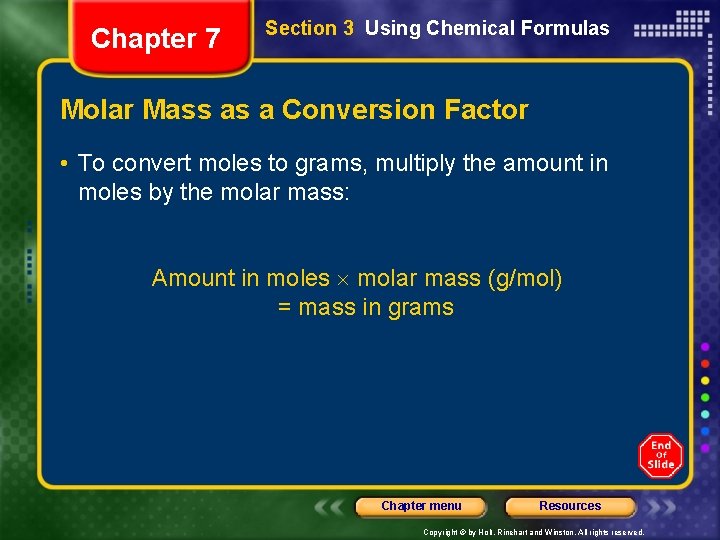
Chapter 7 Section 3 Using Chemical Formulas Molar Mass as a Conversion Factor • To convert moles to grams, multiply the amount in moles by the molar mass: Amount in moles molar mass (g/mol) = mass in grams Chapter menu Resources Copyright © by Holt, Rinehart and Winston. All rights reserved.
Chapter 7 Visual Concepts Molar Mass as a Conversion Factor Click below to watch the Visual Concept Chapter menu Resources Copyright © by Holt, Rinehart and Winston. All rights reserved.
Chapter 7 Section 3 Using Chemical Formulas Sample Problem H What is the mass in grams of 2. 50 mol of oxygen gas? Chapter menu Resources Copyright © by Holt, Rinehart and Winston. All rights reserved.
Chapter 7 Section 3 Using Chemical Formulas Sample Problem I Ibuprofen, C 13 H 18 O 2, is the active ingredient in many nonprescription pain relievers. Its molar mass is 206. 31 g/mol. a. If the tablets in a bottle contain a total of 33 g of ibuprofen, how many moles of ibuprofen are in the bottle? b. How many molecules of ibuprofen are in the bottle? c. What is the total mass in grams of carbon in 33 g of ibuprofen? Chapter menu Resources Copyright © by Holt, Rinehart and Winston. All rights reserved.
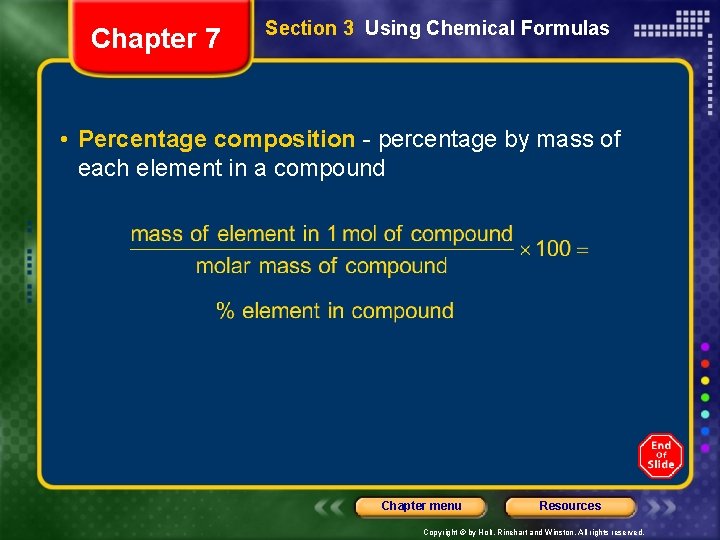
Chapter 7 Section 3 Using Chemical Formulas • Percentage composition - percentage by mass of each element in a compound Chapter menu Resources Copyright © by Holt, Rinehart and Winston. All rights reserved.
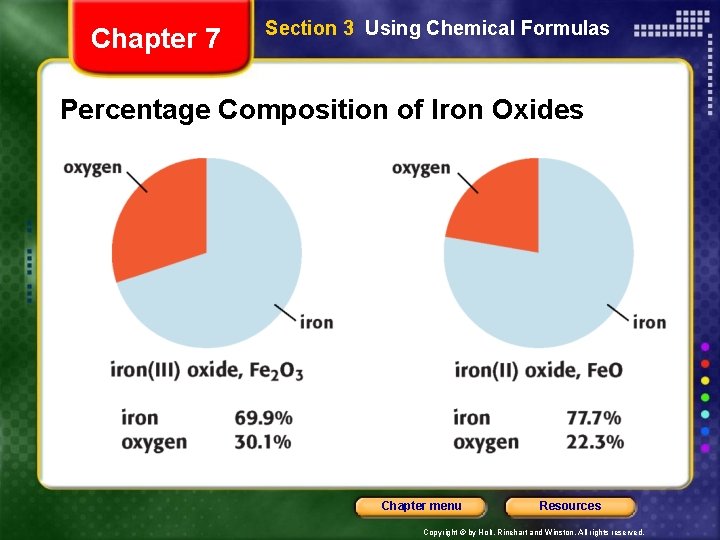
Chapter 7 Section 3 Using Chemical Formulas Percentage Composition of Iron Oxides Chapter menu Resources Copyright © by Holt, Rinehart and Winston. All rights reserved.
Chapter 7 Section 3 Using Chemical Formulas Sample Problem J Find the percentage composition of copper(I) sulfide, Cu 2 S. Chapter menu Resources Copyright © by Holt, Rinehart and Winston. All rights reserved.