
Chapter 7 Section 3 Notes The Midwestern States

- Slides: 8
Chapter 7 Section 3 Notes The Midwestern States
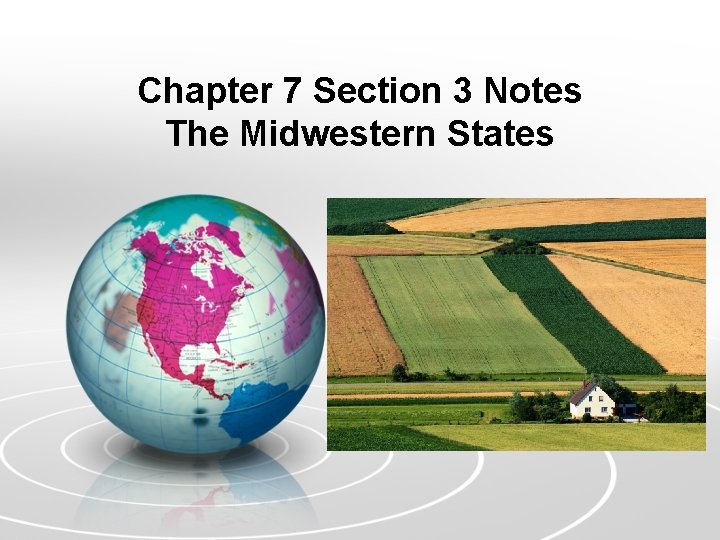
An Agricultural Economy • The Midwest is relatively flat and contains fertile soil that is rich in a dark-colored organic material called humus. • The Midwestern climate favors agriculture with its long, hot summers. • There are many regional variations, such as precipitation, growing season, and quality of soil, that affect the type of agriculture possible.
An Agricultural Economy Continued • Midwestern farms, the most productive in the world, have earned the Midwest the nickname “the nation’s breadbasket. ”
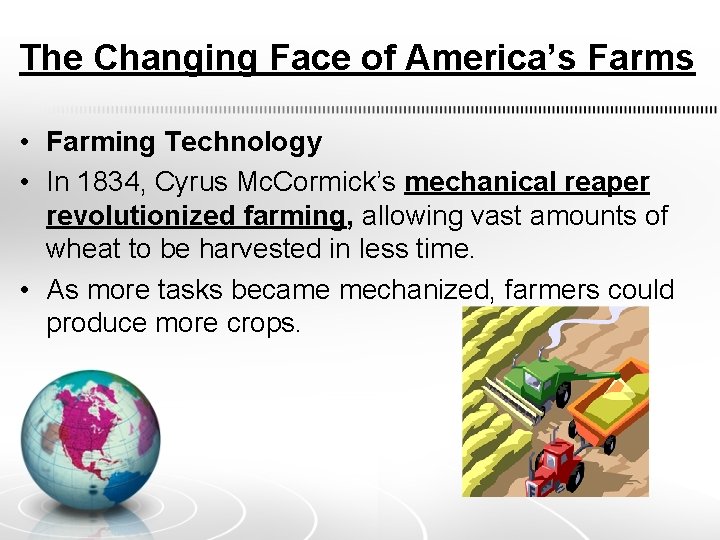
The Changing Face of America’s Farms • Farming Technology • In 1834, Cyrus Mc. Cormick’s mechanical reaper revolutionized farming, allowing vast amounts of wheat to be harvested in less time. • As more tasks became mechanized, farmers could produce more crops.
The Changing Face of America’s Farms continued – Push-and-pull migration factors have helped reduce the number of farm workers. – Farm output has increased dramatically. • Linking Farms to Cities – Agriculture dominates the Midwestern economy. – Business activities focus on dairies or on grain elevators. – Large Midwestern cities are closely linked to the countryside.
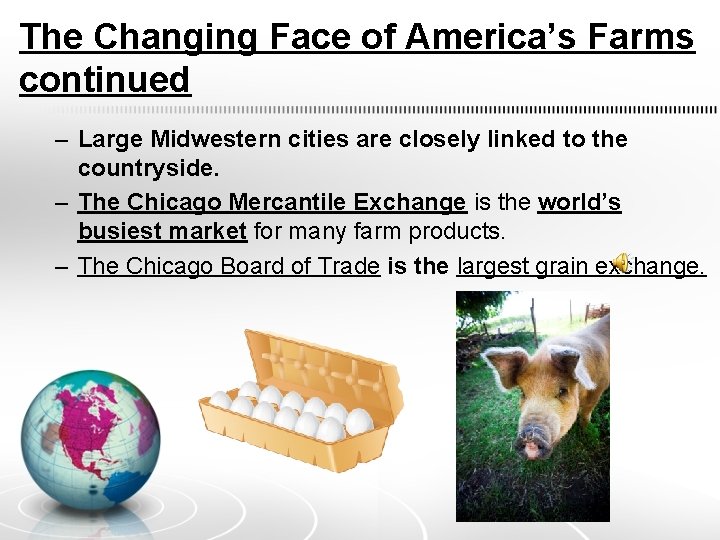
The Changing Face of America’s Farms continued – Large Midwestern cities are closely linked to the countryside. – The Chicago Mercantile Exchange is the world’s busiest market for many farm products. – The Chicago Board of Trade is the largest grain exchange.
Industry, Resources, and Transportation • The Midwest is home to much heavy manufacturing because of its supply of natural resources. • Minnesota is a leader in iron ore production, while sizeable coal deposits are found in Indiana and Illinois. • Easy access to minerals spurred the development of steel mills, which encouraged the region’s automobile industry. •
Industry, Resources, Transportation • Many of the major cities in the Midwest are located on the shores of the Great Lakes or along major rivers, and water transportation aided the growth of heavy industries. • The growth of the railway system brought farm products to Chicago from the West to be processed and shipped east.