
Chapter 7 Section 3 Extending Financial Statement Information


- Slides: 14
Chapter 7 Section 3 Extending Financial Statement Information on a Work Sheet
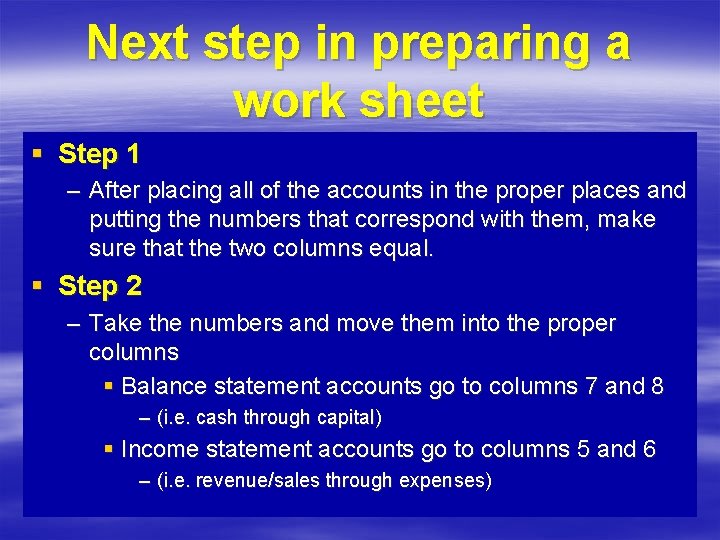
Next step in preparing a work sheet § Step 1 – After placing all of the accounts in the proper places and putting the numbers that correspond with them, make sure that the two columns equal. § Step 2 – Take the numbers and move them into the proper columns § Balance statement accounts go to columns 7 and 8 – (i. e. cash through capital) § Income statement accounts go to columns 5 and 6 – (i. e. revenue/sales through expenses)
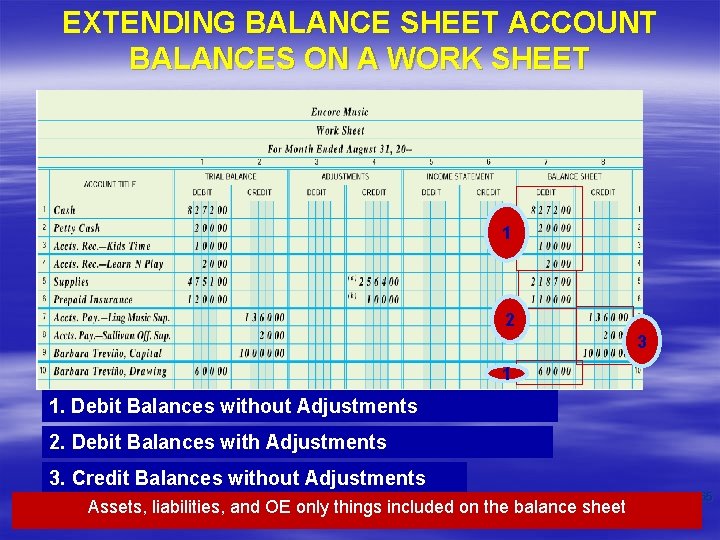
EXTENDING BALANCE SHEET ACCOUNT BALANCES ON A WORK SHEET 1 2 3 1 1. Debit Balances without Adjustments 2. Debit Balances with Adjustments 3. Credit Balances without Adjustments Lesson 7 -3, page 165 Assets, liabilities, and OE only things included on the balance sheet
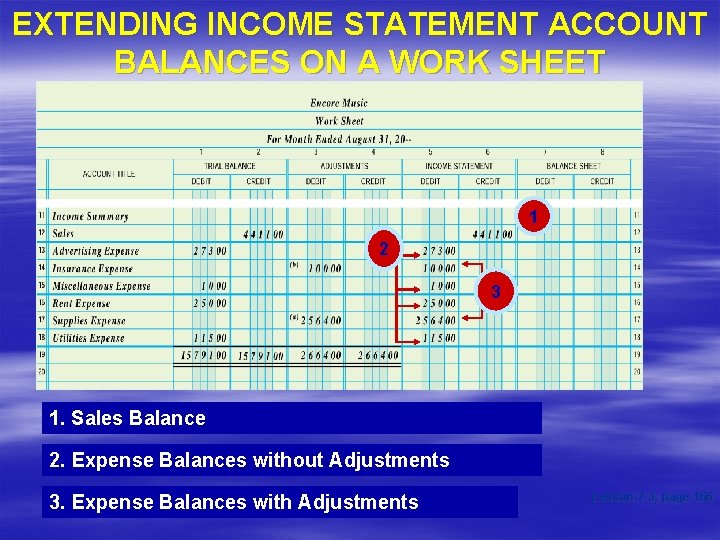
Income Statement § A financial statement showing the revenue and expenses for a fiscal period is called an income statement. § Revenue and Expense accounts are included in the income statement. § Examples of revenue and expense accounts include Sales, and all of your expenses, Utilities, Miscellaneous, Insurance, etc.
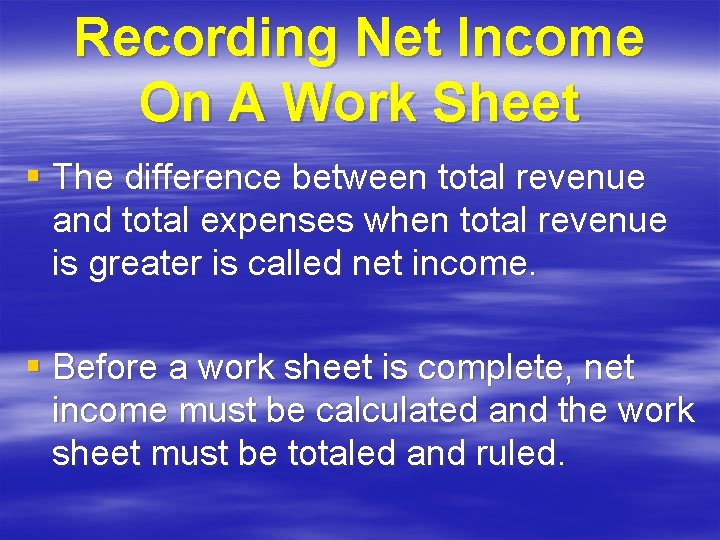
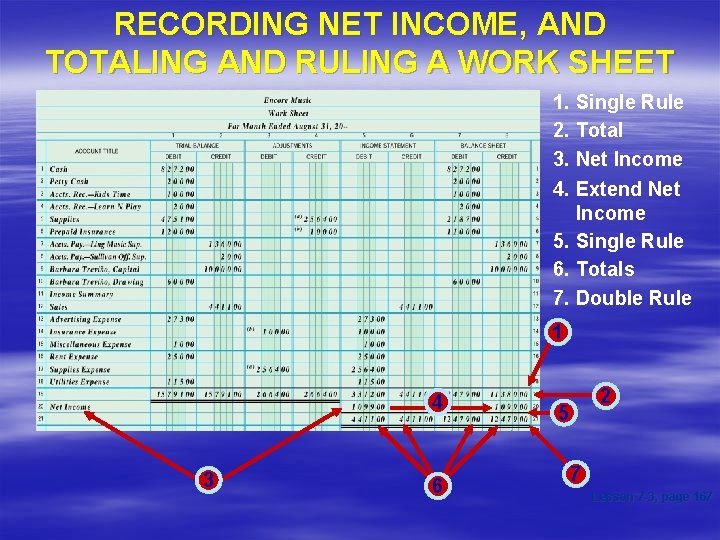
Recording Net Income On A Work Sheet § The difference between total revenue and total expenses when total revenue is greater is called net income. § Before a work sheet is complete, net income must be calculated and the work sheet must be totaled and ruled.
EXTENDING INCOME STATEMENT ACCOUNT BALANCES ON A WORK SHEET 1 2 3 1. Sales Balance 2. Expense Balances without Adjustments 3. Expense Balances with Adjustments Lesson 7 -3, page 166
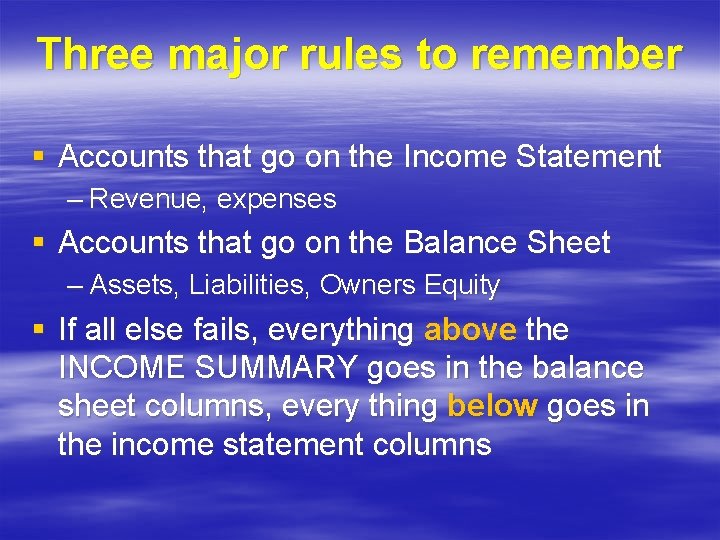
Three major rules to remember § Accounts that go on the Income Statement – Revenue, expenses § Accounts that go on the Balance Sheet – Assets, Liabilities, Owners Equity § If all else fails, everything above the INCOME SUMMARY goes in the balance sheet columns, every thing below goes in the income statement columns
RECORDING NET INCOME, AND TOTALING AND RULING A WORK SHEET 1. Single Rule 2. Total 3. Net Income 4. Extend Net Income 5. Single Rule 6. Totals 7. Double Rule 1 4 3 6 2 5 7 Lesson 7 -3, page 167
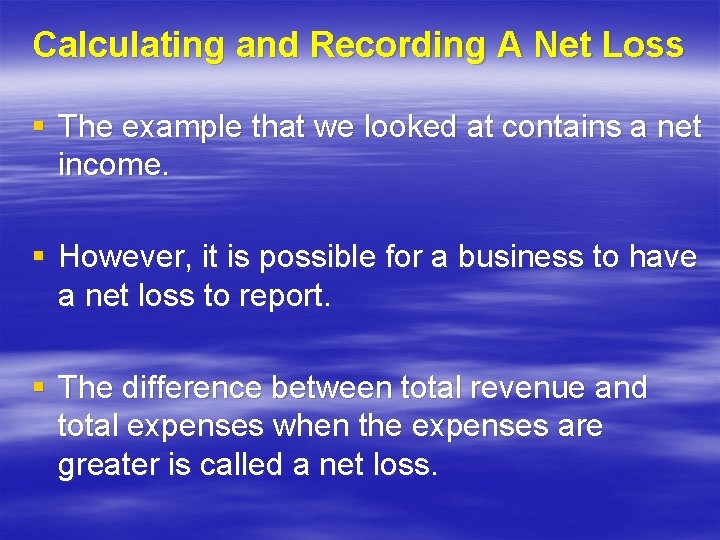
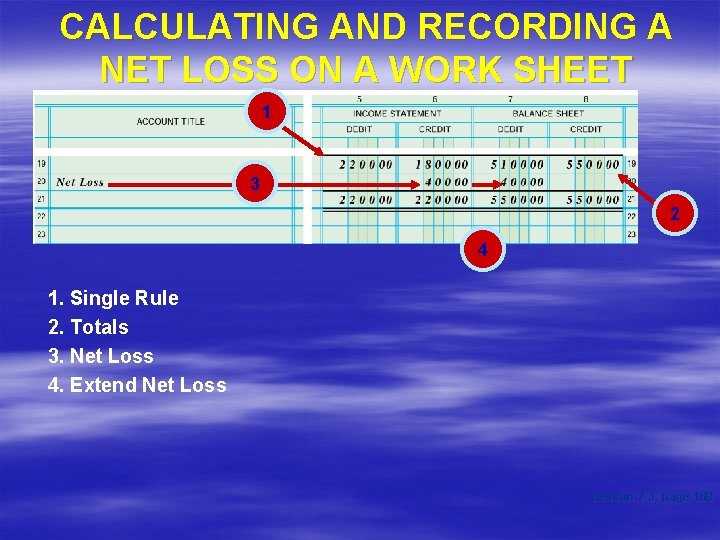
Calculating and Recording A Net Loss § The example that we looked at contains a net income. § However, it is possible for a business to have a net loss to report. § The difference between total revenue and total expenses when the expenses are greater is called a net loss.
CALCULATING AND RECORDING A NET LOSS ON A WORK SHEET 1 3 2 4 1. Single Rule 2. Totals 3. Net Loss 4. Extend Net Loss Lesson 7 -3, page 168
Finishing the work sheet § In the income statement – Take the credit side and subtract out the debit side. § In the balance sheet columns – Take the debit side and subtract out the credit side. § Rule of thumb after subtracting the numbers it always goes under the smaller of the amounts so that we may get it to equal.
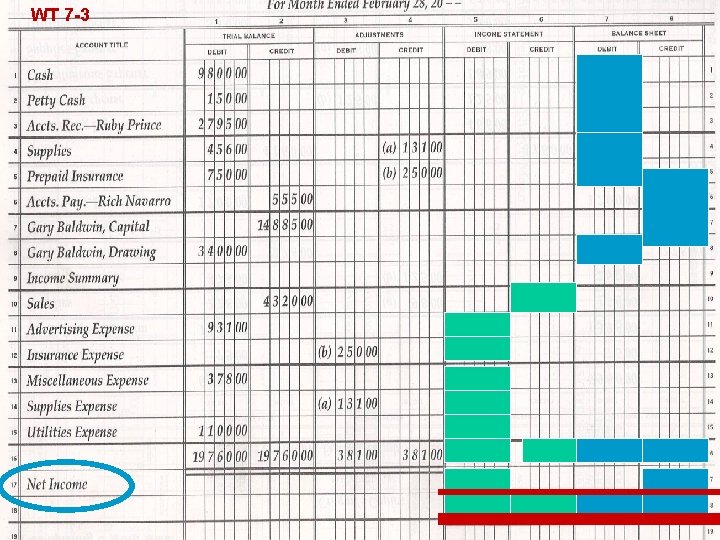
Work Together 7 -3 Txtbk Page 169 Wkbk Page 131
WT 7 -3
Classwork § “OYO” textbook page 169 using work book page 132 § Application Problem 7 -3 textbook page 175 using work book page 149. § Go to my website www. sssuc. weebly. com and open up the Excel file named “ch 7 7 -3 work sheet” and follow the directions.