
Chapter 7 Section 2 Oxidation Numbers Oxidation numbers
Chapter 7 Section 2 Oxidation Numbers • Oxidation numbers - indicates the general distribution of electrons among the bonded atoms in a molecular compound or a polyatomic ion Chapter menu Resources Copyright © by Holt, Rinehart and Winston. All rights reserved.

Chapter 7 Section 2 Oxidation Numbers Assigning Oxidation Numbers • In general when assigning oxidation numbers, shared electrons are assumed to “belong” to the more electronegative atom in each bond. • More-specific rules are provided by the following guidelines. 1. The atoms in a pure element have an oxidation number of zero. examples: all atoms in sodium, Na, oxygen, O 2, phosphorus, P 4, and sulfur, S 8, have oxidation numbers of zero. Chapter menu Resources Copyright © by Holt, Rinehart and Winston. All rights reserved.
Chapter 7 Section 2 Oxidation Numbers Assigning Oxidation Numbers 2. The more-electronegative element in a binary compound is assigned a negative number equal to the charge it would have as an anion. Likewise for the less-electronegative element. 3. Fluorine has an oxidation number of – 1 in all of its compounds because it is the most electronegative element. Chapter menu Resources Copyright © by Holt, Rinehart and Winston. All rights reserved.

Chapter 7 Section 2 Oxidation Numbers Assigning Oxidation Numbers 4. Oxygen usually has an oxidation number of – 2. Exceptions: • In peroxides, such as H 2 O 2, oxygen’s oxidation number is – 1. • In compounds with fluorine, such as OF 2, oxygen’s oxidation number is +2. 5. Hydrogen has an oxidation number of +1 in all compounds containing elements that are more electronegative than it; it has an oxidation number of – 1 with metals. Chapter menu Resources Copyright © by Holt, Rinehart and Winston. All rights reserved.
Chapter 7 Section 2 Oxidation Numbers Assigning Oxidation Numbers 6. The algebraic sum of the oxidation numbers of all atoms in an neutral compound is equal to zero. 7. The algebraic sum of the oxidation numbers of all atoms in a polyatomic ion is equal to the charge of the ion. 8. Although rules 1 through 7 apply to covalently bonded atoms, oxidation numbers can also be applied to atoms in ionic compounds similarly. Chapter menu Resources Copyright © by Holt, Rinehart and Winston. All rights reserved.
Chapter 7 Visual Concepts Rules for Assigning Oxidation Numbers Click below to watch the Visual Concept Chapter menu Resources Copyright © by Holt, Rinehart and Winston. All rights reserved.
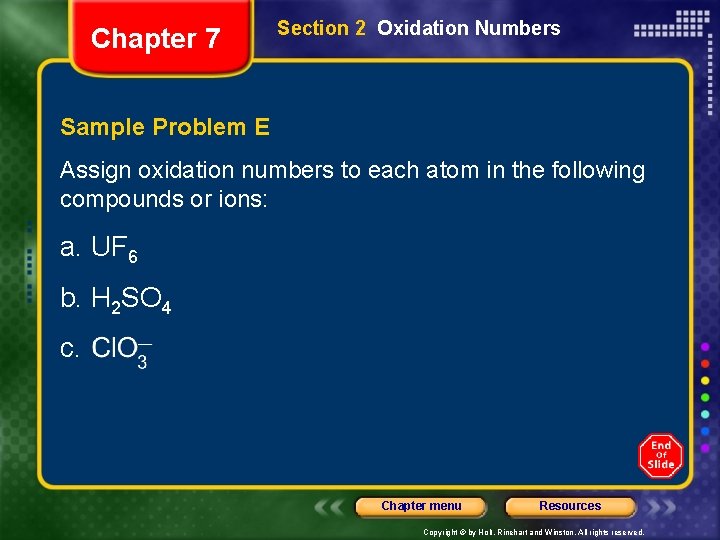
Chapter 7 Section 2 Oxidation Numbers Sample Problem E Assign oxidation numbers to each atom in the following compounds or ions: a. UF 6 b. H 2 SO 4 c. Chapter menu Resources Copyright © by Holt, Rinehart and Winston. All rights reserved.
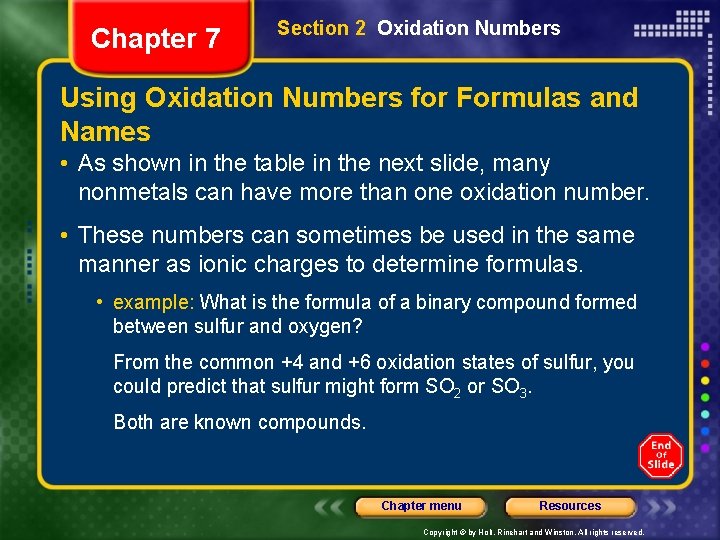
Chapter 7 Section 2 Oxidation Numbers Using Oxidation Numbers for Formulas and Names • As shown in the table in the next slide, many nonmetals can have more than one oxidation number. • These numbers can sometimes be used in the same manner as ionic charges to determine formulas. • example: What is the formula of a binary compound formed between sulfur and oxygen? From the common +4 and +6 oxidation states of sulfur, you could predict that sulfur might form SO 2 or SO 3. Both are known compounds. Chapter menu Resources Copyright © by Holt, Rinehart and Winston. All rights reserved.
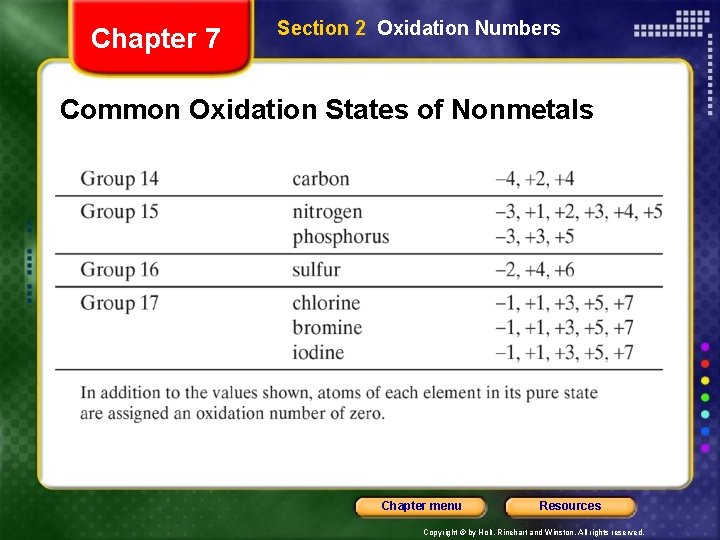
Chapter 7 Section 2 Oxidation Numbers Common Oxidation States of Nonmetals Chapter menu Resources Copyright © by Holt, Rinehart and Winston. All rights reserved.
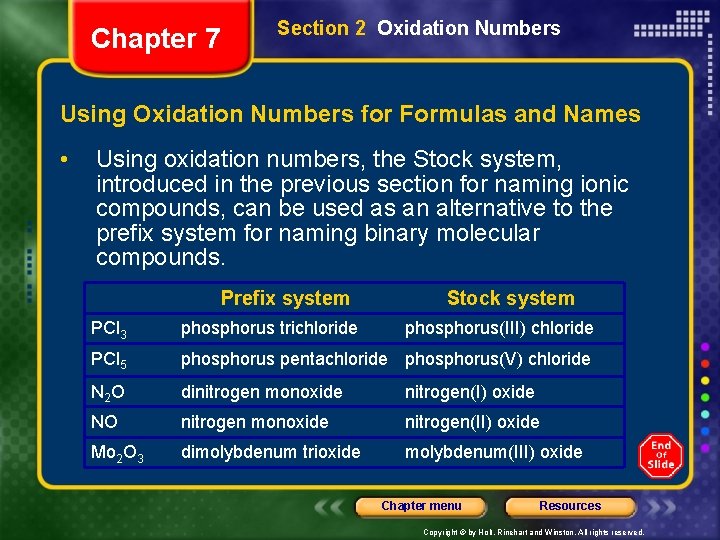
Chapter 7 Section 2 Oxidation Numbers Using Oxidation Numbers for Formulas and Names • Using oxidation numbers, the Stock system, introduced in the previous section for naming ionic compounds, can be used as an alternative to the prefix system for naming binary molecular compounds. Prefix system Stock system PCl 3 phosphorus trichloride phosphorus(III) chloride PCl 5 phosphorus pentachloride phosphorus(V) chloride N 2 O dinitrogen monoxide nitrogen(I) oxide NO nitrogen monoxide nitrogen(II) oxide Mo 2 O 3 dimolybdenum trioxide molybdenum(III) oxide Chapter menu Resources Copyright © by Holt, Rinehart and Winston. All rights reserved.
- Slides: 10