
Chapter 7 Section 1 Change over Time Bellringer
Chapter 7 Section 1 Change over Time Bellringer The cockroach first appeared on Earth over 250 million years ago and is thriving today all over the world. A giant deer that was 2 m tall and had antlers up to 3. 6 m wide first appeared less than 1 million years ago and became extinct around 11, 000 years ago. Why do you think one animal thrived and the other one perished? Chapter menu Resources Copyright © by Holt, Rinehart and Winston. All rights reserved.
Chapter 7 Section 1 Change over Time Objectives • Identify two kinds of evidence that show that organisms have evolved. • Describe one pathway through which a modern whale could have evolved from an ancient mammal. • Explain how comparing organisms can provide evidence that they have ancestors in common. Chapter menu Resources Copyright © by Holt, Rinehart and Winston. All rights reserved.
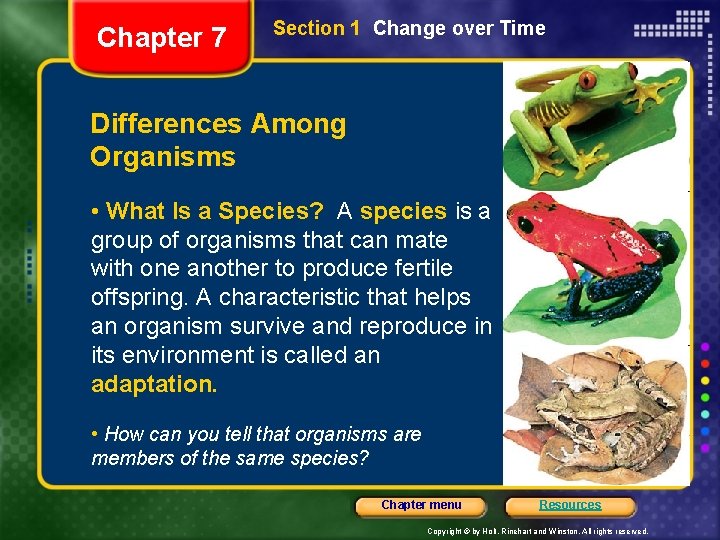
Chapter 7 Section 1 Change over Time Differences Among Organisms • What Is a Species? A species is a group of organisms that can mate with one another to produce fertile offspring. A characteristic that helps an organism survive and reproduce in its environment is called an adaptation. • How can you tell that organisms are members of the same species? Chapter menu Resources Copyright © by Holt, Rinehart and Winston. All rights reserved.
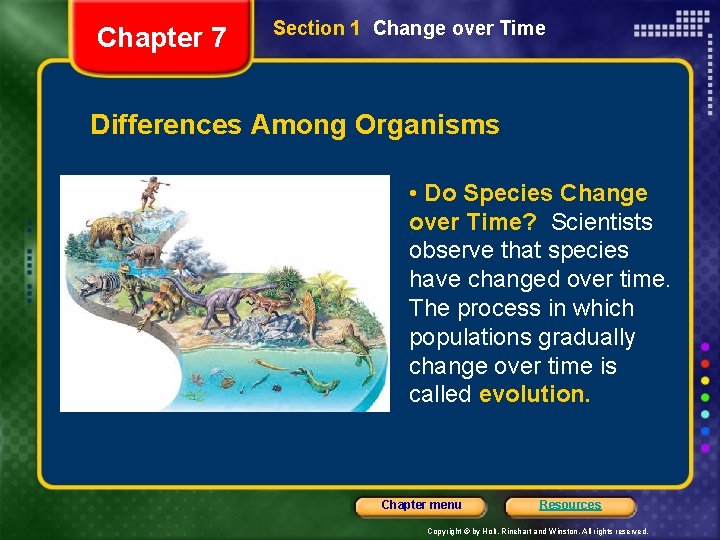
Chapter 7 Section 1 Change over Time Differences Among Organisms • Do Species Change over Time? Scientists observe that species have changed over time. The process in which populations gradually change over time is called evolution. Chapter menu Resources Copyright © by Holt, Rinehart and Winston. All rights reserved.
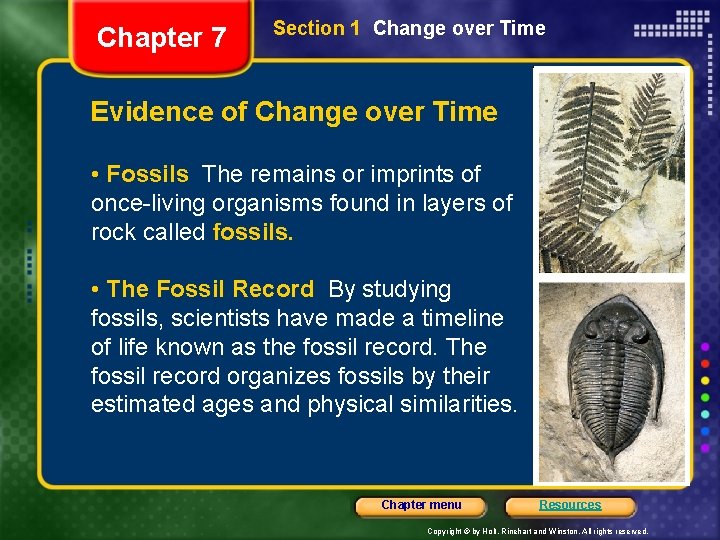
Chapter 7 Section 1 Change over Time Evidence of Change over Time • Fossils The remains or imprints of once-living organisms found in layers of rock called fossils. • The Fossil Record By studying fossils, scientists have made a timeline of life known as the fossil record. The fossil record organizes fossils by their estimated ages and physical similarities. Chapter menu Resources Copyright © by Holt, Rinehart and Winston. All rights reserved.
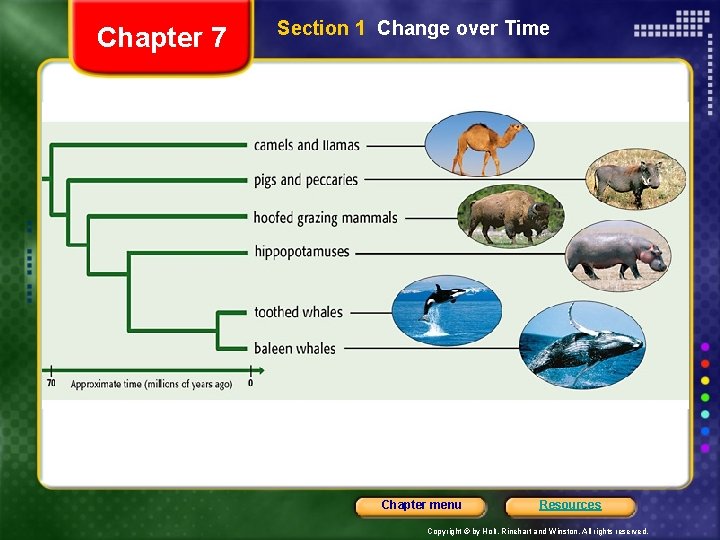
Chapter 7 Section 1 Change over Time Evidence of Ancestry • Order of Life The fossil record provides evidence about the order in which species have existed. • Drawing Connections Scientists have named and described hundreds of thousands of living and ancient species. Scientists use information about these species to sketch out a “ tree of life” that includes all known organisms. Chapter menu Resources Copyright © by Holt, Rinehart and Winston. All rights reserved.
Chapter 7 Section 1 Change over Time Chapter menu Resources Copyright © by Holt, Rinehart and Winston. All rights reserved.
Chapter 7 Section 1 Change over Time Examining Organisms • Case Study: Evolution of the Whale Scientists think that the ancient ancestor of whales was probably a mammal that lived on land that could run on four legs. • Walking Whales The organisms shown on the next slide form a sequence between ancient four-legged mammals and modern whales. Several pieces of evidence indicate that these species are related by ancestry. Chapter menu Resources Copyright © by Holt, Rinehart and Winston. All rights reserved.
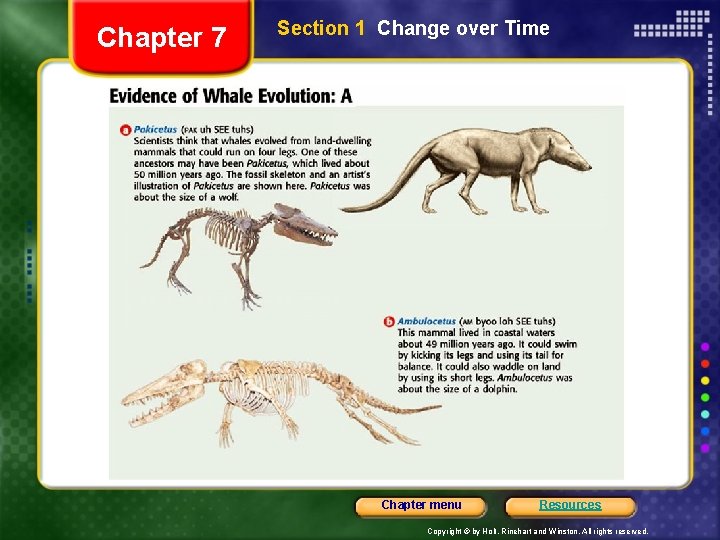
Chapter 7 Section 1 Change over Time Chapter menu Resources Copyright © by Holt, Rinehart and Winston. All rights reserved.
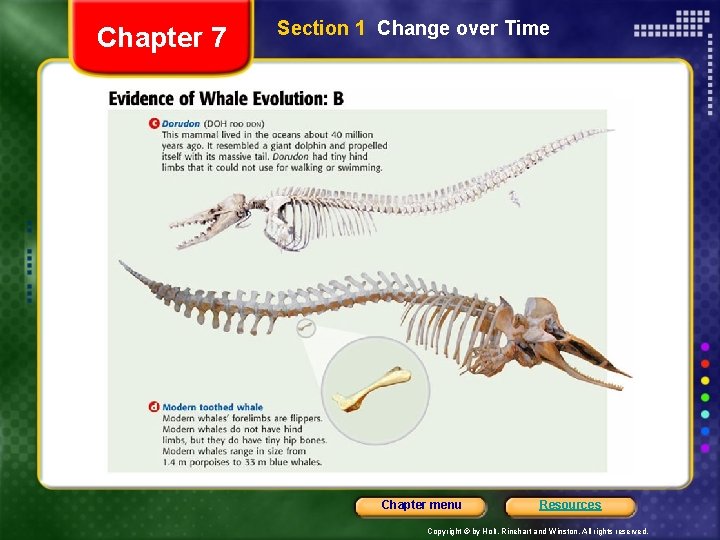
Chapter 7 Section 1 Change over Time Chapter menu Resources Copyright © by Holt, Rinehart and Winston. All rights reserved.
Chapter 7 Section 1 Change over Time Comparing Organisms • Comparing Skeletal Structures The structure and order of bones of a human arm are similar to those of the front limbs of a cat, a dolphin, and a bat. These similarities suggest that cats, dolphins, bats, and humans had a common ancestor. Chapter menu Resources Copyright © by Holt, Rinehart and Winston. All rights reserved.
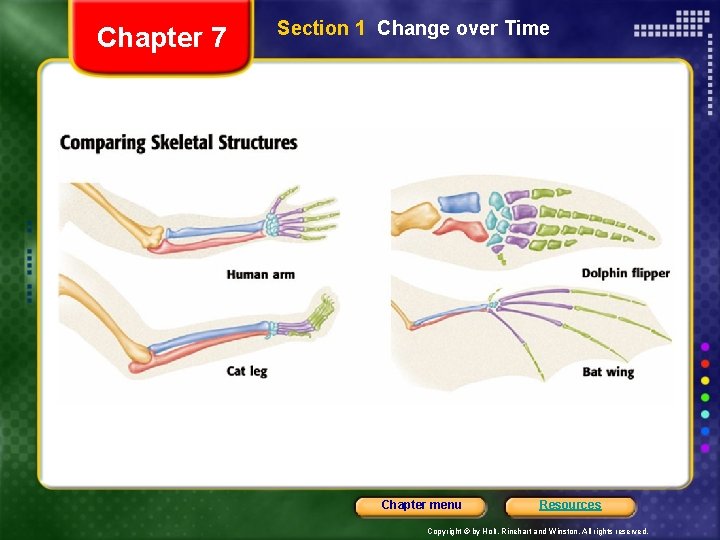
Chapter 7 Section 1 Change over Time Chapter menu Resources Copyright © by Holt, Rinehart and Winston. All rights reserved.
Chapter 7 Section 1 Change over Time Comparing Organisms • Comparing DNA The greater the number of similarities in DNA between species, the more closely those two species are related through a common ancestor. • The fact that all existing species have DNA supports theory that all species share a common ancestor. Chapter menu Resources Copyright © by Holt, Rinehart and Winston. All rights reserved.
Chapter 7 Section 1 Change over Time Section Summary • Evolution is the process in which inherited characteristics within a population change over generations, sometimes giving rise to new species. Scientists continue to develop theories to explain how evolution happens. • Evidence that organisms evolve can be found by comparing living organisms to each other and to the fossil record. Such comparisons provide evidence of common ancestry. Chapter menu Resources Copyright © by Holt, Rinehart and Winston. All rights reserved.
Chapter 7 Section 1 Change over Time Section Summary • Scientists think that modern whales evolved from an ancient, land-dwelling mammal ancestor. Fossil organisms that support this hypothesis have been found. • Evidence of common ancestry among living organisms is provided by comparing DNA and inherited traits. Species that have a common ancestor will have traits and DNA that are more similar to each other than to those of distantly related species. Chapter menu Resources Copyright © by Holt, Rinehart and Winston. All rights reserved.
- Slides: 15