
Chapter 7 Sec 7 3 Names and Formulas
- Slides: 30
Chapter 7 Sec. 7. 3: Names and Formulas for Ionic Compounds
Objectives l Relate a formula unit of an ionic compound to its composition. l Write formulas for ionic compounds and oxyanions. l Apply naming conventions to ionic compounds and oxyanions.
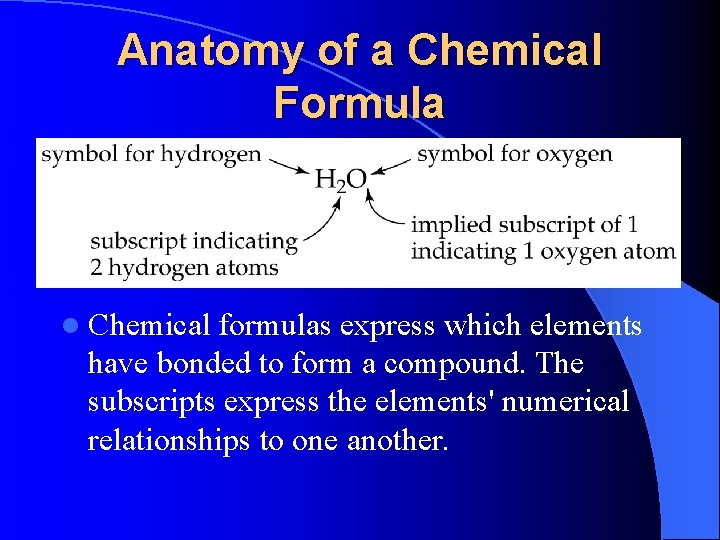
Anatomy of a Chemical Formula l Chemical formulas express which elements have bonded to form a compound. The subscripts express the elements' numerical relationships to one another.
Formulas for Ionic Compounds l Since ionic compounds do not exist as single units, the formula of an ionic compounds represents the simplest ratio of ions. It is called a FORMULA UNIT. For example: Mg. Cl 2 is a formula unit of magnesium chloride. l Remember that a formula unit of an ionic compound has no charge! l u The symbol for the cation is always written first, followed by the symbol of the anion.
Formulas for Ionic Compounds l Monatomic ions are one-atom ions. l Polyatomic ions are a group of covalentlybonded atoms that together have a net charge. l Since polyatomic ions exist as a unit, the subscripts of the atoms within the ion is NEVER changed. When more than one polyatomic ion is needed, parentheses MUST be placed around the ion and the appropriate subscript is written outside the parentheses. l Oxidation number, or oxidation state, is the charge of a monatomic or polyatomic ion.
Writing Formulas for Binary Ionic Compounds l Binary: made up of 2 elements A monatomic metal ion and a monatomic nonmetal ion l The numbers of each ion (their ratios) in the formula are determined by the charges Remember: the # of electrons lost must equal the # gained l
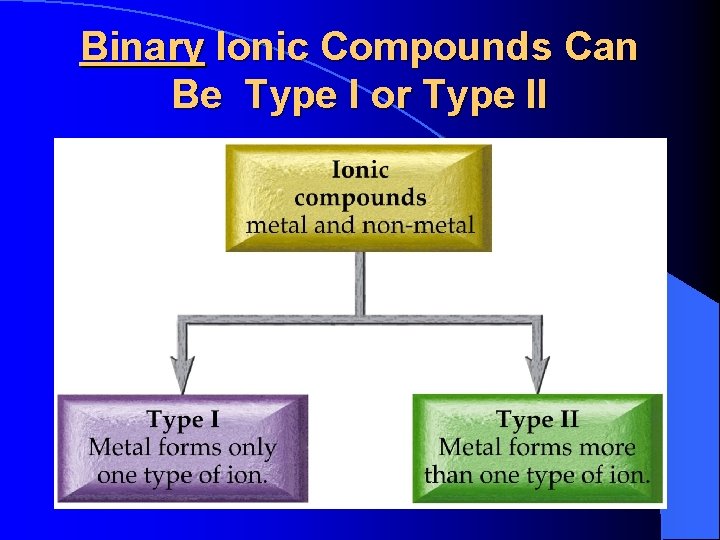
Binary Ionic Compounds Can Be Type I or Type II
Determining the Type of Metal l. A representative (A group) metal is called a Type I metal. Its charge (or oxidation number) can be found from the location of the metal in the periodic table.
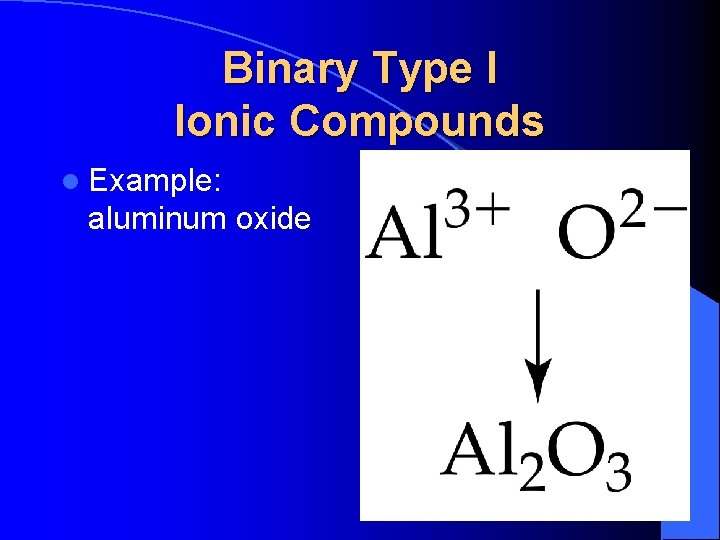
Binary Type I Ionic Compounds l Example: aluminum oxide
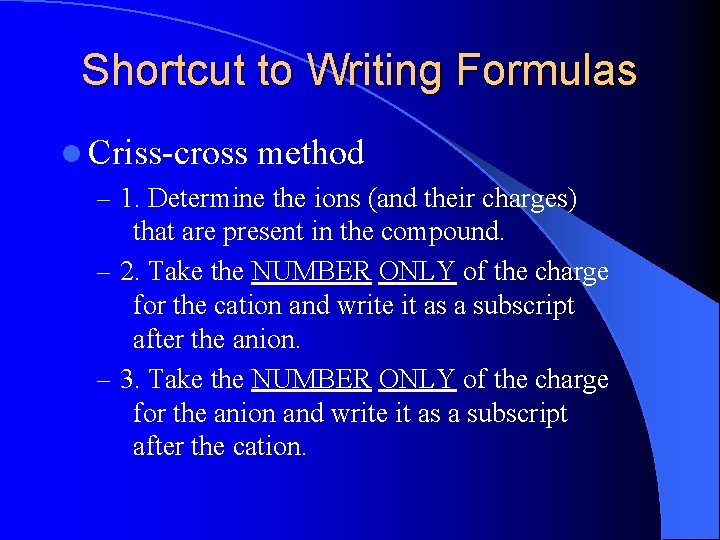
Shortcut to Writing Formulas l Criss-cross method – 1. Determine the ions (and their charges) that are present in the compound. – 2. Take the NUMBER ONLY of the charge for the cation and write it as a subscript after the anion. – 3. Take the NUMBER ONLY of the charge for the anion and write it as a subscript after the cation.
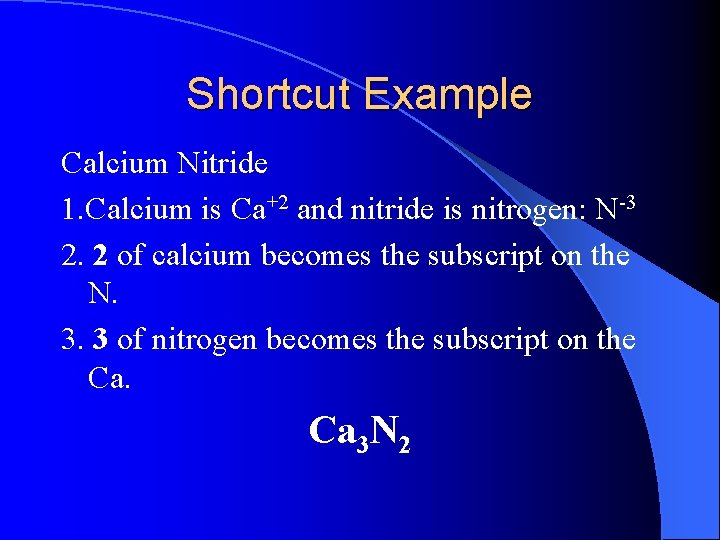
Shortcut Example Calcium Nitride 1. Calcium is Ca+2 and nitride is nitrogen: N-3 2. 2 of calcium becomes the subscript on the N. 3. 3 of nitrogen becomes the subscript on the Ca. Ca 3 N 2
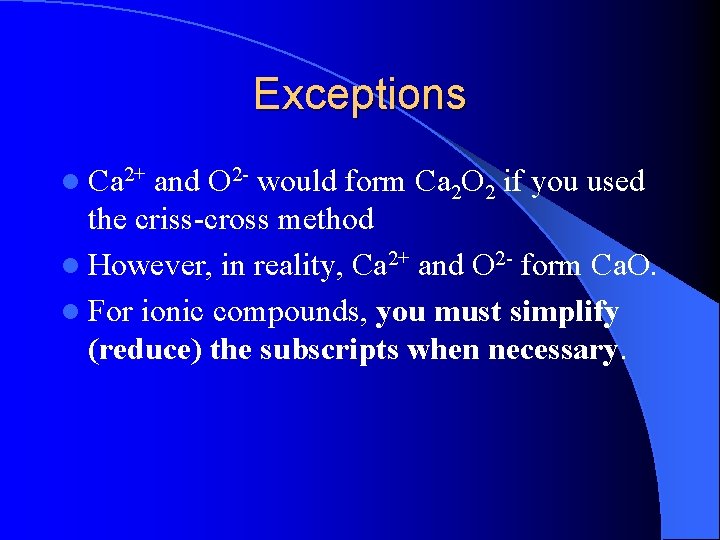
Exceptions l Ca 2+ and O 2 - would form Ca 2 O 2 if you used the criss-cross method l However, in reality, Ca 2+ and O 2 - form Ca. O. l For ionic compounds, you must simplify (reduce) the subscripts when necessary.
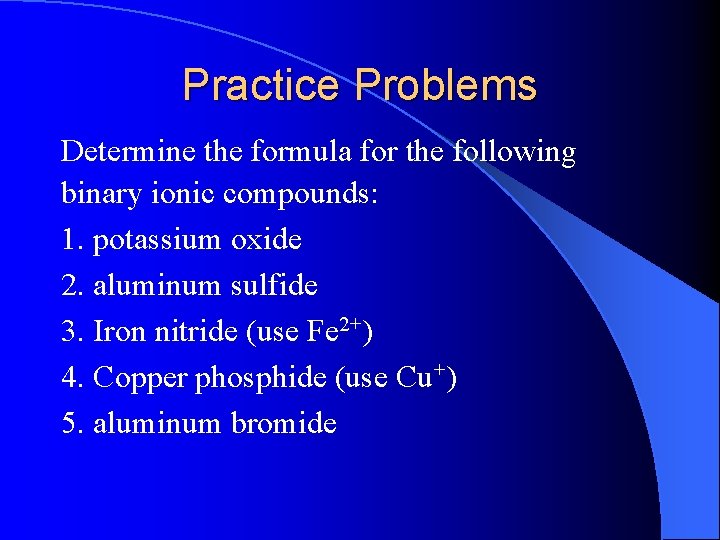
Practice Problems Determine the formula for the following binary ionic compounds: 1. potassium oxide 2. aluminum sulfide 3. Iron nitride (use Fe 2+) 4. Copper phosphide (use Cu+) 5. aluminum bromide
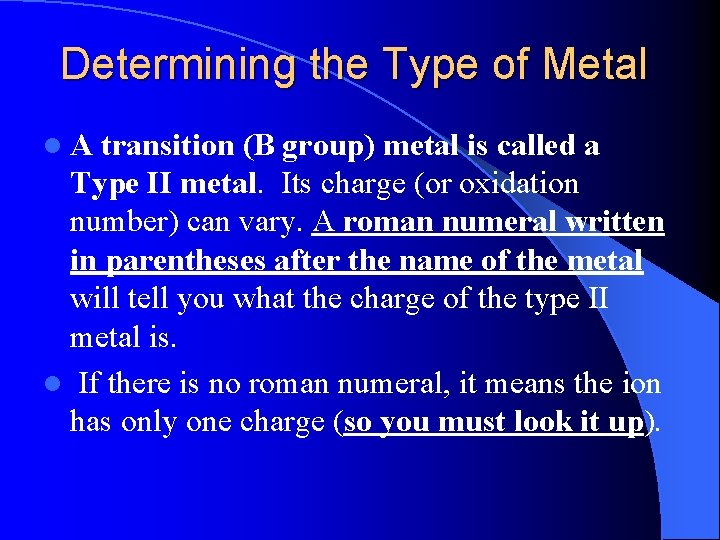
Determining the Type of Metal l. A transition (B group) metal is called a Type II metal. Its charge (or oxidation number) can vary. A roman numeral written in parentheses after the name of the metal will tell you what the charge of the type II metal is. l If there is no roman numeral, it means the ion has only one charge (so you must look it up).
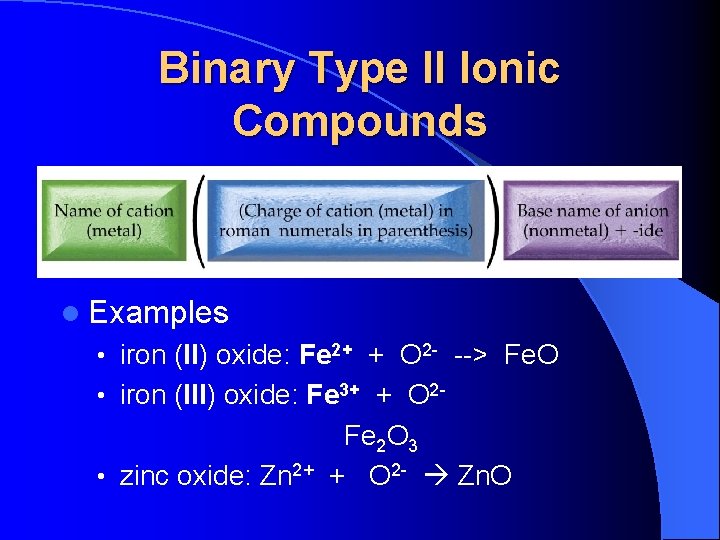
Binary Type II Ionic Compounds l Examples • iron (II) oxide: Fe 2+ + O 2 - --> Fe. O • iron (III) oxide: Fe 3+ + O 2 • zinc oxide: Zn 2+ Fe 2 O 3 + O 2 - Zn. O
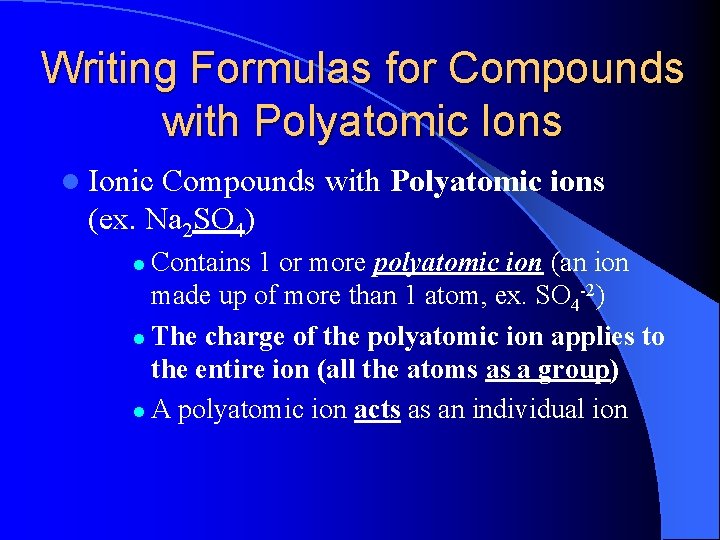
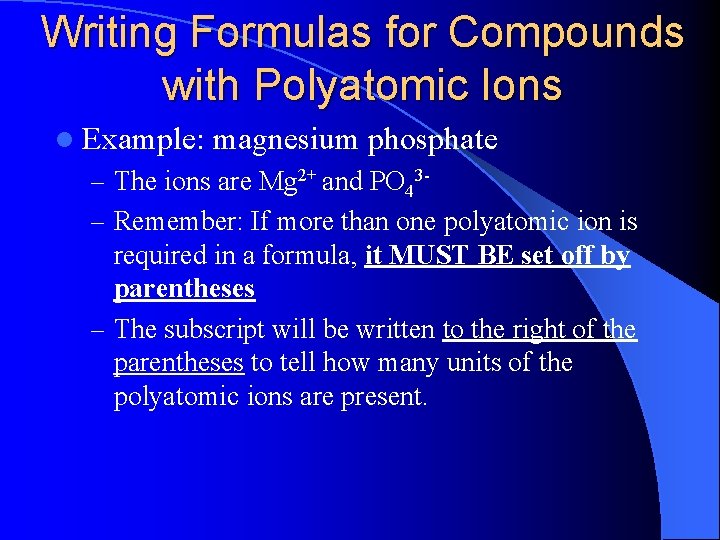
Writing Formulas for Compounds with Polyatomic Ions l Ionic Compounds with Polyatomic ions (ex. Na 2 SO 4) Contains 1 or more polyatomic ion (an ion made up of more than 1 atom, ex. SO 4 -2) l The charge of the polyatomic ion applies to the entire ion (all the atoms as a group) l A polyatomic ion acts as an individual ion l
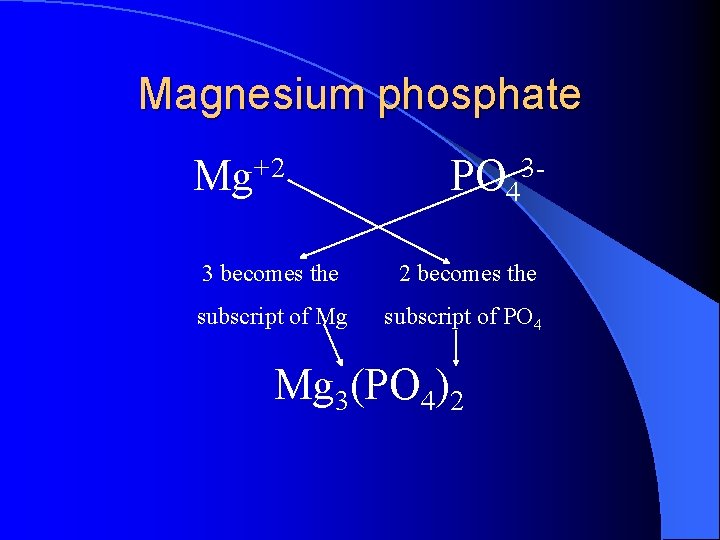
Writing Formulas for Compounds with Polyatomic Ions l Example: magnesium phosphate – The ions are Mg 2+ and PO 43– Remember: If more than one polyatomic ion is required in a formula, it MUST BE set off by parentheses – The subscript will be written to the right of the parentheses to tell how many units of the polyatomic ions are present.
Magnesium phosphate Mg+2 PO 43 - 3 becomes the 2 becomes the subscript of Mg subscript of PO 4 Mg 3(PO 4)2
NEVER change the subscripts of the atoms witihin a polyatomic ion. The formulas for the polyatomic ions are written in stone!
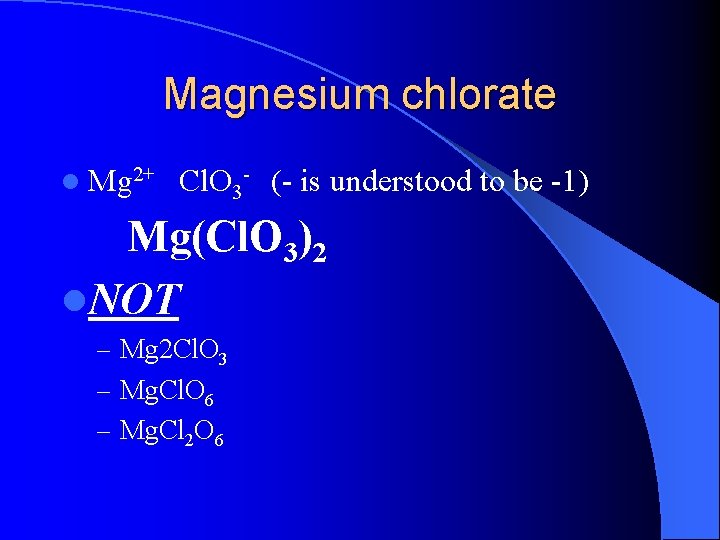
Magnesium chlorate l Mg 2+ Cl. O 3 - (- is understood to be -1) Mg(Cl. O 3)2 l. NOT – Mg 2 Cl. O 3 – Mg. Cl. O 6 – Mg. Cl 2 O 6
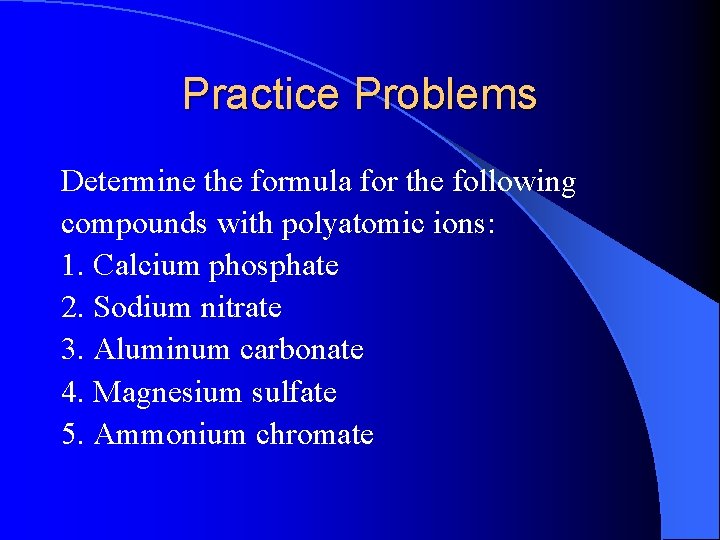
Practice Problems Determine the formula for the following compounds with polyatomic ions: 1. Calcium phosphate 2. Sodium nitrate 3. Aluminum carbonate 4. Magnesium sulfate 5. Ammonium chromate
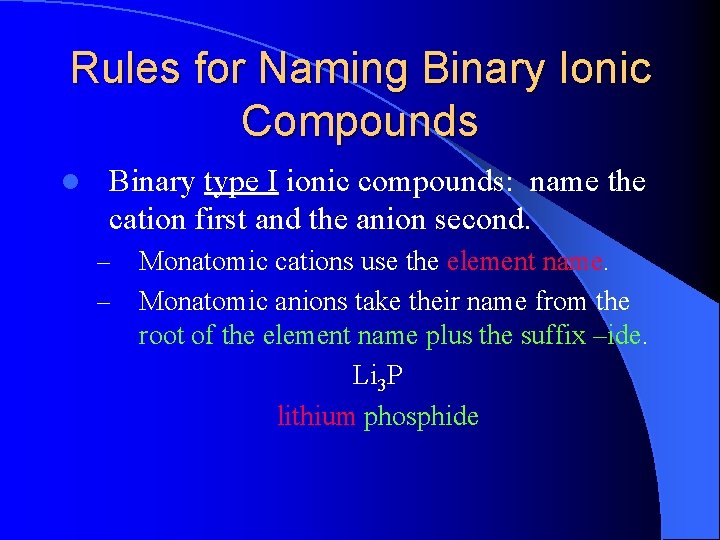
Rules for Naming Binary Ionic Compounds l Binary type I ionic compounds: name the cation first and the anion second. – – Monatomic cations use the element name. Monatomic anions take their name from the root of the element name plus the suffix –ide. Li 3 P lithium phosphide
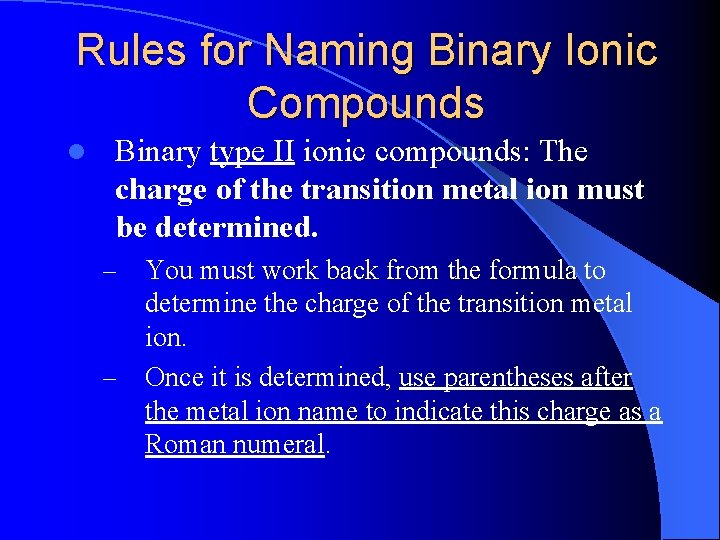
Rules for Naming Binary Ionic Compounds l Binary type II ionic compounds: The charge of the transition metal ion must be determined. – – You must work back from the formula to determine the charge of the transition metal ion. Once it is determined, use parentheses after the metal ion name to indicate this charge as a Roman numeral.
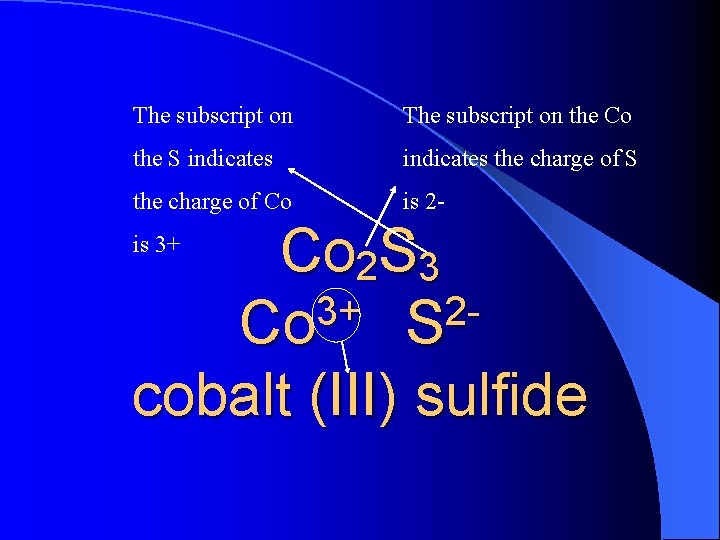
The subscript on the Co the S indicates the charge of S the charge of Co is 2 - Co 2 S 3 3+ 2 Co S cobalt (III) sulfide is 3+
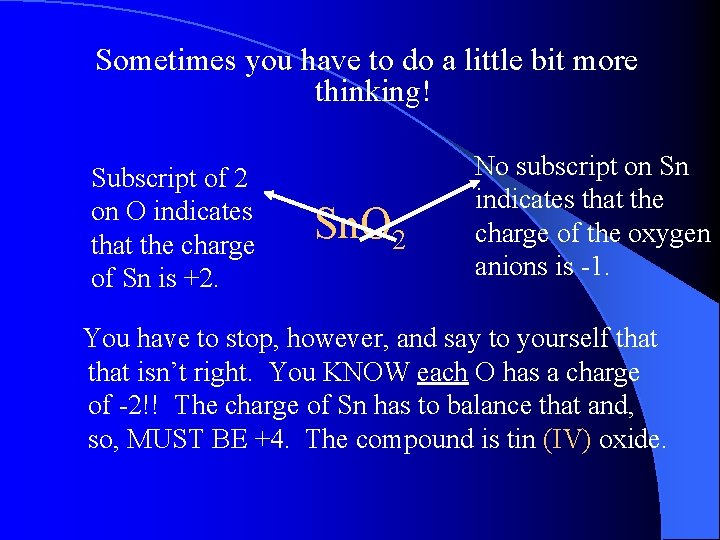
Sometimes you have to do a little bit more thinking! Subscript of 2 on O indicates that the charge of Sn is +2. Sn. O 2 No subscript on Sn indicates that the charge of the oxygen anions is -1. You have to stop, however, and say to yourself that isn’t right. You KNOW each O has a charge of -2!! The charge of Sn has to balance that and, so, MUST BE +4. The compound is tin (IV) oxide.
Rules for Naming Compounds with Polyatomic Ions l You must first determine the name of the polyatomic ion. l Once that is known, use it to name the compound. l Example: Na. HCO 3 – the polyatomic ion, HCO 3 -, has 2 possible names – the compound is named sodium hydrogen carbonate or sodium bicarbonate
Practice Problems Name the following compounds. 1. Na. Br 2. KOH 3. Cu. Cl 2 4. Fe. Cr. O 4
Naming Polyatomic Ions l Most polyatomic ions are oxyanions. An oxyanion is a polyatomic ion composed of an element, usually a nonmetal, bonded to one or more oxygen atoms. l More than one oxyanion exists for some nonmetals such as nitrogen and sulfur.
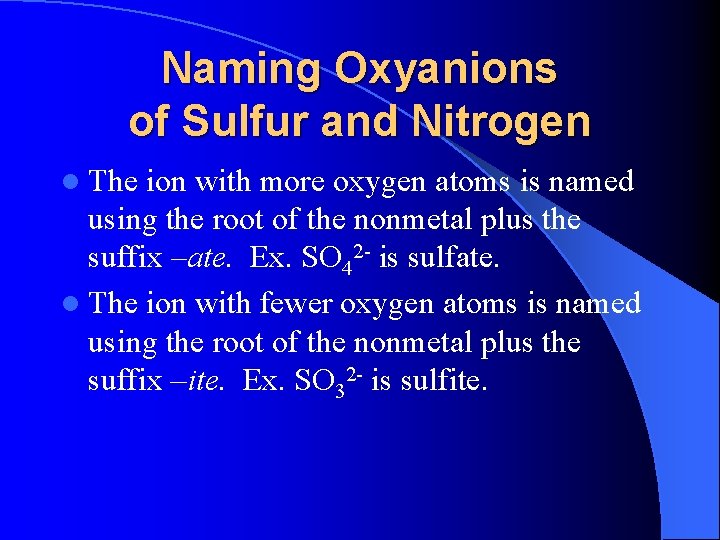
Naming Oxyanions of Sulfur and Nitrogen l The ion with more oxygen atoms is named using the root of the nonmetal plus the suffix –ate. Ex. SO 42 - is sulfate. l The ion with fewer oxygen atoms is named using the root of the nonmetal plus the suffix –ite. Ex. SO 32 - is sulfite.
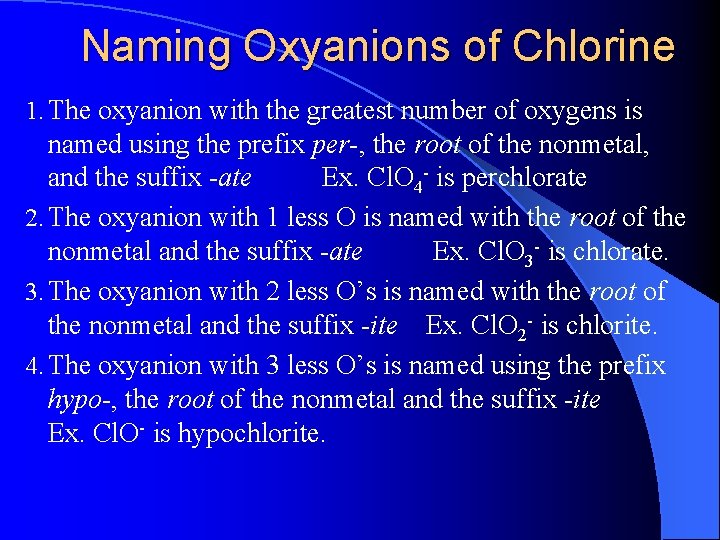
Naming Oxyanions of Chlorine 1. The oxyanion with the greatest number of oxygens is named using the prefix per-, the root of the nonmetal, and the suffix -ate Ex. Cl. O 4 - is perchlorate 2. The oxyanion with 1 less O is named with the root of the nonmetal and the suffix -ate Ex. Cl. O 3 - is chlorate. 3. The oxyanion with 2 less O’s is named with the root of the nonmetal and the suffix -ite Ex. Cl. O 2 - is chlorite. 4. The oxyanion with 3 less O’s is named using the prefix hypo-, the root of the nonmetal and the suffix -ite Ex. Cl. O- is hypochlorite.