
Chapter 7 Sampling Distributions Section 7 2 Sample
+ Chapter 7: Sampling Distributions Section 7. 2 Sample Proportions The Practice of Statistics, 4 th edition – For AP* STARNES, YATES, MOORE
+ Chapter 7 Sampling Distributions n 7. 1 What is a Sampling Distribution? n 7. 2 Sample Proportions n 7. 3 Sample Means
+ Section 7. 2 Sample Proportions Learning Objectives After this section, you should be able to… ü FIND the mean and standard deviation of the sampling distribution of a sample proportion ü DETERMINE whether or not it is appropriate to use the Normal approximation to calculate probabilities involving the sample proportion ü CALCULATE probabilities involving the sample proportion ü EVALUATE a claim about a population proportion using the sampling distribution of the sample proportion
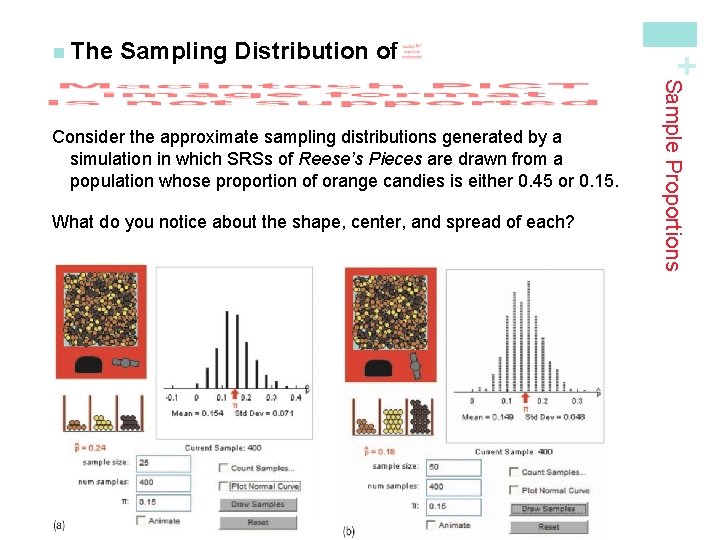
Sampling Distribution of What do you notice about the shape, center, and spread of each? Sample Proportions Consider the approximate sampling distributions generated by a simulation in which SRSs of Reese’s Pieces are drawn from a population whose proportion of orange candies is either 0. 45 or 0. 15. + n The
Sampling Distribution of Sample Proportions What did you notice about the shape, center, and spread of each sampling distribution? + n The
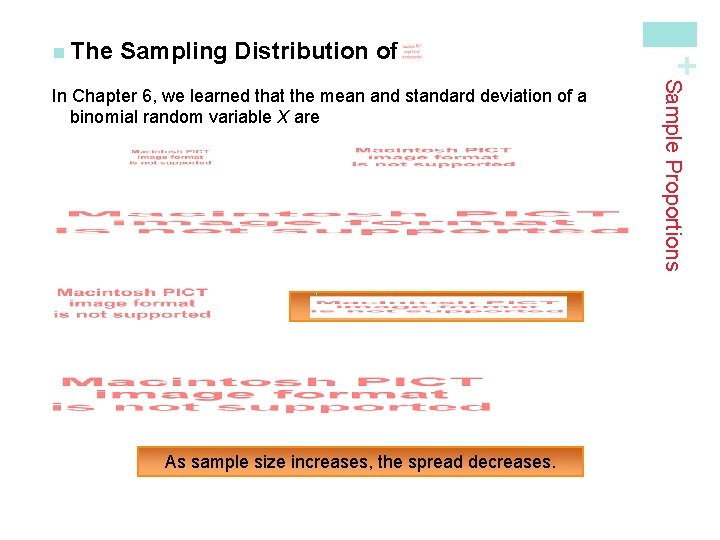
Sampling Distribution of As sample size increases, the spread decreases. Sample Proportions In Chapter 6, we learned that the mean and standard deviation of a binomial random variable X are + n The
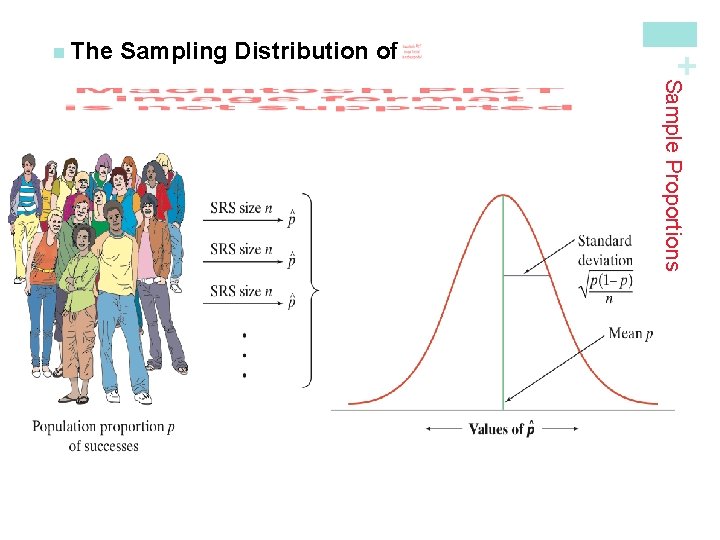
Sampling Distribution of As n increases, the sampling distribution becomes approximately Normal. Before you perform Normal calculations, check that the Normal condition is satisfied: np ≥ 10 and n(1 – p) ≥ 10. Sample Proportions Sampling Distribution of a Sample Proportion + n The
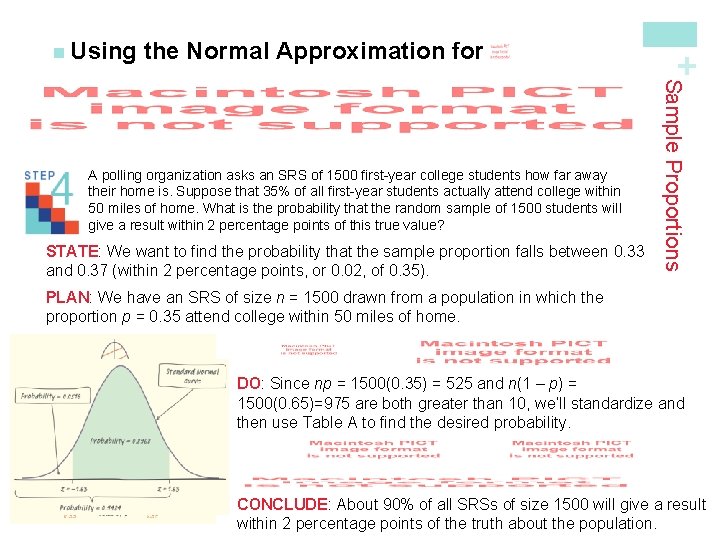
the Normal Approximation for STATE: We want to find the probability that the sample proportion falls between 0. 33 and 0. 37 (within 2 percentage points, or 0. 02, of 0. 35). Sample Proportions A polling organization asks an SRS of 1500 first-year college students how far away their home is. Suppose that 35% of all first-year students actually attend college within 50 miles of home. What is the probability that the random sample of 1500 students will give a result within 2 percentage points of this true value? + n Using PLAN: We have an SRS of size n = 1500 drawn from a population in which the proportion p = 0. 35 attend college within 50 miles of home. DO: Since np = 1500(0. 35) = 525 and n(1 – p) = 1500(0. 65)=975 are both greater than 10, we’ll standardize and then use Table A to find the desired probability. CONCLUDE: About 90% of all SRSs of size 1500 will give a result within 2 percentage points of the truth about the population.
+ Section 7. 2 Sample Proportions Summary In this section, we learned that… ü ü In practice, use this Normal approximation when both np ≥ 10 and n(1 - p) ≥ 10 (the Normal condition).
+ Looking Ahead… In the next Section… We’ll learn how to describe and use the sampling distribution of sample means. We’ll learn about ü The sampling distribution of ü Sampling from a Normal population ü The central limit theorem
- Slides: 10