
Chapter 7 Sampling Distributions Introduction n Parameters are
Chapter 7: Sampling Distributions Introduction n Parameters are numerical descriptive measures for populations. • • n n For the normal distribution, the location and shape are described by m and s. For a binomial distribution consisting of n trials, the location and shape are determined by p. Often the values of parameters that specify the exact form of a distribution are unknown. You must rely on the sample to infer these parameters.
Sampling Examples: n A pollster is sure that the responses to his “agree/disagree” question will follow a binomial distribution, but p, the proportion of those who “agree” in the population, is unknown. n An agronomist believes that the yield per acre of a variety of wheat is approximately normally distributed, but the mean m and the standard deviation s of the yields are unknown. ü If you want the sample to provide reliable information about the population, you must select your sample in a certain way. But how?
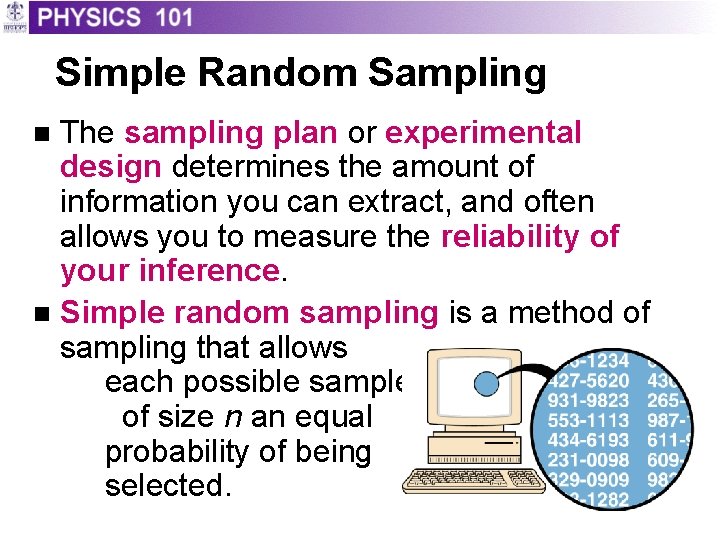
Simple Random Sampling The sampling plan or experimental design determines the amount of information you can extract, and often allows you to measure the reliability of your inference. n Simple random sampling is a method of sampling that allows each possible sample of size n an equal probability of being selected. n
Types of Samples • Sampling can occur in two types of practical situations: 1. 1. Observational studies: The data exists before you decide to study it. Watch out for: ü Selection Effects: Have you sampled the entire population randomly? Be careful -- just because you can’t measure it doesn’t mean that it is not there!! ü Undercoverage: Are certain segments of the population systematically excluded? ü Observational Bias: Are your methods predisposing you to draw an incorrect conclusion?
Types of Samples 2. Experimentation: The data are generated by imposing an experimental condition or treatment on the experimental units. ü Hypothetical populations can make random sampling difficult if not impossible. ü Samples must sometimes be chosen so that the experimenter believes they are representative of the whole population. ü Samples must behave like random samples!
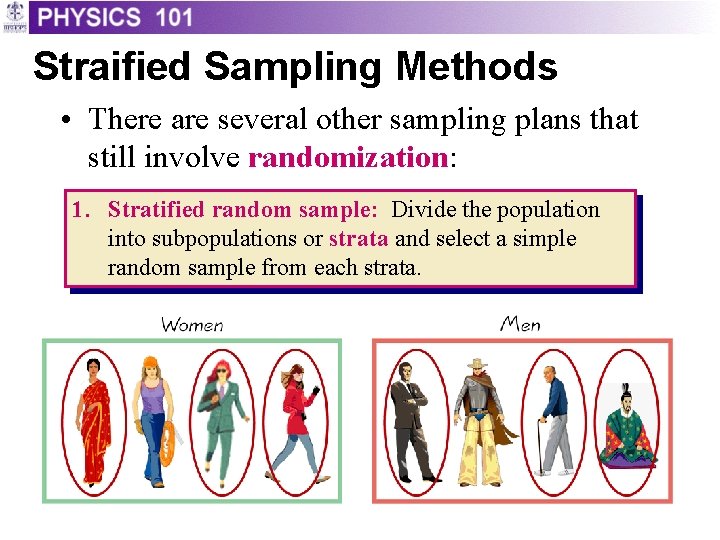
Straified Sampling Methods • There are several other sampling plans that still involve randomization: 1. Stratified random sample: Divide the population into subpopulations or strata and select a simple random sample from each strata.

Other Sampling Methods 1. Cluster Sample: Divide the population into subgroups called clusters; select a simple random sample of clusters and take a measurement of every element in the cluster.
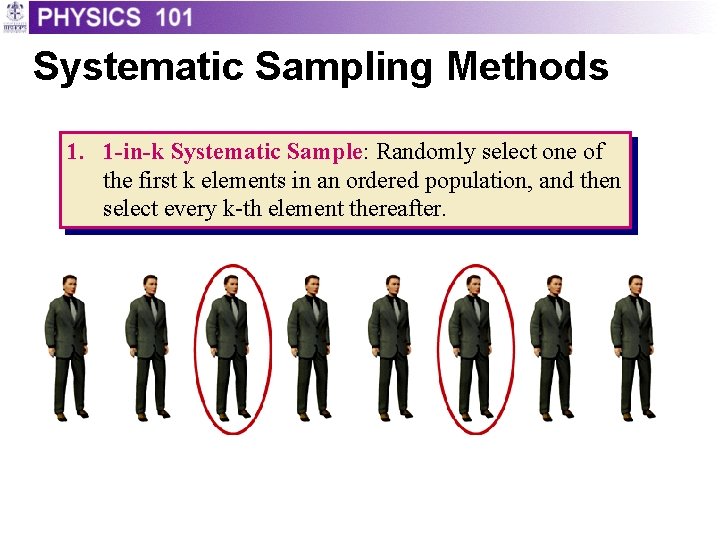
Systematic Sampling Methods 1. 1 -in-k Systematic Sample: Randomly select one of the first k elements in an ordered population, and then select every k-th element thereafter.
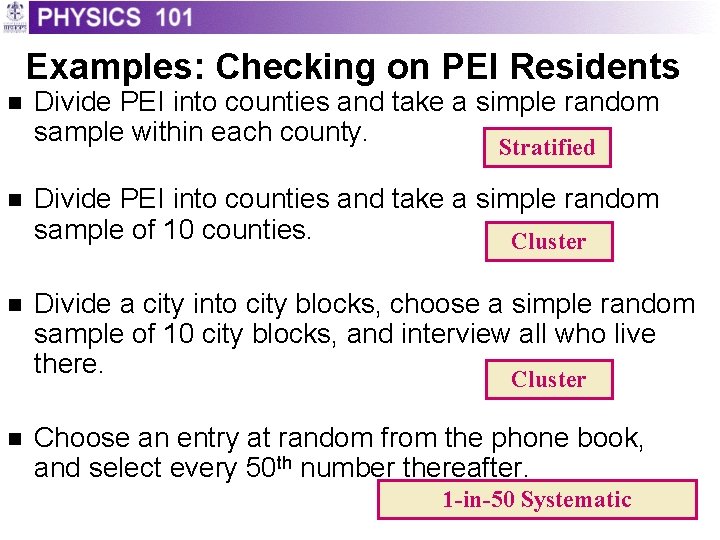
Examples: Checking on PEI Residents n Divide PEI into counties and take a simple random sample within each county. Stratified n Divide PEI into counties and take a simple random sample of 10 counties. Cluster n Divide a city into city blocks, choose a simple random sample of 10 city blocks, and interview all who live there. Cluster n Choose an entry at random from the phone book, and select every 50 th number thereafter. 1 -in-50 Systematic
Non-Random Sampling Plans • There are several other sampling plans that do not involve randomization. They should NOT be used for statistical inference! 1. Convenience sample: A sample that can be taken easily without random selection. • People walking by on the street 2. Judgment sample: The sampler decides what will and will not be included in the sample.
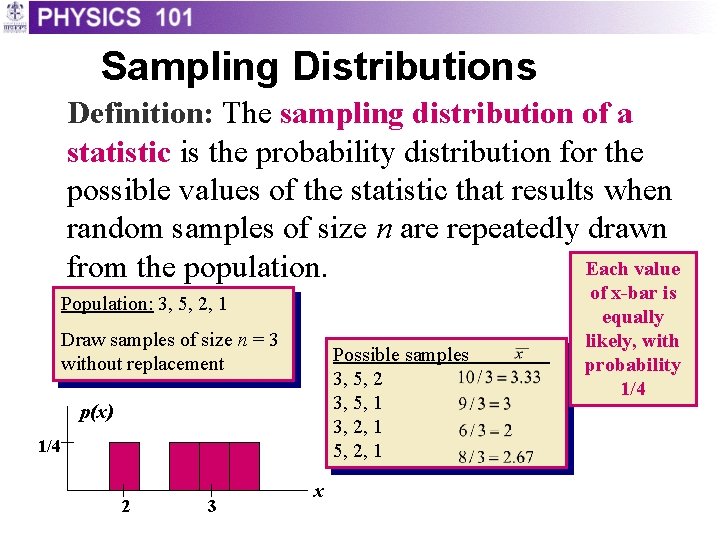
Sampling Distributions Definition: The sampling distribution of a statistic is the probability distribution for the possible values of the statistic that results when random samples of size n are repeatedly drawn Each value from the population. Population: 3, 5, 2, 1 Draw samples of size n = 3 without replacement Possible samples 3, 5, 2 3, 5, 1 3, 2, 1 5, 2, 1 p(x) 1/4 2 3 x of x-bar is equally likely, with probability 1/4
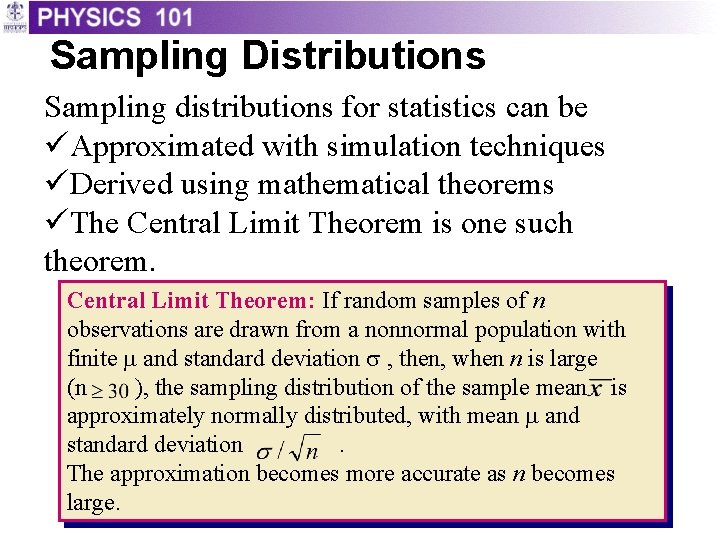
Sampling Distributions Sampling distributions for statistics can be üApproximated with simulation techniques üDerived using mathematical theorems üThe Central Limit Theorem is one such theorem. Central Limit Theorem: If random samples of n observations are drawn from a nonnormal population with finite m and standard deviation s , then, when n is large (n ), the sampling distribution of the sample mean is approximately normally distributed, with mean m and standard deviation. The approximation becomes more accurate as n becomes large.
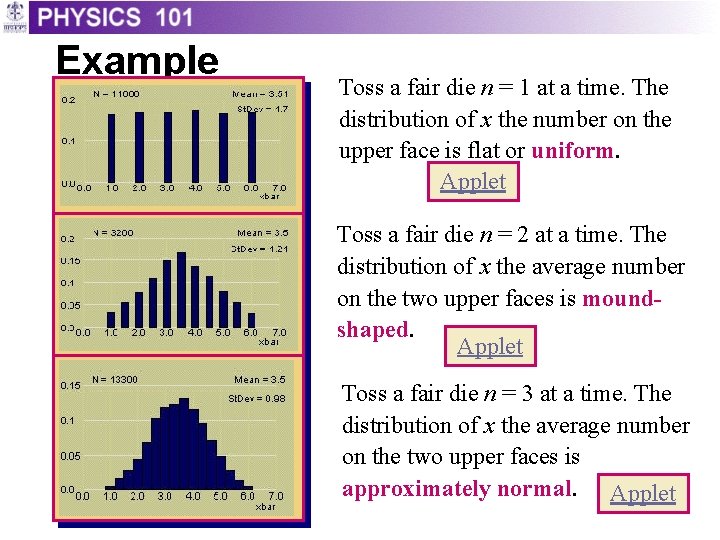
Example Toss a fair die n = 1 at a time. The distribution of x the number on the upper face is flat or uniform. Applet Toss a fair die n = 2 at a time. The distribution of x the average number on the two upper faces is moundshaped. Applet Toss a fair die n = 3 at a time. The distribution of x the average number on the two upper faces is approximately normal. Applet
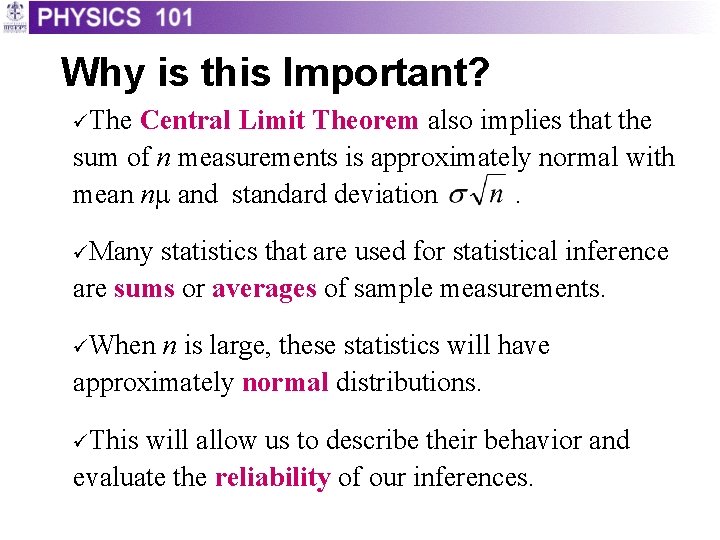
Why is this Important? üThe Central Limit Theorem also implies that the sum of n measurements is approximately normal with mean nm and standard deviation. üMany statistics that are used for statistical inference are sums or averages of sample measurements. üWhen n is large, these statistics will have approximately normal distributions. üThis will allow us to describe their behavior and evaluate the reliability of our inferences.
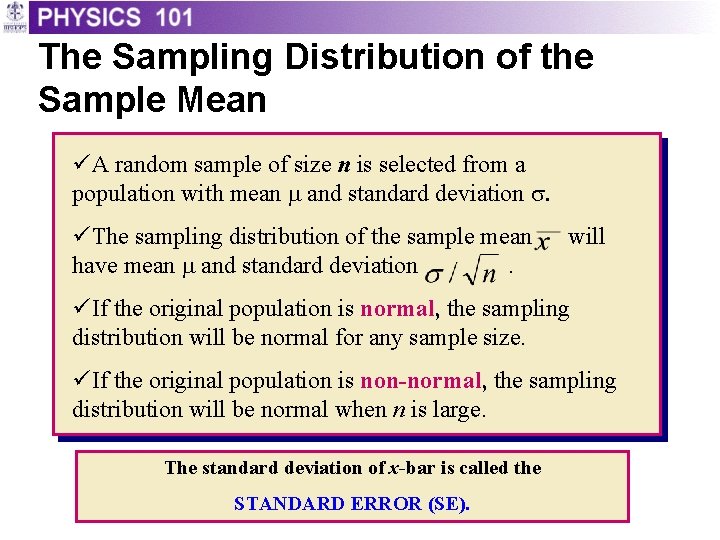
The Sampling Distribution of the Sample Mean üA random sample of size n is selected from a population with mean m and standard deviation s. üThe sampling distribution of the sample mean have mean m and standard deviation. will üIf the original population is normal, the sampling distribution will be normal for any sample size. üIf the original population is non-normal, the sampling distribution will be normal when n is large. The standard deviation of x-bar is called the STANDARD ERROR (SE).
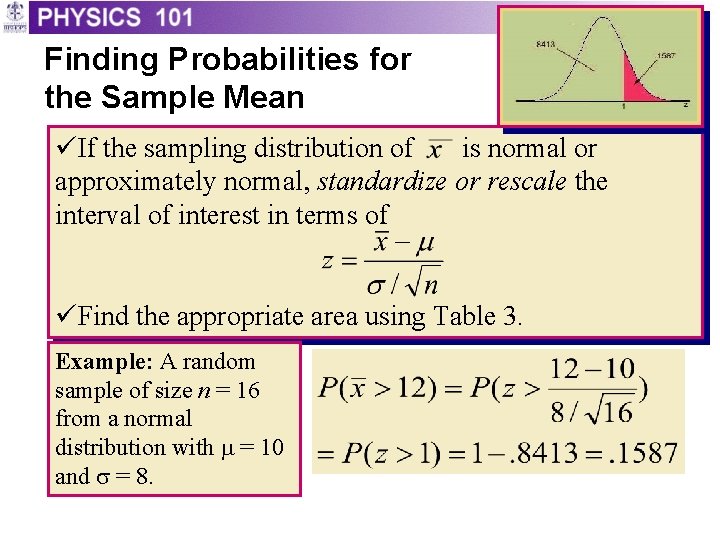
Finding Probabilities for the Sample Mean üIf the sampling distribution of is normal or approximately normal, standardize or rescale the interval of interest in terms of üFind the appropriate area using Table 3. Example: A random sample of size n = 16 from a normal distribution with m = 10 and s = 8.
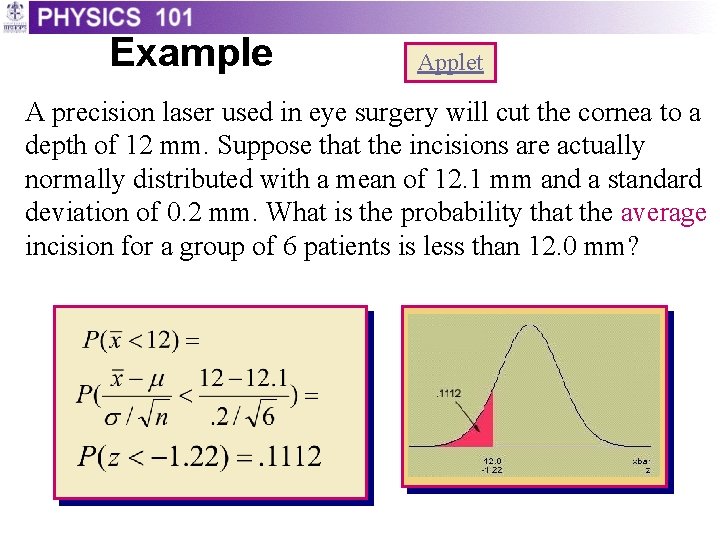
Example Applet A precision laser used in eye surgery will cut the cornea to a depth of 12 mm. Suppose that the incisions are actually normally distributed with a mean of 12. 1 mm and a standard deviation of 0. 2 mm. What is the probability that the average incision for a group of 6 patients is less than 12. 0 mm?
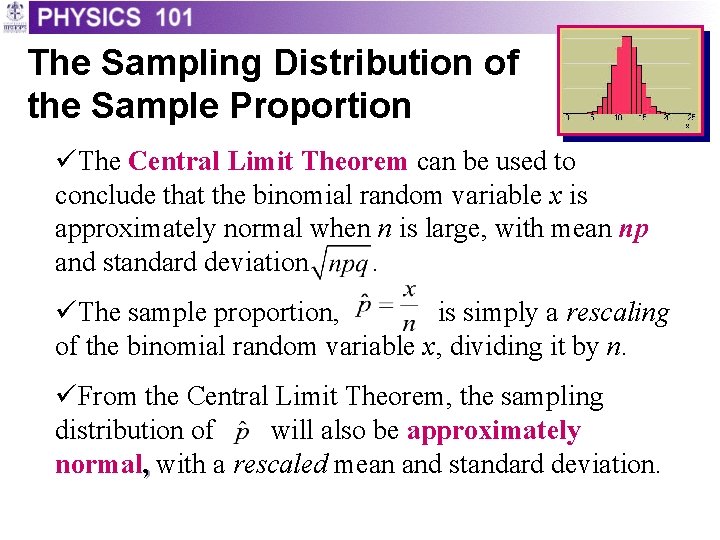
The Sampling Distribution of the Sample Proportion üThe Central Limit Theorem can be used to conclude that the binomial random variable x is approximately normal when n is large, with mean np and standard deviation. üThe sample proportion, is simply a rescaling of the binomial random variable x, dividing it by n. üFrom the Central Limit Theorem, the sampling distribution of will also be approximately normal, with a rescaled mean and standard deviation.
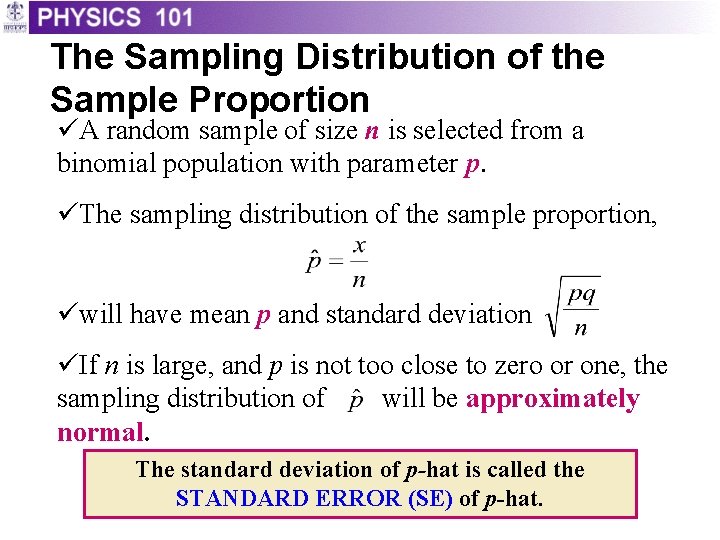
The Sampling Distribution of the Sample Proportion üA random sample of size n is selected from a binomial population with parameter p. üThe sampling distribution of the sample proportion, üwill have mean p and standard deviation üIf n is large, and p is not too close to zero or one, the sampling distribution of will be approximately normal. The standard deviation of p-hat is called the STANDARD ERROR (SE) of p-hat.
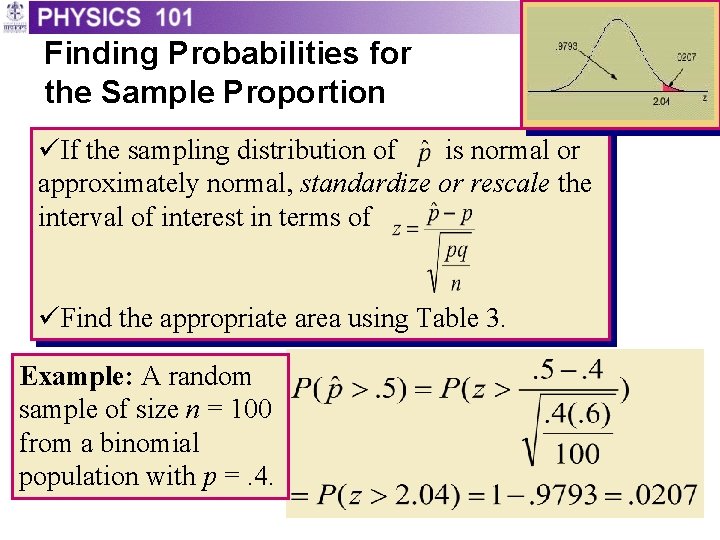
Finding Probabilities for the Sample Proportion üIf the sampling distribution of is normal or approximately normal, standardize or rescale the interval of interest in terms of üFind the appropriate area using Table 3. Example: A random sample of size n = 100 from a binomial population with p =. 4.
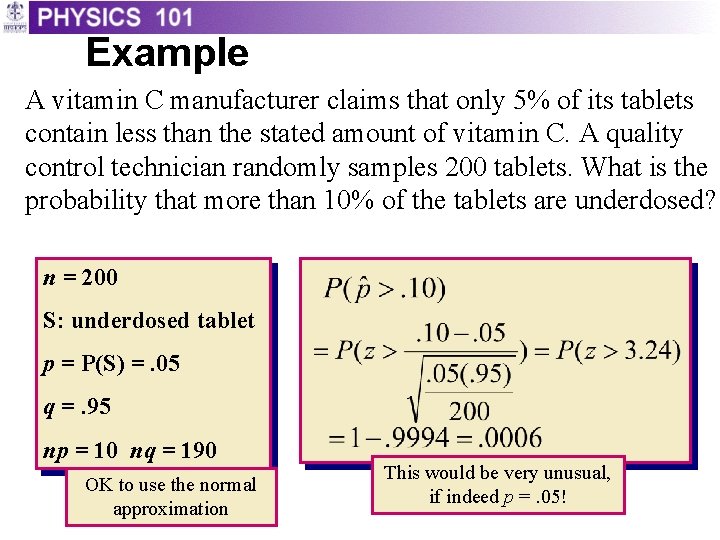
Example A vitamin C manufacturer claims that only 5% of its tablets contain less than the stated amount of vitamin C. A quality control technician randomly samples 200 tablets. What is the probability that more than 10% of the tablets are underdosed? n = 200 S: underdosed tablet p = P(S) =. 05 q =. 95 np = 10 nq = 190 OK to use the normal approximation This would be very unusual, if indeed p =. 05!
Statistical Process Control l. The cause of a change in the variable is said to be assignable if it can be found and corrected. l. Other variation that is not controlled is regarded as random variation. l. If the variation in a process variable is solely random, the process is said to be in control. l. If out of control, we must reduce the variation and get the measurements of the process variable within specified limits.
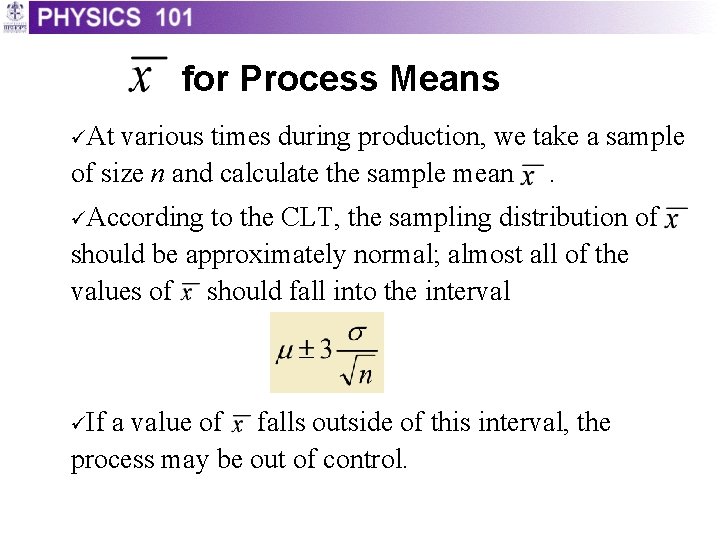
for Process Means üAt various times during production, we take a sample of size n and calculate the sample mean. üAccording to the CLT, the sampling distribution of should be approximately normal; almost all of the values of should fall into the interval üIf a value of falls outside of this interval, the process may be out of control.
Key Concepts I. Sampling Plans and Experimental Designs 1. Simple random sampling a. Each possible sample is equally likely to occur. b. Use a computer or a table of random numbers. c. Problems are nonresponse, undercoverage, and wording bias. 2. Other sampling plans involving randomization a. Stratified random sampling b. Cluster sampling c. Systematic 1 -in-k sampling
Key Concepts 3. Nonrandom sampling a. Convenience sampling b. Judgment sampling c. Quota sampling II. Statistics and Sampling Distributions 1. Sampling distributions describe the possible values of a statistic and how often they occur in repeated sampling. 2. Sampling distributions can be derived mathematically, approximated empirically, or found using statistical theorems. 3. The Central Limit Theorem states that sums and averages of measurements from a nonnormal population with finite mean m and standard deviation s have approximately normal distributions for large samples of size n.
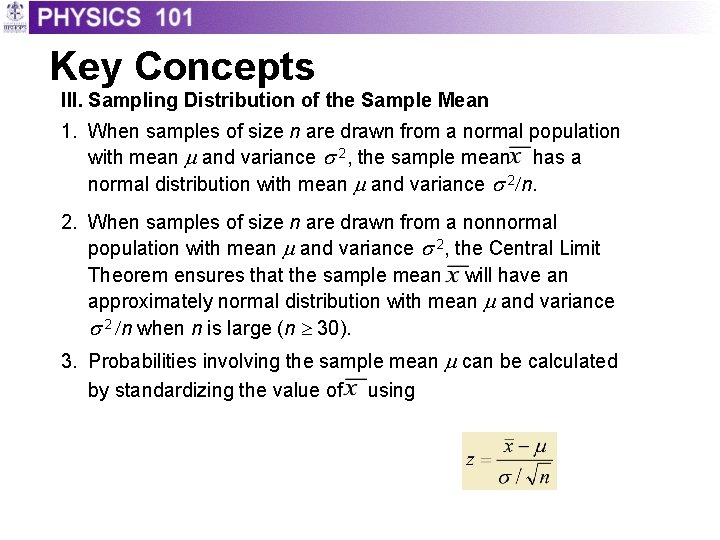
Key Concepts III. Sampling Distribution of the Sample Mean 1. When samples of size n are drawn from a normal population with mean m and variance s 2, the sample mean has a normal distribution with mean m and variance s 2/n. 2. When samples of size n are drawn from a nonnormal population with mean m and variance s 2, the Central Limit Theorem ensures that the sample mean will have an approximately normal distribution with mean m and variance s 2 /n when n is large (n ³ 30). 3. Probabilities involving the sample mean m can be calculated by standardizing the value of using
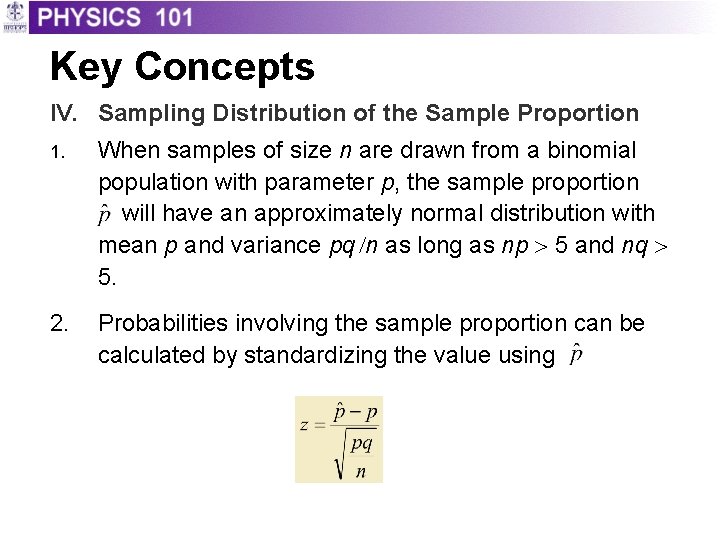
Key Concepts IV. Sampling Distribution of the Sample Proportion 1. When samples of size n are drawn from a binomial population with parameter p, the sample proportion will have an approximately normal distribution with mean p and variance pq /n as long as np > 5 and nq > 5. 2. Probabilities involving the sample proportion can be calculated by standardizing the value using
- Slides: 27