
Chapter 7 Sampling Distributions Copyright 2016 Pearson Education
Chapter 7 Sampling Distributions Copyright © 2016 Pearson Education, Ltd. Chapter 7, Slide 1
Objectives In this chapter, you learn: n n n The concept of the sampling distribution To compute probabilities related to the sample mean and the sample proportion The importance of the Central Limit Theorem Copyright © 2016 Pearson Education, Ltd. Chapter 7, Slide 2
Sampling Distributions DCOVA n n A sampling distribution is a distribution of all of the possible values of a sample statistic for a given sample size selected from a population. For example, suppose you sample 50 students from your college regarding their mean GPA. If you obtained many different samples of size 50, you will compute a different mean for each sample. We are interested in the distribution of all potential mean GPAs we might calculate for any sample of 50 students. Copyright © 2016 Pearson Education, Ltd. Chapter 7, Slide 3
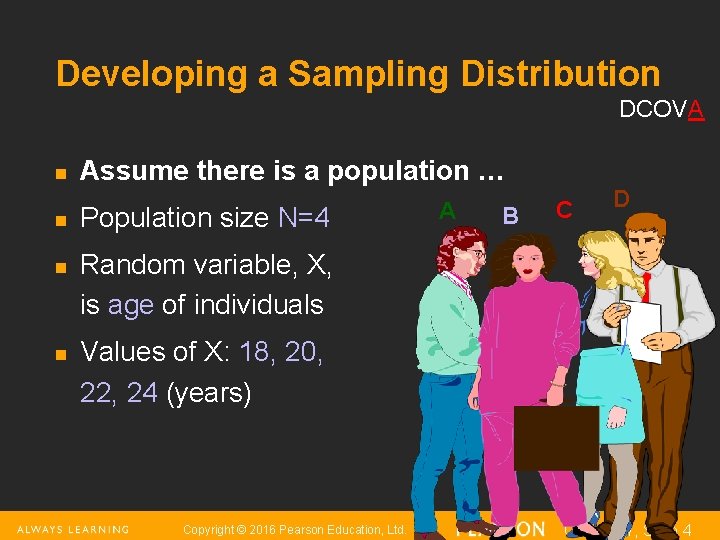
Developing a Sampling Distribution DCOVA n n Assume there is a population … Population size N=4 A B C D Random variable, X, is age of individuals Values of X: 18, 20, 22, 24 (years) Copyright © 2016 Pearson Education, Ltd. Chapter 7, Slide 4
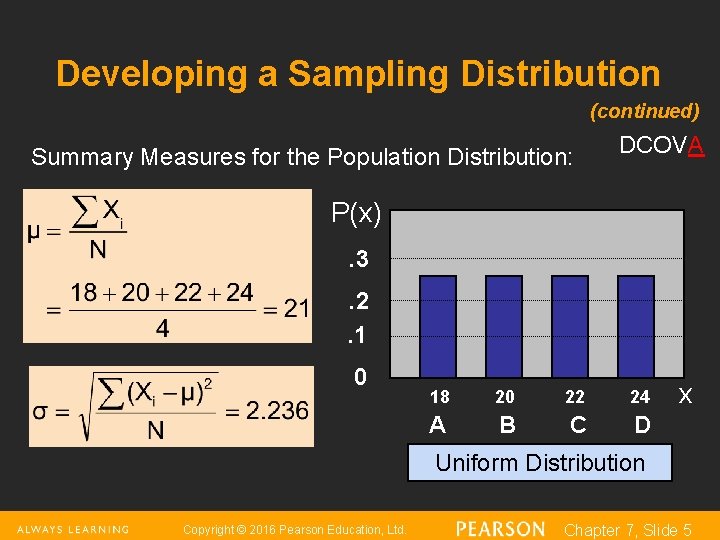
Developing a Sampling Distribution (continued) Summary Measures for the Population Distribution: DCOVA P(x). 3. 2. 1 0 18 20 22 24 A B C D x Uniform Distribution Copyright © 2016 Pearson Education, Ltd. Chapter 7, Slide 5
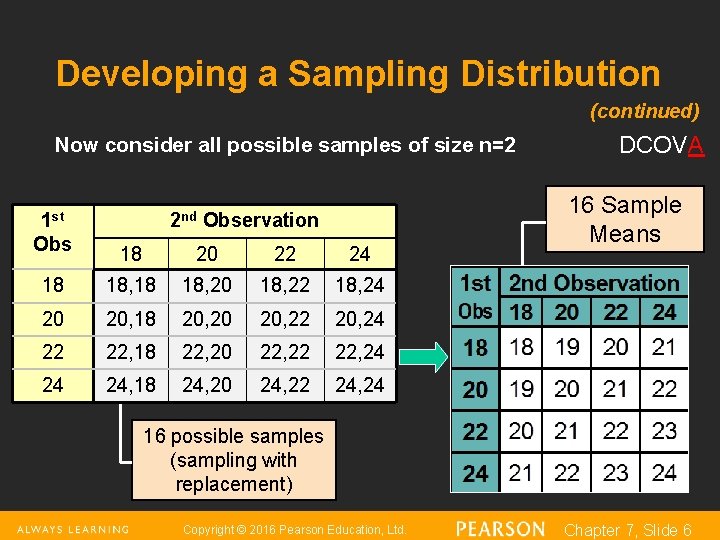
Developing a Sampling Distribution (continued) Now consider all possible samples of size n=2 1 st Obs 2 nd Observation 18 20 22 24 18 18, 20 18, 22 18, 24 20 20, 18 20, 20 20, 22 20, 24 22 22, 18 22, 20 22, 22 22, 24 24 24, 18 24, 20 24, 22 24, 24 DCOVA 16 Sample Means 16 possible samples (sampling with replacement) Copyright © 2016 Pearson Education, Ltd. Chapter 7, Slide 6
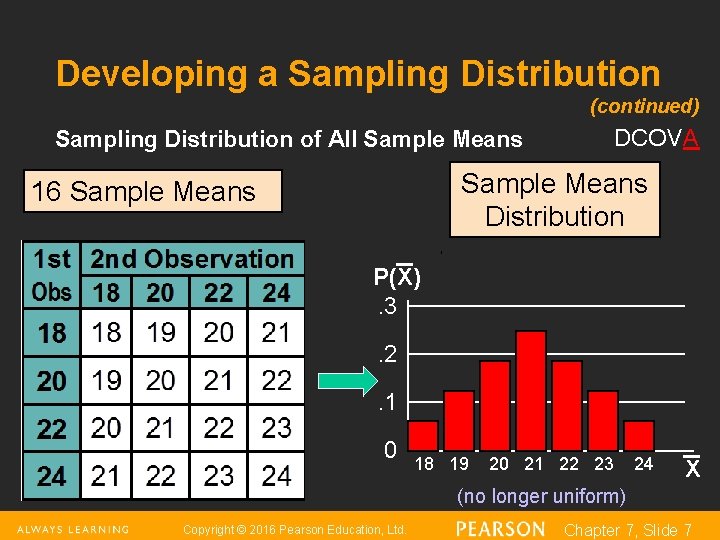
Developing a Sampling Distribution (continued) DCOVA Sampling Distribution of All Sample Means Distribution 16 Sample Means _ P(X). 3. 2. 1 0 18 19 20 21 22 23 24 _ X (no longer uniform) Copyright © 2016 Pearson Education, Ltd. Chapter 7, Slide 7
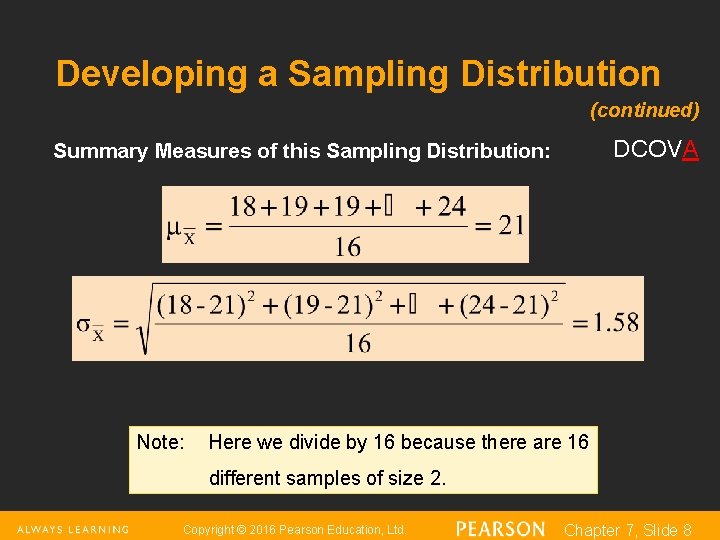
Developing a Sampling Distribution (continued) DCOVA Summary Measures of this Sampling Distribution: Note: Here we divide by 16 because there are 16 different samples of size 2. Copyright © 2016 Pearson Education, Ltd. Chapter 7, Slide 8
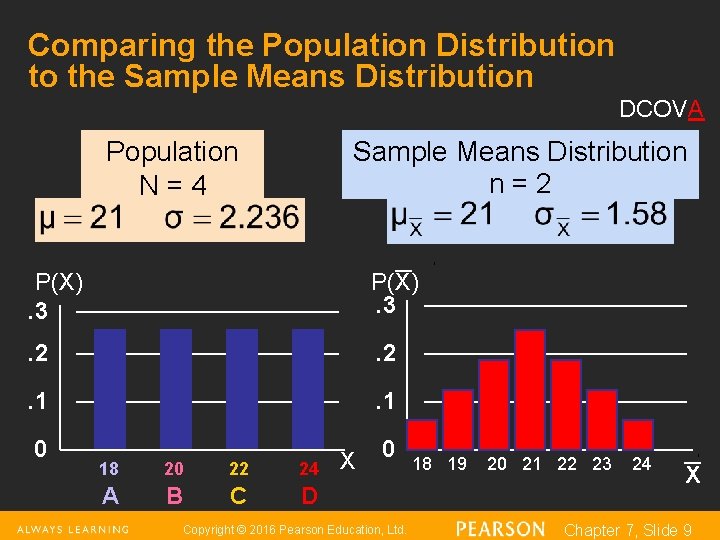
Comparing the Population Distribution to the Sample Means Distribution DCOVA Population N=4 Sample Means Distribution n=2 _ P(X). 3 . 2 . 1 0 18 20 22 24 A B C D X 0 Copyright © 2016 Pearson Education, Ltd. 18 19 20 21 22 23 24 _ X Chapter 7, Slide 9
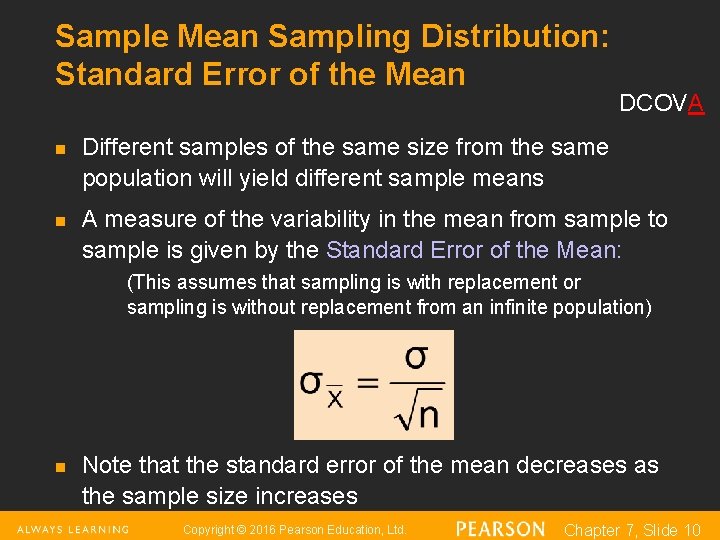
Sample Mean Sampling Distribution: Standard Error of the Mean n n DCOVA Different samples of the same size from the same population will yield different sample means A measure of the variability in the mean from sample to sample is given by the Standard Error of the Mean: (This assumes that sampling is with replacement or sampling is without replacement from an infinite population) n Note that the standard error of the mean decreases as the sample size increases Copyright © 2016 Pearson Education, Ltd. Chapter 7, Slide 10
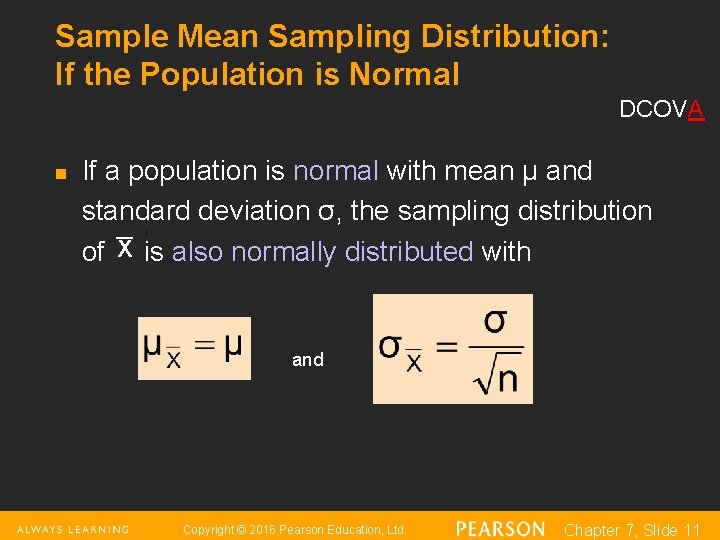
Sample Mean Sampling Distribution: If the Population is Normal DCOVA n If a population is normal with mean μ and standard deviation σ, the sampling distribution _ of X is also normally distributed with and Copyright © 2016 Pearson Education, Ltd. Chapter 7, Slide 11
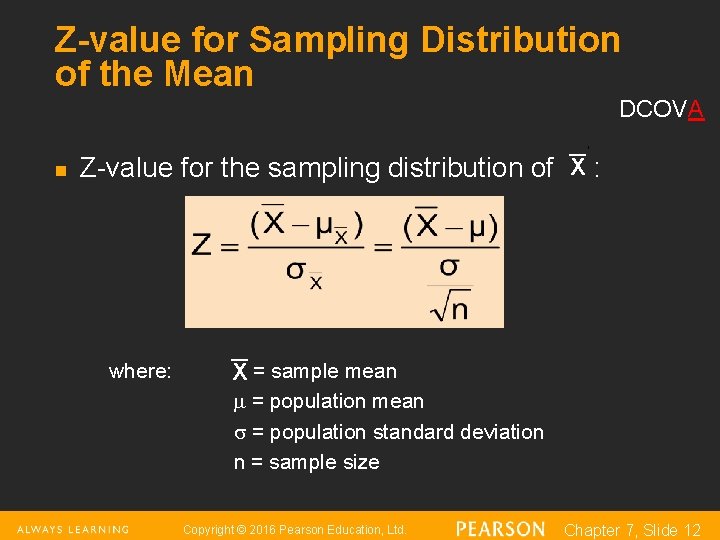
Z-value for Sampling Distribution of the Mean DCOVA _ n Z-value for the sampling distribution of X : where: _ X = sample mean = population standard deviation n = sample size Copyright © 2016 Pearson Education, Ltd. Chapter 7, Slide 12
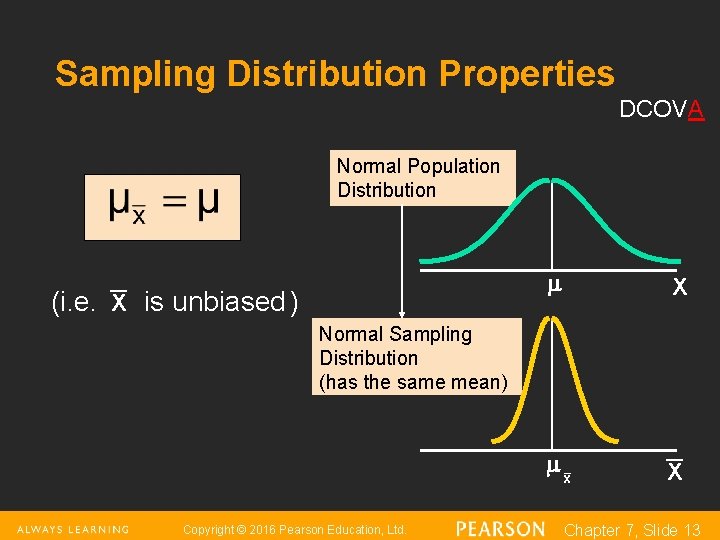
Sampling Distribution Properties DCOVA Normal Population Distribution _ (i. e. X is unbiased ) X Normal Sampling Distribution (has the same mean) _X Copyright © 2016 Pearson Education, Ltd. _ X Chapter 7, Slide 13
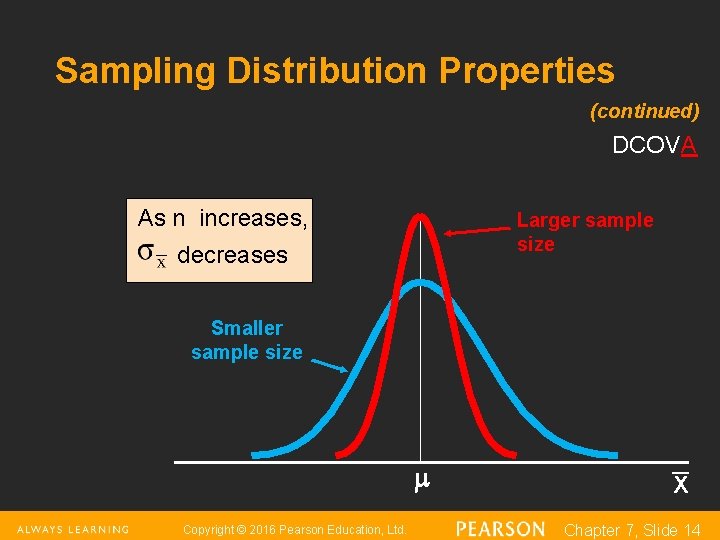
Sampling Distribution Properties (continued) DCOVA As n increases, Larger sample size decreases Smaller sample size Copyright © 2016 Pearson Education, Ltd. _ X Chapter 7, Slide 14
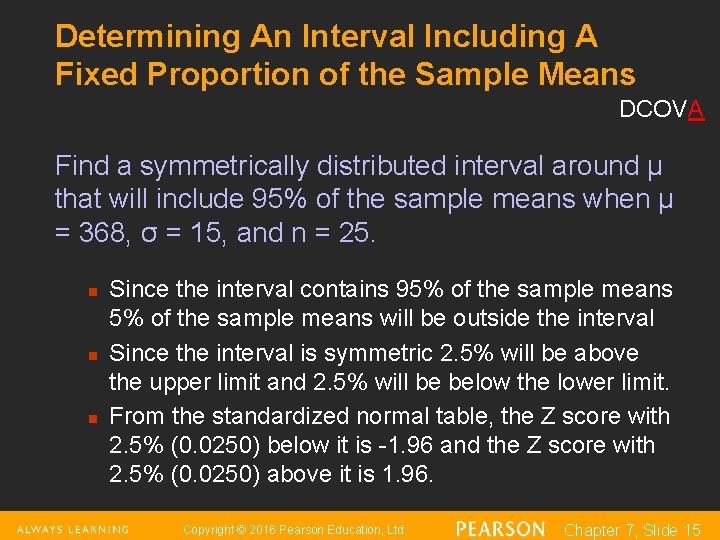
Determining An Interval Including A Fixed Proportion of the Sample Means DCOVA Find a symmetrically distributed interval around µ that will include 95% of the sample means when µ = 368, σ = 15, and n = 25. n n n Since the interval contains 95% of the sample means will be outside the interval Since the interval is symmetric 2. 5% will be above the upper limit and 2. 5% will be below the lower limit. From the standardized normal table, the Z score with 2. 5% (0. 0250) below it is -1. 96 and the Z score with 2. 5% (0. 0250) above it is 1. 96. Copyright © 2016 Pearson Education, Ltd. Chapter 7, Slide 15
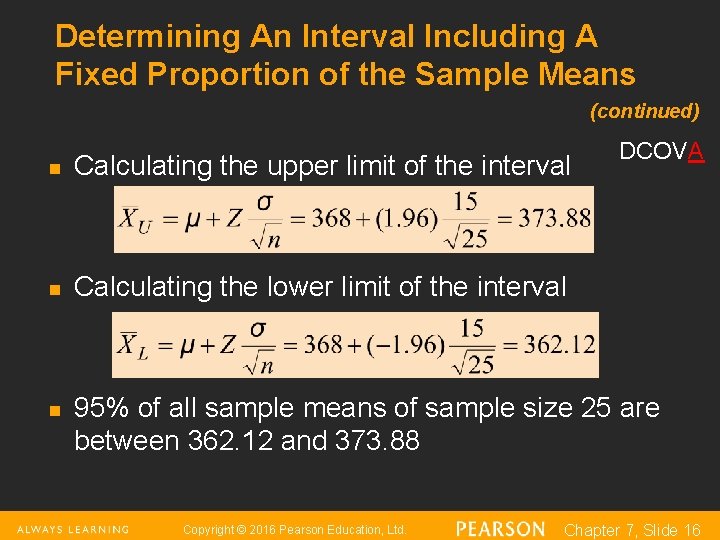
Determining An Interval Including A Fixed Proportion of the Sample Means (continued) n Calculating the upper limit of the interval n Calculating the lower limit of the interval n DCOVA 95% of all sample means of sample size 25 are between 362. 12 and 373. 88 Copyright © 2016 Pearson Education, Ltd. Chapter 7, Slide 16
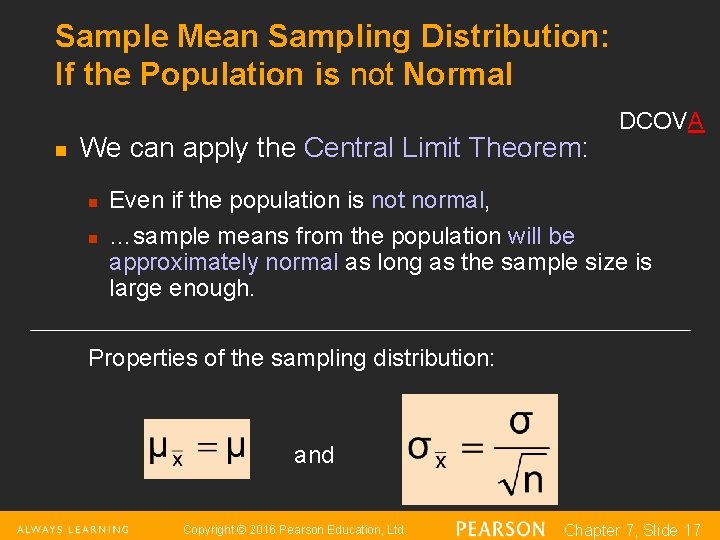
Sample Mean Sampling Distribution: If the Population is not Normal n We can apply the Central Limit Theorem: n n DCOVA Even if the population is not normal, …sample means from the population will be approximately normal as long as the sample size is large enough. Properties of the sampling distribution: and Copyright © 2016 Pearson Education, Ltd. Chapter 7, Slide 17
Central Limit Theorem As the sample size gets large enough… n↑ DCOVA the sampling distribution of the sample mean becomes almost normal regardless of shape of population _ X Copyright © 2016 Pearson Education, Ltd. Chapter 7, Slide 18
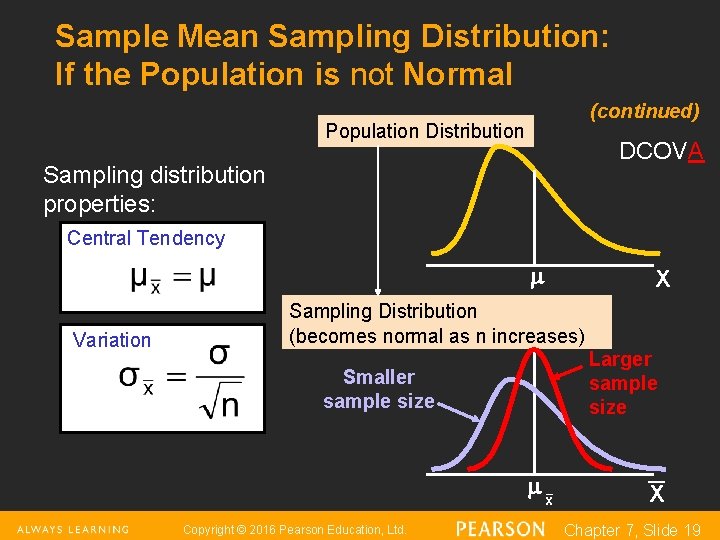
Sample Mean Sampling Distribution: If the Population is not Normal (continued) Population Distribution DCOVA Sampling distribution properties: Central Tendency Variation X Sampling Distribution (becomes normal as n increases) Larger sample size Smaller sample size _X Copyright © 2016 Pearson Education, Ltd. _ X Chapter 7, Slide 19
How Large is Large Enough? DCOVA n n n For most distributions, n > 30 will give a sampling distribution that is nearly normal For fairly symmetric distributions, n > 15 For a normal population distribution, the sampling distribution of the mean is always normally distributed Copyright © 2016 Pearson Education, Ltd. Chapter 7, Slide 20
Example DCOVA n n Suppose a population has mean μ = 8 and standard deviation σ = 3. Suppose a random sample of size n = 36 is selected. What is the probability that the sample mean is between 7. 8 and 8. 2? Copyright © 2016 Pearson Education, Ltd. Chapter 7, Slide 21
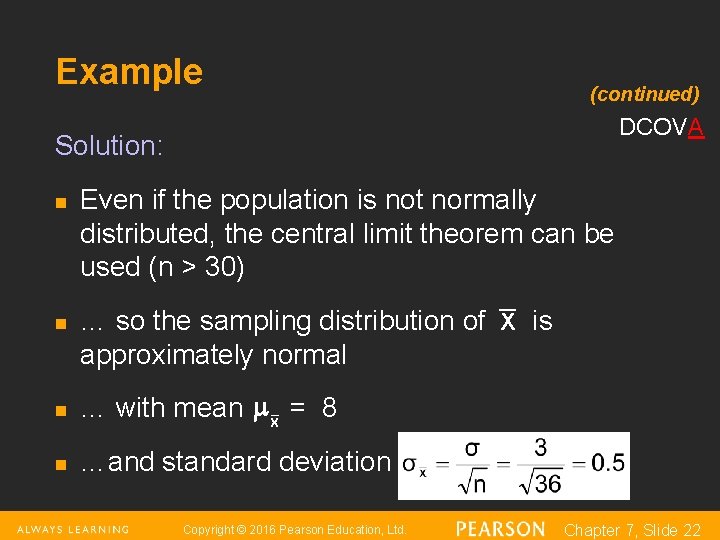
Example (continued) DCOVA Solution: n n Even if the population is not normally distributed, the central limit theorem can be used (n > 30) _ … so the sampling distribution of X is approximately normal n … with mean _X = 8 n …and standard deviation Copyright © 2016 Pearson Education, Ltd. Chapter 7, Slide 22
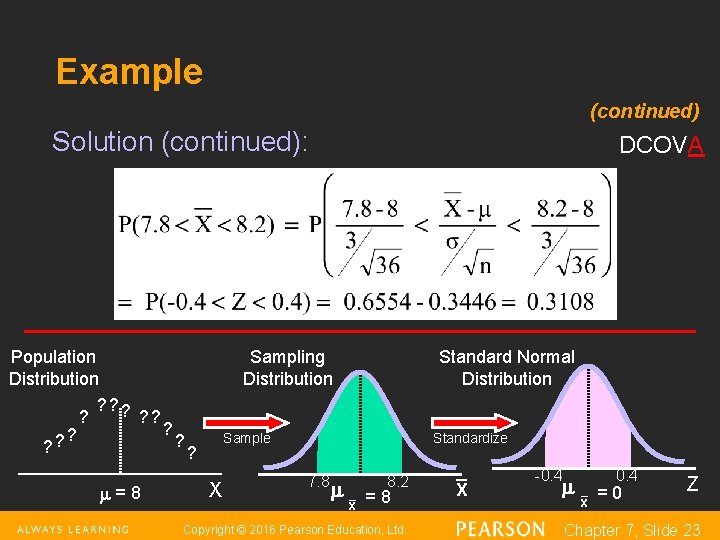
Example (continued) Solution (continued): Population Distribution ? ? ? =8 DCOVA Sampling Distribution Standard Normal Distribution Sample ? X Standardize 7. 8 _ X 8. 2 =8 Copyright © 2016 Pearson Education, Ltd. _ X -0. 4 _ X 0. 4 =0 Z Chapter 7, Slide 23
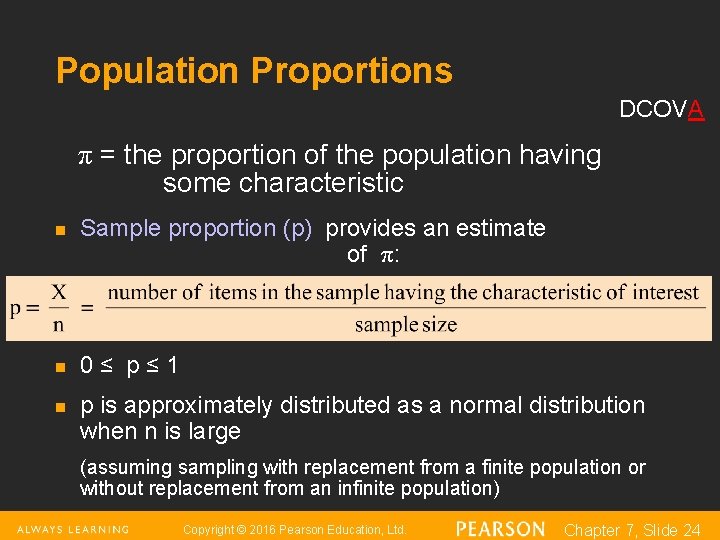
Population Proportions DCOVA π = the proportion of the population having some characteristic n n n Sample proportion (p) provides an estimate of π: 0≤ p≤ 1 p is approximately distributed as a normal distribution when n is large (assuming sampling with replacement from a finite population or without replacement from an infinite population) Copyright © 2016 Pearson Education, Ltd. Chapter 7, Slide 24
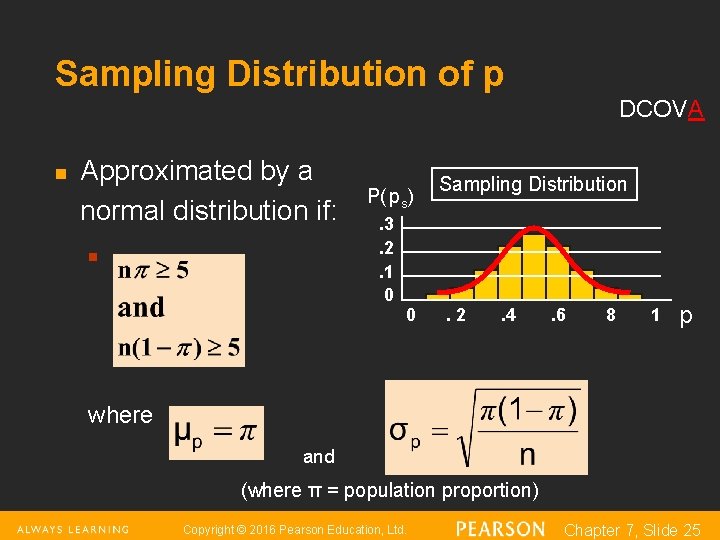
Sampling Distribution of p DCOVA n Approximated by a normal distribution if: n P( ps). 3. 2. 1 0 0 Sampling Distribution . 2 . 4 . 6 8 1 p where and (where π = population proportion) Copyright © 2016 Pearson Education, Ltd. Chapter 7, Slide 25
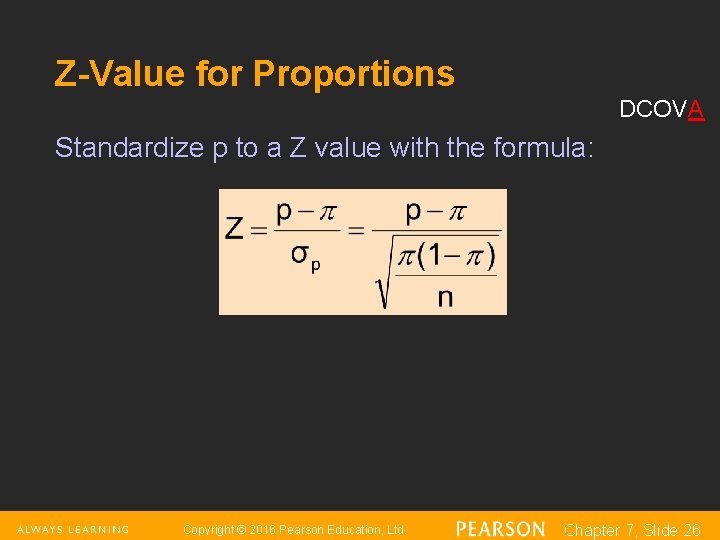
Z-Value for Proportions DCOVA Standardize p to a Z value with the formula: Copyright © 2016 Pearson Education, Ltd. Chapter 7, Slide 26
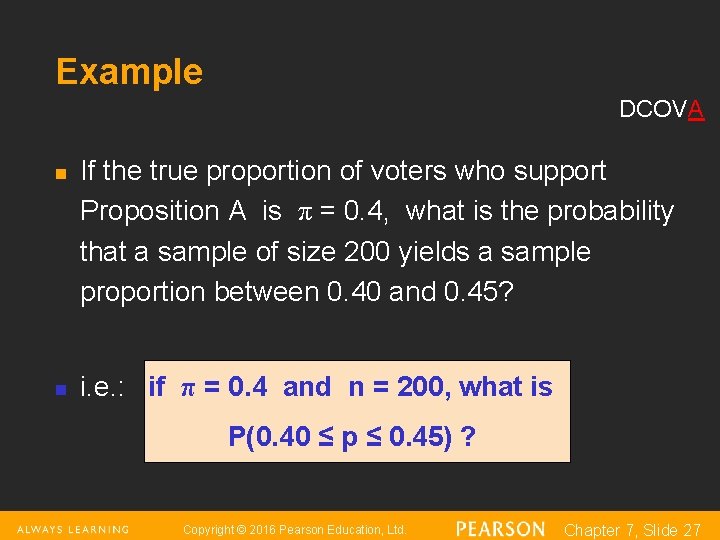
Example DCOVA n n If the true proportion of voters who support Proposition A is π = 0. 4, what is the probability that a sample of size 200 yields a sample proportion between 0. 40 and 0. 45? i. e. : if π = 0. 4 and n = 200, what is P(0. 40 ≤ p ≤ 0. 45) ? Copyright © 2016 Pearson Education, Ltd. Chapter 7, Slide 27
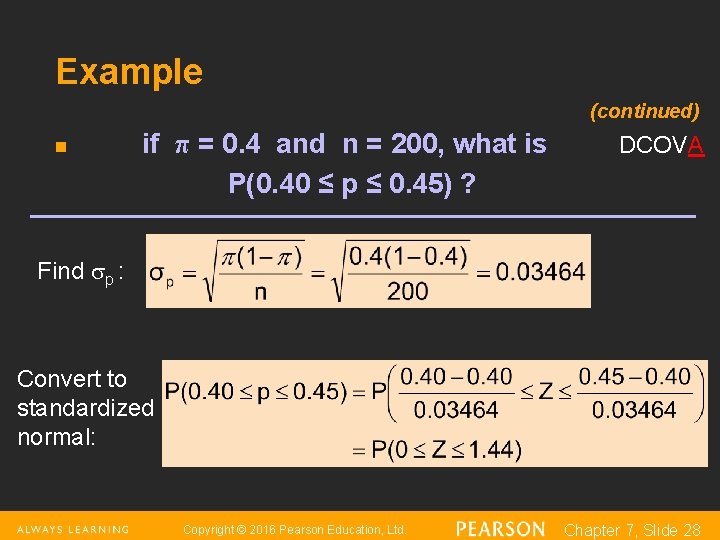
Example (continued) n if π = 0. 4 and n = 200, what is P(0. 40 ≤ p ≤ 0. 45) ? DCOVA Find p : Convert to standardized normal: Copyright © 2016 Pearson Education, Ltd. Chapter 7, Slide 28
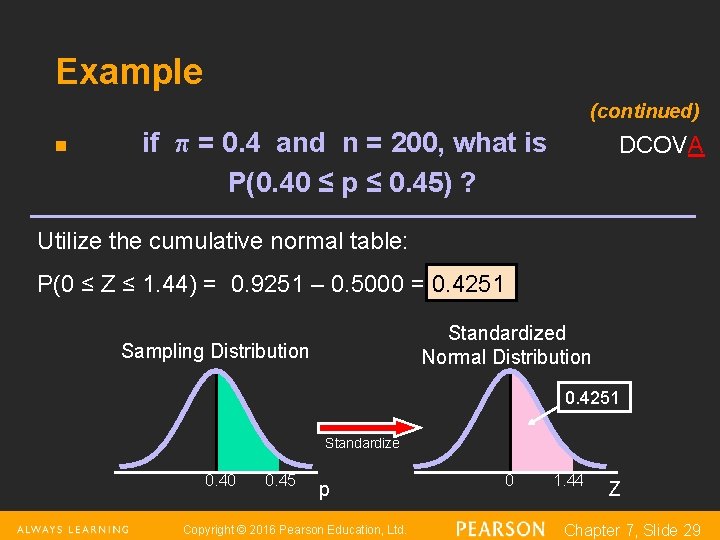
Example (continued) n if π = 0. 4 and n = 200, what is P(0. 40 ≤ p ≤ 0. 45) ? DCOVA Utilize the cumulative normal table: P(0 ≤ Z ≤ 1. 44) = 0. 9251 – 0. 5000 = 0. 4251 Standardized Normal Distribution Sampling Distribution 0. 4251 Standardize 0. 40 0. 45 p Copyright © 2016 Pearson Education, Ltd. 0 1. 44 Z Chapter 7, Slide 29
Chapter Summary In this chapter we discussed: n n n The concept of a sampling distribution Computing probabilities related to the sample mean and the sample proportion The importance of the Central Limit Theorem Copyright © 2016 Pearson Education, Ltd. Chapter 7, Slide 30
- Slides: 30