
Chapter 7 Rotational Motion and The Law of

- Slides: 28
Chapter 7 Rotational Motion and The Law of Gravity
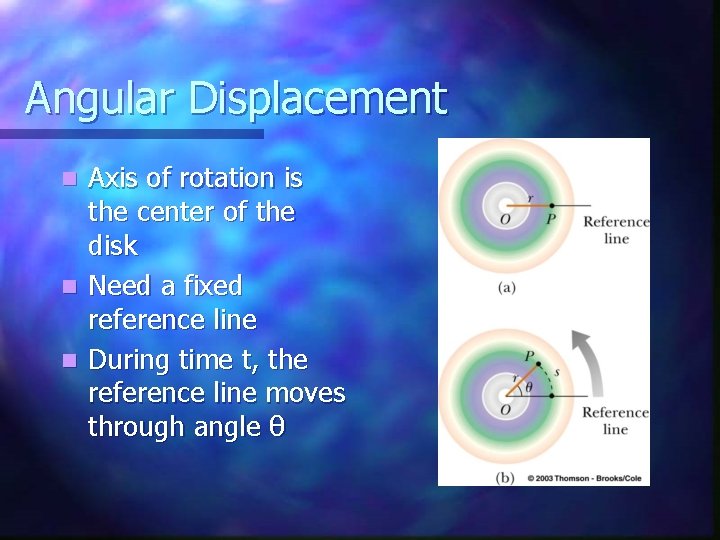
Angular Displacement Axis of rotation is the center of the disk n Need a fixed reference line n During time t, the reference line moves through angle θ n
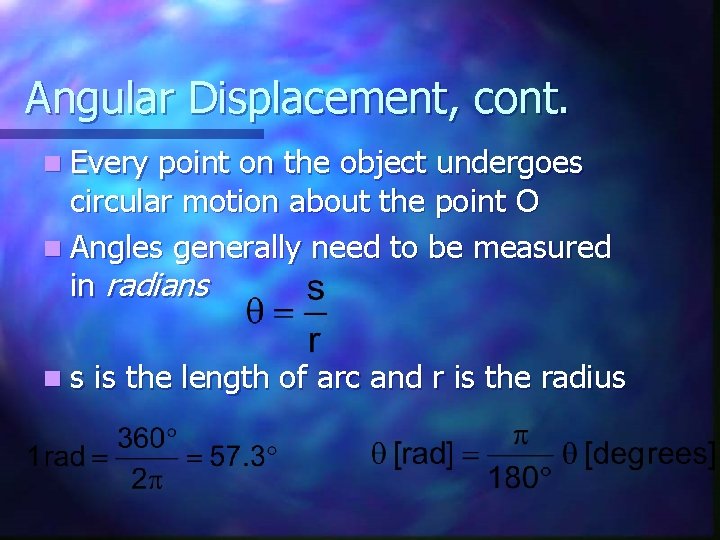
Angular Displacement, cont. n Every point on the object undergoes circular motion about the point O n Angles generally need to be measured in radians ns is the length of arc and r is the radius
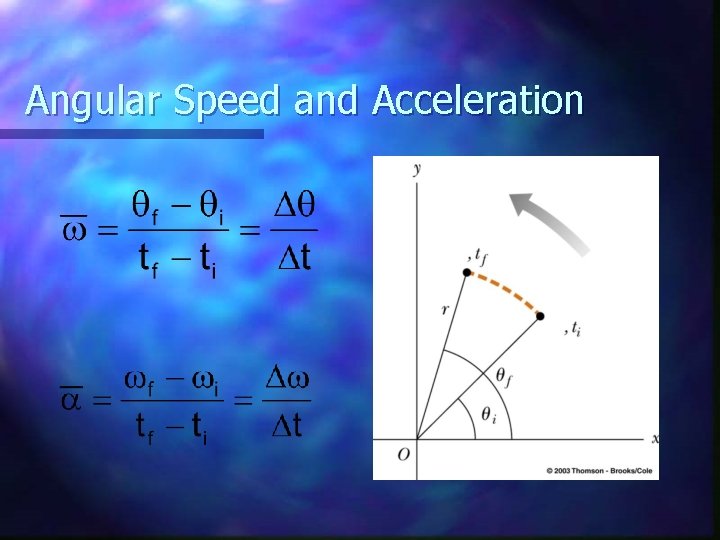
Angular Speed and Acceleration
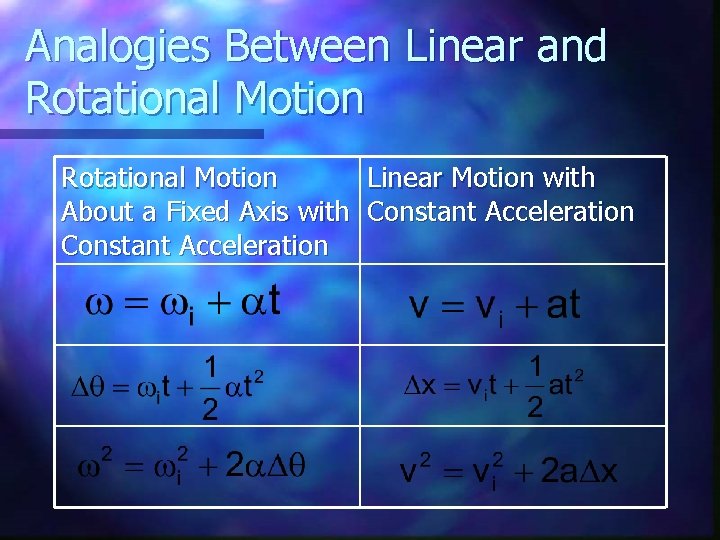
Analogies Between Linear and Rotational Motion Linear Motion with About a Fixed Axis with Constant Acceleration
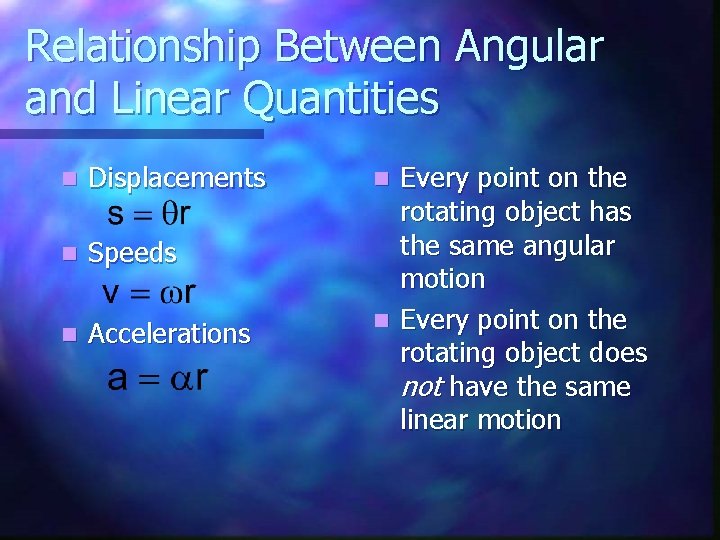
Relationship Between Angular and Linear Quantities n Displacements n Speeds n Accelerations Every point on the rotating object has the same angular motion n Every point on the rotating object does not have the same linear motion n
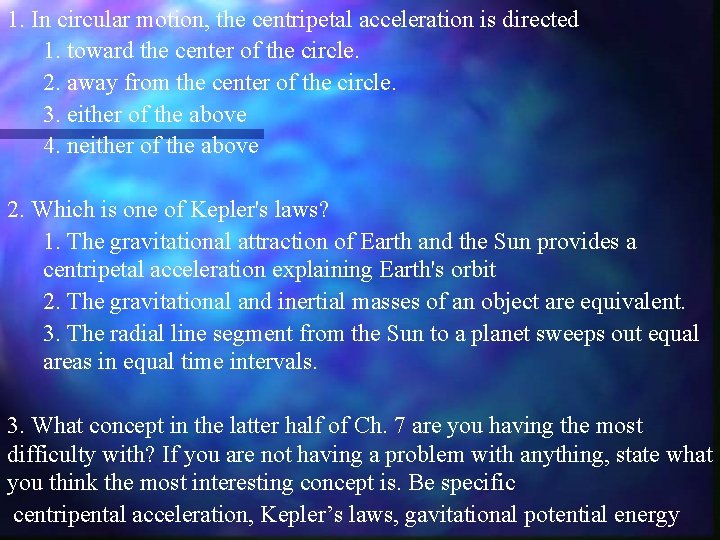
1. In circular motion, the centripetal acceleration is directed 1. toward the center of the circle. 2. away from the center of the circle. 3. either of the above 4. neither of the above 2. Which is one of Kepler's laws? 1. The gravitational attraction of Earth and the Sun provides a centripetal acceleration explaining Earth's orbit 2. The gravitational and inertial masses of an object are equivalent. 3. The radial line segment from the Sun to a planet sweeps out equal areas in equal time intervals. 3. What concept in the latter half of Ch. 7 are you having the most difficulty with? If you are not having a problem with anything, state what you think the most interesting concept is. Be specific centripental acceleration, Kepler’s laws, gavitational potential energy
Centripetal Acceleration n An object traveling in a circle, even though it moves with a constant speed, will have an acceleration due to the change in the direction of the velocity
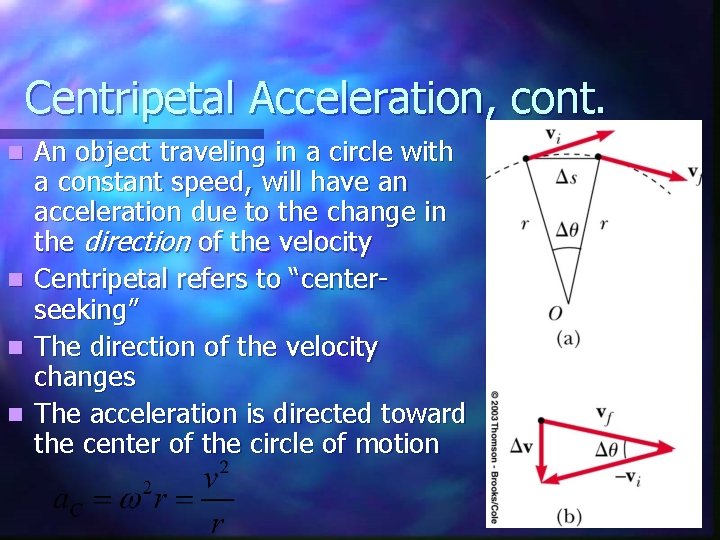
Centripetal Acceleration, cont. n n An object traveling in a circle with a constant speed, will have an acceleration due to the change in the direction of the velocity Centripetal refers to “centerseeking” The direction of the velocity changes The acceleration is directed toward the center of the circle of motion
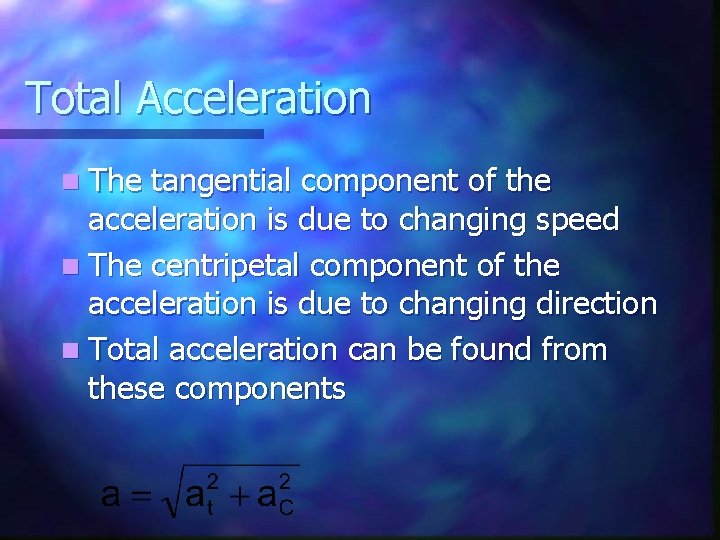
Total Acceleration n The tangential component of the acceleration is due to changing speed n The centripetal component of the acceleration is due to changing direction n Total acceleration can be found from these components
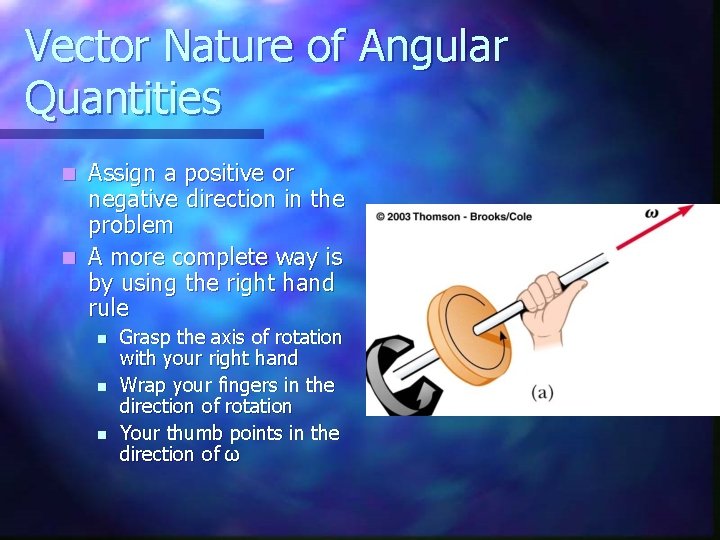
Vector Nature of Angular Quantities Assign a positive or negative direction in the problem n A more complete way is by using the right hand rule n n Grasp the axis of rotation with your right hand Wrap your fingers in the direction of rotation Your thumb points in the direction of ω
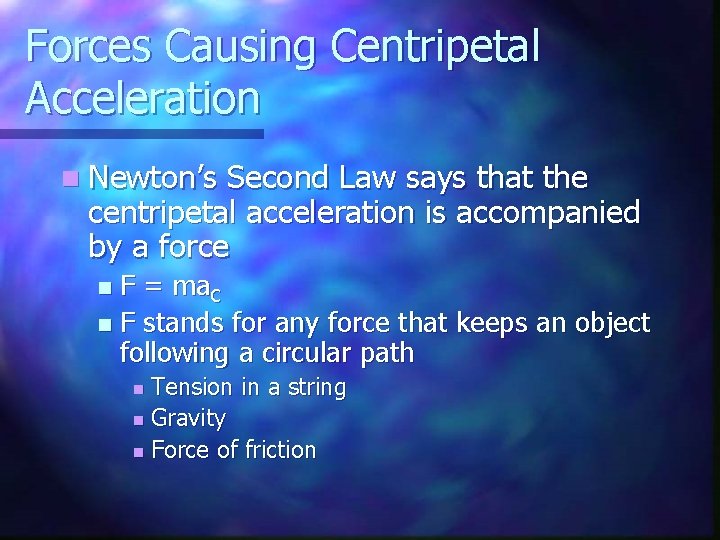
Forces Causing Centripetal Acceleration n Newton’s Second Law says that the centripetal acceleration is accompanied by a force F = ma. C n F stands for any force that keeps an object following a circular path n Tension in a string n Gravity n Force of friction n
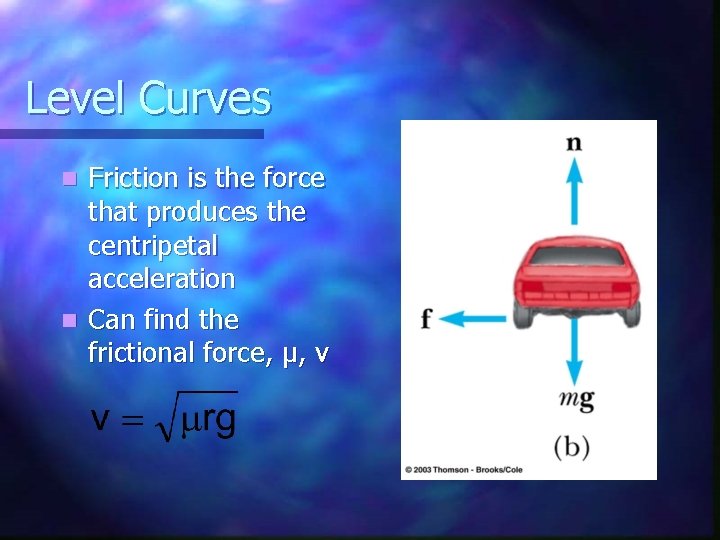
Level Curves Friction is the force that produces the centripetal acceleration n Can find the frictional force, µ, v n
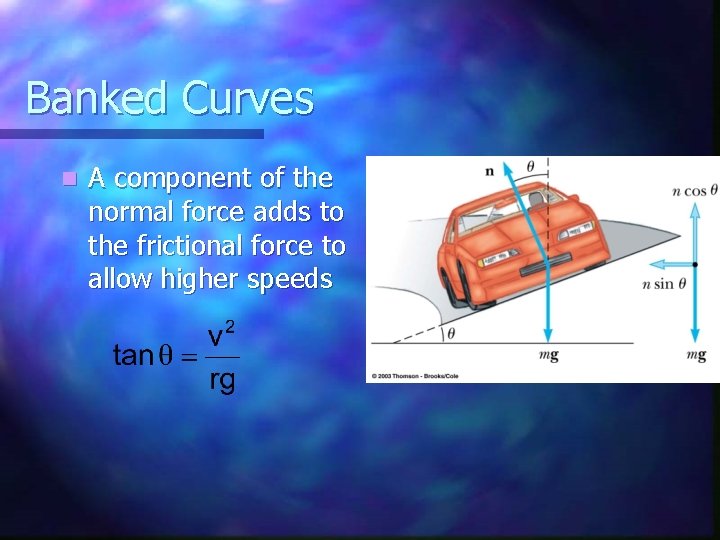
Banked Curves n A component of the normal force adds to the frictional force to allow higher speeds
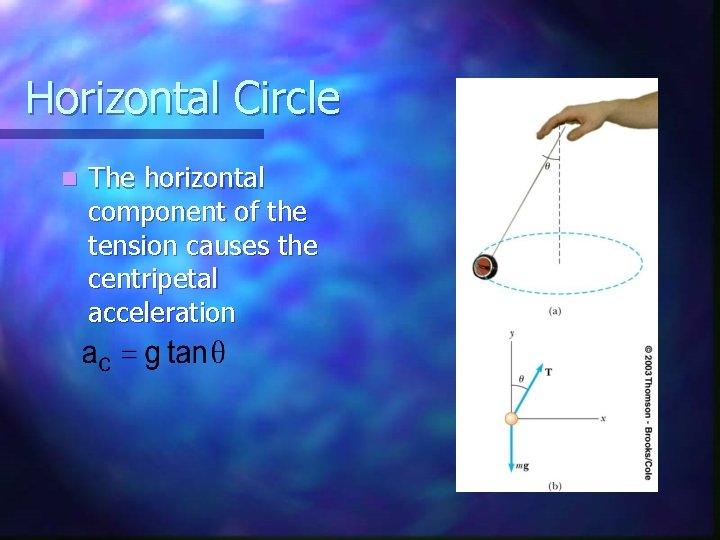
Horizontal Circle n The horizontal component of the tension causes the centripetal acceleration
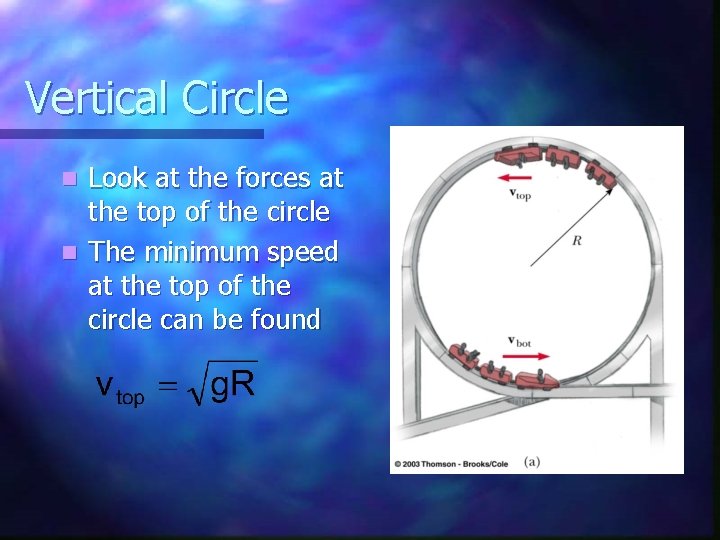
Vertical Circle Look at the forces at the top of the circle n The minimum speed at the top of the circle can be found n
Forces in Accelerating Reference Frames n Distinguish real forces from fictitious forces n Centrifugal force is a fictitious force n Real forces always represent interactions between objects
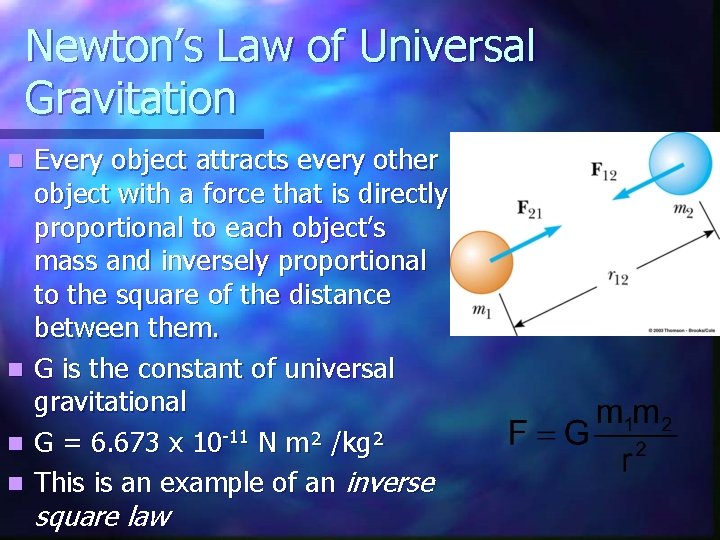
Newton’s Law of Universal Gravitation n n Every object attracts every other object with a force that is directly proportional to each object’s mass and inversely proportional to the square of the distance between them. G is the constant of universal gravitational G = 6. 673 x 10 -11 N m² /kg² This is an example of an inverse square law
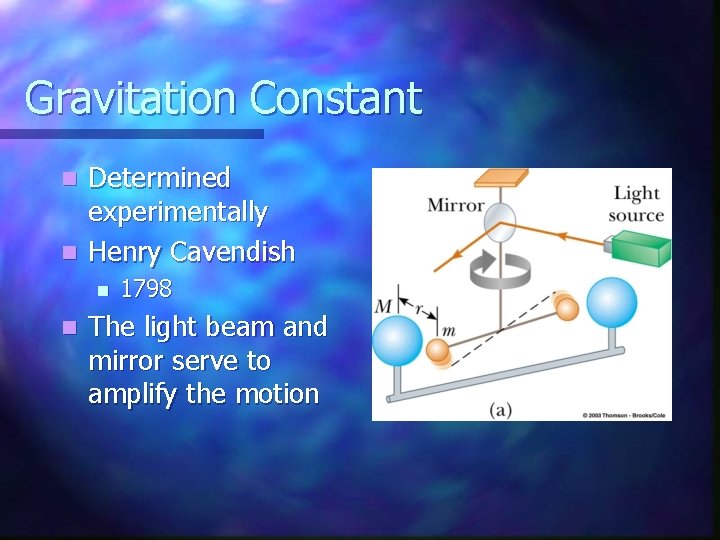
Gravitation Constant Determined experimentally n Henry Cavendish n n n 1798 The light beam and mirror serve to amplify the motion
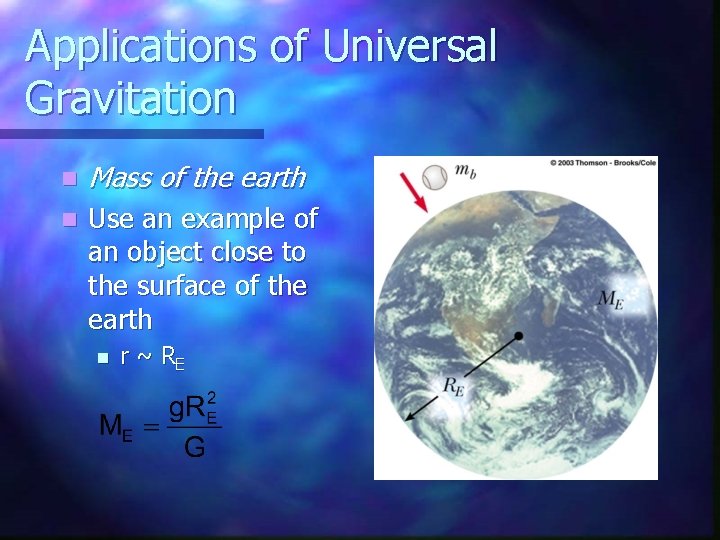
Applications of Universal Gravitation n Mass of the earth n Use an example of an object close to the surface of the earth n r ~ RE
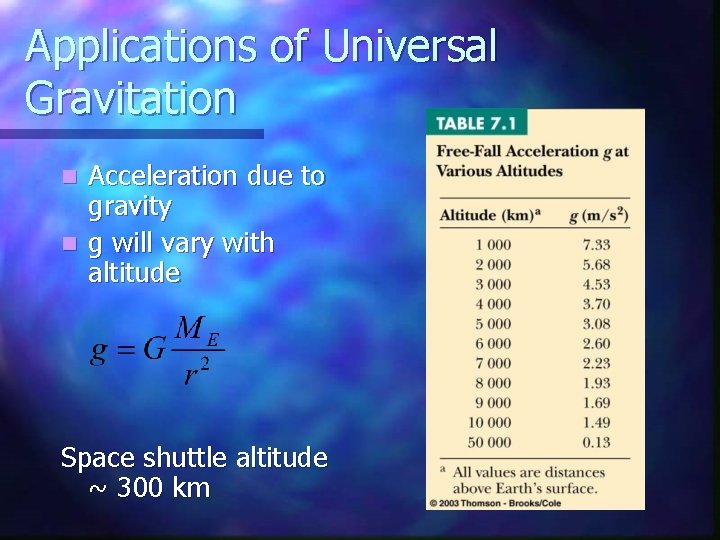
Applications of Universal Gravitation Acceleration due to gravity n g will vary with altitude n Space shuttle altitude ~ 300 km
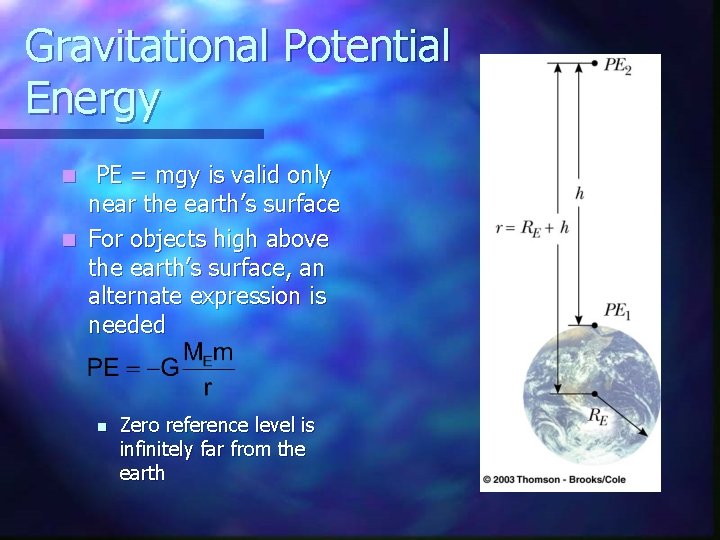
Gravitational Potential Energy PE = mgy is valid only near the earth’s surface n For objects high above the earth’s surface, an alternate expression is needed n n Zero reference level is infinitely far from the earth
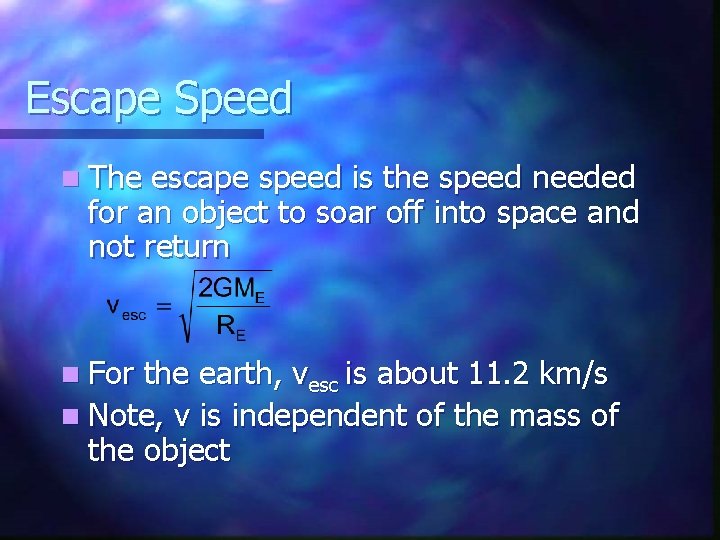
Escape Speed n The escape speed is the speed needed for an object to soar off into space and not return n For the earth, vesc is about 11. 2 km/s n Note, v is independent of the mass of the object
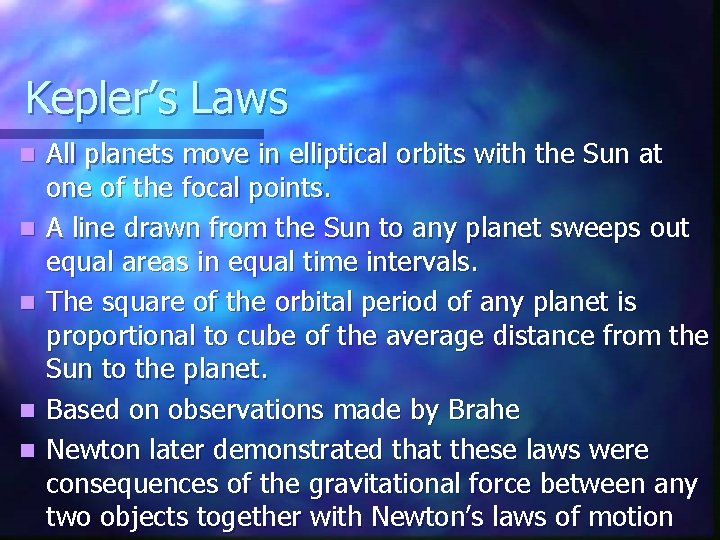
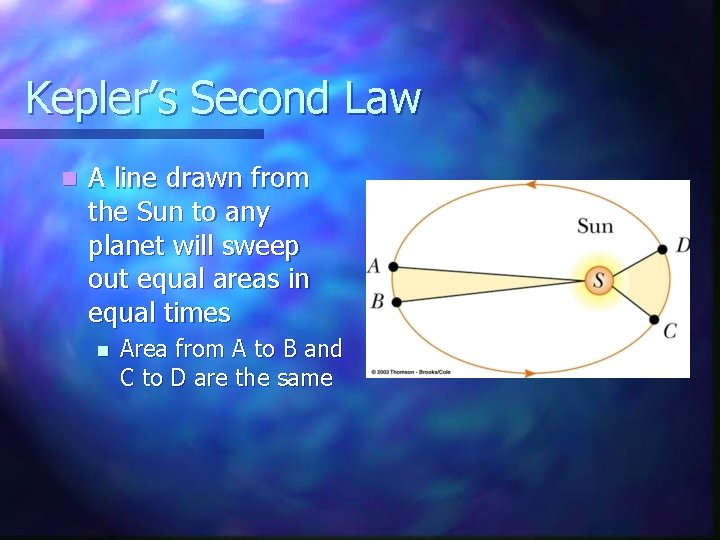
Kepler’s Laws n n n All planets move in elliptical orbits with the Sun at one of the focal points. A line drawn from the Sun to any planet sweeps out equal areas in equal time intervals. The square of the orbital period of any planet is proportional to cube of the average distance from the Sun to the planet. Based on observations made by Brahe Newton later demonstrated that these laws were consequences of the gravitational force between any two objects together with Newton’s laws of motion
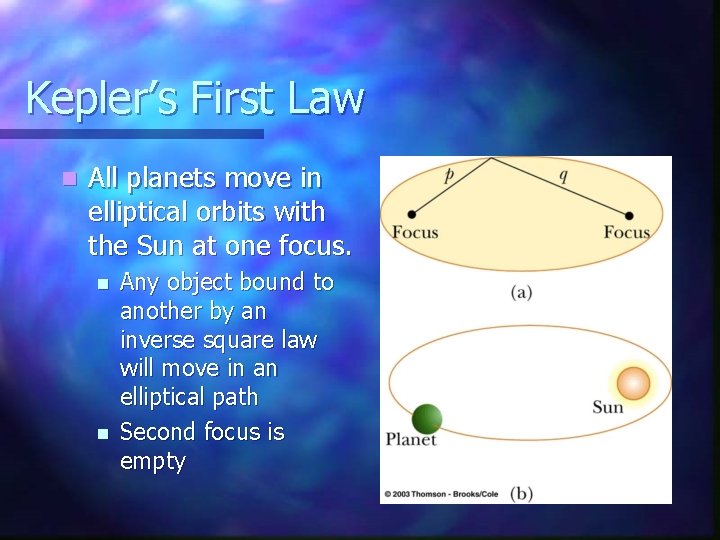
Kepler’s First Law n All planets move in elliptical orbits with the Sun at one focus. n n Any object bound to another by an inverse square law will move in an elliptical path Second focus is empty
Kepler’s Second Law n A line drawn from the Sun to any planet will sweep out equal areas in equal times n Area from A to B and C to D are the same
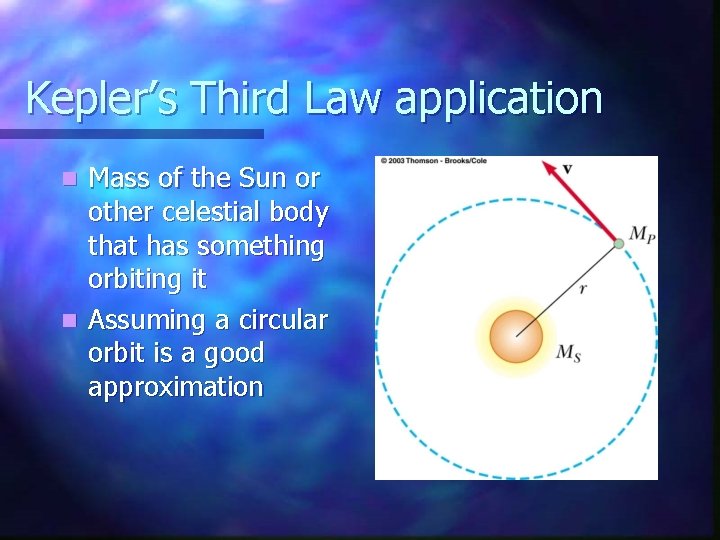
Kepler’s Third Law application Mass of the Sun or other celestial body that has something orbiting it n Assuming a circular orbit is a good approximation n
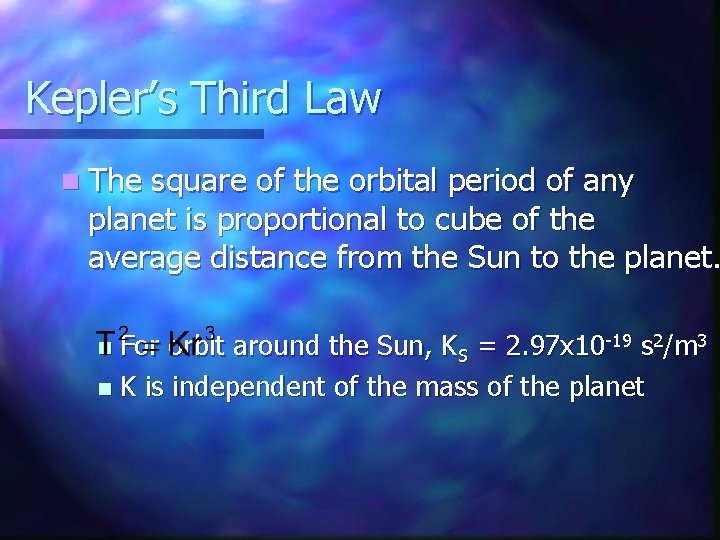
Kepler’s Third Law n The square of the orbital period of any planet is proportional to cube of the average distance from the Sun to the planet. For orbit around the Sun, KS = 2. 97 x 10 -19 s 2/m 3 n K is independent of the mass of the planet n