
Chapter 7 Rotational Motion and The Law of




- Slides: 45
Chapter 7 Rotational Motion and The Law of Gravity
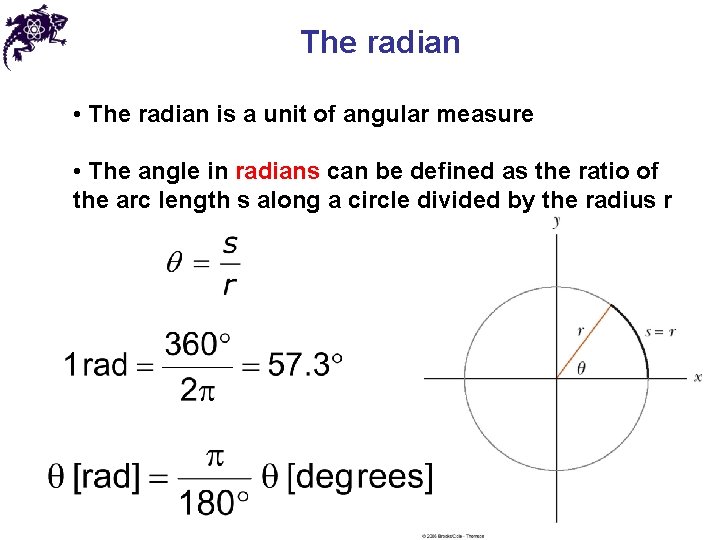
The radian • The radian is a unit of angular measure • The angle in radians can be defined as the ratio of the arc length s along a circle divided by the radius r
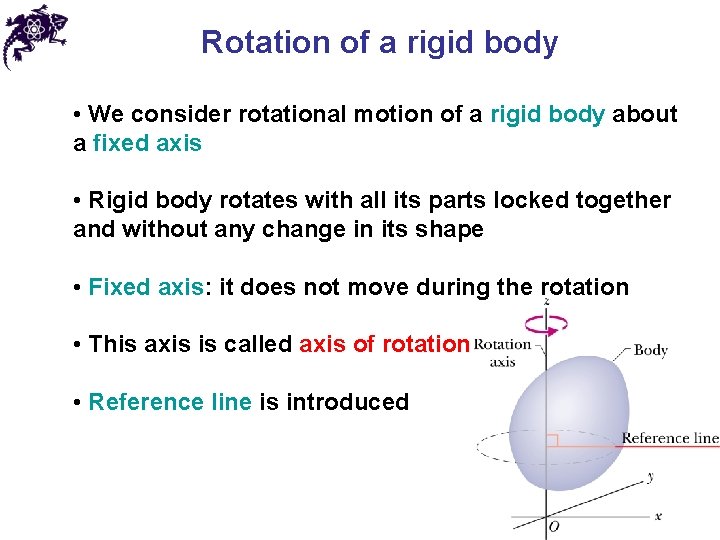
Rotation of a rigid body • We consider rotational motion of a rigid body about a fixed axis • Rigid body rotates with all its parts locked together and without any change in its shape • Fixed axis: it does not move during the rotation • This axis is called axis of rotation • Reference line is introduced
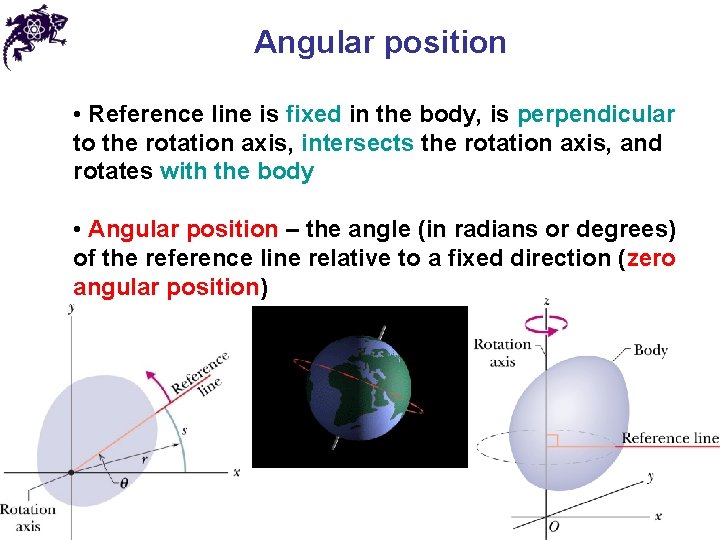
Angular position • Reference line is fixed in the body, is perpendicular to the rotation axis, intersects the rotation axis, and rotates with the body • Angular position – the angle (in radians or degrees) of the reference line relative to a fixed direction (zero angular position)
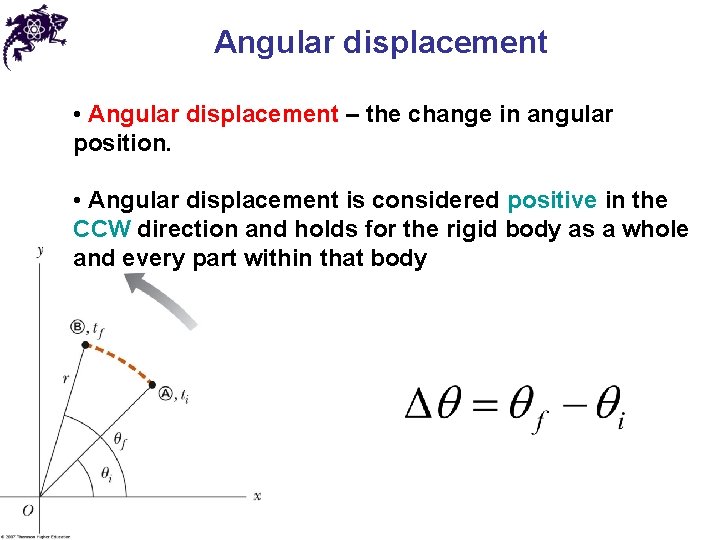
Angular displacement • Angular displacement – the change in angular position. • Angular displacement is considered positive in the CCW direction and holds for the rigid body as a whole and every part within that body
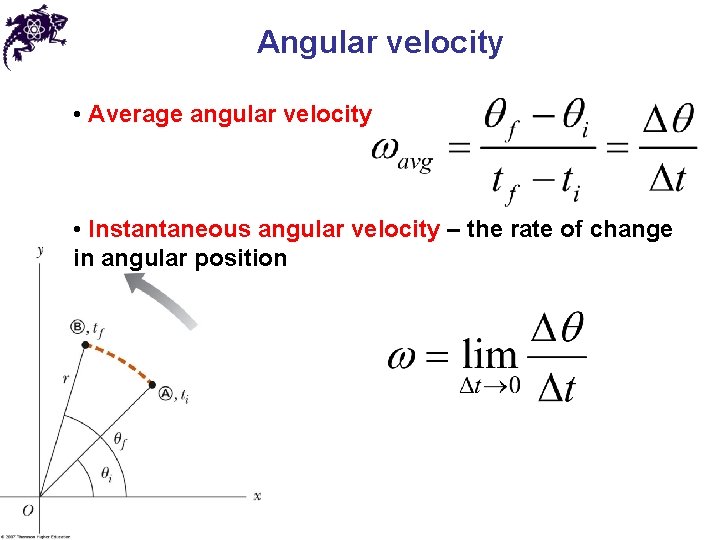
Angular velocity • Average angular velocity • Instantaneous angular velocity – the rate of change in angular position
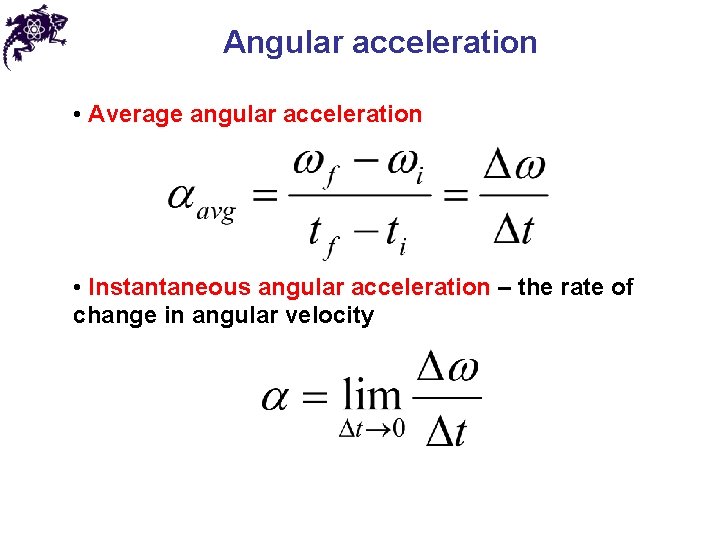
Angular acceleration • Average angular acceleration • Instantaneous angular acceleration – the rate of change in angular velocity
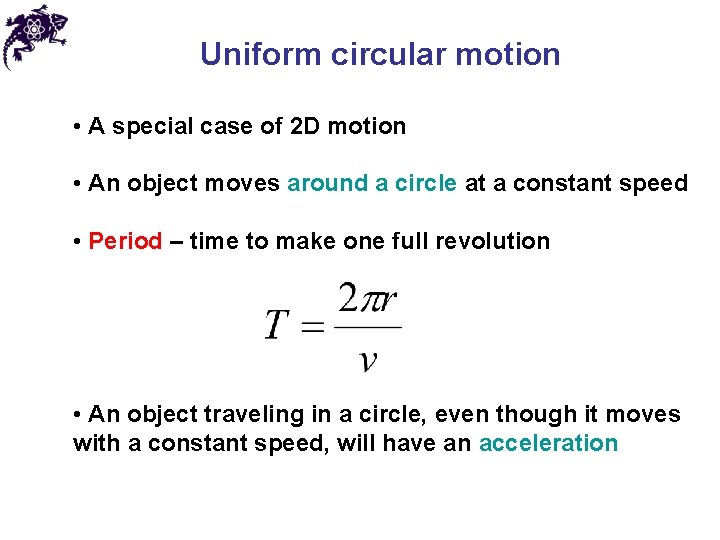
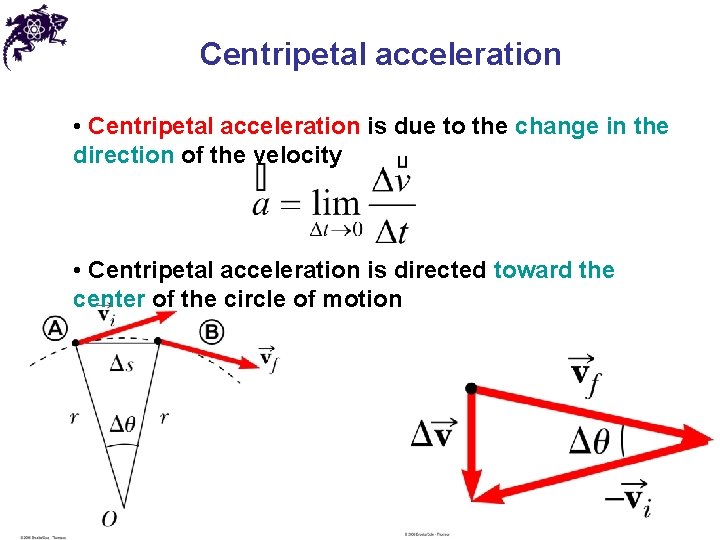
Uniform circular motion • A special case of 2 D motion • An object moves around a circle at a constant speed • Period – time to make one full revolution • An object traveling in a circle, even though it moves with a constant speed, will have an acceleration
Centripetal acceleration • Centripetal acceleration is due to the change in the direction of the velocity • Centripetal acceleration is directed toward the center of the circle of motion
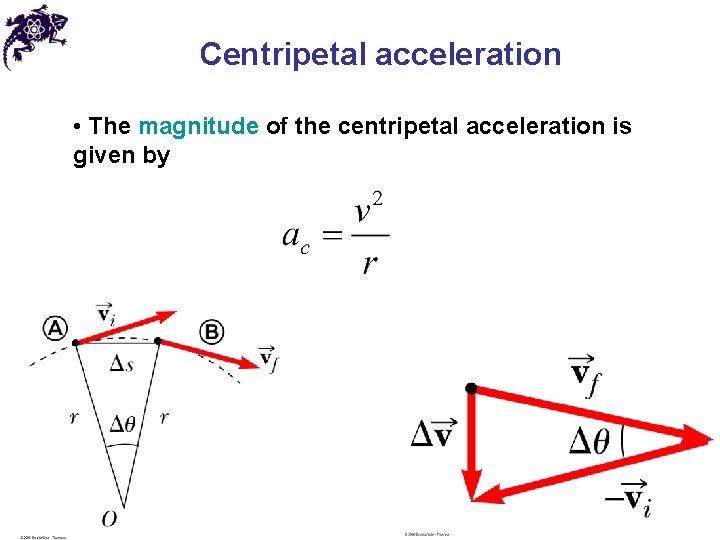
Centripetal acceleration • The magnitude of the centripetal acceleration is given by
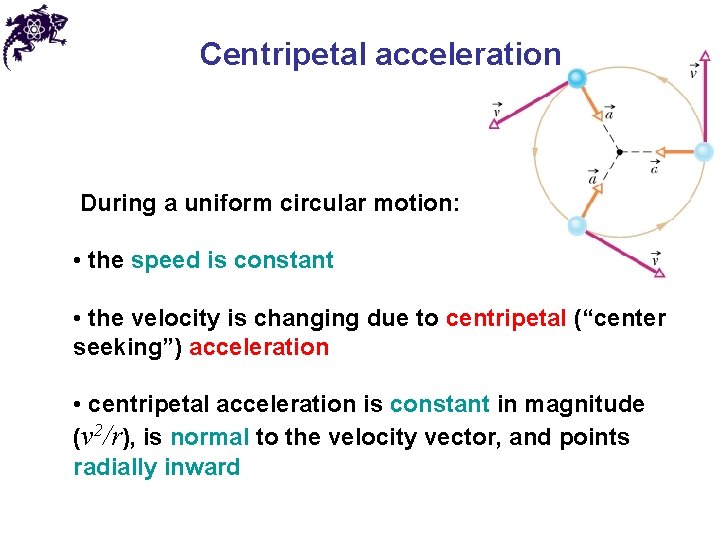
Centripetal acceleration During a uniform circular motion: • the speed is constant • the velocity is changing due to centripetal (“center seeking”) acceleration • centripetal acceleration is constant in magnitude (v 2/r), is normal to the velocity vector, and points radially inward
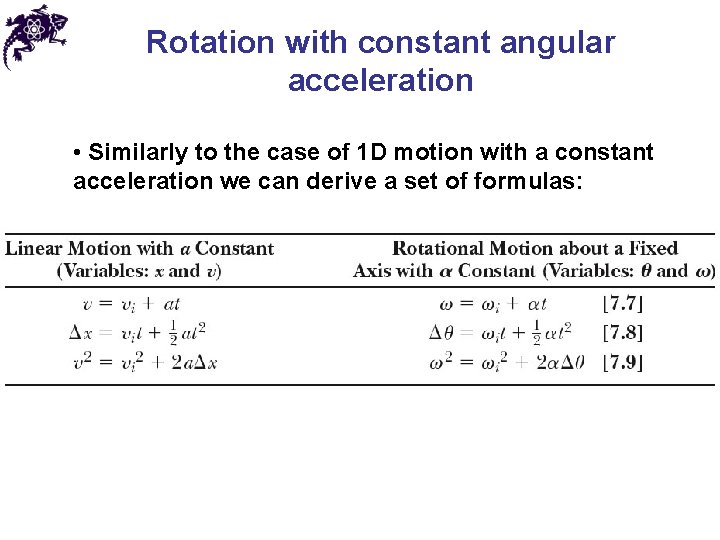
Rotation with constant angular acceleration • Similarly to the case of 1 D motion with a constant acceleration we can derive a set of formulas:
Chapter 7 Problem 5 A dentist’s drill starts from rest. After 3. 20 s of constant angular acceleration, it turns at a rate of 2. 51 × 104 rev/min. (a) Find the drill’s angular acceleration. (b) Determine the angle (in radians) through which the drill rotates during this period.
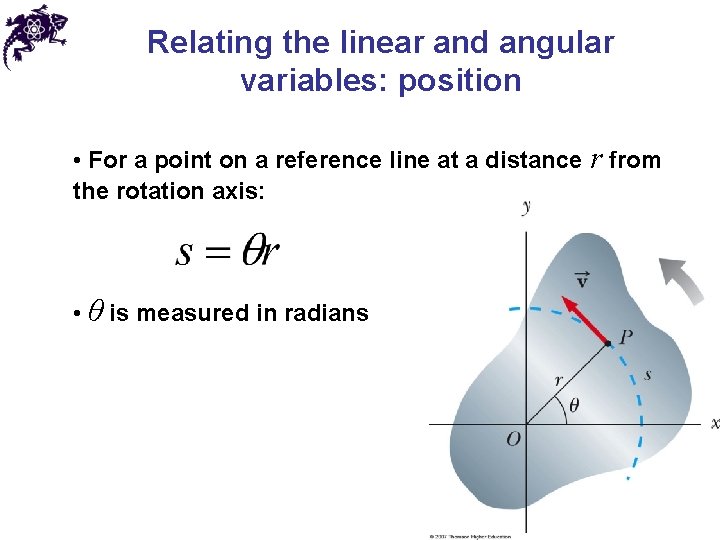
Relating the linear and angular variables: position • For a point on a reference line at a distance r from the rotation axis: • θ is measured in radians
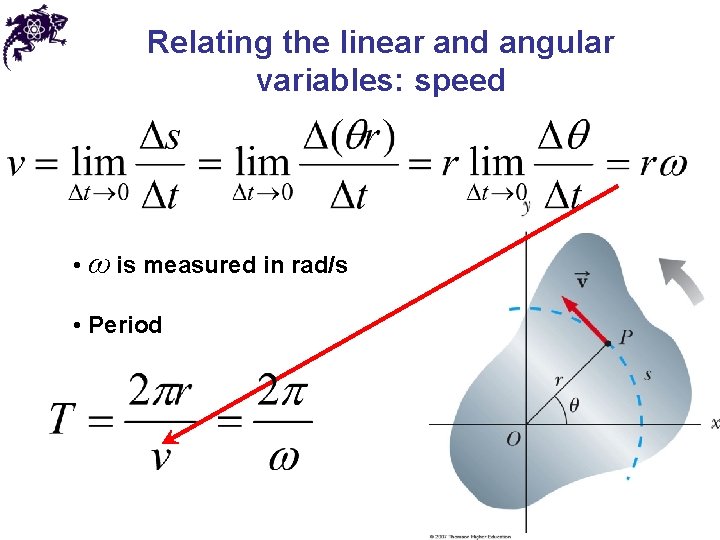
Relating the linear and angular variables: speed • ω is measured in rad/s • Period
Chapter 7 Problem 2 A wheel has a radius of 4. 1 m. How far (path length) does a point on the circumference travel if the wheel is rotated through angles of 30°, 30 rad, and 30 rev, respectively?
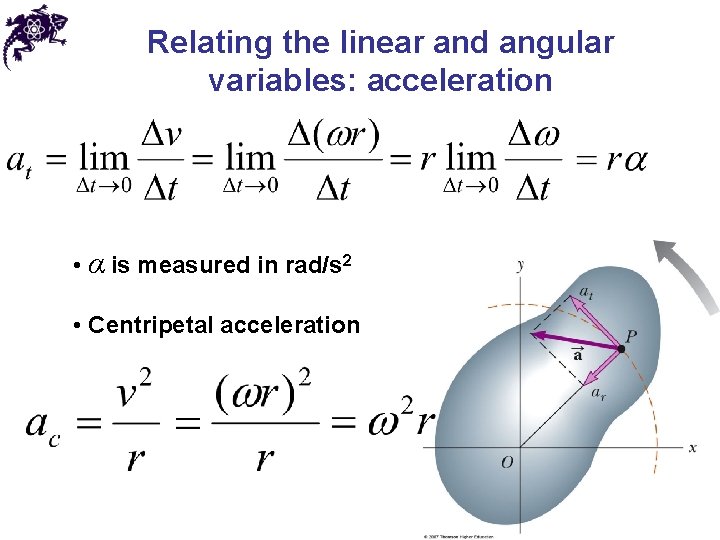
Relating the linear and angular variables: acceleration • α is measured in rad/s 2 • Centripetal acceleration
Total acceleration • Tangential acceleration is due to changing speed • Centripetal acceleration is due to changing direction • Total acceleration:
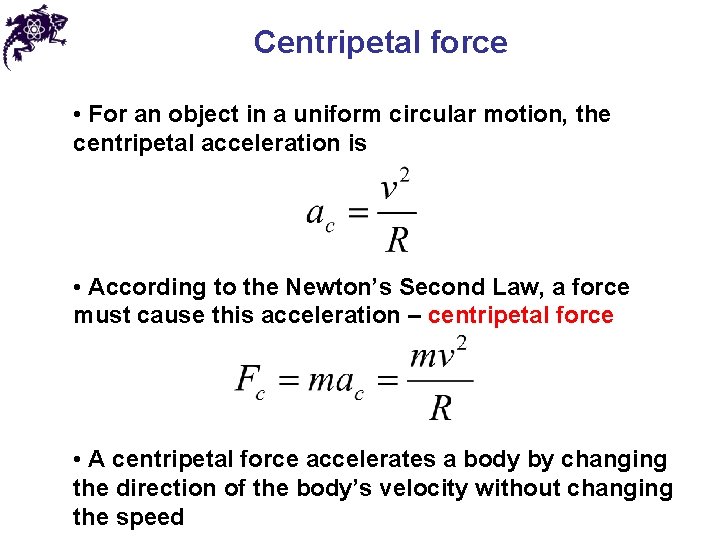
Centripetal force • For an object in a uniform circular motion, the centripetal acceleration is • According to the Newton’s Second Law, a force must cause this acceleration – centripetal force • A centripetal force accelerates a body by changing the direction of the body’s velocity without changing the speed
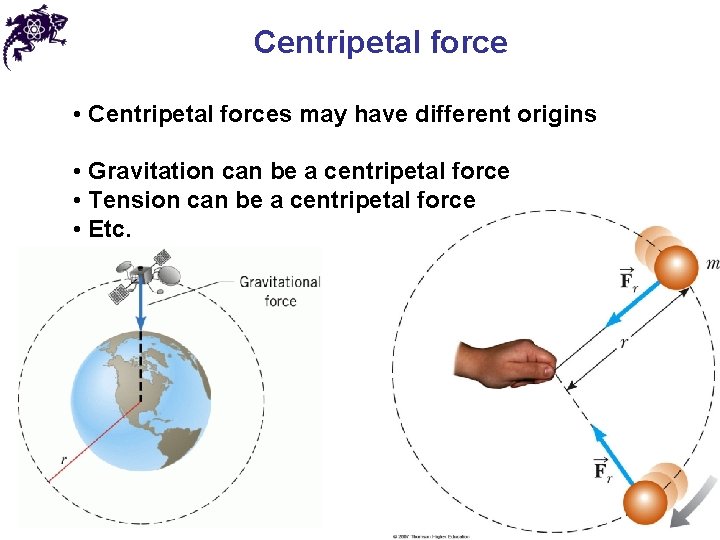
Centripetal force • Centripetal forces may have different origins • Gravitation can be a centripetal force • Tension can be a centripetal force • Etc.
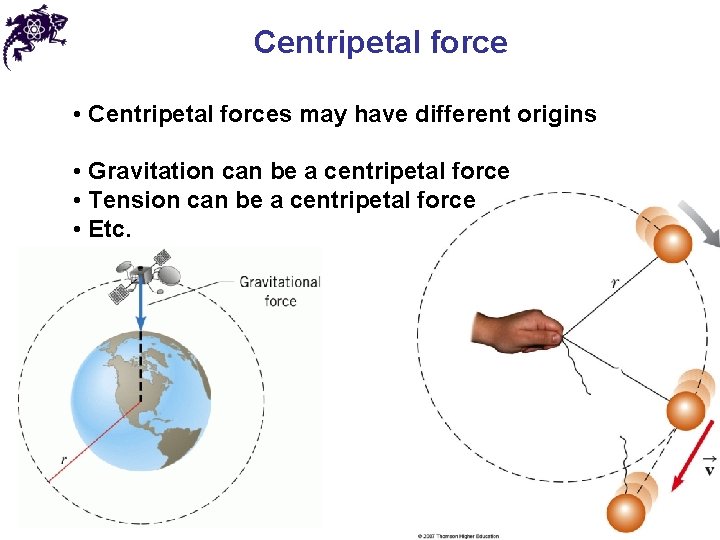
Centripetal force • Centripetal forces may have different origins • Gravitation can be a centripetal force • Tension can be a centripetal force • Etc.
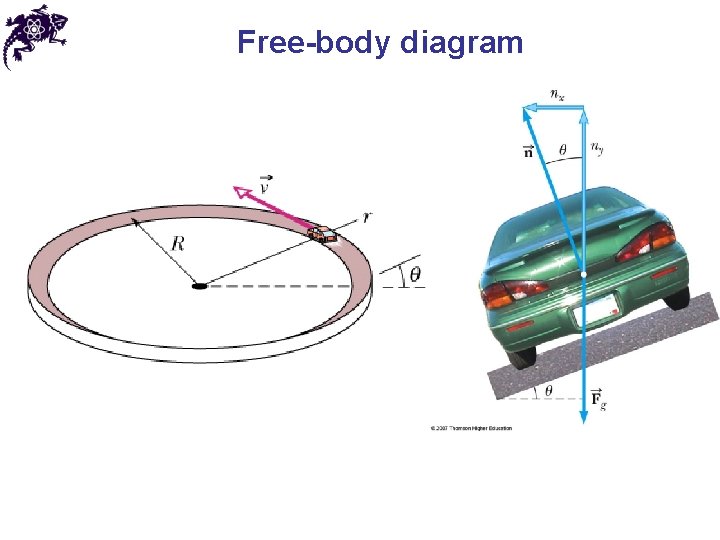
Free-body diagram
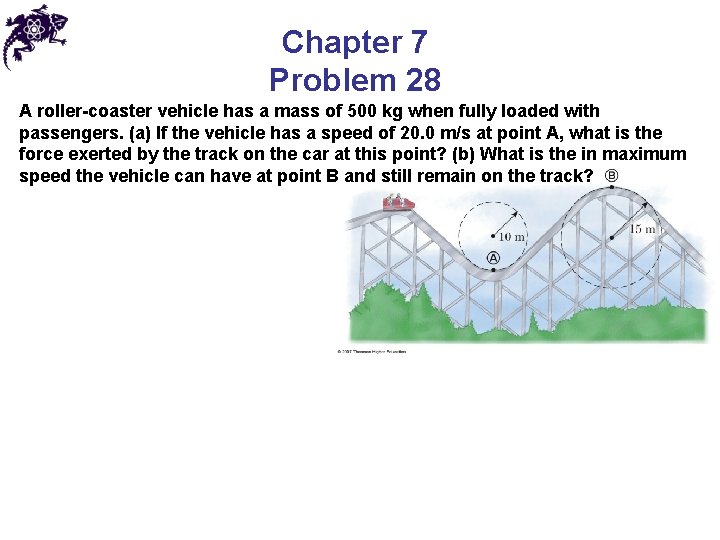
Chapter 7 Problem 28 A roller-coaster vehicle has a mass of 500 kg when fully loaded with passengers. (a) If the vehicle has a speed of 20. 0 m/s at point A, what is the force exerted by the track on the car at this point? (b) What is the in maximum speed the vehicle can have at point B and still remain on the track?
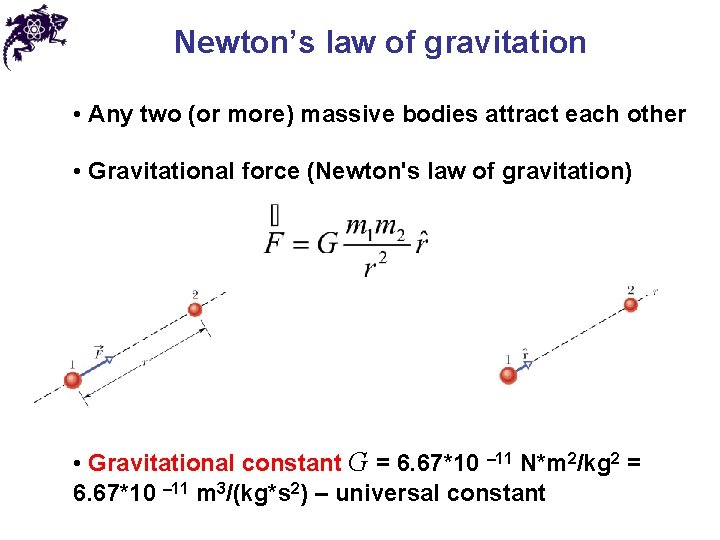
Newton’s law of gravitation • Any two (or more) massive bodies attract each other • Gravitational force (Newton's law of gravitation) • Gravitational constant G = 6. 67*10 – 11 N*m 2/kg 2 = 6. 67*10 – 11 m 3/(kg*s 2) – universal constant
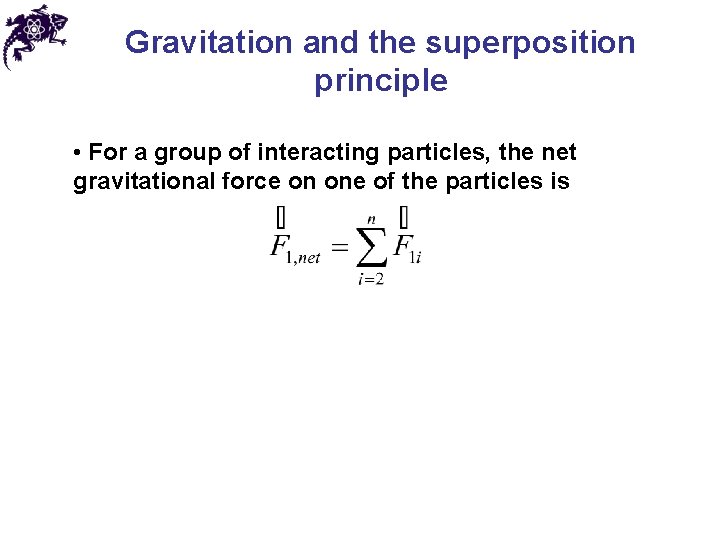
Gravitation and the superposition principle • For a group of interacting particles, the net gravitational force on one of the particles is
Chapter 7 Problem 33 Objects with masses of 200 kg and 500 kg are separated by 0. 400 m. (a) Find the net gravitational force exerted by these objects on a 50. 0 -kg object placed midway between them. (b) At what position (other than infinitely remote ones) can the 50. 0 -kg object be placed so as to experience a net force of zero?
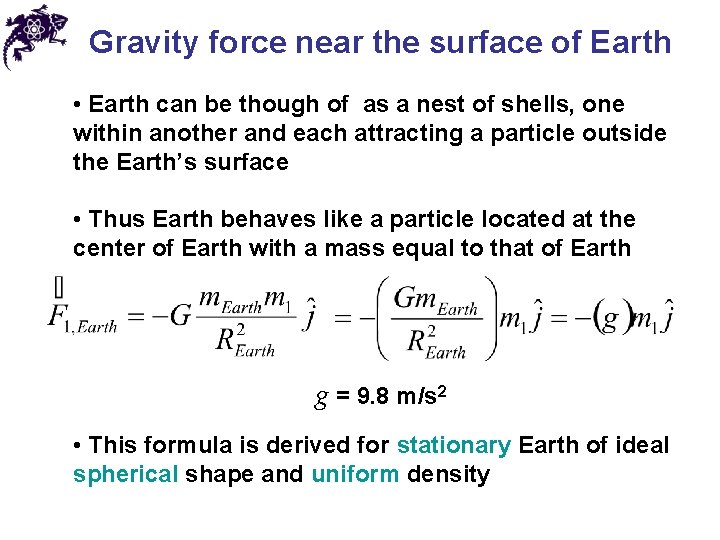
Gravity force near the surface of Earth • Earth can be though of as a nest of shells, one within another and each attracting a particle outside the Earth’s surface • Thus Earth behaves like a particle located at the center of Earth with a mass equal to that of Earth g = 9. 8 m/s 2 • This formula is derived for stationary Earth of ideal spherical shape and uniform density
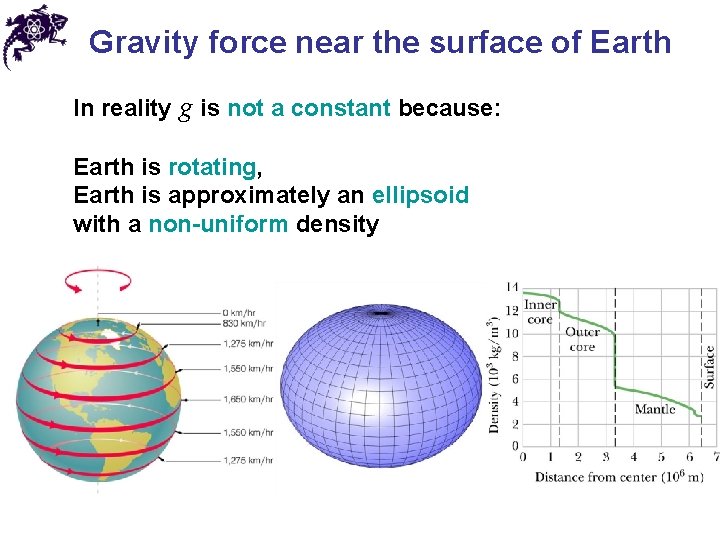
Gravity force near the surface of Earth In reality g is not a constant because: Earth is rotating, Earth is approximately an ellipsoid with a non-uniform density
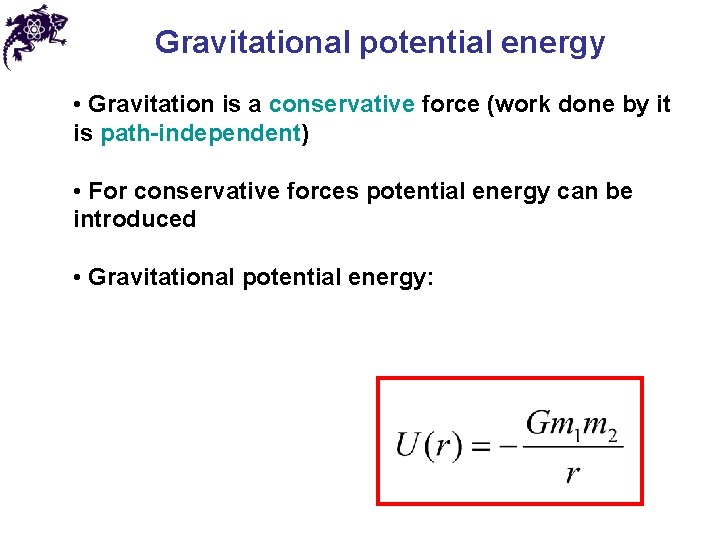
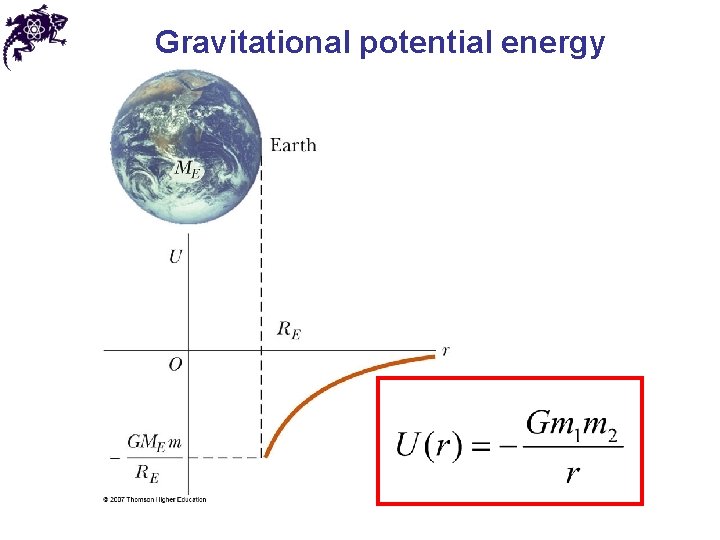
Gravitational potential energy • Gravitation is a conservative force (work done by it is path-independent) • For conservative forces potential energy can be introduced • Gravitational potential energy:
Gravitational potential energy
Escape speed • Accounting for the shape of Earth, projectile motion (Ch. 3) has to be modified:
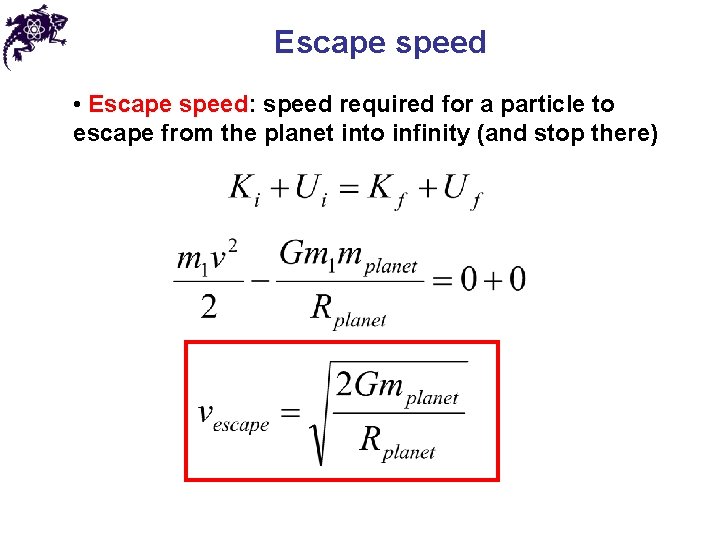
Escape speed • Escape speed: speed required for a particle to escape from the planet into infinity (and stop there)
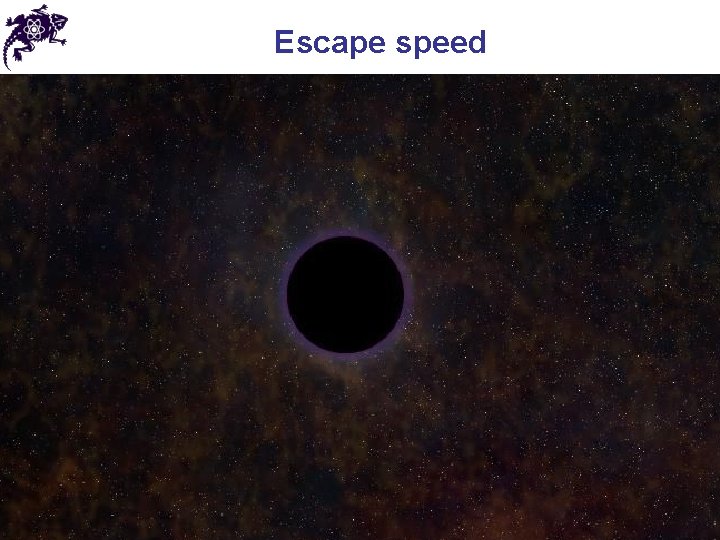
Escape speed • If for some astronomical object • Nothing (even light) can escape from the surface of this object – a black hole
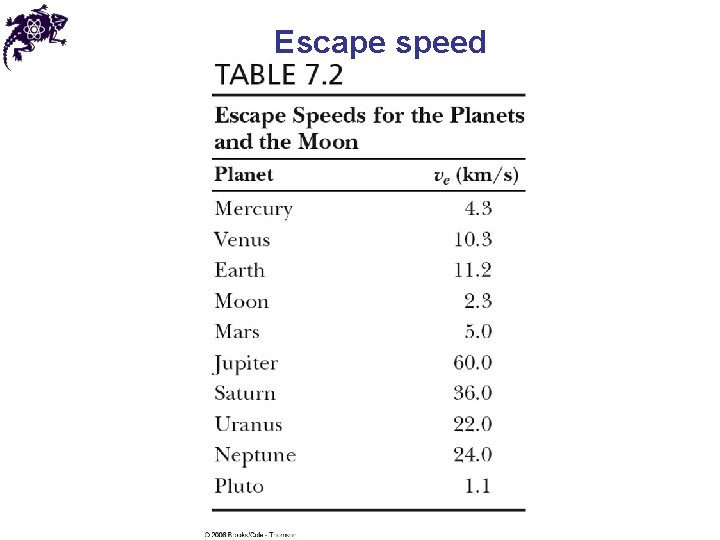
Escape speed
Chapter 7 Problem 56 Show that the escape speed from the surface of a planet of uniform density is directly proportional to the radius of the planet.
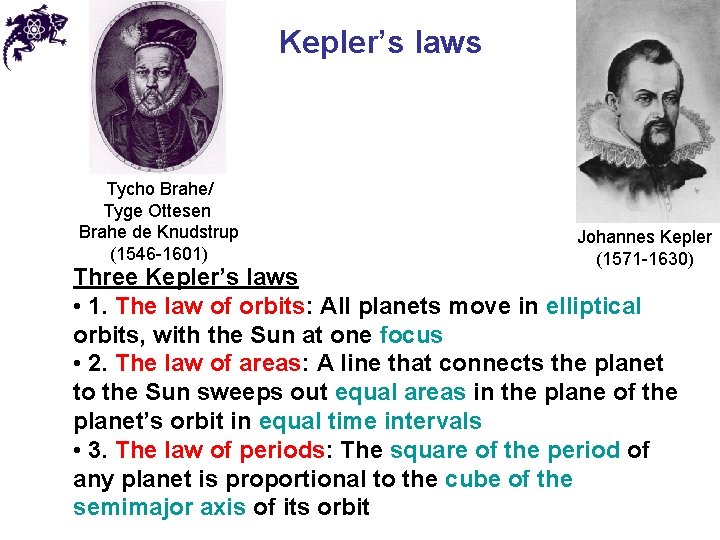
Kepler’s laws Tycho Brahe/ Tyge Ottesen Brahe de Knudstrup (1546 -1601) Johannes Kepler (1571 -1630) Three Kepler’s laws • 1. The law of orbits: All planets move in elliptical orbits, with the Sun at one focus • 2. The law of areas: A line that connects the planet to the Sun sweeps out equal areas in the plane of the planet’s orbit in equal time intervals • 3. The law of periods: The square of the period of any planet is proportional to the cube of the semimajor axis of its orbit
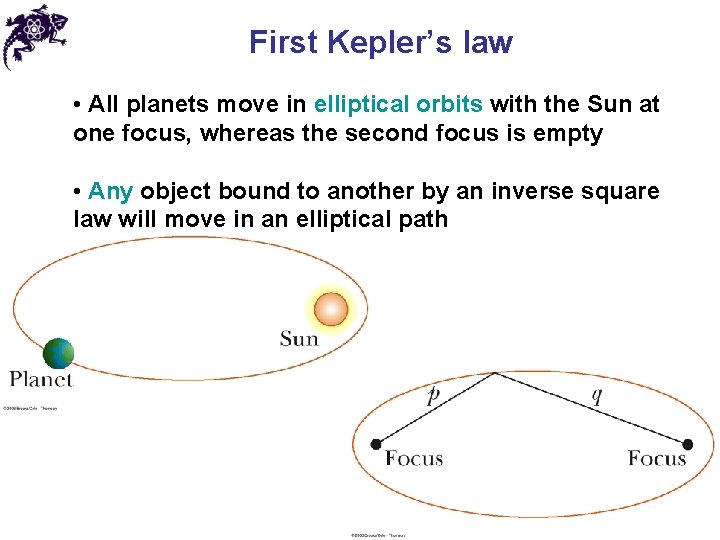
First Kepler’s law • All planets move in elliptical orbits with the Sun at one focus, whereas the second focus is empty • Any object bound to another by an inverse square law will move in an elliptical path
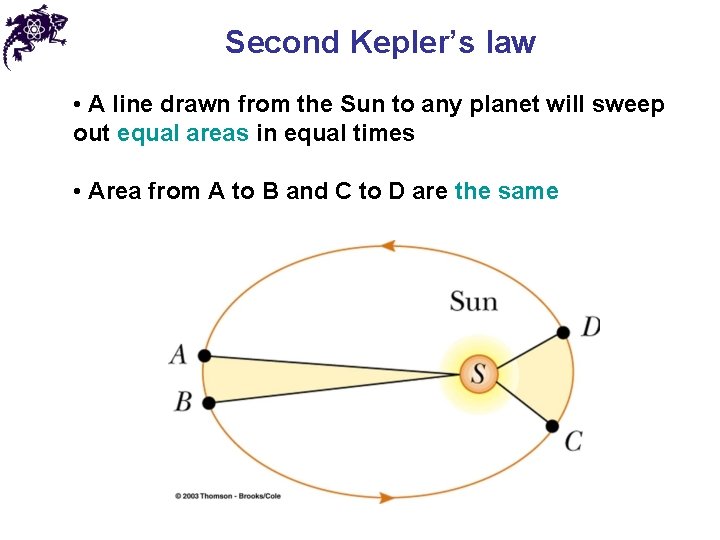
Second Kepler’s law • A line drawn from the Sun to any planet will sweep out equal areas in equal times • Area from A to B and C to D are the same
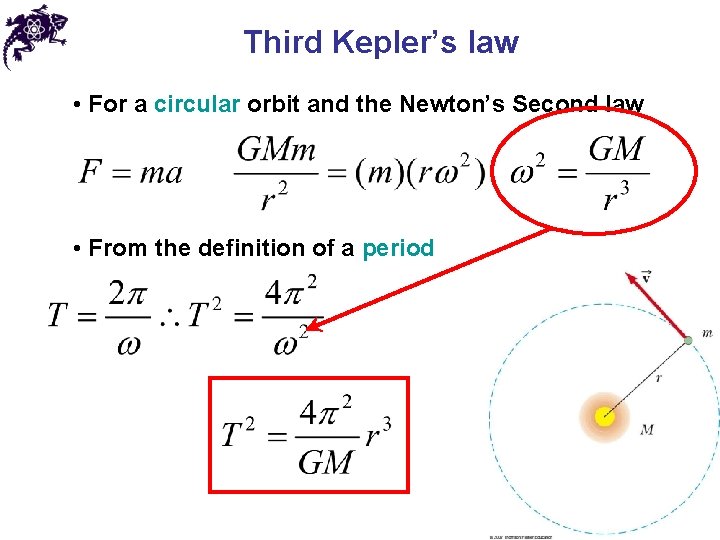
Third Kepler’s law • For a circular orbit and the Newton’s Second law • From the definition of a period
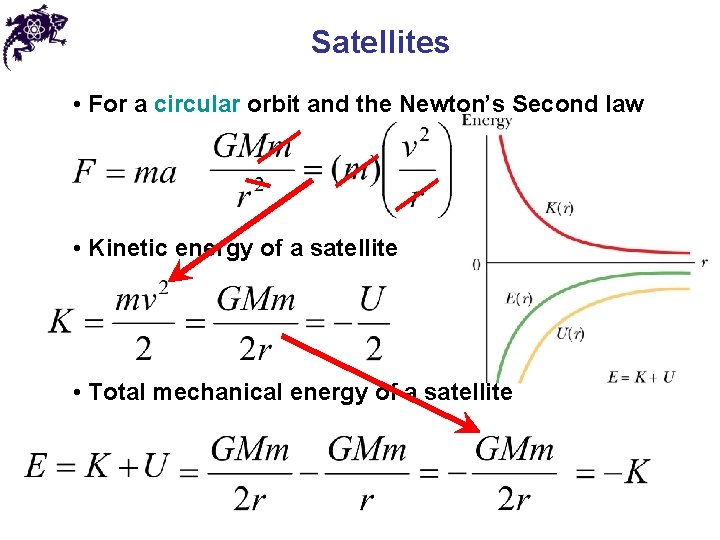
Satellites • For a circular orbit and the Newton’s Second law • Kinetic energy of a satellite • Total mechanical energy of a satellite
Chapter 7 Problem 45 The Solar Maximum Mission Satellite was placed in a circular orbit about 150 mi above Earth. Determine (a) the orbital speed of the satellite and (b) the time required for one complete revolution.
Questions?
Answers to the even-numbered problems Chapter 7 Problem 10 50 rev
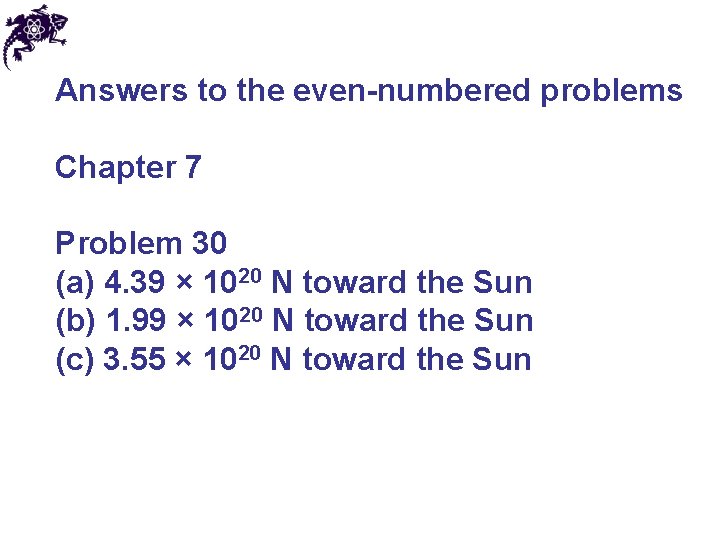
Answers to the even-numbered problems Chapter 7 Problem 30 (a) 4. 39 × 1020 N toward the Sun (b) 1. 99 × 1020 N toward the Sun (c) 3. 55 × 1020 N toward the Sun
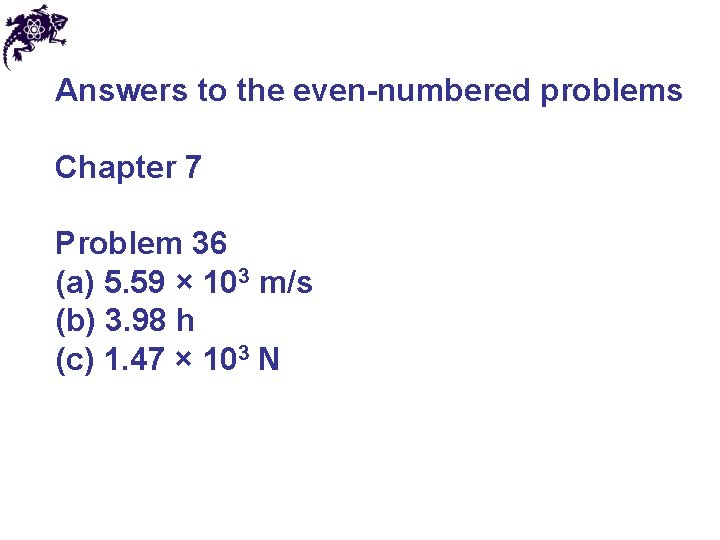
Answers to the even-numbered problems Chapter 7 Problem 36 (a) 5. 59 × 103 m/s (b) 3. 98 h (c) 1. 47 × 103 N