
Chapter 7 Requirements Engineering The Problems with our
Chapter 7 Requirements Engineering
The Problems with our Requirements Practices • We have trouble understanding the requirements that we do acquire from the customer. • We often record requirements in a disorganized manner. • We spend far too little time verifying what we do record. • We allow change to control us, rather than establishing mechanisms to control change. • Most importantly, we fail to establish a solid foundation for the system or software that the user wants built. 2

Importance of Software Requirements • The hardest single part of building a software system is deciding what to build. . . No other part of the work so cripples the resulting system if done wrong. No other part is difficult to rectify later • Fred Brooks 3
Impact of Wrong Requirements • When requirements are wrong, systems are late, unreliable and don’t meet customers needs. • This results in enormous loss of time, revenue, market share, and trust of customers. 4
Functional and non-functional requirements • Functional requirements • Statements of services the system should provide, how the system should react to particular inputs and how the system should behave in particular situations. • May state what the system should not do. • Non-functional requirements • Most non-functional requirements relate to the system as a whole. They include constraints on timing and performance, reliability, security, maintainability, accuracy, the development process, standards, etc. 5
A Solution: Requirements Engineering • Begins during the communication activity and continues into the modeling activity • Builds a bridge from the system requirements into software design and construction • Allows the requirements engineer: • to examine the context of the software work to be performed • the specific needs that design and construction must address • the priorities that guide the order in which work is to be completed • the information, function, and behavior that will have a profound impact on the resultant design 6
Requirements Engineering Tasks • Seven distinct tasks are : 1. 2. 3. 4. 5. 6. 7. Inception Elicitation Elaboration Negotiation Specification Validation Requirements Management • Some of these tasks may occur in parallel and all are adapted to the needs of the project • All strive to define what the customer wants • All serve to establish a solid foundation for the design and construction of the software
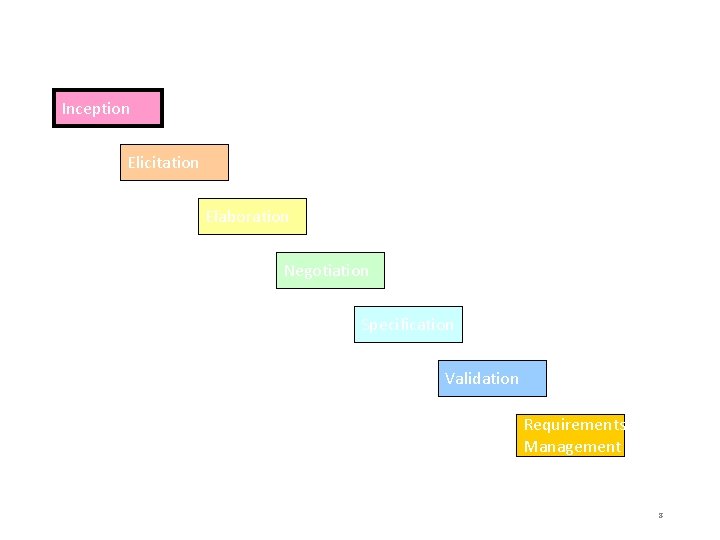
Inception Elicitation Elaboration Negotiation Specification Validation Requirements Management 8

Inception Task • During inception, the requirements engineer asks a set of questions to establish… • A basic understanding of the problem • The people who want a solution • The nature of the solution that is desired • The effectiveness of preliminary communication and collaboration between the customer and the developer • Through these questions, the requirements engineer needs to… • Identify the stakeholders • Recognize multiple viewpoints • Work toward collaboration • Break the ice and initiate the communication
The First Set of Questions These questions focus on the customer, other stakeholders, the overall goals, and the benefits • Who is behind the request for this work? • Who will use the solution? • What will be the economic benefit of a successful solution? • Is there another source for the solution that you need? 10
The Next Set of Questions These questions enable the requirements engineer to gain a better understanding of the problem and allow the customer to voice his or her perceptions about a solution • How would you characterize "good" output that would be generated by a successful solution? • What problem(s) will this solution address? • Can you show me (or describe) the business environment in which the solution will be used? • Will special performance issues or constraints affect the way the solution is approached? 11
The Final Set of Questions These questions focus on the effectiveness of the communication activity itself • Are you the right person to answer these questions? Are your answers "official"? • Are my questions relevant to the problem that you have? • Am I asking too many questions? • Can anyone else provide additional information? • Should I be asking you anything else? 12
Requirements Elicitation Requirements elicitation activity is performed by • Determines the system requirements through consultation with stakeholders, from system documents, domain knowledge, and market studies • Requirements acquisition or requirements discovery 13
Elicitation Work Products The work products will vary depending on the system, but should include one or more of the following items • A statement of need and feasibility • A bounded statement of scope for the system or product • A list of customers, users, and other stakeholders who participated in requirements elicitation • A description of the system's technical environment • A list of requirements (organized by function) and the domain constraints that apply to each. • A set of preliminary usage scenarios (in the form of use cases) that provide insight into the use of the system or product under different operating conditions • Any prototypes developed to better define requirements 17
Elaboration Task • During elaboration, the software engineer takes the information obtained during inception and elicitation and begins to expand refine it • Elaboration focuses on developing a refined technical model of software functions, features, and constraints • It is an analysis modeling task • Use cases are developed • Domain classes are identified along with their attributes and relationships • State machine diagrams are used to capture the life of an object • The end result is an analysis model that defines the functional, informational, and behavioral domains of the problem 18
Elements of the Analysis Model • Scenario-based elements • Describe the system from the user's point of view using scenarios that are depicted in use cases and activity diagrams. • Class-based elements • Identify the domain classes for the objects manipulated by the actors, the attributes of these classes, and how they interact with one another; they utilize class diagrams to do this. • Behavioral elements • Use state diagrams to represent the state of the system, the events that cause the system to change state, and the actions that are taken as a result of a particular event; can also be applied to each class in the system. • Flow-oriented elements • Use data flow diagrams to show the input data that comes into a system, what functions are applied to that data to do transformations, and what resulting output data are produced 19
Negotiation Task • During negotiation, the software engineer reconciles the conflicts between what the customer wants and what can be achieved given limited business resources. • Requirements are ranked (i. e. , prioritized) by the customers, users, and other stakeholders. Risks associated with each requirement are identified analyzed. • Rough guesses of development effort are made and used to assess the impact of each requirement on project cost and delivery time. • Using an iterative approach, requirements are eliminated, combined and/or modified so that each party achieves some measure of satisfaction. 20
Specification Task • A specification is the final work product produced by the requirements engineer. It is also known as SRS document. • It serves as the foundation for subsequent software engineering activities. • It describes the function and performance of a computer-based system and the constraints that will govern its development. • It formalizes the informational, functional, and behavioral requirements of the proposed software in both a graphical and textual format. 21
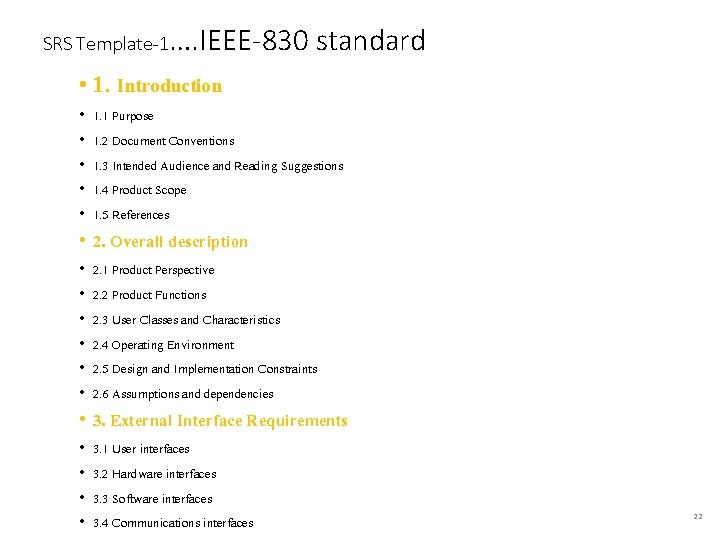
SRS Template-1 …. IEEE-830 standard • 1. Introduction • 1. 1 Purpose • 1. 2 Document Conventions • 1. 3 Intended Audience and Reading Suggestions • 1. 4 Product Scope • 1. 5 References • 2. Overall description • 2. 1 Product Perspective • 2. 2 Product Functions • 2. 3 User Classes and Characteristics • 2. 4 Operating Environment • 2. 5 Design and Implementation Constraints • 2. 6 Assumptions and dependencies • 3. External Interface Requirements • 3. 1 User interfaces • 3. 2 Hardware interfaces • 3. 3 Software interfaces • 3. 4 Communications interfaces 22
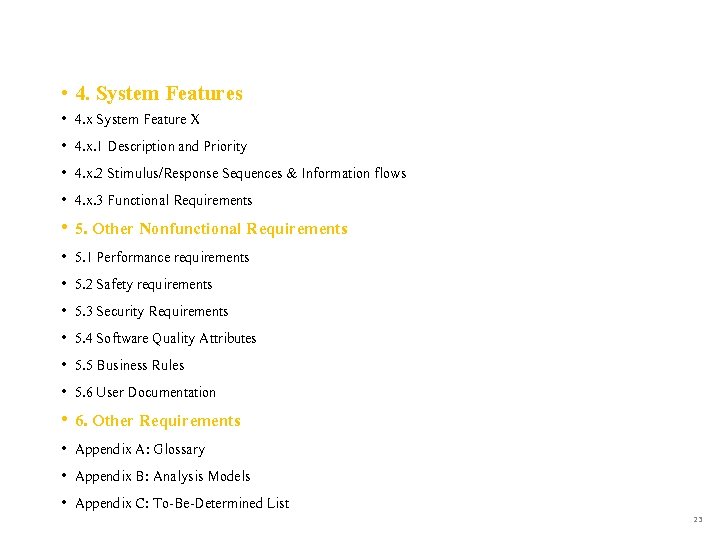
• 4. System Features • • 4. x System Feature X 4. x. 1 Description and Priority 4. x. 2 Stimulus/Response Sequences & Information flows 4. x. 3 Functional Requirements • 5. Other Nonfunctional Requirements • • • 5. 1 Performance requirements 5. 2 Safety requirements 5. 3 Security Requirements 5. 4 Software Quality Attributes 5. 5 Business Rules 5. 6 User Documentation • 6. Other Requirements • Appendix A: Glossary • Appendix B: Analysis Models • Appendix C: To-Be-Determined List 23
Validation Task • Certifies that the requirements document is an acceptable description of the system to be implemented. • The formal technical review serves as the primary requirements validation mechanism. • Checks a requirements document for: • Completeness and consistency • Conformance to standards • Requirements conflicts • Technical errors • Ambiguous requirements 24
Requirements Management Task • Definition: “Requirements management is the process of documenting, analyzing, tracing, prioritizing and agreeing on requirements and then controlling change and communicating to relevant stakeholders. • or • The process of managing changes to the requirements for a system. • every requirement should have a unique identification, 25
- Slides: 22