
Chapter 7 Refining idea and Decision q Objectives
Chapter 7. Refining idea and Decision q Objectives: u Learn the process of refining idea with high quality, and learn how to decide the best idea by evaluation. q Content: u Definitions and rules of refining idea u Preparing and execution of refining idea u Definition of decision and its importance Chapter 7. Refining an idea and Decision 1
7. 1 Refining idea q 2 nd step of Brainstorming q Improve to “better and practical” concept from the “bold and reckless” idea of 1 st step. Chapter 7. Refining an idea and Decision 2
Four rules of Refining idea q Find idea with “better” quality. u Improve the “quality” rather than “quantity” - develop the advantages of each idea q Change “bold” idea to more practical one. u Repeat creative thinking and analytical thinking to develop practical idea. q Synthesize ideas to get more complete solution. u Combine, synthesize, fit, fuse the created ideas to develop optimum idea. q Continuously keep the critical decision u Need positive attitude, analytic, logical and practical thinking. Chapter 7. Refining an idea and Decision 3
Timing and Preparing q Refining time u At least one day after the brainstorming q Tools for organized approach u Write the ideas from brainstorming on top of the list card (size of 4 x 6) to be seen to all team members. u Give an unique number for each cards. u Write a new ideas to new card and give new number. q Materials u Idea card, empty card, color pen, paper clip, rubber band, chart, highlighter, protection tape, meeting table, chart rack Chapter 7. Refining an idea and Decision 4
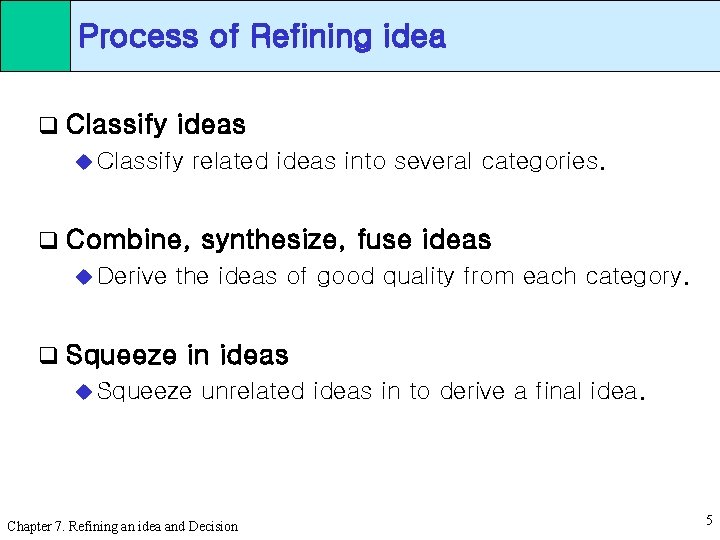
Process of Refining idea q Classify ideas u Classify related ideas into several categories. q Combine, u Derive synthesize, fuse ideas the ideas of good quality from each category. q Squeeze in ideas u Squeeze unrelated ideas in to derive a final idea. Chapter 7. Refining an idea and Decision 5
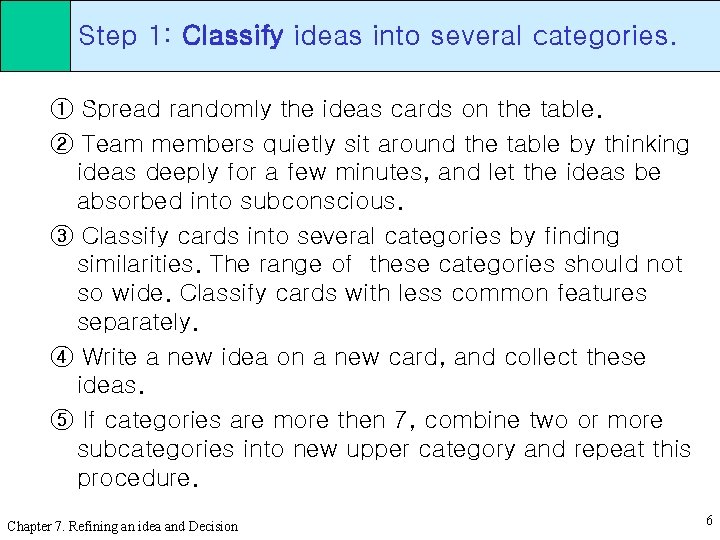
Step 1: Classify ideas into several categories. ① Spread randomly the ideas cards on the table. ② Team members quietly sit around the table by thinking ideas deeply for a few minutes, and let the ideas be absorbed into subconscious. ③ Classify cards into several categories by finding similarities. The range of these categories should not so wide. Classify cards with less common features separately. ④ Write a new idea on a new card, and collect these ideas. ⑤ If categories are more then 7, combine two or more subcategories into new upper category and repeat this procedure. Chapter 7. Refining an idea and Decision 6

Step 2. Draw new good idea through "add, improve, synthesize“ ideas in each category. ① Each team has to work on one category at a time. ② Improve perfectly many ideas and fragmentary ideas in the category to a few practical good ideas by arbitration. ③ Can add details, can modify, can hitch ride in the other ideas, and can combine or squeeze in ideas. The synthesis (combine several concepts or ideas into new one) of ideas is highly recommended. ④ Use a paper clip to tie cards, which contain combined single idea, and put the most improved and synthesis idea at the top of the tied cards. ⑤ Do not discard “too bold ideas" or not appropriate ideas in early time. ⑥ After the refining all the ideas, write the refined ideas in each category on the blackboard or a large piece of paper and pasted on the wall and be prepared to move on to the next step. Chapter 7. Refining an idea and Decision 7
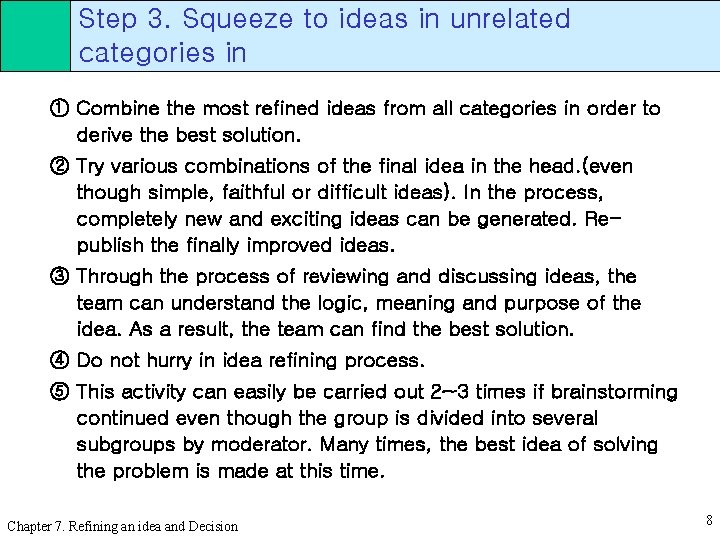
Step 3. Squeeze to ideas in unrelated categories in ① Combine the most refined ideas from all categories in order to derive the best solution. ② Try various combinations of the final idea in the head. (even though simple, faithful or difficult ideas). In the process, completely new and exciting ideas can be generated. Republish the finally improved ideas. ③ Through the process of reviewing and discussing ideas, the team can understand the logic, meaning and purpose of the idea. As a result, the team can find the best solution. ④ Do not hurry in idea refining process. ⑤ This activity can easily be carried out 2~3 times if brainstorming continued even though the group is divided into several subgroups by moderator. Many times, the best idea of solving the problem is made at this time. Chapter 7. Refining an idea and Decision 8
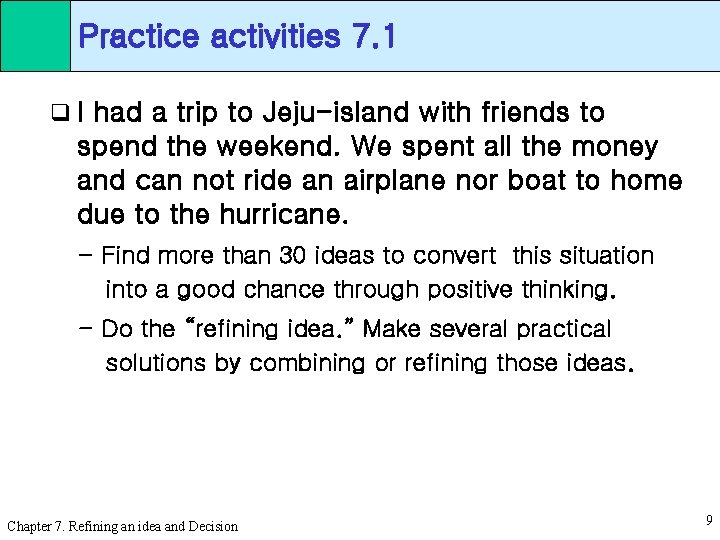
Practice activities 7. 1 q. I had a trip to Jeju-island with friends to spend the weekend. We spent all the money and can not ride an airplane nor boat to home due to the hurricane. - Find more than 30 ideas to convert this situation into a good chance through positive thinking. - Do the “refining idea. ” Make several practical solutions by combining or refining those ideas. Chapter 7. Refining an idea and Decision 9
7. Idea Decision q Preparation Activities 7. 1 : Discuss the criteria of decision and priorities when selecting a mobile phone among several phones. Write the criteria and priorities, and will continue discussion after learning the related theory. Chapter 7. Refining an idea and Decision 10
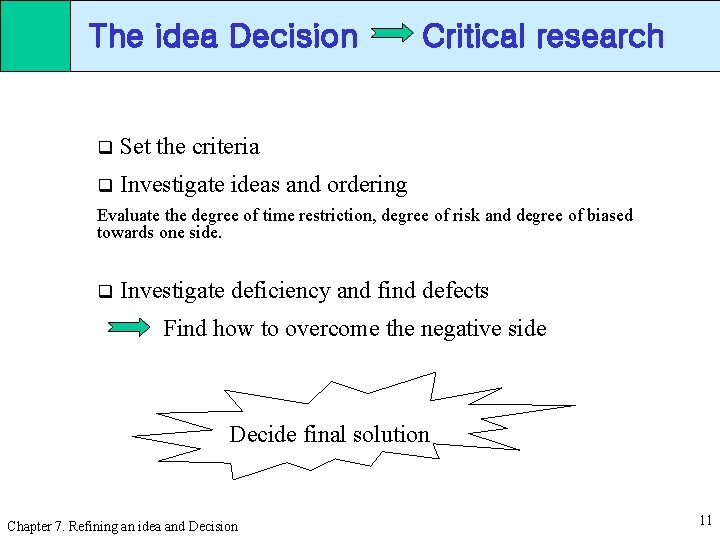
The idea Decision q Set the criteria q Investigate ideas and ordering Critical research Evaluate the degree of time restriction, degree of risk and degree of biased towards one side. q Investigate deficiency and find defects Find how to overcome the negative side Decide final solution Chapter 7. Refining an idea and Decision 11
Importance of Decision q "Deciding an idea" is a process of choosing the best idea among the ideas, which come after the process of "Creating idea” and “Refining idea". q Deciding an idea is a step to decide the solution of the problem, and the decision result affects the quality of the solution. q Engineer, who decides idea have to have the attitude of "judge". q Decision standard must be set before deciding idea and performs in accordance with that standard. Chapter 7. Refining an idea and Decision 12
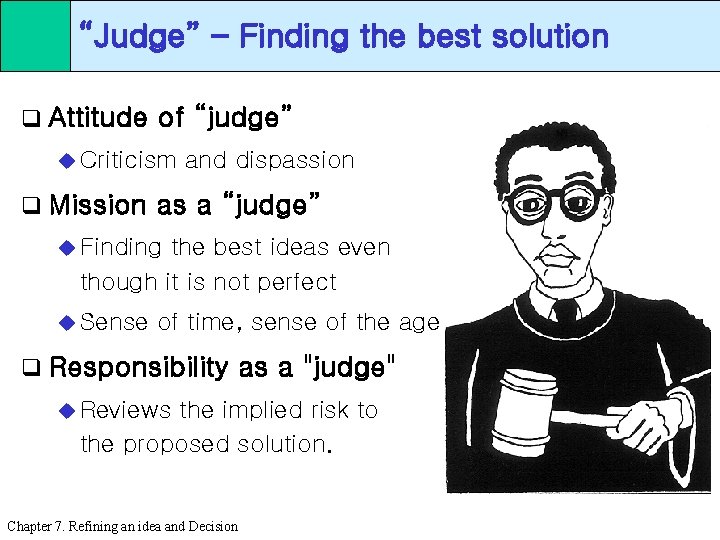
“Judge” – Finding the best solution q Attitude of “judge” u Criticism q Mission and dispassion as a “judge” u Finding the best ideas even though it is not perfect u Sense of time, sense of the age q Responsibility as a "judge" u Reviews the implied risk to the proposed solution. Chapter 7. Refining an idea and Decision
What is an excellent “Decision? ” q Excellent Decision is deriving best solution by finding and removing in advance the mistake, risk, side effects and uncertainty arise in the process of problem solving and the results. q The ability of engineers for excellent decision : u Ability to discover the mistakes that can occur during the to problem solving process or design process. u Ability to remove defects u Ability to criticize the risk, result, uncertainties in ideas. u Ability to recognize and remove the prejudice, biased values which affects the determination. u Ability to critical thinking u Ability to ethical decision Chapter 7. Refining an idea and Decision 14
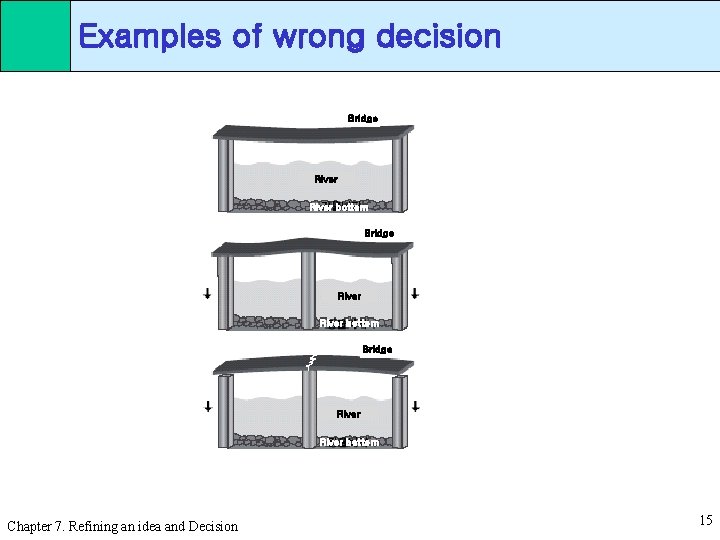
Examples of wrong decision Bridge River bottom Bridge River bottom Chapter 7. Refining an idea and Decision 15
Critical thinking q An essential way of thinking for the idea decision q Ability to express the situation and position logically based on the controversy and the evidence q A process of finding the defects and risks inside of the proposed idea, design, products, and suggesting improved for that. Chapter 7. Refining an idea and Decision 16
Attitude of person with critical thinking q He knows the possibility of distortion in the world of broadcast media. q He knows the possibility of not representing the exact circumstances in the statistics. q He knows the physical limitation of reality perception and its psychological analysis. (e. g. , he knows how the lack of sleep or fatigue can affect the decision. ) q He can recognize mental disability, excessive generalization, and wrong rationalization. q He can criticize the biased thinking and language that is implied in the verbal expression of ideas. q He is honest to himself. q He recognizes the fact and feeling, and assign a value to it. q He can reject the manipulation of the facts, askes always, and make a balanced decision regardless of the pressure of the surrounding. Chapter 7. Refining an idea and Decision 17
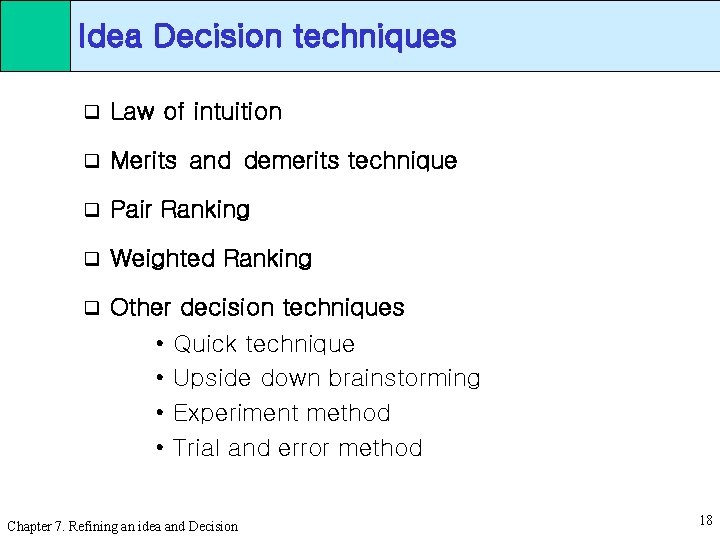
Idea Decision techniques q Law of intuition q Merits and demerits technique q Pair Ranking q Weighted Ranking q Other decision techniques • • Quick technique Upside down brainstorming Experiment method Trial and error method Chapter 7. Refining an idea and Decision 18
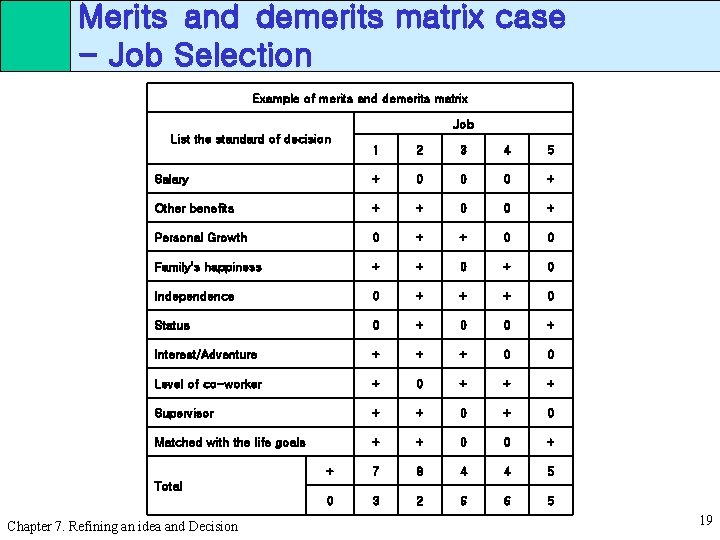
Merits and demerits matrix case - Job Selection Example of merits and demerits matrix Job List the standard of decision 1 2 3 4 5 Salary + 0 0 0 + Other benefits + + 0 0 + Personal Growth 0 + + 0 0 Family's happiness + + 0 Independence 0 + + + 0 Status 0 + 0 0 + Interest/Adventure + + + 0 0 Level of co-worker + 0 + + + Supervisor + + 0 Matched with the life goals + + 0 0 + + 7 8 4 4 5 0 3 2 6 6 5 Total Chapter 7. Refining an idea and Decision 19
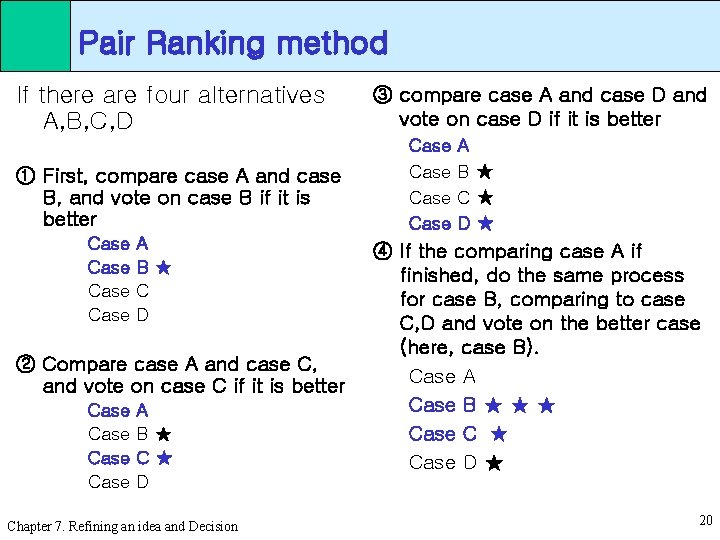
Pair Ranking method If there are four alternatives A, B, C, D ① First, compare case A and case B, and vote on case B if it is better Case A B★ C D ② Compare case A and case C, and vote on case C if it is better Case A B★ C★ D Chapter 7. Refining an idea and Decision ③ compare case A and case D and vote on case D if it is better Case A B★ C★ D★ ④ If the comparing case A if finished, do the same process for case B, comparing to case C, D and vote on the better case (here, case B). Case A Case B ★ ★ ★ Case C ★ Case D ★ 20
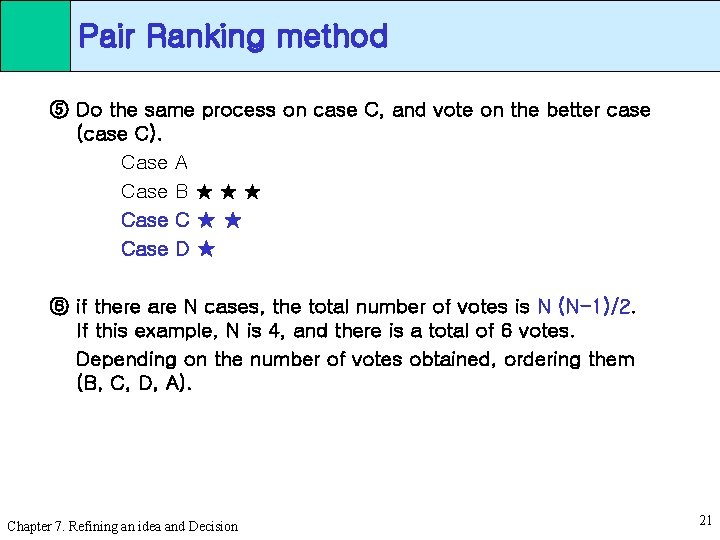
Pair Ranking method ⑤ Do the same process on case C, and vote on the better case (case C). Case A Case B ★ ★ ★ Case C ★ ★ Case D ★ ⑥ if there are N cases, the total number of votes is N (N-1)/2. If this example, N is 4, and there is a total of 6 votes. Depending on the number of votes obtained, ordering them (B, C, D, A). Chapter 7. Refining an idea and Decision 21
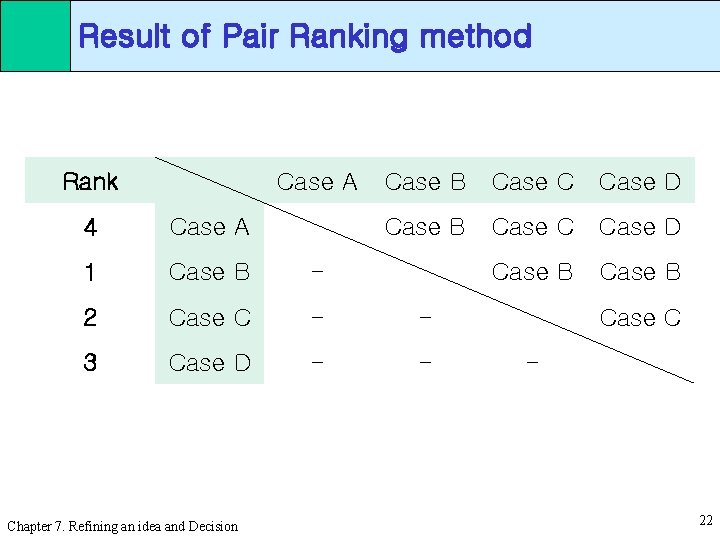
Result of Pair Ranking method Rank Case A Case B Case C Case D 4 Case A Case B Case C Case D 1 Case B - Case B 2 Case C - - Case C 3 Case D - - - Chapter 7. Refining an idea and Decision 22
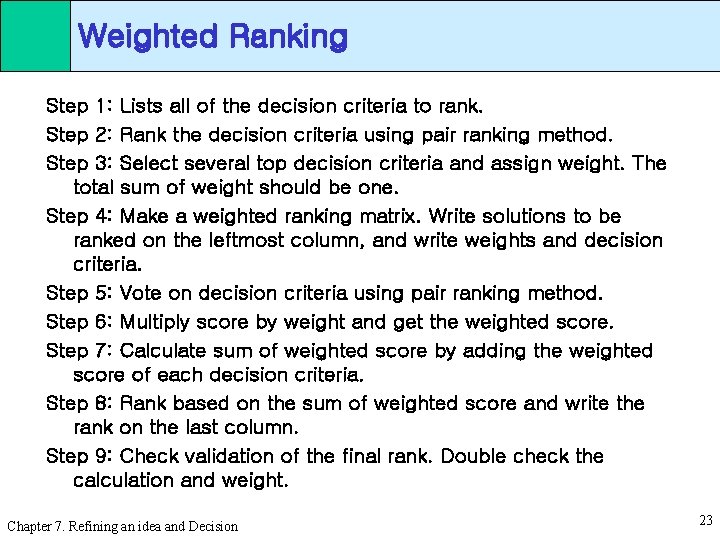
Weighted Ranking Step 1: Lists all of the decision criteria to rank. Step 2: Rank the decision criteria using pair ranking method. Step 3: Select several top decision criteria and assign weight. The total sum of weight should be one. Step 4: Make a weighted ranking matrix. Write solutions to be ranked on the leftmost column, and write weights and decision criteria. Step 5: Vote on decision criteria using pair ranking method. Step 6: Multiply score by weight and get the weighted score. Step 7: Calculate sum of weighted score by adding the weighted score of each decision criteria. Step 8: Rank based on the sum of weighted score and write the rank on the last column. Step 9: Check validation of the final rank. Double check the calculation and weight. Chapter 7. Refining an idea and Decision 23
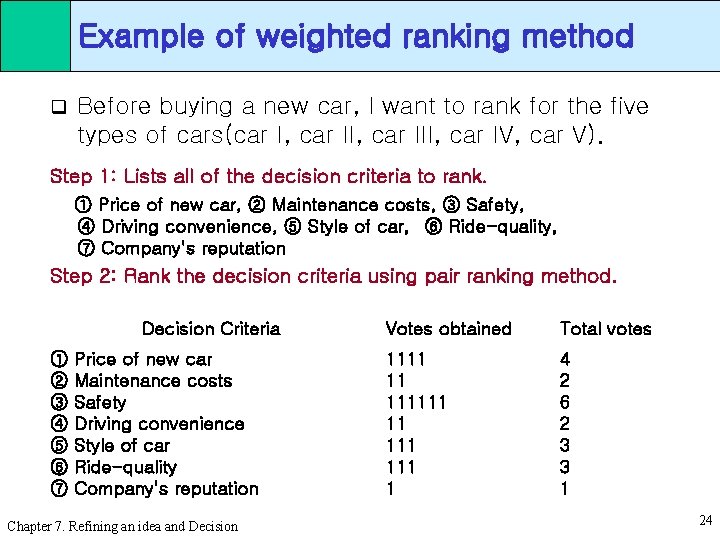
Example of weighted ranking method q Before buying a new car, I want to rank for the five types of cars(car I, car III, car IV, car V). Step 1: Lists all of the decision criteria to rank. ① Price of new car, ② Maintenance costs, ③ Safety, ④ Driving convenience, ⑤ Style of car, ⑥ Ride-quality, ⑦ Company's reputation Step 2: Rank the decision criteria using pair ranking method. Decision Criteria ① ② ③ ④ ⑤ ⑥ ⑦ Price of new car Maintenance costs Safety Driving convenience Style of car Ride-quality Company's reputation Chapter 7. Refining an idea and Decision Votes obtained Total votes 1111 111 1 4 2 6 2 3 3 1 24
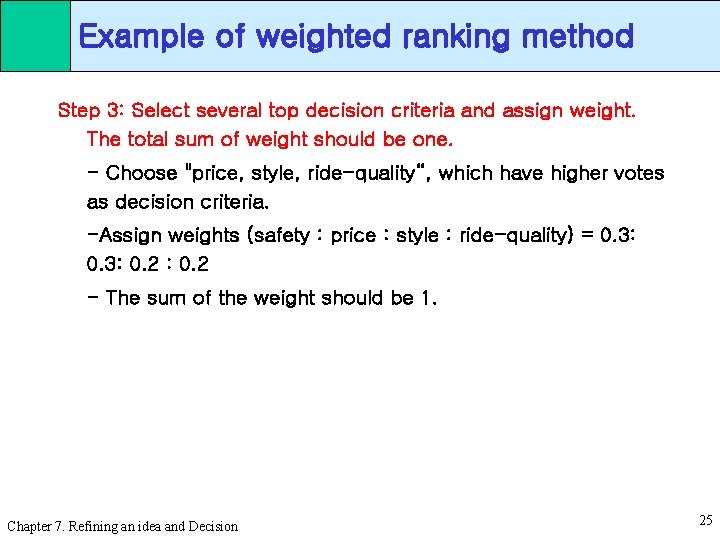
Example of weighted ranking method Step 3: Select several top decision criteria and assign weight. The total sum of weight should be one. - Choose "price, style, ride-quality“, which have higher votes as decision criteria. -Assign weights (safety : price : style : ride-quality) = 0. 3: 0. 2 - The sum of the weight should be 1. Chapter 7. Refining an idea and Decision 25
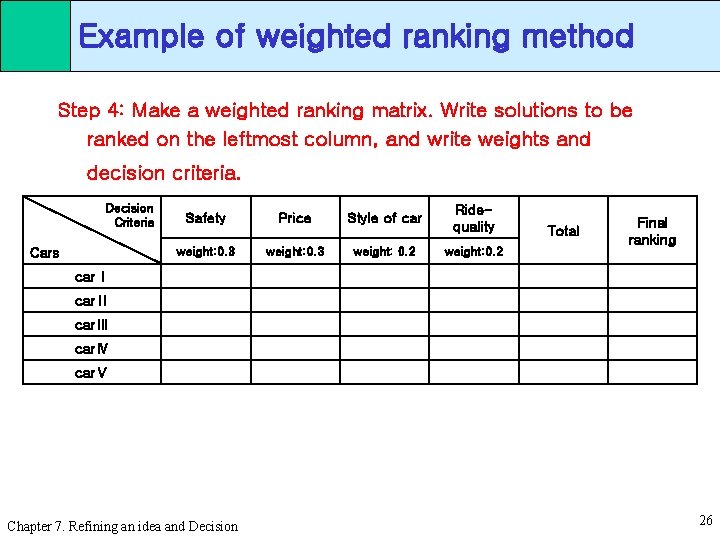
Example of weighted ranking method Step 4: Make a weighted ranking matrix. Write solutions to be ranked on the leftmost column, and write weights and decision criteria. Decision Criteria Safety Price Style of car Ridequality weight: 0. 3 weight: 0. 2 carⅠ carⅡ carⅢ carⅣ carⅤ Cars Total Final ranking Chapter 7. Refining an idea and Decision 26
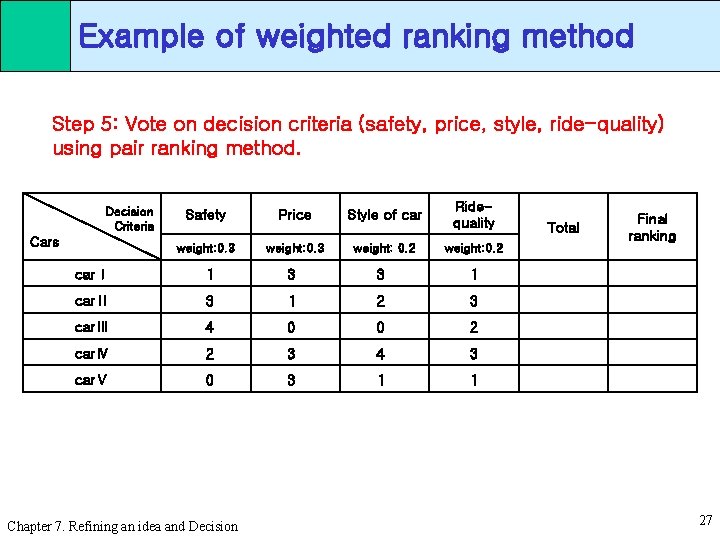
Example of weighted ranking method Step 5: Vote on decision criteria (safety, price, style, ride-quality) using pair ranking method. Safety Price Style of car Ridequality weight: 0. 3 weight: 0. 2 carⅠ 1 3 3 carⅡ 3 1 carⅢ 4 carⅣ carⅤ Decision Criteria Cars Total Final ranking 1 2 3 0 0 2 3 4 3 0 3 1 1 Chapter 7. Refining an idea and Decision 27
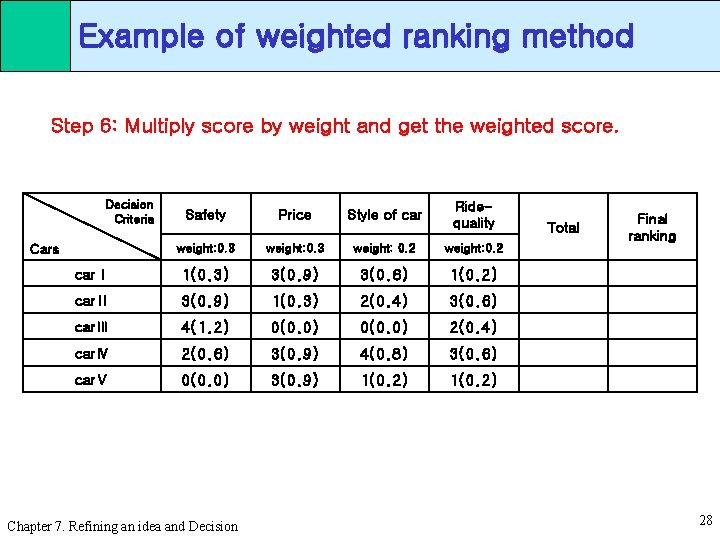
Example of weighted ranking method Step 6: Multiply score by weight and get the weighted score. Decision Criteria Safety Price Style of car Ridequality weight: 0. 3 weight: 0. 2 carⅠ 1(0. 3) 3(0. 9) 3(0. 6) carⅡ 3(0. 9) 1(0. 3) carⅢ 4(1. 2) carⅣ carⅤ Cars Total Final ranking 1(0. 2) 2(0. 4) 3(0. 6) 0(0. 0) 2(0. 4) 2(0. 6) 3(0. 9) 4(0. 8) 3(0. 6) 0(0. 0) 3(0. 9) 1(0. 2) Chapter 7. Refining an idea and Decision 28
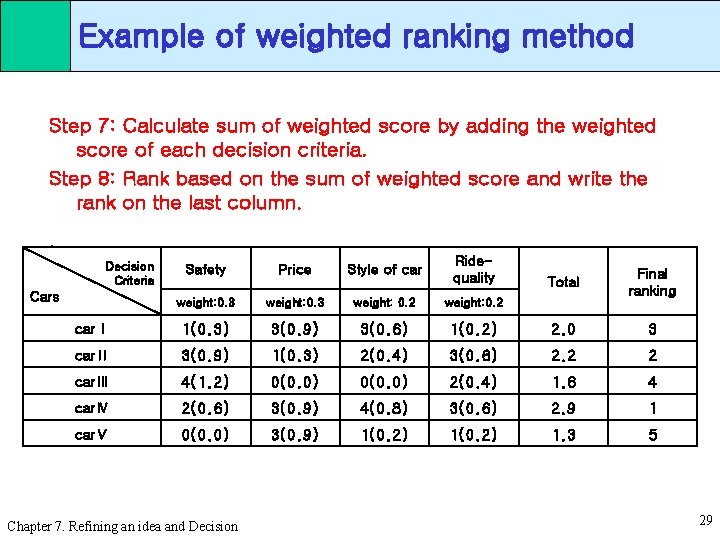
Example of weighted ranking method Step 7: Calculate sum of weighted score by adding the weighted score of each decision criteria. Step 8: Rank based on the sum of weighted score and write the rank on the last column. . Safety Price Style of car Ridequality weight: 0. 3 weight: 0. 2 carⅠ 1(0. 3) 3(0. 9) 3(0. 6) carⅡ 3(0. 9) 1(0. 3) carⅢ 4(1. 2) carⅣ carⅤ Decision Criteria Cars Total Final ranking 1(0. 2) 2. 0 3 2(0. 4) 3(0. 6) 2. 2 2 0(0. 0) 2(0. 4) 1. 6 4 2(0. 6) 3(0. 9) 4(0. 8) 3(0. 6) 2. 9 1 0(0. 0) 3(0. 9) 1(0. 2) 1. 3 5 Chapter 7. Refining an idea and Decision 29
Example of weighted ranking method Step 9: Check validation of the final rank. Double check the calculation and weight. If the selected vehicle is different from the vehicle selected intuitively, u Did not consider important decision criteria properly in intuitive decision. (Ex: Not considering safety but considering only price) u Did not distribute the proportion of the weights properly. u Did mistake in pair ranking method and calculation in adding weighted scores. Therefore, do not accept solution using the weighted ranking method without checking and double check on calculation and weight distribution. After double check, to the final decision. Chapter 7. Refining an idea and Decision 30
Example of weighted ranking method Step 10: Complement the drawbacks of the idea that received the highest score. u Seek ways to complement the shortcomings of the selected idea. u Seek ways to take advantage of the eliminated ideas. Chapter 7. Refining an idea and Decision 31
- Slides: 31