
CHAPTER 7 Recursion Java Software Structures Designing and
- Slides: 37
CHAPTER 7: Recursion Java Software Structures: Designing and Using Data Structures Third Edition John Lewis & Joseph Chase Addison Wesley is an imprint of © 2010 Pearson Addison-Wesley. All rights reserved.
Chapter Objectives • Explain the underlying concepts of recursion • Examine recursive methods and unravel their processing steps • Define infinite recursion and discuss ways to avoid it • Explain when recursion should and should not be used • Demonstrate the use of recursion to solve problems 1 -2 © 2010 Pearson Addison-Wesley. All rights reserved. 1 -2
Recursive Thinking • Recursion is a programming technique in which a method can call itself to solve a problem • A recursive definition is one which uses the word or concept being defined in the definition itself • In some situations, a recursive definition can be an appropriate way to express a concept • Before applying recursion to programming, it is best to practice thinking recursively 1 -3 © 2010 Pearson Addison-Wesley. All rights reserved. 1 -3
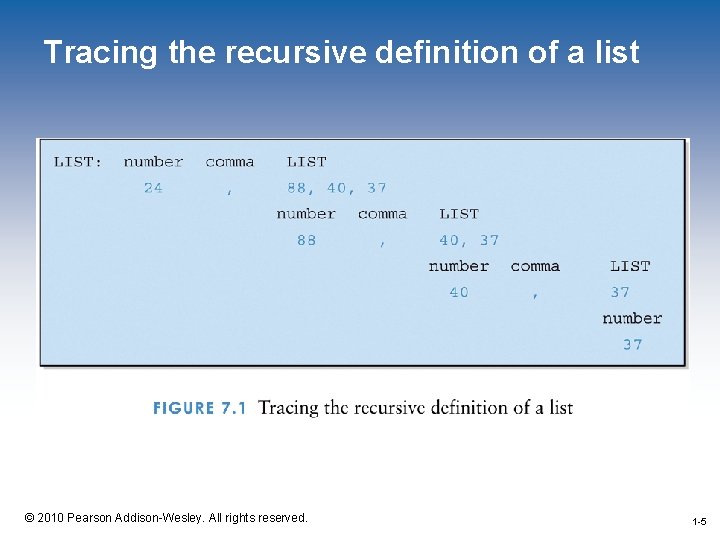
Recursive Definitions • Consider the following list of numbers: 24, 88, 40, 37 • Such a list can be defined recursively: A LIST is a: or a: number comma LIST • That is, a LIST can be a number, or a number followed by a comma followed by a LIST • The concept of a LIST is used to define itself 1 -4 © 2010 Pearson Addison-Wesley. All rights reserved. 1 -4
Tracing the recursive definition of a list 1 -5 © 2010 Pearson Addison-Wesley. All rights reserved. 1 -5
Infinite Recursion • All recursive definitions must have a nonrecursive part • If they don't, there is no way to terminate the recursive path • A definition without a non-recursive part causes infinite recursion • This problem is similar to an infinite loop -with the definition itself causing the infinite "looping" • The non-recursive part often is called the base case © 2010 Pearson Addison-Wesley. All rights reserved. 1 -6
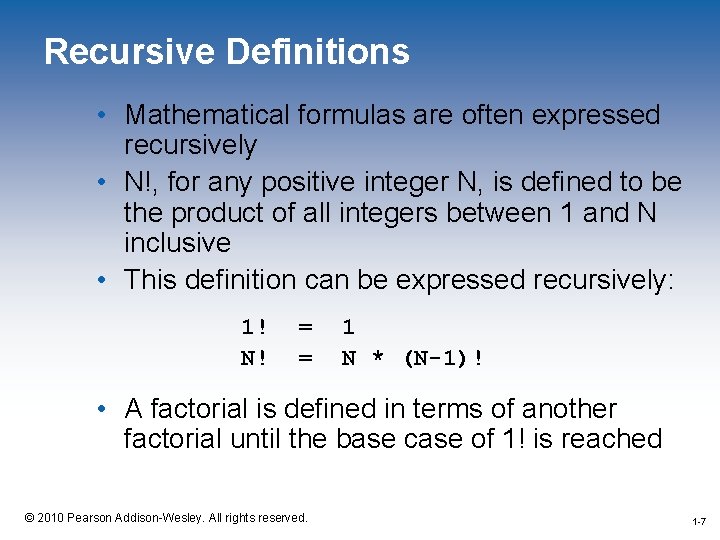
Recursive Definitions • Mathematical formulas are often expressed recursively • N!, for any positive integer N, is defined to be the product of all integers between 1 and N inclusive • This definition can be expressed recursively: 1! N! = = 1 N * (N-1)! • A factorial is defined in terms of another factorial until the base case of 1! is reached 1 -7 © 2010 Pearson Addison-Wesley. All rights reserved. 1 -7
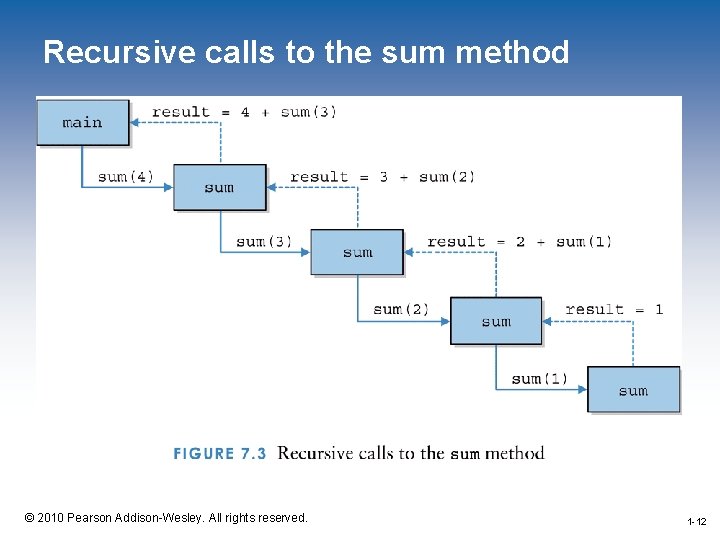
Recursive Programming • A method in Java can invoke itself; if set up that way, it is called a recursive method • The code of a recursive method must be structured to handle both the base case and the recursive case • Each call sets up a new execution environment, with new parameters and new local variables • As always, when the method completes, control returns to the method that invoked it (which may be another instance of itself) 1 -8 © 2010 Pearson Addison-Wesley. All rights reserved. 1 -8
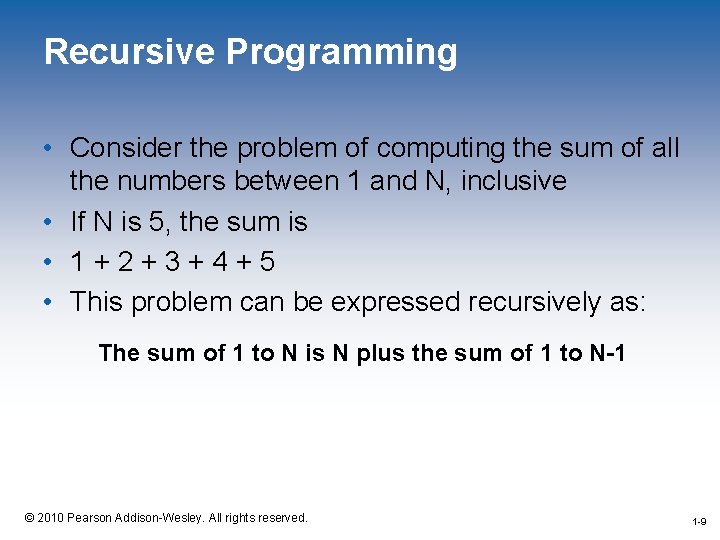
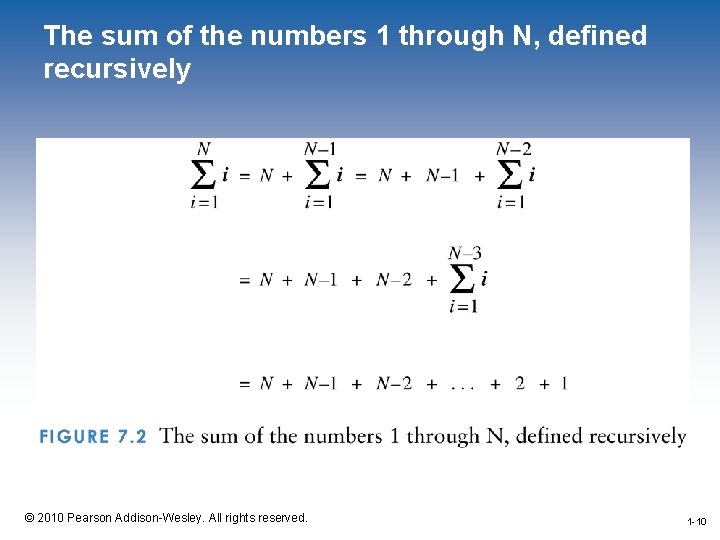
Recursive Programming • Consider the problem of computing the sum of all the numbers between 1 and N, inclusive • If N is 5, the sum is • 1+2+3+4+5 • This problem can be expressed recursively as: The sum of 1 to N is N plus the sum of 1 to N-1 1 -9 © 2010 Pearson Addison-Wesley. All rights reserved. 1 -9
The sum of the numbers 1 through N, defined recursively 1 -10 © 2010 Pearson Addison-Wesley. All rights reserved. 1 -10
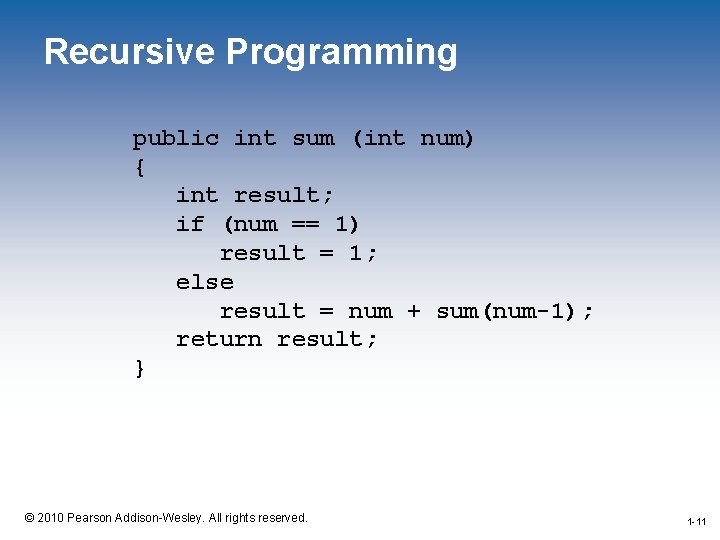
Recursive Programming public int sum (int num) { int result; if (num == 1) result = 1; else result = num + sum(num-1); return result; } 1 -11 © 2010 Pearson Addison-Wesley. All rights reserved. 1 -11
Recursive calls to the sum method 1 -12 © 2010 Pearson Addison-Wesley. All rights reserved. 1 -12
Recursion vs. Iteration • Just because we can use recursion to solve a problem, doesn't mean we should • For instance, we usually would not use recursion to solve the sum of 1 to N • The iterative version is easier to understand (in fact there is a formula that is superior to both recursion and iteration in this case) • You must be able to determine when recursion is the correct technique to use 1 -13 © 2010 Pearson Addison-Wesley. All rights reserved. 1 -13
Recursion vs. Iteration • Every recursive solution has a corresponding iterative solution • For example, the sum of the numbers between 1 and N can be calculated with a loop • Recursion has the overhead of multiple method invocations • However, for some problems recursive solutions are often more simple and elegant than iterative solutions 1 -14 © 2010 Pearson Addison-Wesley. All rights reserved. 1 -14
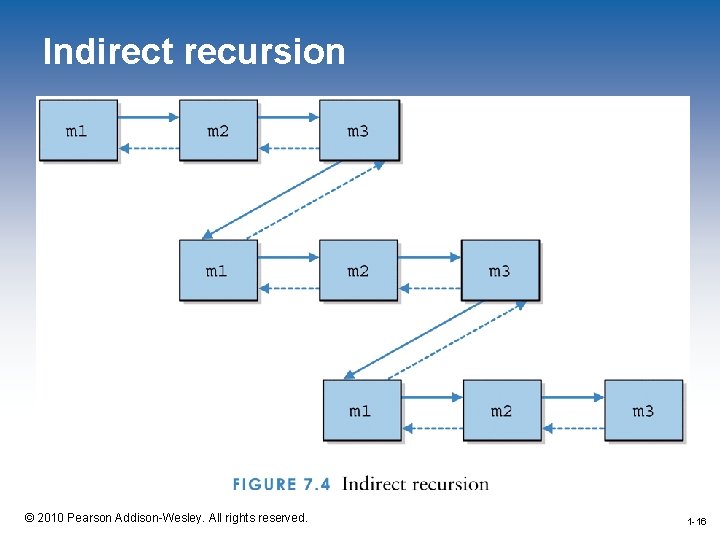
Indirect Recursion • A method invoking itself is considered to be direct recursion • A method could invoke another method, which invokes another, etc. , until eventually the original method is invoked again • For example, method m 1 could invoke m 2, which invokes m 3, which invokes m 1 again • This is called indirect recursion • It is often more difficult to trace and debug 1 -15 © 2010 Pearson Addison-Wesley. All rights reserved. 1 -15
Indirect recursion 1 -16 © 2010 Pearson Addison-Wesley. All rights reserved. 1 -16
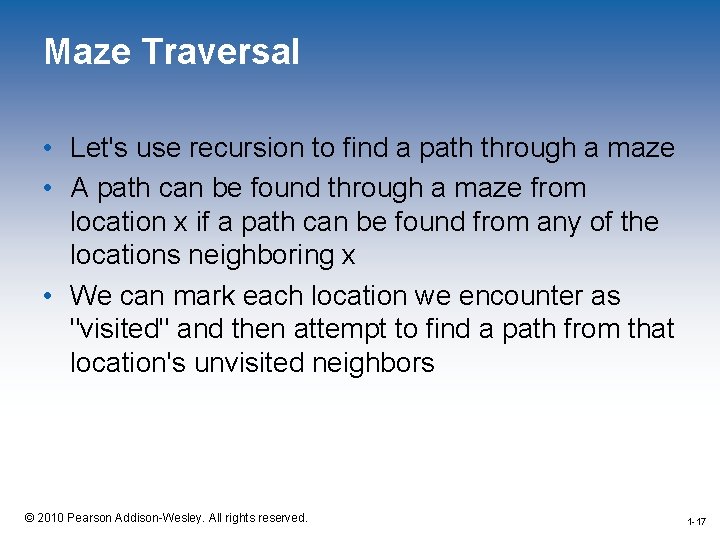
Maze Traversal • Let's use recursion to find a path through a maze • A path can be found through a maze from location x if a path can be found from any of the locations neighboring x • We can mark each location we encounter as "visited" and then attempt to find a path from that location's unvisited neighbors 1 -17 © 2010 Pearson Addison-Wesley. All rights reserved. 1 -17
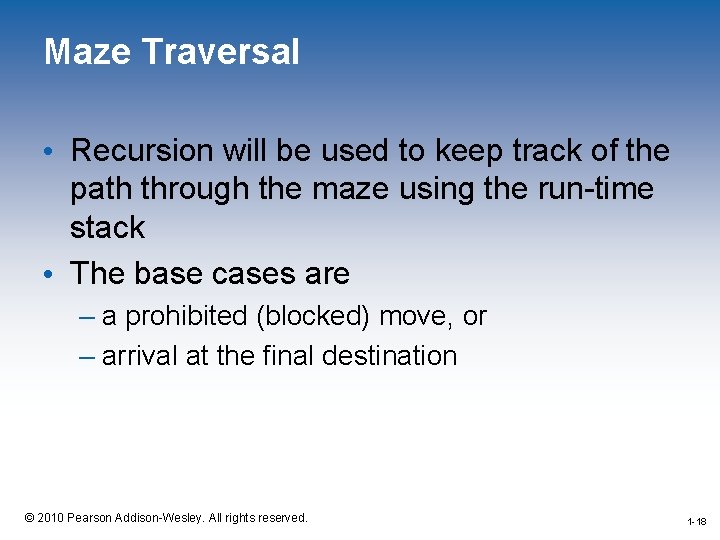
Maze Traversal • Recursion will be used to keep track of the path through the maze using the run-time stack • The base cases are – a prohibited (blocked) move, or – arrival at the final destination 1 -18 © 2010 Pearson Addison-Wesley. All rights reserved. 1 -18
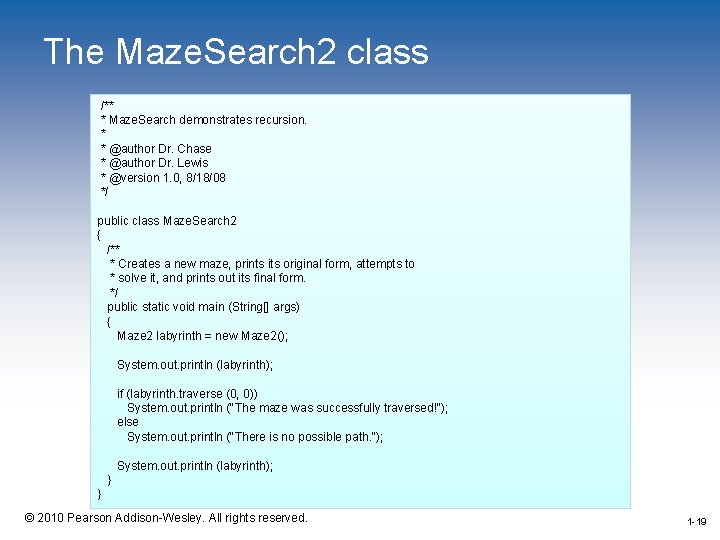
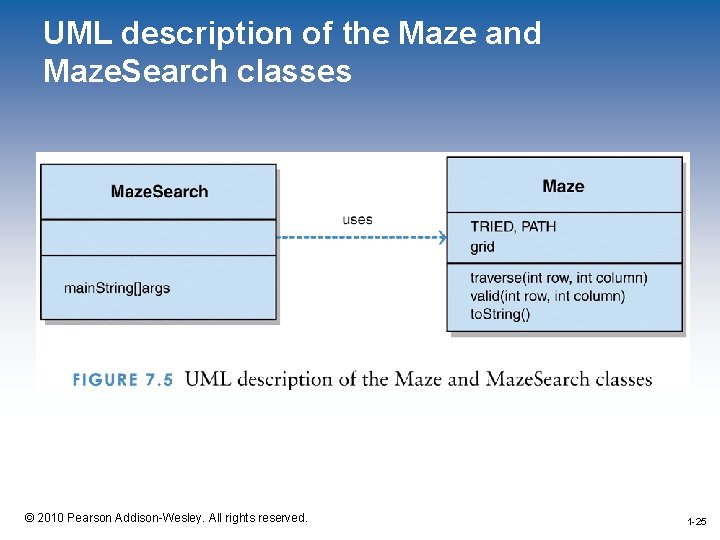
The Maze. Search 2 class /** * Maze. Search demonstrates recursion. * * @author Dr. Chase * @author Dr. Lewis * @version 1. 0, 8/18/08 */ public class Maze. Search 2 { /** * Creates a new maze, prints its original form, attempts to * solve it, and prints out its final form. */ public static void main (String[] args) { Maze 2 labyrinth = new Maze 2(); System. out. println (labyrinth); if (labyrinth. traverse (0, 0)) System. out. println ("The maze was successfully traversed!"); else System. out. println ("There is no possible path. "); System. out. println (labyrinth); } } © 2010 Pearson Addison-Wesley. All rights reserved. 1 -19
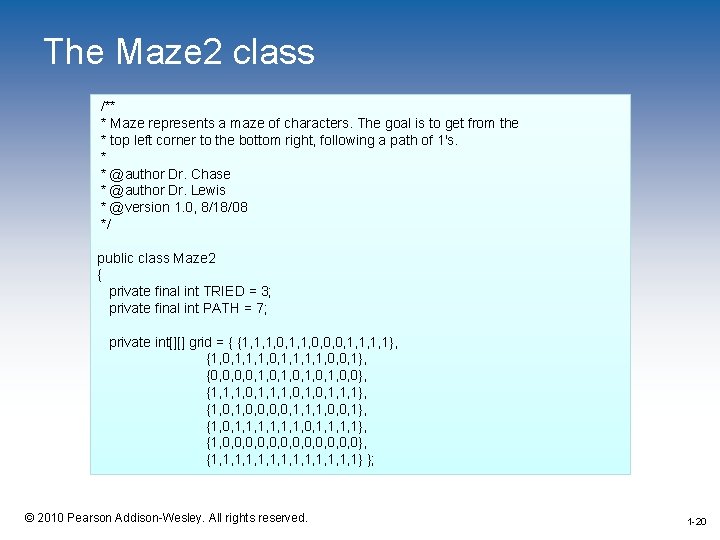
The Maze 2 class /** * Maze represents a maze of characters. The goal is to get from the * top left corner to the bottom right, following a path of 1's. * * @author Dr. Chase * @author Dr. Lewis * @version 1. 0, 8/18/08 */ public class Maze 2 { private final int TRIED = 3; private final int PATH = 7; private int[][] grid = { {1, 1, 1, 0, 0, 0, 1, 1}, {1, 0, 1, 1, 0, 0, 1}, {0, 0, 1, 0, 0}, {1, 1, 1, 0, 1, 1, 1}, {1, 0, 0, 1, 1, 1, 0, 0, 1}, {1, 0, 1, 1, 1, 0, 1, 1}, {1, 0, 0, 0, 0}, {1, 1, 1, 1} }; 1 -20 © 2010 Pearson Addison-Wesley. All rights reserved. 1 -20
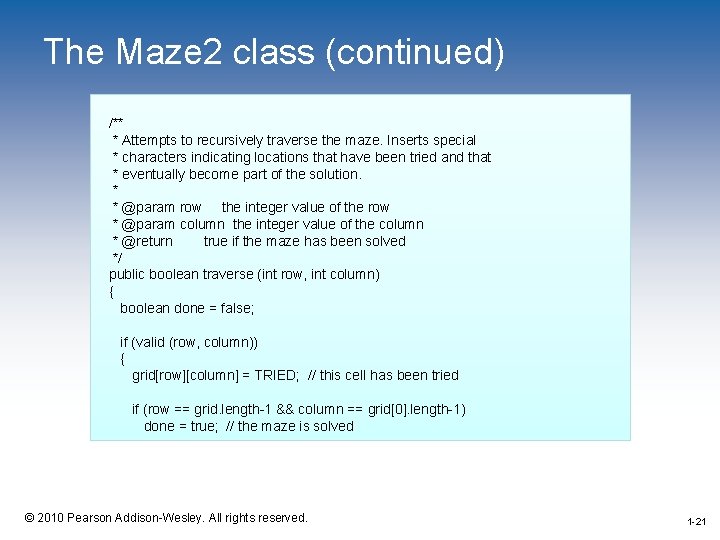
The Maze 2 class (continued) /** * Attempts to recursively traverse the maze. Inserts special * characters indicating locations that have been tried and that * eventually become part of the solution. * * @param row the integer value of the row * @param column the integer value of the column * @return true if the maze has been solved */ public boolean traverse (int row, int column) { boolean done = false; if (valid (row, column)) { grid[row][column] = TRIED; // this cell has been tried if (row == grid. length-1 && column == grid[0]. length-1) done = true; // the maze is solved 1 -21 © 2010 Pearson Addison-Wesley. All rights reserved. 1 -21
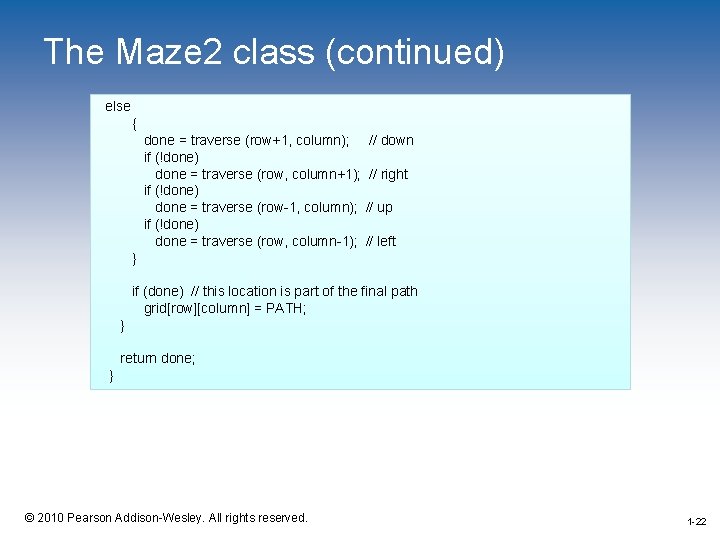
The Maze 2 class (continued) else { done = traverse (row+1, column); if (!done) done = traverse (row, column+1); if (!done) done = traverse (row-1, column); if (!done) done = traverse (row, column-1); // down // right // up // left } if (done) // this location is part of the final path grid[row][column] = PATH; } return done; } 1 -22 © 2010 Pearson Addison-Wesley. All rights reserved. 1 -22
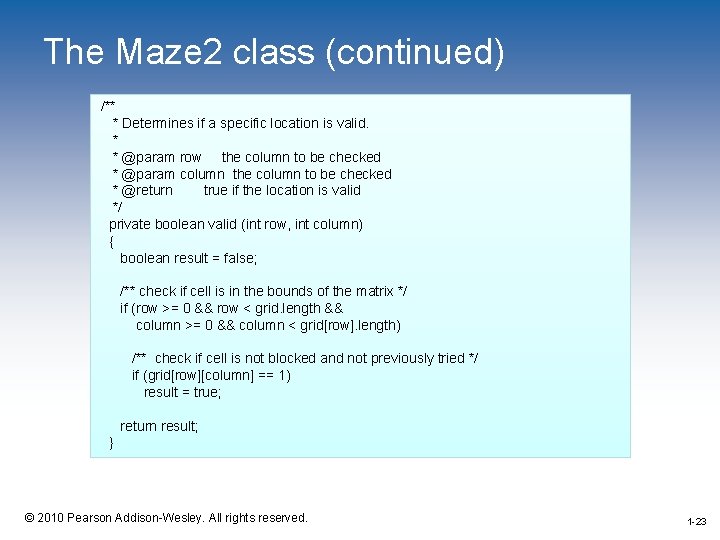
The Maze 2 class (continued) /** * Determines if a specific location is valid. * * @param row the column to be checked * @param column the column to be checked * @return true if the location is valid */ private boolean valid (int row, int column) { boolean result = false; /** check if cell is in the bounds of the matrix */ if (row >= 0 && row < grid. length && column >= 0 && column < grid[row]. length) /** check if cell is not blocked and not previously tried */ if (grid[row][column] == 1) result = true; return result; } 1 -23 © 2010 Pearson Addison-Wesley. All rights reserved. 1 -23
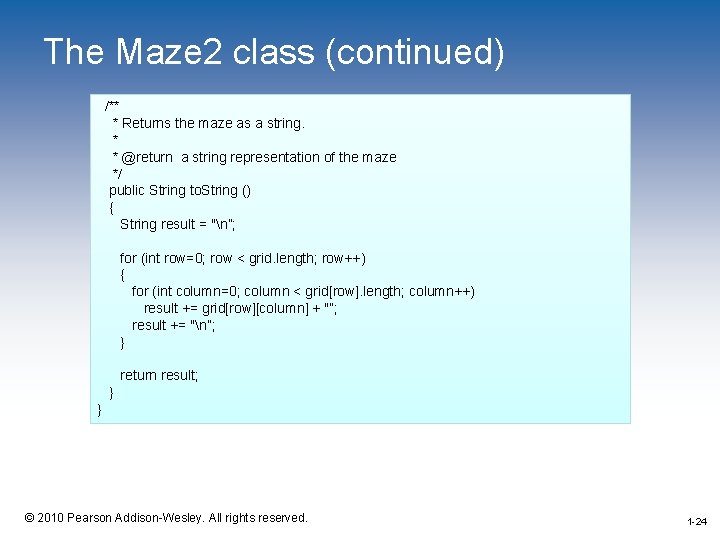
The Maze 2 class (continued) /** * Returns the maze as a string. * * @return a string representation of the maze */ public String to. String () { String result = "n”; for (int row=0; row < grid. length; row++) { for (int column=0; column < grid[row]. length; column++) result += grid[row][column] + "”; result += "n”; } return result; } } 1 -24 © 2010 Pearson Addison-Wesley. All rights reserved. 1 -24
UML description of the Maze and Maze. Search classes 1 -25 © 2010 Pearson Addison-Wesley. All rights reserved. 1 -25
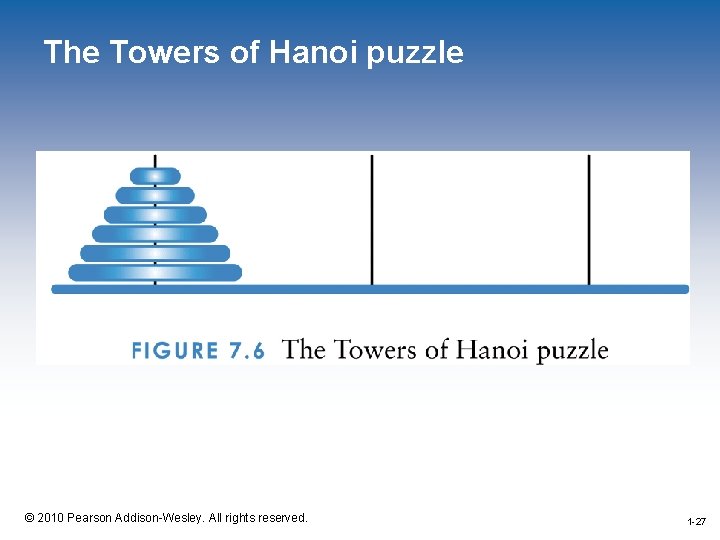
The Towers of Hanoi • The Towers of Hanoi is a puzzle made up of three vertical pegs and several disks that slide onto the pegs • The disks are of varying size, initially placed on one peg with the largest disk on the bottom and increasingly smaller disks on top • The goal is to move all of the disks from one peg to another following these rules: – Only one disk can be moved at a time – A disk cannot be placed on top of a smaller disk – All disks must be on some peg (except for the one in transit) 1 -26 © 2010 Pearson Addison-Wesley. All rights reserved. 1 -26
The Towers of Hanoi puzzle 1 -27 © 2010 Pearson Addison-Wesley. All rights reserved. 1 -27
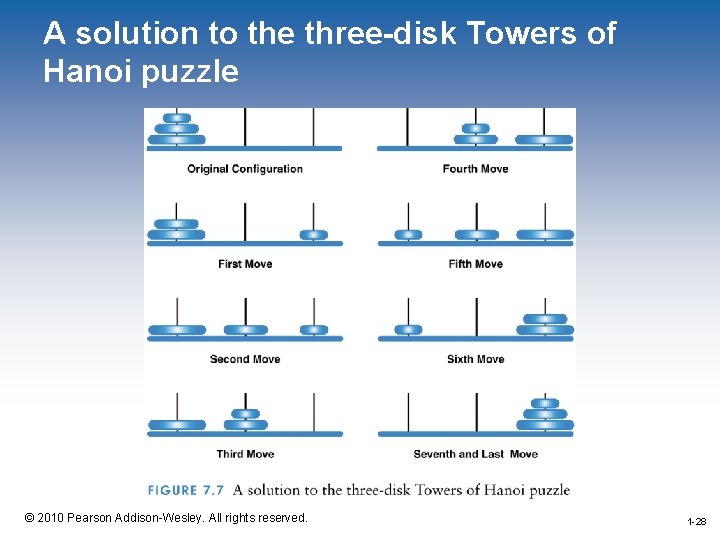
A solution to the three-disk Towers of Hanoi puzzle 1 -28 © 2010 Pearson Addison-Wesley. All rights reserved. 1 -28
Towers of Hanoi • To move a stack of N disks from the original peg to the destination peg: – Move the topmost N-1 disks from the original peg to the extra peg – Move the largest disk from the original peg to the destination peg – Move the N-1 disks from the extra peg to the destination peg • The base case occurs when a "stack" contains only one disk 1 -29 © 2010 Pearson Addison-Wesley. All rights reserved. 1 -29
Towers of Hanoi • Note that the number of moves increases exponentially as the number of disks increases • The recursive solution is simple and elegant to express (and program) • An iterative solution to this problem is much more complex 1 -30 © 2010 Pearson Addison-Wesley. All rights reserved. 1 -30
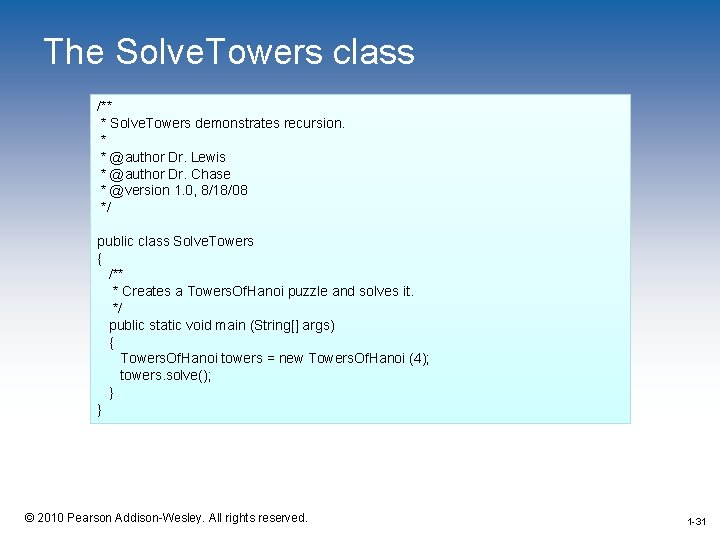
The Solve. Towers class /** * Solve. Towers demonstrates recursion. * * @author Dr. Lewis * @author Dr. Chase * @version 1. 0, 8/18/08 */ public class Solve. Towers { /** * Creates a Towers. Of. Hanoi puzzle and solves it. */ public static void main (String[] args) { Towers. Of. Hanoi towers = new Towers. Of. Hanoi (4); towers. solve(); } } 1 -31 © 2010 Pearson Addison-Wesley. All rights reserved. 1 -31
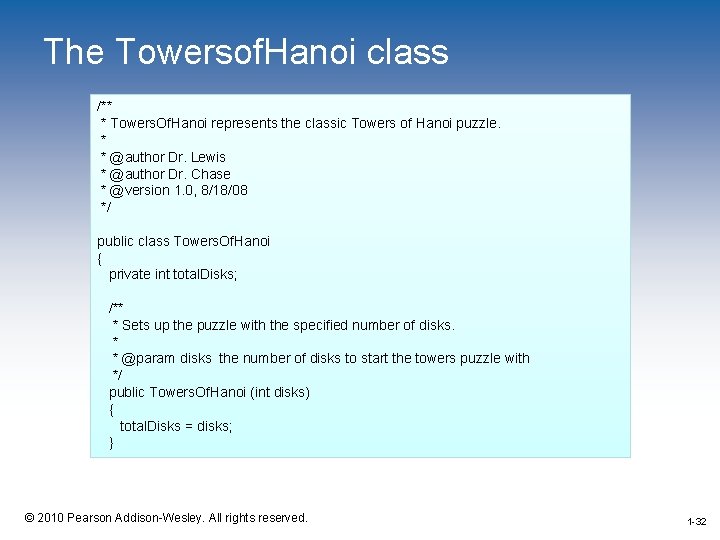
The Towersof. Hanoi class /** * Towers. Of. Hanoi represents the classic Towers of Hanoi puzzle. * * @author Dr. Lewis * @author Dr. Chase * @version 1. 0, 8/18/08 */ public class Towers. Of. Hanoi { private int total. Disks; /** * Sets up the puzzle with the specified number of disks. * * @param disks the number of disks to start the towers puzzle with */ public Towers. Of. Hanoi (int disks) { total. Disks = disks; } 1 -32 © 2010 Pearson Addison-Wesley. All rights reserved. 1 -32
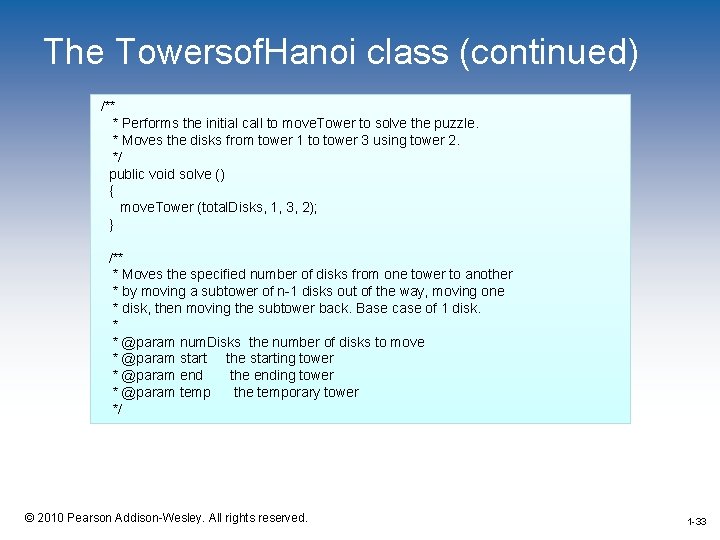
The Towersof. Hanoi class (continued) /** * Performs the initial call to move. Tower to solve the puzzle. * Moves the disks from tower 1 to tower 3 using tower 2. */ public void solve () { move. Tower (total. Disks, 1, 3, 2); } /** * Moves the specified number of disks from one tower to another * by moving a subtower of n-1 disks out of the way, moving one * disk, then moving the subtower back. Base case of 1 disk. * * @param num. Disks the number of disks to move * @param start the starting tower * @param end the ending tower * @param temp the temporary tower */ 1 -33 © 2010 Pearson Addison-Wesley. All rights reserved. 1 -33
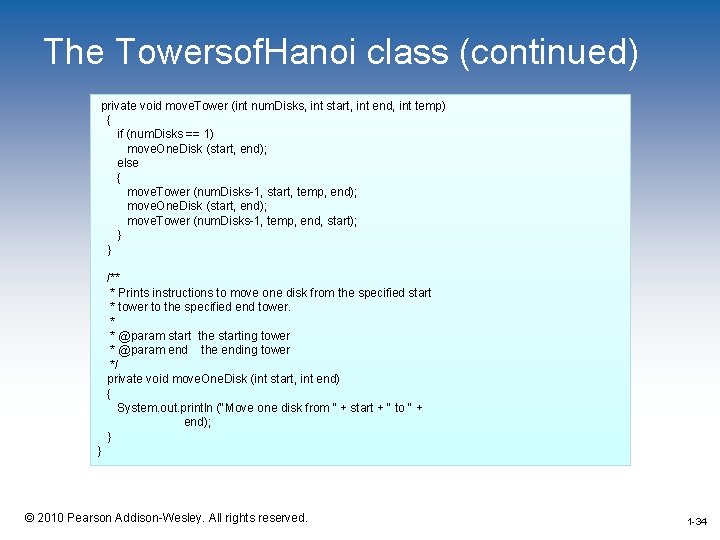
The Towersof. Hanoi class (continued) private void move. Tower (int num. Disks, int start, int end, int temp) { if (num. Disks == 1) move. One. Disk (start, end); else { move. Tower (num. Disks-1, start, temp, end); move. One. Disk (start, end); move. Tower (num. Disks-1, temp, end, start); } } /** * Prints instructions to move one disk from the specified start * tower to the specified end tower. * * @param start the starting tower * @param end the ending tower */ private void move. One. Disk (int start, int end) { System. out. println ("Move one disk from " + start + " to " + end); } } 1 -34 © 2010 Pearson Addison-Wesley. All rights reserved. 1 -34
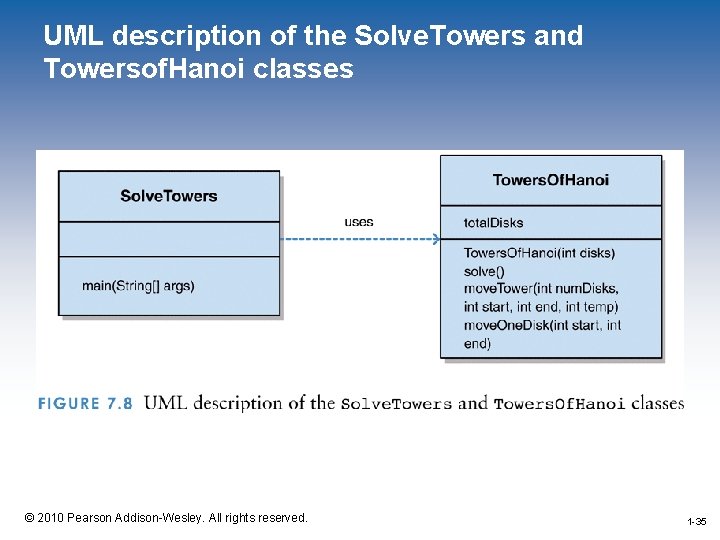
UML description of the Solve. Towers and Towersof. Hanoi classes 1 -35 © 2010 Pearson Addison-Wesley. All rights reserved. 1 -35
Analyzing Recursive Algorithms • When analyzing a loop, we determine the order of the loop body and multiply it by the number of times the loop is executed • Recursive analysis is similar • We determine the order of the method body and multiply it by the order of the recursion (the number of times the recursive definition is followed) 1 -36 © 2010 Pearson Addison-Wesley. All rights reserved. 1 -36
Analyzing Recursive Algorithms • For the Towers of Hanoi, the size of the problem is the number of disks and the operation of interest is moving one disk • Except for the base case, each recursive call results in calling itself twice more • To solve a problem of N disks, we make 2 N-1 disk moves • Therefore the algorithm is O(2 n), which is called exponential complexity 1 -37 © 2010 Pearson Addison-Wesley. All rights reserved. 1 -37