
Chapter 7 Principles of Pharmacology Introduction 1 of

- Slides: 57
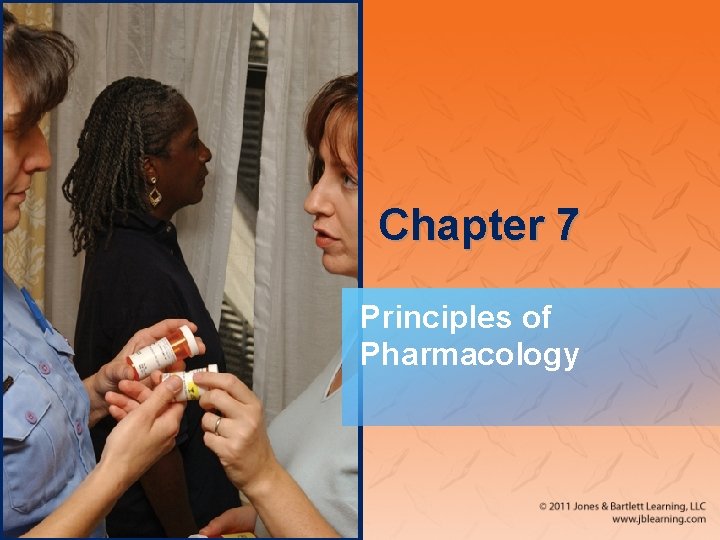
Chapter 7 Principles of Pharmacology
Introduction (1 of 2) • Administering medications is a serious business. • Medications may alleviate pain and improve patient’s well-being. • Used inappropriately, may cause harm and even death.
Introduction (2 of 2) • As an EMT, you will: – Administer medications. – Help patients self-administer medications. – Ask patients about medication use. – Report patient information to hospital personnel.
How Medications Work (1 of 3) • Pharmacology is the science of drugs. • A medication is a chemical substance used to: – Prevent disease – Relieve pain • Pharmacodynamics is a process by which medication works on the body.
How Medications Work (2 of 3) • Agonist: causes stimulation of receptors • Antagonist: binds to a receptor and blocks other medications • Dose: amount of medication given – Depends on weight, age, desired action
How Medications Work (3 of 3) • Action • Indications • Contraindications • Side effects – Unintended effects – Untoward effects
Medication Names (1 of 2) • Generic name is nonproprietary name – Original chemical name of medication – Example: ibuprofen • Trade name is manufacturer’s brand name. – One drug may have more than one trade name – Example: Tylenol
Medication Names (2 of 2) • Prescription medications • Over-the-counter (OTC) medications • Street drugs • Herbal medications • Enhancement drugs • Vitamin supplements
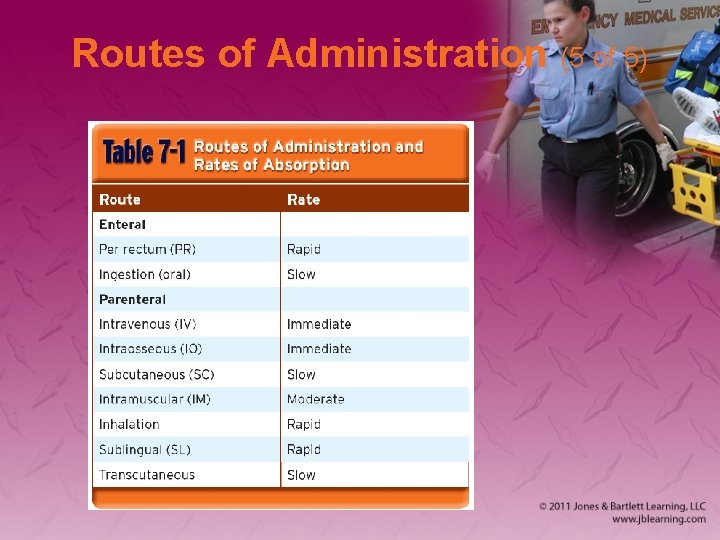
Routes of Administration (1 of 5) • Enteral medications enter body through digestive system. • Parenteral medications enter body by some other means.
Routes of Administration (2 of 5) • Absorption is process by which medications travel through body tissues to bloodstream. • Common routes of administration: – Per rectum (PR)—by rectum – Oral or per os (PO)—by mouth
Routes of Administration (3 of 5) • Common routes of administration (cont’d): – Intravenous (IV)—into the vein – Intraosseous (IO)—into the bone – Subcutaneous (SC)—beneath the skin – Intramuscular (IM)—into the muscle
Routes of Administration (4 of 5) • Common routes of administration (cont’d): – Inhalation—inhaled into the lungs – Sublingual (SL)—under the tongue – Transcutaneous (transdermal)—through the skin – Intranasal (IN)—into nostril via mucosal atomizer device (MAD)
Routes of Administration (5 of 5)
Medication Forms (1 of 2) • Form of medication usually dictates route of administration. • Manufacturer chooses the form to ensure: – Proper route of administration – Timing of its release into the bloodstream – Effects on the target organs or body systems
Medication Forms (2 of 2) • Basic Forms – Tablets and capsules – Solutions and suspensions – Metered-dose inhalers – Topical medications – Transcutaneous medications – Gels – Gases for inhalation
Tablets and Capsules • Capsules are gelatin shells filled with powdered or liquid medication. • Tablets often contain other materials that are mixed with the medication and compressed.
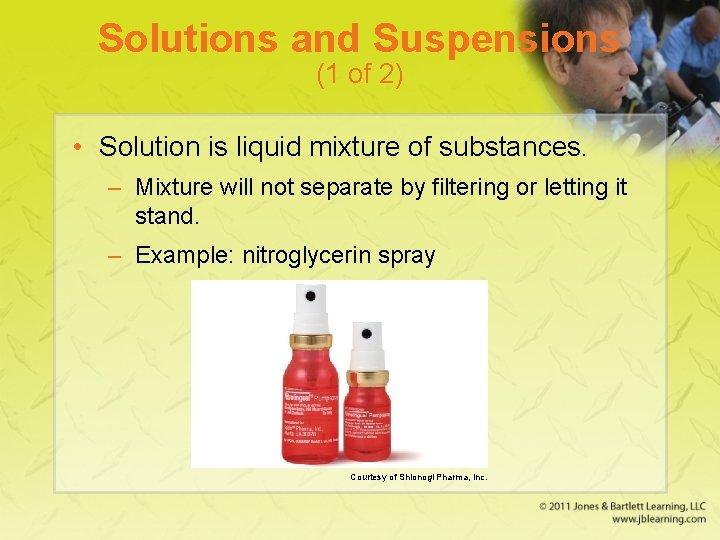
Solutions and Suspensions (1 of 2) • Solution is liquid mixture of substances. – Mixture will not separate by filtering or letting it stand. – Example: nitroglycerin spray Courtesy of Shionogi Pharma, Inc.
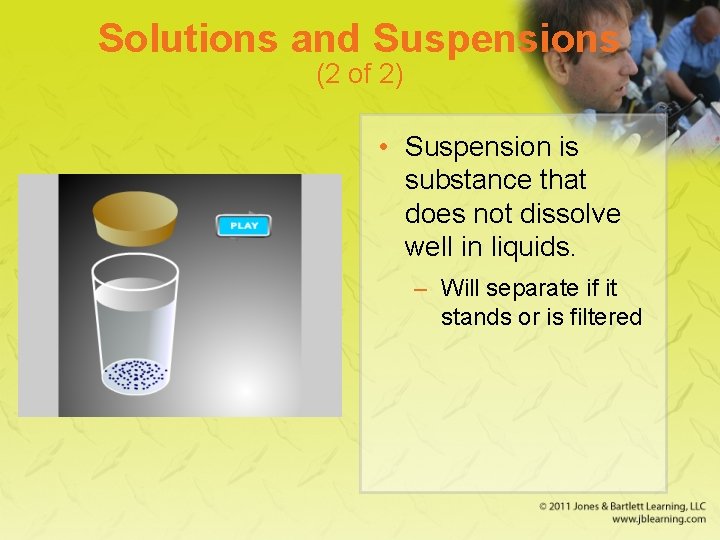
Solutions and Suspensions (2 of 2) • Suspension is substance that does not dissolve well in liquids. – Will separate if it stands or is filtered
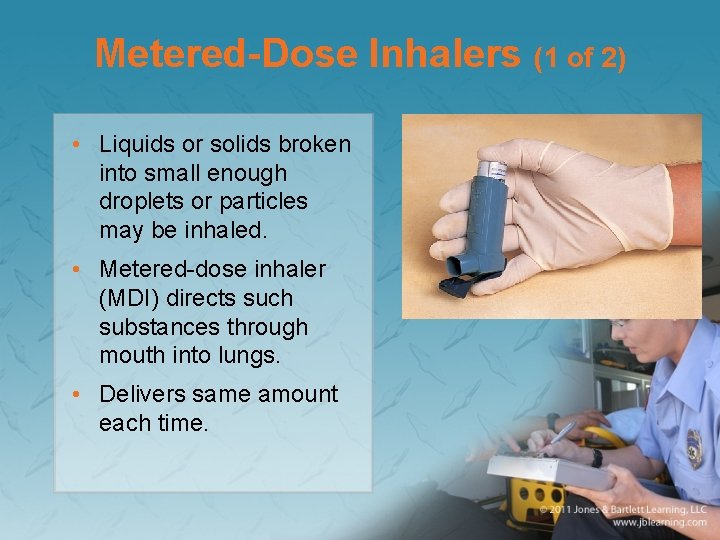
Metered-Dose Inhalers (1 of 2) • Liquids or solids broken into small enough droplets or particles may be inhaled. • Metered-dose inhaler (MDI) directs such substances through mouth into lungs. • Delivers same amount each time.
Metered-Dose Inhalers (2 of 2)
Topical Medications • Include lotions, creams, ointments • Applied to skin surface and only affect that area • Examples – Lotion: Calamine lotion – Cream: hydrocortisone cream – Ointment: Neosporin ointment
Transcutaneous Medications (1 of 2) • Also referred to as transdermal • Designed to be absorbed through skin • Many have systemic effects. • Examples: – Nitroglycerin paste – Adhesive patch
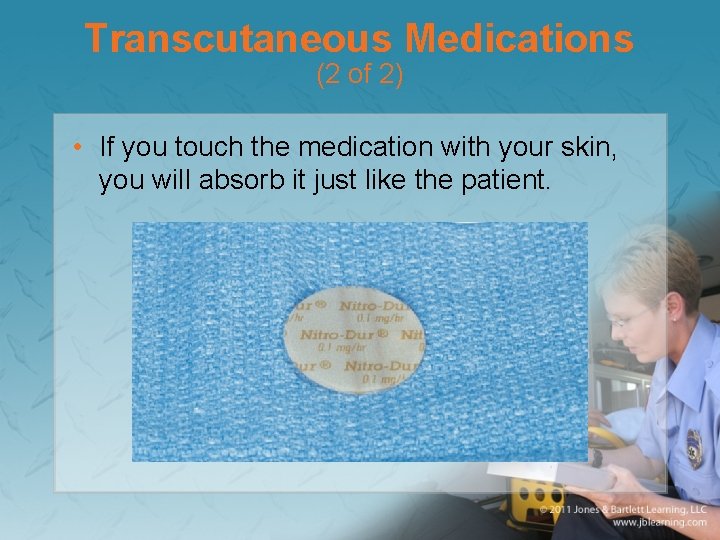
Transcutaneous Medications (2 of 2) • If you touch the medication with your skin, you will absorb it just like the patient.
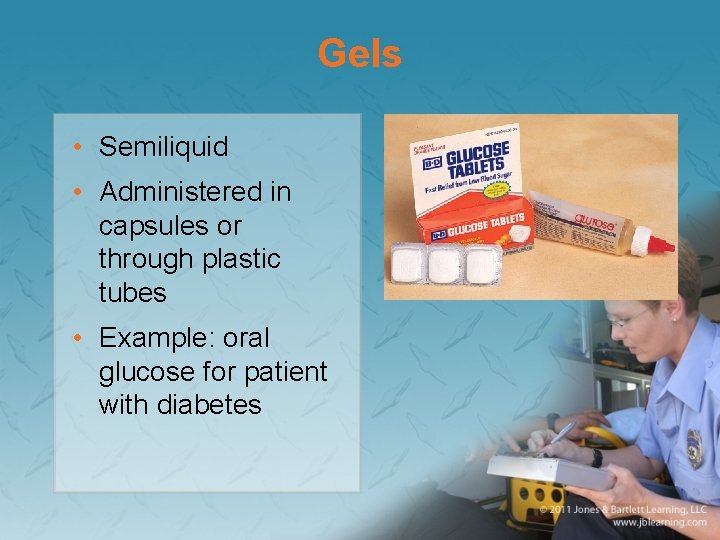
Gels • Semiliquid • Administered in capsules or through plastic tubes • Example: oral glucose for patient with diabetes
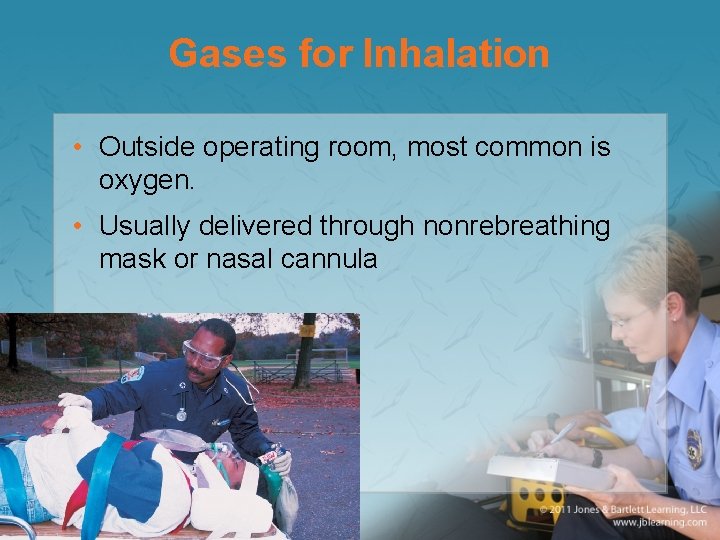
Gases for Inhalation • Outside operating room, most common is oxygen. • Usually delivered through nonrebreathing mask or nasal cannula
General Steps in Administering Medication (1 of 2) • Only administer medications with order from medical control. • Follow “six rights” of medication administration
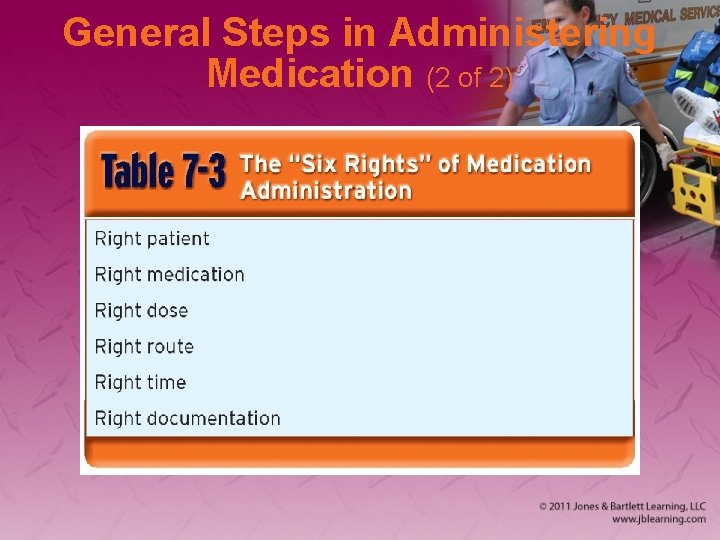
General Steps in Administering Medication (2 of 2)
Medication Administration and the EMT (1 of 2) • Unit may carry: – Oxygen – Oral glucose – Activated charcoal – Aspirin – Epinephrine
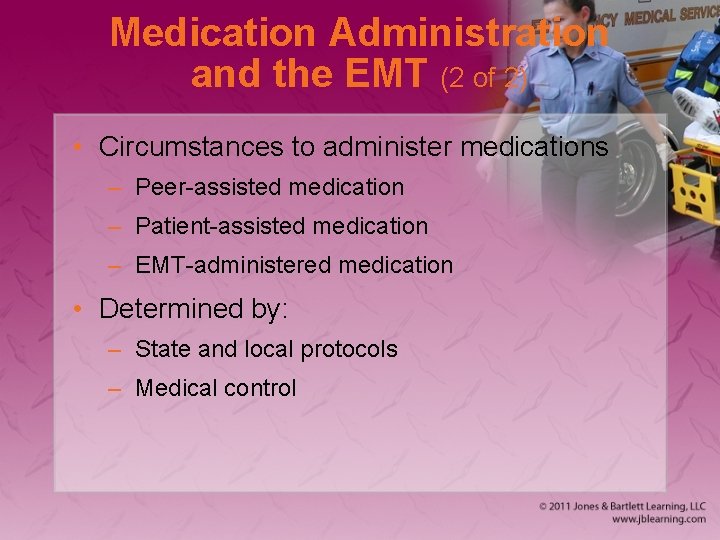
Medication Administration and the EMT (2 of 2) • Circumstances to administer medications – Peer-assisted medication – Patient-assisted medication – EMT-administered medication • Determined by: – State and local protocols – Medical control
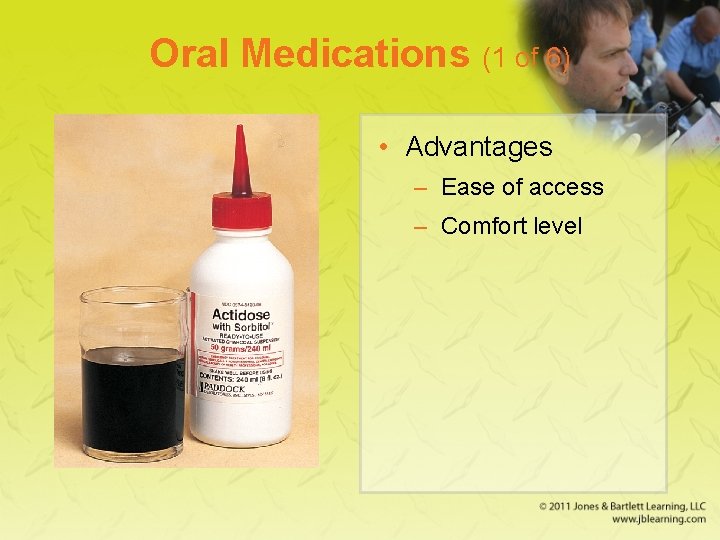
Oral Medications (1 of 6) • Advantages – Ease of access – Comfort level
Oral Medications (2 of 6)
Oral Medications (3 of 6) • Disadvantages – Digestive tract can be easily affected by foods, stress, and illness. – Speed of movement of food through the tract dramatically changes the speed of absorption.
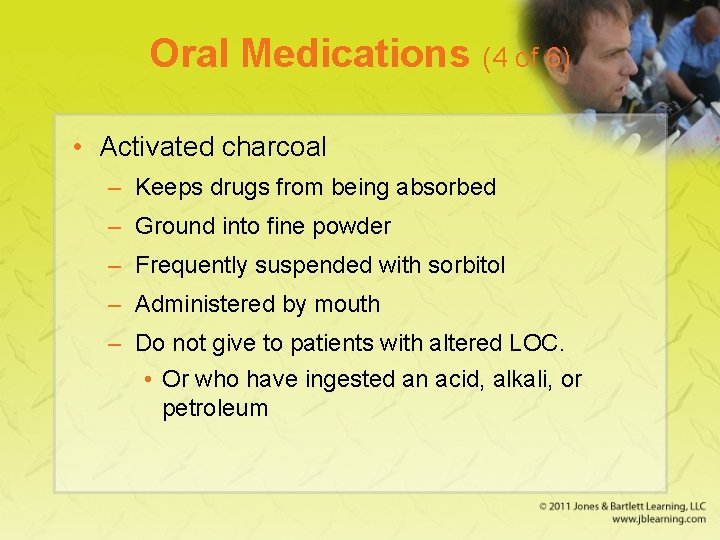
Oral Medications (4 of 6) • Activated charcoal – Keeps drugs from being absorbed – Ground into fine powder – Frequently suspended with sorbitol – Administered by mouth – Do not give to patients with altered LOC. • Or who have ingested an acid, alkali, or petroleum
Oral Medications (5 of 6) • Oral glucose – A sugar that cells use for energy – Treats hypoglycemia – EMTs only give it by mouth. – Do not give to unconscious patient or one who cannot protect airway.
Oral Medications (6 of 6) • Aspirin – Reduces fever, pain, inflammation – Inhibits platelet aggregation • Useful during heart attack – Contraindications • Hypersensitivity to aspirin • Liver damage, bleeding disorder, asthma • Children during fever-causing illness
Sublingual Medications (1 of 6) • Advantages – Easy to advise patients – Quick absorption • Disadvantages – Constant evaluation of the airway – Possible choking – Not for uncooperative or unconscious patients
Sublingual Medications (2 of 6) • Nitroglycerin – Relieves angina pain (cardiac patients) – Increases blood flow – Relaxes veins – Before administering: • Check blood pressure • Obtain order to administer
Sublingual Medications (3 of 6) • Nitroglycerin (cont’d) – Possibility of MI, if no relief – Should not be used with erectile dysfunction medications – May cause mild headache
Sublingual Medications (4 of 6) • Nitroglycerin (cont’d) – Administration by tablet • Sublingually under tongue • Slight tingling or burning • Storage is important. – Administration by metered-dose spray • On or under tongue • One spray = one tablet
Sublingual Medications (5 of 6)
Sublingual Medications (6 of 6) • There administration considerations (for both tablet and spray). – Wait 5 minutes before repeating dose. – Monitor vital signs. – Wear gloves. – Know local protocols.
Intramuscular Medications (1 of 5) • Advantages – Quick, easy access without using vein – Stable blood flow to muscles • Disadvantages – Use of a needle (and subsequent pain) – Patients may fear pain or injury.
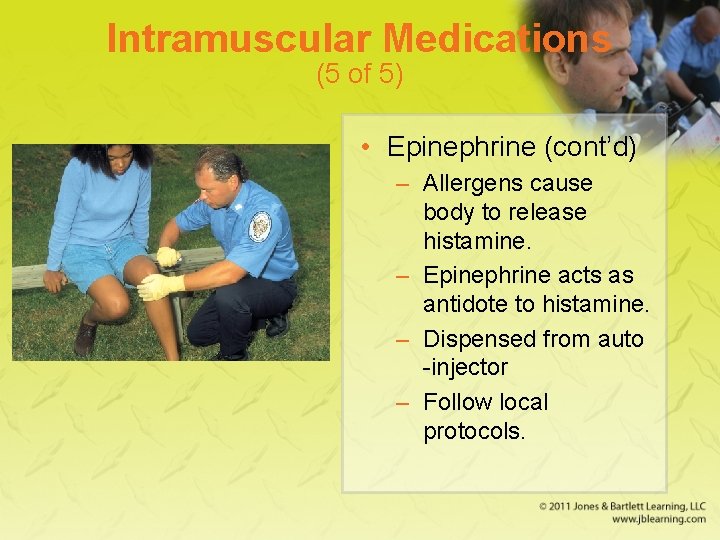
Intramuscular Medications (2 of 5) • Epinephrine – Controls fight-or-flight response – Primary medication for delivery IM – Also called adrenaline, released inside body under stress – Sympathomimetic
Intramuscular Medications (3 of 5) • Epinephrine (cont’d) – Increases heart rate and constricts blood vessels – Do not give to patients with hypertension, hypothermia, an MI, wheezing. – May be delivered with an auto-injector to treat life-threatening anaphylaxis
Intramuscular Medications (4 of 5)
Intramuscular Medications (5 of 5) • Epinephrine (cont’d) – Allergens cause body to release histamine. – Epinephrine acts as antidote to histamine. – Dispensed from auto -injector – Follow local protocols.
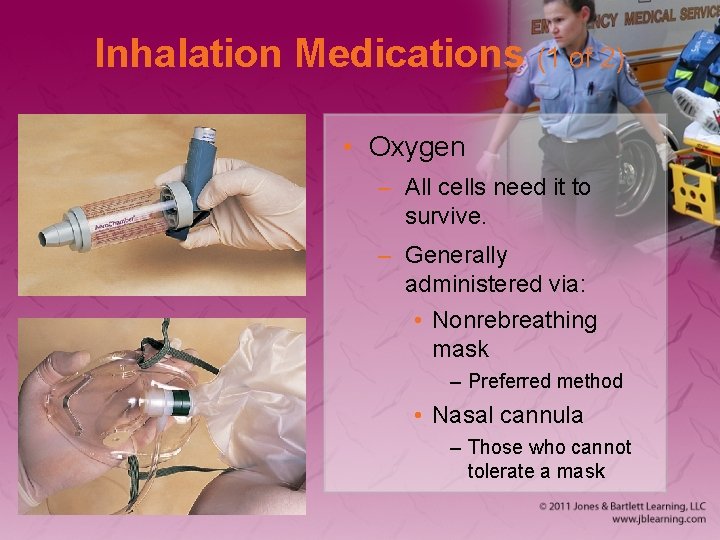
Inhalation Medications (1 of 2) • Oxygen – All cells need it to survive. – Generally administered via: • Nonrebreathing mask – Preferred method • Nasal cannula – Those who cannot tolerate a mask
Inhalation Medications (2 of 2) • MDIs and nebulizers – Liquid turned into mist or spray – Medication is breathed in and delivered to alveoli. – Absorption rate is fast. – Easy route to access – Portable
Patient Medications • Patient assessment includes finding out medications patient is taking. – Provides vital clues to patient’s condition – Guides treatment – Will be useful to emergency department
Summary (1 of 8) • Pharmacology is the science of drugs, including their ingredients, preparation, uses, and actions on the body.
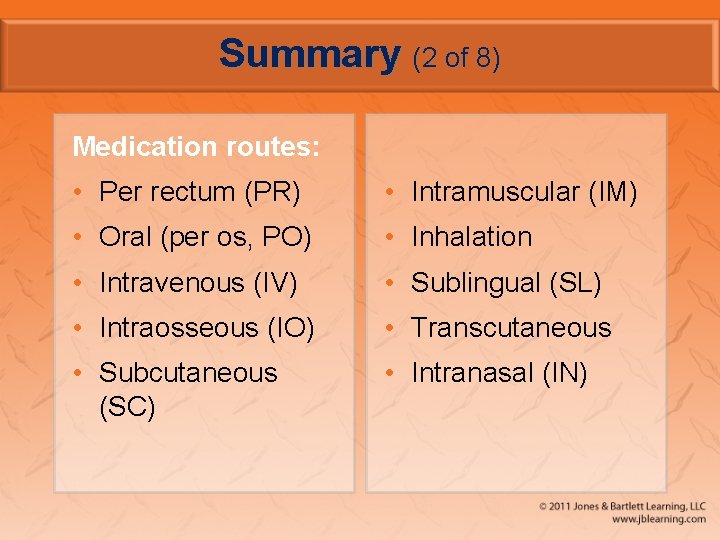
Summary (2 of 8) Medication routes: • Per rectum (PR) • Intramuscular (IM) • Oral (per os, PO) • Inhalation • Intravenous (IV) • Sublingual (SL) • Intraosseous (IO) • Transcutaneous • Subcutaneous (SC) • Intranasal (IN)
Summary (3 of 8) • Medication forms – Tablets and capsules – Solutions and suspensions – Metered-dose inhalers (MDIs) – Topical medications – Transcutaneous medications – Gels – Gases for inhalation
Summary (4 of 8) • The administration of any medication requires approval by medical control, through direct orders given online or standing orders that are part of the local protocols.
Summary (5 of 8) • Six rights of medication administration – Right patient – Right medication – Right dose – Right route – Right time – Right documentation
Summary (6 of 8) • After the medication has been administered, document: – Reassessed vital signs – Patient’s history – Assessment – Treatment – Response findings
Summary (7 of 8) • EMS medications – Activated charcoal – Oral glucose – Aspirin – Nitroglycerin – Epinephrine – Oxygen
Summary (8 of 8) • Knowing what medications a patient takes is important to: – Provide vital clues about your patient’s condition – Inform you of any chronic or underlying conditions – Guide your treatment – Report to the emergency department physician