
Chapter 7 Principles of Asset Valuation Objective Explain

Chapter 7: Principles of Asset Valuation Objective Explain the principles of asset evaluation 1 Copyright © Prentice Hall Inc. 1999. Author: Nick Bagley
Chapter 7 Contents • 1 The relationship between an asset’s value & price • 6 Exchange rates & triangular arbitrage • 2 Value maximization & financial decisions • 7 Valuation using comparables • 3 The law of one price & arbitrage • 8 Valuation Models • 4 Arbitrage & the law of one price • 5 Interest rates & the law of one price • 9 Accounting measures of value • 10 How information is reflected in security prices • 11 The efficient markets hypothesis 2
Introduction • Recall that the three pillars of finance are – time value of money – risk management – asset valuation • Many financial decisions are, in essence, the determination of an asset’s value 3

Introduction (Continued) • The key to asset valuation is comparison of the asset to be valued with a set of assets with similar characteristics and known values • By the law of one price, the price of all equivalent assets must be the same 4

7. 1 Relationship between Asset Value and Price • Definition: • An asset’s fundamental value is the price well informed investors must pay to purchase it in a free and competitive market 5

Relationship between Asset Value and Price • There can exist temporary differences between the market price of an asset and its fundamental value – Security analysts make their living by discovering these aberrations – Many well-informed professionals are looking for these aberrations. A reasonable initial assumption is that aberrations are small 6

7. 2 Value Maximization and Financial Decisions • Financial decisions can be made rationally purely on the basis of value maximization, and without regard to risk preferences and expectations • Markets for financial assets provide the information needed to choose between some alternatives 7
7. 3 The Law of One Price • Law of One Price: – In a competitive market, if two assets are equivalent, they will tend to have the same price 8
The Law of One Price and Arbitrage • The law of one price is enforced by a process called arbitrage • Arbitrage is the purchasing of a set of assets, and immediate sale of another set of assets, in such a way as to earn a sure profit from price differences 9
The Law of One Price and Arbitrage • Arbitrageurs engage in the business of trading similar assets with a price differential that cannot be justified by transaction- and transformation-costs • Example: Gold in any two parts of the country should not differ by more than the transaction costs of moving it 10
7. 4 Arbitrage and the Prices of Financial Assets • Arbitraging by shipping a physical commodity (gold) involves higher transaction costs than arbitraging financial assets (shares of stock) • We expect the same financial commodity trading on two markets to be priced very closely 11
Arbitrage and the Prices of Financial Assets • The rule of one price is the most fundamental valuation principle in finance. – If two very similar securities trade at significantly different prices, we first suspect • Interference with normal market operation • Some unrecognized difference between the two assets 12
Arbitrage and the Prices of Financial Assets • No two non-identical assets are exactly alike, and there may be occasions when two similar assets trade at different prices – Dollar bills with certain serial numbers are very valuable to players of liar’s poker – Not even a dollar is always worth a dollar! 13
7. 5 Interest Rates and the Law of One Price • If two organizations with similar creditworthiness issue bonds with similar terms, then their interest rates will be similar – Take care to ensure that there are no subtle differences in • the tax status of the bonds • the value of collateral or backing of the bonds 14

7. 6 Exchange Rates and Triangular Arbitrage • The law of one price also applies to foreign exchange markets • If three currencies are freely convertible in competitive markets, then it is enough know any two exchange rates to compute third exchange rate 15
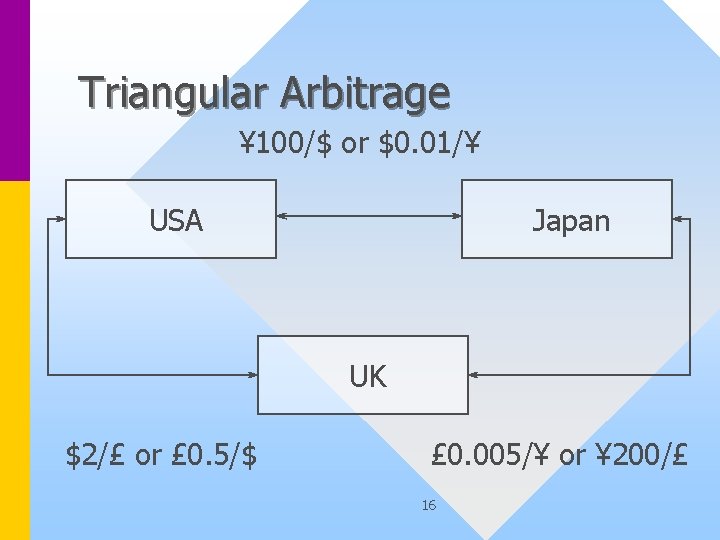
Triangular Arbitrage ¥ 100/$ or $0. 01/¥ USA Japan UK $2/£ or £ 0. 5/$ £ 0. 005/¥ or ¥ 200/£ 16
Triangular Arbitrage • Every country has its own conventions for expressing exchange rates – Traders in the U. K. express exchange rates as foreign currency per pound – Traders in the U. S. A. express exchange rates as dollars per unit of foreign currency – In the case of $/£ exchange rates, dealers in both countries use the same rate, say 2 $/£ 17
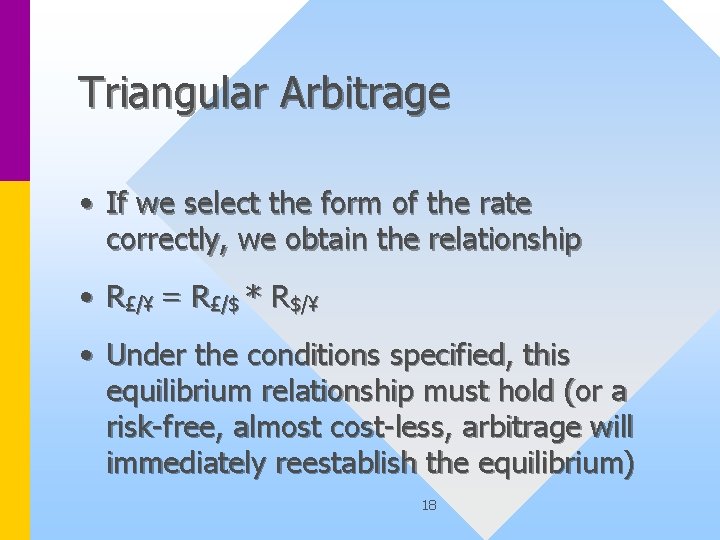
Triangular Arbitrage • If we select the form of the rate correctly, we obtain the relationship • R£/¥ = R£/$ * R$/¥ • Under the conditions specified, this equilibrium relationship must hold (or a risk-free, almost cost-less, arbitrage will immediately reestablish the equilibrium) 18
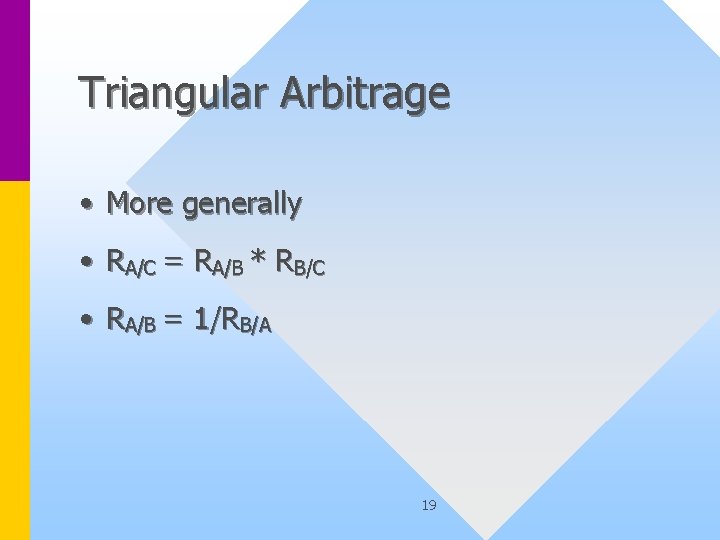
Triangular Arbitrage • More generally • RA/C = RA/B * RB/C • RA/B = 1/RB/A 19
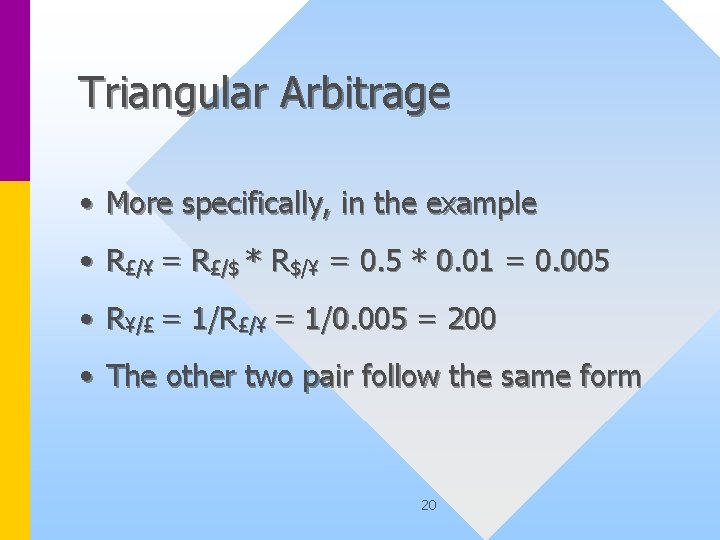
Triangular Arbitrage • More specifically, in the example • R£/¥ = R£/$ * R$/¥ = 0. 5 * 0. 01 = 0. 005 • R¥/£ = 1/R£/¥ = 1/0. 005 = 200 • The other two pair follow the same form 20
Triangular Arbitrage – If this relationship were to fail significantly, then traders would profit by immediately moving large sums of money round the diagram clockwise or anti-clockwise – Currency traders may borrow large amounts of money at close to government rates – Aberrations have only fleeting existences 21
7. 7 Valuation Using Comparables • Some assets are not traded, or are only traded infrequently, but we still need to evaluate them • The law of one price may be used to evaluate assets, even when arbitrage can not be used to enforce the law 22
Valuation Using Comparables • Two cases – a work of art in an estate that needs to be evaluated for computation of estate taxes – a home that needs to be evaluated to ensure the fairness of property taxes 23
Valuation Using Comparables • To evaluate the non-trading asset, one finds comparable prices of traded assets – It is useful to think of asset prices in a feature-time framework • Similar assets have prices that tend to move up and down together in time • At a particular time, differences in asset prices are largely accountable in terms of differences in features 24
Valuation Using Comparables • To evaluate a work of art, it is necessary to find assets that are “close” in featuretime space – The closer the features match, the longer the data collection period may be – The closer to the present time an asset was sold, the more diverse the features may be • Both kinds of “closeness” are needed 25
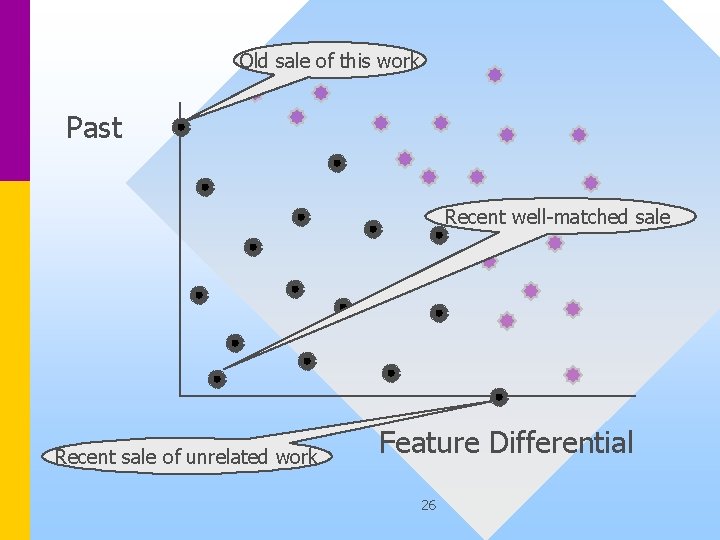
Old sale of this work Past Recent well-matched sale Recent sale of unrelated work Feature Differential 26
Valuation Using Comparables • In the above diagram, the black stars indicate usable price exemplars, and the pink stars indicate poor exemplars • The variable “feature” is a aggregate of many factors, some objective, some subjective 27

Valuation Using Comparables • Example – Collect prices and feature differentials for • art by the same artist: 10 -years • art of the same quality: 5 -years • art from the same school: 5 -years • broadly similar art: 2 -years 28
Valuation Using Comparables • From this information you can – determine price trends in the general art market – obtain trend-adjusted benchmark prices – gain an understanding of how to adjust the benchmark for feature differences 29
7. 8 Valuation Models • A valuation model is a quantitative method used for estimating an asset’s value from known prices of other assets that are not its exact equivalent • The valuation model employed may depend on the purpose of the evaluation – traditional shareholder v. take-over specialist 30
Stock Evaluation using P/Es • The price-over-earnings ratios of similar companies are determined • Based on these, an estimate is made of the p/e ratio of the non-priced firm • The earnings of the firm are multiplied by this p/e ratio to obtain an evaluation 31
Stock Evaluation using P/Es • The accuracy of this method depends on the appropriateness of the exemplar firms • Future profitability, accounting methods, leverage, technology, and a host of other factors, will affect the exemplars’ p/e ratios 32
Valuation Model Refinement • You are a security analyst for an asset • You have developed a valuation model you believe is superior to valuation models used by other traders • Assuming the superior model remains proprietary, it may be difficult to exploit it 33
Valuation Model Refinement • When a market is driven by a valuation model, using a superior model may lead to inferior trading performance – arbitrage strategies created using the “superior model” are sometimes less effective than those of the standard model – when using a superior propriety model, you need to be selective about when to employ it 34
P/E Ratio and Small Businesses • You already have enough theoretical knowledge to price a small business correctly using NPV • Traditionally, small businesses were priced using P/Es (sub-optimal model) • This leads to price aberrations from which you can still benefit (use NPV) 35
Tax Cheats • Some small bars, restaurants, hairdressers, and other cash businesses cheat the IRS by keeping two sets of books – Assuming a p/e ratio of 8, such a business will lose $8 for every $1/year cheated when it comes to selling the business – Such businesses are “dressed for sale” a couple of years prior to the planned sale 36
7. 9 Accounting Measures of Value • Owner’s equity is not an accurate indicator of the firm’s market value – Assets and liabilities are not market priced • marking the balance sheet to market helps – Intangibles are under-included • a firm is a going concern, not just its physical assets and liabilities 37
7. 10 How Information is reflected in Security Prices • Sometimes a stock price will rise sharply with the release of information – An important drug has achieved an important step on its road to being marketed – Poor trading results are announced, but they are better than those anticipated by traders – An unanticipated positive Fed announcement 38
How Information is reflected in Security Prices • Market traders form probability distributions of key stock-price determinants (Example, sales revenue) • When these distributions change to assimilate new information, the stock market reacts, and the price changes – This leads to the efficient market hypothesis 39
7. 11 Efficient Market Hypothesis • The efficient market hypothesis states – an asset’s current price reflects all publicly available information about future economic fundamentals affecting market price 40
Efficient Market Hypothesis • The mechanism leading to the efficient market’s hypothesis – Collection of relevant information – Analysis of this information to obtain a price – Trading on this analysis until the price aberration is eliminated 41

Collection of Relevant Information • Collect information or “facts” about a company, and the factors that may affect it – SEC filings, annual reports, clipping services, conferences with CEO /CFO, industry analyses, patent filings, rumors, discussions with competitors and customers, informal market surveys, advertising campaigns, recruitment activity, technological surveys… 42
Analysis of this Information • At one time, analysts were content to form just a point estimate of the price • Today, analysts try to incorporate probability into their pricing, by working with ranges, for instance • The more accurate the information, the smaller the price dispersion -> less risk 43
Trading on this Analysis • Based on her estimates, the analyst may recommend a trade – The magnitude of resulting trades depend on her past successes and her current status – Barriers to entry are low, and successful analysts are well rewarded & gain influence • Result: Knowledgeable individuals keep the market efficient 44
- Slides: 44