
Chapter 7 Price and Customers Perceptions of Value

- Slides: 33
Chapter 7 Price and Customers’ Perceptions of Value Mc. Graw-Hill/Irwin © 2003 The Mc. Graw-Hill Companies, Inc. , All Rights Reserved.
Chapter Objectives • To understand that eventually the external reference price must be internalized in some way to affect the buyer’s decision • To understand how buyers use price and quality to make purchase judgments and decisions • The size of sums of money appears to vary in a remarkable way according to whether they are being paid out or paid in. -Julian Huxley Mc. Graw-Hill/Irwin © 2003 The Mc. Graw-Hill Companies, Inc. , All Rights Reserved.
Price and Perceived Value • The context of the place of purchase affects the purchase decision – Buying beer at a fancy hotel vs. a small, rundown grocery store • The availability of information affects the purchase decision – More weight on information that is most readily available, or easily recalled from memory Mc. Graw-Hill/Irwin © 2003 The Mc. Graw-Hill Companies, Inc. , All Rights Reserved.
Price and Perceived Value • The anchoring affect has a direct impact on pricing – The order of price presentation, the low or high prices in a product line, and the original price of a product • People tend to choose an alternative they associate with some past success or refuse to choose an alternative they associate with a previous failure Mc. Graw-Hill/Irwin © 2003 The Mc. Graw-Hill Companies, Inc. , All Rights Reserved.
Price-Perceived Quality Relationship • Buyers use cues to determine the product or service quality – Extrinsic cues are product-related attributes but they are not part of the product • Price, brand name, packaging – Intrinsic cues are product-related attributes but they cannot be changed without altering the physical properties of the product Mc. Graw-Hill/Irwin © 2003 The Mc. Graw-Hill Companies, Inc. , All Rights Reserved.
Price-Perceived Quality Relationship • Other external cues include: – – – Store Brand name Product warranties and guarantees Product’s country of origin Perceived product and price differences Buyers’ familiarity with the product or service • Only when perceived differences between prices and product attributes (internal cues) are relatively large would significant differences in buyers’ perceptions of quality occur! Mc. Graw-Hill/Irwin © 2003 The Mc. Graw-Hill Companies, Inc. , All Rights Reserved.
Price and Perceived Value Mc. Graw-Hill/Irwin © 2003 The Mc. Graw-Hill Companies, Inc. , All Rights Reserved.
Price-Perceived Quality Relationship • The strength of the use of price or other external cues, such as brand or store name, as indicators of product quality, depends on the relative perceived differences between different cues and on the degree to which buyers know about the product and actual price-quality relationships Mc. Graw-Hill/Irwin © 2003 The Mc. Graw-Hill Companies, Inc. , All Rights Reserved.
Research concludes… • The effect of brand name on quality perceptions is larger than price, store name, or product characteristics • If certain countries are perceived to be capable of producing quality products in specific categories, these products will be perceived to be of higher quality • Buyers use warranties as a cue to infer product quality when the seller was reputed to offer highquality products, but not when the seller was reputed to offer low-quality products Mc. Graw-Hill/Irwin © 2003 The Mc. Graw-Hill Companies, Inc. , All Rights Reserved.
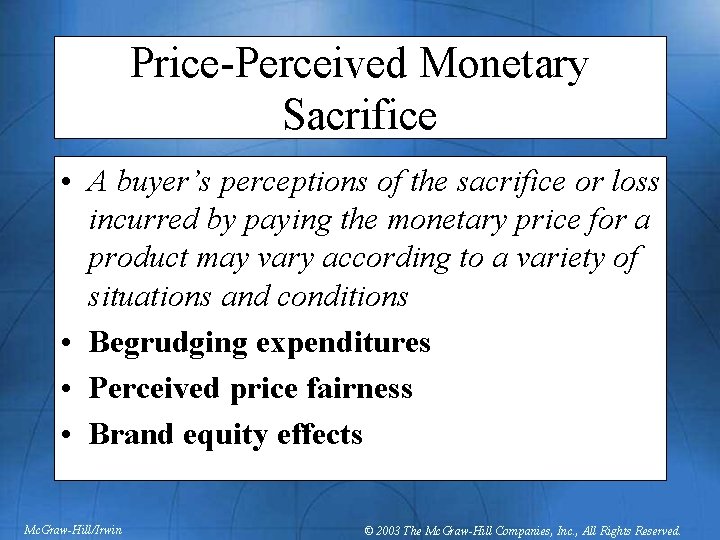
Price-Perceived Monetary Sacrifice • A buyer’s perceptions of the sacrifice or loss incurred by paying the monetary price for a product may vary according to a variety of situations and conditions • Begrudging expenditures • Perceived price fairness • Brand equity effects Mc. Graw-Hill/Irwin © 2003 The Mc. Graw-Hill Companies, Inc. , All Rights Reserved.
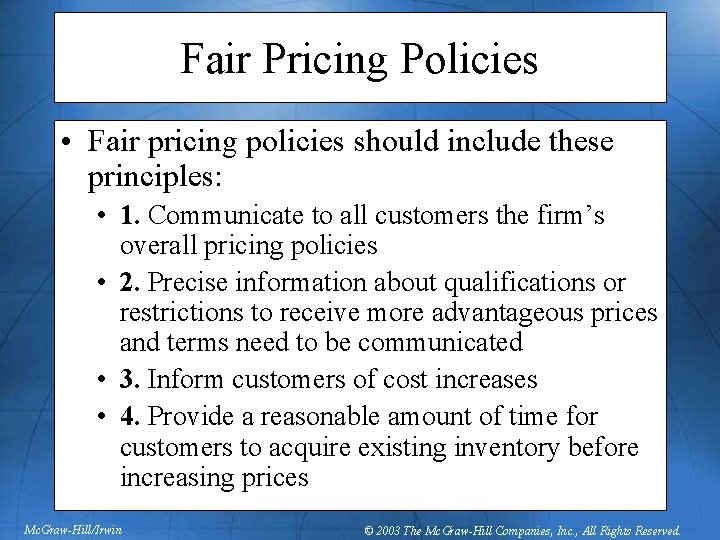
Fair Pricing Policies • Fair pricing policies should include these principles: • 1. Communicate to all customers the firm’s overall pricing policies • 2. Precise information about qualifications or restrictions to receive more advantageous prices and terms need to be communicated • 3. Inform customers of cost increases • 4. Provide a reasonable amount of time for customers to acquire existing inventory before increasing prices Mc. Graw-Hill/Irwin © 2003 The Mc. Graw-Hill Companies, Inc. , All Rights Reserved.
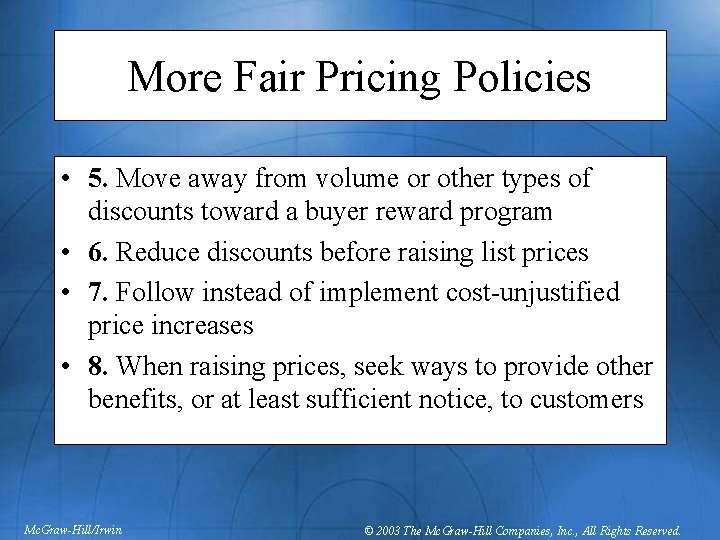
More Fair Pricing Policies • 5. Move away from volume or other types of discounts toward a buyer reward program • 6. Reduce discounts before raising list prices • 7. Follow instead of implement cost-unjustified price increases • 8. When raising prices, seek ways to provide other benefits, or at least sufficient notice, to customers Mc. Graw-Hill/Irwin © 2003 The Mc. Graw-Hill Companies, Inc. , All Rights Reserved.
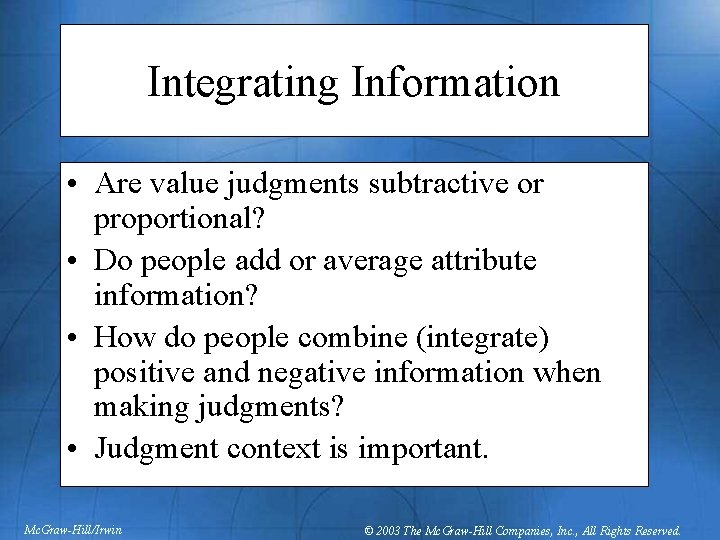
Integrating Information • Are value judgments subtractive or proportional? • Do people add or average attribute information? • How do people combine (integrate) positive and negative information when making judgments? • Judgment context is important. Mc. Graw-Hill/Irwin © 2003 The Mc. Graw-Hill Companies, Inc. , All Rights Reserved.
Price-Quality and Price-Sacrifice Tradeoffs • Adding vs. averaging attribute information – Buyers average attribute information • Price as a negative attribute – Buyers determine a quality rating per unit price – Buyers assess the positive quality information against the negative sacrifice information to determine overall value Mc. Graw-Hill/Irwin © 2003 The Mc. Graw-Hill Companies, Inc. , All Rights Reserved.
Price-Quality and Price-Sacrifice Tradeoffs • Price as a multidimensional attribute – It is important to determine the conditions when buyers will be more likely to use price primarily either as an indicator of quality or as an indicator of sacrifice • Implications of price-quality tradeoffs Mc. Graw-Hill/Irwin © 2003 The Mc. Graw-Hill Companies, Inc. , All Rights Reserved.
The Effect of Time Pressure on Buyers’ Perceptions of Value • When buyers are attempting to process all available information, they place greater weight on price as an indicator of sacrifice • When buyers process information using heuristics, they place greater weight on price as an indicator of product quality Mc. Graw-Hill/Irwin © 2003 The Mc. Graw-Hill Companies, Inc. , All Rights Reserved.
The Effect of Time Pressure on Buyers’ Perceptions of Value • The processing of price information depends on: – 1. The buyers’ motivation to process the information – 2. Whether the buyers have the cognitive resources for this processing Mc. Graw-Hill/Irwin © 2003 The Mc. Graw-Hill Companies, Inc. , All Rights Reserved.
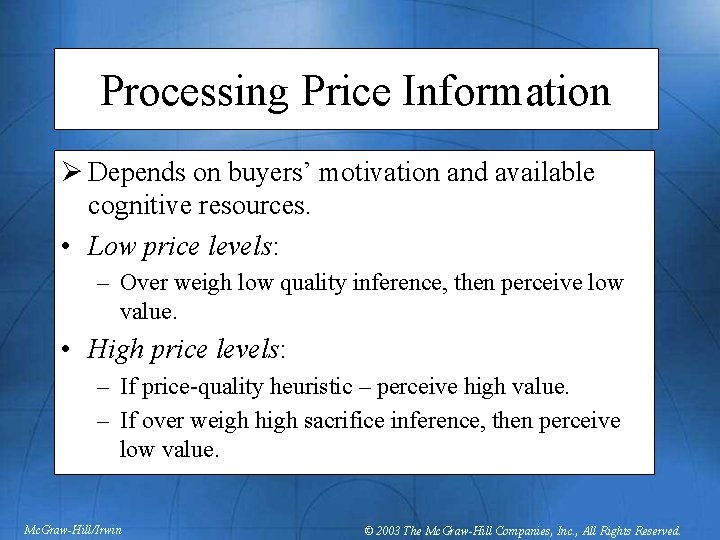
Processing Price Information Ø Depends on buyers’ motivation and available cognitive resources. • Low price levels: – Over weigh low quality inference, then perceive low value. • High price levels: – If price-quality heuristic – perceive high value. – If over weigh high sacrifice inference, then perceive low value. Mc. Graw-Hill/Irwin © 2003 The Mc. Graw-Hill Companies, Inc. , All Rights Reserved.
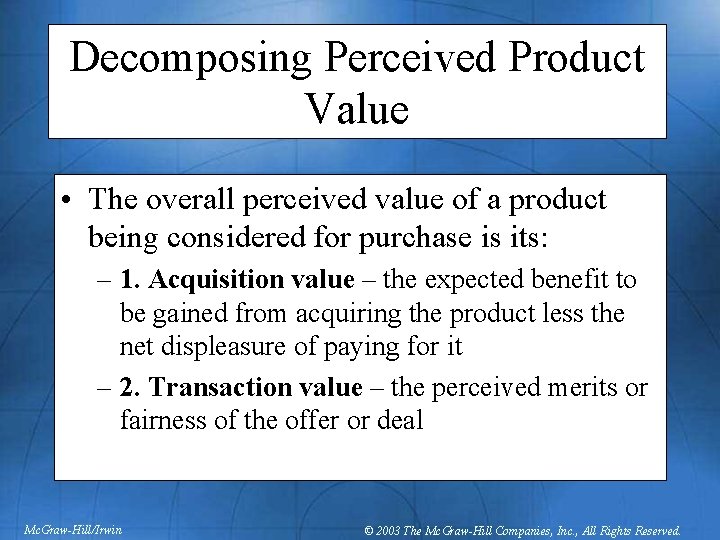
Decomposing Perceived Product Value • The overall perceived value of a product being considered for purchase is its: – 1. Acquisition value – the expected benefit to be gained from acquiring the product less the net displeasure of paying for it – 2. Transaction value – the perceived merits or fairness of the offer or deal Mc. Graw-Hill/Irwin © 2003 The Mc. Graw-Hill Companies, Inc. , All Rights Reserved.
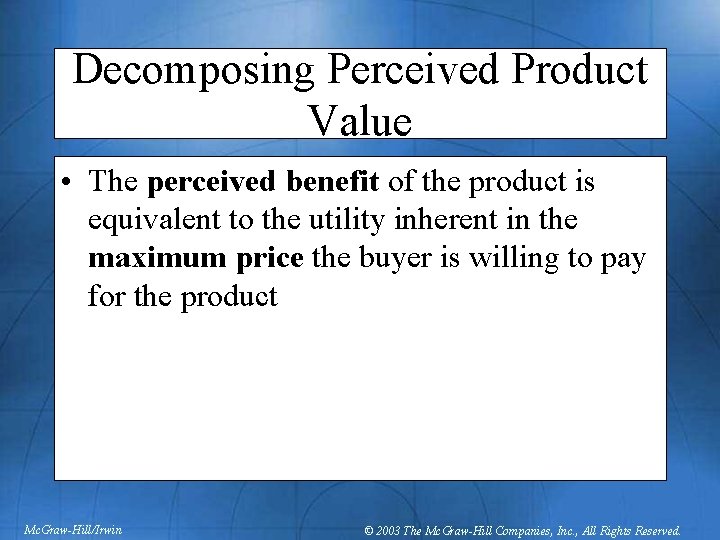
Decomposing Perceived Product Value • The perceived benefit of the product is equivalent to the utility inherent in the maximum price the buyer is willing to pay for the product Mc. Graw-Hill/Irwin © 2003 The Mc. Graw-Hill Companies, Inc. , All Rights Reserved.
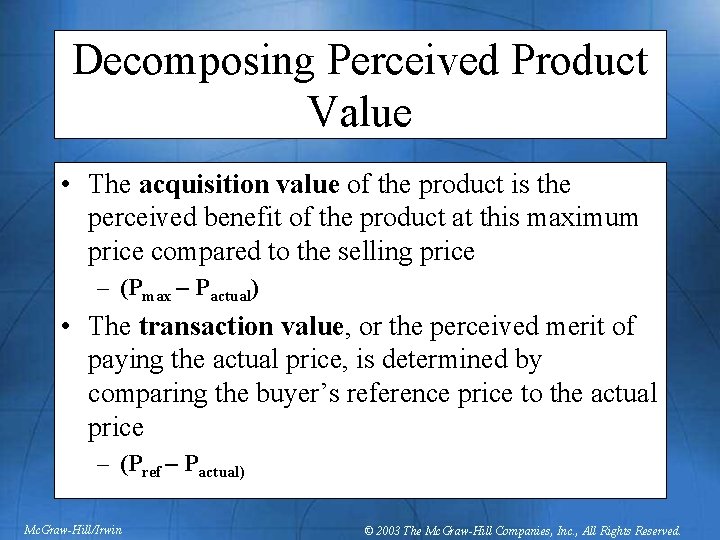
Decomposing Perceived Product Value • The acquisition value of the product is the perceived benefit of the product at this maximum price compared to the selling price – (Pmax – Pactual) • The transaction value, or the perceived merit of paying the actual price, is determined by comparing the buyer’s reference price to the actual price – (Pref – Pactual) Mc. Graw-Hill/Irwin © 2003 The Mc. Graw-Hill Companies, Inc. , All Rights Reserved.
Enhancing Transaction Value • Comparative price advertising, coupons or rebates enhance transaction value by creating the presence of a higher reference price, and thus a perceived reduction of a sacrifice or loss Mc. Graw-Hill/Irwin © 2003 The Mc. Graw-Hill Companies, Inc. , All Rights Reserved.
Framing Price Offers and Price Changes • Examples of ways to communicate price offers and price changes: – Present a price change in monetary or percentage terms, or combinations of the two – Price discount available to all customers, or a subset of customers – Shifts in reference points • Including an external reference price in a purchase offer to frame the buyers’ choice Mc. Graw-Hill/Irwin © 2003 The Mc. Graw-Hill Companies, Inc. , All Rights Reserved.
Ways To Frame Offers Ø 1. Provide a price reduction with no comparison to previous price (or other external reference price) ØNo “deal perception” ØTherefore, no transaction value and only acquisition value based on the regular price perceived quality and price perceived sacrifice relationships Mc. Graw-Hill/Irwin © 2003 The Mc. Graw-Hill Companies, Inc. , All Rights Reserved.
Ways To Frame Offers Ø 2. Price reduction with comparison to previous or other external reference price (e. g. , regular price $xx. xx, sale price $yy. yy). Ø TV based on perceived price difference, i. e. , Regular price - sale price. Ø AV based on regular price - perceived quality relation. Ø Therefore, TV enhances overall perceived (acquisition) value. Mc. Graw-Hill/Irwin © 2003 The Mc. Graw-Hill Companies, Inc. , All Rights Reserved.
Ways To Frame Offers Mc. Graw-Hill/Irwin © 2003 The Mc. Graw-Hill Companies, Inc. , All Rights Reserved.
Ways To Frame Offers Mc. Graw-Hill/Irwin © 2003 The Mc. Graw-Hill Companies, Inc. , All Rights Reserved.
Plausible v. Implausible Reference Prices • Internal price reference is the buyers’ expectations about usual prices for the product in the marketplace • If the advertised price is plausible, buyers will judge the product’s quality based on this price • If the advertised price is implausible, buyers will use their internal price reference to judge the product’s quality Mc. Graw-Hill/Irwin © 2003 The Mc. Graw-Hill Companies, Inc. , All Rights Reserved.
Plausible v. Implausible Reference Prices • If buyers have no prior expectations about the usual price of the product, the plausibility of the advertised reference price will be determined by the perceived difference between the advertised reference price and the advertised sale price Mc. Graw-Hill/Irwin © 2003 The Mc. Graw-Hill Companies, Inc. , All Rights Reserved.
Available Empirical Evidence • Offers showing both a regular and a sale price are perceived as more believable and as providing more value for the money Mc. Graw-Hill/Irwin © 2003 The Mc. Graw-Hill Companies, Inc. , All Rights Reserved.
Tensile Price Claims • A tensile price claim has a factual foundation but uses vague wording that increases ambiguity and reduces specificity and concreteness of the information provided Mc. Graw-Hill/Irwin © 2003 The Mc. Graw-Hill Companies, Inc. , All Rights Reserved.
Tensile Price Claims For example, the seller may advertise: • A range of potential savings – “Save 30 -70% off” • A minimum amount of price reduction – “Prices reduced 30% or more” • A maximum amount of savings – “Save up to 70%” Mc. Graw-Hill/Irwin © 2003 The Mc. Graw-Hill Companies, Inc. , All Rights Reserved.
Tensile Price Claims • When a price reduction range is provided, buyers tend to anchor on the minimum value and make an upward estimate of the savings they expect – If the range is narrow, buyers may not make an upward estimate from the minimum value given • When only a maximum amount of savings is provided, buyers anchor on the maximum value and make a downward estimate of the savings they expect Buyers perceptions of savings and transaction value will depend on how the promotion is phrased! Mc. Graw-Hill/Irwin © 2003 The Mc. Graw-Hill Companies, Inc. , All Rights Reserved.