
CHAPTER 7 Portable Fire Extinguishers Knowledge Objectives State
CHAPTER 7 Portable Fire Extinguishers
Knowledge Objectives • • State the primary purposes of fire extinguishers. Define Class A fires. Define Class B fires. Define Class C fires. Define Class D fires. Define Class K fires. Explain the classification and rating system for fire extinguishers. • Explain the labeling system for fire extinguishers.
Knowledge Objectives • Describe three risk classifications for area hazards. • Describe the types of agents and operating systems used in fire extinguishers. • Select the proper class of fire extinguisher. • Describe the basic steps of fire extinguisher operation. • Explain the basic steps of inspecting, maintaining, recharging, and hydrostatic testing of fire extinguishers.
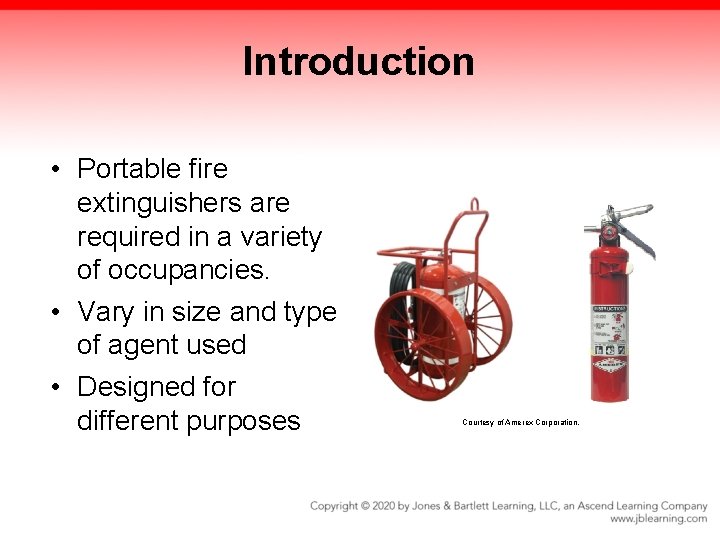
Introduction • Portable fire extinguishers are required in a variety of occupancies. • Vary in size and type of agent used • Designed for different purposes Courtesy of Amerex Corporation.
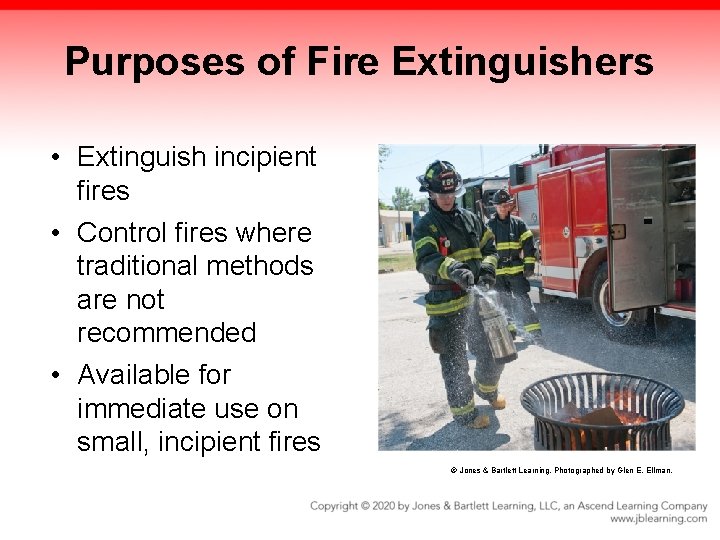
Purposes of Fire Extinguishers • Extinguish incipient fires • Control fires where traditional methods are not recommended • Available for immediate use on small, incipient fires © Jones & Bartlett Learning. Photographed by Glen E. Ellman.
Extinguishing Incipient Stage Fires • One advantage of fire extinguishers is their portability. – Most fire department vehicles carry at least one fire extinguisher. – Fire fighter may even use an extinguisher from the fire site. • The primary disadvantage of fire extinguishers is that they are “one-shot” devices. – If the device does not control the fire, some other device or method is needed.
Extinguishing Fires with the Appropriate Extinguishing Agent • Fire extinguishers are also used to control fires where traditional extinguishing methods are not recommended. – Using water on fires that involve energized electrical equipment increases the risk of electrocution to fire fighters. – Appropriate extinguishing agents are also required for fires that involve flammable liquids, cooking oils, and combustible metals.
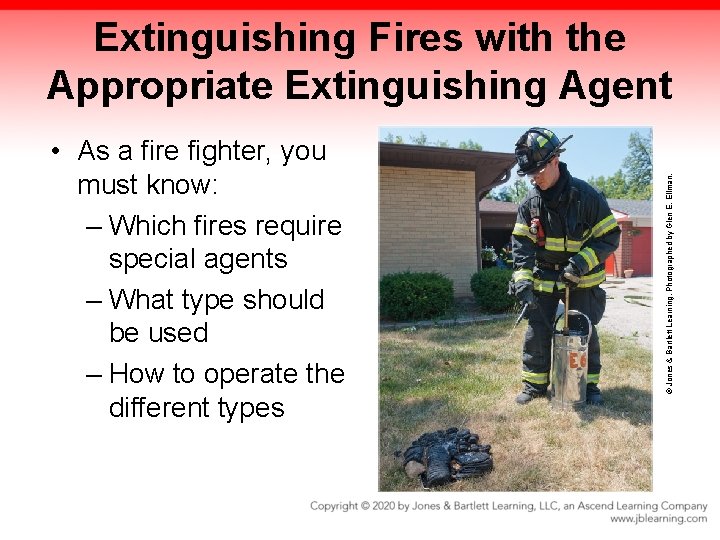
• As a fire fighter, you must know: – Which fires require special agents – What type should be used – How to operate the different types © Jones & Bartlett Learning. Photographed by Glen E. Ellman. Extinguishing Fires with the Appropriate Extinguishing Agent

Methods of Fire Extinguishment • Fires require fuel, heat, and oxygen. • Most extinguishers stop the burning by cooling the fuel below its ignition temperature, by cutting off the supply of oxygen, or by combining these two techniques. • Some extinguishing agents interrupt the complex chemical reactions that occur between the heated fuel and the oxygen. • Modern portable fire extinguishers contain agents that use one or more of these methods.
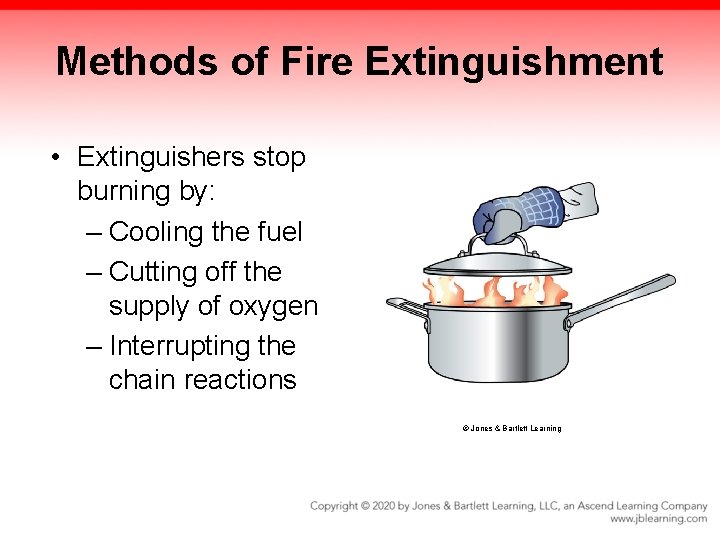
Methods of Fire Extinguishment • Extinguishers stop burning by: – Cooling the fuel – Cutting off the supply of oxygen – Interrupting the chain reactions © Jones & Bartlett Learning
Classes of Fires • Essential to match extinguisher and fire – Some agents are more efficient on certain fires. – Some agents will not control certain fires. – Some agents are dangerous when applied to certain fires. • Before selecting a fire extinguisher, ask yourself, “Which class of fire am I fighting? ”
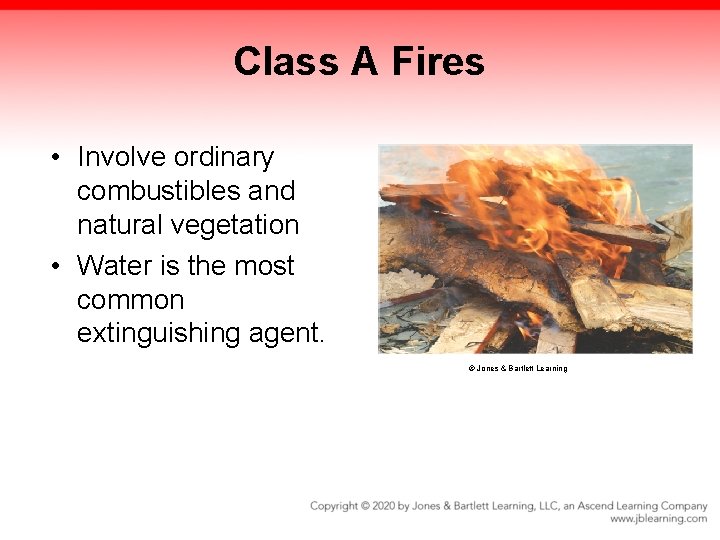
Class A Fires • Involve ordinary combustibles and natural vegetation • Water is the most common extinguishing agent. © Jones & Bartlett Learning
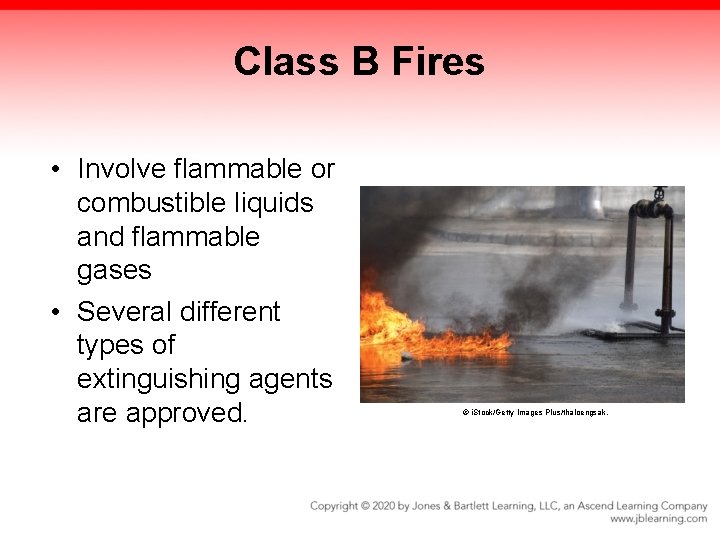
Class B Fires • Involve flammable or combustible liquids and flammable gases • Several different types of extinguishing agents are approved. © i. Stock/Getty Images Plus/thaloengsak.

Class C Fires • Involve energized electrical equipment – Can generate tremendous heat that ignites nearby Class A or B materials • Agents that will not conduct electricity must be used. © Photo. Stock-Israel / Alamy Stock Photo

Class D Fires • Involve combustible metals • Special techniques and agents are required. – Normal agents can react violently. © Andrew Lambert Photography/Photo Researchers, Inc.
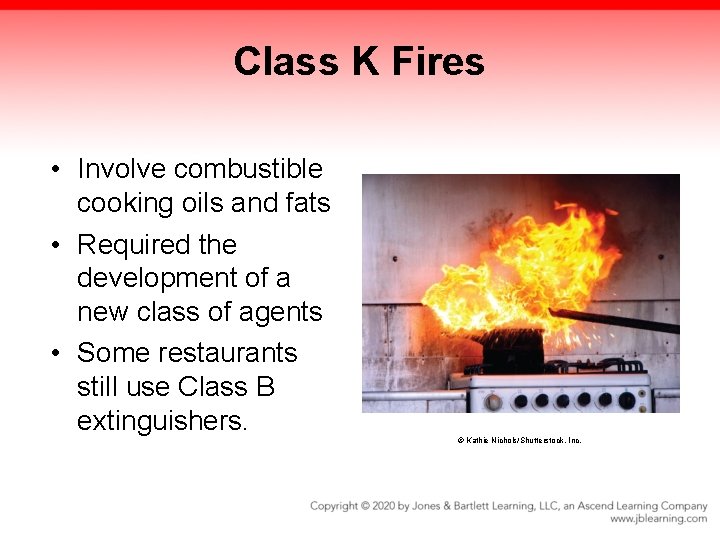
Class K Fires • Involve combustible cooking oils and fats • Required the development of a new class of agents • Some restaurants still use Class B extinguishers. © Kathie Nichols/Shutterstock, Inc.
Classification and Rating of Fire Extinguishers • Based on their characteristics and capabilities. – This information is important for selecting the proper extinguisher to fight a particular fire. – It is also used to determine what type(s) of fire extinguishers should be placed where. • UL developed the standards, classification, and rating system for portable fire extinguishers. – Each fire extinguisher has a specific rating that identifies the classes of fires for which it is both safe and effective.
Classification of Fire Extinguishers • System uses letters and numbers. – Letters indicate the class of fire for which the extinguisher can be used. – Numbers indicate its effectiveness. – Fire extinguishers that are safe and effective for more than one class will be rated with multiple letters. – Class A and Class B fire extinguishers also indicate the relative effectiveness of the fire extinguisher in the hands of a nonexpert.
Classification of Fire Extinguishers • Standard test fires are used to rate the effectiveness of fire extinguishers. – Testing may involve different agents, amounts, application rates, and methods. – Fire extinguishers are rated for their ability to control a specific type of fire and prevent rekindling. – A rating is only given if the extinguisher completely extinguishes the standard test fire and prevents rekindling.
Labeling of Fire Extinguishers • Fire extinguishers that have been tested and approved by an independent laboratory are labeled to clearly designate the class(es) of fire the unit is capable of extinguishing safely. • The traditional lettering system has been used for many years and is still found on extinguishers. • More recently, a universal pictograph system has been developed.
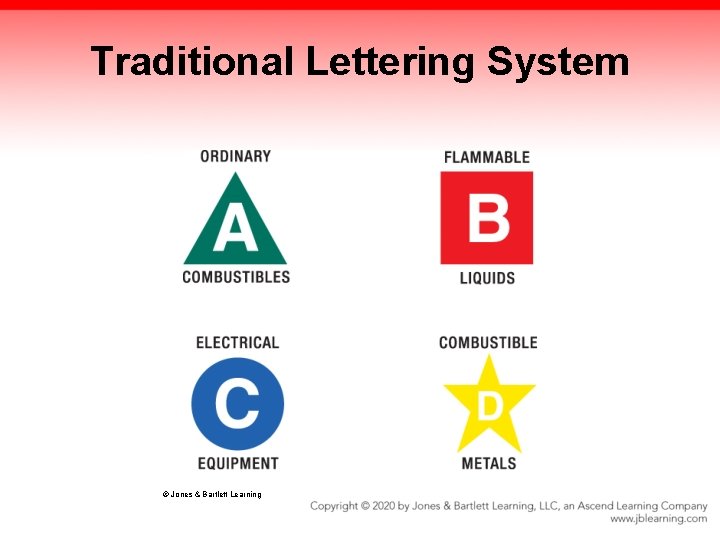
Traditional Lettering System © Jones & Bartlett Learning

Universal Pictograph System © Jones & Bartlett Learning
Fire Extinguisher Placement • Fire and building codes and regulations require the installation of fire extinguishers in many areas • NFPA 10 lists the recommendations for placing and mounting portable fire extinguishers and the recommended mounting heights. • Two key factors must be considered: – the class of fire that is likely to occur, and – the potential magnitude of an incipient fire.
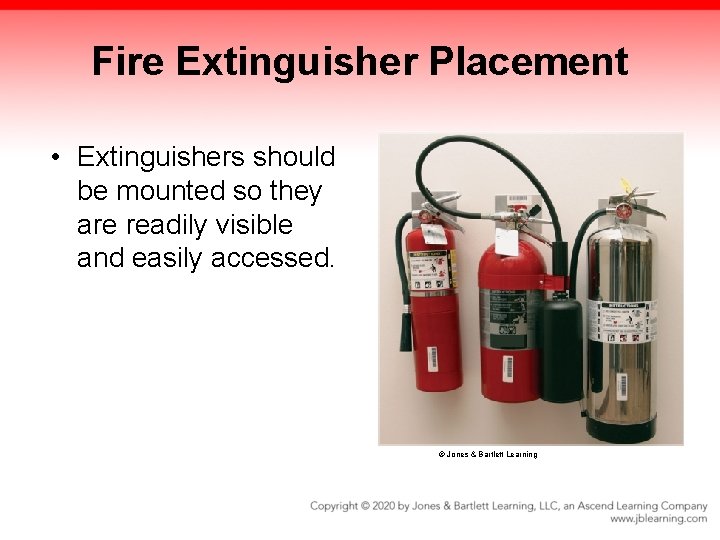
Fire Extinguisher Placement • Extinguishers should be mounted so they are readily visible and easily accessed. © Jones & Bartlett Learning
Classifying Area Hazards • Areas are divided into risk classifications according to the amount and type of combustibles that are present. – The larger the fire load, the larger the potential fire. • Occupancy use category does not necessarily determine the appropriate hazard classification. • The recommended classifications are guidelines based on typical situations.
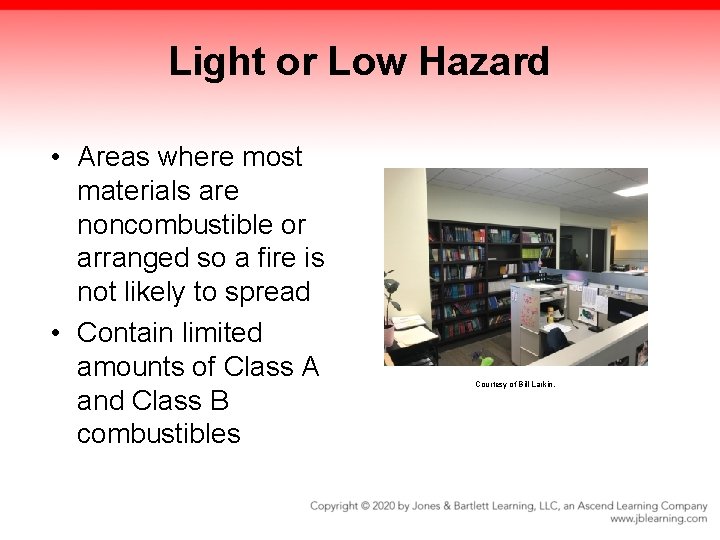
Light or Low Hazard • Areas where most materials are noncombustible or arranged so a fire is not likely to spread • Contain limited amounts of Class A and Class B combustibles Courtesy of Bill Larkin.
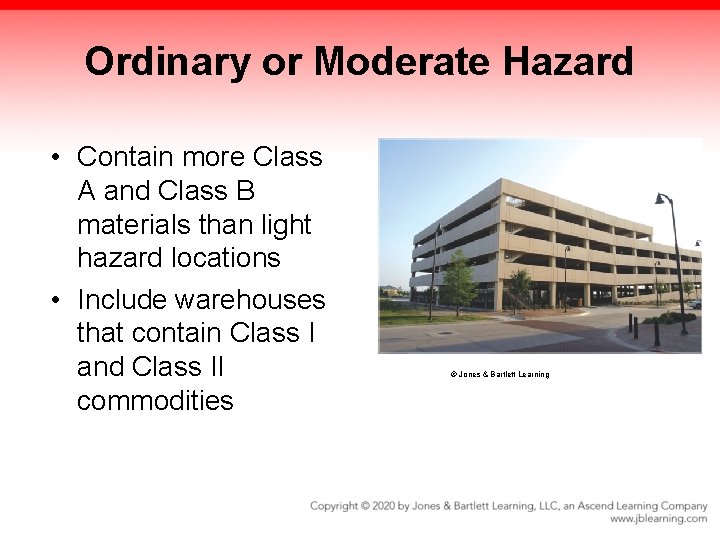
Ordinary or Moderate Hazard • Contain more Class A and Class B materials than light hazard locations • Include warehouses that contain Class I and Class II commodities © Jones & Bartlett Learning
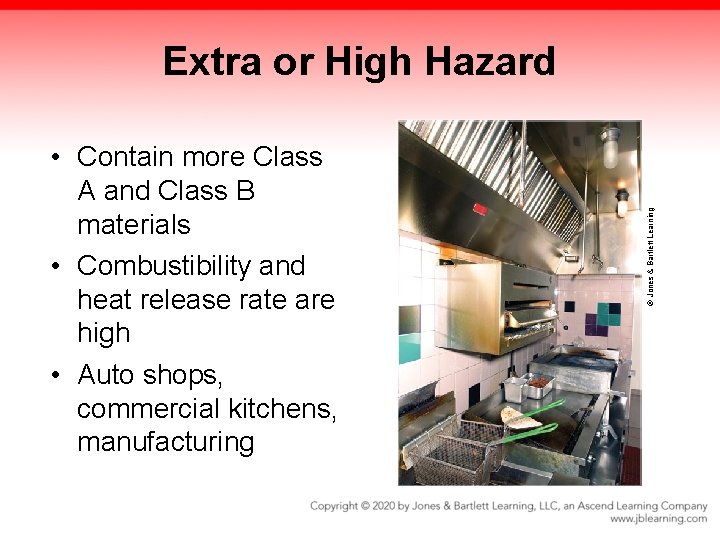
• Contain more Class A and Class B materials • Combustibility and heat release rate are high • Auto shops, commercial kitchens, manufacturing © Jones & Bartlett Learning Extra or High Hazard
Determining the Appropriate Placement of Fire Extinguisher • Consider the types and quantities of fuels found in the area. • Some areas may need extinguishers with more than one rating or more than one type of fire extinguisher. • One multipurpose extinguisher is generally less expensive than two individual fire extinguishers and eliminates the problem of selecting the proper extinguisher for a particular fire.
Fire Extinguisher Design • Use pressure to expel contents. • Many extinguishers require pressurized gas to expel the agent. – Can be stored with the agent or externally in a separate cartridge or cylinder • Some agents are self-expelling. • Hand-operated pumps expel water or water with additives.
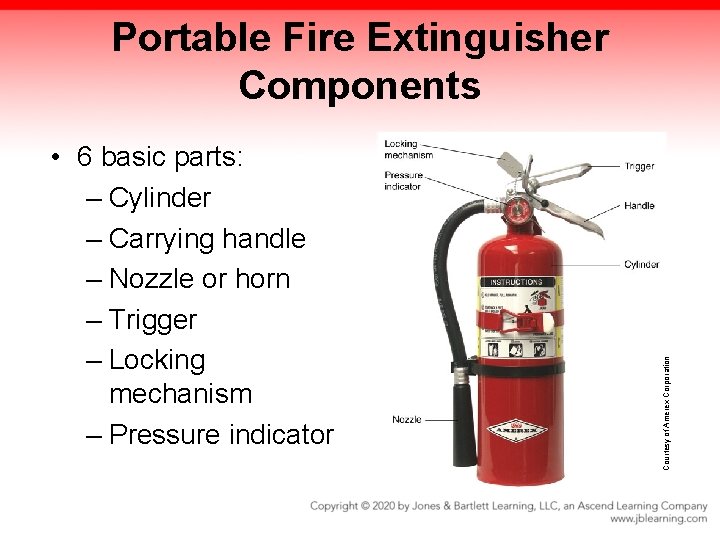
• 6 basic parts: – Cylinder – Carrying handle – Nozzle or horn – Trigger – Locking mechanism – Pressure indicator Courtesy of Amerex Corporation Portable Fire Extinguisher Components
Portable Fire Extinguisher Components: Cylinder • Holds the extinguishing agent. • Nitrogen, compressed air, or CO 2 can be used to pressurize the cylinder to expel the agent. • Stored-pressure fire extinguishers hold both the extinguishing agent, in wet or dry form, and the expeller gas under pressure in the cylinder. • Cartridge/cylinder-operated fire extinguishers rely on an external cartridge of pressurized gas, which is only released when the extinguisher is to be used.
Portable Fire Extinguisher Components: Handle • Used to carry a portable fire extinguisher and, in many cases, to hold it during use. • The actual design of the handle varies from model to model – All extinguishers that weigh more than 3 lb (1. 4 kg) have handles. • In many cases, the handle is located just below the trigger mechanism.
Portable Fire Extinguisher Components: Nozzle/Horn • Extinguishing agent is expelled through a nozzle or horn. • In some extinguishers, the nozzle is attached directly to the valve assembly at the top of the extinguisher. • In other models, the nozzle is at the end of a short hose.
Portable Fire Extinguisher Components: Trigger • Mechanism that is squeezed or depressed to discharge extinguishing agent • Usually a lever located above the handle • Cartridge/cylinder models usually have a twostep operating sequence. – Handle or lever is pushed to pressurize the agent. – Trigger-type mechanism in the nozzle assembly controls the discharge.
Portable Fire Extinguisher Components: Locking Mechanism • Simple quick-release that prevents accidental discharge • Simplest form is a stiff pin – Tamper seal secures the pin – Makes it easy to see if extinguisher has been used – Discourages people from tinkering with extinguisher
Portable Fire Extinguisher Components: Pressure Indicator • Shows whether a stored-pressure extinguisher has sufficient pressure to operate • Most extinguishers use a needle gauge. – Indicators vary in design and sophistication. • Not all extinguishers have these. – You may need to weigh the extinguisher. – Extinguishers pressurized by a cartridge lack a pressure gauge.
Wheeled Fire Extinguishers • Large units mounted on wheeled carriages • Typically contain 150 to 350 lb (68 -158 kg) of agent • Lets one person transport it to the fire • Long delivery hoses allow operators to attack fire from multiple sides. • Usually, separate compressed gas cylinder provides the operational pressure. • Installed in special hazard areas
Fire Extinguisher Characteristics • Portable extinguishers vary according to: – Extinguishing agent – Capacity – Effective range – Time it takes to completely discharge agent • Extinguishers also have different mechanical designs. • Seven types of extinguishers
Water-Type Fire Extinguishers • Efficient, plentiful, and inexpensive • When applied to fire, water converts from liquid into steam, absorbing heat in the process. – Very effective for Class A fires • Water is a much less effective extinguishing agent for other fire classes – Splatters hot oil – Water conducts electricity • Therefore, only used in Class A extinguishers
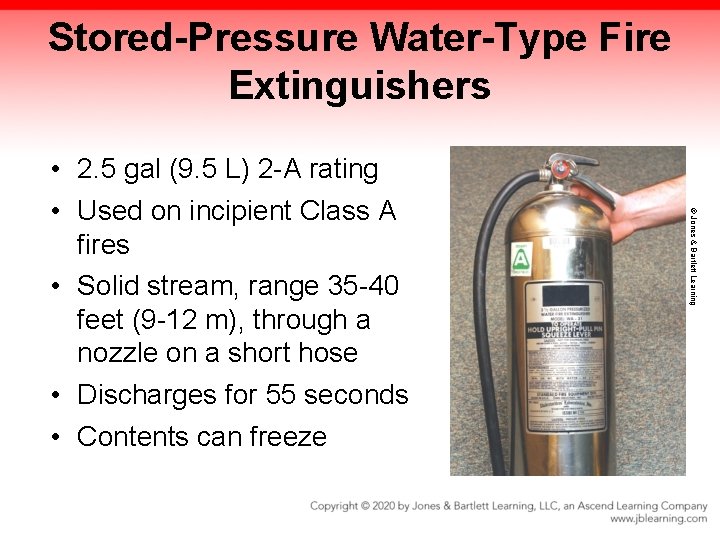
Stored-Pressure Water-Type Fire Extinguishers © Jones & Bartlett Learning • 2. 5 gal (9. 5 L) 2 -A rating • Used on incipient Class A fires • Solid stream, range 35 -40 feet (9 -12 m), through a nozzle on a short hose • Discharges for 55 seconds • Contents can freeze
Stored-Pressure Water-Type Fire Extinguishers: Procedure • Set it on the ground, grasp the handle, and pull out the ring pin or release the locking latch. • The extinguisher can be lifted and used to douse the fire. • Use one hand to aim the stream at the fire, and squeeze the trigger with the other hand. • The stream of water can be made into a spray by putting a thumb at the end of the nozzle; this technique is often used after the flames have been extinguished to thoroughly soak the fuel.
Water Mist Fire Extinguishers • Constructed in a manner similar to storedpressure water-type extinguishers, but are more easily identifiable because they are white • They have a discharge hose that is connected to an applicator wand misting nozzle • Commonly available in 1. 75 - and 2. 5 -gal (6. 6 and 9. 5 L) sizes • Contain distilled or de-ionized water (conduct less electricity)
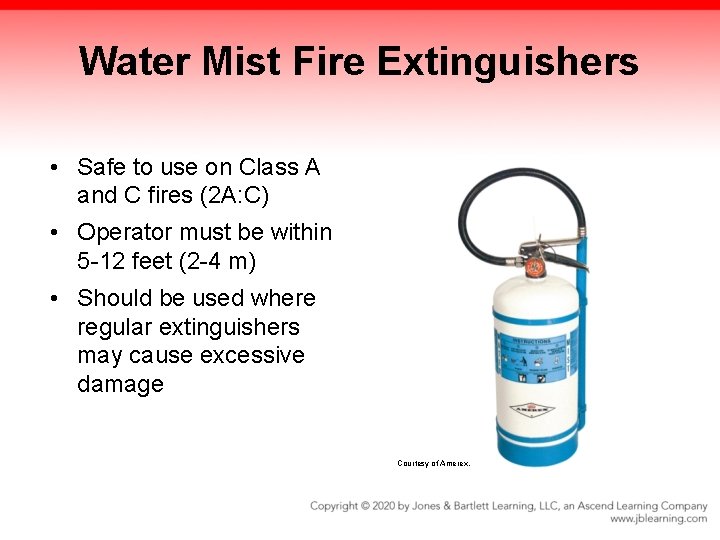
Water Mist Fire Extinguishers • Safe to use on Class A and C fires (2 A: C) • Operator must be within 5 -12 feet (2 -4 m) • Should be used where regular extinguishers may cause excessive damage Courtesy of Amerex.
Loaded-Stream Fire Extinguishers • Can be used in areas that are subject to freezing – These extinguishers combine an alkali metal salt and water. • The most common model is the 2. 5 -gal (9 -L) unit, identical to stored-pressure extinguisher • Hand-held models are available with capacities of 1 to 2. 5 gal (4 to 9 L), rated from 1 -A to 3 -A. • Larger units are also available.
Wetting-Agent and Class A Foam Water-Type Extinguishers • Wetting-agent extinguishers expel water that contains a solution to reduce surface tension. – Allows water to spread over the fire and penetrate more efficiently into Class A fuels • Class A foam fire extinguishers contain a solution of water and foam concentrate. • Both are available in the same configurations as water extinguishers. • Do not expose these to temperatures below 40ºF (4ºC).
Pump Tank Fire Extinguishers • Range from 1 -A rated, 1. 5 -gal (6 -L) to 4 -A rated, 5 -gal (19 -L) units. • The water in these units is not stored under pressure. • The pressure to expel the water is provided by a hand-operated, double-acting, vertical piston pump • Sits upright on the ground during use • Can be used with antifreeze agents
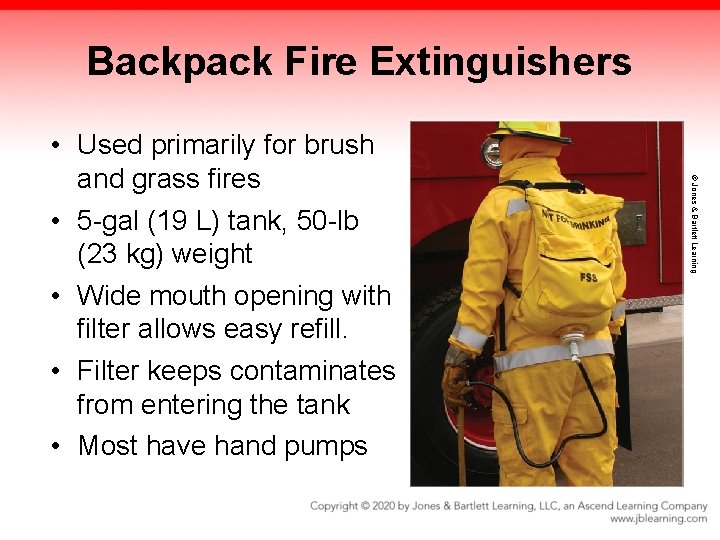
Backpack Fire Extinguishers © Jones & Bartlett Learning • Used primarily for brush and grass fires • 5 -gal (19 L) tank, 50 -lb (23 kg) weight • Wide mouth opening with filter allows easy refill. • Filter keeps contaminates from entering the tank • Most have hand pumps
Dry Chemical Extinguishers • Deliver a stream of very finely ground particles onto a fire. – Varying capabilities and characteristics • First, the finer particles of the chemical vaporize when they reach the flame and release a vapor that interrupts flame chemistry. • Particles shield the fuel surface from the flame radiation, thereby reducing the rate at which the burning fuel is being vaporized. • It can smother the fire by forming an insulating blanket.
Dry Chemical Extinguishers • Sodium bicarbonate – Rated for Class B and C fires only – Often used in small household extinguishers • Potassium bicarbonate – Rated for Class B and C fires only • Urea-based potassium bicarbonate – Rated for Class B and C fires only
Dry Chemical Extinguishers • Potassium chloride – Rated for Class B and C fires only – More corrosive than the other agents • Ammonium phosphate – Rated for Class A, B, and C fires – The only one suitable for Class A fires
Dry Chemical Extinguishers: Advantages • They are effective on Class B (flammable liquids and gases) fires. • They can be used on Class C (energized electrical equipment) fires because the chemicals are nonconductive. • They are not subject to freezing.
Dry Chemical Extinguishers: Disadvantages • The chemicals, particularly the multipurpose dry chemicals, are corrosive and can damage electronic equipment. – The fine particles are carried by the air and settle like a fine dust inside the equipment. – During a period of months, the residue can corrode metal parts, causing damage. • Chemicals may make breathing more difficult when discharged in an enclosed environment.
Dry Chemical Extinguishers • Stored-pressure units expel the dry chemical agent in the same manner as a stored-pressure water-type fire extinguisher. – However, they cannot be put aside and used again later; the dry chemical causes the valve to leak. • Depending on the extinguisher’s size, the horizontal range of the discharge stream can be from 5 to 45 feet (2 -9 m). – Discharge completely in 8 to 20 seconds.
Ordinary Dry-Chemical Extinguishers • Introduced during the 1950 s, rated only for Class B and C fires • Available in hand-held models with ratings up to 160 -B: C. • Larger, wheeled units carry ratings up to 640 B: C.
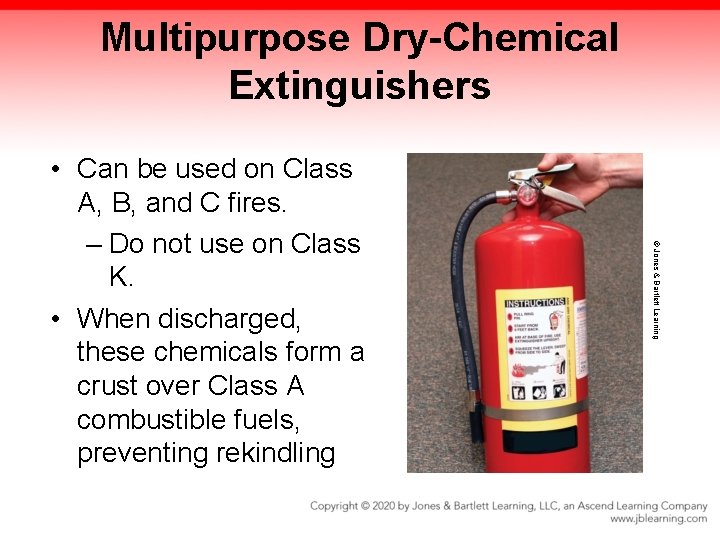
Multipurpose Dry-Chemical Extinguishers © Jones & Bartlett Learning • Can be used on Class A, B, and C fires. – Do not use on Class K. • When discharged, these chemicals form a crust over Class A combustible fuels, preventing rekindling
Carbon Dioxide Fire Extinguishers • Colorless, odorless, and nontoxic • Envelopes fuel in a cloud of inert gas – Also cools the burning material – Disrupts the fuel’s ability to vaporize • Both an expelling agent and an extinguishing agent • Rated for Class B and C fires – Does not conduct electricity – Is not corrosive – Does not leave any residue
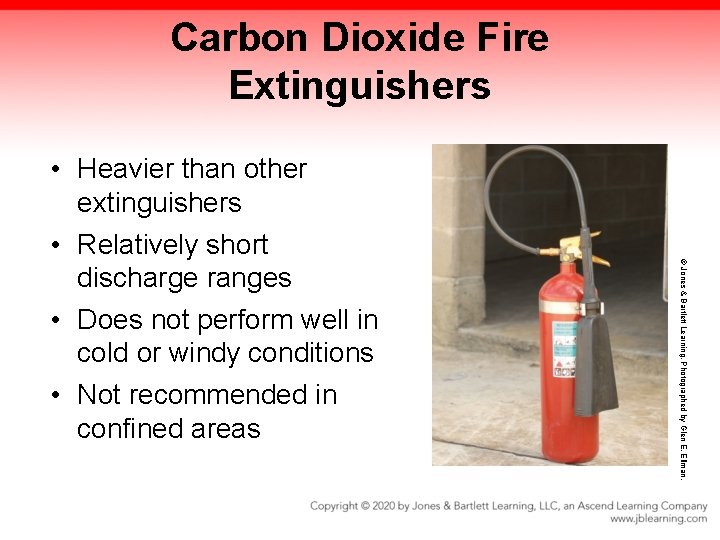
Carbon Dioxide Fire Extinguishers © Jones & Bartlett Learning. Photographed by Glen E. Ellman. • Heavier than other extinguishers • Relatively short discharge ranges • Does not perform well in cold or windy conditions • Not recommended in confined areas
Carbon Dioxide Fire Extinguishers • Trigger mechanism allows intermittent operation. • Extinguisher will have to be recharged after use. • Extinguisher is weighed to determine how much agent is left in the storage cylinder. • The smaller CO 2 extinguishers contain from 2 to 5 lb (1 -2 kg) of agent.
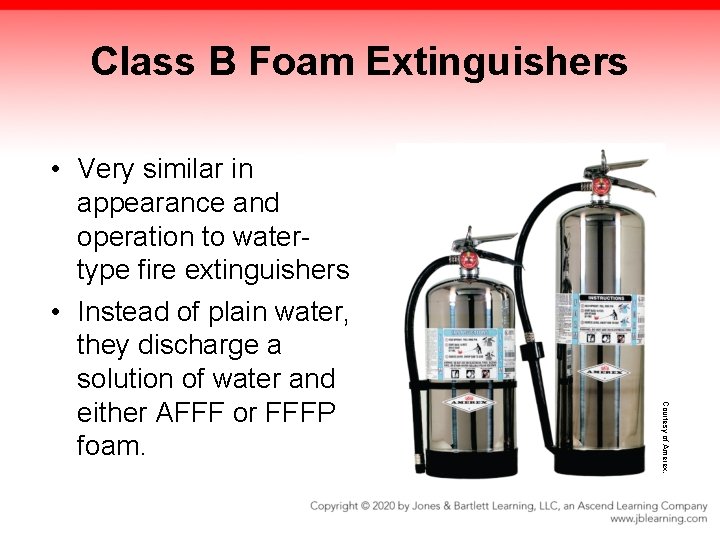
Class B Foam Extinguishers Courtesy of Amerex. • Very similar in appearance and operation to watertype fire extinguishers • Instead of plain water, they discharge a solution of water and either AFFF or FFFP foam.
Class B Foam Extinguishers • Aspirating nozzle discharges solution of water and aqueous film-forming foam and filmforming fluoroprotein agent. • Foam blanket floats over surface of liquid. • Effective for Class A and B fires – Not suitable for Class C or K fires • Not effective at freezing temperatures
Class B Foam Extinguishers • Available in two sizes: – 1. 6 gallons (6 L), rated 2 -A: 10 -B – 2. 5 gallons (9 L), rated 3 -A: 20 -B. • Whether AFFF or FFFP should be used depends on the product’s compatibility with a particular flammable liquid and other available extinguishing agents.
Wet Chemical Extinguishers • Only type of extinguisher to qualify under the new Class K rating requirements. • The Class K wet chemical agents include aqueous solutions of potassium acetate, potassium carbonate, and potassium citrate, either singly or in various combinations. • The wet agents convert the fatty acids in cooking oils or fats to a soap (saponification) • Before these were developed, most fire extinguishing systems used dry chemicals.
Wet Chemical Extinguishers • Dry chemicals required extensive clean-up. – Resulted in serious business interruptions. • Wet chemical agents are discharged as a fine spray, which reduces the risk of splattering. – Clean-up afterward is much easier, allowing a business to reopen sooner. – The fixed, automatic systems discharge the agent directly over the cooking surfaces. • Currently available in three sizes – No numerical ratings available
Halogenated-Agent Fire Extinguishers • Produced from a family of liquefied gases, known as halogens, that includes fluorine, bromine, iodine, and chlorine • Called “clean agents” because they leave no residue and are ideally suited for areas that contain computers or sensitive equipment • Two categories: halons and halocarbons – Available in hand-held models rated for Class B and C fires – Larger-capacity also rated for Class A fires
Halogenated-Agent Fire Extinguishers • Agent discharged as a streaming liquid under relatively high pressure – Use with care in confined areas. • Four types are used in portable extinguishers: – Hydrochlorofluorocarbon – Hydrofluorocarbon – Perfluorocarbon – Fluoroiodocarbon • Halon 1211 is available in hand-held extinguishers with capacities that range from 2 lb (0. 9 kg), rated 2 -B: C to 22 lb (10 kg), rated 4 -A: 80 -B: C.
Dry-Powder Extinguishers and Extinguishing Agents • For Class D fires involving combustible metals: – Stored in fine granular or powdered form, and are applied to smother the fire – Forms a solid crust over the burning metal to exclude oxygen and absorb heat • Agents and techniques vary. – Each agent listed for use on specific combustible metal fires – Most common is formulated from table salt
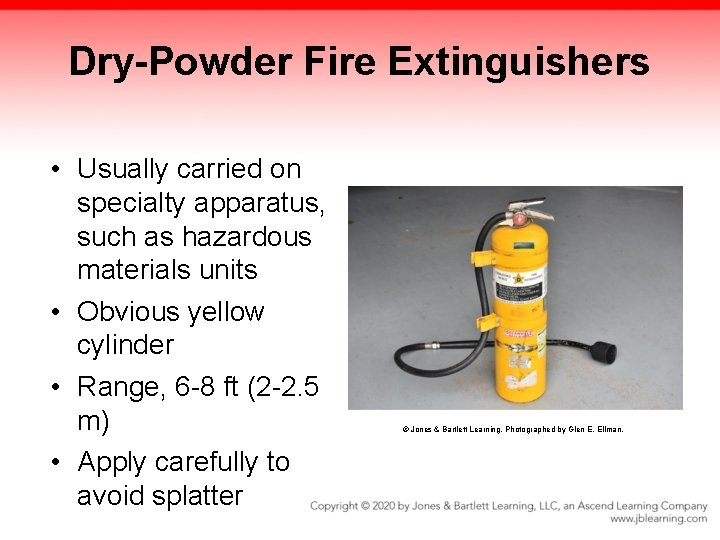
Dry-Powder Fire Extinguishers • Usually carried on specialty apparatus, such as hazardous materials units • Obvious yellow cylinder • Range, 6 -8 ft (2 -2. 5 m) • Apply carefully to avoid splatter © Jones & Bartlett Learning. Photographed by Glen E. Ellman.
Bulk Dry Powder Agents • The same agent used in portable fire extinguishers can be stored in bulk form and applied by hand. • Another dry powder extinguishing agent, graded granular graphite mixed with compounds containing phosphorus, cannot be expelled from a portable fire extinguisher. – Applied manually from a pail or other container using a shovel or scoop. • Available in 40 -50 lb (18 -23 kg) pails and 350 -lb (159 kg) drums
Use of Fire Extinguishers • Should be simple to operate • Six basic steps for extinguishing fires: – Locate the fire. – Select the proper extinguisher. – Ensure personal safety and exit route. – Transport the extinguisher to the fire. – Activate the extinguisher to release the agent. – Apply the extinguishing agent.
Use of Fire Extinguishers • Practice and training are essential for effective fire suppression. – A trained expert can extinguish a fire up to twice as large as a nonexpert can, using the same extinguisher. • You should be able to operate any fire extinguisher that you might be required to use, whether it is carried on your fire apparatus, hanging on the wall of your firehouse, or elsewhere.
Locating a Fire Extinguisher • Know the types and locations of extinguisher on apparatus. • Know where extinguishers are located in and around the fire station. • Have at least one extinguisher in your home and another in your personal vehicle.
Selecting the Proper Extinguisher • Requires an understanding of the classification and rating system • Fire fighters must quickly determine whether a fire can be controlled by an extinguisher. – If fire is too large, you will have to consider other options • Fire fighters should also determine the appropriate type of extinguisher to place in a given area.
Ensure Your Personal Safety • • Approach fire with an exit behind you. Have a planned escape route. Never let fire get between you and exit. Never turn your back on the fire. Watch fire for rekindle. Keep the wind at your back. Wear appropriate personal protective equipment (PPE) and self-contained breathing apparatus (SCBA).
Transporting a Fire Extinguisher • Best method depends on size, weight, and design of extinguisher. – Handheld units can range from 1 (0. 45 kg) to 50 lb (23 kg). • Carry fixed nozzle units in stronger hand. • Use weaker hand for units with a hose between trigger and nozzle.
Basic Steps of Fire Extinguisher Operation • PASS acronym: – Pull the safety pin. – Aim the nozzle at the base of the flames. – Squeeze the trigger to discharge agent. – Sweep the nozzle across the base of the flames. • Practice discharging different types of extinguishers in training situations to build confidence.
Care of Fire Extinguishers • Extinguishers must be regularly inspected and properly maintained. • Records keep inspections and maintenance on schedule. • Proper training required. • Follow manufacturer’s recommendations.
Inspection • • Check extinguishers every month. Check tamper seals. Weigh or “heft” to determine fullness. Examine for obvious physical damage, corrosion, or leaks. Check the pressure gauge. Ensure the extinguisher is properly identified. Check the hose and nozzle. Check the hydrostatic test date.
Inspection • If an inspection reveals problems, the extinguisher should be removed from service. • The pressure gauge on a stored-pressure extinguisher indicates whether the pressure is sufficient to expel the entire agent. • The weight of the extinguisher and the presence of an intact tamper seal should indicate that it is full of extinguishing agent. • Properly charged cartridge-type extinguishers will be full of agent and will not be punctured.
Maintenance • Includes internal inspections and repairs • Must be performed periodically • Only qualified personnel can perform maintenance. – Some procedures can be performed only at a licensed facility.
Common Indicators of Need for Maintenance • • Pressure gauge reads outside normal range Inspection tag is out-of-date Broken tamper seal Any indication that unit is not full Obstructed hose or nozzle assembly Physical damage, corrosion, or rust Leakage around the discharge valve or nozzle assembly
Recharging • Required after every use – Even if it was not fully discharged • Replace only when properly recharged. – Extinguishing agent refilled – Expulsion agent recharged • Tamper seal installed after recharging • Typical 2. 5 -gal (9 -L) stored-pressure water extinguishers can be recharged by fire fighters using water and a source of compressed air.
Hydrostatic Testing • Measures extinguisher’s ability to withstand internal pressure • Special test facility required • Above-normal pressure is applied to water-filled cylinder • Each extinguisher has an assigned maximum interval between hydrostatic tests, usually 5 or 12 years, depending on material and type. – Any extinguisher that is out of date should be sent for testing.
Summary • Fire extinguishers are used successfully to put out hundreds of fires every day, preventing millions of dollars in property damage and saving countless lives. • Portable fire extinguishers have two primary uses: to extinguish incipient stage fires and to control fires where traditional methods of fire suppression, such as use of a hose line, are not recommended. • The primary disadvantage: “one-shot” devices.
Summary • The five classes of fires affect the choice of extinguishing equipment: – Class A fires involve ordinary combustibles. – Class B fires involve flammable or combustible liquids. – Class C fires involve energized electrical equipment. – Class D fires involve combustible metals. Class K fires involve combustible cooking oils and fats.
Summary • Portable fire extinguishers are classified and rated based on their extinguishing properties and capabilities. • The classification system for fire extinguishers uses both letters and numbers. The letters indicate the classes of fire for which the fire extinguisher can be used, and the numbers indicate its relative effectiveness. Fire extinguishers that are safe and effective for more than one class are rated with multiple letters.
Summary • The two fire extinguisher labeling systems are the traditional lettering system and the pictograph system: – Class A: the letter “A” on a solid green triangle, or an icon showing a burning trash can beside a wood fire – Class B: the letter “B” on a solid red square, or by an icon showing a flame and gasoline can
Summary – Class C: the letter “C” on a solid blue circle, or by an icon showing a flame, electrical plug, and socket – Class D: the letter “D” on a solid yellow, fivepointed star, or by an icon showing a flame and a metal gear – Class K: an icon showing a fire in a frying pan. Because the Class K designation is new, there is no traditional-system alphabet graphic for it.
Summary • NFPA 10 lists the requirements for placing and mounting portable fire extinguishers of different weights. Following these requirements ensures safe fire extinguisher storage and accessibility. • Areas are divided into three risk classifications based on the fire risks associated with the materials in those areas: – Light (low) hazard locations – Ordinary (moderate) hazard locations – Extra (high) hazard locations
Summary • Most fire extinguishers stop fires by cooling the fuel below its ignition temperature, by cutting off the supply of oxygen, or by combining the two techniques. • Most Class B foams can be used on Class A fires, but Class A foams are not effective on Class B fires. • Fire extinguishers must be regularly inspected and properly maintained to ensure that they will be available for use in an emergency. The fire fighter charged with inspecting the fire extinguishers should perform the tasks on slide 78.
Summary • Most Class B foams can be used on Class A fires, but Class A foams are not effective on Class B fires. • Fire extinguishers must be regularly inspected and properly maintained to ensure that they will be available for use in an emergency. The fire fighter charged with inspecting the fire extinguishers should perform the tasks on slide 78.
Summary • Common indications that a fire extinguisher needs maintenance are listed on Slide 81. • A fire extinguisher must be recharged after each and every use, even if it was not completely discharged. The only exceptions are nonrechargeable extinguishers, which should be replaced after any use.
Summary • Most fire extinguishers are pressurized vessels, meaning that they are designed to hold a steady internal pressure. The ability of a fire extinguisher to withstand this internal pressure facility involves filling the fire extinguisher with water and applying above-normal pressure.
- Slides: 93