
CHAPTER 7 POLITICAL PARTIES What Is a Party

- Slides: 52
CHAPTER 7 POLITICAL PARTIES
What Is a Party? • A political party is a group of persons who seek to control government by winning elections and holding office. • The two major parties in American politics are the Republican and Democratic parties. • Parties can be principle-oriented, issue-oriented, or election-oriented. The American parties are election-oriented.
What Do Parties Do? Nominate Candidates—Recruit, choose, and present candidates for public office. Inform and Activate Supporters—Campaign, define issues, and criticize other candidates. Act as a Bonding Agent—Guarantee that their candidate is worthy of the office. Govern—Members of government according to their partisanship, or firm allegiance to a party. Act as a Watchdog—Parties that are out of power keep a close eye on the actions of the party in power for a blunder to use against them in the next election.
Why a Two-Party System? The Historical Basis. The nation started out with two-parties: the Federalists and the Anti-Federalists. The Force of Tradition. America has a two-party system because it always had one. Minor parties, lacking wide political support, have never made a successful showing, so people are reluctant to support them. The Electoral System. Certain features of government, such as single -member districts, are designed to favor two major parties. Ideological Consensus. Most Americans have a general agreement on fundamental matters. Conditions that would spark several strong rival parties do not exist in the United States.
Party as nominator of candidates Most states use the primary as a way of nominating Some use caucus or conventions-party leaders play stronger role in nominating
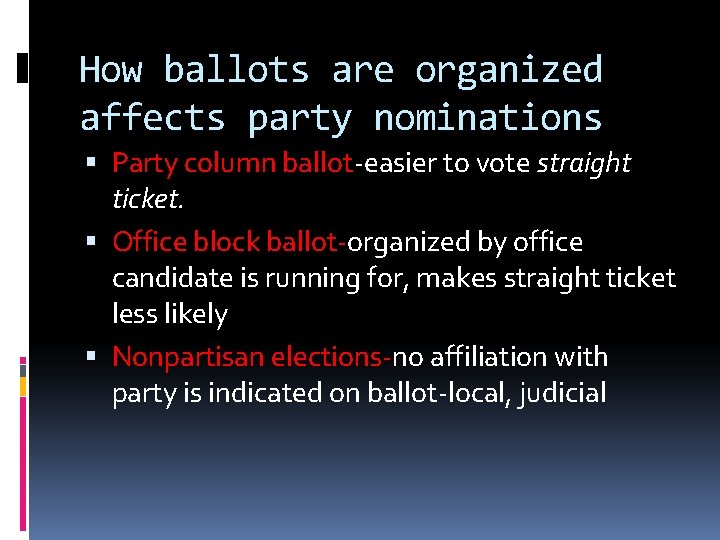
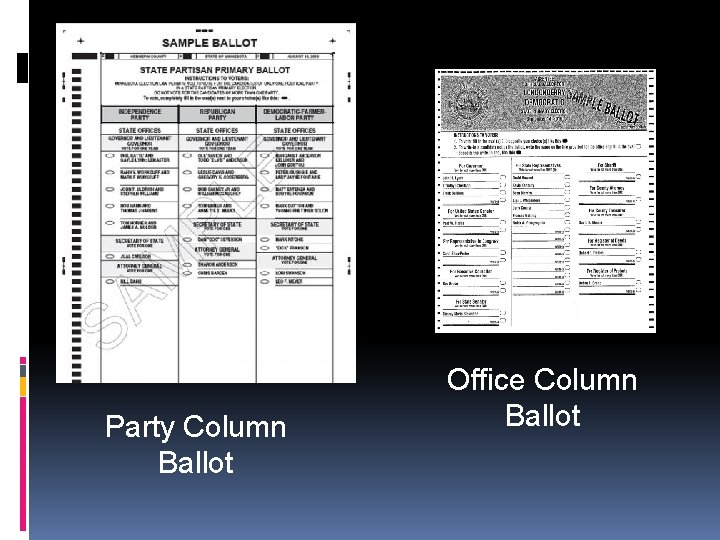
How ballots are organized affects party nominations Party column ballot-easier to vote straight ticket. Office block ballot-organized by office candidate is running for, makes straight ticket less likely Nonpartisan elections-no affiliation with party is indicated on ballot-local, judicial
Party Column Ballot Office Column Ballot
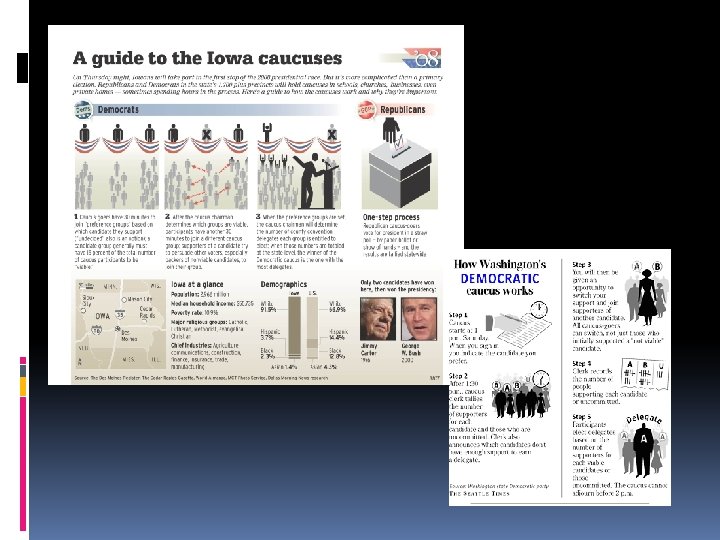
The Caucus-history & modern use Caucus-meeting of local party members to choose party officials or candidates for public office and to decide the platform By 1820’s this became corrupt-backroom deals
Convention method of nomination 1830’s-1840’s Party Conventions-delegates, usually chosen directly by party members Once again, falls to corruption, replaced by primary election
How do primaries differ? 1. ) who may run and how one qualifies for the ballot; 2. ) whether the party organization can or does endorse candidates before the primary; 3. ) who may vote in a party’s primary; 4. ) how many votes are need for nominationplurality, majority or some other number determined by party rule or state law.
Impact of differing types of Primary elections Open primaries-any voter, regardless of party may vote Permits crossover voting -Republicans voting in Democratic primary & vice versa Closed primaries-only persons of registered in the party holding that primary may vote
Primary system and the Power of the Party Decreases the role of the party in nominating candidates. Party officials have less influence in an election so have much less control over nominations ***PARTY’S DO NOT CONTROL WHO IS NOMINATED IN OUR CANDIDATE CENTERED SYSTEM
Blanket Primaries Washington and California experimented with this All voters could vote for any candidate, regardless of party-allowed raiding of other parties ballot
Watchdog Role Parties give each other a polite reprieve from attack shortly after an election This is called the honeymoon period. Most Presidents have used this to their advantage-the first 100 days.
The Party as an agent of governing Legislative: all committees are chaired by majority party, all committees have a majority of members that are of the majority party in that house. Executive: Patronage - President appoints or selects party loyalists to key government and federal judicial positions Patronage…the awarding of government jobs to persons of the winning party
The Party as agent of governing Even the party in power must moderate its position because it usually needs the help of the minority…to get legislation passed and especially to get re-elected.
Other Party Systems Multi party systems-parliamentary systems Exception –England-strong two party system Italy/Israel-many parties-coalitions necessary, minor parties get concessions(positions in cabinet, etc. ) in exchange Creates incentive and environment for strong third/fourth parties to flourish
Multiparty Systems Parties run slates of candidates for legislature Winners determined by Proportional Representation-parties receive proportion of legislators based on proportion of votes ____________________ U. S. -Winner-take-all-only candidate with most votes takes office. Minor parties can rarely overcome the assumption that a vote for them is wasted Plurality-most votes Majority-more than 50%
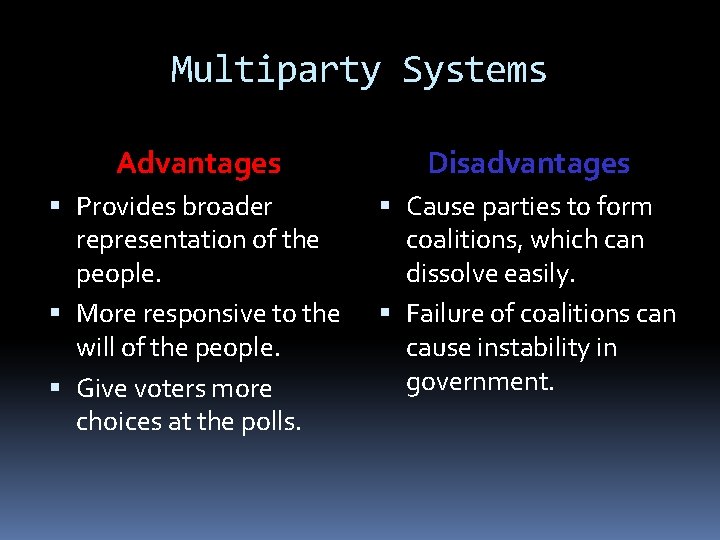
Multiparty Systems Advantages Disadvantages Provides broader representation of the people. More responsive to the will of the people. Give voters more choices at the polls. Cause parties to form coalitions, which can dissolve easily. Failure of coalitions can cause instability in government.
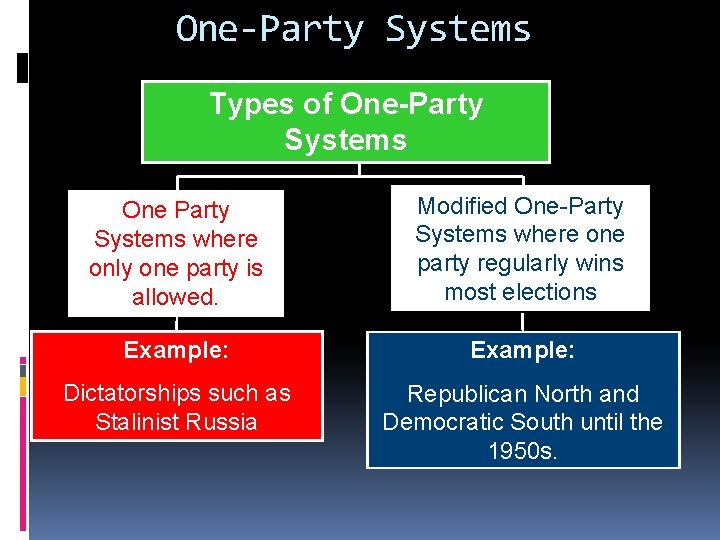
One-Party Systems Types of One-Party Systems One Party Systems where only one party is allowed. Modified One-Party Systems where one party regularly wins most elections Example: Dictatorships such as Stalinist Russia Republican North and Democratic South until the 1950 s.
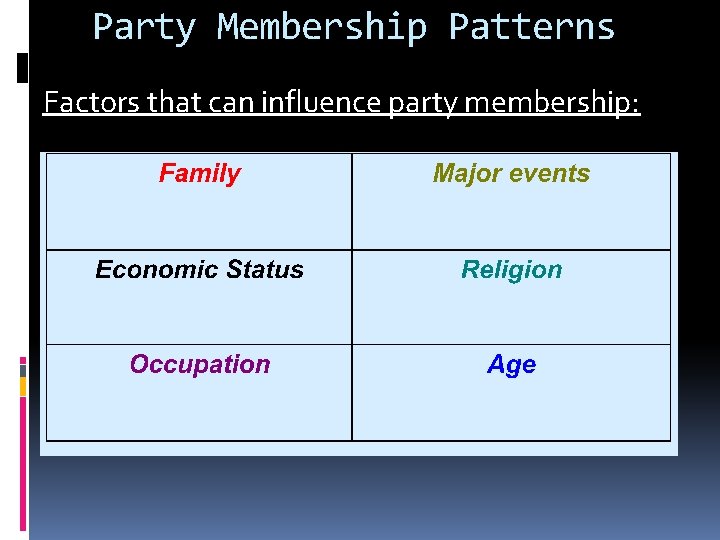
Party Membership Patterns Factors that can influence party membership:
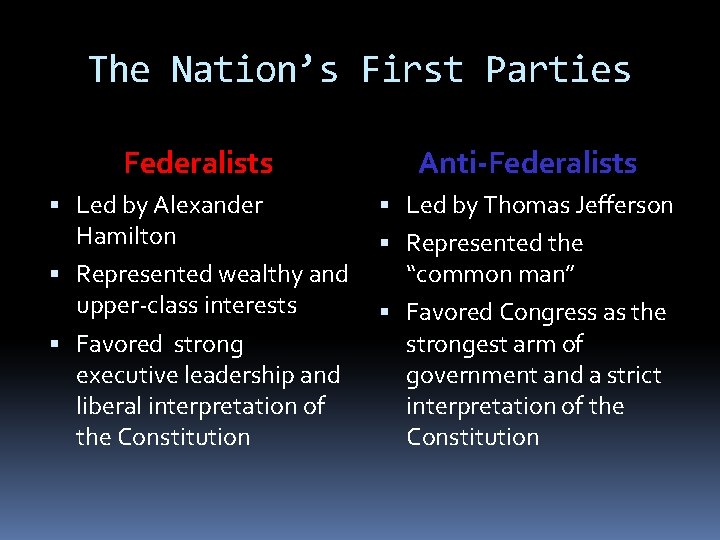
The Nation’s First Parties Federalists Led by Alexander Hamilton Represented wealthy and upper-class interests Favored strong executive leadership and liberal interpretation of the Constitution Anti-Federalists Led by Thomas Jefferson Represented the “common man” Favored Congress as the strongest arm of government and a strict interpretation of the Constitution
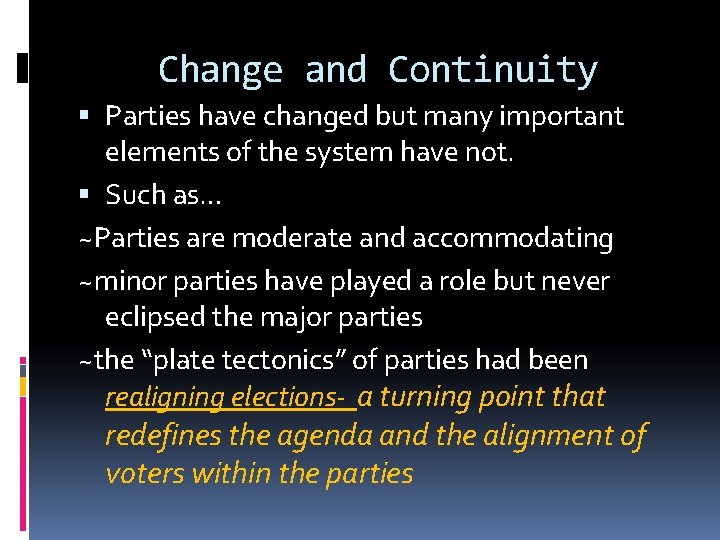
Change and Continuity Parties have changed but many important elements of the system have not. Such as… ~Parties are moderate and accommodating ~minor parties have played a role but never eclipsed the major parties ~the “plate tectonics” of parties had been realigning elections- a turning point that redefines the agenda and the alignment of voters within the parties
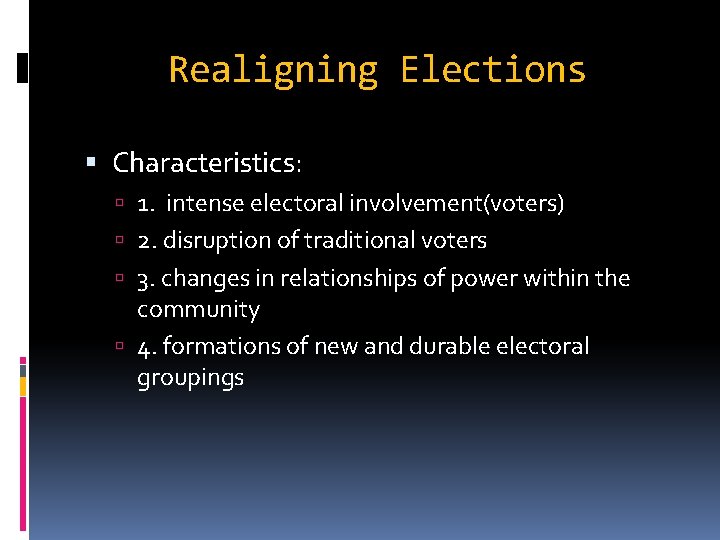
Realigning Elections Characteristics: 1. intense electoral involvement(voters) 2. disruption of traditional voters 3. changes in relationships of power within the community 4. formations of new and durable electoral groupings
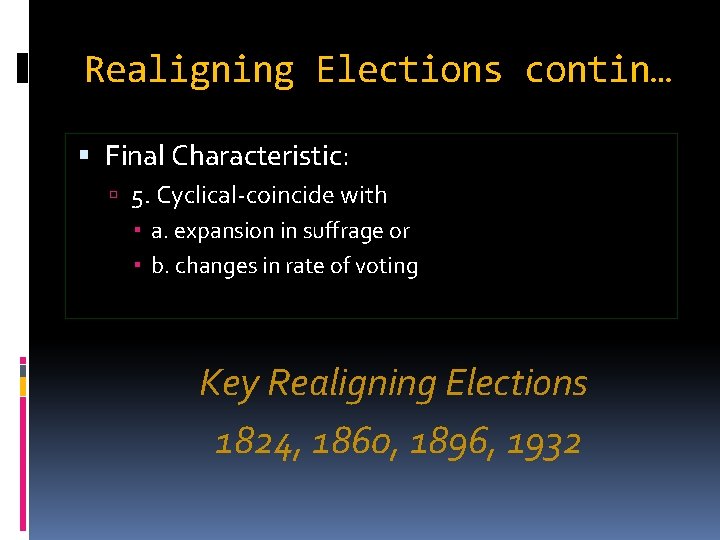
Realigning Elections contin… Final Characteristic: 5. Cyclical-coincide with a. expansion in suffrage or b. changes in rate of voting Key Realigning Elections 1824, 1860, 1896, 1932
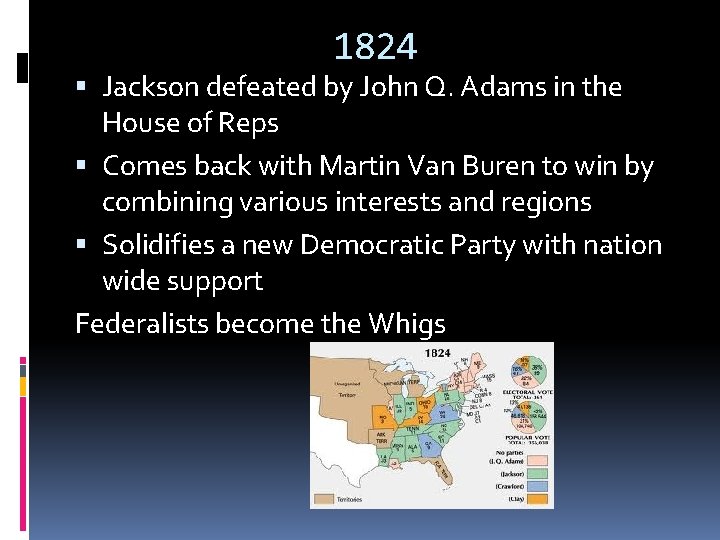
1824 Jackson defeated by John Q. Adams in the House of Reps Comes back with Martin Van Buren to win by combining various interests and regions Solidifies a new Democratic Party with nation wide support Federalists become the Whigs
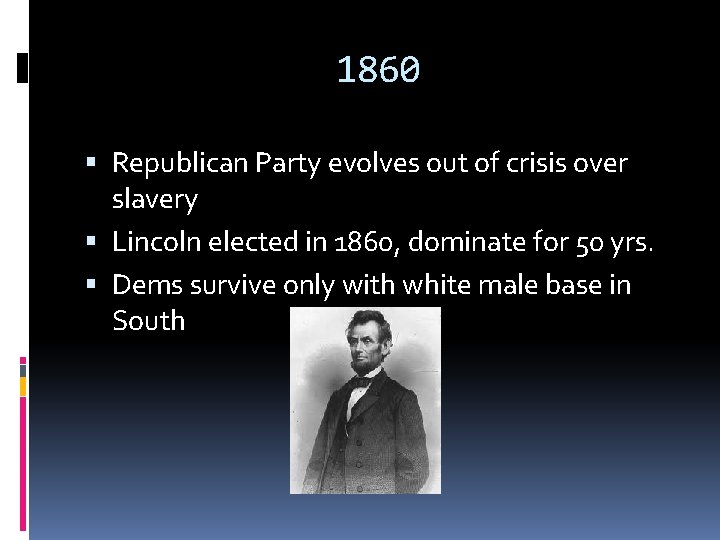
1860 Republican Party evolves out of crisis over slavery Lincoln elected in 1860, dominate for 50 yrs. Dems survive only with white male base in South
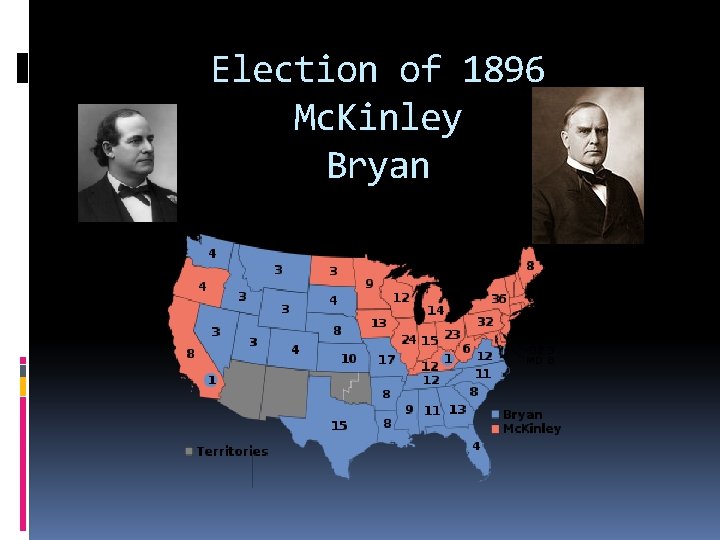
Election of 1896 Mc. Kinley Bryan
1896 Party in power did not change hands * exception called a converting realignment because party in power was same but was reinforced by those characteristics of realignment because of the threat to the party
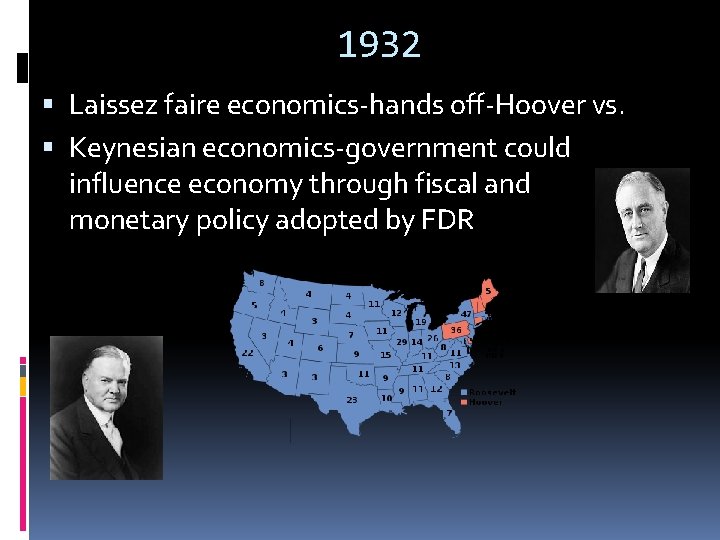
1932 Laissez faire economics-hands off-Hoover vs. Keynesian economics-government could influence economy through fiscal and monetary policy adopted by FDR
American Parties: Four Major Eras The Three Historical Eras The Era of the Democrats, 1800— 1860 – Democrats dominate all but two presidential elections. – The Whig Party emerges in 1834, but declines by the 1850 s, electing only two Presidents. – The Republican Party is founded in 1854. The Era of the Republicans, 1860— 1932 – Republicans dominate all but four presidential elections. – The Civil War disables the Democratic Party for the remainder of the 1800 s. The Return of the Democrats, 1932— 1968 – Democrats dominate all but two presidential elections. – Democrat Franklin D. Roosevelt is elected President four times.
American Parties: Parties Today The Start of a New Era: The Era of Divided Government Since 1968, neither Republicans nor Democrats have dominated the presidency and Congress has often been controlled by the opposing party. 1968– 1976 Republicans hold the presidency Congress is controlled by Democrats 1976– 1980 Democrats hold the presidency Congress is controlled by Democrats 1992 – 2000 1980– 1992 Democrats hold the presidency Republicans hold the presidency Congress controlled by Senate controlled by Republicans 1980 -1986, Republicans, 1994 to present controlled by Democrats from 1986 to 1994 2000 Republicans hold the presidency Congress is controlled by Republicans
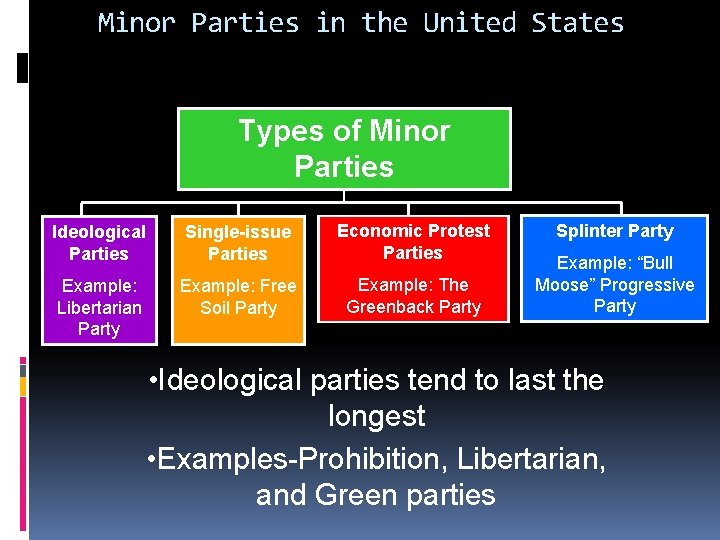
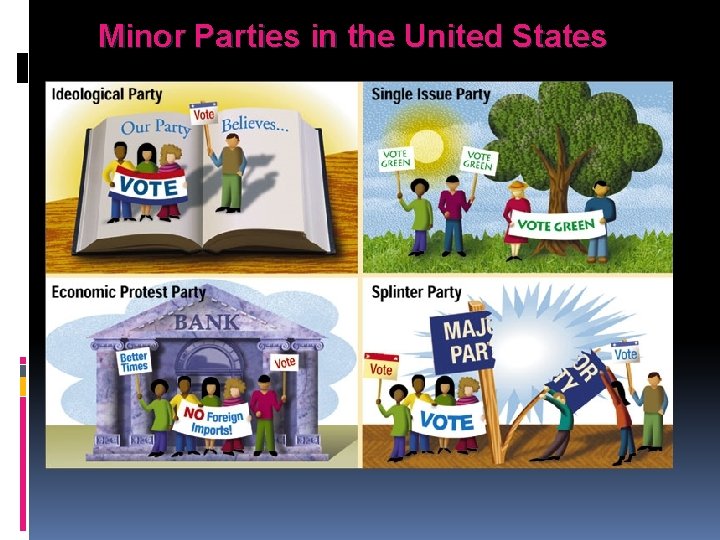
Minor Parties in the United States Types of Minor Parties Ideological Parties Single-issue Parties Economic Protest Parties Example: Libertarian Party Example: Free Soil Party Example: The Greenback Party Splinter Party Example: “Bull Moose” Progressive Party • Ideological parties tend to last the longest • Examples-Prohibition, Libertarian, and Green parties
Minor Parties in the United States
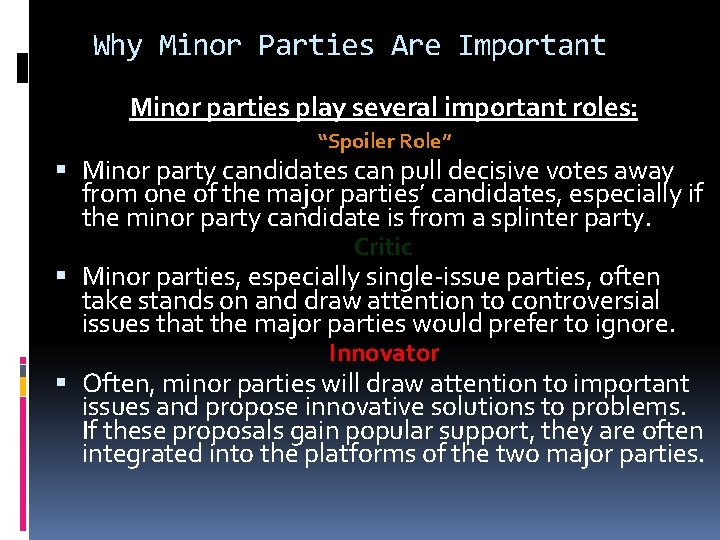
Why Minor Parties Are Important Minor parties play several important roles: “Spoiler Role” Minor party candidates can pull decisive votes away from one of the major parties’ candidates, especially if the minor party candidate is from a splinter party. Critic Minor parties, especially single-issue parties, often take stands on and draw attention to controversial issues that the major parties would prefer to ignore. Innovator Often, minor parties will draw attention to important issues and propose innovative solutions to problems. If these proposals gain popular support, they are often integrated into the platforms of the two major parties.
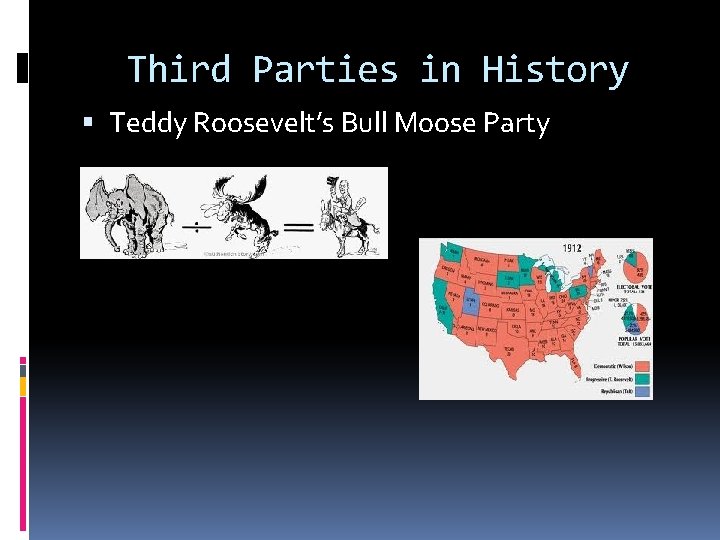
Third Parties in History Teddy Roosevelt’s Bull Moose Party
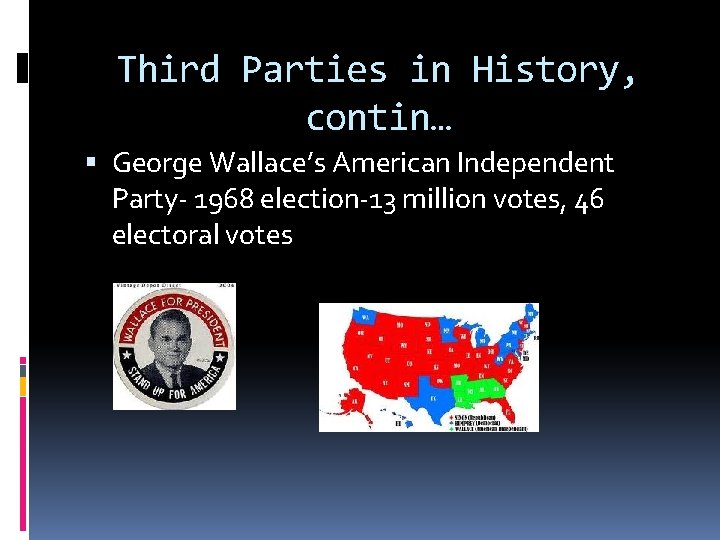
Third Parties in History, contin… George Wallace’s American Independent Party- 1968 election-13 million votes, 46 electoral votes
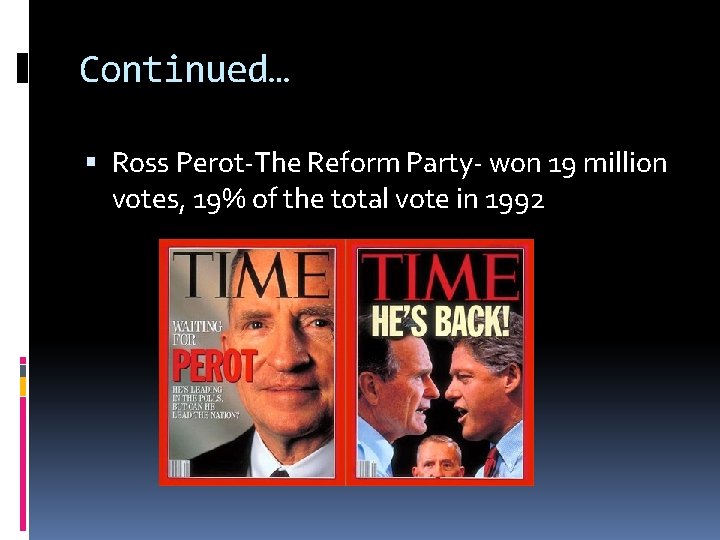
Continued… Ross Perot-The Reform Party- won 19 million votes, 19% of the total vote in 1992
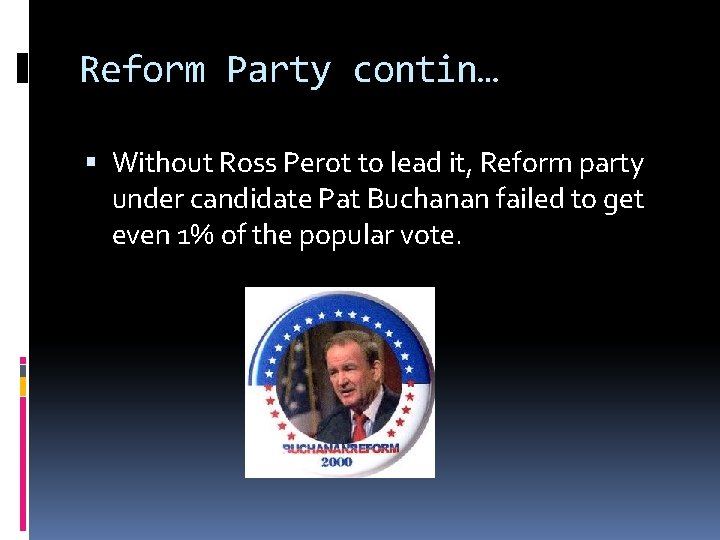
Reform Party contin… Without Ross Perot to lead it, Reform party under candidate Pat Buchanan failed to get even 1% of the popular vote.
The Decentralized Nature of the Parties Both of the major parties are highly decentralized and fragmented. Why? • • The party out of power lacks a strong leader. • The nominating process pits party members against one another because only one person can chosen to be the party’s presidential candidate. The federal system distributes powers widely, in turn causing the parties to be decentralized.
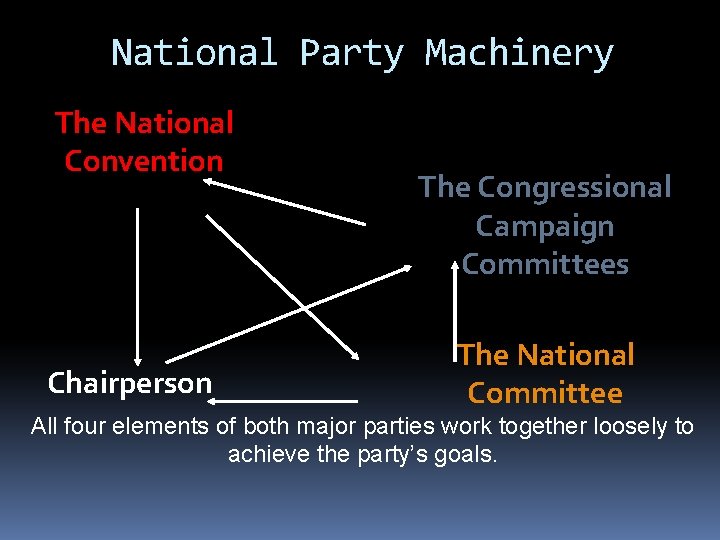
National Party Machinery The National Convention The National Chairperson The Congressional Campaign Committees The National Committee All four elements of both major parties work together loosely to achieve the party’s goals.
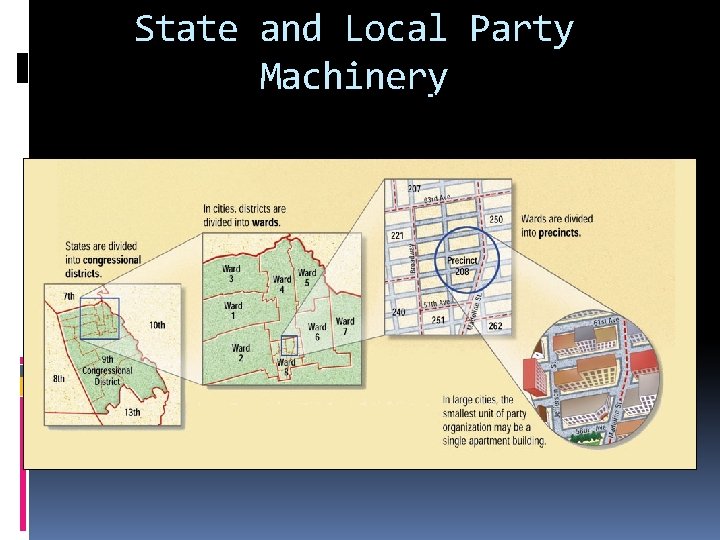
State and Local Party Machinery State and local party organization varies from State to State, but usually follow the general principles below.
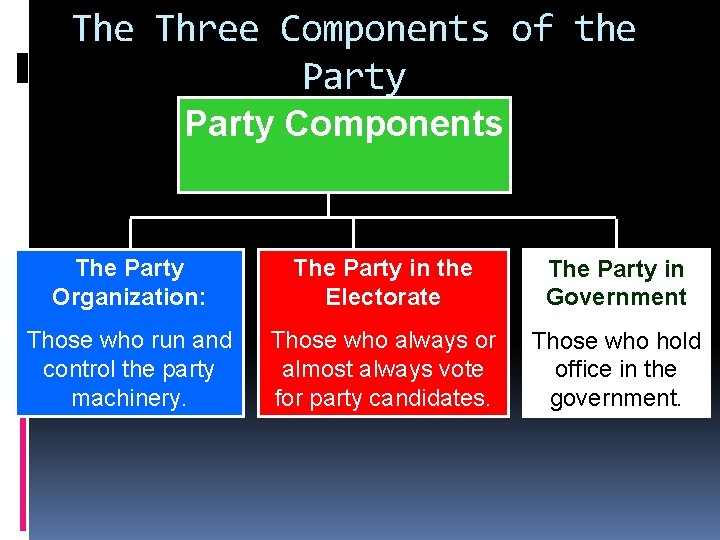
The Three Components of the Party Components The Party Organization: The Party in the Electorate The Party in Government Those who run and control the party machinery. Those who always or almost always vote for party candidates. Those who hold office in the government.
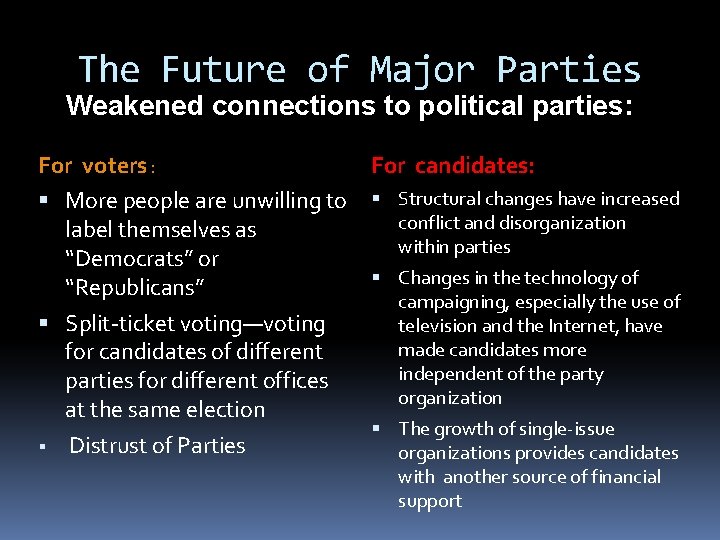
The Future of Major Parties Weakened connections to political parties: For voters : More people are unwilling to label themselves as “Democrats” or “Republicans” Split-ticket voting—voting for candidates of different parties for different offices at the same election Distrust of Parties For candidates: Structural changes have increased conflict and disorganization within parties Changes in the technology of campaigning, especially the use of television and the Internet, have made candidates more independent of the party organization The growth of single-issue organizations provides candidates with another source of financial support
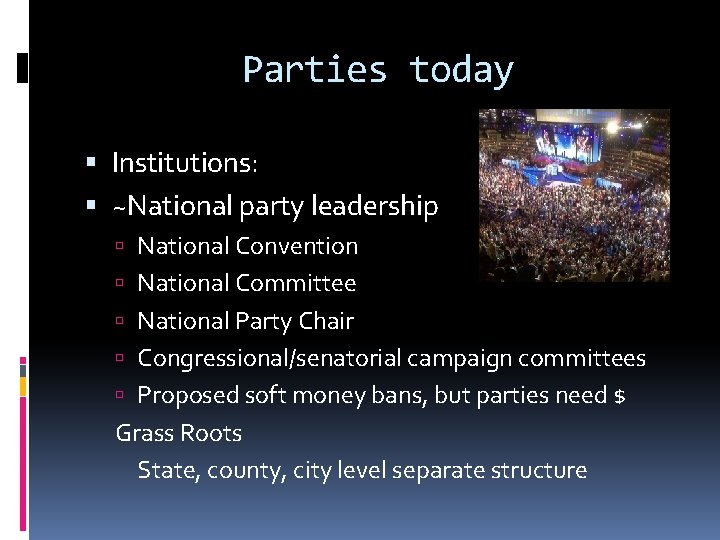
Parties today Institutions: ~National party leadership National Convention National Committee National Party Chair Congressional/senatorial campaign committees Proposed soft money bans, but parties need $ Grass Roots State, county, city level separate structure
Institutions of the Party, contin… Party Platform-official statement, vague on purpose Party platform-doesn’t help a presidential candidate but can hurt a candidate
Party Activists Those who identify themselves as strong Republican or strong Democrat are the most active in politics and are generally more knowledgeable and informed.
The Fate of the Party system Three challenges 1. Parties do not take meaningful and contrasting positions on issues 2. Party membership is meaningless 3. Parties are concerned with the middle of the ideological spectrum so they are not capable of social progress
Is the Party System in Severe Decline? Reforms of early 1900’s progressives weaken parties Nonpartisan elections and the large number of elections make it harder for party to exert influence The new media have reinforced the role of the candidate
Will the Parties have a revived role? The national party organizations are better funded Have the big $$$ that candidates need in such an expensive election process.
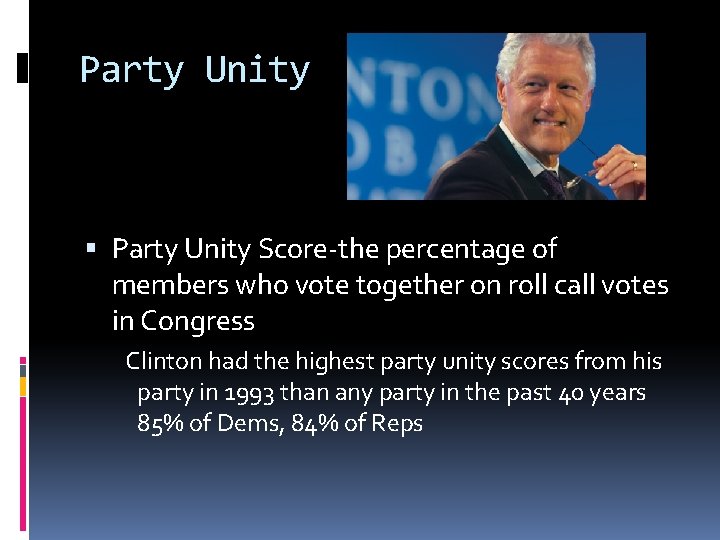
Party Unity Score-the percentage of members who vote together on roll call votes in Congress Clinton had the highest party unity scores from his party in 1993 than any party in the past 40 years 85% of Dems, 84% of Reps