
Chapter 7 Point Estimation of Parameters Learning Objectives

Chapter 7 Point Estimation of Parameters
Learning Objectives • Explain the general concepts of estimating • Explain important properties of point estimators • Know how to construct point estimators using the method of maximum likelihood • Understand the central limit theorem • Explain the important role of the normal distribution
Statistical Inference • Used to make decisions or to draw conclusions about a population • Utilize the information contained in a sample from the population • Divided into two major areas – parameter estimation – hypothesis testing • Use sample data to compute a number • Called a point estimate

Statistic and Sampling Distribution • Obtain a point estimate of a population parameter • Observations are random variables • Any function of the observation, or any statistic, is also a random variable • Sample mean and sample variance are statistics • Has a probability distribution • Call the probability distribution of a statistic a sampling distribution
Definition of the Point Estimate • Suppose we need to estimate the mean of a single population by a sample mean – Population mean, , is the unknown parameter – Estimator of the unknown parameter is the sample mean – is a statistic and can take on any value • Convenient to have a general symbol • Symbols are used in parameter estimation – Unknown population parameter id denoted by – Point estimate of this parameter by – Point estimator is a statistic and is denoted by
General Concepts of Point Estimation • Unbiased Estimator – Estimator should be “close” to the true value of the unknown parameter – Estimator is unbiased when its expected value is equal to the parameter of interest – Bias is zero • Variance of a Point Estimator – Considering all unbiased estimators, the one with the smallest variance is called the minimum variance unbiased estimator (MVUE) – MVUE is most likely estimator that gives a close value to the true value of the parameter of interest
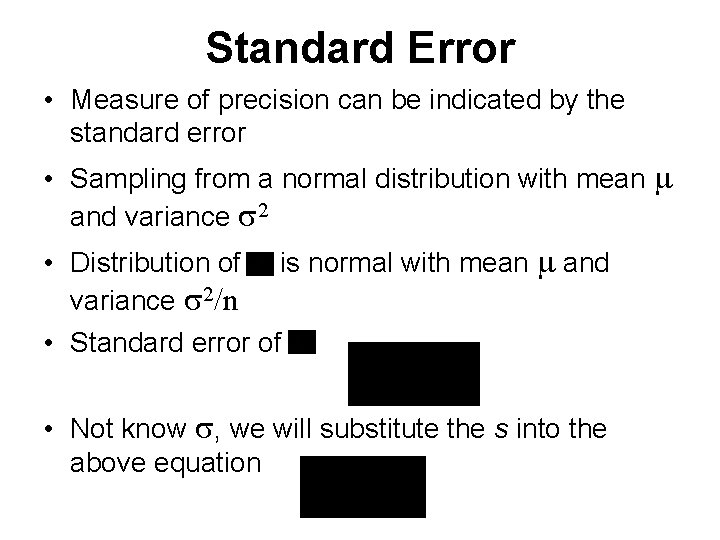
Standard Error • Measure of precision can be indicated by the standard error • Sampling from a normal distribution with mean and variance 2 • Distribution of is normal with mean and variance 2/n • Standard error of • Not know , we will substitute the s into the above equation
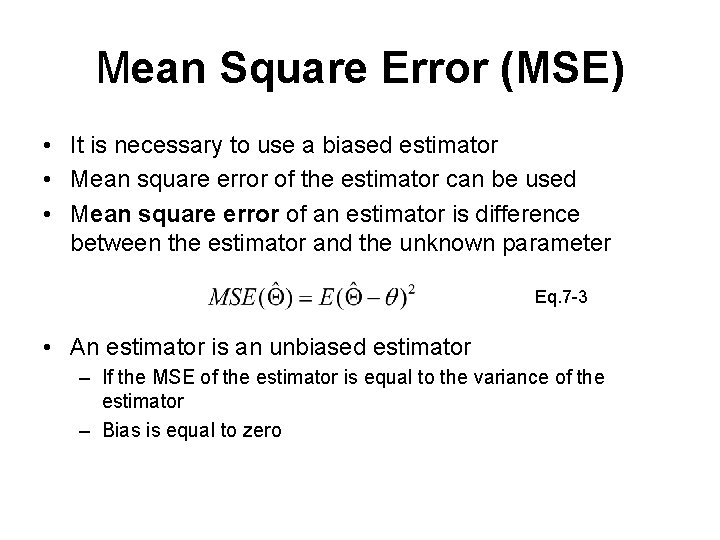
Mean Square Error (MSE) • It is necessary to use a biased estimator • Mean square error of the estimator can be used • Mean square error of an estimator is difference between the estimator and the unknown parameter Eq. 7 -3 • An estimator is an unbiased estimator – If the MSE of the estimator is equal to the variance of the estimator – Bias is equal to zero
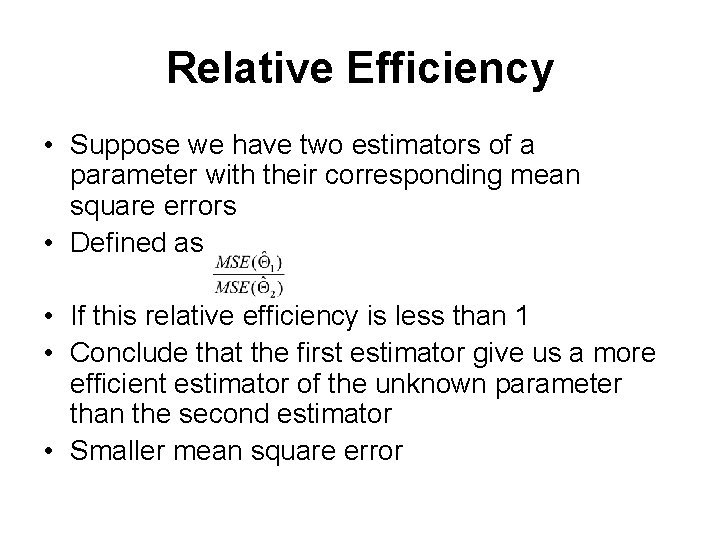
Relative Efficiency • Suppose we have two estimators of a parameter with their corresponding mean square errors • Defined as • If this relative efficiency is less than 1 • Conclude that the first estimator give us a more efficient estimator of the unknown parameter than the second estimator • Smaller mean square error
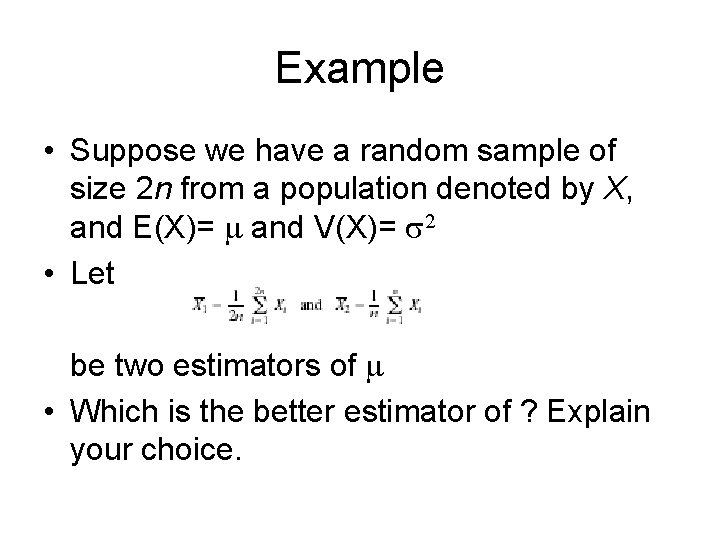
Example • Suppose we have a random sample of size 2 n from a population denoted by X, and E(X)= and V(X)= 2 • Let be two estimators of • Which is the better estimator of ? Explain your choice.
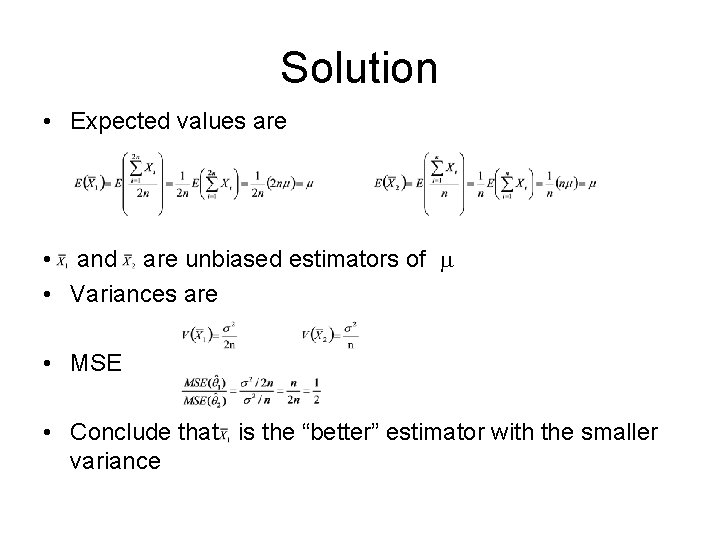
Solution • Expected values are • and are unbiased estimators of • Variances are • MSE • Conclude that is the “better” estimator with the smaller variance
Methods of Point Estimation • Definition of unbiasness and other properties do not provide any guidance about how good estimators can be obtained • Discuss the method of maximum likelihood • Estimator will be the value of the parameter that maximizes the probability of occurrence of the sample values
Definition • Let X be a random variable with probability distribution f(x; ) – is a single unknown parameter – Let x 1, x 2, …, xn be the observed values in a random sample of size n – Then the likelihood function of the sample L( )= f(x 1: ). f(x 2: ). … f(xn: )
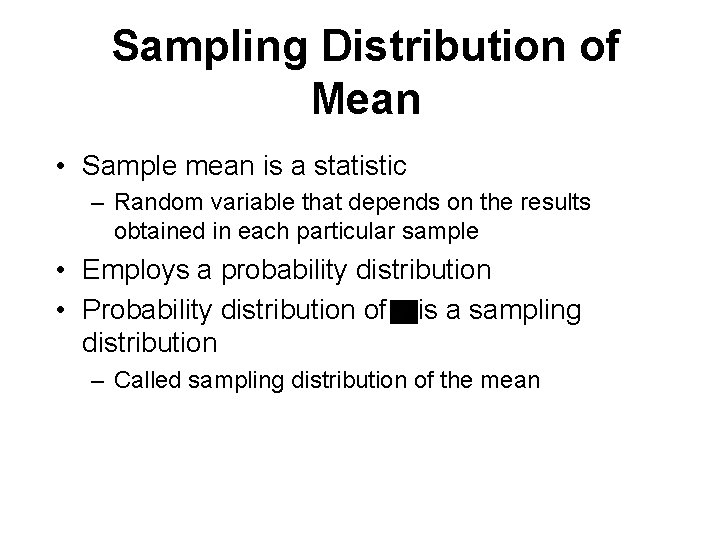
Sampling Distribution of Mean • Sample mean is a statistic – Random variable that depends on the results obtained in each particular sample • Employs a probability distribution • Probability distribution of is a sampling distribution – Called sampling distribution of the mean
Sampling Distributions of Means • Determine the sampling distribution of the sample mean • Random sample of size n is taken from a normal population with mean and variance 2 • Each observation is a normally and independently distributed random variable with mean and variance 2
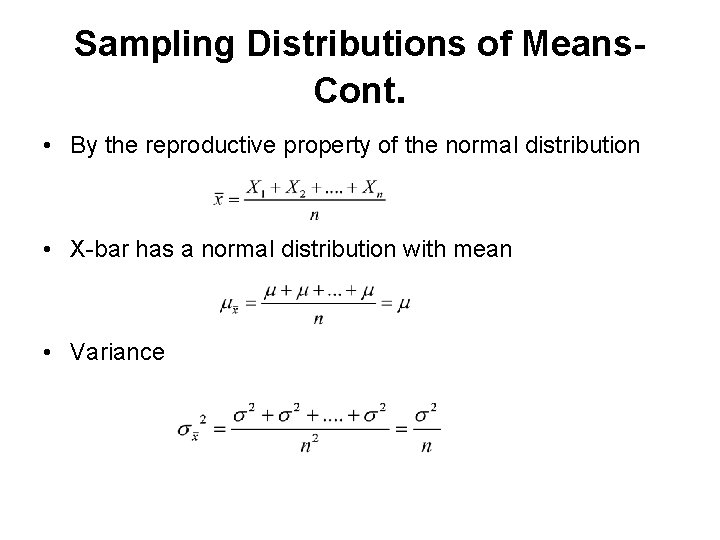
Sampling Distributions of Means. Cont. • By the reproductive property of the normal distribution • X-bar has a normal distribution with mean • Variance
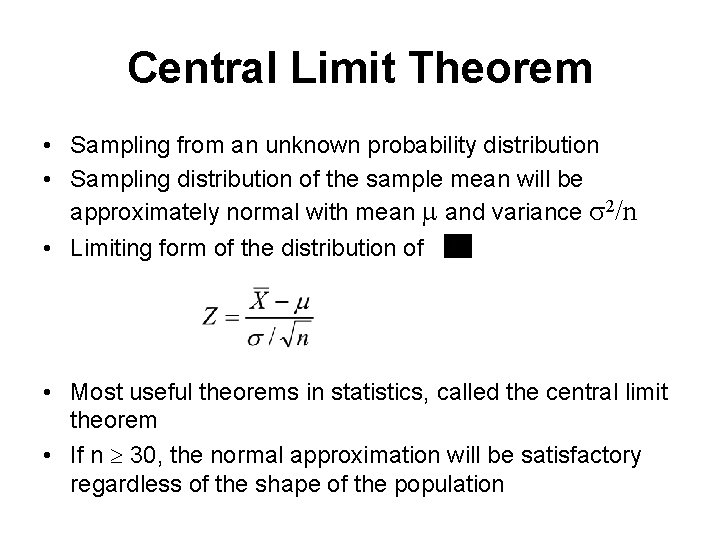
Central Limit Theorem • Sampling from an unknown probability distribution • Sampling distribution of the sample mean will be approximately normal with mean and variance 2/n • Limiting form of the distribution of • Most useful theorems in statistics, called the central limit theorem • If n 30, the normal approximation will be satisfactory regardless of the shape of the population
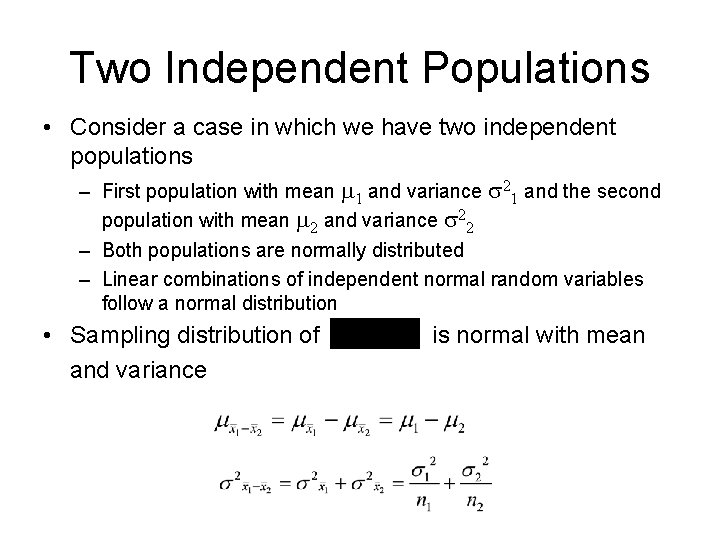
Two Independent Populations • Consider a case in which we have two independent populations – First population with mean 1 and variance 21 and the second population with mean 2 and variance 22 – Both populations are normally distributed – Linear combinations of independent normal random variables follow a normal distribution • Sampling distribution of and variance is normal with mean
- Slides: 18