
Chapter 7 Photosynthesis Using Light to Make Food
- Slides: 54
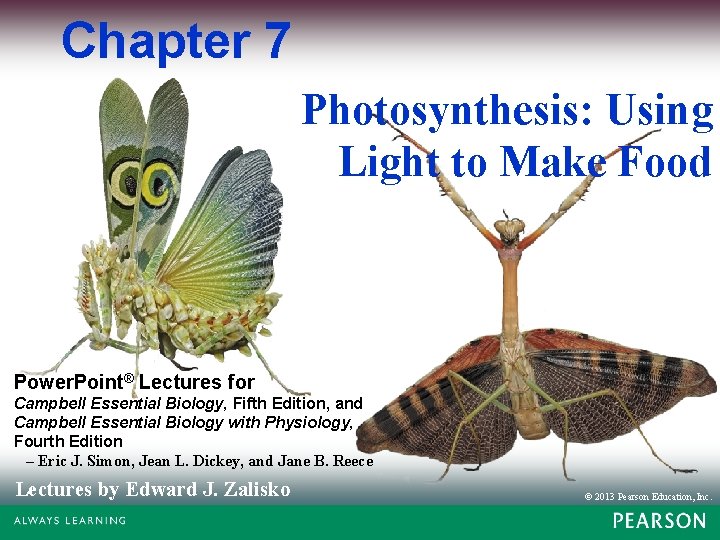
Chapter 7 Photosynthesis: Using Light to Make Food Power. Point® Lectures for Campbell Essential Biology, Fifth Edition, and Campbell Essential Biology with Physiology, Fourth Edition – Eric J. Simon, Jean L. Dickey, and Jane B. Reece Lectures by Edward J. Zalisko © 2013 Pearson Education, Inc.
Biology and Society: Green Energy • People take advantage of the plant's ability to capture solar energy • Wood has historically been the main fuel used to: – cook – warm homes – provide light at night • Industrialized societies replaced wood with fossil fuels including coal, gas, and oil. • To limit the damaging effects of fossil fuels, researchers are investigating the use of biomass (living material) as efficient and renewable energy sources.
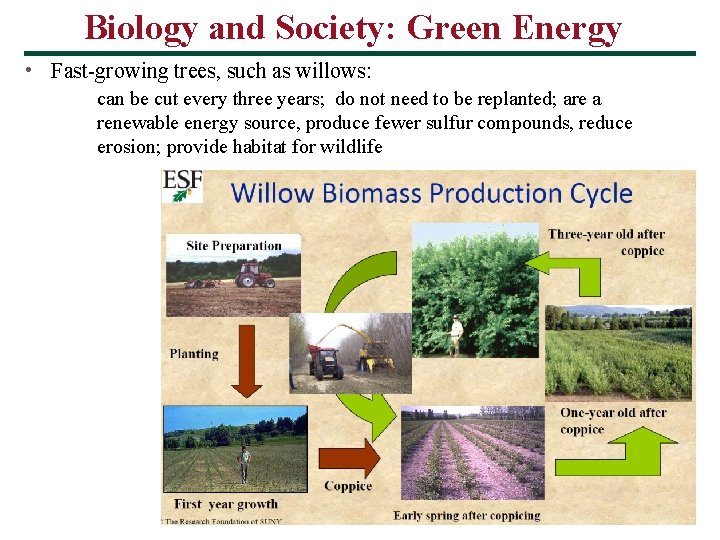
Biology and Society: Green Energy • Fast-growing trees, such as willows: can be cut every three years; do not need to be replanted; are a renewable energy source, produce fewer sulfur compounds, reduce erosion; provide habitat for wildlife
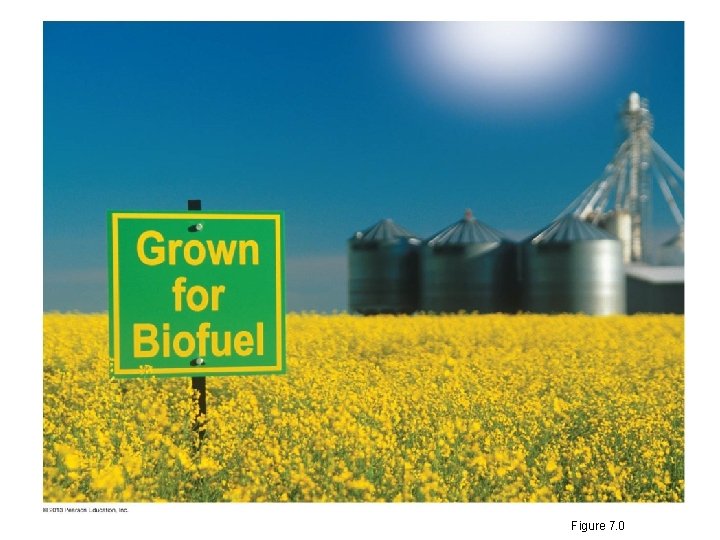
Figure 7. 0
Biology and Society: Biofuels • There are several types of biofuels. - Bioethanol is a type of alcohol produced by the fermentation of glucose made from starches in crops such as grains, sugar beets, and sugar cane. - Bioethanol may be used - directly as a fuel source in specially designed vehicles or - as a gasoline additive. - Cellulosic ethanol is a type of bioethanol made from cellulose in nonedible plant material such as wood or grass. - Biodiesel is made from plant oils or recycled frying oil
THE BASICS OF PHOTOSYNTHESIS • Photosynthesis: – is used by plants, some protists, and some bacteria – transforms light energy into chemical energy – uses carbon dioxide and water as starting materials • The chemical energy produced via photosynthesis is stored in the bonds of sugar molecules.
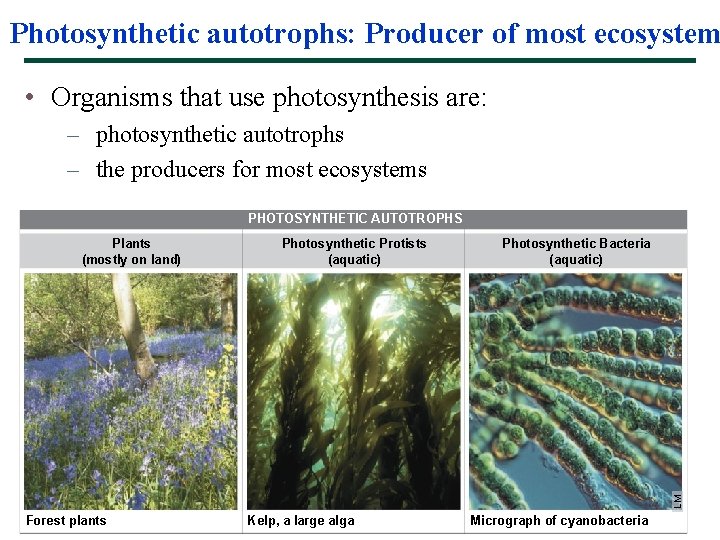
Photosynthetic autotrophs: Producer of most ecosystem • Organisms that use photosynthesis are: – photosynthetic autotrophs – the producers for most ecosystems PHOTOSYNTHETIC AUTOTROPHS Photosynthetic Protists (aquatic) Photosynthetic Bacteria (aquatic) LM Plants (mostly on land) Forest plants Kelp, a large alga Micrograph of cyanobacteria
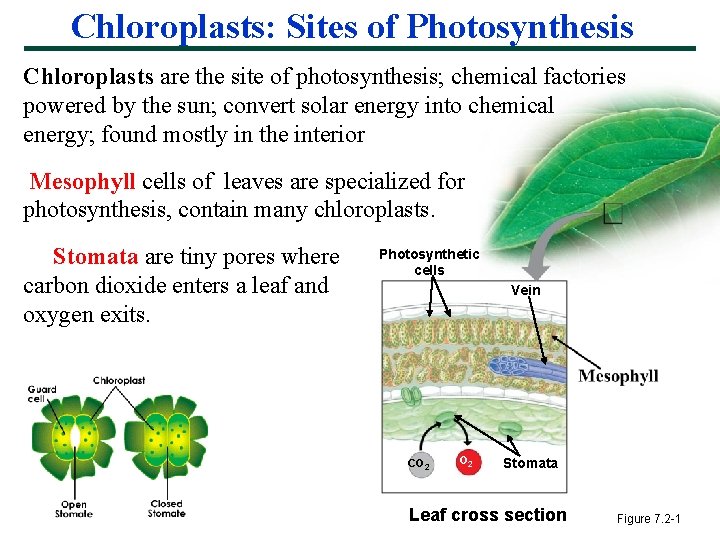
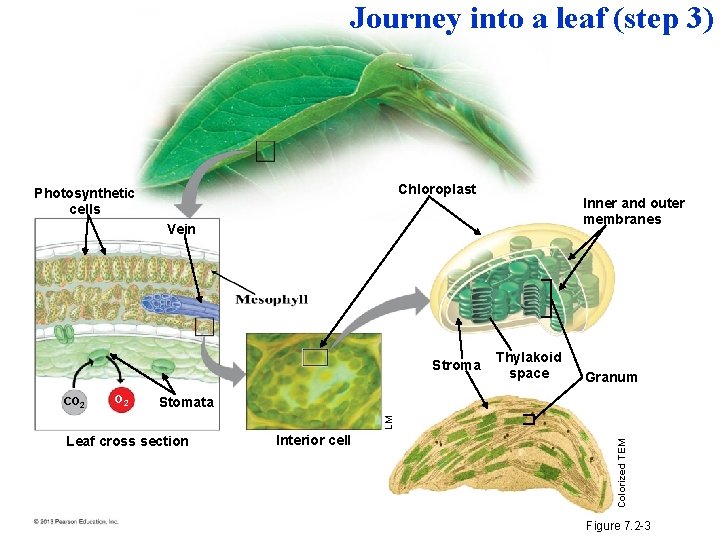
Chloroplasts: Sites of Photosynthesis Chloroplasts are the site of photosynthesis; chemical factories powered by the sun; convert solar energy into chemical energy; found mostly in the interior Mesophyll cells of leaves are specialized for photosynthesis, contain many chloroplasts. Stomata are tiny pores where carbon dioxide enters a leaf and oxygen exits. Photosynthetic cells Vein CO 2 Stomata Leaf cross section Figure 7. 2 -1
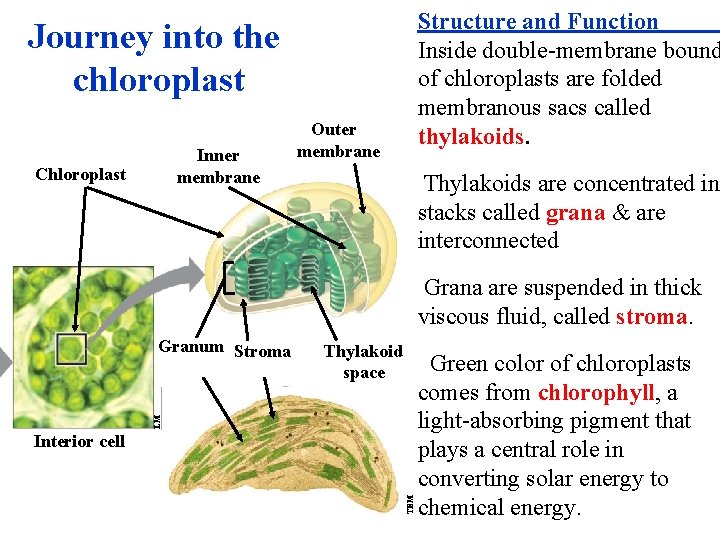
Structure and Function Inside double-membrane bound of chloroplasts are folded membranous sacs called thylakoids. Journey into the chloroplast Inner membrane Chloroplast Outer membrane Thylakoids are concentrated in stacks called grana & are interconnected Grana are suspended in thick viscous fluid, called stroma. Thylakoid space LM Granum Stroma TEM Interior cell Green color of chloroplasts comes from chlorophyll, a light-absorbing pigment that plays a central role in converting solar energy to chemical energy.
Journey into a leaf (step 3) Chloroplast Photosynthetic cells Inner and outer membranes Vein Stroma O 2 Granum Stomata Leaf cross section Interior cell Colorized TEM LM CO 2 Thylakoid space Figure 7. 2 -3
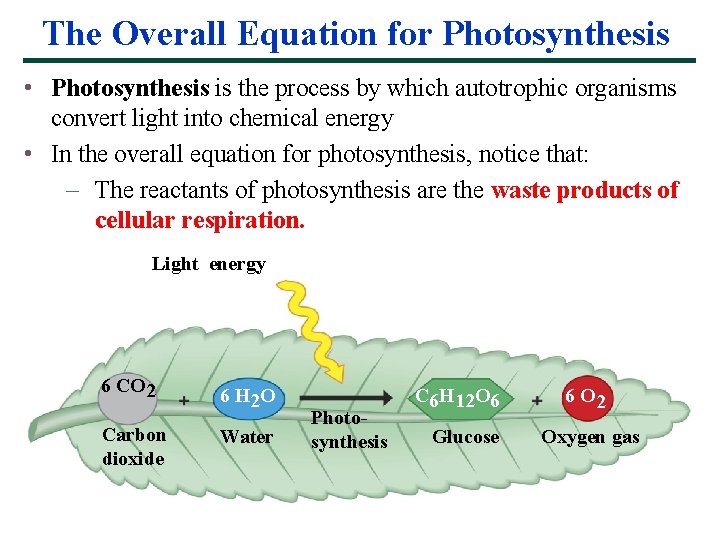
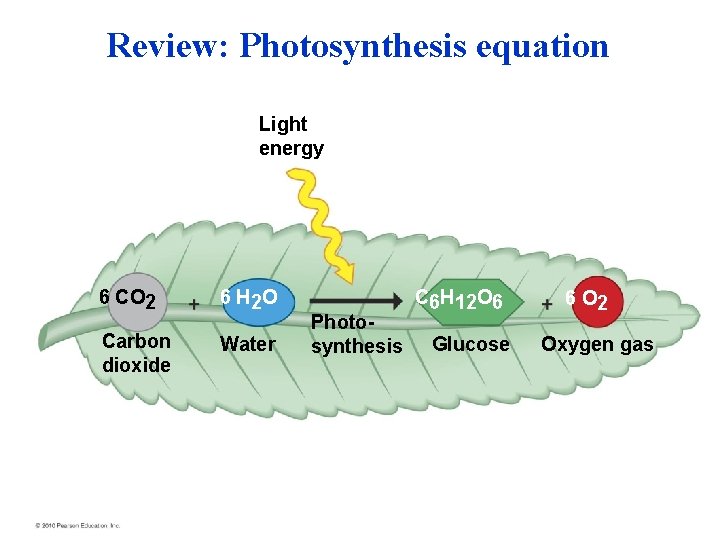
The Overall Equation for Photosynthesis • Photosynthesis is the process by which autotrophic organisms convert light into chemical energy • In the overall equation for photosynthesis, notice that: – The reactants of photosynthesis are the waste products of cellular respiration. Light energy 6 CO 2 Carbon dioxide 6 H 2 O Water Photosynthesis C 6 H 12 O 6 Glucose 6 O 2 Oxygen gas
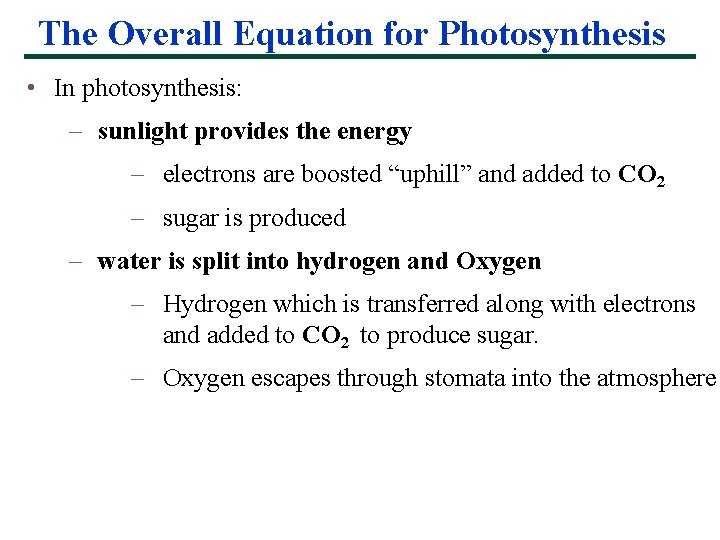
The Overall Equation for Photosynthesis • In photosynthesis: – sunlight provides the energy – electrons are boosted “uphill” and added to CO 2 – sugar is produced – water is split into hydrogen and Oxygen – Hydrogen which is transferred along with electrons and added to CO 2 to produce sugar. – Oxygen escapes through stomata into the atmosphere
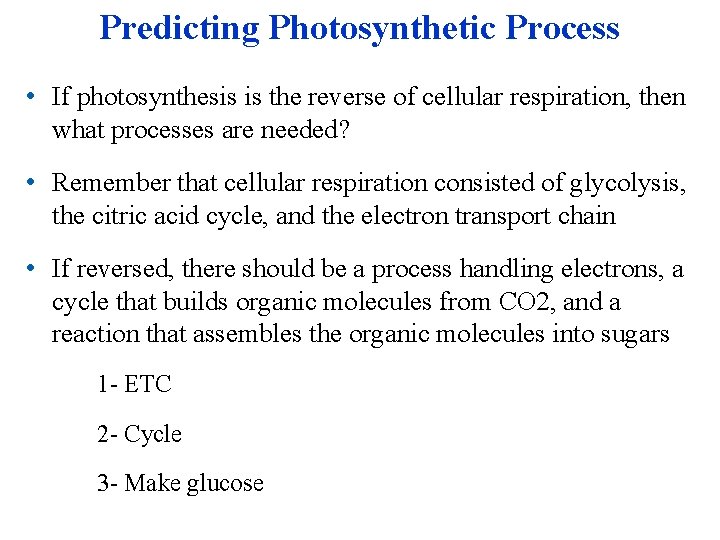
Predicting Photosynthetic Process • If photosynthesis is the reverse of cellular respiration, then what processes are needed? • Remember that cellular respiration consisted of glycolysis, the citric acid cycle, and the electron transport chain • If reversed, there should be a process handling electrons, a cycle that builds organic molecules from CO 2, and a reaction that assembles the organic molecules into sugars 1 - ETC 2 - Cycle 3 - Make glucose
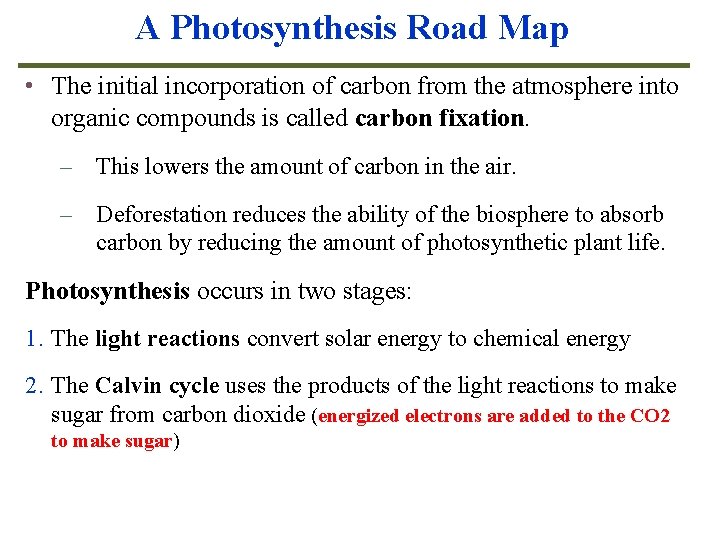
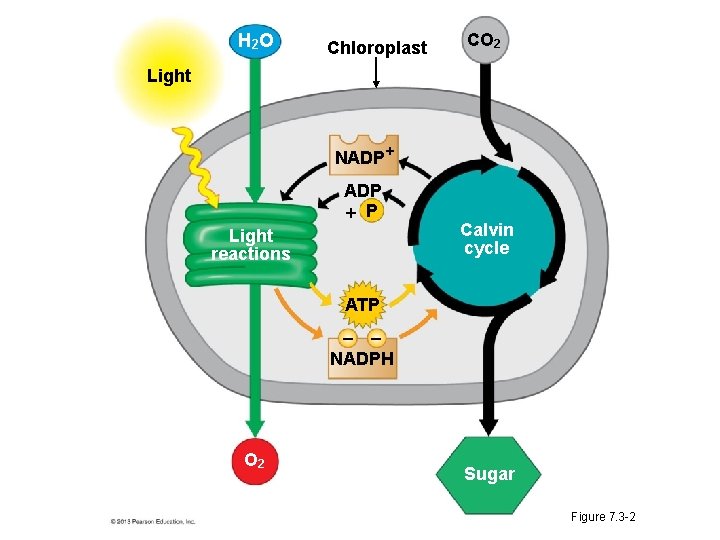
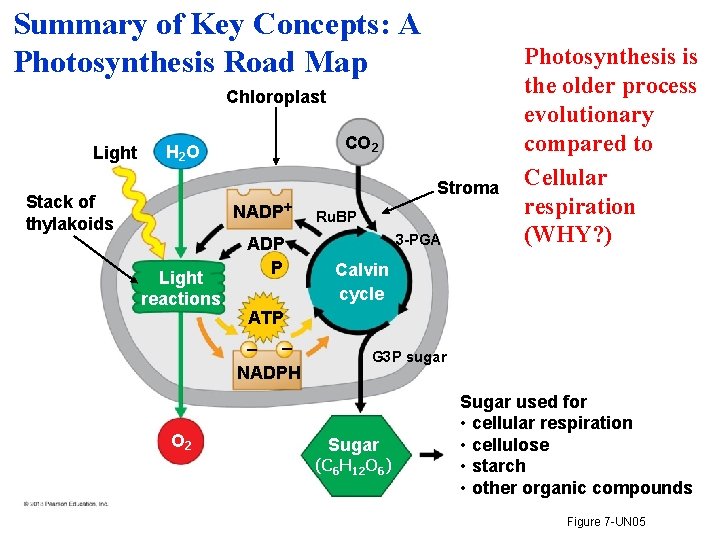
A Photosynthesis Road Map • The initial incorporation of carbon from the atmosphere into organic compounds is called carbon fixation. – This lowers the amount of carbon in the air. – Deforestation reduces the ability of the biosphere to absorb carbon by reducing the amount of photosynthetic plant life. Photosynthesis occurs in two stages: 1. The light reactions convert solar energy to chemical energy 2. The Calvin cycle uses the products of the light reactions to make sugar from carbon dioxide (energized electrons are added to the CO 2 to make sugar)
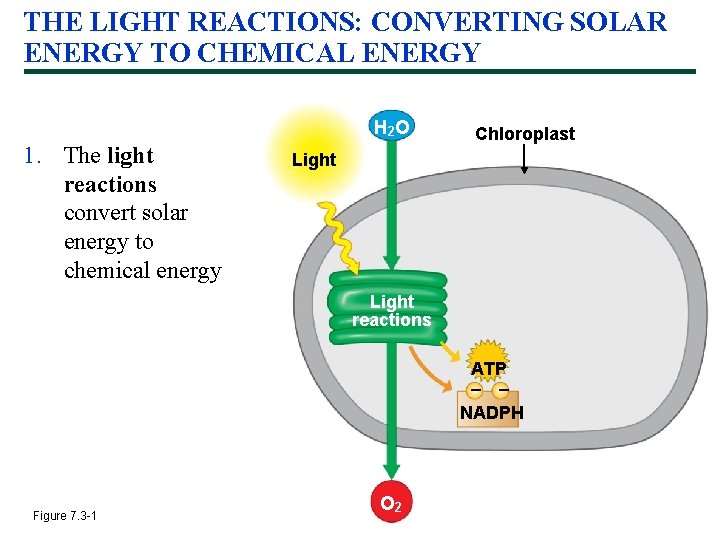
THE LIGHT REACTIONS: CONVERTING SOLAR ENERGY TO CHEMICAL ENERGY H 2 O 1. The light reactions convert solar energy to chemical energy Chloroplast Light reactions ATP – – NADPH Figure 7. 3 -1 O 2
H 2 O Chloroplast CO 2 Light NADP+ ADP P Light reactions Calvin cycle ATP – – NADPH O 2 Sugar Figure 7. 3 -2
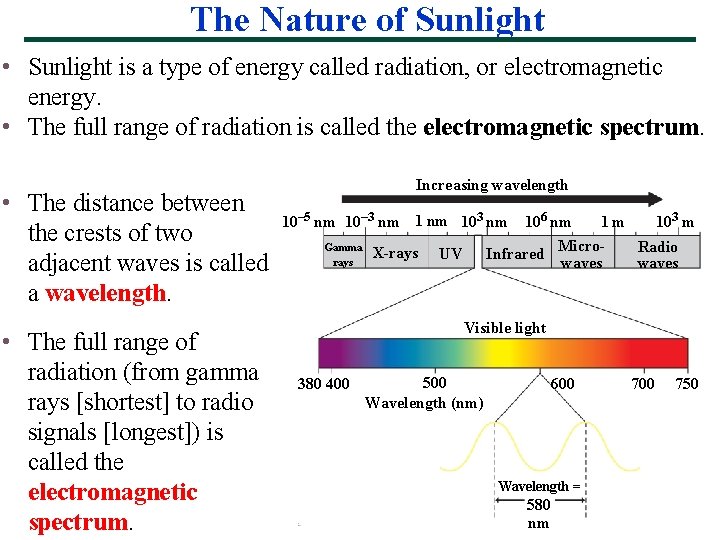
The Nature of Sunlight • Sunlight is a type of energy called radiation, or electromagnetic energy. • The full range of radiation is called the electromagnetic spectrum. • The distance between the crests of two adjacent waves is called a wavelength. • The full range of radiation (from gamma rays [shortest] to radio signals [longest]) is called the electromagnetic spectrum. Increasing wavelength 10– 5 nm 10– 3 nm 103 nm 106 nm Gamma rays X-rays Infrared Microwaves UV 103 m 1 m Radio waves Visible light 380 400 500 Wavelength (nm) 600 Wavelength = 580 nm 700 750
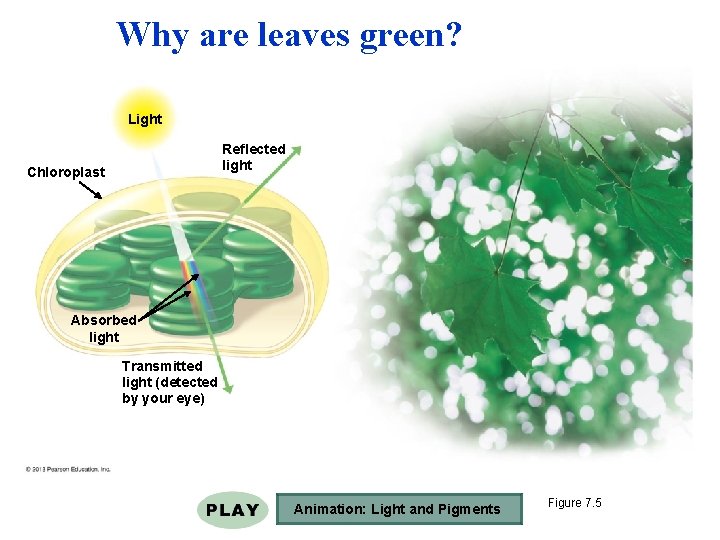
Why are leaves green? Light Reflected light Chloroplast Absorbed light Transmitted light (detected by your eye) Animation: Light and Pigments Figure 7. 5
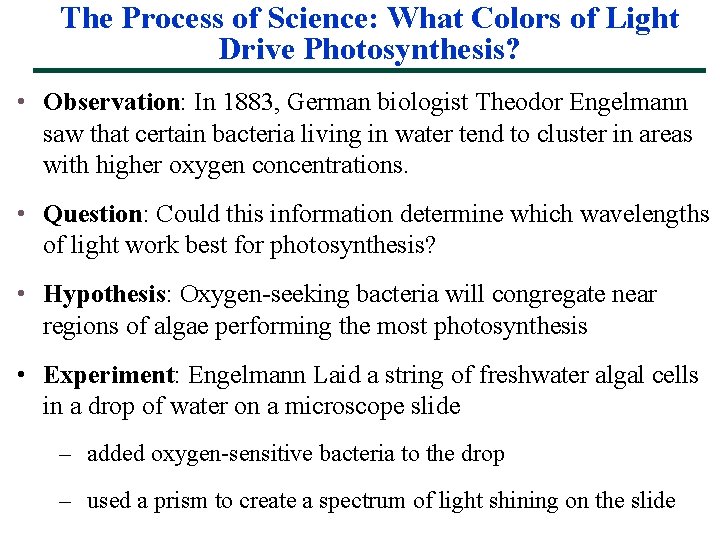
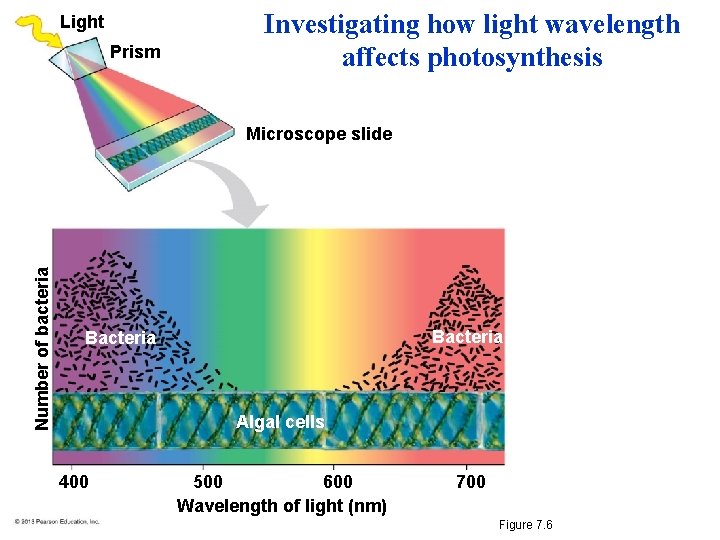
The Process of Science: What Colors of Light Drive Photosynthesis? • Observation: In 1883, German biologist Theodor Engelmann saw that certain bacteria living in water tend to cluster in areas with higher oxygen concentrations. • Question: Could this information determine which wavelengths of light work best for photosynthesis? • Hypothesis: Oxygen-seeking bacteria will congregate near regions of algae performing the most photosynthesis • Experiment: Engelmann Laid a string of freshwater algal cells in a drop of water on a microscope slide – added oxygen-sensitive bacteria to the drop – used a prism to create a spectrum of light shining on the slide
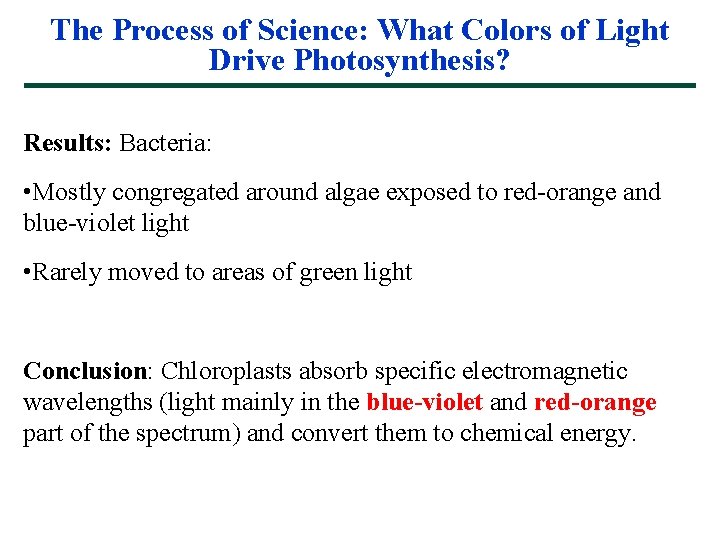
The Process of Science: What Colors of Light Drive Photosynthesis? Results: Bacteria: • Mostly congregated around algae exposed to red-orange and blue-violet light • Rarely moved to areas of green light Conclusion: Chloroplasts absorb specific electromagnetic wavelengths (light mainly in the blue-violet and red-orange part of the spectrum) and convert them to chemical energy.
Light Prism Investigating how light wavelength affects photosynthesis Number of bacteria Microscope slide Bacteria Algal cells 400 500 600 Wavelength of light (nm) 700 Figure 7. 6
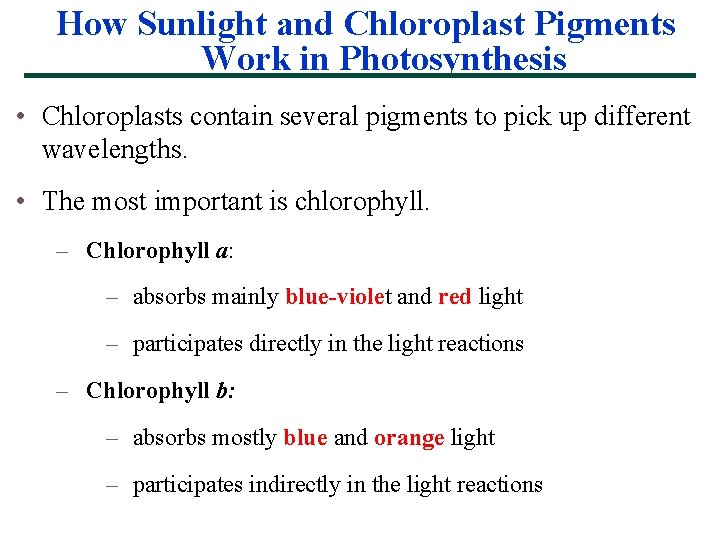
How Sunlight and Chloroplast Pigments Work in Photosynthesis • Chloroplasts contain several pigments to pick up different wavelengths. • The most important is chlorophyll. – Chlorophyll a: – absorbs mainly blue-violet and red light – participates directly in the light reactions – Chlorophyll b: – absorbs mostly blue and orange light – participates indirectly in the light reactions
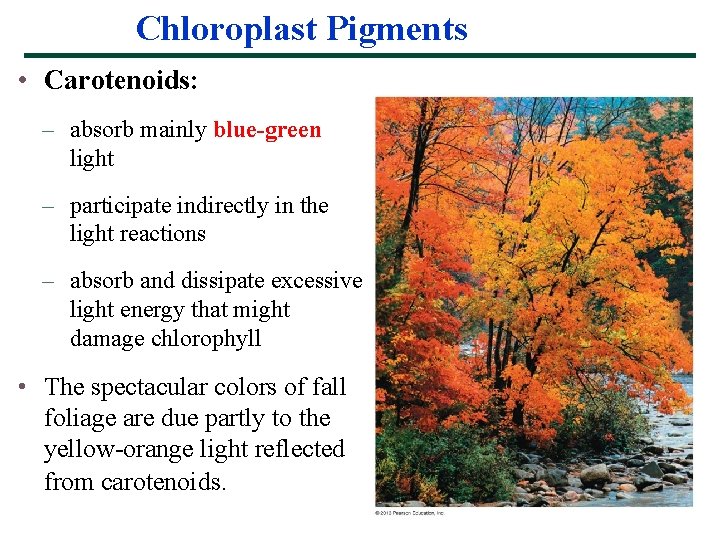
Chloroplast Pigments • Carotenoids: – absorb mainly blue-green light – participate indirectly in the light reactions – absorb and dissipate excessive light energy that might damage chlorophyll • The spectacular colors of fall foliage are due partly to the yellow-orange light reflected from carotenoids.
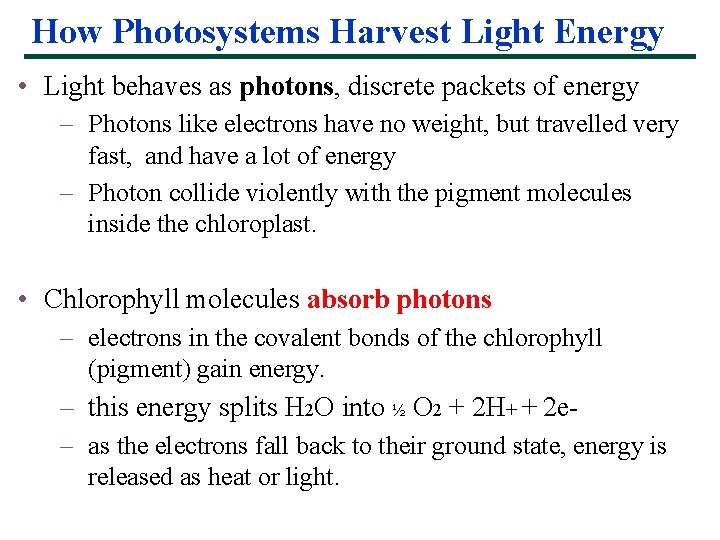
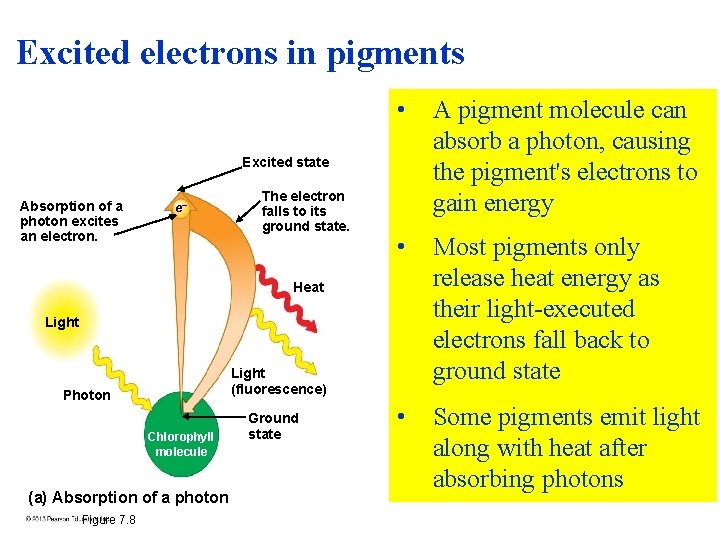
How Photosystems Harvest Light Energy • Light behaves as photons, discrete packets of energy – Photons like electrons have no weight, but travelled very fast, and have a lot of energy – Photon collide violently with the pigment molecules inside the chloroplast. • Chlorophyll molecules absorb photons – electrons in the covalent bonds of the chlorophyll (pigment) gain energy. – this energy splits H 2 O into ½ O 2 + 2 H+ + 2 e– as the electrons fall back to their ground state, energy is released as heat or light.
Excited electrons in pigments • A pigment molecule can absorb a photon, causing the pigment's electrons to gain energy • Most pigments only release heat energy as their light-executed electrons fall back to ground state • Some pigments emit light along with heat after absorbing photons Excited state Absorption of a photon excites an electron. e– The electron falls to its ground state. Heat Light (fluorescence) Photon Chlorophyll molecule (a) Absorption of a photon Figure 7. 8 Ground state
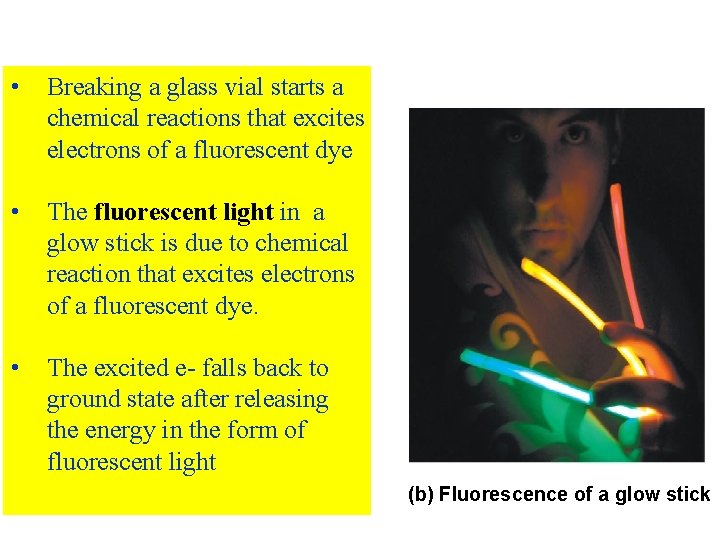
• Breaking a glass vial starts a chemical reactions that excites electrons of a fluorescent dye • The fluorescent light in a glow stick is due to chemical reaction that excites electrons of a fluorescent dye. • The excited e- falls back to ground state after releasing the energy in the form of fluorescent light (b) Fluorescence of a glow stick
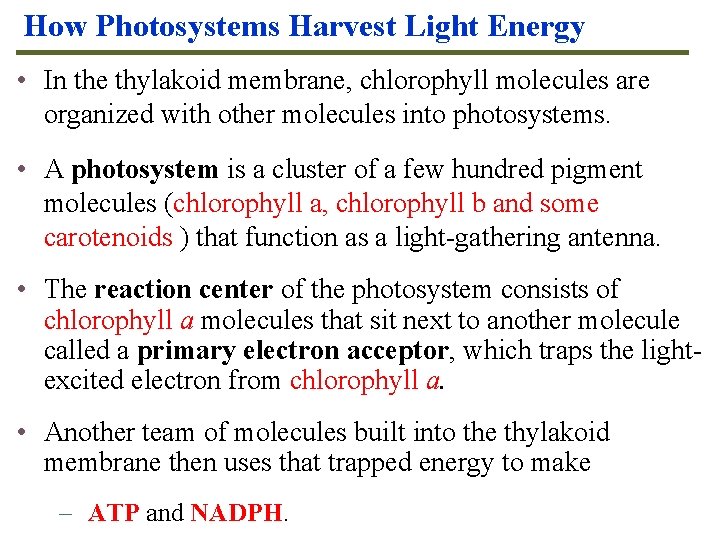
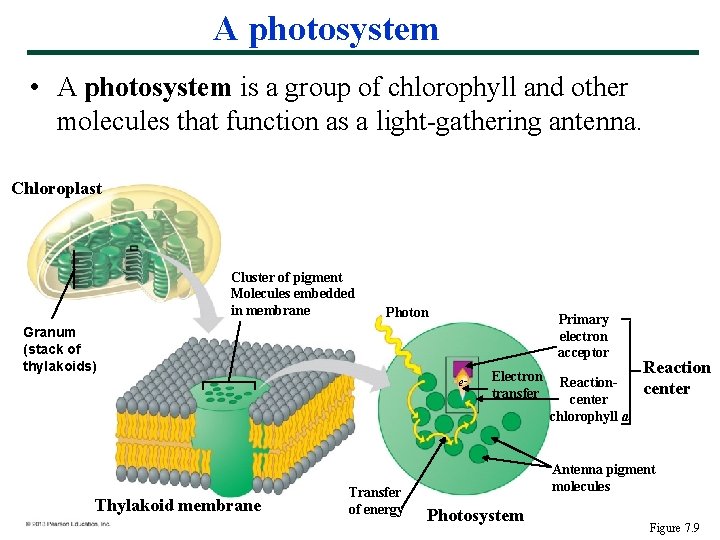
How Photosystems Harvest Light Energy • In the thylakoid membrane, chlorophyll molecules are organized with other molecules into photosystems. • A photosystem is a cluster of a few hundred pigment molecules (chlorophyll a, chlorophyll b and some carotenoids ) that function as a light-gathering antenna. • The reaction center of the photosystem consists of chlorophyll a molecules that sit next to another molecule called a primary electron acceptor, which traps the lightexcited electron from chlorophyll a. • Another team of molecules built into the thylakoid membrane then uses that trapped energy to make – ATP and NADPH.
A photosystem • A photosystem is a group of chlorophyll and other molecules that function as a light-gathering antenna. Chloroplast Cluster of pigment Molecules embedded in membrane Photon Primary electron acceptor Granum (stack of thylakoids) e– Thylakoid membrane Transfer of energy Electron transfer Reactioncenter chlorophyll a Reaction center Antenna pigment molecules Photosystem Figure 7. 9
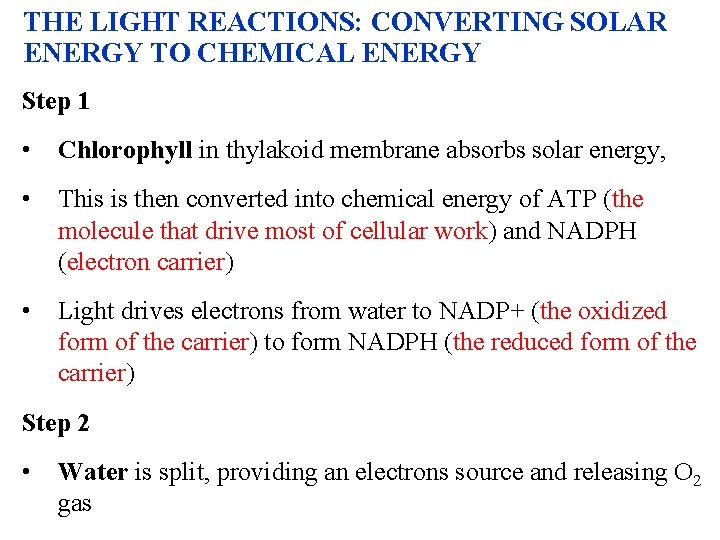
THE LIGHT REACTIONS: CONVERTING SOLAR ENERGY TO CHEMICAL ENERGY Step 1 • Chlorophyll in thylakoid membrane absorbs solar energy, • This is then converted into chemical energy of ATP (the molecule that drive most of cellular work) and NADPH (electron carrier) • Light drives electrons from water to NADP+ (the oxidized form of the carrier) to form NADPH (the reduced form of the carrier) Step 2 • Water is split, providing an electrons source and releasing O 2 gas
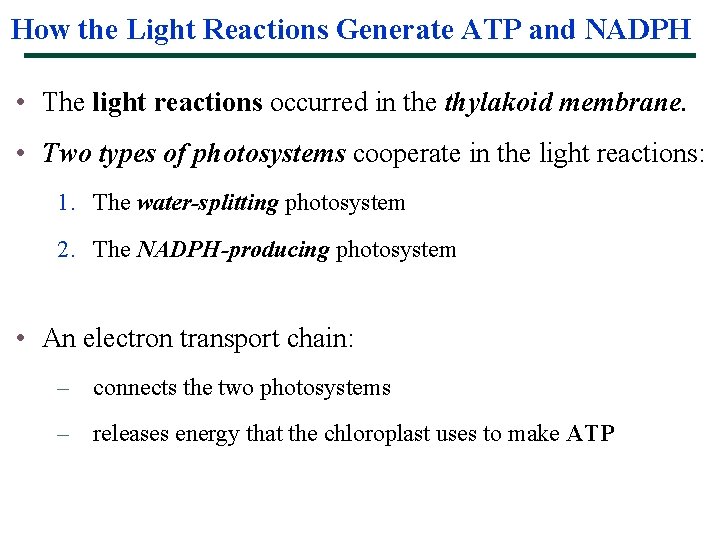
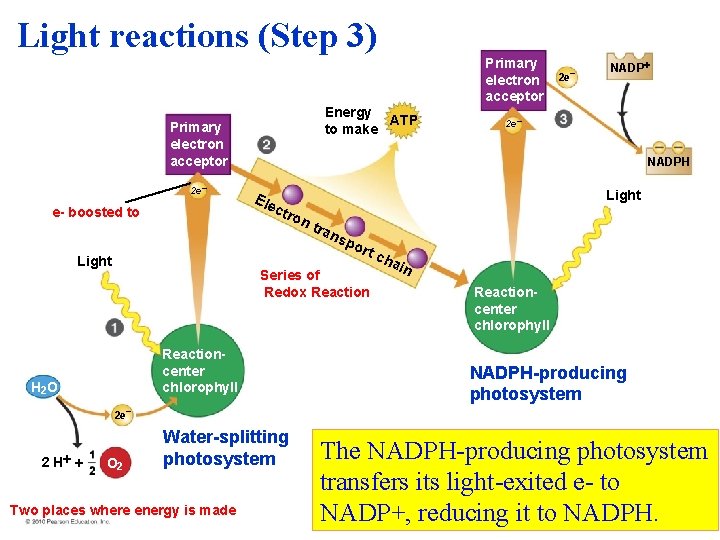
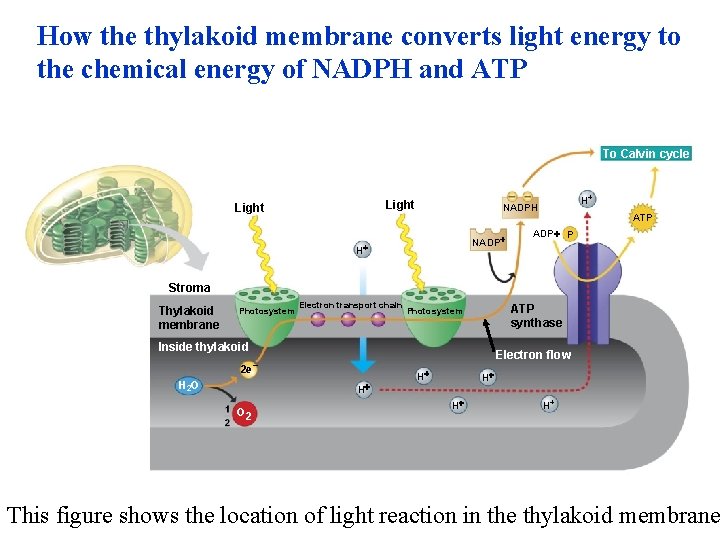
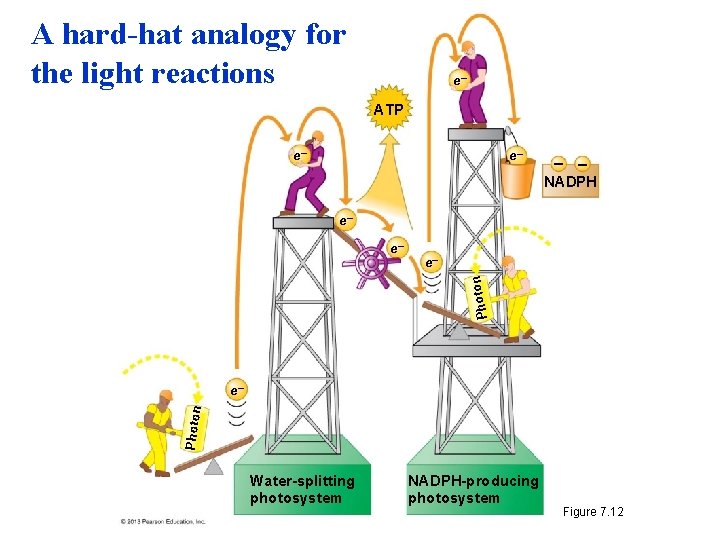
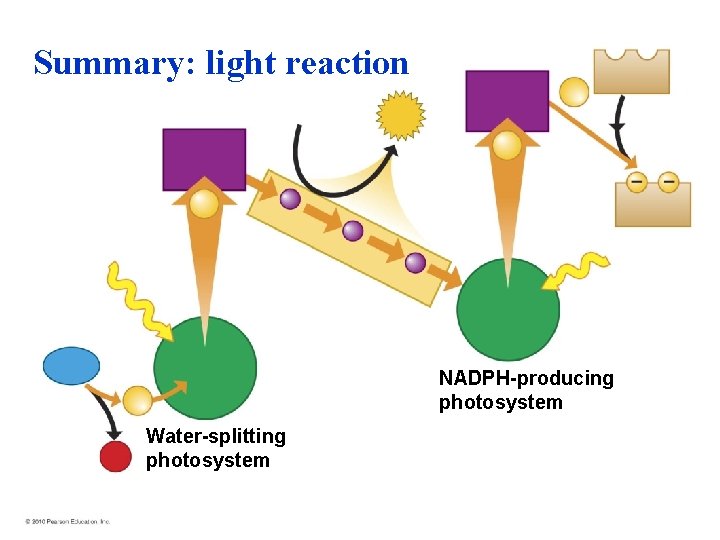
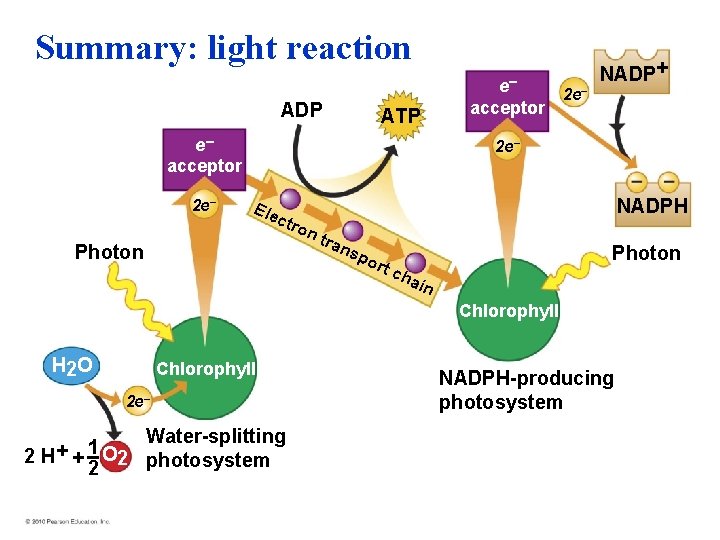
How the Light Reactions Generate ATP and NADPH • The light reactions occurred in the thylakoid membrane. • Two types of photosystems cooperate in the light reactions: 1. The water-splitting photosystem 2. The NADPH-producing photosystem • An electron transport chain: – connects the two photosystems – releases energy that the chloroplast uses to make ATP
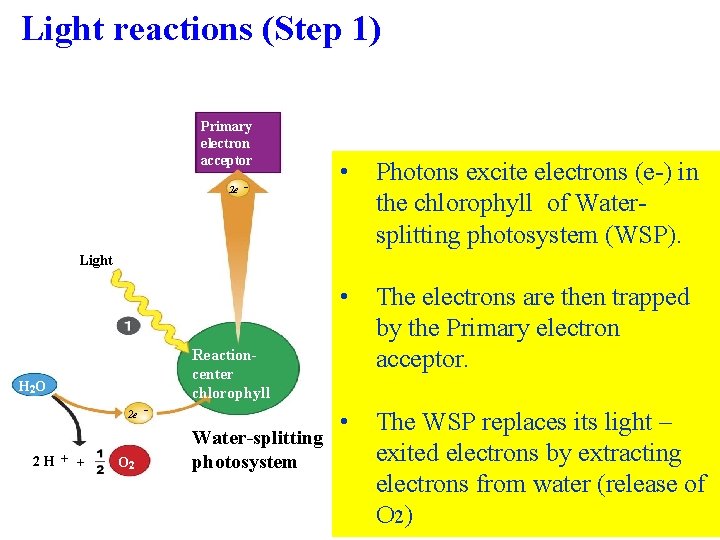
Light reactions (Step 1) Primary electron acceptor 2 e – • Photons excite electrons (e-) in the chlorophyll of Watersplitting photosystem (WSP). • The electrons are then trapped by the Primary electron acceptor. • The WSP replaces its light – exited electrons by extracting electrons from water (release of O 2) Light Reactioncenter chlorophyll H 2 O 2 e 2 H + + O 2 – Water-splitting photosystem
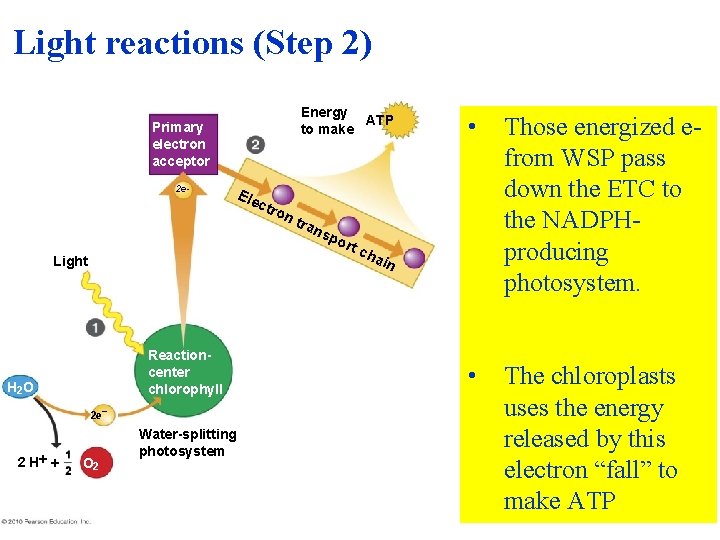
Light reactions (Step 2) Energy ATP to make Primary electron acceptor 2 e- Ele ctr tra n spo Those energized efrom WSP pass down the ETC to the NADPHproducing photosystem. • The chloroplasts uses the energy released by this electron “fall” to make ATP rt c h ain Light Reactioncenter chlorophyll H 2 O 2 e – 2 H+ + on • O 2 Water-splitting photosystem
Light reactions (Step 3) Energy ATP to make Primary electron acceptor 2 e– Light NADP 2 e– Light Ele tra nsp ort Series of Redox Reactioncenter chlorophyll H 2 O 2 e – NADPH ctr on e- boosted to Primary electron acceptor cha in Reactioncenter chlorophyll NADPH-producing photosystem 2 e – 2 H+ + O 2 Water-splitting photosystem Two places where energy is made The NADPH-producing photosystem transfers its light-exited e- to NADP+, reducing it to NADPH.
How the thylakoid membrane converts light energy to the chemical energy of NADPH and ATP To Calvin cycle Light H+ NADPH NADP H ATP ADP P Stroma Thylakoid membrane Photosystem Electron transport chain ATP synthase Photosystem Inside thylakoid 2 e H 2 O Electron flow – H O 2 H H+ This figure shows the location of light reaction in the thylakoid membrane
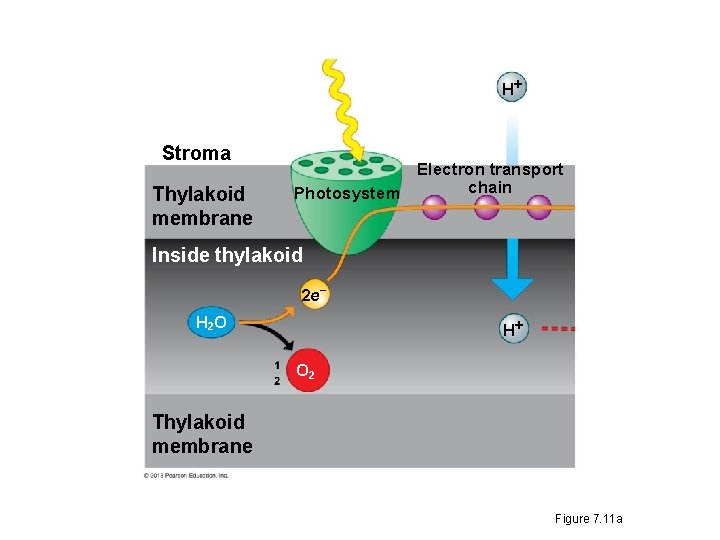
H Stroma Thylakoid membrane Electron transport chain Photosystem Inside thylakoid 2 e H 2 O – H O 2 Thylakoid membrane Figure 7. 11 a
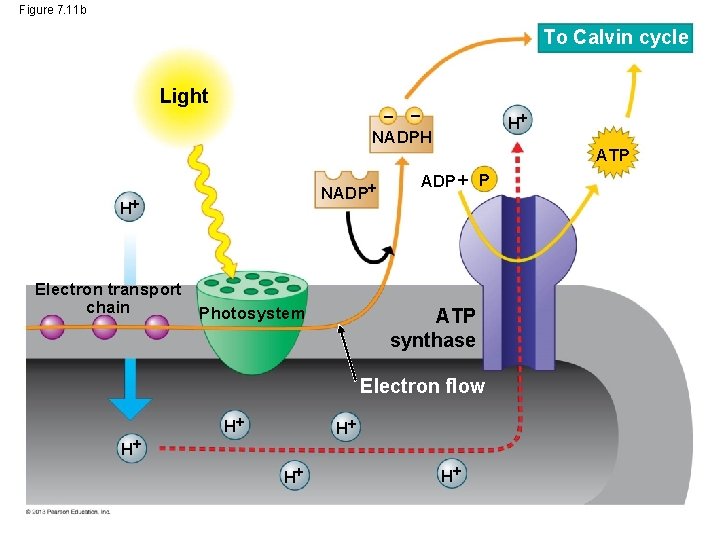
Figure 7. 11 b To Calvin cycle Light – – H NADPH NADP H Electron transport chain Photosystem ATP ADP P ATP synthase Electron flow H H H
A hard-hat analogy for the light reactions e– ATP e– e– – – NADPH e– e– Photon e– Water-splitting photosystem NADPH-producing photosystem Figure 7. 12
§ In summary, light reactions take place in the thylakoid membranes § Products are • NADPH • ATP • Oxygen.
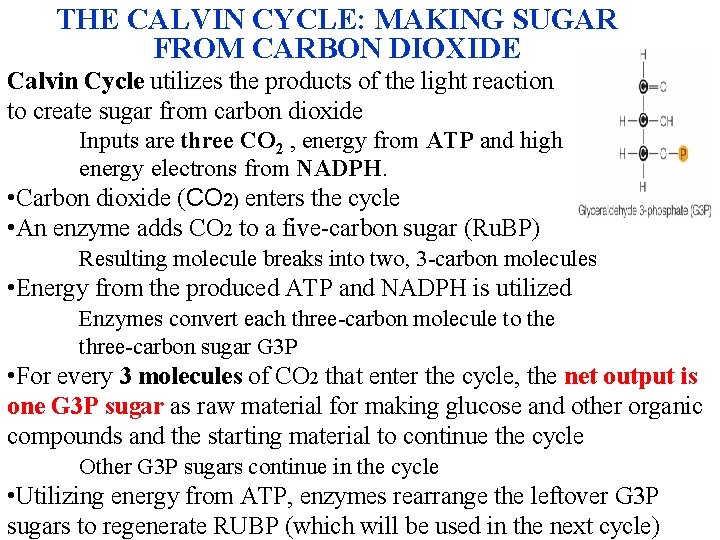
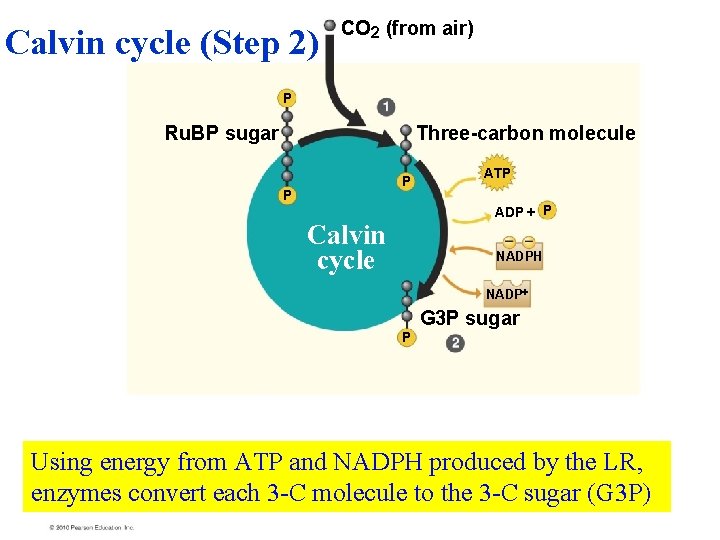
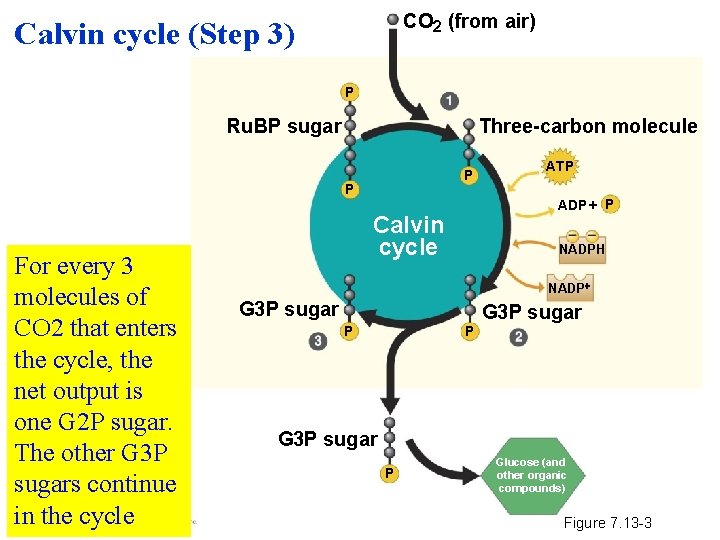
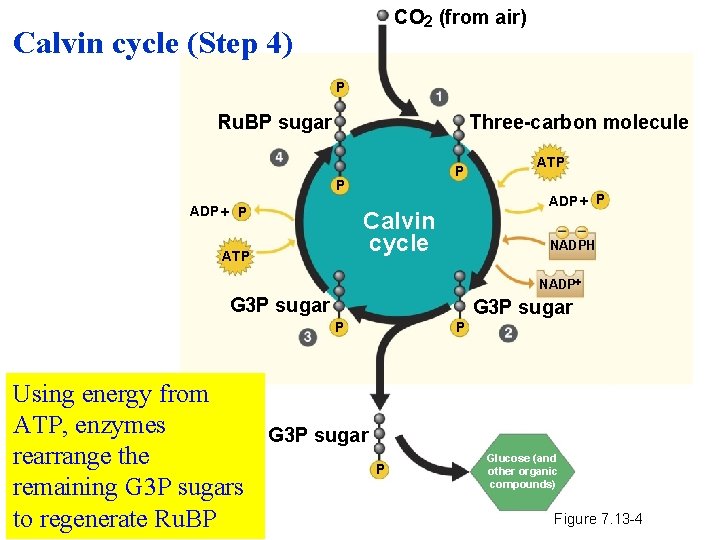
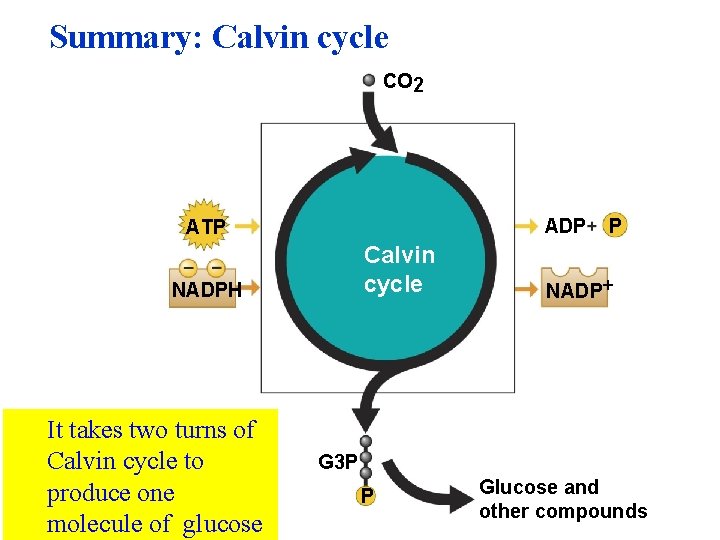
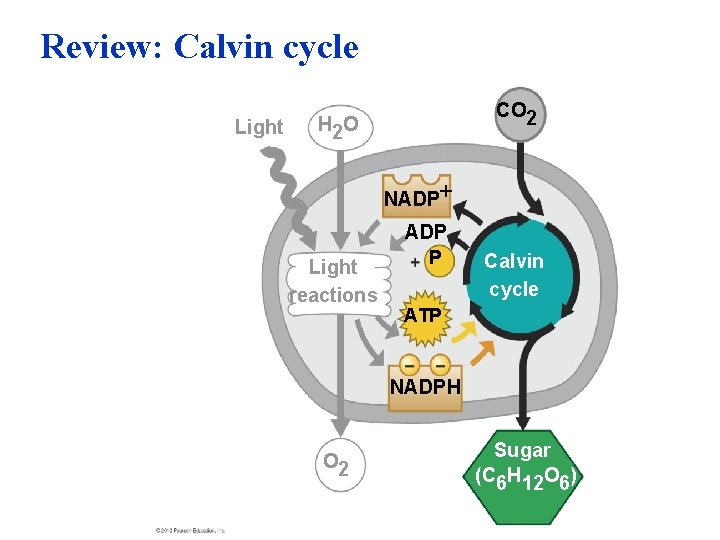
THE CALVIN CYCLE: MAKING SUGAR FROM CARBON DIOXIDE Calvin Cycle utilizes the products of the light reaction to create sugar from carbon dioxide Inputs are three CO 2 , energy from ATP and high energy electrons from NADPH. • Carbon dioxide (CO 2) enters the cycle • An enzyme adds CO 2 to a five-carbon sugar (Ru. BP) Resulting molecule breaks into two, 3 -carbon molecules • Energy from the produced ATP and NADPH is utilized Enzymes convert each three-carbon molecule to the three-carbon sugar G 3 P • For every 3 molecules of CO 2 that enter the cycle, the net output is one G 3 P sugar as raw material for making glucose and other organic compounds and the starting material to continue the cycle Other G 3 P sugars continue in the cycle • Utilizing energy from ATP, enzymes rearrange the leftover G 3 P sugars to regenerate RUBP (which will be used in the next cycle)
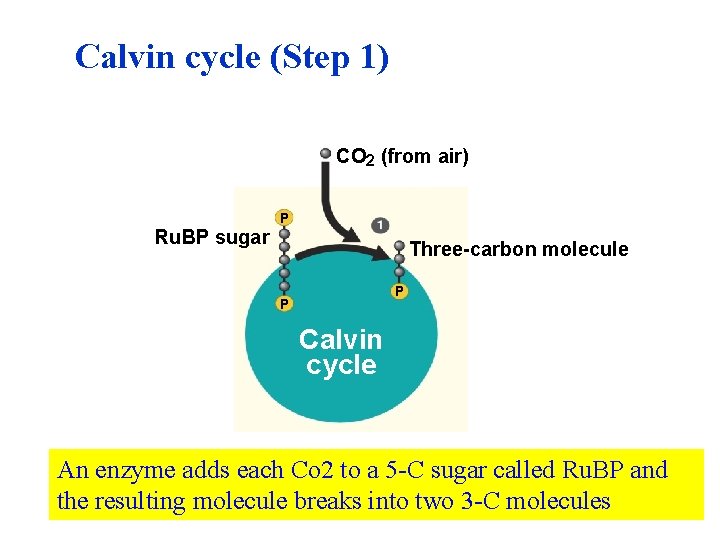
Calvin cycle (Step 1) CO 2 (from air) Ru. BP sugar P Three-carbon molecule P P Calvin cycle An enzyme adds each Co 2 to a 5 -C sugar called Ru. BP and the resulting molecule breaks into two 3 -C molecules
Calvin cycle (Step 2) CO 2 (from air) P Three-carbon molecule Ru. BP sugar P P ATP ADP P Calvin cycle NADPH NADP G 3 P sugar P Using energy from ATP and NADPH produced by the LR, enzymes convert each 3 -C molecule to the 3 -C sugar (G 3 P)
CO 2 (from air) Calvin cycle (Step 3) P Three-carbon molecule Ru. BP sugar P P For every 3 molecules of CO 2 that enters the cycle, the net output is one G 2 P sugar. The other G 3 P sugars continue in the cycle ATP ADP P Calvin cycle NADPH NADP G 3 P sugar P P G 3 P sugar P Glucose (and other organic compounds) Figure 7. 13 -3
CO 2 (from air) Calvin cycle (Step 4) P Three-carbon molecule Ru. BP sugar P P ADP P Calvin cycle ATP NADPH NADP G 3 P sugar P Using energy from ATP, enzymes rearrange the remaining G 3 P sugars to regenerate Ru. BP P G 3 P sugar P Glucose (and other organic compounds) Figure 7. 13 -4
Summary: Calvin cycle CO 2 ADP ATP Calvin cycle NADPH It takes two turns of Calvin cycle to produce one molecule of glucose P NADP G 3 P P Glucose and other compounds
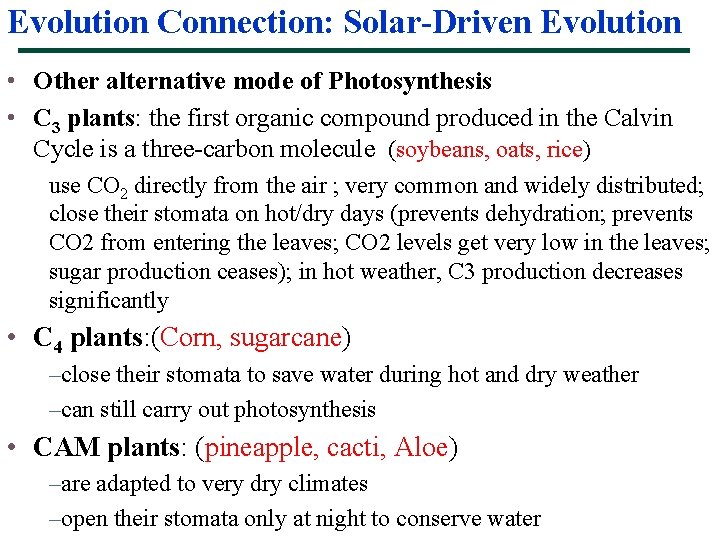
Evolution Connection: Solar-Driven Evolution • Other alternative mode of Photosynthesis • C 3 plants: the first organic compound produced in the Calvin Cycle is a three-carbon molecule (soybeans, oats, rice) use CO 2 directly from the air ; very common and widely distributed; close their stomata on hot/dry days (prevents dehydration; prevents CO 2 from entering the leaves; CO 2 levels get very low in the leaves; sugar production ceases); in hot weather, C 3 production decreases significantly • C 4 plants: (Corn, sugarcane) –close their stomata to save water during hot and dry weather –can still carry out photosynthesis • CAM plants: (pineapple, cacti, Aloe) –are adapted to very dry climates –open their stomata only at night to conserve water
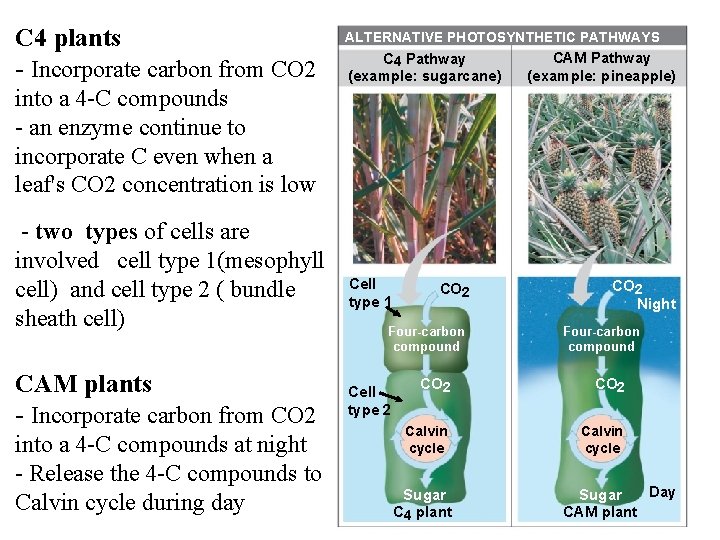
C 4 plants - Incorporate carbon from CO 2 ALTERNATIVE PHOTOSYNTHETIC PATHWAYS C 4 Pathway (example: sugarcane) CAM Pathway (example: pineapple) into a 4 -C compounds - an enzyme continue to incorporate C even when a leaf's CO 2 concentration is low - two types of cells are involved cell type 1(mesophyll cell) and cell type 2 ( bundle sheath cell) CAM plants - Incorporate carbon from CO 2 into a 4 -C compounds at night - Release the 4 -C compounds to Calvin cycle during day Cell type 1 CO 2 Four-carbon compound Cell type 2 CO 2 Night Four-carbon compound CO 2 Calvin cycle Sugar C 4 plant Day Sugar CAM plant
Review: Photosynthesis equation Light energy 6 CO 2 6 H 2 O Carbon dioxide Water Photosynthesis C 6 H 12 O 6 Glucose 6 O 2 Oxygen gas
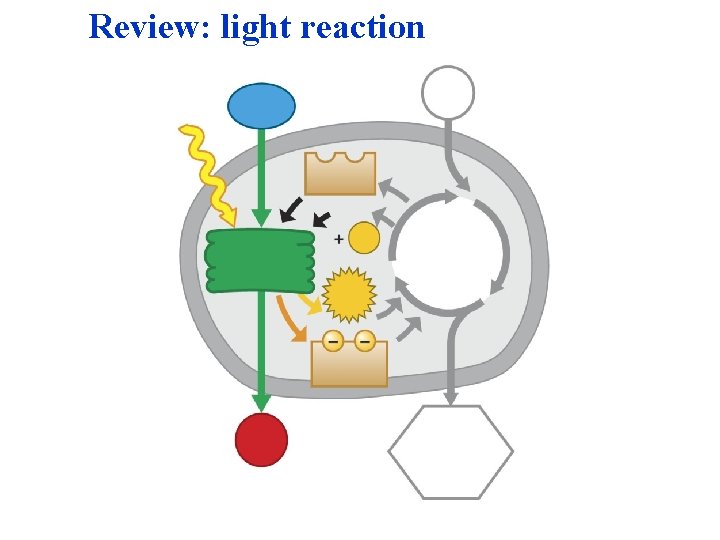
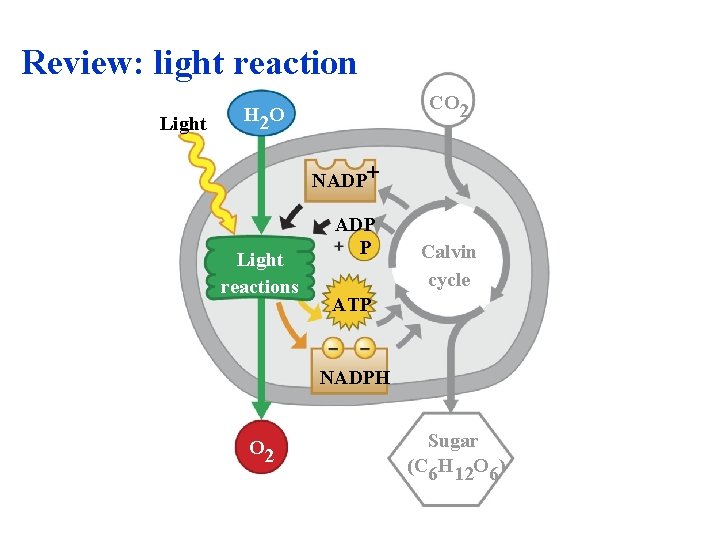
Review: light reaction
Review: light reaction Light CO 2 H 2 O NADP Light reactions ADP P Calvin cycle ATP NADPH O 2 Sugar (C 6 H 12 O 6)
Summary: light reaction NADPH-producing photosystem Water-splitting photosystem
Summary: light reaction e– ADP acceptor ATP e– acceptor 2 e – NADP+ 2 e – Ele c NADPH tro Photon nt ran spo Photon rt c hai n Chlorophyll H 2 O Chlorophyll 2 e – Water-splitting 1 2 H+ + O 2 photosystem 2 NADPH-producing photosystem
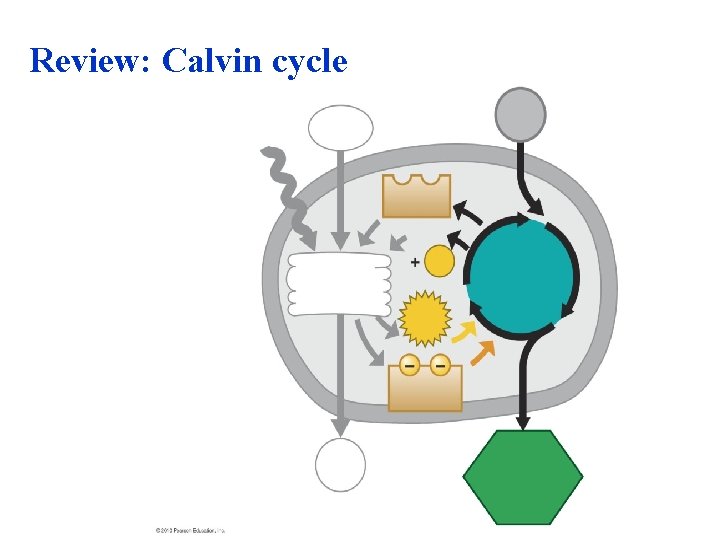
Review: Calvin cycle
Summary of Key Concepts: A Photosynthesis Road Map Chloroplast Light CO 2 H 2 O Stroma Stack of thylakoids NADP Light reactions ADP P 3 -PGA Calvin cycle ATP – – NADPH O 2 Ru. BP Photosynthesis is the older process evolutionary compared to Cellular respiration (WHY? ) G 3 P sugar Sugar (C 6 H 12 O 6) Sugar used for • cellular respiration • cellulose • starch • other organic compounds Figure 7 -UN 05
Review: Calvin cycle Light CO 2 H 2 O NADP Light reactions P Calvin cycle ATP NADPH O 2 Sugar (C 6 H 12 O 6)