
Chapter 7 Photosynthesis Biology 2 AP OxidationReduction Reactions
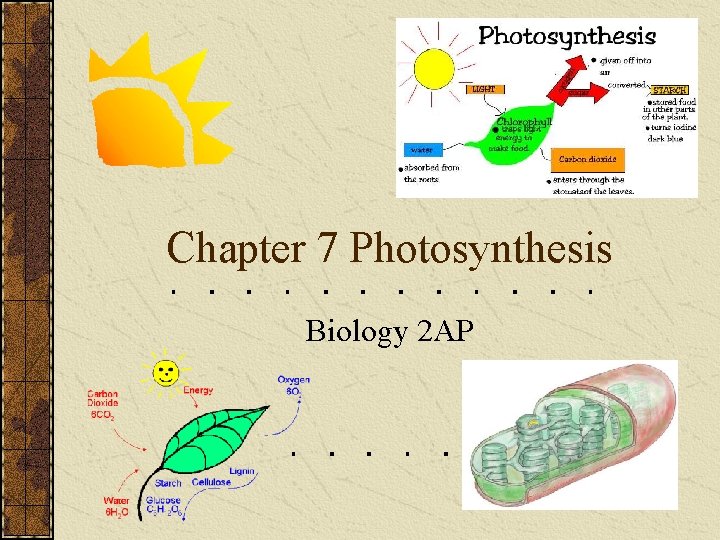
Chapter 7 Photosynthesis Biology 2 AP
Oxidation-Reduction Reactions aka Redox reactions Electron transfer reactions Oxidation – lose electrons Reduction – gain electrons (LEOGR) Oxidation and reduction take place at the same time one molecule loses electrons while another molecule gains the electrons
Photosynthesis and Redox Reactions H+ ions usually accompany electrons Oxidation in living things lose e-’s and H+ Reduction in living things gain e-’s and H+
Photosynthesis and Redox Reactions 6 CO 2 + 6 H 2 O + Energy C 6 H 12 O 6+ 6 O 2 Hydrogen atoms are transferred (lost) from water is being oxidized Carbon dioxide gains the hydrogen atoms carbon dioxide is reduced Chloroplasts capture solar energy convert to chemical energy of ATP molecules
Photosynthesis and Redox Reactions Coenzyme for redox NADP+ • • nicotinamide adenine dinucleotide phosphate active during photosynthesis has a positive charge accepts e-’s and H+ ions during photosynthesis s NADP+ + 2 e- + H+ NADPH • NADPH passes the e-’s and H+ ions to CO 2 during photosynthesis
Cellular Respiration and Redox Reactions C 6 H 12 O 6+ 6 O 2 6 CO 2 + 6 H 2 O + Energy Glucose loses hydrogen atoms glucose is oxidized Oxygen gains hydrogen atoms oxygen is reduced Mitochondria use the energy released to make ATP

Cellular Respiration and Redox Reactions Coenzyme for redox in cellular respiration NAD+ • nicotinamide adenine nucleotide • has a positive charge • accepts electrons and H+ s NAD+ + 2 e- + H+ NADH
Solar Energy + CO 2 + H 2 O Carbohydrate + O 2 Solar energy is converted to chemical energy Energy is found in discrete packets photons
Light is part of the electromagnetic spectrum Light behaves like waves Short wavelength – high energy Gamma ray, x-rays, uv Long wavelength – low energy Radio waves, microwaves, visible light Visible light – ROYGBIV Low energy, long wavelength high energy, short wavelength
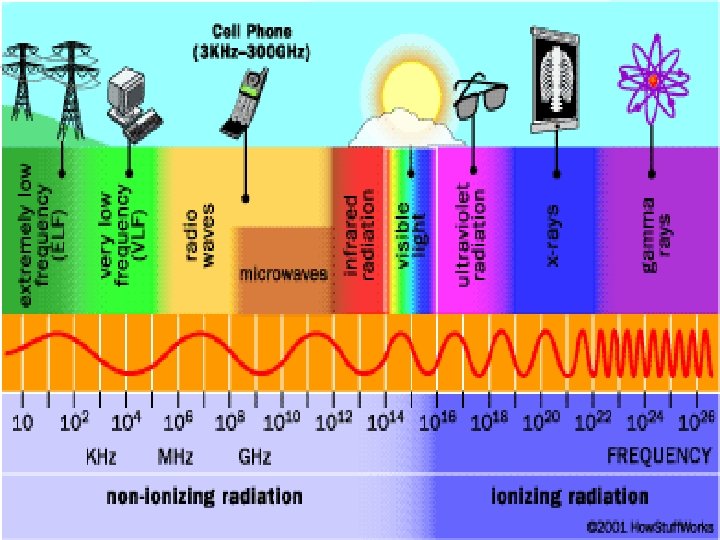
Light High energy photons dangerous to cells can break down organic molecules Low energy photons do not damage cells increase vibrational or rotational energy do not break bonds Visible light only part of EMR spectrum used in photosynthesis just the right amount of energy to excite electrons
Energy Balance Sheet Only 42% of solar radiation reaches the earth’s surface most is w/in visible light range higher energy wavelengths are blocked by the ozone layer lower energy wavelengths are absorbed by water vapor and carbon dioxide Photosynthesis captures only 2% of the solar energy that reaches the earth’s surface plants incorporate only about 0. 1 – 1. 6% of this energy
Light and Pigments When light strikes an object, it can be Absorbed Transmitted Reflected Pigment – a molecule that absorbs certain wavelengths more strongly than others The color observed are the colors not absorbed by the pigment
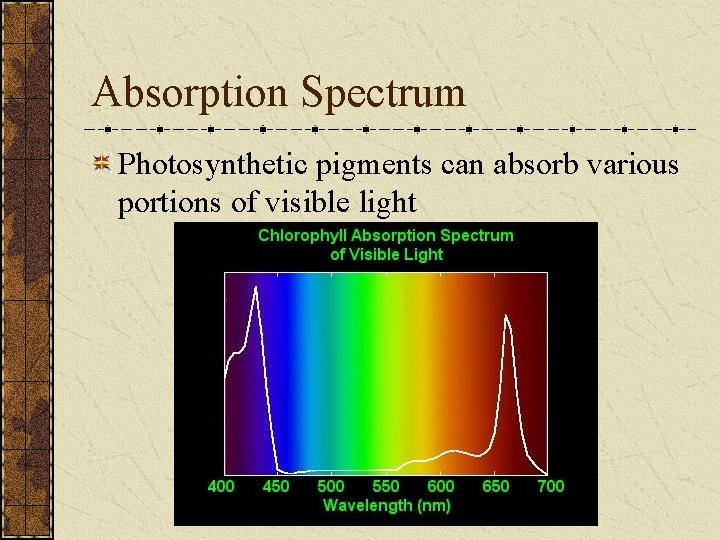
Absorption Spectrum Photosynthetic pigments can absorb various portions of visible light
Chloroplast pigments Found in the membrane of the thylakoids Several different types of chlorophylls Chlorophyll a and chlorophyll b – most common • Absorb different wavelength of light • Chlorophyll a – absorbs more red and less blue • Chlorophyll b – absorbs more blue and less red Since green light is not absorbed by the chlorophyll, it is reflected, which is why plants look green
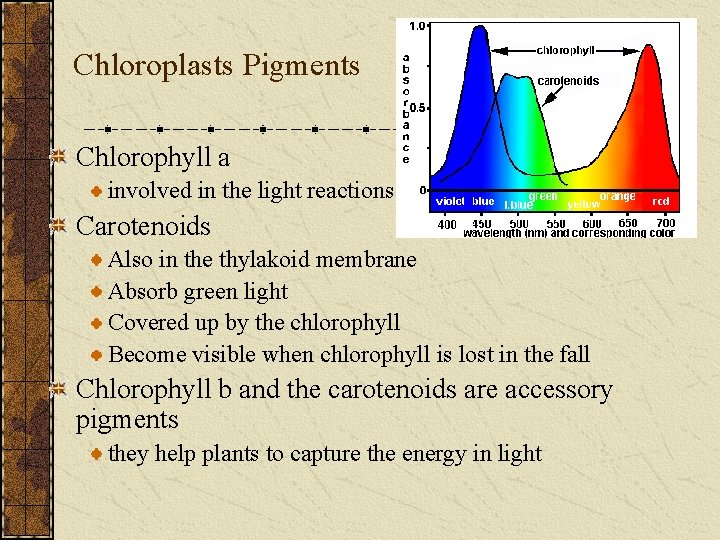
Chloroplasts Pigments Chlorophyll a involved in the light reactions Carotenoids Also in the thylakoid membrane Absorb green light Covered up by the chlorophyll Become visible when chlorophyll is lost in the fall Chlorophyll b and the carotenoids are accessory pigments they help plants to capture the energy in light
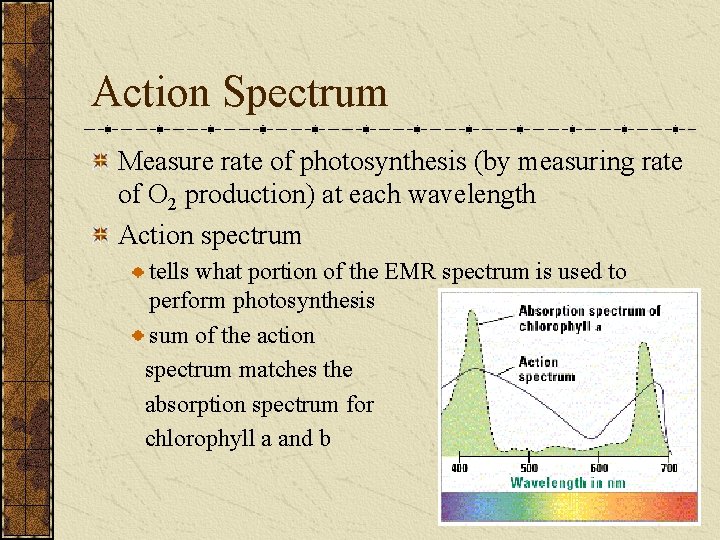
Action Spectrum Measure rate of photosynthesis (by measuring rate of O 2 production) at each wavelength Action spectrum tells what portion of the EMR spectrum is used to perform photosynthesis sum of the action spectrum matches the absorption spectrum for chlorophyll a and b
Chloroplasts Where photosynthesis occurs in eukaryotes O 2 given off in photosynthesis comes from H 2 O (C. B. van Niel, 1930) Water is oxidized Carbon dioxide is reduced used CO 2* (used heavy oxygen, 18 O) • O 2 made did not contain 18 O used heavy H 2 O (the oxygen is tagged) • O 2 made contained 18 O
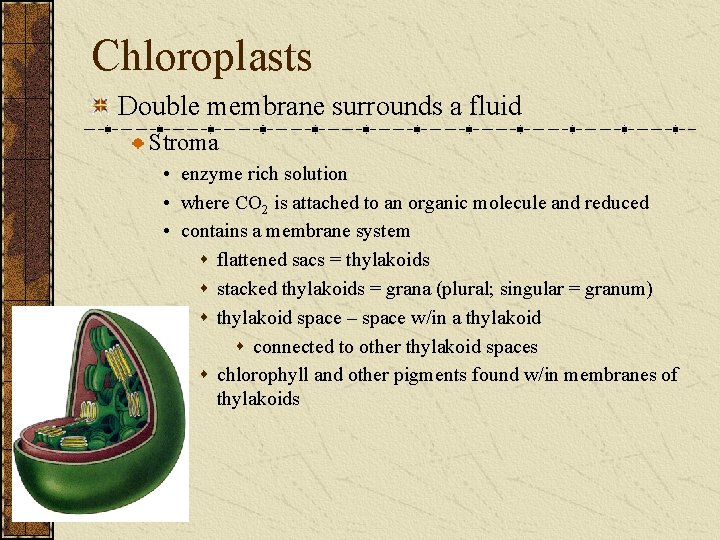
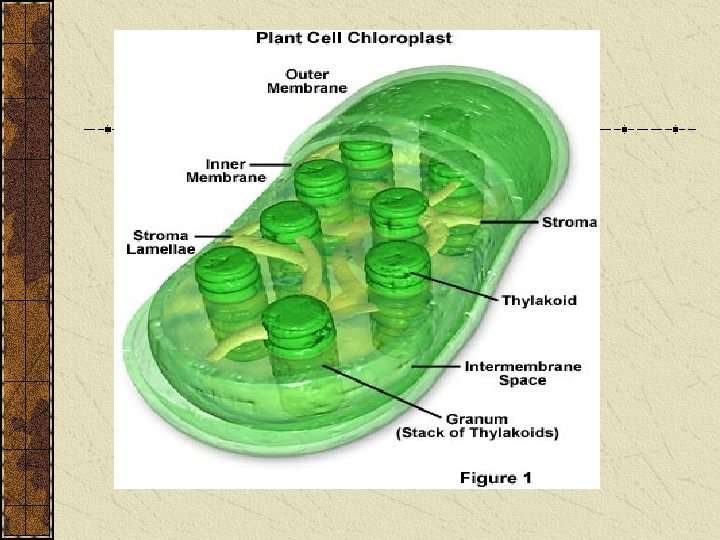
Chloroplasts Double membrane surrounds a fluid Stroma • enzyme rich solution • where CO 2 is attached to an organic molecule and reduced • contains a membrane system s flattened sacs = thylakoids s stacked thylakoids = grana (plural; singular = granum) s thylakoid space – space w/in a thylakoid s connected to other thylakoid spaces s chlorophyll and other pigments found w/in membranes of thylakoids
Reactions of Photosynthesis F. F. Blackman, 1905 suggested two sets of reactions involved in photosynthesis • when light is maximally absorbed, the rate of photosynthesis can still be increased by raising the temperature s raising the temperature affects enzymes 1 st set of reactions: light dependent reactions 2 nd set: light independent reactions
Light Dependent Reactions Occur in the thylakoid membranes where chlorophyll a and b and carotenoids are located • chlorophyll a appears blue-green s reflects blue-green, absorbs all other wavelengths • chlorophyll b appears yellow-green s reflects yellow-green, absorbs all other wavelengths Energy capturing reactions pigments capture sun’s energy use sun’s energy to excite electrons • remove electrons from water
Light Dependent Reactions e-’s move from chlorophyll a to the electron transport system ATP ADP + P NADP+ + 2 e- + H+ NADPH • NADPH “holds” energy in the form of energized electrons s used to reduced CO 2 later
Light Independent Reactions Occurs in the stroma of the chloroplast Can take place in either the light or the dark The synthesis reactions uses ATP and NADPH formed in the thylakoids reduce CO 2
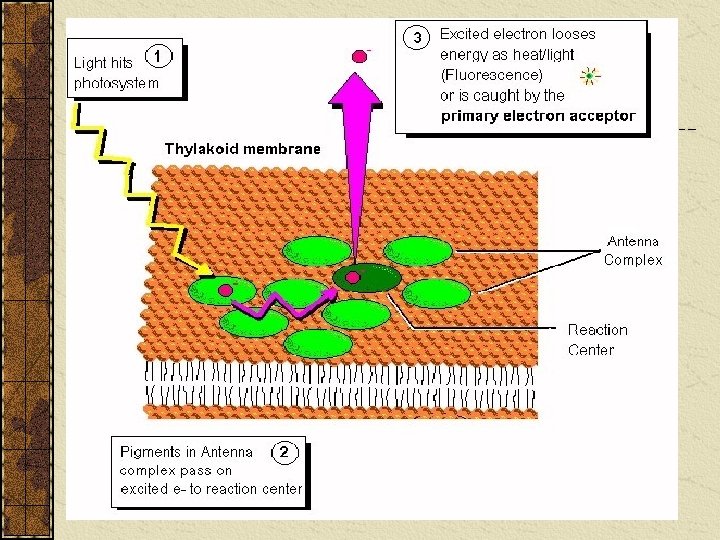
Photosystems I and II Light gathering units in the thylakoid membrane Named for the order in which they were discovered Contain closely packed molecules of chlorophyll a and b and accessory pigments pigment molecules are an antenna complex solar energy is passed from one pigment to another • concentrated in the reaction center chlorophyll a molecule • energy is used to excite electrons from the chlorophyll a molecule • electrons escape to a nearby electron acceptor molecule
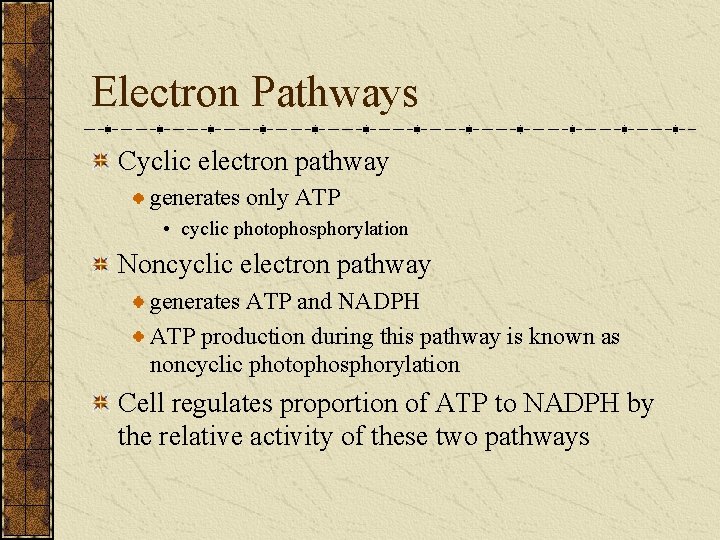
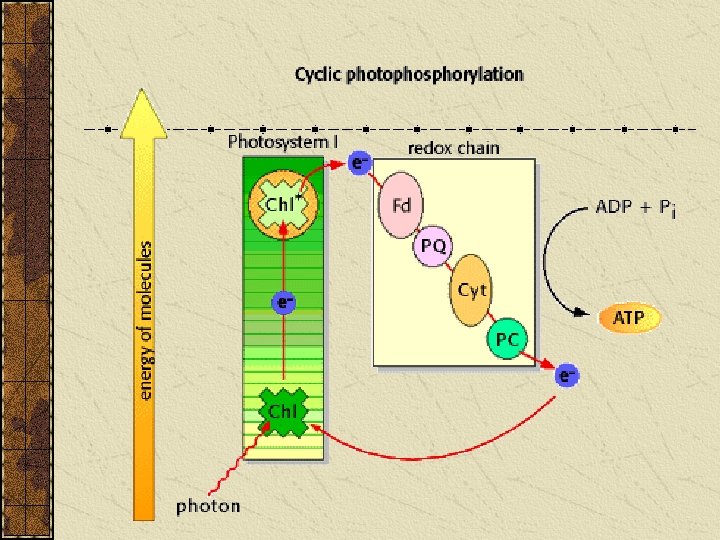
Electron Pathways Cyclic electron pathway generates only ATP • cyclic photophosphorylation Noncyclic electron pathway generates ATP and NADPH ATP production during this pathway is known as noncyclic photophosphorylation Cell regulates proportion of ATP to NADPH by the relative activity of these two pathways
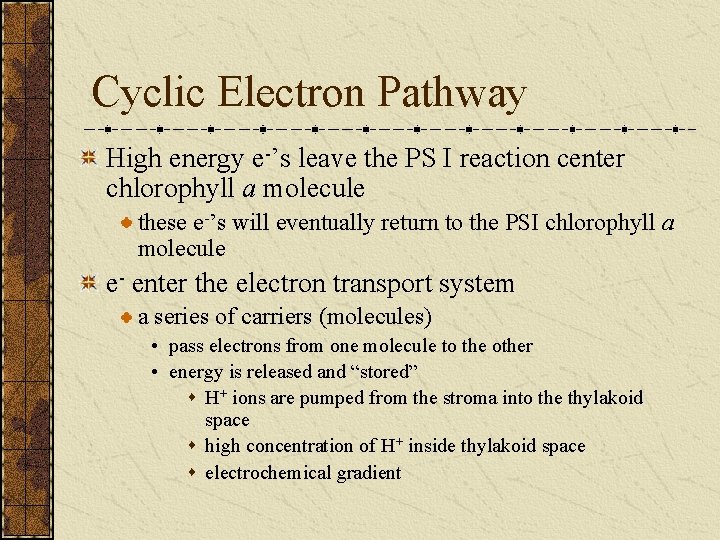
Cyclic Electron Pathway High energy e-’s leave the PS I reaction center chlorophyll a molecule these e-’s will eventually return to the PSI chlorophyll a molecule e- enter the electron transport system a series of carriers (molecules) • pass electrons from one molecule to the other • energy is released and “stored” s H+ ions are pumped from the stroma into the thylakoid space s high concentration of H+ inside thylakoid space s electrochemical gradient
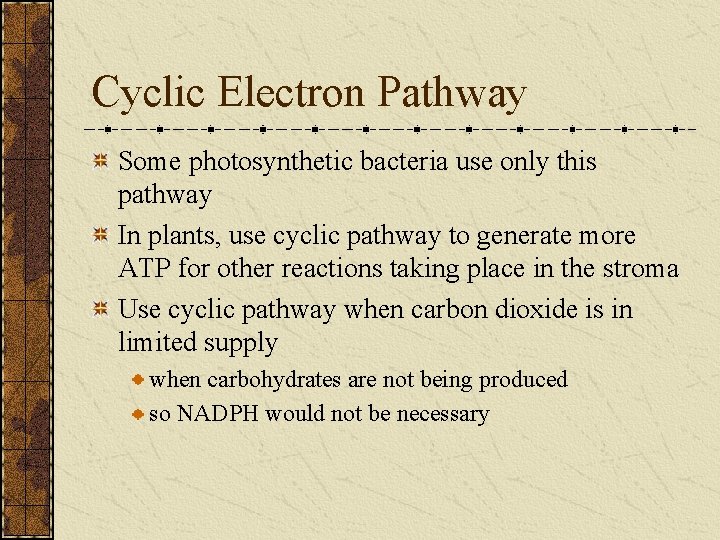
Cyclic Electron Pathway Some photosynthetic bacteria use only this pathway In plants, use cyclic pathway to generate more ATP for other reactions taking place in the stroma Use cyclic pathway when carbon dioxide is in limited supply when carbohydrates are not being produced so NADPH would not be necessary
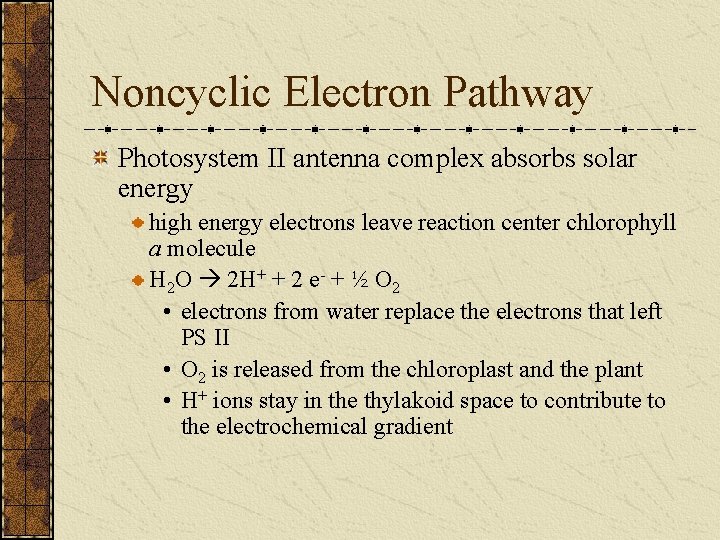
Noncyclic Electron Pathway Photosystem II antenna complex absorbs solar energy high energy electrons leave reaction center chlorophyll a molecule H 2 O 2 H+ + 2 e- + ½ O 2 • electrons from water replace the electrons that left PS II • O 2 is released from the chloroplast and the plant • H+ ions stay in the thylakoid space to contribute to the electrochemical gradient
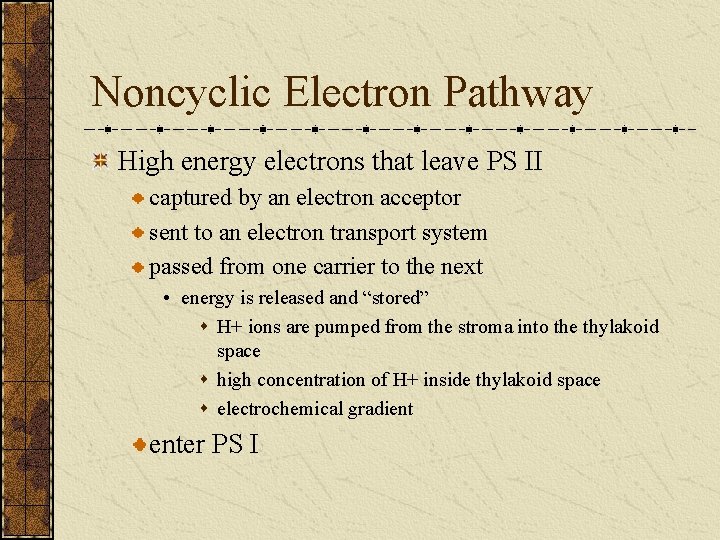
Noncyclic Electron Pathway High energy electrons that leave PS II captured by an electron acceptor sent to an electron transport system passed from one carrier to the next • energy is released and “stored” s H+ ions are pumped from the stroma into the thylakoid space s high concentration of H+ inside thylakoid space s electrochemical gradient enter PS I
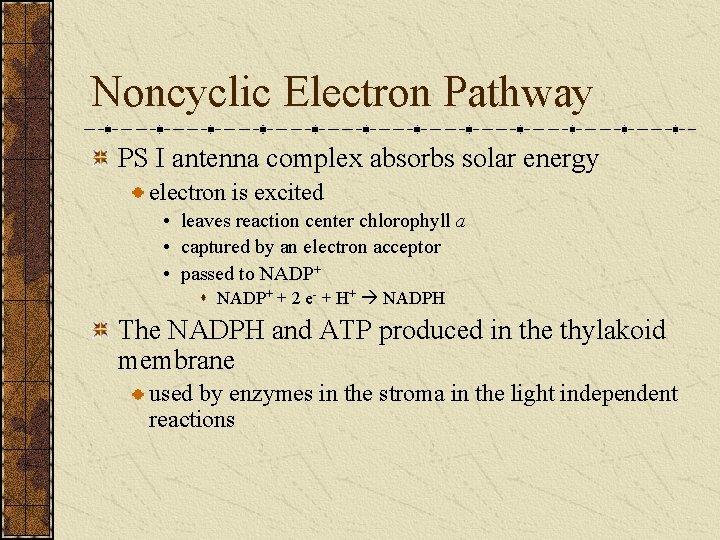
Noncyclic Electron Pathway PS I antenna complex absorbs solar energy electron is excited • leaves reaction center chlorophyll a • captured by an electron acceptor • passed to NADP+ s NADP+ + 2 e- + H+ NADPH The NADPH and ATP produced in the thylakoid membrane used by enzymes in the stroma in the light independent reactions
ATP Production H+ “stored” in the thylakoid space from water being oxidized • H 2 O 2 e- + 2 H+ + ½ O 2 from e- moving down the electron transport system • H+ pumped into thylakoid space using energy given off
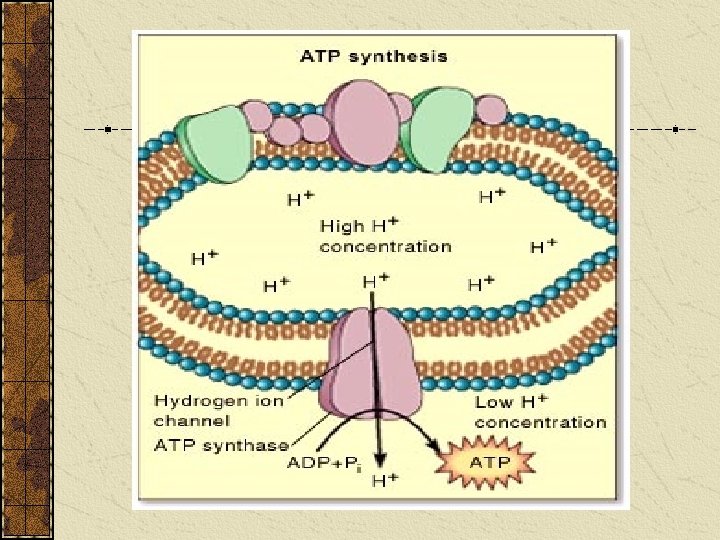
ATP Production - Chemiosmosis Flow of H+ ions from high concentration to low concentration across the thylakoid membrane from the thylakoid space to the stroma provides energy for ATP synthase • catalyzes ADP + P ATP
Complexes found in the Thylakoid Membrane PS II protein complex light gathering antenna complex oxidizes water produces O 2 gives off high energy electrons
Complexes found in the Thylakoid Membrane Cytochrome Complex transporter of electrons between PS II and PS I H+ pumped into thylakoid space PS I protein complex light gathering antenna complex associated w/ enzymes to reduce NADP+ to NADPH
Complexes found in the Thylakoid Membrane ATP synthase complex Has an H+ channel protruding ATP synthase H+ flows down its concentration gradient • from thylakoid space to stroma ADP + P ATP
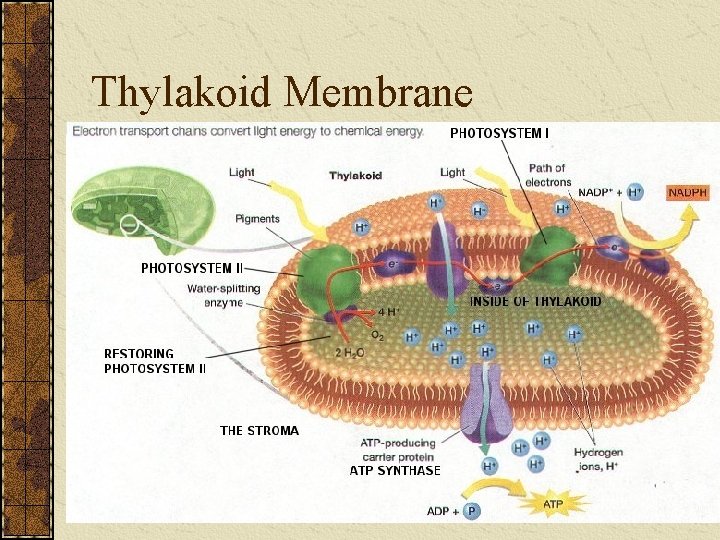
Thylakoid Membrane
Light Independent Reactions Light not needed for these reactions CO 2 enters leaf Use ATP and NADP produced in light dependent reactions reduce CO 2 provide electrons and energy Occurs in the stroma Series of reactions – the Calvin cycle
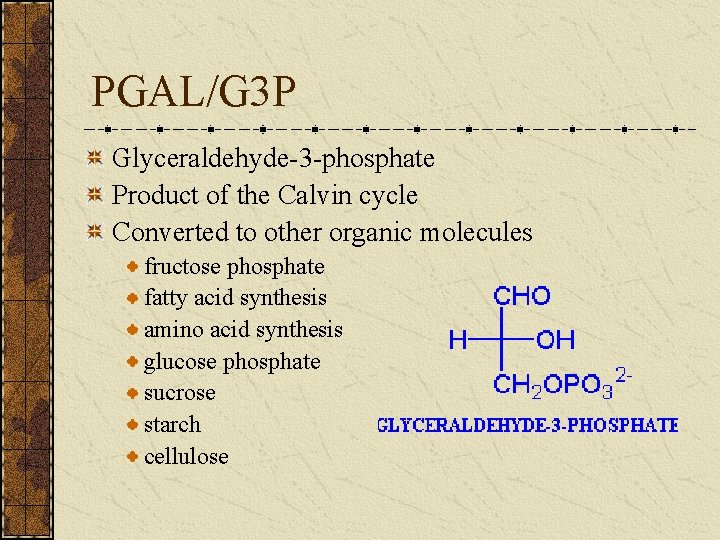
PGAL/G 3 P Glyceraldehyde-3 -phosphate Product of the Calvin cycle Converted to other organic molecules fructose phosphate fatty acid synthesis amino acid synthesis glucose phosphate sucrose starch cellulose
Calvin Cycle Light Independent Reactions Synthesize carbohydrates Include carbon dioxide fixation carbon dioxide reduction regeneration of Ru. BP (ribulose bisphosphate)
Carbon Dioxide Fixation Attachment of CO 2 to an organic compound 1 st step of Calvin cycle CO 2 combines w/ Ru. BP carboxylase enzyme for reaaction makes up 20 – 50% of the protein content in chloroplasts relatively slow
Reducing Carbon Dioxide 6 -Carbon molecule breaks down to two 3 Carbon molecules PGA (3 -phosphoglycerate) PGAP PGAL 2 steps Reduction requires NADPH + H+ NADP+ • supplies electrons for reduction requires ATP ADP + P • supplies energy
Regeneration of Ru. BP 3 turns of the Calvin cycle needed net gain of 1 PGAL molecule • 2 PGAL molecules needed to form 1 glucose molecule • so 6 turns of the Calvin cycle needed to form 1 glucose molecule 5 molecules of PGAL (5 x 3 C molecule) needed to reform 3 Ru. BP (3 x 5 C molecule)
Calvin Cycle aka C 3 cycle 1 st molecule in cycle identified by Melvin Calvin was PGA Different plant species fix CO 2 in different ways C 3 plants (Calvin Cycle used to fix CO 2) C 4 plants CAM plants
C 4 Photosynthesis Structure of leaf of C 3 plant differs from that of a C 4 plant C 3 plant mesophyll cells contain well formed chloroplasts • chloroplasts arranged in parallel layers C 4 plant bundle sheath cells and mesophyll cells contain chloroplasts mesophyll cells are arranged concentrically around bundle sheath cells
C 4 Photosynthesis C 3 Plants Ru. BP carboxylase used to fix CO 2 to Ru. BP breaks down to give two 3 -Carbon molecules, PGA C 4 Plants PEP carboxylase used to fix CO 2 to PEP (phosphoenolpyruvate, a 3 -Carbon molecule) make oxoaloacetate, a 4 -Carbon molecule
C 4 Plants Oxaloacetate malate is pumped into bundle sheath cells CO 2 then enters Calvin cycle in the bundle sheath cells Include sugarcane corn Bermuda grass Net photosynthetic rate is 2 – 3 times that of C 3 plants avoids photorespiration
Photorespiration Occurs in C 3 plants Leaves have little openings stomates • water leaves through the stomates • CO 2 enters Hot and dry weather stomates close to conserve water CO 2 concentration decreases in leaves O 2 concentration increases
Photorespiration O 2, not CO 2, combines w/ Ru. BP carboxylase make 1 molecule of PGA release 1 molecule of CO 2 Photorespiration occurs in the presence of light (photo-) O 2 is taken up CO 2 is given off (respiration)
Photorespiration Does not occur in C 4 leaves When stomates are closed CO 2 is still delivered to the bundle sheath cells CO 2 fixation occurs in bundle sheath cells Fix CO 2 by forming a C 4 molecule prior to the Calvin Cycle
Advantages to. . . C 3 plants have the advantage in moderate weather C 4 plants have the advantage in hot and ry weather Early summer C 3 plants predominate • wheat, rice, oats • Kentucky bluegrass, creeping bent grass Late summer C 4 plants predominate • crabgrass
CAM Photosynthesis Crassulacean acid metabolism Crassulaceae family of flowering succulent plants live in warm, arid regions CAM first discovered in these plants • prevalent among most succulent plants in desert environments • minimal photosynthesis
CAM Photosynthesis Stomates close in the day no CO 2 enters light dependent reactions still take place • make ATP and NADPH Stomates open at night take in CO 2 combines w/ PEP • forms 4 -Carbon molecules • stored in vacuoles in mesophyll cells In the day, these C 4 molecules release CO 2 to the Calvin cycle when ATP and NADPH are available
C 4 vs. CAM C 4 plants CO 2 uptake is physically separated from Calvin cycle • CO 2 uptake in mesophyll cells to make a 4 Carbon molecule • 4 Carbon molecule pumped into bundle cells s releases CO 2 for the Calvin cycle CAM Plants CO 2 uptake is separated from Calvin cycle by time • CO 2 uptake is at night s make a 4 Carbon molecule • 4 Carbon molecule releases CO 2 in the daytime for the Calvin cycle
- Slides: 57