
Chapter 7 Part Two Team Leadership LeaderMember Exchange
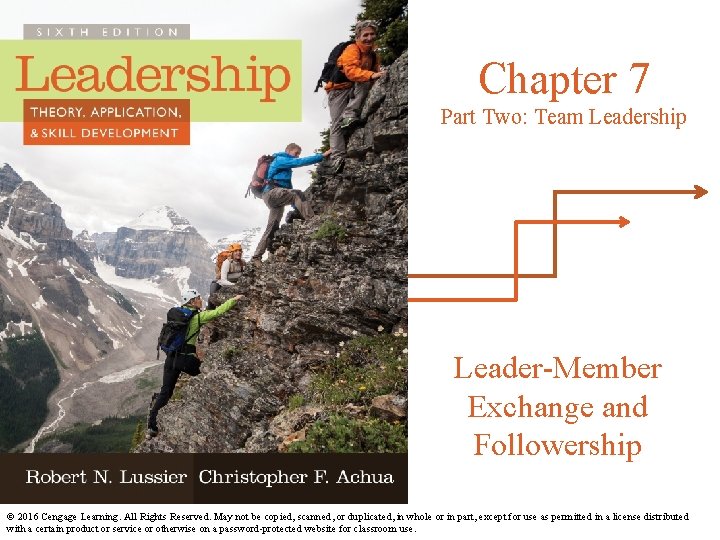
Chapter 7 Part Two: Team Leadership Leader-Member Exchange and Followership © 2016 Cengage Learning. All Rights Reserved. May not be copied, scanned, or duplicated, in whole or in part, except for use as permitted in a license distributed with a certain product or service or otherwise on a password-protected website for classroom use. 7 -
Learning Outcomes 1) 2) 3) 4) 5) 6) 7) 8) Describe the two subgroups that can form under Vertical Dyadic Linkage Theory. Define the two kinds of relationships that can occur between a leader and followers under Leader-Member Exchange Theory. Describe the role of the leader and follower in influencing LMX relationships. Discuss the main criticisms of LMX Theory. Describe the two behaviors used in the Kelley Model and the resulting five follower types. Briefly describe three factors that can enhance a follower’s influence. List five things a leader should delegate. An effective evaluation should accomplish at least three things – Name them. © 2016 Cengage Learning. All Rights Reserved. May not be copied, scanned, or duplicated, in whole or in part, except for use as permitted in a license distributed with a certain product or service or otherwise on a password-protected website for classroom use. 7 -2
From Vertical Dyadic Linkage Theory to Leader-Member Exchange Theory • Some suggest the quality of relationship between a leader and a follower is more predictive of follower outcomes than traits or behaviors of leaders. • Vertical dyadic linkage (VDL) theory focuses on how the relationship (or linkage) between a leader and follower can affect leadership. > In the 1980’s VDL was renamed the leadermember exchange theory (LMX). © 2016 Cengage Learning. All Rights Reserved. May not be copied, scanned, or duplicated, in whole or in part, except for use as permitted in a license distributed with a certain product or service or otherwise on a password-protected website for classroom use. 7 -3

Vertical Dyadic Linkage Theory • A dyad is defined as the individualized relationship between a leader and each follower in a work unit. • Dyadic theory approaches leadership as an exchange relationship which develops between a leader and a follower over time during role-making activities. © 2016 Cengage Learning. All Rights Reserved. May not be copied, scanned, or duplicated, in whole or in part, except for use as permitted in a license distributed with a certain product or service or otherwise on a password-protected website for classroom use. 7 -4
In-Groups and Out-Groups • The in-group includes followers with strong social ties to their leader in a supportive relationship characterized by high mutual trust, respect, loyalty, and influence. o Leaders influence with expert, referent, and reward power. • The out-group includes followers with few or no social ties to their leader, in a strictly taskcentered relationship characterized by low exchange and top-down influence. o Leaders influence with position power. © 2016 Cengage Learning. All Rights Reserved. May not be copied, scanned, or duplicated, in whole or in part, except for use as permitted in a license distributed with a certain product or service or otherwise on a password-protected website for classroom use. 7 -5

Leader-member exchange (LMX) is the quality of the exchange relationship between a leader and a follower. Leaders have LMXs that vary in quality. This relationship results in higher job satisfaction and better performance. This relationship only extends to the formal employment contract. High-quality social exchanges Low-quality LMX relationships © 2016 Cengage Learning. All Rights Reserved. May not be copied, scanned, or duplicated, in whole or in part, except for use as permitted in a license distributed with a certain product or service or otherwise on a password-protected website for classroom use. 7 -6
Factors That Influence LMX Relationships • LMX relationships are based on social exchanges, > meaning there is reciprocity. • According to LMX theory, a leader > varies behavior according to the quality of the interpersonal relationship with each individual. • The leader and the follower both influence the exchange relationship. © 2016 Cengage Learning. All Rights Reserved. May not be copied, scanned, or duplicated, in whole or in part, except for use as permitted in a license distributed with a certain product or service or otherwise on a password-protected website for classroom use. 7 -7

The Role of the Leader • LMX relationships develop when leaders move from economic-based exchange to socially based exchange. o Followers with the latter exhibit greater organizational citizenship behavior (OCB). • Organizational citizenship behavior is individual behavior that is discretionary, not directly or explicitly recognized by the formal reward system, and that in the aggregate promotes the effective functioning of the organization. © 2016 Cengage Learning. All Rights Reserved. May not be copied, scanned, or duplicated, in whole or in part, except for use as permitted in a license distributed with a certain product or service or otherwise on a password-protected website for classroom use. 7 -8
The Role of the Leader • A leader’s span of control is the number of direct followers to a particular leader. • A positive work climate provides a setting for positive LMX relationships. o Between leaders and followers and between followers. • Social identity is the degree to which members form close social ties with the group and how it subsequently influences interactions within and between group members. © 2016 Cengage Learning. All Rights Reserved. May not be copied, scanned, or duplicated, in whole or in part, except for use as permitted in a license distributed with a certain product or service or otherwise on a password-protected website for classroom use. 7 -9
The Role of the Follower • A follower’s behavior and attributes influence how the follower is perceived. > Proactive followers: actively seek feedback about their role expectations, o show initiative, o possess a strong commitment to work unit goals, o show a sense of responsibility for unit success, and o have the right attitude. o © 2016 Cengage Learning. All Rights Reserved. May not be copied, scanned, or duplicated, in whole or in part, except for use as permitted in a license distributed with a certain product or service or otherwise on a password-protected website for classroom use. 7 - 10

The Role of the Follower • Impression management is a follower’s effort to project a favorable image to gain an immediate benefit or improve a long-term relationship with the leader. Ø Performance-driven motive is the seeking of information to improve work performance. Ø Impressions-driven motive is the desire to control how one appears to the leader. • Ingratiation is the effort to appear supportive, appreciative, and respectful. • Self-promotion if the effort to appear competent and dependable. © 2016 Cengage Learning. All Rights Reserved. May not be copied, scanned, or duplicated, in whole or in part, except for use as permitted in a license distributed with a certain product or service or otherwise on a password-protected website for classroom use. 7 - 11
Benefits of High-Quality LMX Relationships • High-quality LMX employees show more OCB. > And receive higher performance ratings in return. > The leader can help with follower’s career. • These relationships are a reciprocal exchange. > When the leader fears damaging the relationship, the follower has earned: o Social capital the set of resources that inheres in the structure of relations between members of the group, which helps them get ahead. © 2016 Cengage Learning. All Rights Reserved. May not be copied, scanned, or duplicated, in whole or in part, except for use as permitted in a license distributed with a certain product or service or otherwise on a password-protected website for classroom use. 7 - 12

Criticisms of LMX Theory • The LMX-7 questionnaire takes only the follower’s perspective. • Attribution bias in favor of some group members > raises the question of fairness and equality. • Some criticize the predictive power of LMX theory. © 2016 Cengage Learning. All Rights Reserved. May not be copied, scanned, or duplicated, in whole or in part, except for use as permitted in a license distributed with a certain product or service or otherwise on a password-protected website for classroom use. 7 - 13
Followership • Good followership is ‘upward influencing’. • Followership is a self-conscious choice. > Followership refers to the behavior of followers that result from the leader-follower mutual influencing relationship. > A follower is a person who is under the direct influence and authority of a leader. • Effective leadership requires effective followership. © 2016 Cengage Learning. All Rights Reserved. May not be copied, scanned, or duplicated, in whole or in part, except for use as permitted in a license distributed with a certain product or service or otherwise on a password-protected website for classroom use. 7 - 14
Types of Followers • The alienated follower is someone low on involvement yet high on critical thinking. o They feel cheated for exemplary work. o These are the “yes people”. o They simply don’t get involved. • The conformist follower is someone who is high on involvement but low on critical thinking. • The passive follower is someone who is neither high on critical thinking nor involvement. © 2016 Cengage Learning. All Rights Reserved. May not be copied, scanned, or duplicated, in whole or in part, except for use as permitted in a license distributed with a certain product or service or otherwise on a password-protected website for classroom use. 7 - 15
Types of Followers • The effective follower is someone who is high on critical thinking and involvement. o They have the courage to take risks for the organization. • The pragmatic follower exhibits a little of all four styles – depending on which style fits the prevailing situation. o o Advantage is this follower knows how to “work the system to get things done”. Disadvantage is this same behavior may be viewed as “playing political games”. See Exhibit 7. 1. © 2016 Cengage Learning. All Rights Reserved. May not be copied, scanned, or duplicated, in whole or in part, except for use as permitted in a license distributed with a certain product or service or otherwise on a password-protected website for classroom use. 7 - 16
Becoming an Effective Follower • How individuals see their role as followers informs how they function. • Effective followers combine two roles: > to execute decisions made by a leader, or > to raise issues about those decisions when they are deemed misguided or unethical. • Effective followers have a high self-efficacy. o Self-efficacy is a person’s beliefs in his or her capabilities to produce at a certain level of performance. See Exhibit 7. 2. © 2016 Cengage Learning. All Rights Reserved. May not be copied, scanned, or duplicated, in whole or in part, except for use as permitted in a license distributed with a certain product or service or otherwise on a password-protected website for classroom use. 7 - 17
Factors that can Enhance Follower Influence • Power position. o Several power types may boost upward influence. • Locus of control. o Locus of control is on a continuum between an external and internal belief over who has control of a person’s destiny. Ø Internal locus of control – masters of their own destiny. Ø External locus of control – pawns of fate. • Education and experience. o Followers can use expert power, skills, and experience. See Exhibit 7. 3. © 2016 Cengage Learning. All Rights Reserved. May not be copied, scanned, or duplicated, in whole or in part, except for use as permitted in a license distributed with a certain product or service or otherwise on a password-protected website for classroom use. 7 - 18
Dual Role • Leaders are still considered followers by those higher up in the organization. • Common to switch from being a leader to being a follower several times a day. • Executing both roles effectively is a challenge, but it can be done. © 2016 Cengage Learning. All Rights Reserved. May not be copied, scanned, or duplicated, in whole or in part, except for use as permitted in a license distributed with a certain product or service or otherwise on a password-protected website for classroom use. 7 - 19
Delegation • Delegation is the process of assigning responsibility and authority for accomplishing objectives. • Effective delegation considers task, time requirement, and follower characteristics. • Leaders should delegate when: o o o Time is short for priority tasks, Followers desire more challenges and opportunities, or when Tasks match follower skill levels and experience. • Effective delegation allows people to prosper. © 2016 Cengage Learning. All Rights Reserved. May not be copied, scanned, or duplicated, in whole or in part, except for use as permitted in a license distributed with a certain product or service or otherwise on a password-protected website for classroom use. 7 - 20
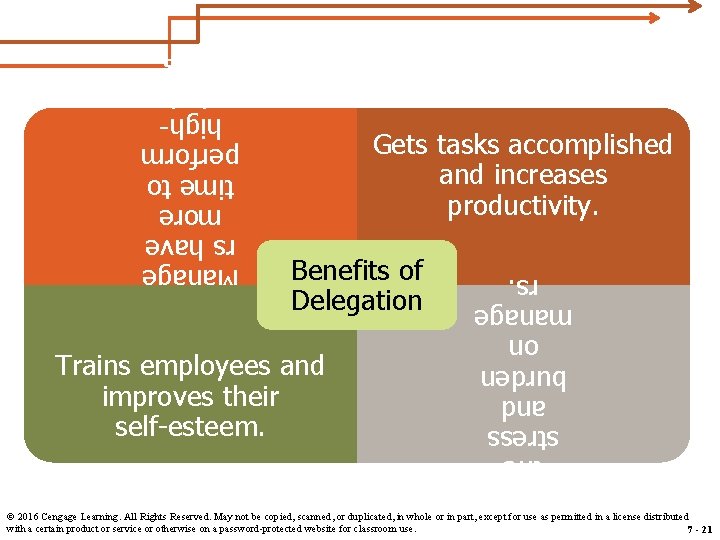
Gets tasks accomplished and increases productivity. Manage rs have more time to perform highpriority tasks. Trains employees and improves their self-esteem. Eases the stress and burden on manage rs. Benefits of Delegation © 2016 Cengage Learning. All Rights Reserved. May not be copied, scanned, or duplicated, in whole or in part, except for use as permitted in a license distributed with a certain product or service or otherwise on a password-protected website for classroom use. 7 - 21
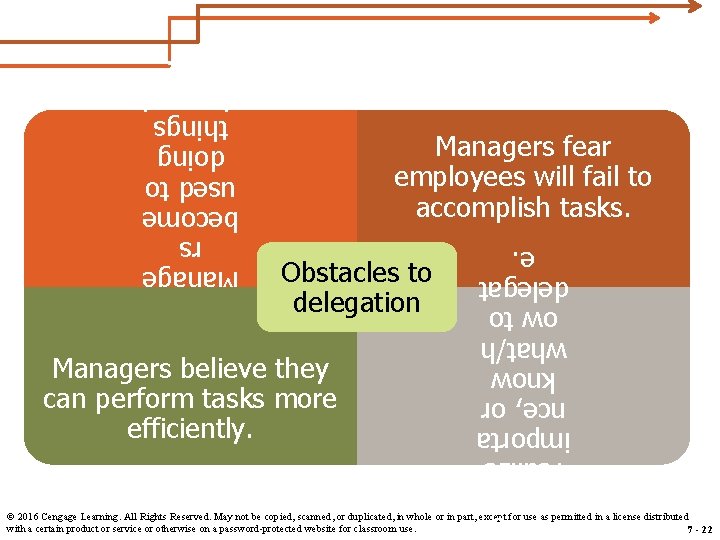
Managers fear employees will fail to accomplish tasks. Manage rs become used to doing things themsel ves. Managers believe they can perform tasks more efficiently. Manage rs don’t realize importa nce, or know what/h ow to delegat e. Obstacles to delegation © 2016 Cengage Learning. All Rights Reserved. May not be copied, scanned, or duplicated, in whole or in part, except for use as permitted in a license distributed with a certain product or service or otherwise on a password-protected website for classroom use. 7 - 22
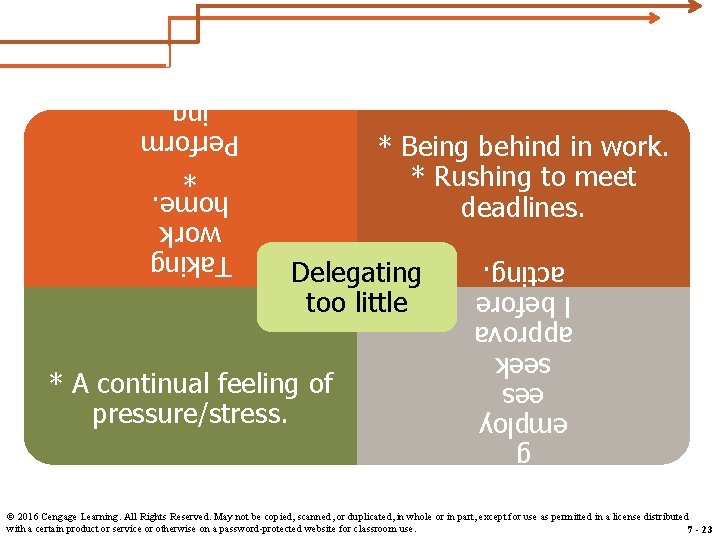
* Being behind in work. * Rushing to meet deadlines. * Taking work home. * Perform ing employ ee tasks. * A continual feeling of pressure/stress. * Requirin g employ ees seek approva l before acting. Delegating too little © 2016 Cengage Learning. All Rights Reserved. May not be copied, scanned, or duplicated, in whole or in part, except for use as permitted in a license distributed with a certain product or service or otherwise on a password-protected website for classroom use. 7 - 23
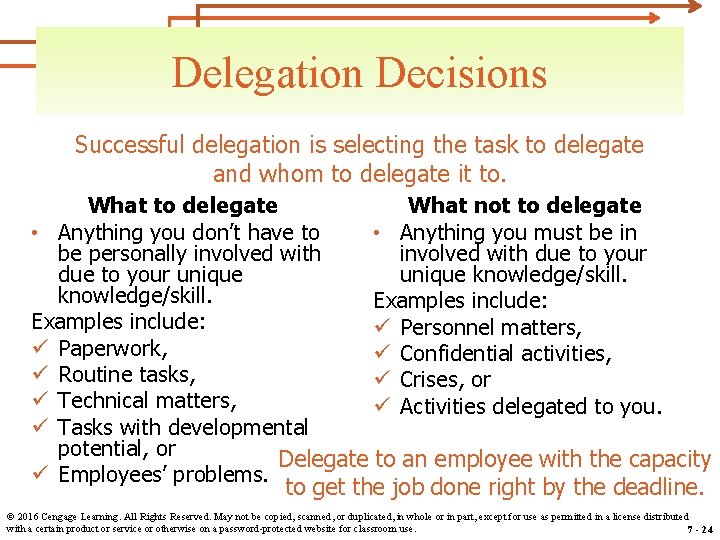
Delegation Decisions Successful delegation is selecting the task to delegate and whom to delegate it to. What to delegate What not to delegate • Anything you don’t have to • Anything you must be in be personally involved with due to your unique knowledge/skill. Examples include: ü Personnel matters, ü Paperwork, ü Confidential activities, ü Routine tasks, ü Crises, or ü Technical matters, ü Activities delegated to you. ü Tasks with developmental potential, or Delegate to an employee with the capacity ü Employees’ problems. to get the job done right by the deadline. © 2016 Cengage Learning. All Rights Reserved. May not be copied, scanned, or duplicated, in whole or in part, except for use as permitted in a license distributed with a certain product or service or otherwise on a password-protected website for classroom use. 7 - 24
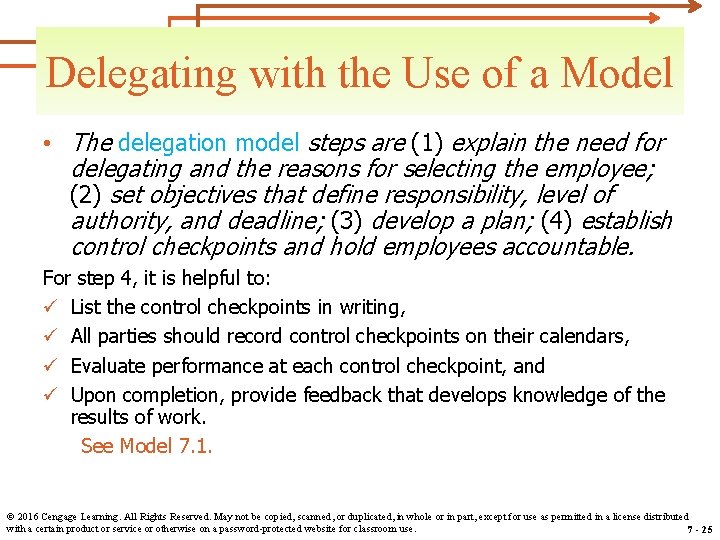
Delegating with the Use of a Model • The delegation model steps are (1) explain the need for delegating and the reasons for selecting the employee; (2) set objectives that define responsibility, level of authority, and deadline; (3) develop a plan; (4) establish control checkpoints and hold employees accountable. For step 4, it is helpful to: ü List the control checkpoints in writing, ü All parties should record control checkpoints on their calendars, ü Evaluate performance at each control checkpoint, and ü Upon completion, provide feedback that develops knowledge of the results of work. See Model 7. 1. © 2016 Cengage Learning. All Rights Reserved. May not be copied, scanned, or duplicated, in whole or in part, except for use as permitted in a license distributed with a certain product or service or otherwise on a password-protected website for classroom use. 7 - 25
Evaluating Followers: Guidelines for Success • Evaluations help followers correct weaknesses. • Followers respect leaders showing honesty, understanding, and empathy during the process. • Followers want a fair, effective evaluation. • Leaders must specifically state deficiencies and calmly explain impact on objectives. • At conclusion, follower must believe the leader desired to help and both must agree on action steps for improvement. See Exhibit 7. 4. © 2016 Cengage Learning. All Rights Reserved. May not be copied, scanned, or duplicated, in whole or in part, except for use as permitted in a license distributed with a certain product or service or otherwise on a password-protected website for classroom use. 7 - 26
Key Terms • • • alienated follower conformist follower delegation model dyadic theory effective followership impressions management ingratiation in-group • leader-member exchange (LMX) • locus of control • organizational citizenship behavior • out-group • passive follower • pragmatic follower • self-efficacy • self-promotion • social capital • social identity © 2016 Cengage Learning. All Rights Reserved. May not be copied, scanned, or duplicated, in whole or in part, except for use as permitted in a license distributed with a certain product or service or otherwise on a password-protected website for classroom use. 7 - 27
- Slides: 27