
Chapter 7 Other Leadership Perspectives Upper Echelon and
- Slides: 25
Chapter 7 Other Leadership Perspectives: Upper Echelon and Leadership of Nonprofits Copyright © 2015 Pearson Education, Inc. 7 -0
Learning Objectives • Differentiate between micro and upper-echelon leadership and describe the domain and roles of strategic leaders • List the individual characteristics of strategic leaders and consider the role of culture • Explain how top-level managers affect their organization • Analyze the unique challenges of leadership in nonprofit organizations Copyright © 2015 Pearson Education, Inc. 7 -2
The Leadership Question Do you think there is a difference between leaders at different levels of the organization and in different organizations? Besides size and number of people who report to you, is leadership fundamentally different at top and lower levels or in different organizations? Copyright © 2015 Pearson Education, Inc. 7 -2
Differences Between Micro and Strategic Leadership • • Who the leader is Scope of responsibility Focus Effectiveness criteria Copyright © 2015 Pearson Education, Inc. 7 -3
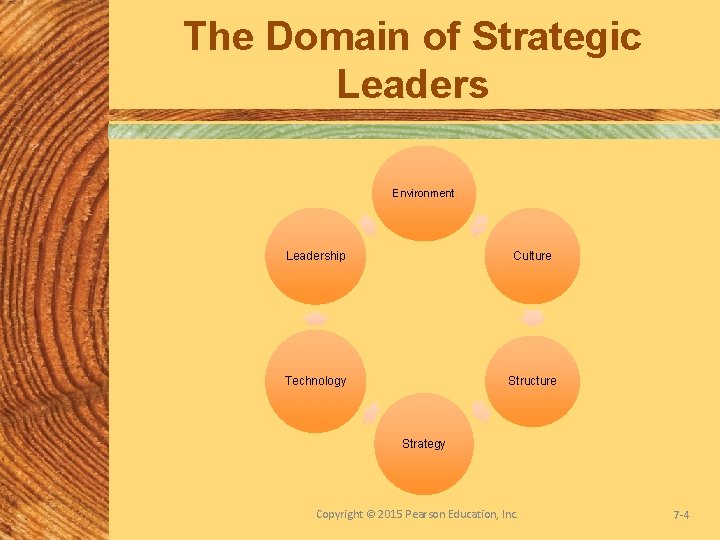
The Domain of Strategic Leaders Environment Leadership Culture Technology Structure Strategy Copyright © 2015 Pearson Education, Inc. 7 -4
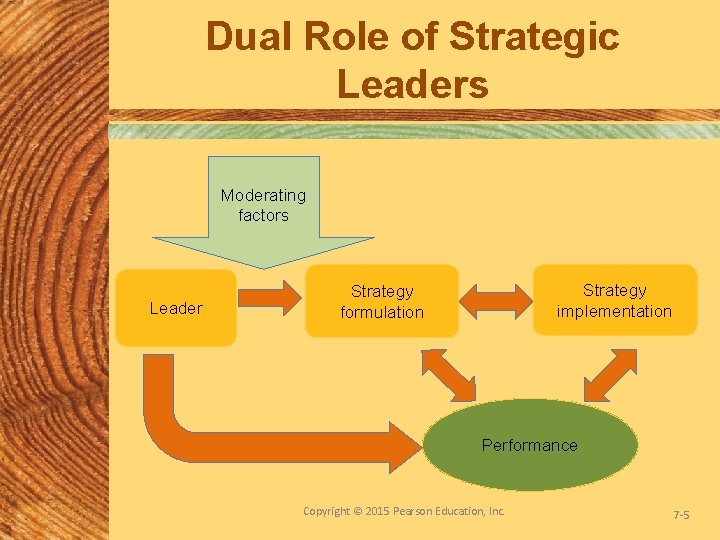
Dual Role of Strategic Leaders Moderating factors Leader Strategy implementation Strategy formulation Performance Copyright © 2015 Pearson Education, Inc. 7 -5
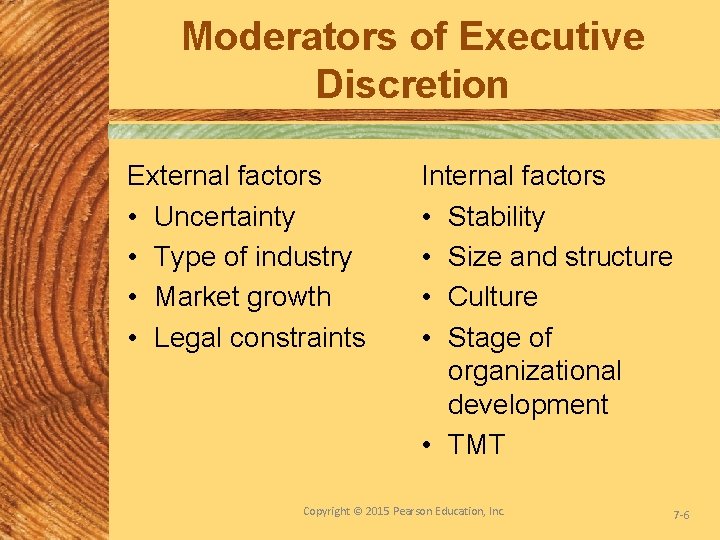
Moderators of Executive Discretion External factors • Uncertainty • Type of industry • Market growth • Legal constraints Internal factors • Stability • Size and structure • Culture • Stage of organizational development • TMT Copyright © 2015 Pearson Education, Inc. 7 -6
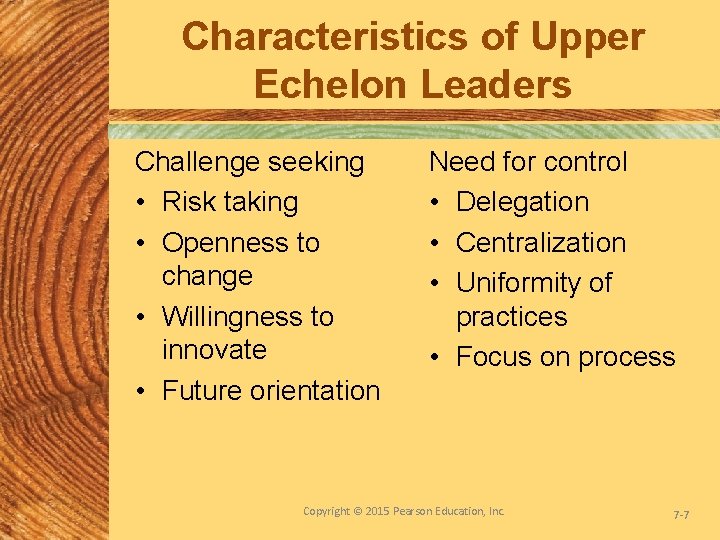
Characteristics of Upper Echelon Leaders Challenge seeking • Risk taking • Openness to change • Willingness to innovate • Future orientation Need for control • Delegation • Centralization • Uniformity of practices • Focus on process Copyright © 2015 Pearson Education, Inc. 7 -7
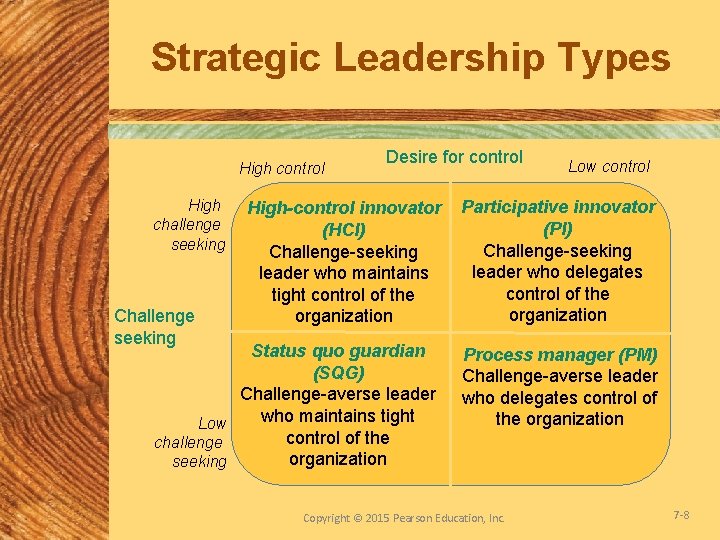
Strategic Leadership Types High control High challenge seeking Desire for control Low control High-control innovator (HCI) Challenge-seeking leader who maintains tight control of the organization Participative innovator (PI) Challenge-seeking leader who delegates control of the organization Status quo guardian (SQG) Challenge-averse leader who maintains tight Low control of the challenge organization seeking Process manager (PM) Challenge-averse leader who delegates control of the organization Challenge seeking Copyright © 2015 Pearson Education, Inc. 7 -8
Culture and Gender • Culture – Different countries have different implicit leadership theories • Gender – Little research on role of gender in upper echelon – Fewer women in executive leadership positions Copyright © 2015 Pearson Education, Inc. 7 -9
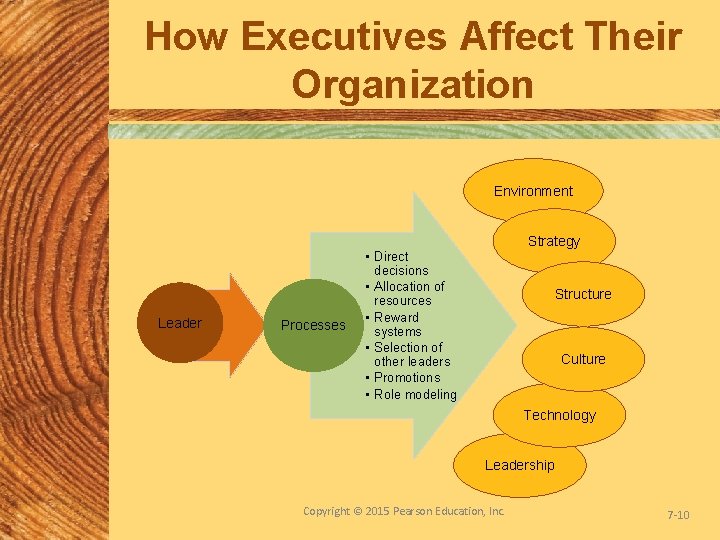
How Executives Affect Their Organization Environment Leader Processes Strategy • Direct decisions • Allocation of resources • Reward systems • Selection of other leaders • Promotions • Role modeling Structure Culture Technology Leadership Copyright © 2015 Pearson Education, Inc. 7 -10
Direct Decisions • • • Vision Mission Strategy Structure Organizational culture Selection of other leaders Copyright © 2015 Pearson Education, Inc. 7 -11
Allocation of Resources and the Reward System • Decisions regarding funding and budgets • Allocation of resources to support goals • Formal rewards such as salary and bonuses • Informal rewards such as recognition • Promotion of other leaders and managers Copyright © 2015 Pearson Education, Inc. 7 -12
Setting the Norms and Role Modeling • Setting decision criteria and rules by which others make decisions • Active or subtle role modeling of wanted behaviors and style Copyright © 2015 Pearson Education, Inc. 7 -13
Responsibilities of Strategic Leaders • Organizational performance • Internal health; organizational culture • Accountability to internal and external constituents • Ethical behavior and role modeling Copyright © 2015 Pearson Education, Inc. 7 -14
Determinants of Executive Compensation • • • Size of the firm Industry competition CEO power and discretion Internationalization High stress and instability Copyright © 2015 Pearson Education, Inc. 7 -15
Characteristics of Nonprofits • Operate without profit • Public service mission • Voluntary board of directors • Funded through various private and public contributions Copyright © 2015 Pearson Education, Inc. 7 -16
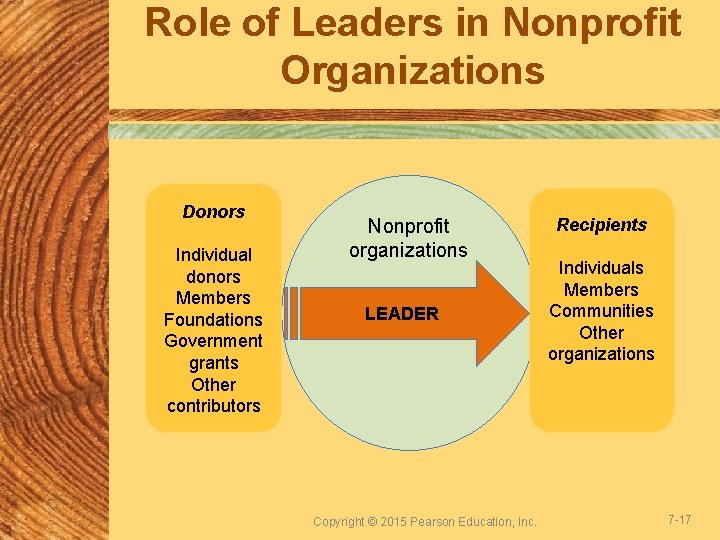
Role of Leaders in Nonprofit Organizations Donors Individual donors Members Foundations Government grants Other contributors Nonprofit organizations LEADER Copyright © 2015 Pearson Education, Inc. Recipients Individuals Members Communities Other organizations 7 -17
Leadership Challenges of Nonprofits • Leaders must rely on participatory leadership to build consensus • Strong ethical requirements • Motivating and retaining employees • Finding and training future leaders Copyright © 2015 Pearson Education, Inc. 7 -18
The Leadership Question Revisited • At some level, leading is leading; you need to take care of the task and people. • Upper echelon requires a heavier reliance on cognitive and interpersonal skills, as well as the ability to juggle many complex factors. • Nonprofits face another challenge of both working with volunteers and having little access to typical rewards for their employees. • Connecting with followers is at the heart of leadership. • Competence and knowledge of the task are essential. • Each leadership situation is unique, and being effective requires preparation, knowledge, experience, and styles and behaviors that fit the situation. Copyright © 2015 Pearson Education, Inc. 7 -19
What Do You Do? You are fully aware that change is not your thing. You are highly successful at creating systems and putting effective structures in place. You like order and predictability and have a track record to show good you are at your job. You join the leadership team of a small company that is also highly successful but that operates very loosely. Everything is decentralized and the focus is on change and innovation. How can you contribute? What do you do to succeed? Copyright © 2015 Pearson Education, Inc. 7 -20
Leadership Challenge • CEO involvement in nomination of board members helps assure that members with the right skills and expertise are selected • Those nominated by CEO may have a conflict of interest and a positive bias toward the CEO • Creation of a balance of members nominated by different stakeholders is essential Copyright © 2015 Pearson Education, Inc. 7 -21
Leading Change: Public Allies • • Leadership is an action (a verb) not a position (a noun) Develop the next generation of community leaders Educate and train community members Tied to community organizations; draws from them and returns trained leaders to them Create connections Public allies are 67% people of color; 60% women Focus on collaboration, diversity, continuous learning, and integrity Copyright © 2015 Pearson Education, Inc. 7 -22
Leadership in Action: P&G • P&G is well established in a highly competitive global market • Constant need for revitalization to remain competitive • Sudden change in leadership (rehire retiring CEO) in spite of careful succession planning • Lafley is focused on simple lessons • Low-key, collaborative, soft-spoken, consensual • Powerful board Copyright © 2015 Pearson Education, Inc. 7 -23
Copyright © 2015 Pearson Education, Inc.