
Chapter 7 ORGANIZATIONAL STRUCTURE AND DESIGN The nature

- Slides: 10
Chapter 7 ORGANIZATIONAL STRUCTURE AND DESIGN -The nature of organization design -Organization structure, technology, and task uncertainty -Organization Structure and the environment -Organization Structure and People 1
I. The nature of organization design v. Organization structure, authority and control Ø If the top manager offer the authority to middle or first-line manager so they have the authority to make decision. Ø In our society , most of them are not like that, top manager always keeps authority in hand. 2
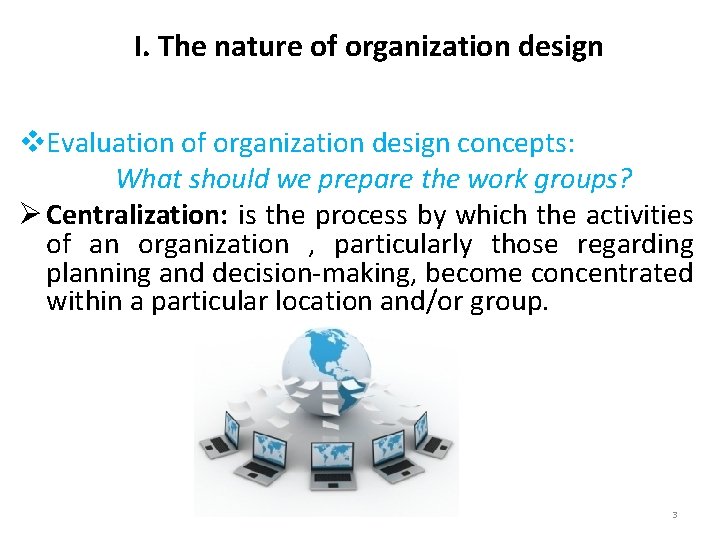
I. The nature of organization design v. Evaluation of organization design concepts: What should we prepare the work groups? Ø Centralization: is the process by which the activities of an organization , particularly those regarding planning and decision-making, become concentrated within a particular location and/or group. 3
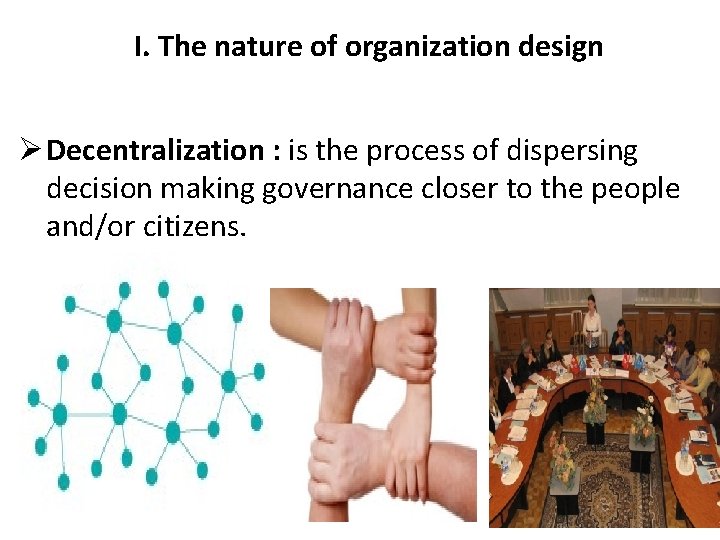
I. The nature of organization design Ø Decentralization : is the process of dispersing decision making governance closer to the people and/or citizens. 4
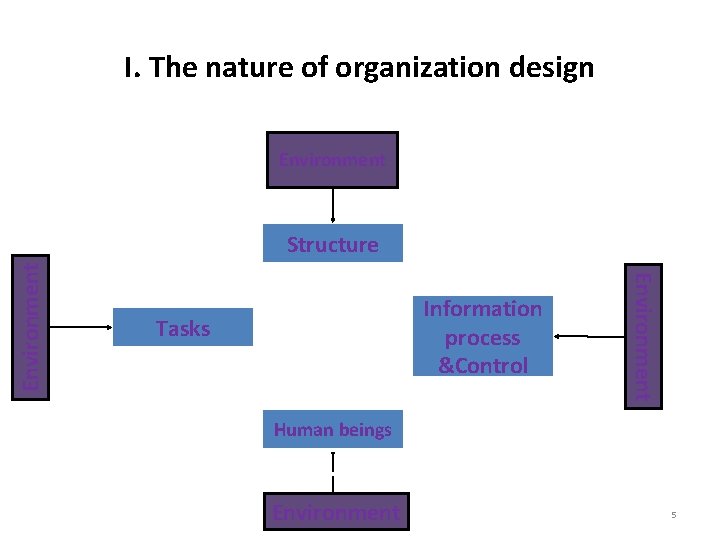
I. The nature of organization design Environment Information process &Control Tasks Environment Structure Human beings Environment 5
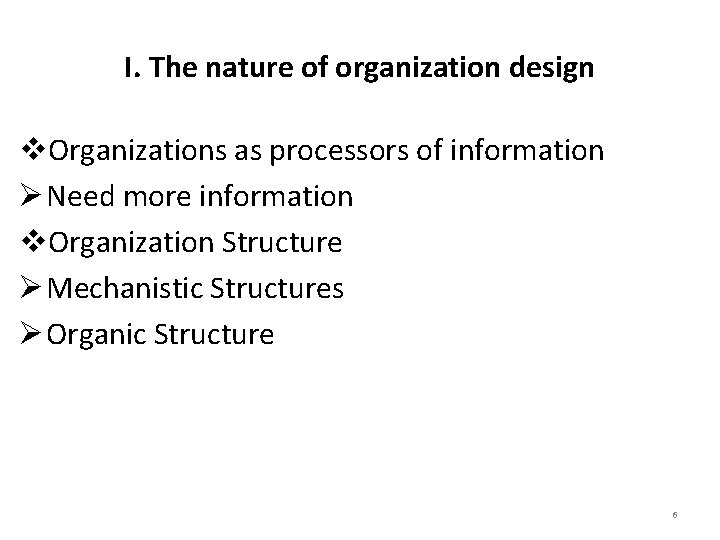
I. The nature of organization design v. Organizations as processors of information Ø Need more information v. Organization Structure Ø Mechanistic Structures Ø Organic Structure 6
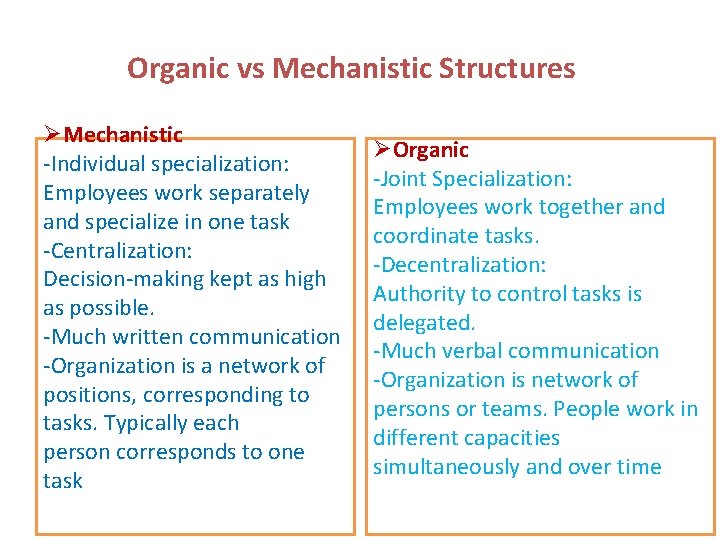
Organic vs Mechanistic Structures ØMechanistic -Individual specialization: Employees work separately and specialize in one task -Centralization: Decision-making kept as high as possible. -Much written communication -Organization is a network of positions, corresponding to tasks. Typically each person corresponds to one task ØOrganic -Joint Specialization: Employees work together and coordinate tasks. -Decentralization: Authority to control tasks is delegated. -Much verbal communication -Organization is network of persons or teams. People work in different capacities simultaneously and over time 7
II. Organization Structure, Technology, and Task Uncertainty Ø Influence of organization objectives on task uncertainty Task uncertainty: is what we face when dealing with some new kind of work never done before. Ø Influence of technology on task uncertainty 8
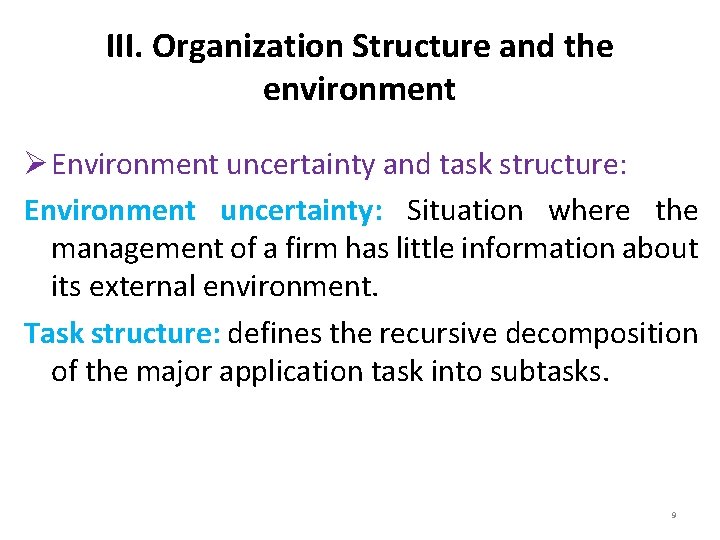
III. Organization Structure and the environment Ø Environment uncertainty and task structure: Environment uncertainty: Situation where the management of a firm has little information about its external environment. Task structure: defines the recursive decomposition of the major application task into subtasks. 9
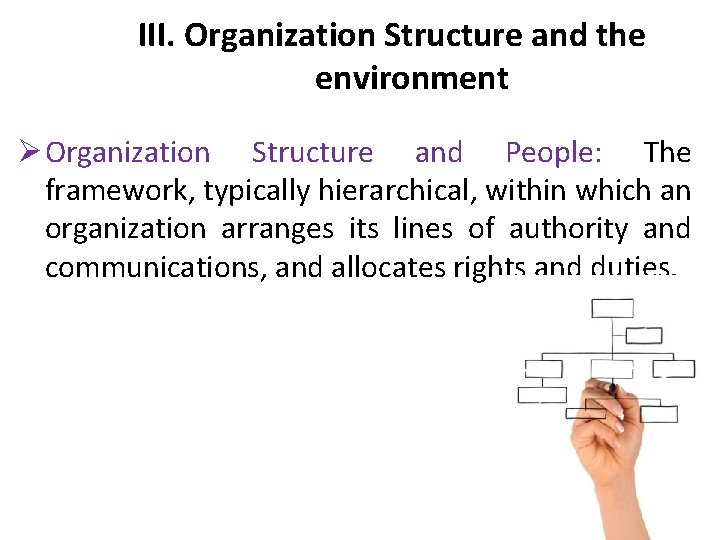
III. Organization Structure and the environment Ø Organization Structure and People: The framework, typically hierarchical, within which an organization arranges its lines of authority and communications, and allocates rights and duties. 10