
Chapter 7 Operating System Support www agungyuliantonugroho com
- Slides: 41
Chapter 7 Operating System Support www. agungyuliantonugroho. com 1
Fungsi Sistem Operasi Sistem operasi merupakan program yang mengontrol eksekusi program aplikasi dan bertindak sebagai antarmuka antara pengguna komputer dengan hardware www. agungyuliantonugroho. com 2
Tujuan Sistem Operasi Mempunyai 2 Tujuan : - Kenyamanan: Suatu sistem operasi membuat komputer lebih mudah digunakan - Efisiensi: Suatu sistem operasi memungkinkan sumber-daya sistem komputer dapat digunakan dengan cara yang efisien www. agungyuliantonugroho. com 3
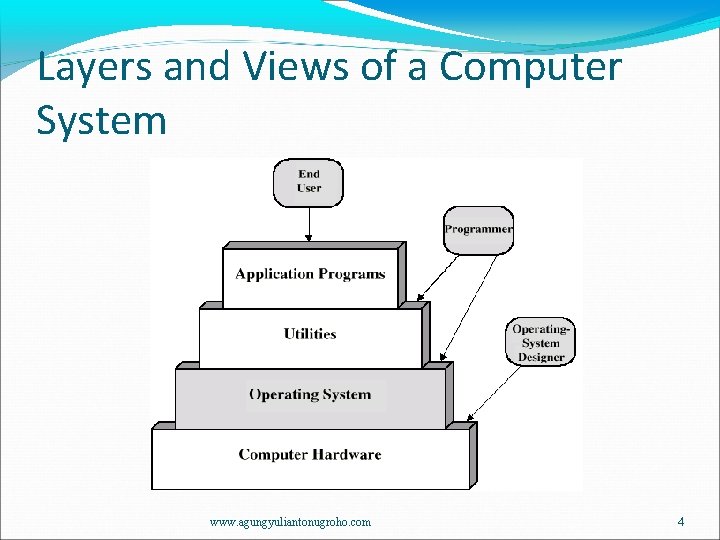
Layers and Views of a Computer System www. agungyuliantonugroho. com 4
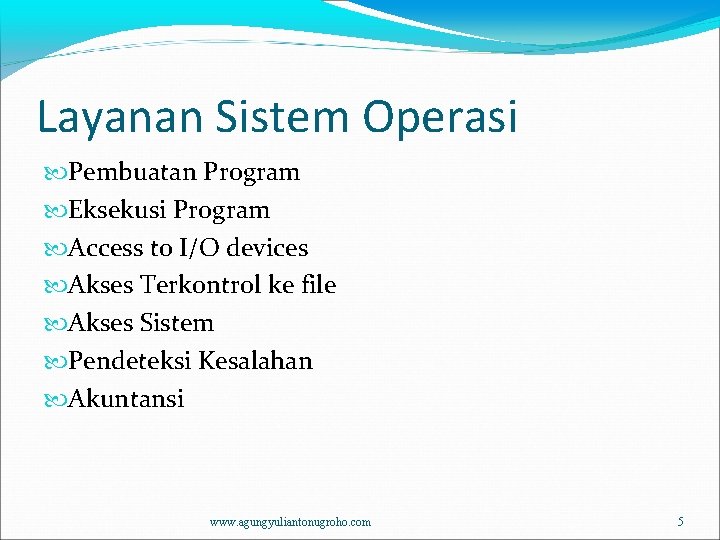
Layanan Sistem Operasi Pembuatan Program Eksekusi Program Access to I/O devices Akses Terkontrol ke file Akses Sistem Pendeteksi Kesalahan Akuntansi www. agungyuliantonugroho. com 5
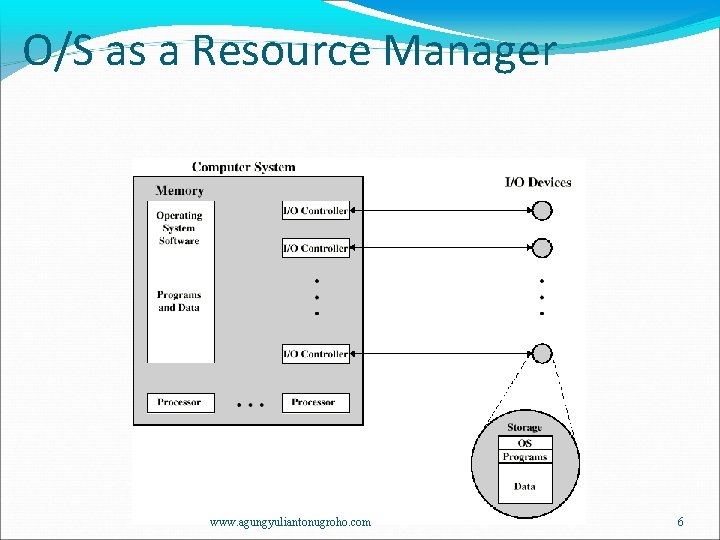
O/S as a Resource Manager www. agungyuliantonugroho. com 6
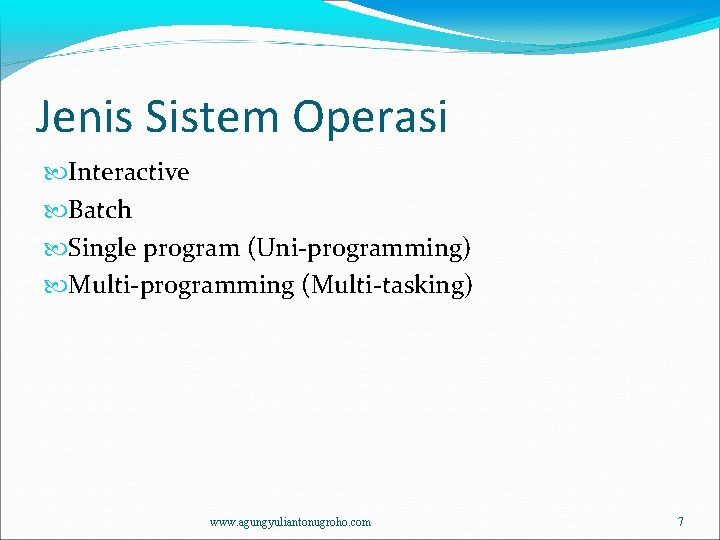
Jenis Sistem Operasi Interactive Batch Single program (Uni-programming) Multi-programming (Multi-tasking) www. agungyuliantonugroho. com 7
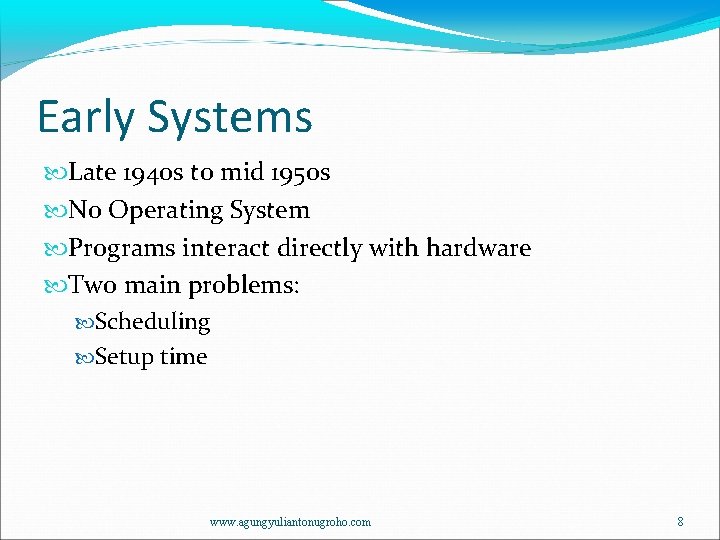
Early Systems Late 1940 s to mid 1950 s No Operating System Programs interact directly with hardware Two main problems: Scheduling Setup time www. agungyuliantonugroho. com 8
Simple Batch Systems Prosesor masa awal sangat mahal, dan oleh karena itu sangat penting untuk memaksimalkan pemanfaatan prosesor. Waktu yang disiasiakan dalam kaitan dengan waktu penjadwalan dan waktu setup sangat sulit untuk diterima. Untuk meningkatkan pemanfaatan dikembangkan sistem operasi bacth sederhana. www. agungyuliantonugroho. com 9
Fitur-fitur perangkat keras - Perlindungan Memori Pada saat program pengguna dieksekusi, maka program itu tidak harus mengubah area memory yg berisi monitor. Jika terjaadi perubahan area memori maka prosesor akan mendeteksi kesalahan dan kontrol transfer ke monitor - Pengatur waktu digunakan untuk mencegah sebuah tugas memonopoli sistem - Instruksi-instruksi istimewa Instruksi yang diistimewakan adalah instruksi I/O - Interupsi Fitur yang memberikan SO lebih flexibel dalam melepaskan kontrol ke program pengguna dan mendapatkan kembali kontrol tersebut www. agungyuliantonugroho. com 10
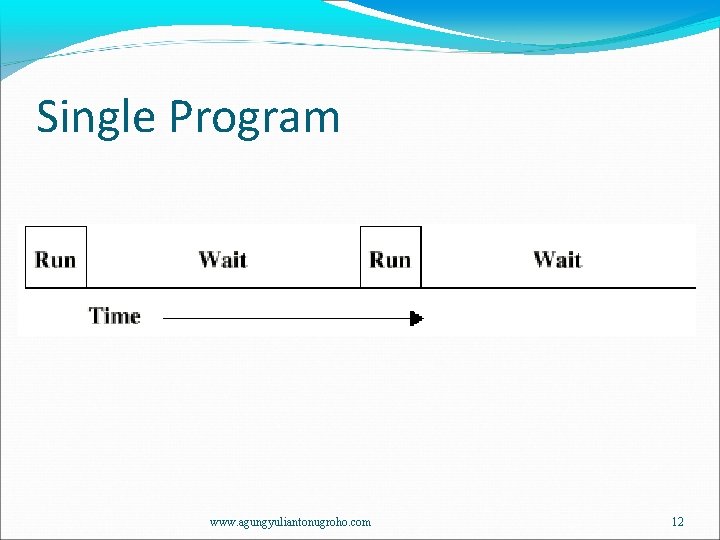
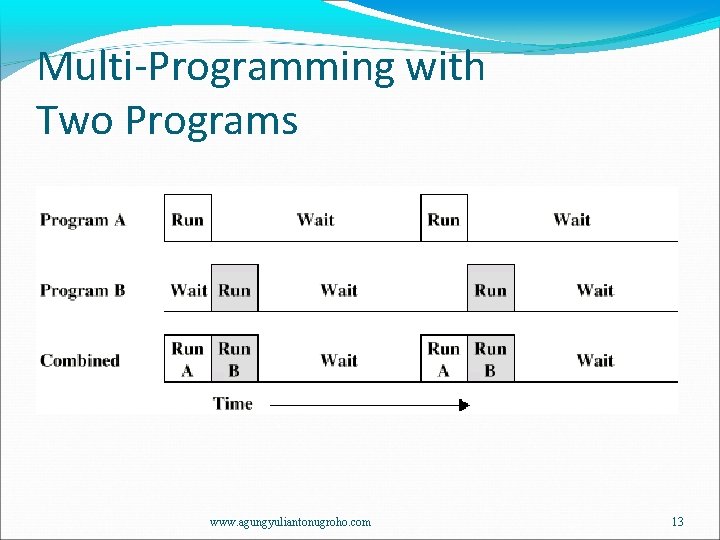
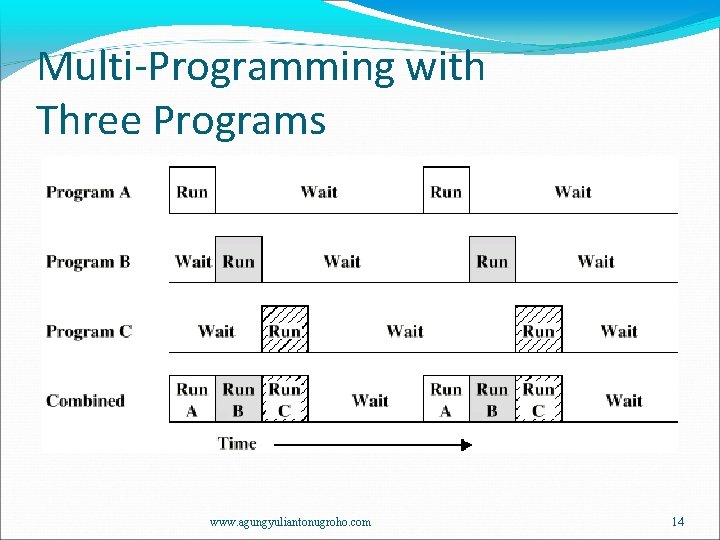
Multi-programmed Batch Systems I/O devices very slow When one program is waiting for I/O, another can use the CPU www. agungyuliantonugroho. com 11
Single Program www. agungyuliantonugroho. com 12
Multi-Programming with Two Programs www. agungyuliantonugroho. com 13
Multi-Programming with Three Programs www. agungyuliantonugroho. com 14
Time Sharing Systems Allow users to interact directly with the computer i. e. Interactive Multi-programming allows a number of users to interact with the computer www. agungyuliantonugroho. com 15
Scheduling Key to multi-programming Long term Medium term Short term I/O www. agungyuliantonugroho. com 16
Long Term Scheduling Determines which programs are submitted for processing i. e. controls the degree of multi-programming Once submitted, a job becomes a process for the short term scheduler (or it becomes a swapped out job for the medium term scheduler) www. agungyuliantonugroho. com 17
Medium Term Scheduling Part of the swapping function (later…) Usually based on the need to manage multiprogramming If no virtual memory, memory management is also an issue www. agungyuliantonugroho. com 18
Short Term Scheduler Dispatcher Fine grained decisions of which job to execute next i. e. which job actually gets to use the processor in the next time slot www. agungyuliantonugroho. com 19
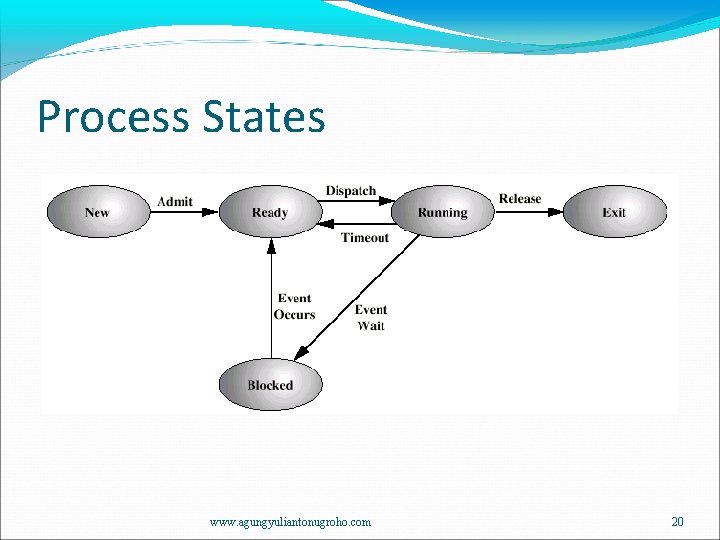
Process States www. agungyuliantonugroho. com 20
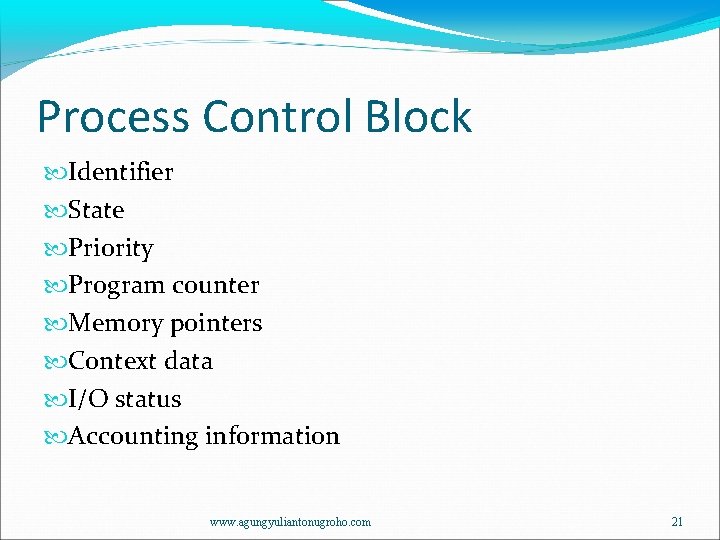
Process Control Block Identifier State Priority Program counter Memory pointers Context data I/O status Accounting information www. agungyuliantonugroho. com 21
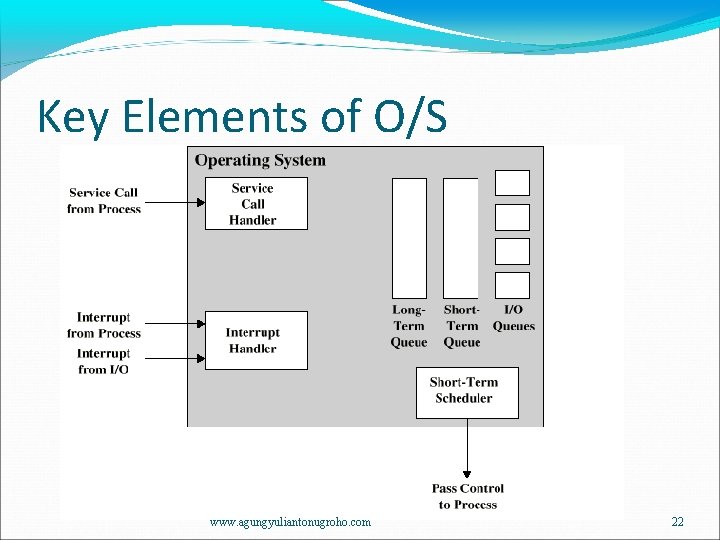
Key Elements of O/S www. agungyuliantonugroho. com 22
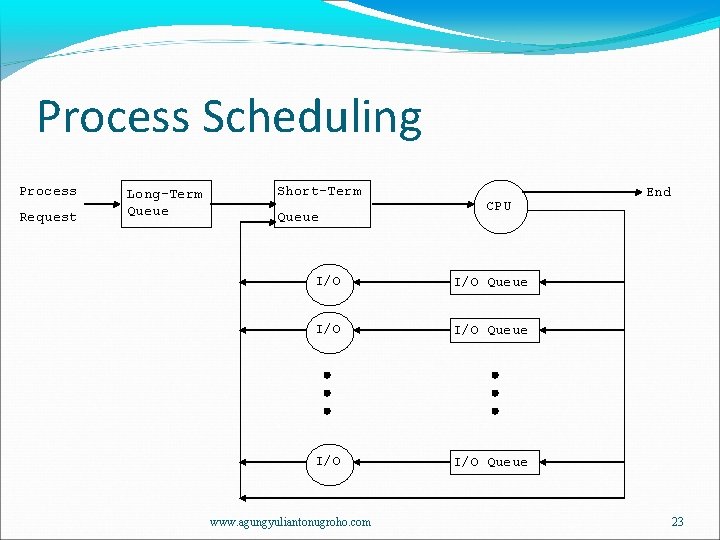
Process Scheduling Process Request Long-Term Queue Short-Term Queue CPU I/O I/O Queue www. agungyuliantonugroho. com End 23
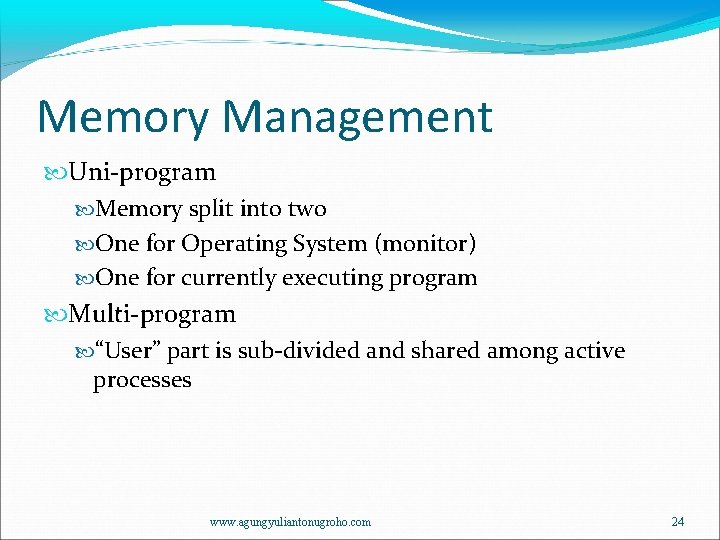
Memory Management Uni-program Memory split into two One for Operating System (monitor) One for currently executing program Multi-program “User” part is sub-divided and shared among active processes www. agungyuliantonugroho. com 24
Swapping Problem: I/O is so slow compared with CPU that even in multi-programming system, CPU can be idle most of the time Solutions: Increase main memory Expensive Leads to larger programs Swapping www. agungyuliantonugroho. com 25
What is Swapping? Long term queue of processes stored on disk Processes “swapped” in as space becomes available As a process completes it is moved out of main memory If none of the processes in memory are ready (i. e. all I/O blocked) Swap out a blocked process to intermediate queue Swap in a ready process or a new process But swapping is an I/O process. . . www. agungyuliantonugroho. com 26
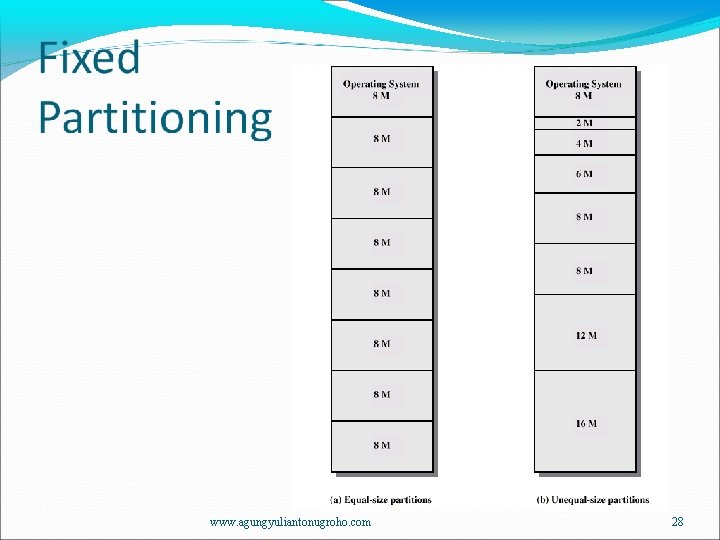
Partitioning Splitting memory into sections to allocate to processes (including Operating System) Fixed-sized partitions May not be equal size Process is fitted into smallest hole that will take it (best fit) Some wasted memory Leads to variable sized partitions www. agungyuliantonugroho. com 27
www. agungyuliantonugroho. com 28
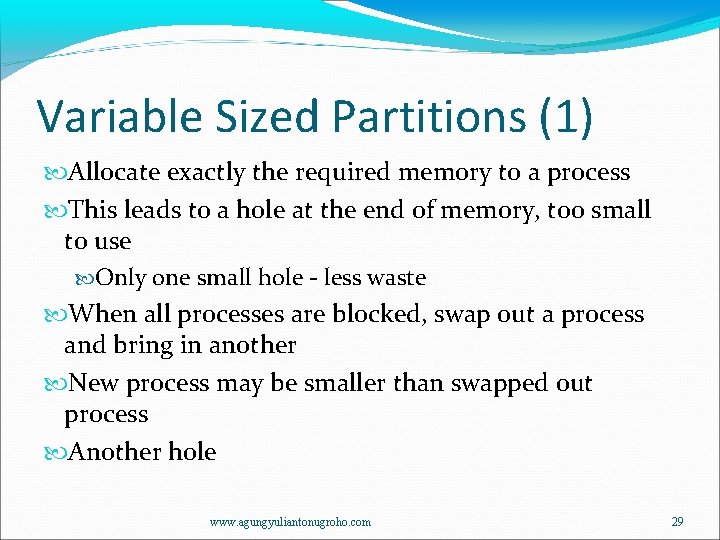
Variable Sized Partitions (1) Allocate exactly the required memory to a process This leads to a hole at the end of memory, too small to use Only one small hole - less waste When all processes are blocked, swap out a process and bring in another New process may be smaller than swapped out process Another hole www. agungyuliantonugroho. com 29
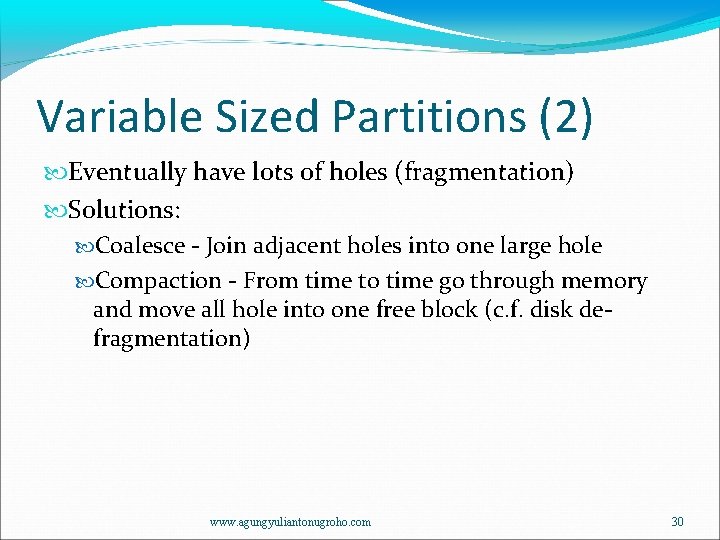
Variable Sized Partitions (2) Eventually have lots of holes (fragmentation) Solutions: Coalesce - Join adjacent holes into one large hole Compaction - From time to time go through memory and move all hole into one free block (c. f. disk defragmentation) www. agungyuliantonugroho. com 30
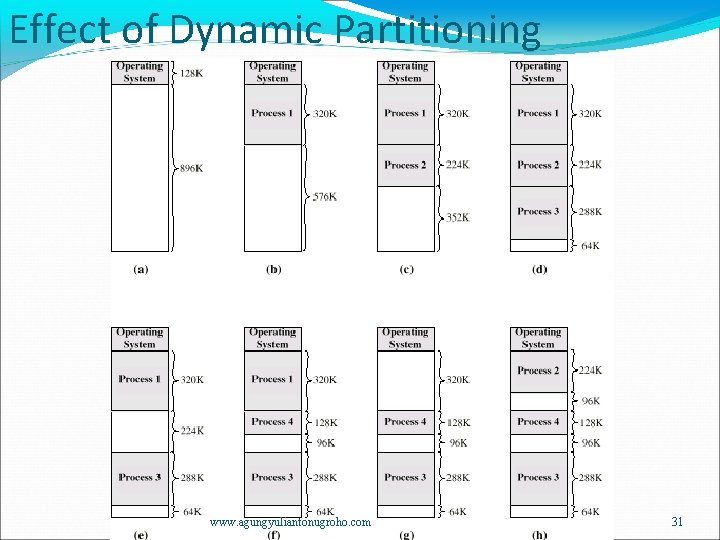
Effect of Dynamic Partitioning www. agungyuliantonugroho. com 31
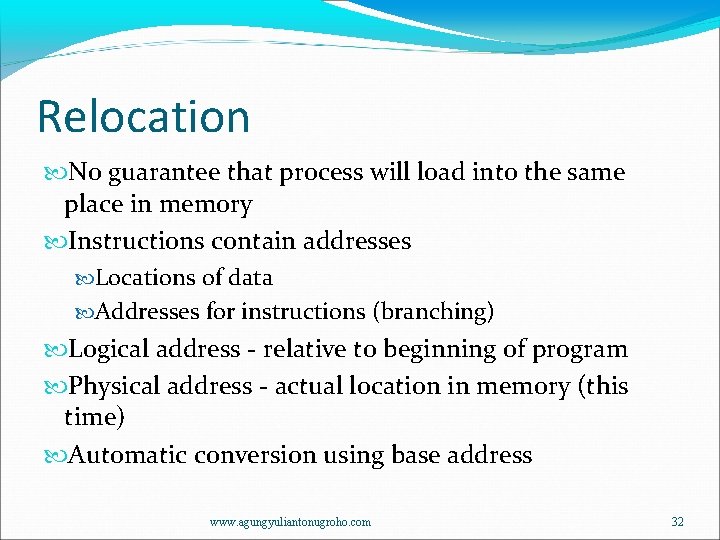
Relocation No guarantee that process will load into the same place in memory Instructions contain addresses Locations of data Addresses for instructions (branching) Logical address - relative to beginning of program Physical address - actual location in memory (this time) Automatic conversion using base address www. agungyuliantonugroho. com 32
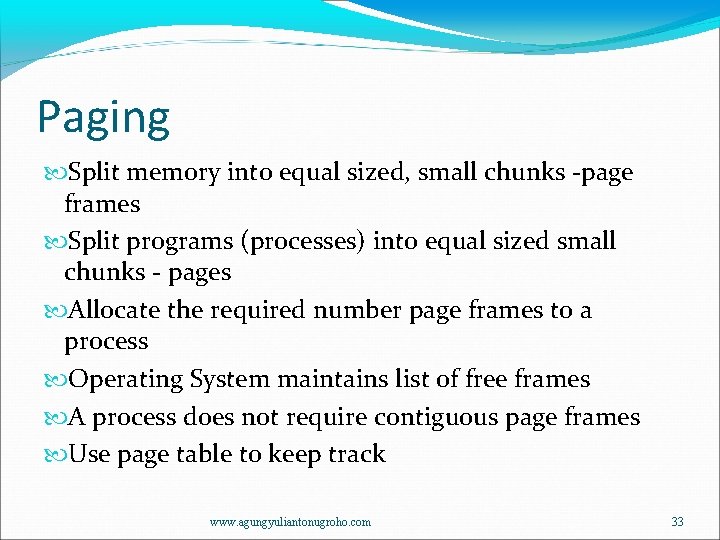
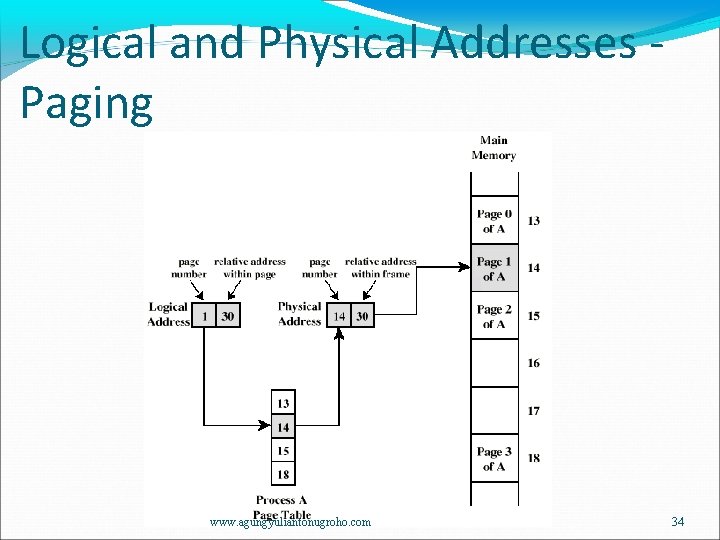
Paging Split memory into equal sized, small chunks -page frames Split programs (processes) into equal sized small chunks - pages Allocate the required number page frames to a process Operating System maintains list of free frames A process does not require contiguous page frames Use page table to keep track www. agungyuliantonugroho. com 33
Logical and Physical Addresses Paging www. agungyuliantonugroho. com 34
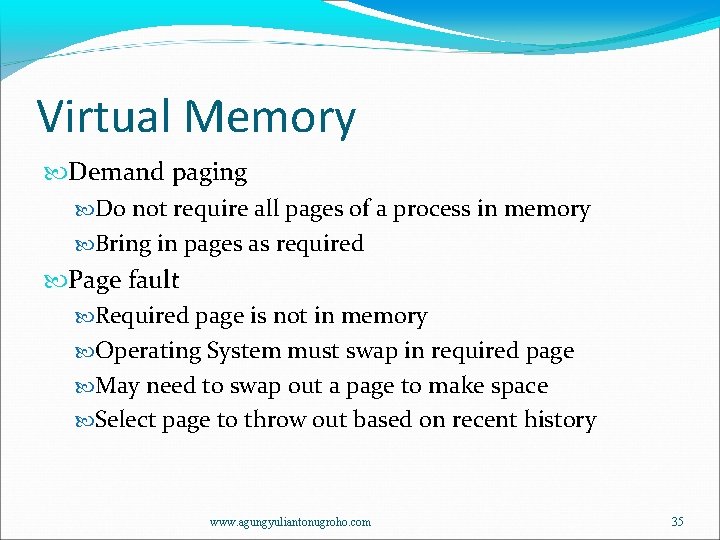
Virtual Memory Demand paging Do not require all pages of a process in memory Bring in pages as required Page fault Required page is not in memory Operating System must swap in required page May need to swap out a page to make space Select page to throw out based on recent history www. agungyuliantonugroho. com 35
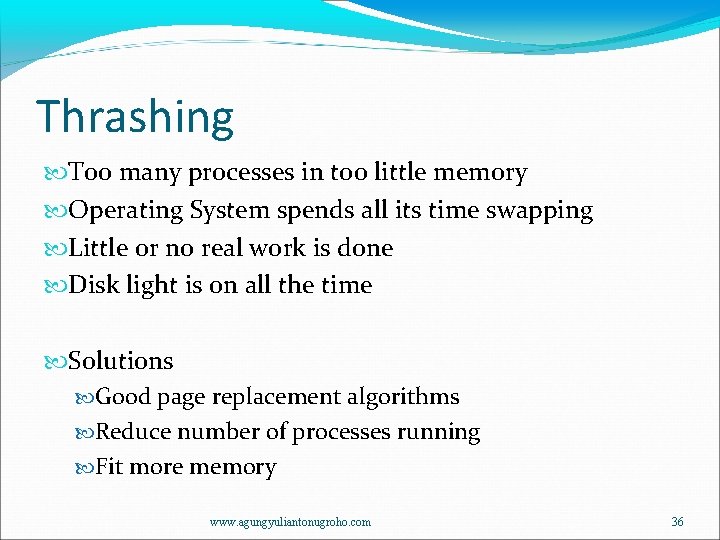
Thrashing Too many processes in too little memory Operating System spends all its time swapping Little or no real work is done Disk light is on all the time Solutions Good page replacement algorithms Reduce number of processes running Fit more memory www. agungyuliantonugroho. com 36
Bonus We do not need all of a process in memory for it to run We can swap in pages as required So - we can now run processes that are bigger than total memory available! Main memory is called real memory User/programmer sees much bigger memory - virtual memory www. agungyuliantonugroho. com 37
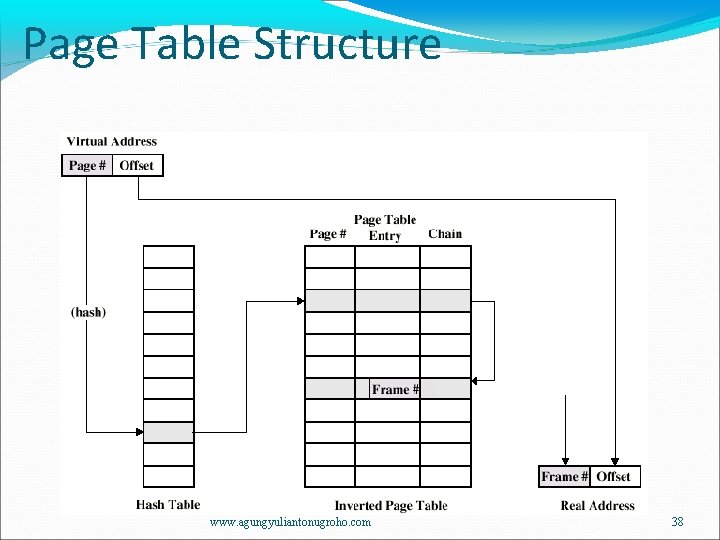
Page Table Structure www. agungyuliantonugroho. com 38
Segmentation Paging is not (usually) visible to the programmer Segmentation is visible to the programmer Usually different segments allocated to program and data May be a number of program and data segments www. agungyuliantonugroho. com 39
Advantages of Segmentation Simplifies handling of growing data structures Allows programs to be altered and recompiled independently, without re-linking and re-loading Lends itself to sharing among processes Lends itself to protection Some systems combine segmentation with paging www. agungyuliantonugroho. com 40
Required Reading Stallings chapter 7 Stallings, W. Operating Systems, Internals and Design Principles, Prentice Hall 1998 Loads of Web sites on Operating Systems www. agungyuliantonugroho. com 41