
Chapter 7 Nursing Management of Pain During Labor
Chapter 7 Nursing Management of Pain During Labor and Birth
Classes Offered • Adjust to pregnancy • Cope with labor • Prepare for life with an infant
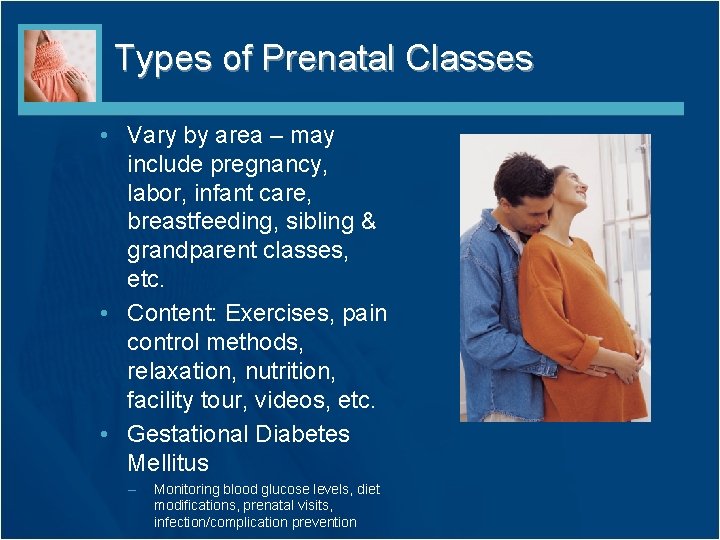
Types of Prenatal Classes • Vary by area – may include pregnancy, labor, infant care, breastfeeding, sibling & grandparent classes, etc. • Content: Exercises, pain control methods, relaxation, nutrition, facility tour, videos, etc. • Gestational Diabetes Mellitus – Monitoring blood glucose levels, diet modifications, prenatal visits, infection/complication prevention
Pain Control Methods • Variety of techniques that may be used during labor: – Skin stimulation, effleurage – Diversion and distraction – Breathing Techniques
Childbirth and Pain • Unpleasant and Distressing • Personal and Subjective • How childbirth pain differs from other pain – Pain is part of a normal birth process – Woman has several months to prepare for pain management – Is self-limiting and rapidly declines after delivery • Culture influences effect how a woman feels about pregnancy & pain during childbirth • See table 6 -1 p. 117
Factors that Influence Labor Pain • Pain threshold and pain tolerance – Threshold/Perception: least amount of sensation that the person perceives as painful. Fairly consistent, varies little under different conditions – Tolerance: amount of pain willing to endure. Can change under different conditions. • Nursing Responsibility is to modify as many factors as possible so that the woman can tolerate the pain of labor. • Sources of pain during labor or Physical Factors – – Dilation and stretching of the cervix Reduced uterine blood supply during contractions (ischemia) Pressure of the fetus on pelvic structures Stretching of the vagina and perineum
Factors that Influence Labor Pain • Central nervous system factors – Gate control theory • Explains how pain impulses reach the brain for interpretation. • Supports several non-pharmacological methods of pain control. » Massage, Palm and Fingertip pressure, heat and cold applications – Endorphins • Natural body substances similar to morphine. • Levels increase during pregnancy and peak during labor. • Laboring women often tolerate more pain than usual during labor because they have high levels of endorphins and concerned about infant’s well-being.
Factors that Influence Pain • Maternal conditions – Cervical readiness • Cervix undergoes prelabor changes that facilitate effacement and dilation in labor • If cervix does not make these changes (ripening), more contractions are needed to cause effacement and dilation. – Pelvis • Size and Shape significantly influence how readily the fetus can descend • Pelvic abnormalities result in longer labor and maternal fatigue • Interferes with normal mechanisms of labor – Labor intensity • Short, intense – more pain compared to women whose birth process was gradual – Cervix, vagina, and perineum stretch more abruptly than during a gentler labor – Fatigue • Reduces pain tolerance and a women’s ability to use coping skills. • Fetal presentation and position • Presenting part acts as a wedge to efface and dilate the cervix as each contraction pushes it downward.
Pharmacological vs. Non Pain Management • Pharmacological – cannot be used until labor is well-established bc they slow the progression of labor. – Most medications do not alleviate pain • Nonpharmacological – Help the women cope with labor before it has advanced far enough for her to be given medications – Only realistic option during advanced labor
Nonpharmacological Pain Management • Advantages – Nonpharmacological methods do not harm the mother or fetus – They do not slow labor if they provide adequate pain control – They carry no risk for allergy or adverse drug effects
Selected Nonpharmacological Pain Relief Measures • • Relaxation techniques Skin stimulation Effleurage Sacral pressure Thermal stimulation Positioning Diversion and distraction Breathing Techniques
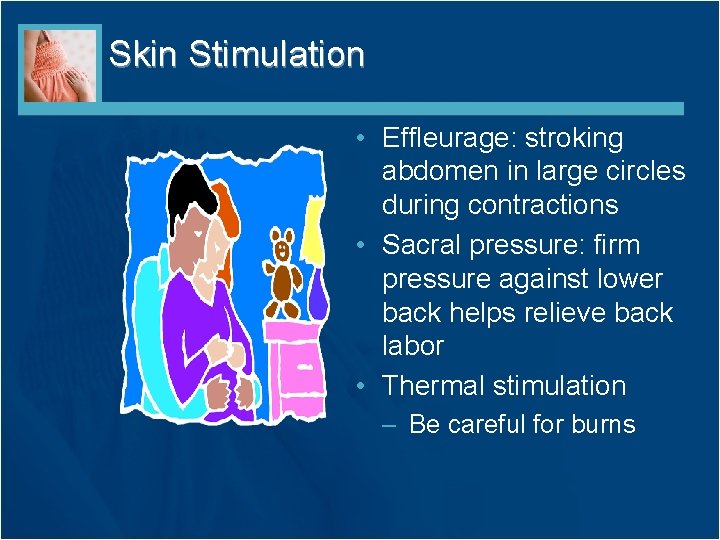
Skin Stimulation • Effleurage: stroking abdomen in large circles during contractions • Sacral pressure: firm pressure against lower back helps relieve back labor • Thermal stimulation – Be careful for burns
Breathing Techniques • Should not use tech. until needed, when cannot walk or talk through contraction. Tiring if used too early. • Each breathing pattern begins and ends with a cleansing breath – Helps relaxation & focusing • Advantage: Do not interfere with normal laboring process • First-stage breathing – Slow-paced breathing • • Starts with a cleansing breath, then breaths slowly, as during sleep. Cleansing breath ends the contraction. 6 -9 breaths per minute is average Half of usual rate to ensure adequate fetal oxygenation and prevent hyperventilation
Breathing Techniques – Modified-paced breathing • Begins and ends with a cleansing breath • Breathes more rapidly and shallowly • No more than 2 x usual – Hyperventilation is sometimes a problem with rapid breathing – Patterned-paced breathing • More difficult bc requires focus on pattern of breathing • Begins with cleansing breath – rapid breaths – and slight blows • “pant/blow” or “hee/hoo” • Second-stage breathing – At pushing time – Begins with cleansing breath – Deep breath – Push down during exhalation and count to 10
How to Recognize and Correct Hyperventilation • Signs and symptoms • Corrective measures – Dizziness – Tingling of hands and feet – Cramps and muscle spasms of hands – Numbness around nose and mouth – Blurring of vision – Breathe slowly, especially when exhaling – Breathe into cupped hands – Place a moist washcloth over the mouth and nose while breathing – Hold breath for a few seconds before exhaling

Breathing Patterns
Relationship of Pregnancy to Analgesia and Anesthesia • Pregnant woman at higher risk for hypoxia • Caused by pressure of the enlarged uterus on the diaphragm • Sluggish GI tract can result in increased risk of vomiting and aspiration • Aortocaval compression (pressure on the abd aorta by heavy uterus when supine) • increases risk of hypotension and shock • Effect on fetus must be considered • Lethargic at birth
Pharmacological Methods • Advantages – Using medications during labor allows the mother to be more comfortable and relaxed. – Increased relaxation will aid in her ability to participate in her care. • Limitations – Two people are being medicated – Any drug given can affect fetus, and effect may be prolonged after birth – Slow labor progression if used in early labor
Analgesics and Adjunctive Drugs • Narcotic (opioid) analgesics – Most common means of labor analgesia in US – Small doses to avoid fetal resp. depression – Do not provide complete pain relief – Used to help cope with labor at tolerable level – Avoid if birth anticipated within 1 hour • Narcotic antagonist – Narcan – reverses respiratory depression • Adjunctive drugs – Enhance the pain-relieving action of analgesics and reduce nausea • Hydralizine
Types of Anesthesia for Childbirth • • • Local infiltration – Injection at perineal area – episiotomy, laceration repair – Short delay between injection and loss of pain – No risks if woman is not allergic to medication Pudendal block – Less common – Injects the pudendal nerve on each side of mothers pelvis – Used during forcep assisted births – Does not block pain of contractions Epidural block – Done by physician or nurse anesthetist – PN can assist in positioning women: sitting or side-lying – Numbness or loss of movement after small test – dura mater was punctured and med was injected into the subarachnoid space – Numbness around mouth, tinnitus, visual disturbances, jitteriness – injection in vein
Types of Anesthesia for Childbirth • Subarachnoid (spinal) block – Spinal fluid confirm placement – Anethesia occurs quickly and more profound than epidural – Women loses all movement and sensation below the block – “one shot” – no placement of catheter • General anesthesia – Rarely used – Emergency cesarean births, refusal or contraindication of epidural/block
Regional Analgesics and Anesthetics • Regional anesthesia usually involves placement of anesthetic in epidural or subarachnoid space • The meninges around the spinal cord – Dura mater – Arachnoid mater • Subarachnoid block – Pia mater
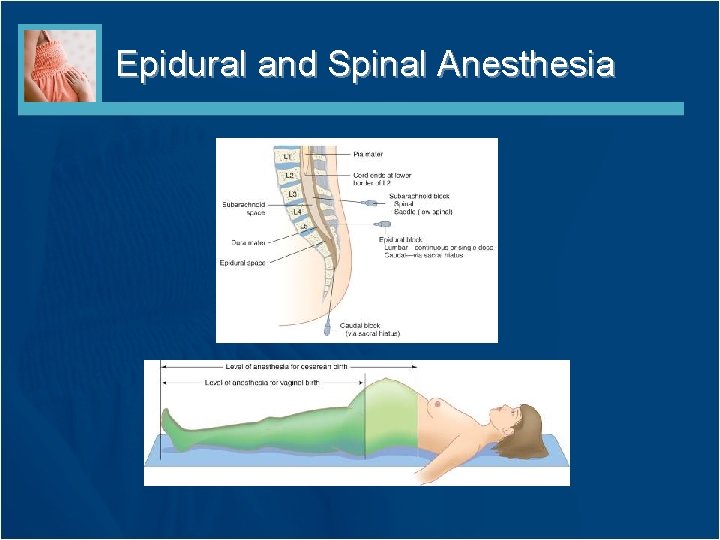
Epidural and Spinal Anesthesia
Adverse Effects of Pharmacological Methods • Systemic opioid – Fetal respiratory depression • Pudendal block – Vaginal hematoma or abscess may develop, not common • Epidural and subarachnoid block (spinal block) – Maternal hypotension and urinary retention – Spinal headache with subarachnoid block (Pt. should remain flat for several hours to reduce chance of postspinal HA. ) • Blood patch (seal) used to provide relief from postspinal headache • General anesthesia – Maternal: aspiration of stomach contents – Fetus: respiratory depression
Pharmacological Techniques • The nurse’s role – – Begins at admission Assess Allergies: drug, anesthetics, latex Woman’s preference for pain relief Keep side rails up if women takes pain relief drugs • Side Effects of Narcotics – Reinforce education regarding procedures and expected effects of pain management method – Observe for hypotension if epidural or subarachnoid block is given

Elsevier items and derived items © 2011, 2007, 2006 by Saunders, an imprint of Elsevier Inc. 26
- Slides: 26