
Chapter 7 Normal Probability Distributions March 21 7
Chapter 7: Normal Probability Distributions March 21 7: Normal Probability Distributions 1
In Chapter 7: 7. 1 Normal Distributions 7. 2 Determining Normal Probabilities 7. 3 Finding Values That Correspond to Normal Probabilities 7. 4 Assessing Departures from Normality 7: Normal Probability Distributions 2
§ 7. 1: Normal Distributions • This pdf is the most popular distribution for continuous random variables • First described de Moivre in 1733 • Elaborated in 1812 by Laplace • Describes some natural phenomena • More importantly, describes sampling characteristics of totals and means 7: Normal Probability Distributions 3
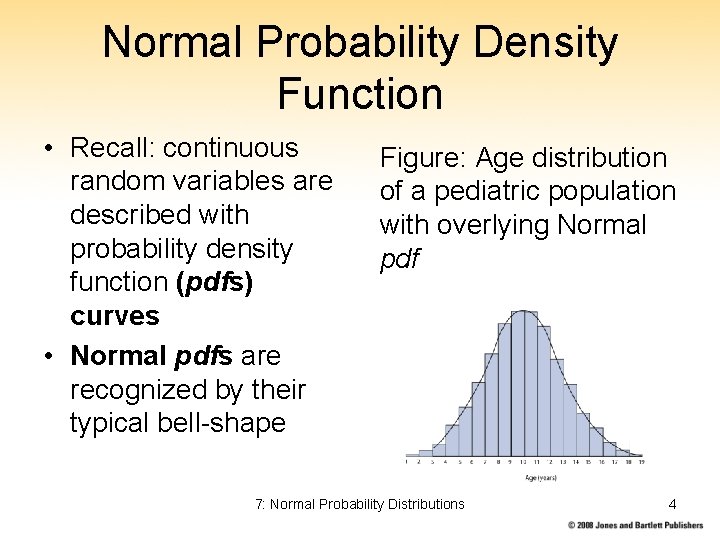
Normal Probability Density Function • Recall: continuous random variables are described with probability density function (pdfs) curves • Normal pdfs are recognized by their typical bell-shape Figure: Age distribution of a pediatric population with overlying Normal pdf 7: Normal Probability Distributions 4
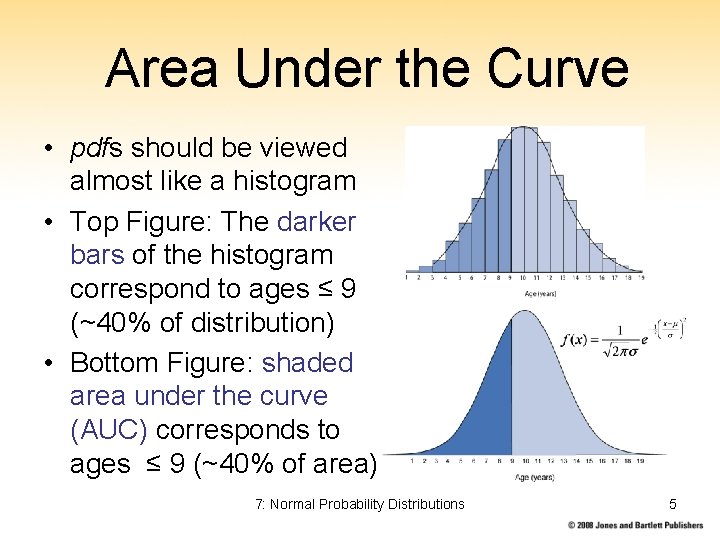
Area Under the Curve • pdfs should be viewed almost like a histogram • Top Figure: The darker bars of the histogram correspond to ages ≤ 9 (~40% of distribution) • Bottom Figure: shaded area under the curve (AUC) corresponds to ages ≤ 9 (~40% of area) 7: Normal Probability Distributions 5
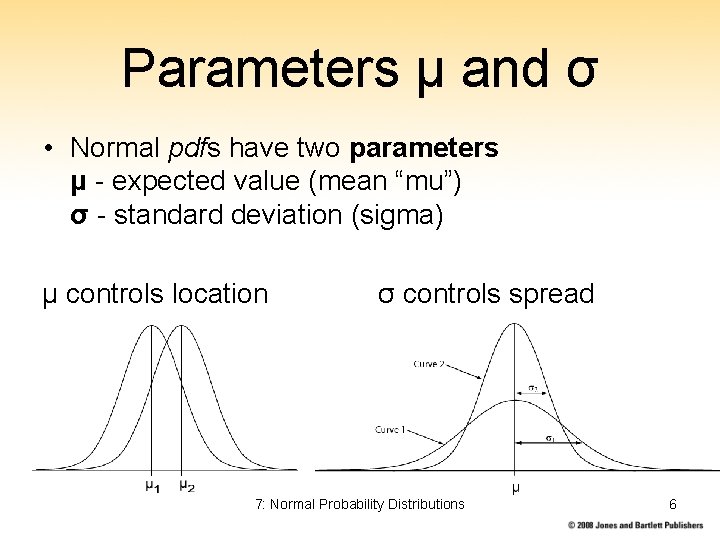
Parameters μ and σ • Normal pdfs have two parameters μ - expected value (mean “mu”) σ - standard deviation (sigma) μ controls location σ controls spread 7: Normal Probability Distributions 6
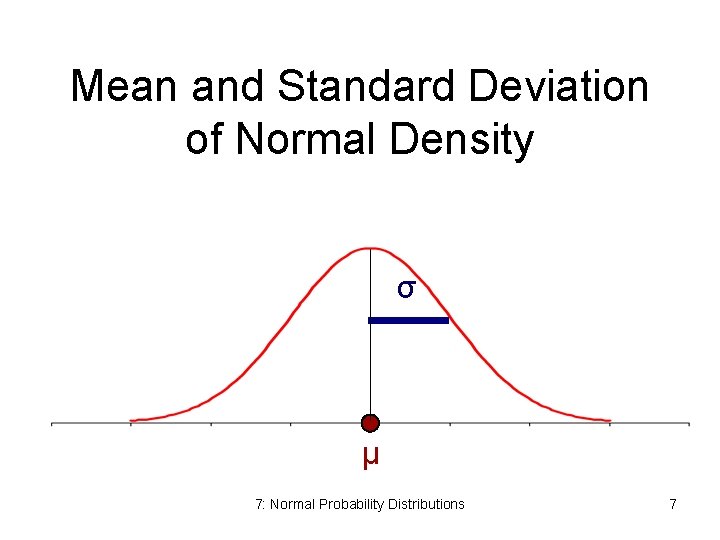
Mean and Standard Deviation of Normal Density σ μ 7: Normal Probability Distributions 7
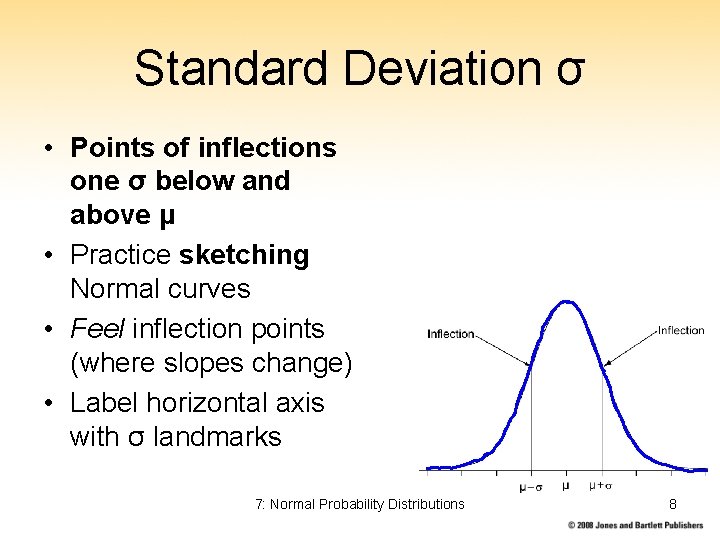
Standard Deviation σ • Points of inflections one σ below and above μ • Practice sketching Normal curves • Feel inflection points (where slopes change) • Label horizontal axis with σ landmarks 7: Normal Probability Distributions 8
Two types of means and standard deviations • The mean and standard deviation from the pdf (denoted μ and σ) are parameters • The mean and standard deviation from a sample (“xbar” and s) are statistics • Statistics and parameters are related, but are not the same thing! 7: Normal Probability Distributions 9
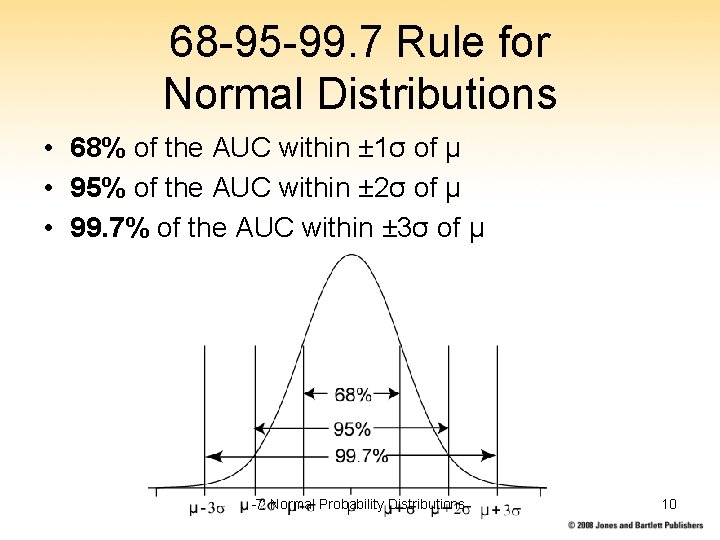
68 -95 -99. 7 Rule for Normal Distributions • 68% of the AUC within ± 1σ of μ • 95% of the AUC within ± 2σ of μ • 99. 7% of the AUC within ± 3σ of μ 7: Normal Probability Distributions 10
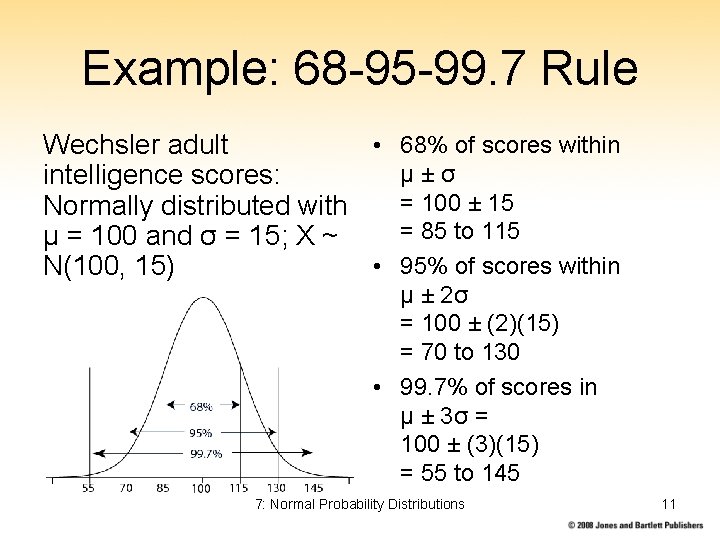
Example: 68 -95 -99. 7 Rule • 68% of scores within Wechsler adult μ±σ intelligence scores: = 100 ± 15 Normally distributed with = 85 to 115 μ = 100 and σ = 15; X ~ • 95% of scores within N(100, 15) μ ± 2σ = 100 ± (2)(15) = 70 to 130 • 99. 7% of scores in μ ± 3σ = 100 ± (3)(15) = 55 to 145 7: Normal Probability Distributions 11

Symmetry in the Tails Because the Normal curve is symmetrical and the total AUC is exactly 1… 95% … we can easily determine the AUC in tails 7: Normal Probability Distributions 12
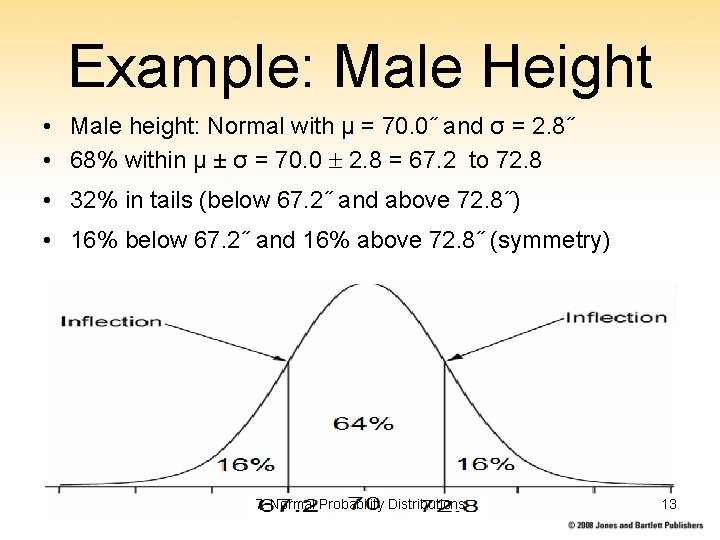
Example: Male Height • Male height: Normal with μ = 70. 0˝ and σ = 2. 8˝ • 68% within μ ± σ = 70. 0 2. 8 = 67. 2 to 72. 8 • 32% in tails (below 67. 2˝ and above 72. 8˝) • 16% below 67. 2˝ and 16% above 72. 8˝ (symmetry) 7: Normal Probability Distributions 13
Reexpression of Non-Normal Random Variables • Many variables are not Normal but can be reexpressed with a mathematical transformation to be Normal • Example of mathematical transforms used for this purpose: – logarithmic – exponential – square roots • Review logarithmic transformations… 7: Normal Probability Distributions 14
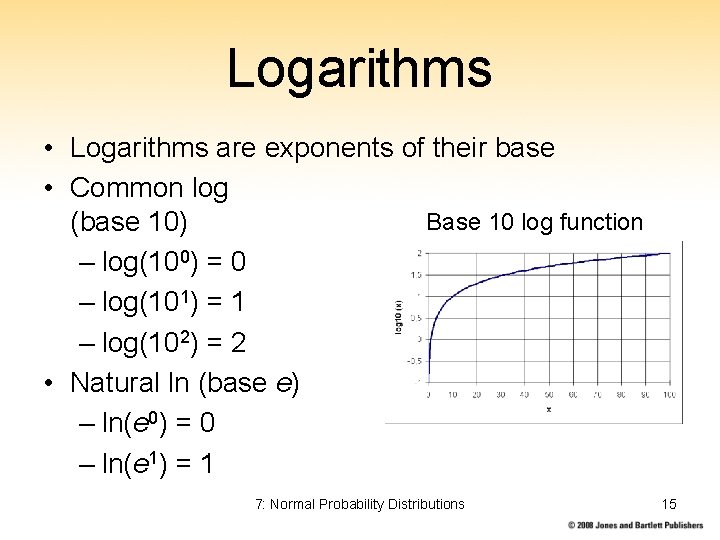
Logarithms • Logarithms are exponents of their base • Common log Base 10 log function (base 10) – log(100) = 0 – log(101) = 1 – log(102) = 2 • Natural ln (base e) – ln(e 0) = 0 – ln(e 1) = 1 7: Normal Probability Distributions 15
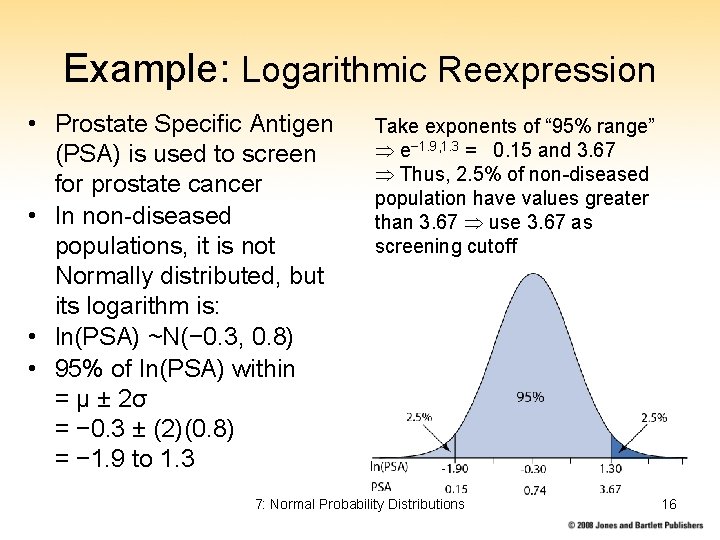
Example: Logarithmic Reexpression • Prostate Specific Antigen (PSA) is used to screen for prostate cancer • In non-diseased populations, it is not Normally distributed, but its logarithm is: • ln(PSA) ~N(− 0. 3, 0. 8) • 95% of ln(PSA) within = μ ± 2σ = − 0. 3 ± (2)(0. 8) = − 1. 9 to 1. 3 Take exponents of “ 95% range” e− 1. 9, 1. 3 = 0. 15 and 3. 67 Thus, 2. 5% of non-diseased population have values greater than 3. 67 use 3. 67 as screening cutoff 7: Normal Probability Distributions 16
§ 7. 2: Determining Normal Probabilities When value do not fall directly on σ landmarks: 1. State the problem 2. Standardize the value(s) (z score) 3. Sketch, label, and shade the curve 4. Use Table B 7: Normal Probability Distributions 17
Step 1: State the Problem • What percentage of gestations are less than 40 weeks? • Let X ≡ gestational length • We know from prior research: X ~ N(39, 2) weeks • Pr(X ≤ 40) = ? 7: Normal Probability Distributions 18
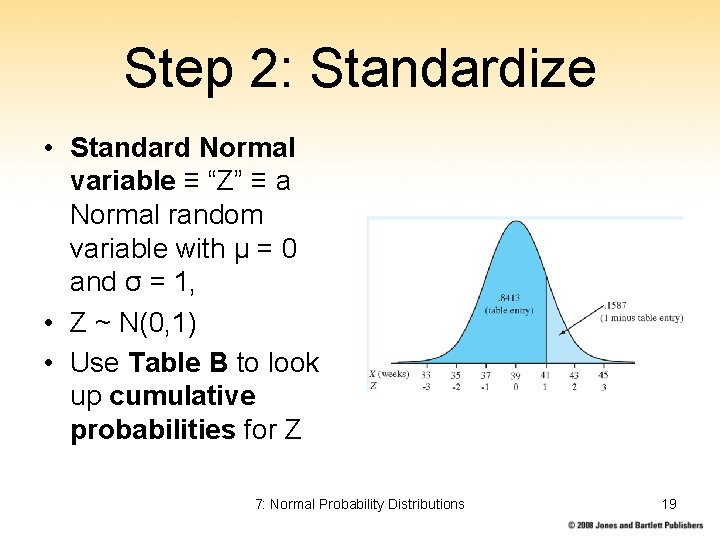
Step 2: Standardize • Standard Normal variable ≡ “Z” ≡ a Normal random variable with μ = 0 and σ = 1, • Z ~ N(0, 1) • Use Table B to look up cumulative probabilities for Z 7: Normal Probability Distributions 19
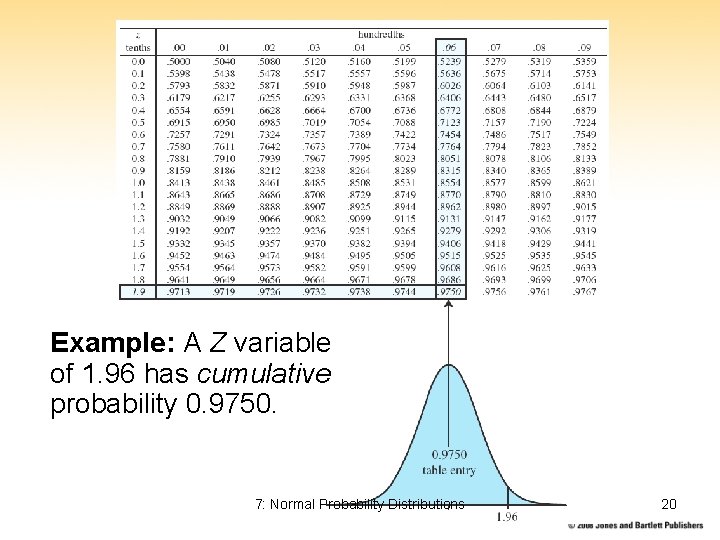
Example: A Z variable of 1. 96 has cumulative probability 0. 9750. 7: Normal Probability Distributions 20
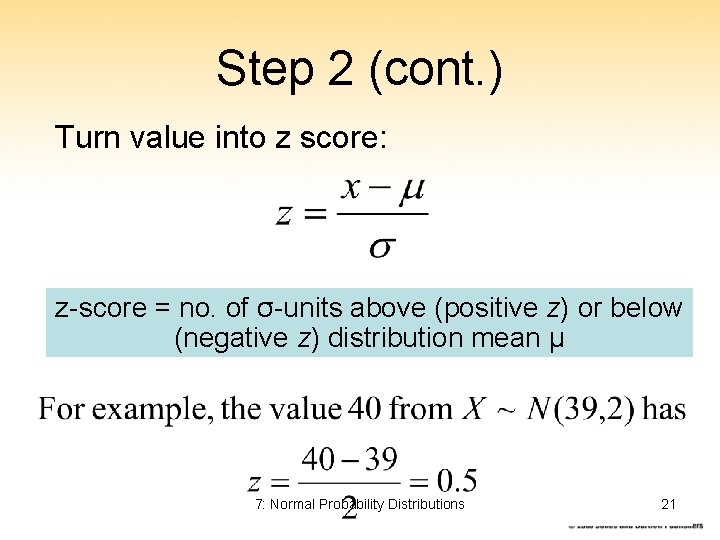
Step 2 (cont. ) Turn value into z score: z-score = no. of σ-units above (positive z) or below (negative z) distribution mean μ 7: Normal Probability Distributions 21
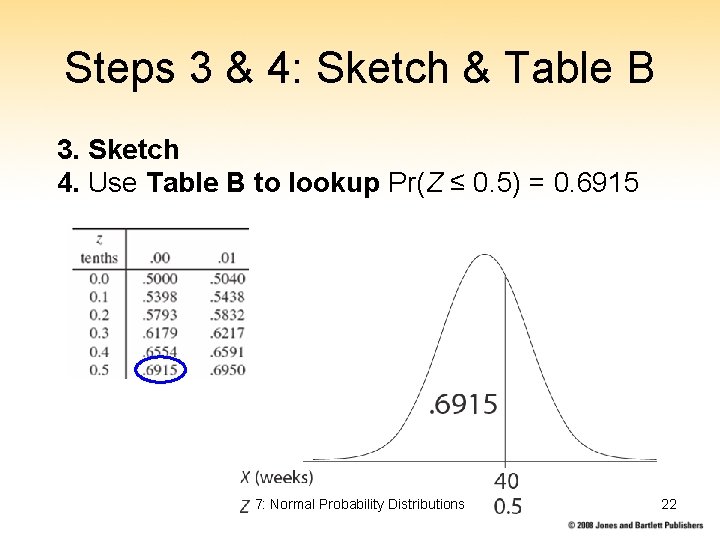
Steps 3 & 4: Sketch & Table B 3. Sketch 4. Use Table B to lookup Pr(Z ≤ 0. 5) = 0. 6915 7: Normal Probability Distributions 22
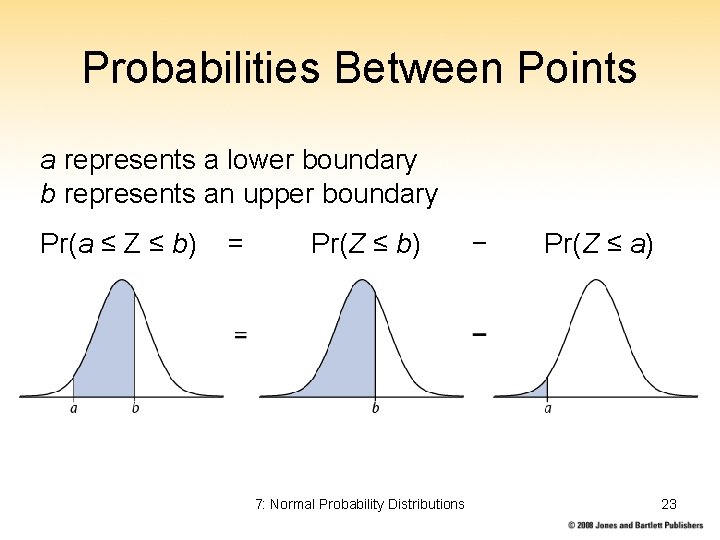
Probabilities Between Points a represents a lower boundary b represents an upper boundary Pr(a ≤ Z ≤ b) = Pr(Z ≤ b) 7: Normal Probability Distributions − Pr(Z ≤ a) 23
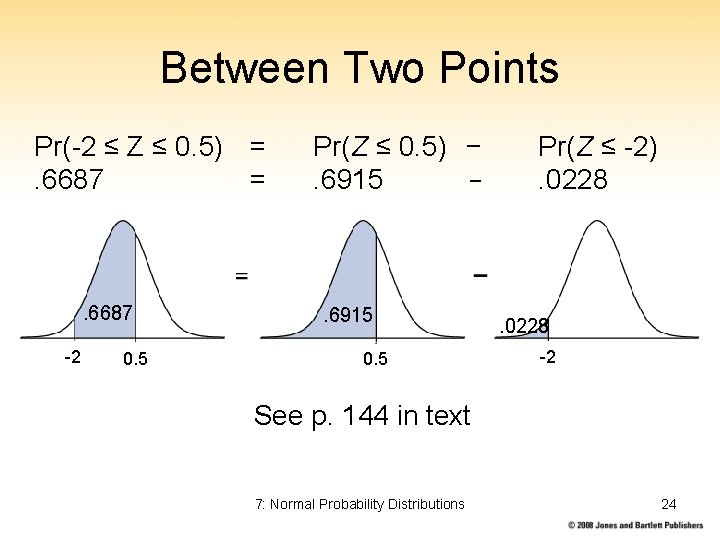
Between Two Points Pr(-2 ≤ Z ≤ 0. 5) =. 6687 = . 6687 -2 0. 5 Pr(Z ≤ 0. 5) −. 6915 − . 6915 0. 5 Pr(Z ≤ -2). 0228 -2 See p. 144 in text 7: Normal Probability Distributions 24
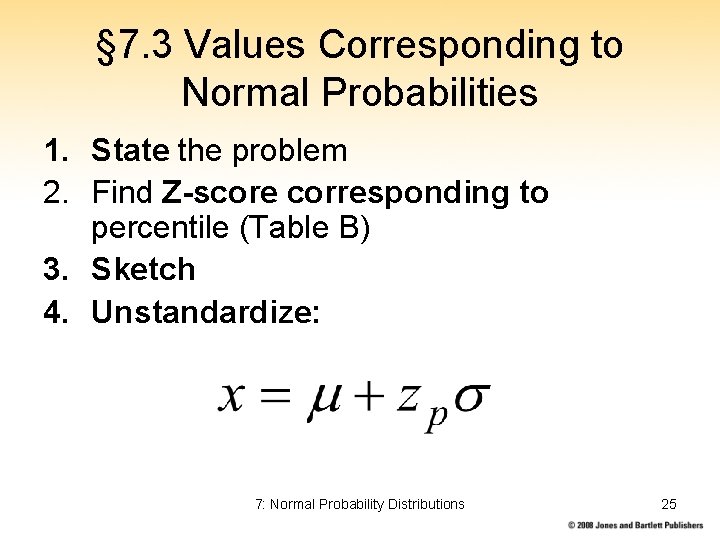
§ 7. 3 Values Corresponding to Normal Probabilities 1. State the problem 2. Find Z-score corresponding to percentile (Table B) 3. Sketch 4. Unstandardize: 7: Normal Probability Distributions 25
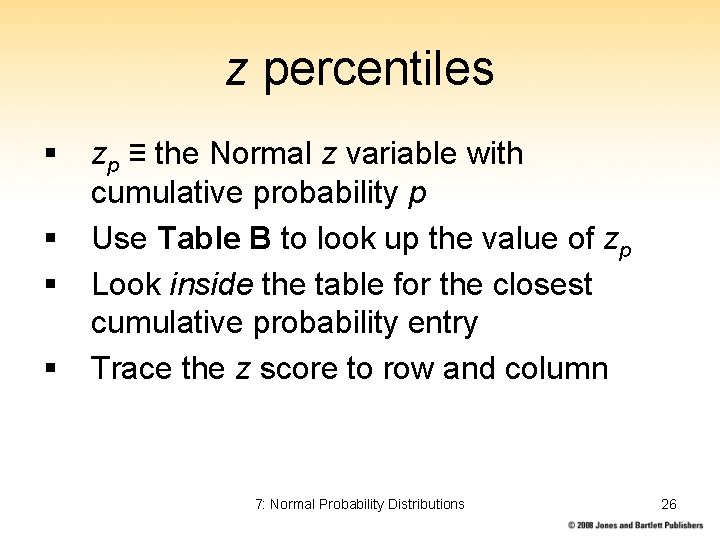
z percentiles § § zp ≡ the Normal z variable with cumulative probability p Use Table B to look up the value of zp Look inside the table for the closest cumulative probability entry Trace the z score to row and column 7: Normal Probability Distributions 26
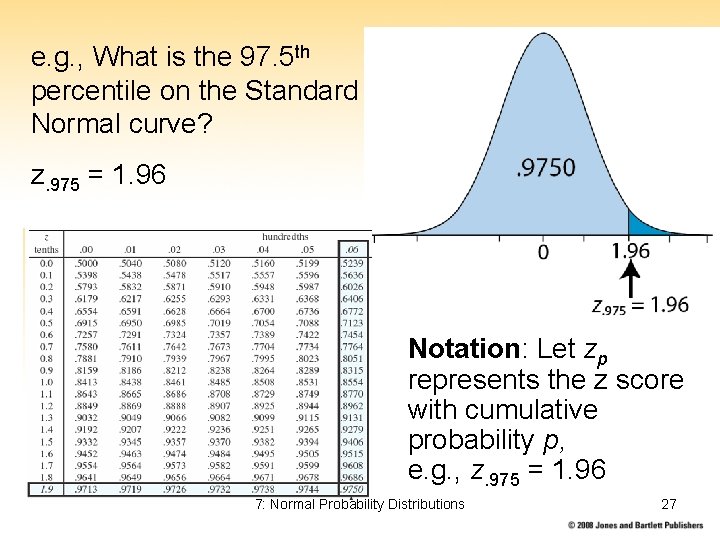
e. g. , What is the 97. 5 th percentile on the Standard Normal curve? z. 975 = 1. 96 Notation: Let zp represents the z score with cumulative probability p, e. g. , z. 975 = 1. 96 7: Normal Probability Distributions 27
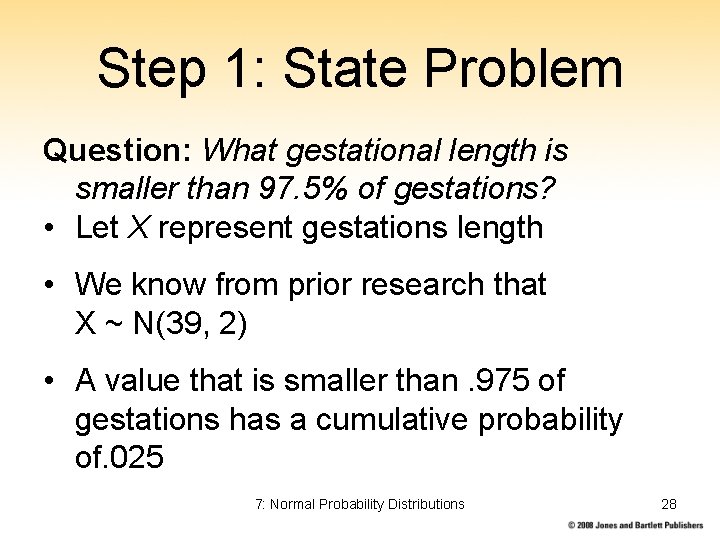
Step 1: State Problem Question: What gestational length is smaller than 97. 5% of gestations? • Let X represent gestations length • We know from prior research that X ~ N(39, 2) • A value that is smaller than. 975 of gestations has a cumulative probability of. 025 7: Normal Probability Distributions 28
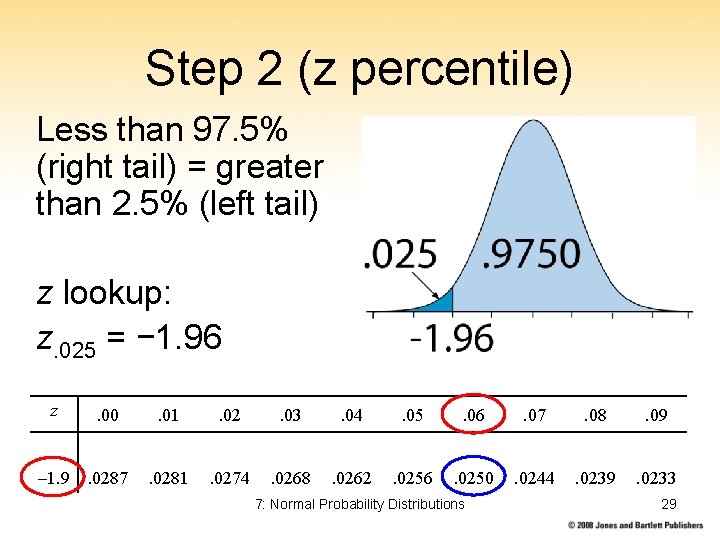
Step 2 (z percentile) Less than 97. 5% (right tail) = greater than 2. 5% (left tail) z lookup: z. 025 = − 1. 96 z . 00 . 01 . 02 . 03 . 04 . 05 . 06 . 07 . 08 . 09 – 1. 9 . 0287 . 0281 . 0274 . 0268 . 0262 . 0256 . 0250 . 0244 . 0239 . 0233 7: Normal Probability Distributions 29
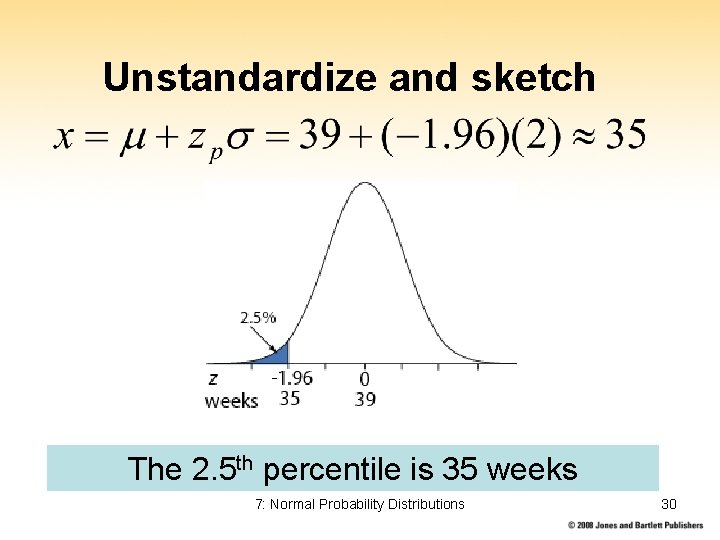
Unstandardize and sketch The 2. 5 th percentile is 35 weeks 7: Normal Probability Distributions 30
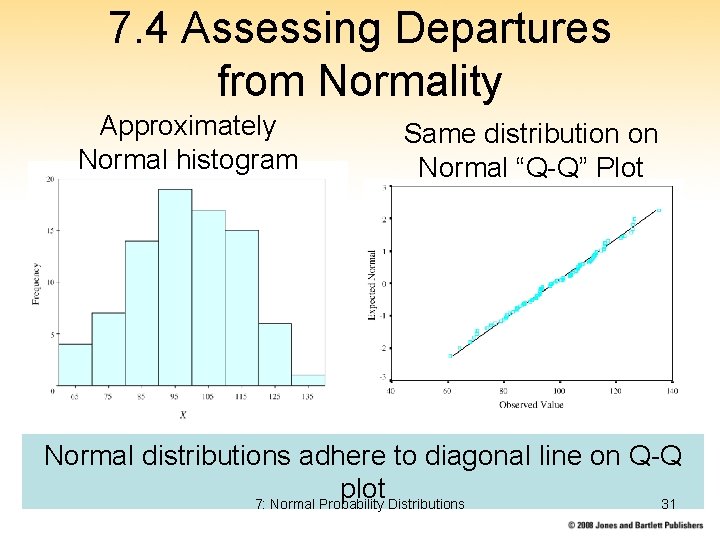
7. 4 Assessing Departures from Normality Approximately Normal histogram Same distribution on Normal “Q-Q” Plot Normal distributions adhere to diagonal line on Q-Q plot 7: Normal Probability Distributions 31
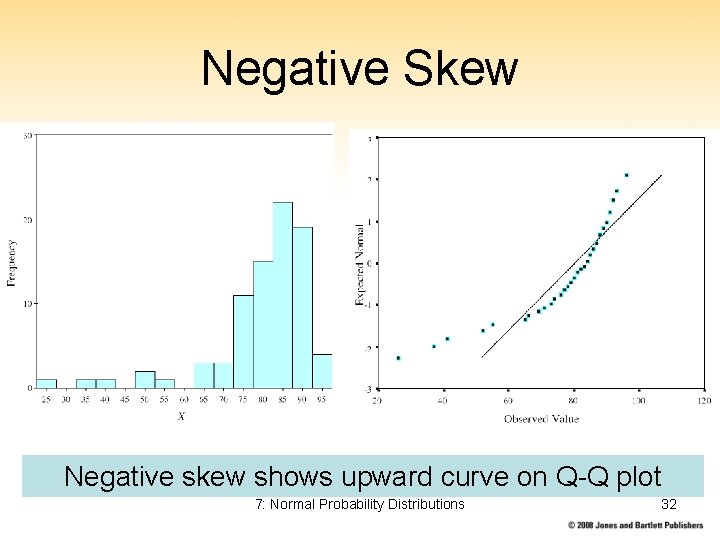
Negative Skew Negative skew shows upward curve on Q-Q plot 7: Normal Probability Distributions 32
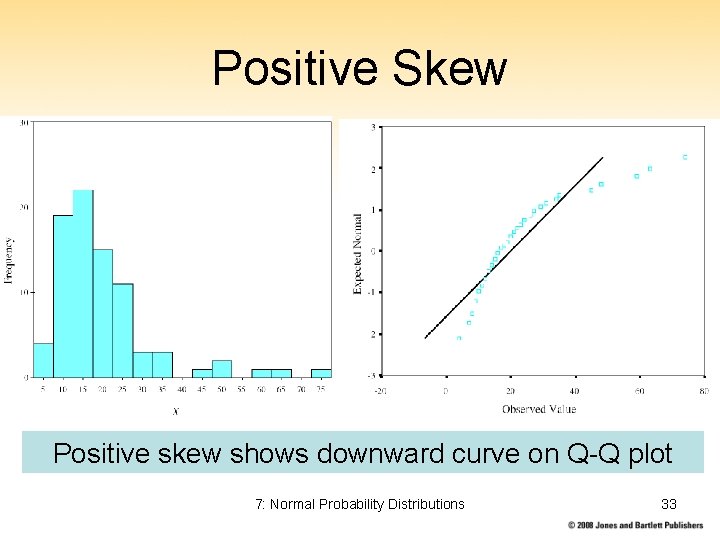
Positive Skew Positive skew shows downward curve on Q-Q plot 7: Normal Probability Distributions 33
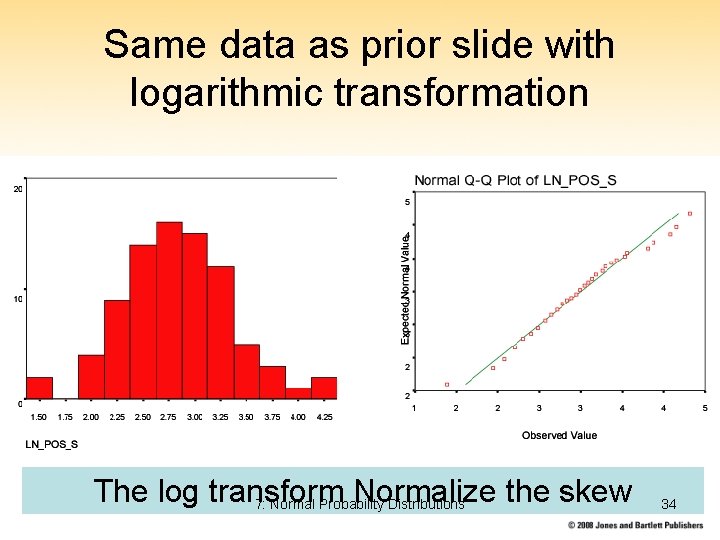
Same data as prior slide with logarithmic transformation The log transform Normalize the skew 7: Normal Probability Distributions 34
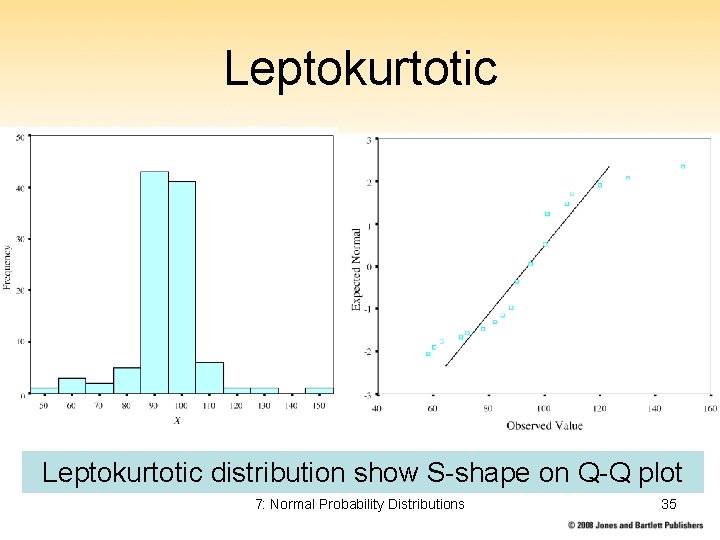
Leptokurtotic distribution show S-shape on Q-Q plot 7: Normal Probability Distributions 35
- Slides: 35