
Chapter 7 Noble Gases Argon Table of Contents
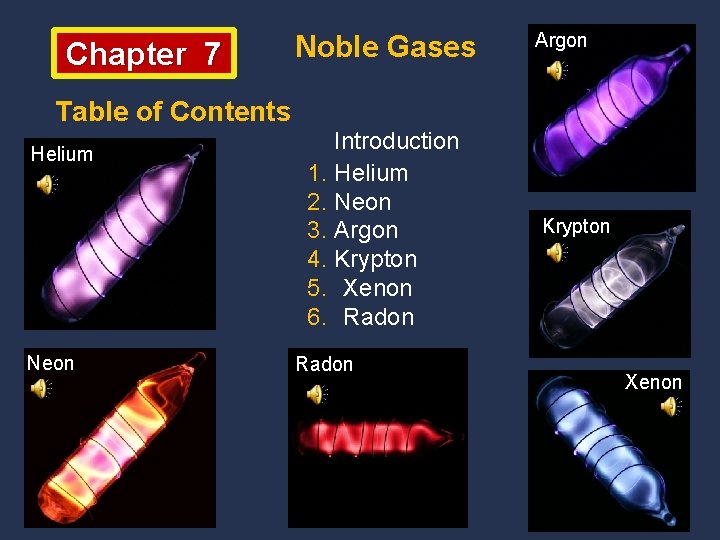
Chapter 7 Noble Gases Argon Table of Contents Helium Neon Introduction 1. Helium 2. Neon 3. Argon 4. Krypton 5. Xenon 6. Radon Krypton Xenon
Chapter 7 Noble Gases Warm Up • What does “Noble” stand for? • Why these elements were discovered barely? • Give examples for the use of these elements.
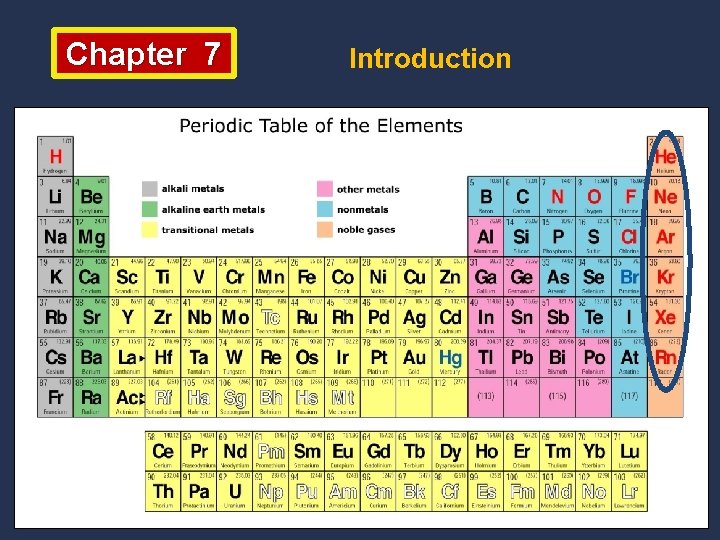
Chapter 7 Introduction
Chapter 7 Introduction • They are all gases at room temperature. • They are colorless, odorless, water insoluble and monatomic. • Argon is the most abundant one in the group. • Except He and Rn, they are produced by the fractional distillation of air. • Radon is obtained in small quantities from the radioactive decay of uranium. • They have no tendency to react chemically, that is why they are called as noble or inert gases. • Each period ends with noble gases in the periodic table.
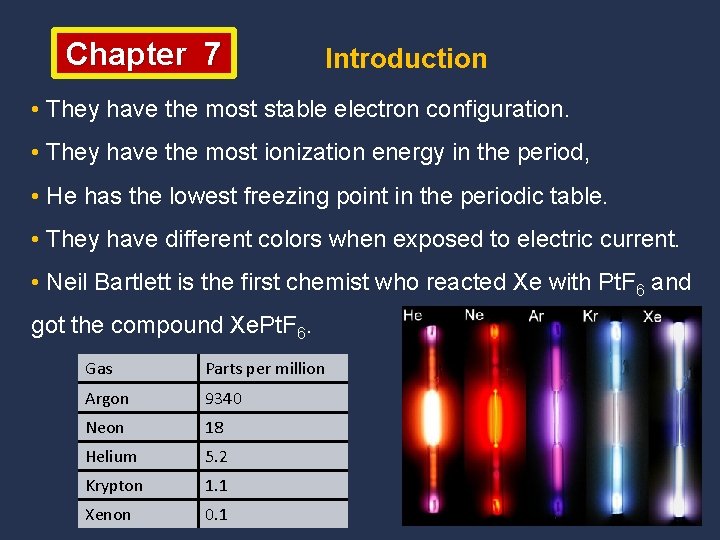
Chapter 7 Introduction • They have the most stable electron configuration. • They have the most ionization energy in the period, • He has the lowest freezing point in the periodic table. • They have different colors when exposed to electric current. • Neil Bartlett is the first chemist who reacted Xe with Pt. F 6 and got the compound Xe. Pt. F 6. Gas Parts per million Argon 9340 Neon 18 Helium 5. 2 Krypton 1. 1 Xenon 0. 1
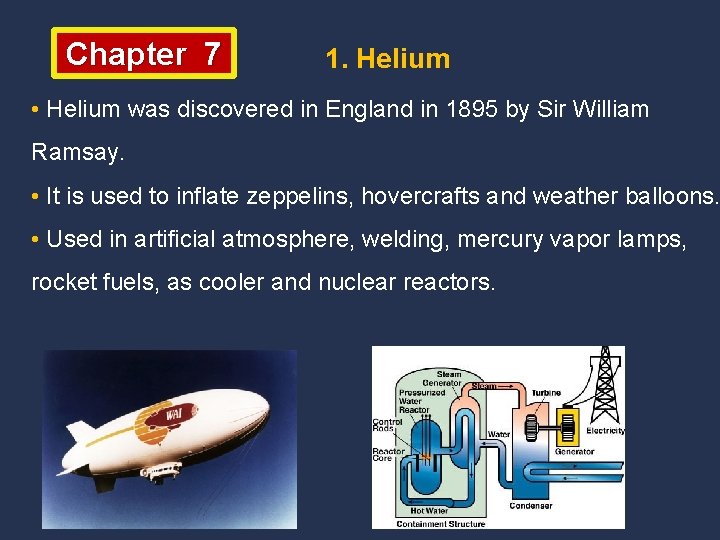
Chapter 7 1. Helium • Helium was discovered in England in 1895 by Sir William Ramsay. • It is used to inflate zeppelins, hovercrafts and weather balloons. • Used in artificial atmosphere, welding, mercury vapor lamps, rocket fuels, as cooler and nuclear reactors.
Chapter 7 1. Helium
Chapter 7 1. Helium
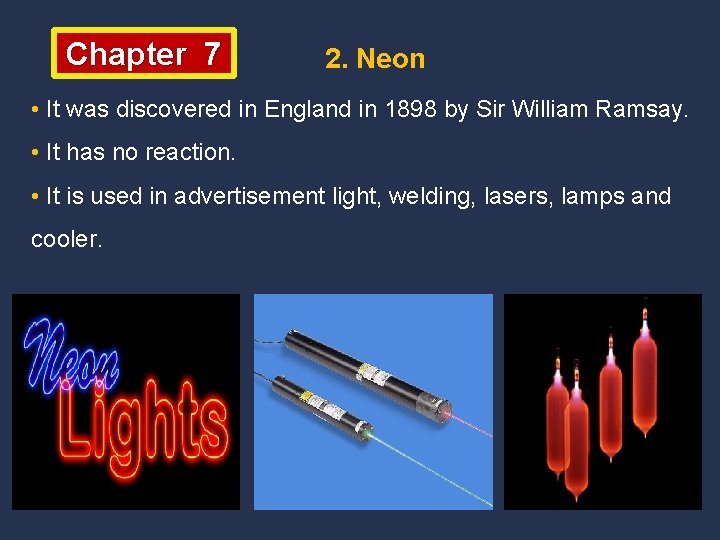
Chapter 7 2. Neon • It was discovered in England in 1898 by Sir William Ramsay. • It has no reaction. • It is used in advertisement light, welding, lasers, lamps and cooler.
Chapter 7 2. Neon
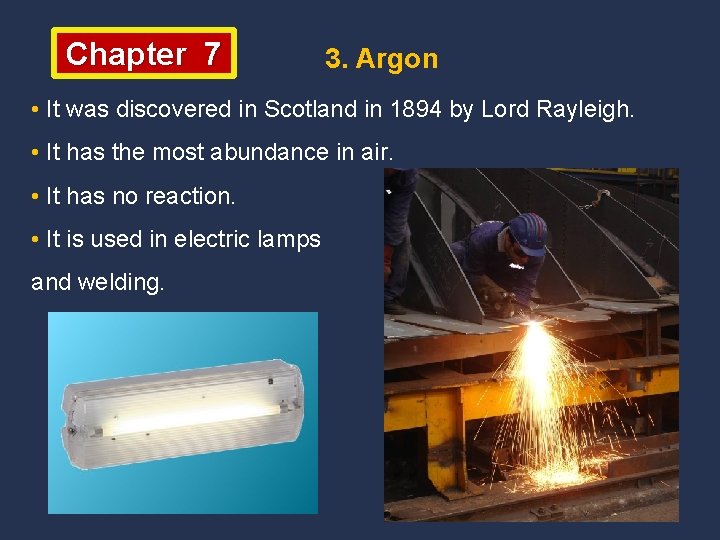
Chapter 7 3. Argon • It was discovered in Scotland in 1894 by Lord Rayleigh. • It has the most abundance in air. • It has no reaction. • It is used in electric lamps and welding.
Chapter 7 3. Argon
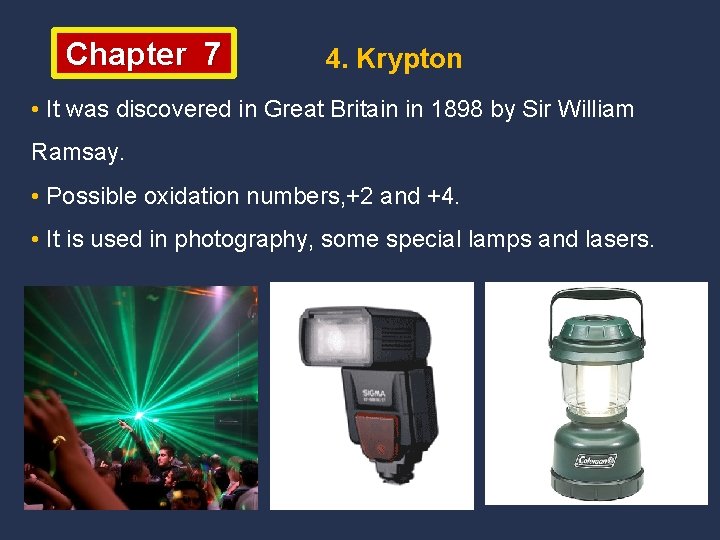
Chapter 7 4. Krypton • It was discovered in Great Britain in 1898 by Sir William Ramsay. • Possible oxidation numbers, +2 and +4. • It is used in photography, some special lamps and lasers.
Chapter 7 4. Krypton

Chapter 7 5. Xenon • It was discovered in England in 1898 by Sir William Ramsay. • Possible oxidation numbers, +2, +4 and +6. • Some compounds are Xe. F 2, Xe. F 4, Xe. F 6. • used in photography, lasers, anesthesia, and imaging body.
Chapter 7 5. Xenon
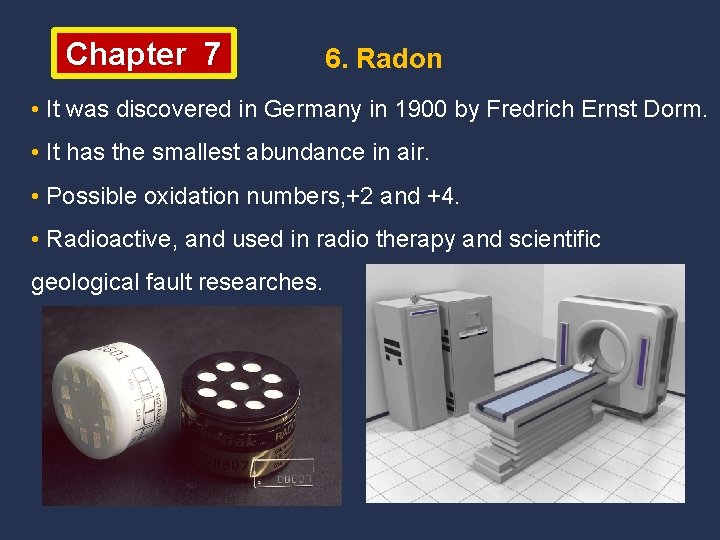
Chapter 7 6. Radon • It was discovered in Germany in 1900 by Fredrich Ernst Dorm. • It has the smallest abundance in air. • Possible oxidation numbers, +2 and +4. • Radioactive, and used in radio therapy and scientific geological fault researches.
Chapter 7 6. Radon

End of the chapter 7
- Slides: 19