
CHAPTER 7 Negative Messages Instructor Only Version 2010
- Slides: 41
CHAPTER 7 Negative Messages Instructor Only Version © 2010 Thomson South-Western
Goals in Communicating Bad News § Acceptance—strive to help receiver understand accept the bad news. § Positive image—promote good image of yourself and your organization. Strive to reduce bad feelings. Convey fairness. § Message clarity—make the message so clear that no further correspondence is necessary. § Protection—avoid creating legal liability. Student Version © 2010 Thomson South-Western
Preventing Legal Problems Avoid abusive language. § Defamation—false published statement that harms an individual's reputation § Libel—written defamation § Slander—spoken defamation Examples: deadbeat, crook, quack Student Version © 2010 Thomson South-Western
Preventing Legal Problems Avoid careless language. Avoid potentially damaging or easily misinterpreted statements. Example: The factory floor is too dangerous for visitors on field trips. Student Version © 2010 Thomson South-Western
Preventing Legal Problems Remember that you represent your organization. § Your business messages must represent the views of the organization. § Be careful about revealing company information, even in a personal blog. Student Version © 2010 Thomson South-Western
Common Reactions to Negative Information § Goods cannot be delivered as promised § Product failure § Credit refusal § Billing error Student Version © 2010 Thomson South-Western § Disappointment § Irritation § Anger
You Can Usually Diminish Negative Feelings if § The reader knows the reasons for the rejection § The bad news is revealed with sensitivity Student Version © 2010 Thomson South-Western § Disappointment § Irritation § Anger
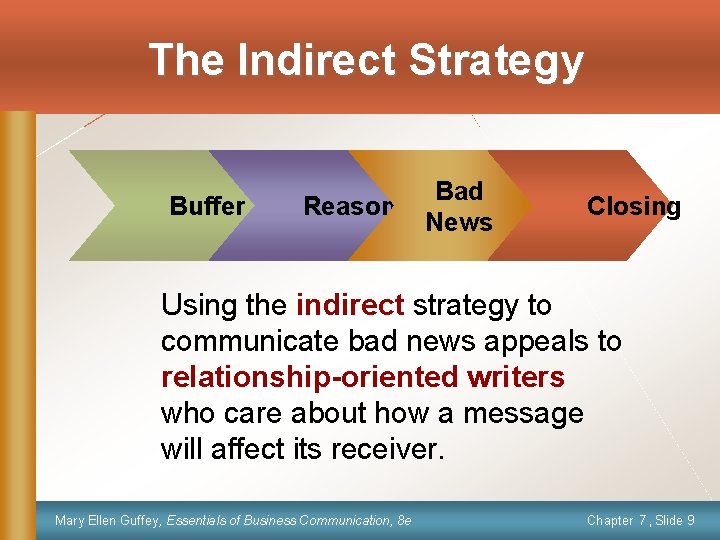
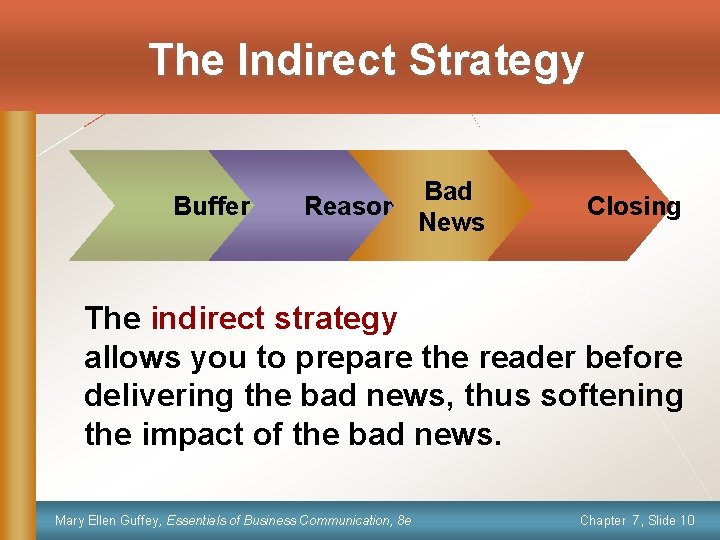
The Indirect Strategy Buffer Bad Reasons News Closing Using the indirect strategy to communicate bad news appeals to relationship-oriented writers who care about how a message will affect its receiver. Mary Ellen Guffey, Essentials of Business Communication, 8 e Chapter 7, Slide 9
The Indirect Strategy Buffer Bad Reasons News Closing The indirect strategy allows you to prepare the reader before delivering the bad news, thus softening the impact of the bad news. Mary Ellen Guffey, Essentials of Business Communication, 8 e Chapter 7, Slide 10
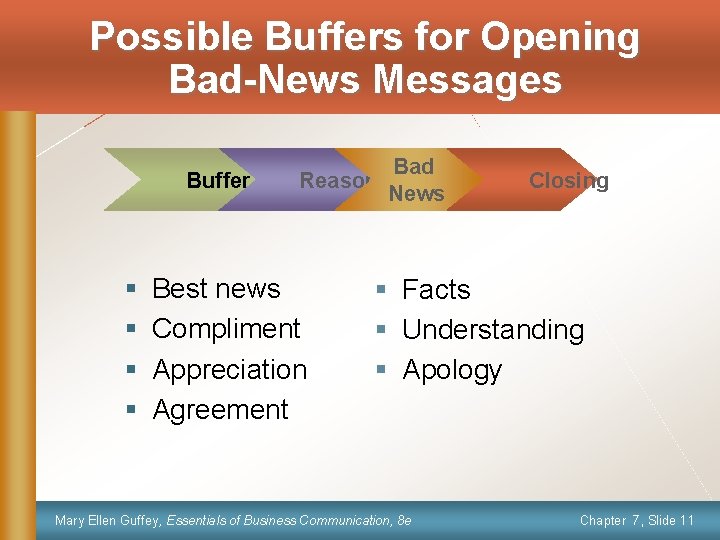
Possible Buffers for Opening Bad-News Messages Buffer § § Bad Reasons News Best news Compliment Appreciation Agreement Closing § Facts § Understanding § Apology Mary Ellen Guffey, Essentials of Business Communication, 8 e Chapter 7, Slide 11
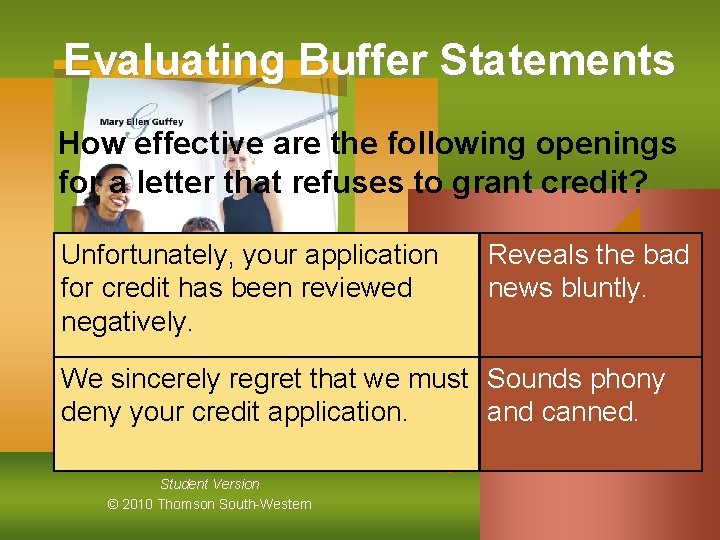
Evaluating Buffer Statements How effective are the following openings for a letter that refuses to grant credit? Unfortunately, your application for credit has been reviewed negatively. Quick Check Reveals the bad news bluntly. We sincerely regret that we must Sounds phony deny your credit application. and canned. Student Version © 2010 Thomson South-Western
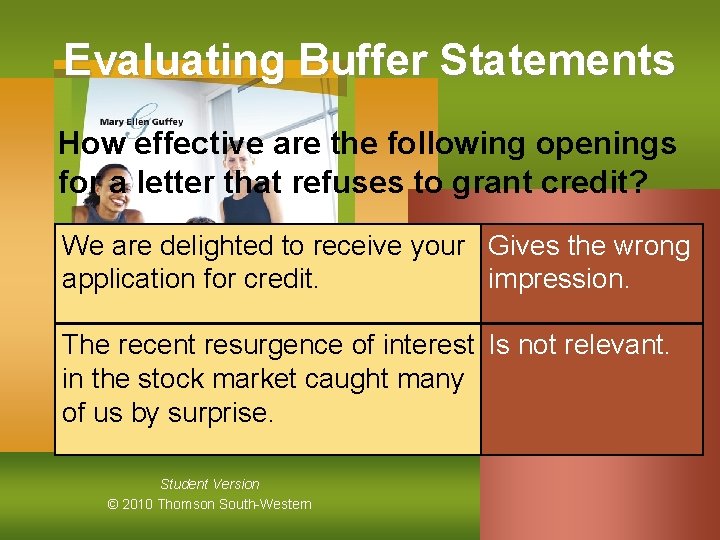
Evaluating Buffer Statements How effective are the following openings for a letter that refuses to grant credit? We are delighted to receive your Gives the wrong application for credit. impression. The recent resurgence of interest Is not relevant. in the stock market caught many of us by surprise. Student Version © 2010 Thomson South-Western
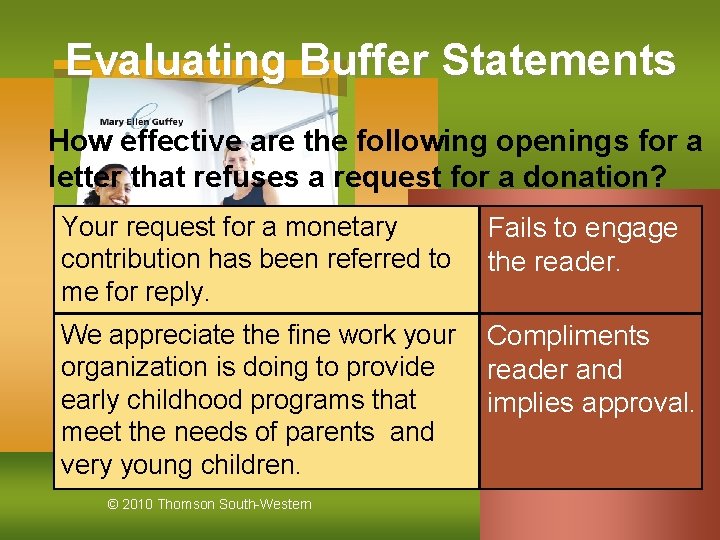
Evaluating Buffer Statements How effective are the following openings for a letter that refuses a request for a donation? Your request for a monetary contribution has been referred to me for reply. Fails to engage the reader. We appreciate the fine work your organization is doing to provide early childhood programs that meet the needs of parents and very young children. Compliments reader and implies approval. Student Version © 2010 Thomson South-Western
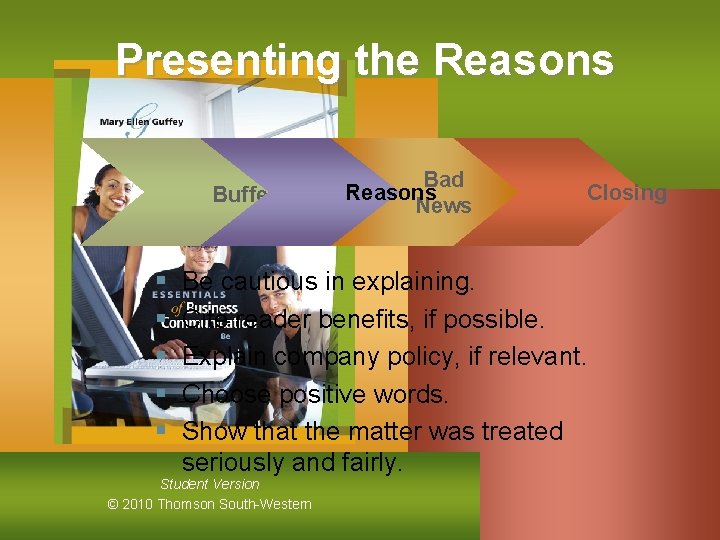
Presenting the Reasons Buffer § § § Bad Reasons News Closing Be cautious in explaining. Cite reader benefits, if possible. Explain company policy, if relevant. Choose positive words. Show that the matter was treated seriously and fairly. Student Version © 2010 Thomson South-Western
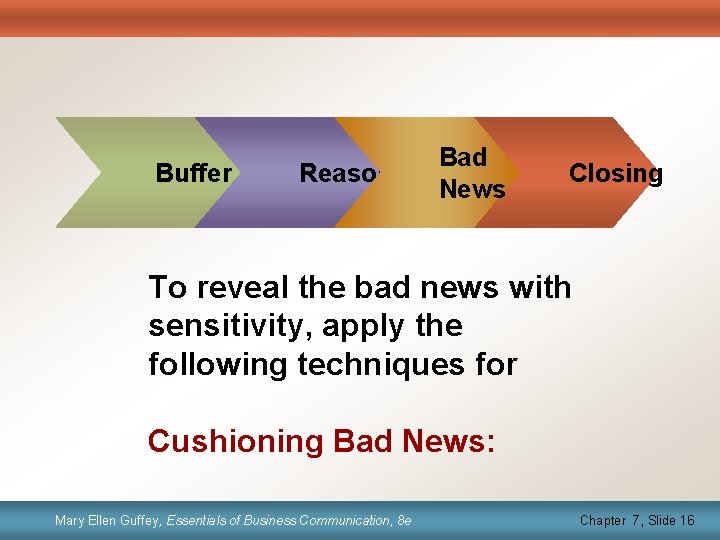
Buffer Reasons Bad News Closing To reveal the bad news with sensitivity, apply the following techniques for Cushioning Bad News: Mary Ellen Guffey, Essentials of Business Communication, 8 e Chapter 7, 1, Slide 16
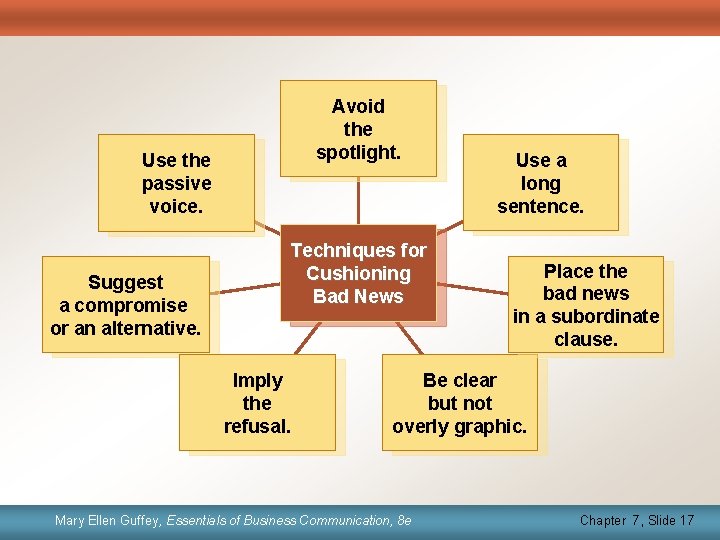
Avoid the spotlight. Use the passive voice. Suggest a compromise or an alternative. Techniques for Cushioning Bad News Imply the refusal. Use a long sentence. Place the bad news in a subordinate clause. Be clear but not overly graphic. Mary Ellen Guffey, Essentials of Business Communication, 8 e Chapter 7, 1, Slide 17
Cushioning the Bad News u Avoid the spotlight. Put the bad news in the middle of a paragraph halfway through the message. v Use a long sentence. Don’t put the bad news in a short, simple sentence. Mary Ellen Guffey, Essentials of Business Communication, 8 e Chapter 7, Slide 18
Cushioning the Bad News w Place the bad news in a subordinate clause. Although we have no opening for an individual with your qualifications at this time, we are pleased that you thought of us when you started your job search. Mary Ellen Guffey, Essentials of Business Communication, 8 e Chapter 7, Slide 19
Cushioning the Bad News x Be clear but not overly graphic. Instead of this Try this Our investigation reveals that you owe three creditors large sums and that you were fired from your last job. Our investigation reveals that your employment status and your financial position are unstable at this time. Student Version © 2010 Thomson South-Western
Cushioning the Bad News y Imply the refusal. Instead of this Try this We cannot contribute to your charity this year. Although all our profits must be reinvested in our company this year, we hope to be able to support your future fund-raising activities. Student Version © 2010 Thomson South-Western
Cushioning the Bad News z Suggest a compromise or an alternative. Although the cashmere sweater cannot be sold at the erroneously listed price of $18, we can allow you to purchase this $218 item for only $118. Student Version © 2010 Thomson South-Western
Cushioning the Bad News { Consider using passive voice verbs. Passive-voice verbs focus attention on actions rather than on personalities. They are useful in being tactful. Instead of this We cannot make a contribution at this time. Mary Ellen Guffey, Essentials of Business Communication, 8 e Try this A contribution cannot be made at this time. Chapter 7, Slide 23
Cushioning the Bad News { Consider using passive voice verbs. Active voice Passive voice I cannot allow you to return the DVD player because. . Return of the DVD player is not allowed because. . Ryan checked the report, but he missed the error. The report was checked, but the error was missed. Student Version © 2010 Thomson South-Western
Cushioning the Bad News Notice that passive-voice verb phrases always include “helper” verbs, such as is, are, was, were, being, or been. Examples of “helper” verbs forming passive voice: § The report was checked. § The schedule is being revised. § Invitations were sent. Student Version © 2010 Thomson South-Western
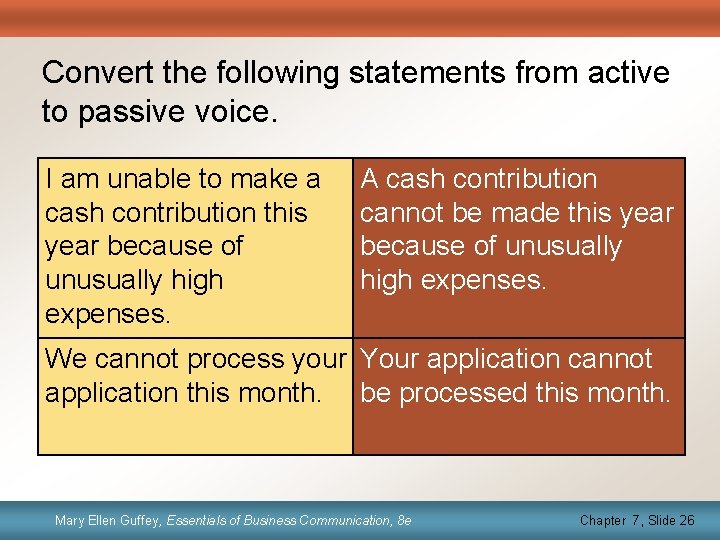
Convert the following statements from active to passive voice. I am unable to make a cash contribution this year because of unusually high expenses. A cash contribution cannot be made this year because of unusually high expenses. Quick Check We cannot process your Your application cannot application this month. be processed this month. Mary Ellen Guffey, Essentials of Business Communication, 8 e Chapter 7, 1, Slide 26
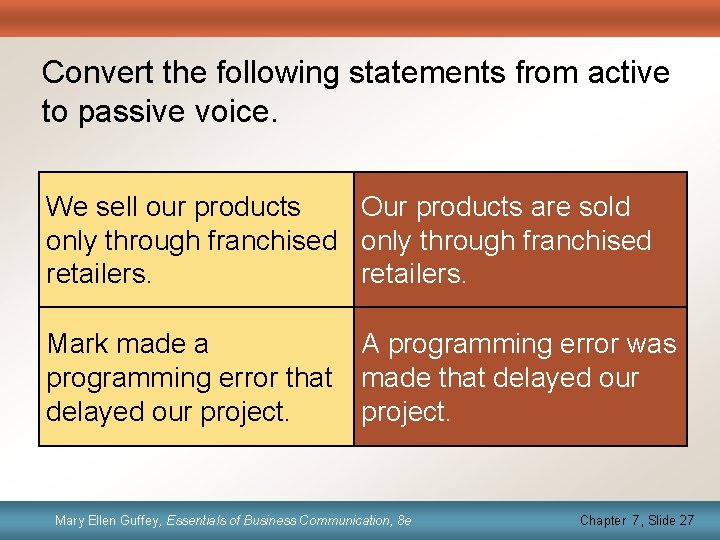
Convert the following statements from active to passive voice. We sell our products Our products are sold only through franchised retailers. Mark made a programming error that delayed our project. A programming error was made that delayed our project. Mary Ellen Guffey, Essentials of Business Communication, 8 e Chapter 7, 1, Slide 27
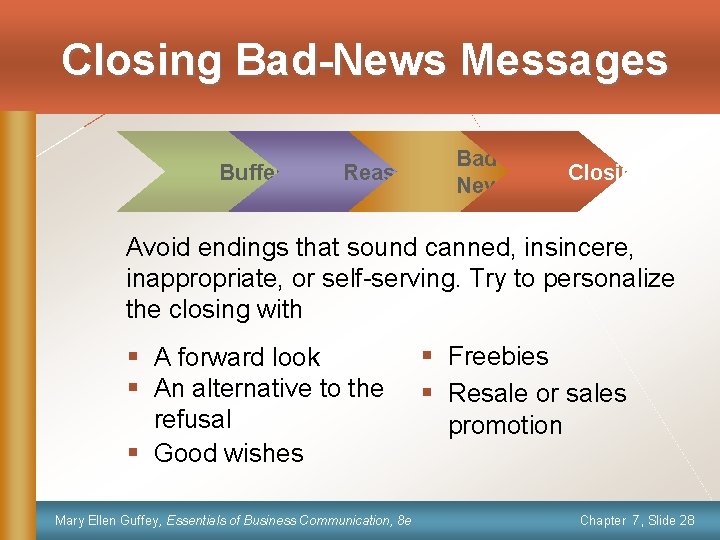
Closing Bad-News Messages Buffer Reasons Bad News Closing Avoid endings that sound canned, insincere, inappropriate, or self-serving. Try to personalize the closing with § A forward look § An alternative to the refusal § Good wishes Mary Ellen Guffey, Essentials of Business Communication, 8 e § Freebies § Resale or sales promotion Chapter 7, Slide 28
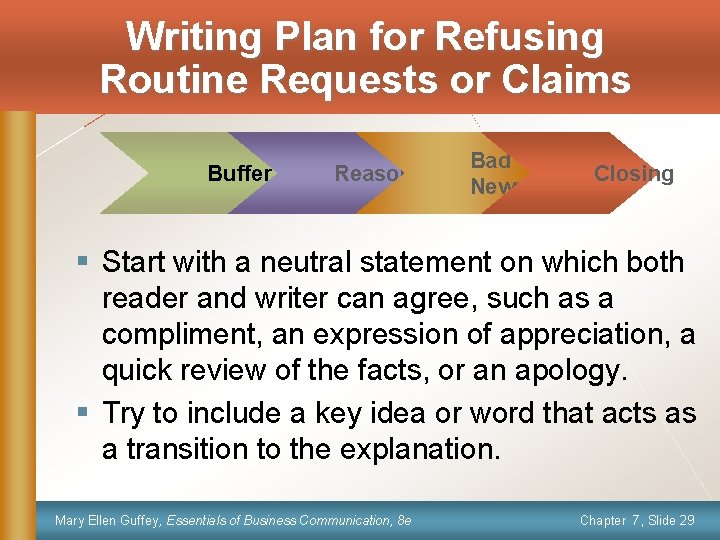
Writing Plan for Refusing Routine Requests or Claims Buffer Reasons Bad News Closing § Start with a neutral statement on which both reader and writer can agree, such as a compliment, an expression of appreciation, a quick review of the facts, or an apology. § Try to include a key idea or word that acts as a transition to the explanation. Mary Ellen Guffey, Essentials of Business Communication, 8 e Chapter 7, Slide 29
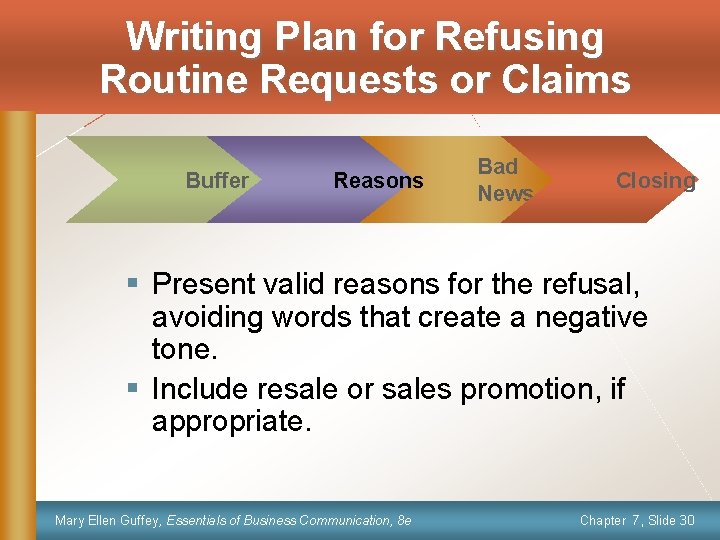
Writing Plan for Refusing Routine Requests or Claims Buffer Reasons Bad News Closing § Present valid reasons for the refusal, avoiding words that create a negative tone. § Include resale or sales promotion, if appropriate. Mary Ellen Guffey, Essentials of Business Communication, 8 e Chapter 7, Slide 30
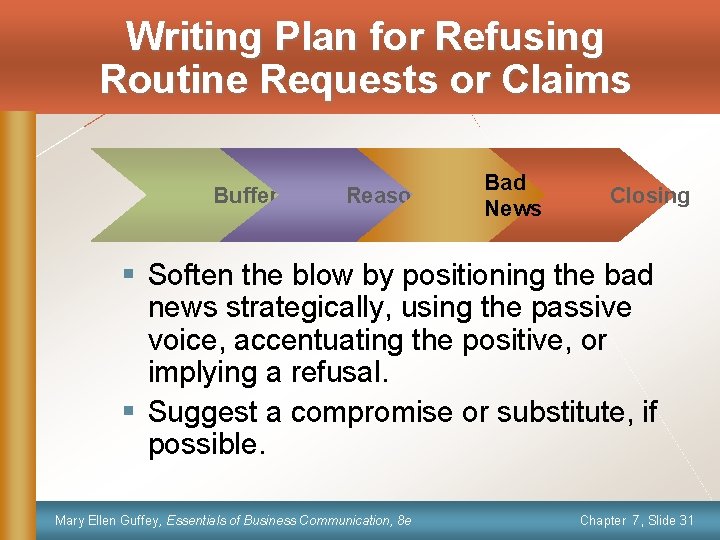
Writing Plan for Refusing Routine Requests or Claims Buffer Reasons Bad News Closing § Soften the blow by positioning the bad news strategically, using the passive voice, accentuating the positive, or implying a refusal. § Suggest a compromise or substitute, if possible. Mary Ellen Guffey, Essentials of Business Communication, 8 e Chapter 7, Slide 31
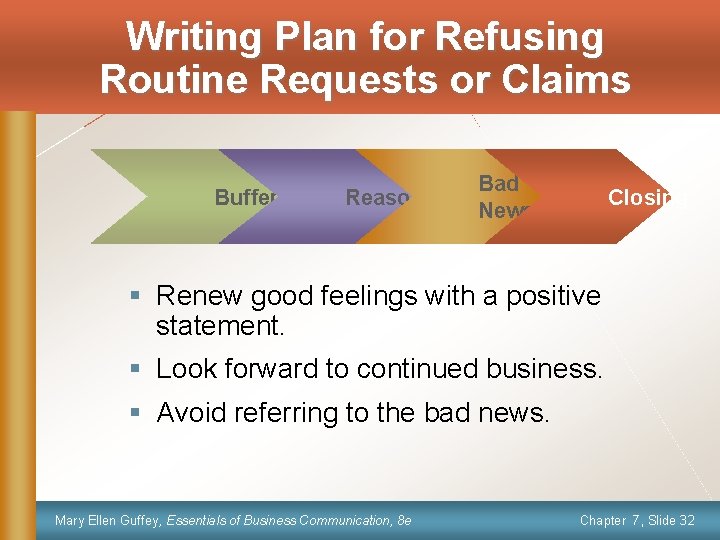
Writing Plan for Refusing Routine Requests or Claims Buffer Reasons Bad News Closing § Renew good feelings with a positive statement. § Look forward to continued business. § Avoid referring to the bad news. Mary Ellen Guffey, Essentials of Business Communication, 8 e Chapter 7, Slide 32
Examine This Effective Refusal of Request for Cash Refund Open letter by clicking icon at right. Mary Ellen Guffey, Essentials of Business Communication, 8 e Chapter 7, Slide 33
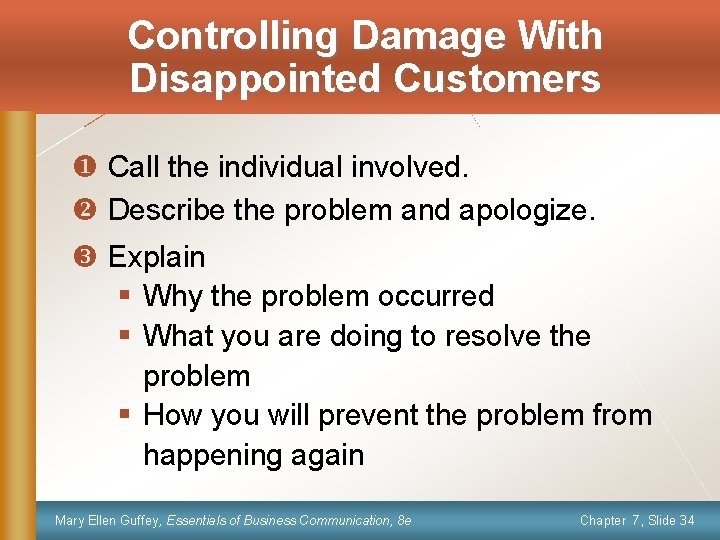
Controlling Damage With Disappointed Customers u Call the individual involved. v Describe the problem and apologize. w Explain § Why the problem occurred § What you are doing to resolve the problem § How you will prevent the problem from happening again Mary Ellen Guffey, Essentials of Business Communication, 8 e Chapter 7, Slide 34
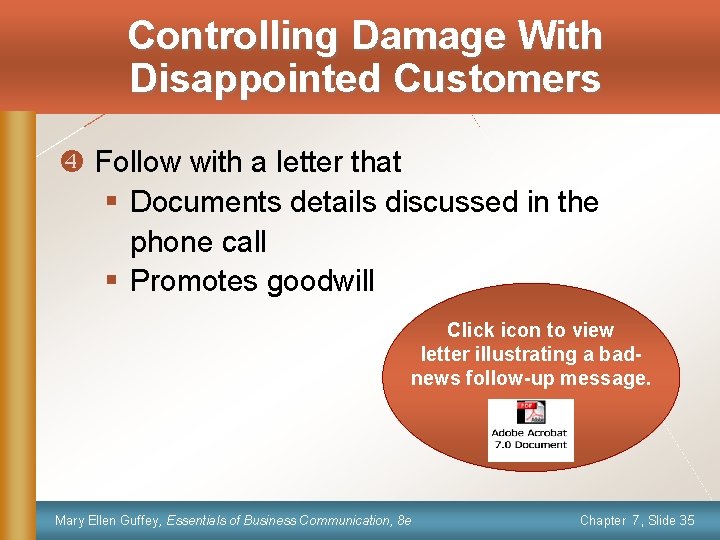
Controlling Damage With Disappointed Customers x Follow with a letter that § Documents details discussed in the phone call § Promotes goodwill Click icon to view letter illustrating a badnews follow-up message. Mary Ellen Guffey, Essentials of Business Communication, 8 e Chapter 7, Slide 35
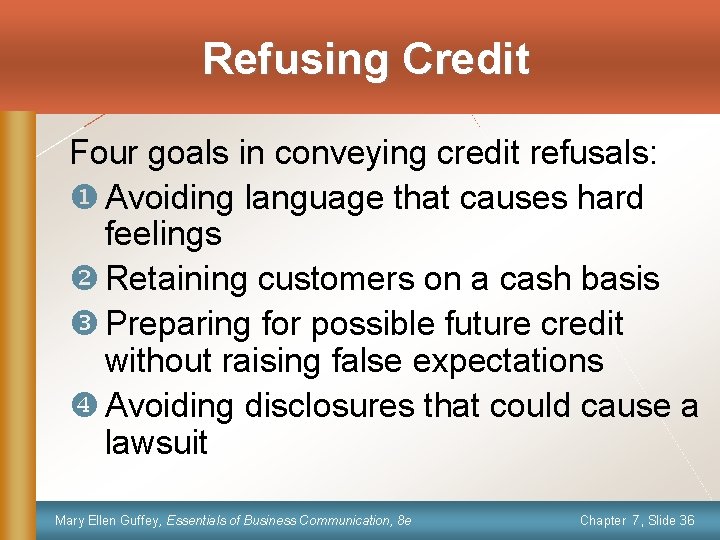
Refusing Credit Four goals in conveying credit refusals: u Avoiding language that causes hard feelings v Retaining customers on a cash basis w Preparing for possible future credit without raising false expectations x Avoiding disclosures that could cause a lawsuit Mary Ellen Guffey, Essentials of Business Communication, 8 e Chapter 7, Slide 36
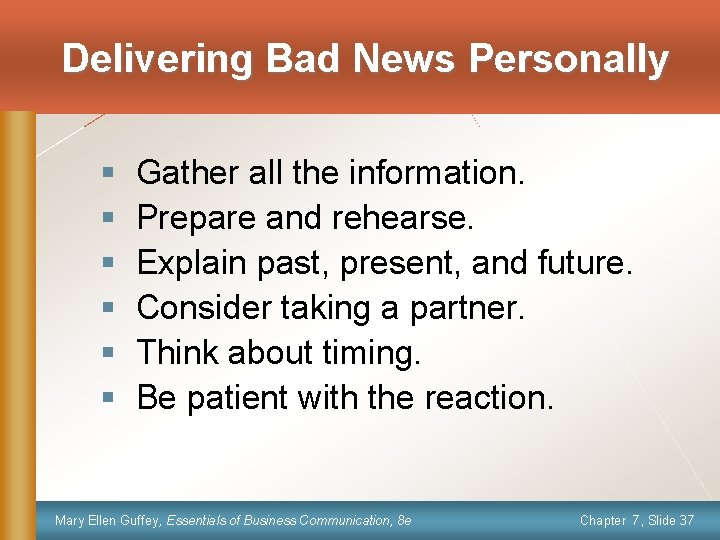
Delivering Bad News Personally § § § Gather all the information. Prepare and rehearse. Explain past, present, and future. Consider taking a partner. Think about timing. Be patient with the reaction. Mary Ellen Guffey, Essentials of Business Communication, 8 e Chapter 7, Slide 37
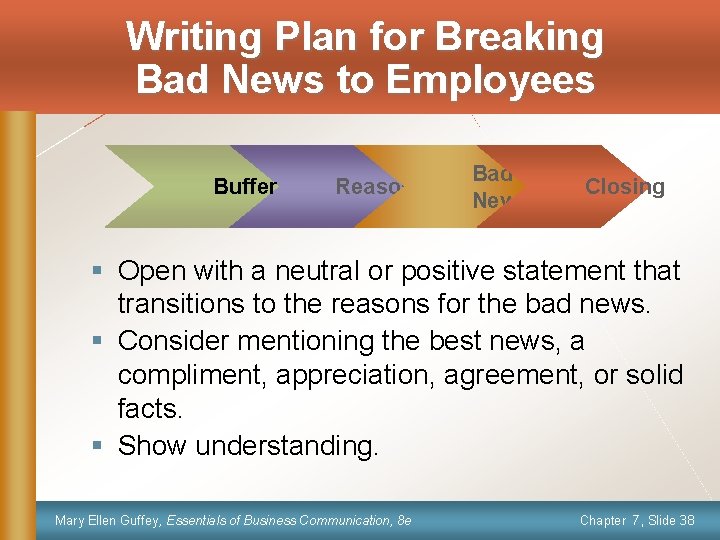
Writing Plan for Breaking Bad News to Employees Buffer Reasons Bad News Closing § Open with a neutral or positive statement that transitions to the reasons for the bad news. § Consider mentioning the best news, a compliment, appreciation, agreement, or solid facts. § Show understanding. Mary Ellen Guffey, Essentials of Business Communication, 8 e Chapter 7, Slide 38
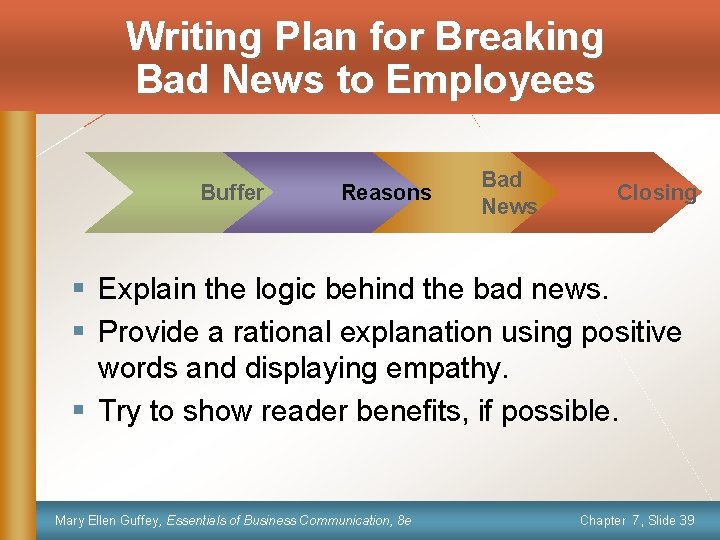
Writing Plan for Breaking Bad News to Employees Buffer Reasons Bad News Closing § Explain the logic behind the bad news. § Provide a rational explanation using positive words and displaying empathy. § Try to show reader benefits, if possible. Mary Ellen Guffey, Essentials of Business Communication, 8 e Chapter 7, Slide 39
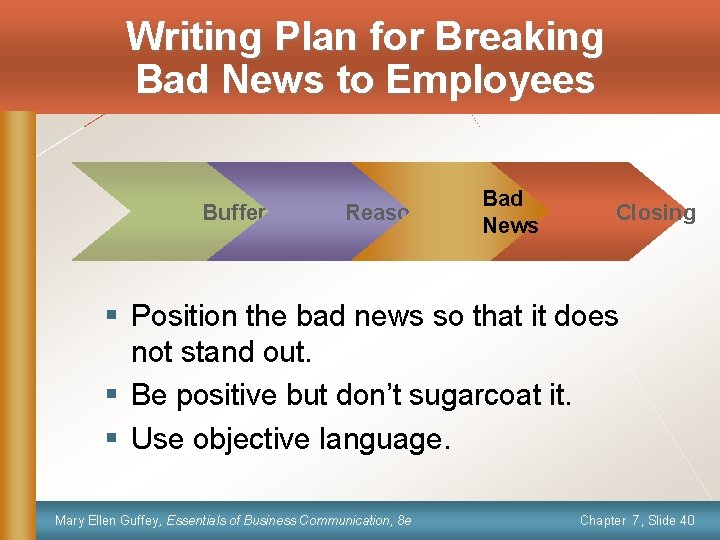
Writing Plan for Breaking Bad News to Employees Buffer Reasons Bad News Closing § Position the bad news so that it does not stand out. § Be positive but don’t sugarcoat it. § Use objective language. Mary Ellen Guffey, Essentials of Business Communication, 8 e Chapter 7, Slide 40
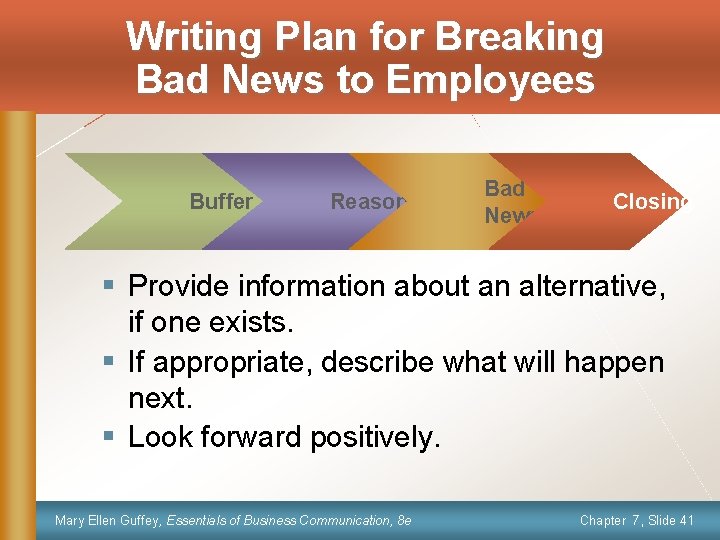
Writing Plan for Breaking Bad News to Employees Buffer Reasons Bad News Closing § Provide information about an alternative, if one exists. § If appropriate, describe what will happen next. § Look forward positively. Mary Ellen Guffey, Essentials of Business Communication, 8 e Chapter 7, Slide 41
END Instructor Only Version © 2010 Thomson South-Western