
CHAPTER 7 Muscles and Joints Muscles Overview Muscles







- Slides: 85
CHAPTER 7 Muscles and Joints
Muscles Overview • Muscles support and maintain body posture through a low level of contraction • Skeletal muscles produce a substantial amount of heat when they contract • More than 600 muscles in the body
Types of Muscles • Skeletal – – – Attaches to the bones of the skeleton Voluntary Striated in appearance Operates under conscious control Many work in pairs; opposing actions (contracting/relaxing)
Types of Muscles • Smooth – – – Also called visceral muscle Involuntary Not striated Not under conscious control In walls of hollow organs and tubes Contraction controlled by hormones and autonomic nervous system
Types of Muscles • Cardiac – – Specialized muscle forming the wall of the heart Involuntary Controlled by the autonomic nervous system Striated in appearance
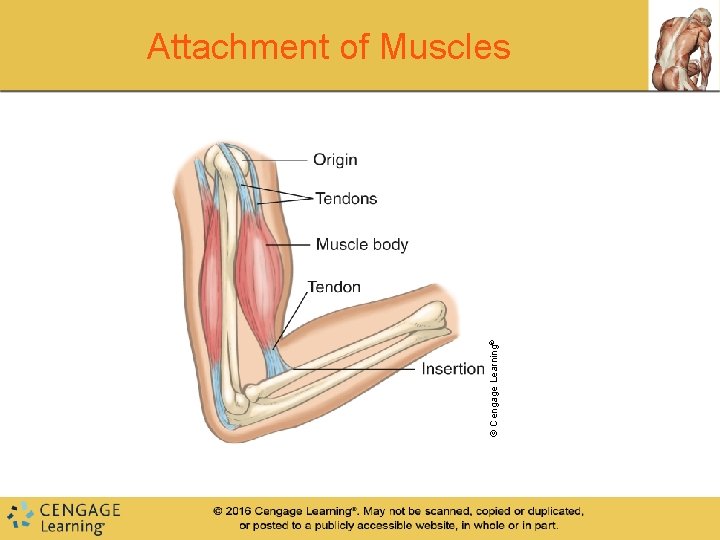
Attachment of Muscles • Tendon – Attaches muscles to bones • Fascia – Sheets of fibrous connective tissue around muscle fibers • Point of origin – Muscle attachment to less movable part of skeleton • Point of insertion – Muscle attachment to movable part of skeleton
© Cengage Learning® Attachment of Muscles
Question True or False: Of the 3 types of muscle, cardiac is the only one that is voluntary.
Answer False. Skeletal is voluntary. Cardiac muscle and smooth muscle are involuntary, resulting in our not having to consciously think about such actions as making our heart beat or moving food through our digestive tract.
Muscles of the Head and Neck • Buccinator – Located in fleshy part of cheek; assists in actions such as whistling and smiling • Temporal – Located above and near the ear – Assists in chewing • Masseter – Located at the angle of the jaw – Raises the mandible and closes the jaw
Muscles of the Head and Neck • Sternomastoid – Also called the sternocleidomastoid – Extends from the sternum upward along the side of the neck to the mastoid process – Assists with actions such as bending your neck and turning your head side to side
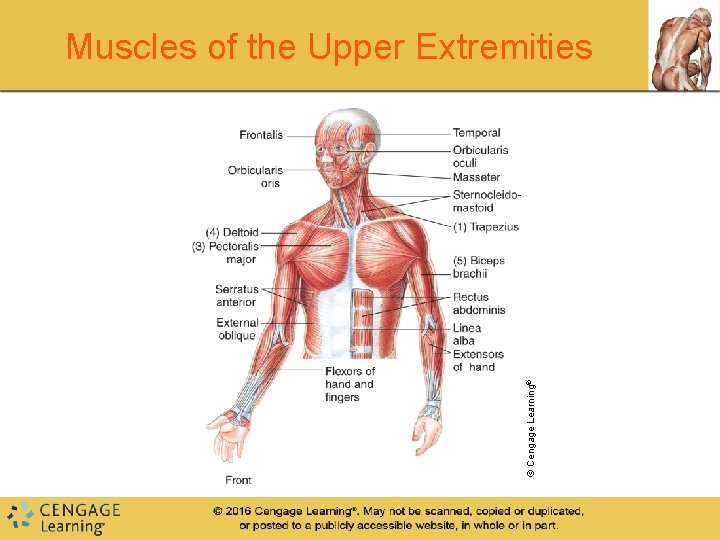
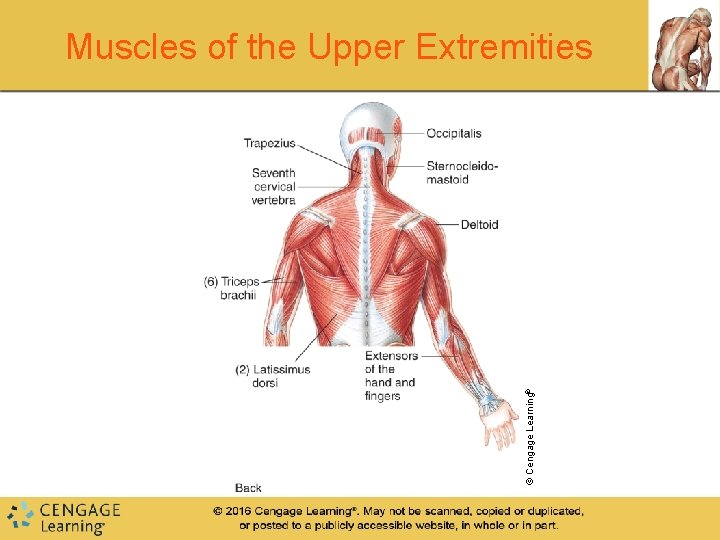
Muscles of the Upper Extremities • Trapezius – – – Triangular-shaped muscle Extends across the back of the shoulder Covers back of neck Inserts on clavicle and scapula Assists with “shrugging” of shoulders
Muscles of the Upper Extremities • Latissimus dorsi – – – Originates from vertebrae of lower back Crosses lower half of thoracic region Passes between humerus and scapula Inserts on anterior surface of humerus Forms the posterior border of the axillae Allows moving of arms, as in a swimming motion
Muscles of the Upper Extremities • Pectoralis major – – – Large, fan-shaped muscle Crosses the upper part of the front chest Originates from the sternum Crosses over to the humerus Allows adduction of the arm
Muscles of the Upper Extremities • Deltoid – – – Covers the shoulder joint Originates from the clavicle and scapula Inserts on the lateral side of the humerus Allows abduction of the arm May be site of IM injections
Muscles of the Upper Extremities • Biceps brachii – – Muscle has two heads Originates from the scapula Inserts on the radius Allows flexing of the lower arm
Muscles of the Upper Extremities • Triceps brachii – Muscle has three heads – Originates from scapula and humerus – Inserts onto olecranon process of the ulna at the elbow – Allows straightening of the elbow, as in boxing
© Cengage Learning® Muscles of the Upper Extremities
© Cengage Learning® Muscles of the Upper Extremities
Question If you have a tension headache and the back of your neck feels like it is in a visegrip, which muscle is most likely responsible? a. b. c. d. trapezius sternocleidomastoid biceps brachii latissimus dorsi
Answer a. The trapezius muscle covers the back of the neck and shoulders, which is where most tension headaches occur.
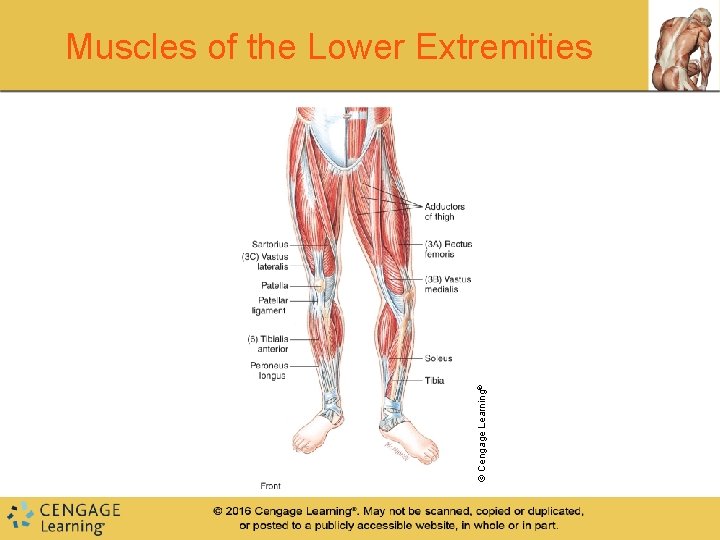
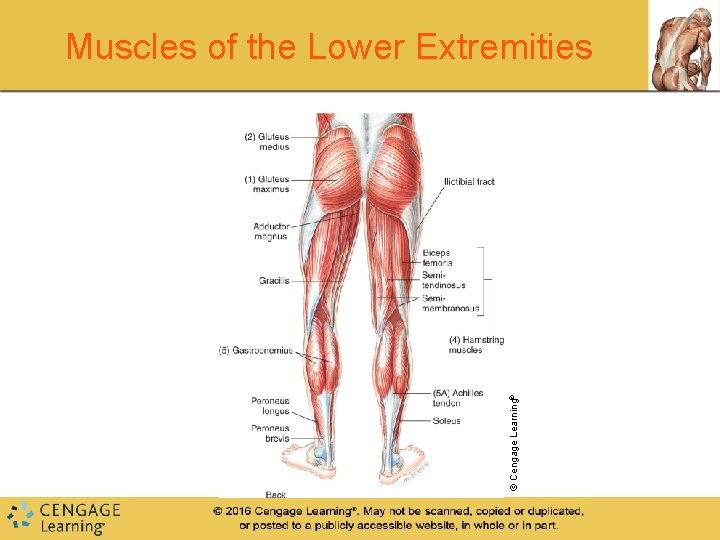
Muscles of the Lower Extremities • Gluteus maximus – Forms most of the fleshy part of the buttock – Originates from the ilium and inserts in the femur – Extends the thigh • Gluteus medius – Located above the upper outer quadrant of the gluteus maximus muscle; site of IM injection – Originates from the posterior part of ilium – Inserts in the greater trochanter of the femur
Muscles of the Lower Extremities • Quadriceps femoris – Forms anterior part of the thigh – Helps in extension of the thigh – Group of four muscles • Hamstring muscles – Located in the posterior part of the thigh; can be felt behind the knee – Assists in the flexion of the leg on the thigh and extension of the thigh – Group of three muscles
Muscles of the Lower Extremities • Gastrocnemius – Main muscle of the calf – Attaches to the heel bone by way of the Achilles tendon – Used to plantar flex foot and flex toes • Tibialis anterior – Positioned on the front of the leg – Used to dorsiflex foot and turn foot inward
© Cengage Learning® Muscles of the Lower Extremities
© Cengage Learning® Muscles of the Lower Extremities
Question A runner suddenly grabs the back of his or her leg in pain. Which muscle group was injured? a. b. c. d. quadriceps femoris gastrocnemius hamstring tibialis anterior
Answer c. The hamstring group. (Located on the posterior surface; can be felt behind the knee. )
PATHOLOGICAL CONDITIONS Muscles
Muscular Dystrophy • Pronounced – (MUSS-kew-lar DIS-troh-fee) • Defined – Group of genetically transmitted disorders – Characterized by progressive weakness and muscle fiber degeneration – No evidence of nerve involvement or degeneration of nerve tissue
Polymyositis • Pronounced – (pol-ee-my-oh-SIGH-tis) • Defined – Chronic, progressive disease affecting the skeletal muscles – Characterized by muscle weakness and atrophy
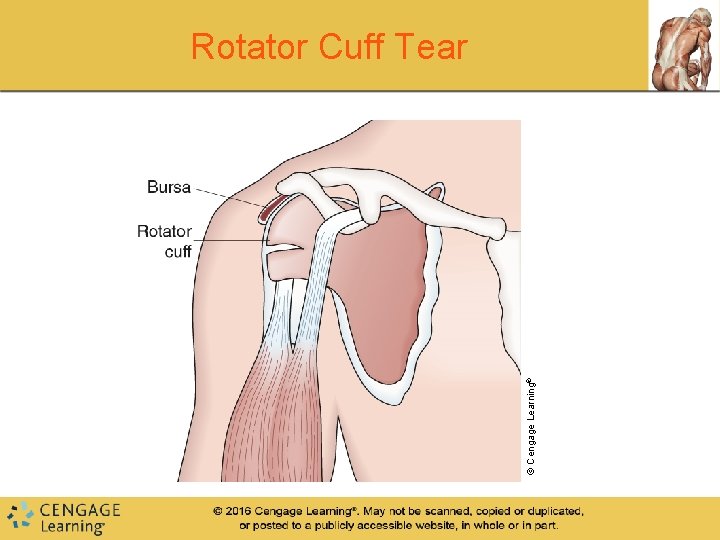
Rotator Cuff Tear • Pronounced – (ROH-tay-tor kuff TAIR) • Defined – Tear in muscles that form a “cuff” over the upper end of the arm • Rotator cuff helps lift and rotate arm • Also helps hold head of humerus in place during abduction of arm
© Cengage Learning® Rotator Cuff Tear
Question True or False: The term muscular dystrophy means “development of bad muscle, ” while polymyositis means “inflammation of many muscles. ”
Answer True. Both diseases affect skeletal muscle, but their effects are different.
DIAGNOSTIC TECHNIQUES, TREATMENTS, AND PROCEDURES Muscles
Diagnostic Techniques, Treatments, and Procedures • Electromyography – Process of recording the strength of contraction of a muscle when stimulated by electric current • Muscle biopsy – Extraction of a specimen of muscle tissue, through a biopsy needle or incisional biopsy, for purpose of examining it under a microscope
ANATOMY & PHYSIOLOGY Joints
Joints Overview • Joint = articulation – Point at which two individual bones connect – Joints determine degree of movement • Suture = immovable joint – Purpose is to bind bones together
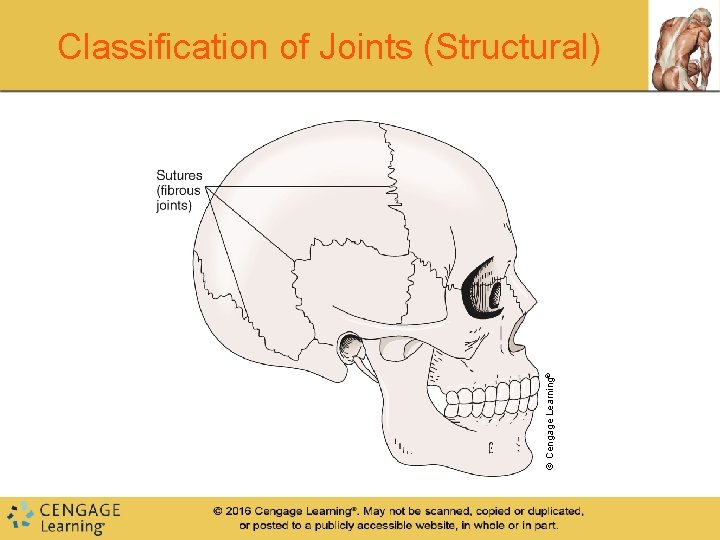
Classification of Joints (Structural) • Fibrous – Surfaces of bone fit closely together – Held together by fibrous connective tissue – Immovable joint • Example: suture between the skull bones
© Cengage Learning® Classification of Joints (Structural)
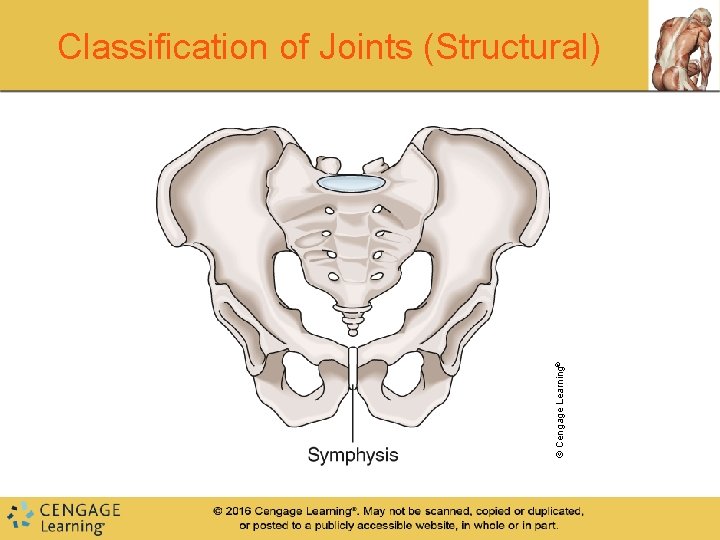
Classification of Joints (Structural) • Cartilaginous – Bones are connected by cartilage – Limited movement joint • Example: Symphysis – Joint between pubic bones of pelvis
© Cengage Learning® Classification of Joints (Structural)
Classification of Joints (Structural) • Synovial – – – Space between the bones = joint cavity Joint cavity lined with synovial membrane Synovial membrane secretes synovial fluid Bones are held together by ligaments Free movement joint • Example = shoulder
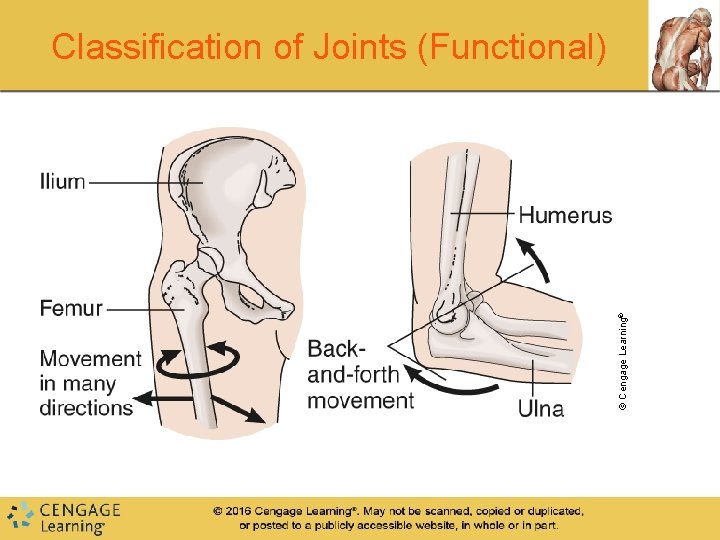
Classification of Joints (Functional) • Hinge – Allows a back-and-forth type motion • Example: elbow • Ball-and-socket – Allows movement in many directions around a central point • Example: shoulder joint and hip joint
© Cengage Learning® Classification of Joints (Functional)
Question What enables our movable joints to move freely and without pain? a. b. c. d. cartilage fibrous tissue connective tissue synovial membrane
Answer d. This membrane secretes synovial fluid for lubrication in the joint cavity.
Movements of Joints • Flexion – Bending motion – Decreases angle between two bones • Extension – Straightening motion – Increases angle between two bones
Movements of Joints • Abduction – Movement of a bone away from the midline of the body • Adduction – Movement of a bone toward the midline of the body
Movements of Joints • Supination – Act of turning the palm up or forward • Pronation – Act of turning the palm down or backward
Movements of Joints • Dorsiflexion – Narrows the angle between the leg and the top of the foot – Foot is bent backward, or upward, at the ankle • Plantar flexion – Increases the angle between the leg and the top of the foot – Foot is bent downward at the ankle – Toes pointing downward, as in ballet dancing
Movements of Joints • Rotation – Turning of a bone on its own axis • Circumduction – Movement of an extremity around in a circular motion – Can be performed with ball-and-socket joints
Question True or False: When I turn my head, I am rotating vertebrae in my neck.
Answer True. C 2, also called the axis, is an important vertebra for head movement.
PATHOLOGICAL CONDITIONS Joints
Adhesive Capsulitis • Pronounced – (add-HE-sive cap-sool-EYE-tis) • Defined – Shoulder condition characterized by a stiffness of the shoulder, limited shoulder movement, and pain – Also known as “frozen shoulder” – May be idiopathic, or due to trauma or systemic diseases – Three stages (painful, adhesive, recovery)
Arthritis • Pronounced – (ar-THRY-tis) • Defined – Inflammation of joints
Ankylosing Spondylitis • Pronounced – (ang-kih-LOH-sing spon-dih-LEYE-tis) • Defined – Type of arthritis that affects the vertebral column – Causes deformities of the spine
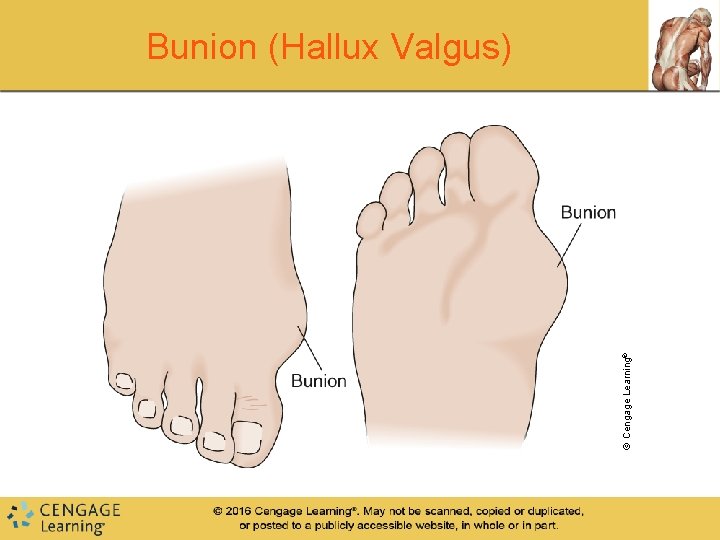
Bunion (Hallux Valgus) • Pronounced – (BUN-yun) (HAL-uks VAL-gus) • Defined – Abnormal enlargement of the joint at the base of the great toe
© Cengage Learning® Bunion (Hallux Valgus)
Question The treatment for bunions is surgical removal of the bony overgrowth. What is the correct term for this procedure? a. b. c. d. buniectomy bonyectomy bunionectomy
Answer c. It is simply the condition added to the suffix. No combining vowel is needed since ‑ectomy begins with a vowel.
Dislocation • Pronounced – (diss-loh-KAY-shun) • Defined – Displacement of a bone from its normal location within a joint – Causes loss of function of the joint – Areas most commonly affected: shoulder, fingers, hip, and knee
Ganglion • Pronounced – (GANG-lee-on) • Defined – Cystic tumor developing on a tendon – Sometimes occurs on back of wrist
Gout • Pronounced – (GOWT) • Defined – Acute arthritis noted when the body does not properly metabolize uric acid – Hereditary – Most often affects great toe (podagra)
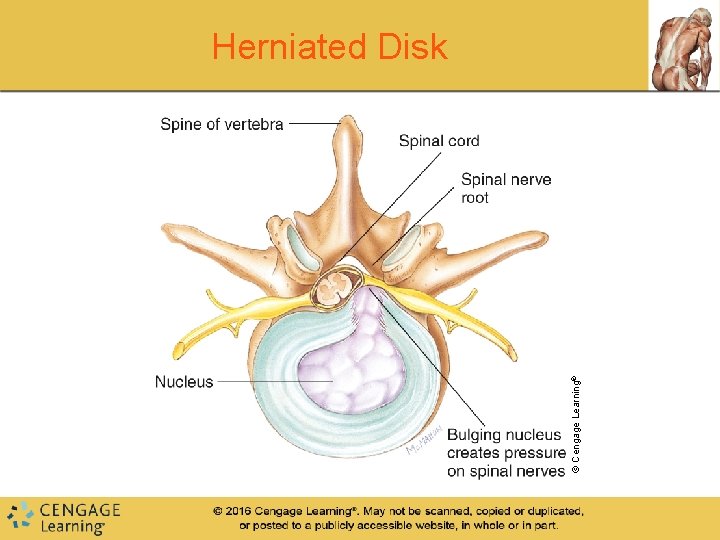
Herniated Disk • Pronounced – (HER-nee-ay-ted DISK) • Defined – Rupture of the central portion of the vertebral disk through the disk wall and into the spinal canal – Also called a ruptured disk or a slipped disk – Causes: injury, abrupt movement, or degeneration of vertebrae
© Cengage Learning® Herniated Disk
Lyme Disease • Pronounced – (LYME dih-ZEEZ) • Defined – Acute, recurrent inflammatory infection, transmitted through the bite of an infected deer tick – Characterized by red, itchy rash with circular center, and accompanying flu like symptoms
Question True or False: A herniated disk is referring to one of the cushions between the vertebral bodies. If inter- means “between, ” the term to describe it must be interdiskal.
Answer False. The correct term is intervertebral, between the vertebrae.
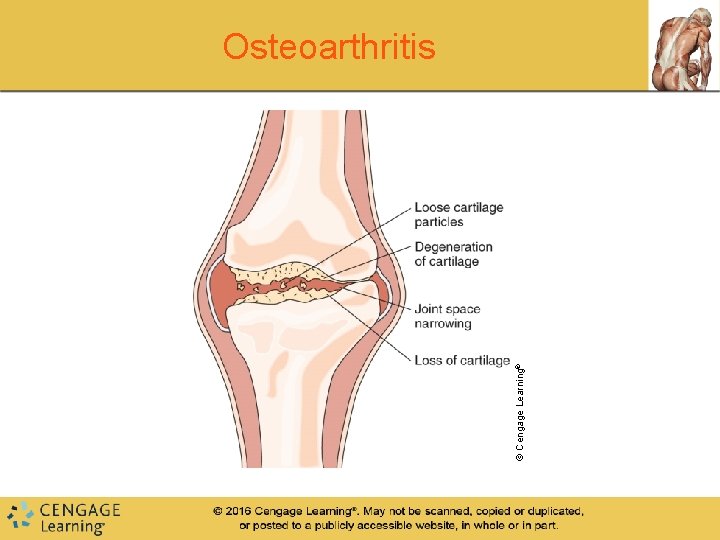
Osteoarthritis • Pronounced – (oss-tee-oh-ar-THRYE-tis) • Defined – Most common form of arthritis – Results from wear and tear on the joints, especially weight-bearing joints such as hips and knees – Also known as degenerative joint disease
© Cengage Learning® Osteoarthritis
Rheumatoid Arthritis • Pronounced – (ROO-mah-toyd ar-THRYE-tis) • Defined – Chronic, systemic, inflammatory disease that affects multiple joints of the body – Mainly the small peripheral joints
Sprain • Pronounced – (SPRAYN) • Defined – Injury involving ligaments that surround and support a joint – Caused by a wrenching or twisting motion
Systemic Lupus Erythematosus • Pronounced – (sis-TEM-ik LOO-pus er-ih-them-ah-TOH-sus) • Defined – Chronic, inflammatory connective tissue disease affecting the skin, joints, nervous system, kidneys, lungs, and other organs – Characteristic “butterfly rash” appears on the face
Question True or False: The most common form of arthritis is osteoarthritis.
Answer True. This is simply a result of wear-andtear over the years. (Also known as degenerative joint disease. )
DIAGNOSTIC TECHNIQUES, TREATMENTS, AND PROCEDURES Joints
Diagnostic Techniques, Treatments, and Procedures • Arthrocentesis – Surgical puncture of a joint with a needle for the purpose of withdrawing fluid for analysis • Arthrography – Process of X-raying the inside of a joint, after injecting the joint with a contrast medium
Diagnostic Techniques, Treatments, and Procedures • Arthroplasty – Surgical repair of a joint • Arthroscopy – Visualization of the interior of a joint using an endoscope
Diagnostic Techniques, Treatments, and Procedures • Erythrocyte sedimentation (sed) rate – Blood test that measures the rate at which erythrocytes settle to the bottom of a test tube filled with unclotted blood – Increased rates are associated with inflammatory conditions – Helpful in determining degree of inflammation in rheumatoid arthritis
Diagnostic Techniques, Treatments, and Procedures • Rheumatoid factor – Blood test that measures the presence of unusual antibodies that develop in a number of connective tissue diseases, such as rheumatoid arthritis
Question An MRI of the knee shows a possible meniscus tear. The doctor opts to look into the joint with a scope. This procedure is known as an _____. a. b. c. d. arthrotomy arthrostomy arthroplasty arthroscopy
Answer d. Arthroscopy is the visualization of the interior of a joint with a specialized endoscope.