
Chapter 7 Multimedia Networking A note on the
- Slides: 49
Chapter 7 Multimedia Networking A note on the use of these ppt slides: We’re making these slides freely available to all (faculty, students, readers). They’re in Power. Point form so you see the animations; and can add, modify, and delete slides (including this one) and slide content to suit your needs. They obviously represent a lot of work on our part. In return for use, we only ask the following: v If you use these slides (e. g. , in a class) that you mention their source (after all, we’d like people to use our book!) v If you post any slides on a www site, that you note that they are adapted from (or perhaps identical to) our slides, and note our copyright of this material. Thanks and enjoy! JFK/KWR Computer Networking: A Top Down Approach 6 th edition Jim Kurose, Keith Ross Addison-Wesley March 2012 All material copyright 1996 -2012 J. F Kurose and K. W. Ross, All Rights Reserved Multmedia Networking 7 -1
Multimedia networking: outline 7. 1 multimedia networking applications 7. 2 streaming stored video 7. 3 voice-over-IP 7. 4 protocols for real-time conversational applications 7. 5 network support for multimedia Multmedia Networking 7 -2
Multimedia networking: outline 7. 1 multimedia networking applications 7. 2 streaming stored video 7. 3 voice-over-IP 7. 4 protocols for real-time conversational applications 7. 5 network support for multimedia Multmedia Networking 7 -3
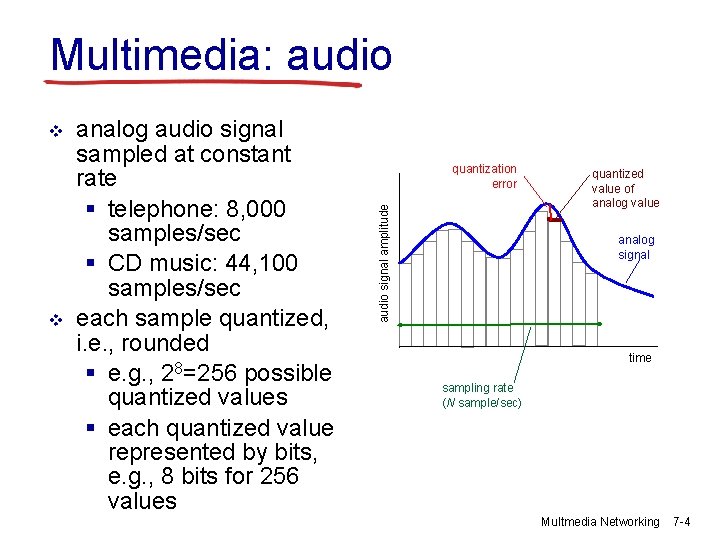
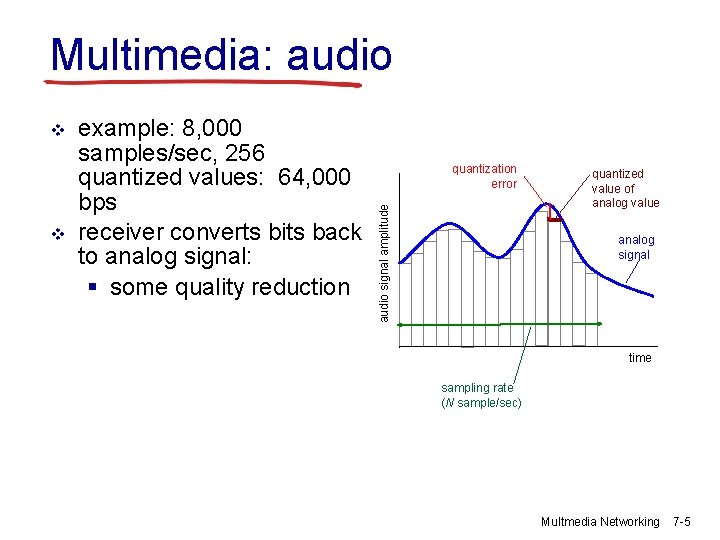
Multimedia: audio v analog audio signal sampled at constant rate § telephone: 8, 000 samples/sec § CD music: 44, 100 samples/sec each sample quantized, i. e. , rounded § e. g. , 28=256 possible quantized values § each quantized value represented by bits, e. g. , 8 bits for 256 values quantization error audio signal amplitude v quantized value of analog value analog signal time sampling rate (N sample/sec) Multmedia Networking 7 -4
Multimedia: audio v example: 8, 000 samples/sec, 256 quantized values: 64, 000 bps receiver converts bits back to analog signal: § some quality reduction quantization error audio signal amplitude v quantized value of analog value analog signal time sampling rate (N sample/sec) Multmedia Networking 7 -5
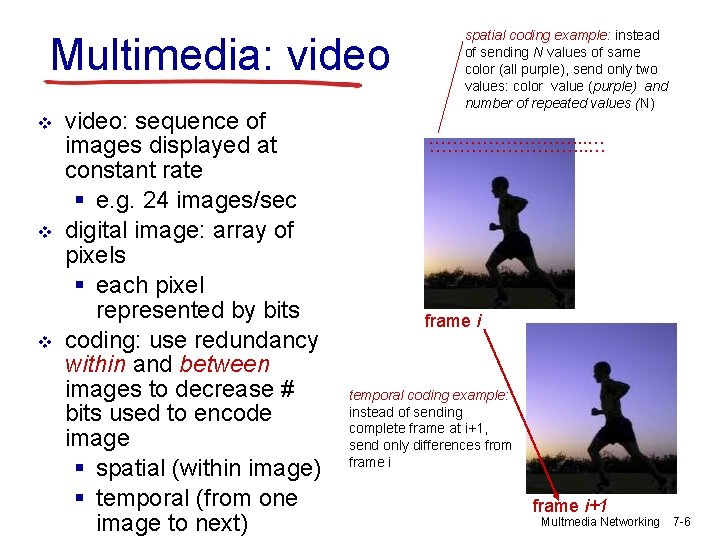
Multimedia: video v video: sequence of images displayed at constant rate § e. g. 24 images/sec digital image: array of pixels § each pixel represented by bits coding: use redundancy within and between images to decrease # bits used to encode image § spatial (within image) § temporal (from one image to next) spatial coding example: instead of sending N values of same color (all purple), send only two values: color value (purple) and number of repeated values (N) ……………………. . . … frame i temporal coding example: instead of sending complete frame at i+1, send only differences from frame i+1 Multmedia Networking 7 -6
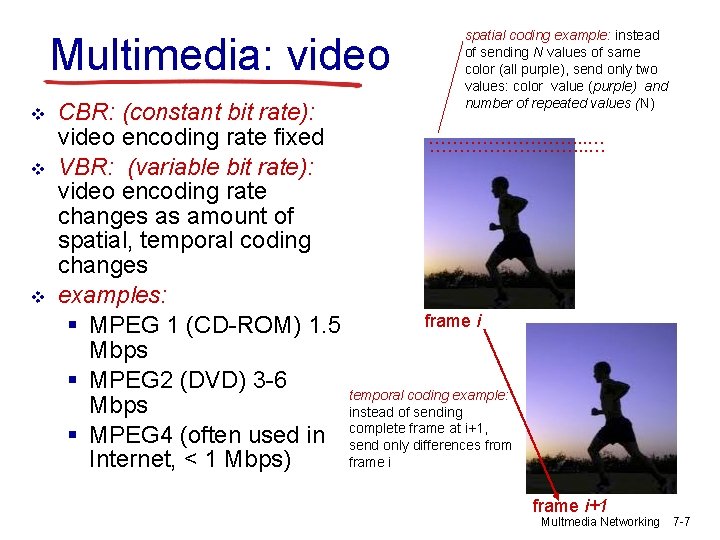
Multimedia: video v v v CBR: (constant bit rate): video encoding rate fixed VBR: (variable bit rate): video encoding rate changes as amount of spatial, temporal coding changes examples: § MPEG 1 (CD-ROM) 1. 5 Mbps § MPEG 2 (DVD) 3 -6 Mbps § MPEG 4 (often used in Internet, < 1 Mbps) spatial coding example: instead of sending N values of same color (all purple), send only two values: color value (purple) and number of repeated values (N) ……………………. . . … frame i temporal coding example: instead of sending complete frame at i+1, send only differences from frame i+1 Multmedia Networking 7 -7
Multimedia networking: 3 application types v streaming, stored audio, video § streaming: can begin playout before downloading entire file § stored (at server): can transmit faster than audio/video will be rendered (implies storing/buffering at client) § e. g. , You. Tube, v conversational voice/video over IP § interactive nature of human-to-human conversation limits delay tolerance § e. g. , Skype v streaming live audio, video § e. g. , live sporting event (futbol) Multmedia Networking 7 -8
Multimedia networking: outline 7. 1 multimedia networking applications 7. 2 streaming stored video 7. 3 voice-over-IP 7. 4 protocols for real-time conversational applications 7. 5 network support for multimedia Multmedia Networking 7 -9
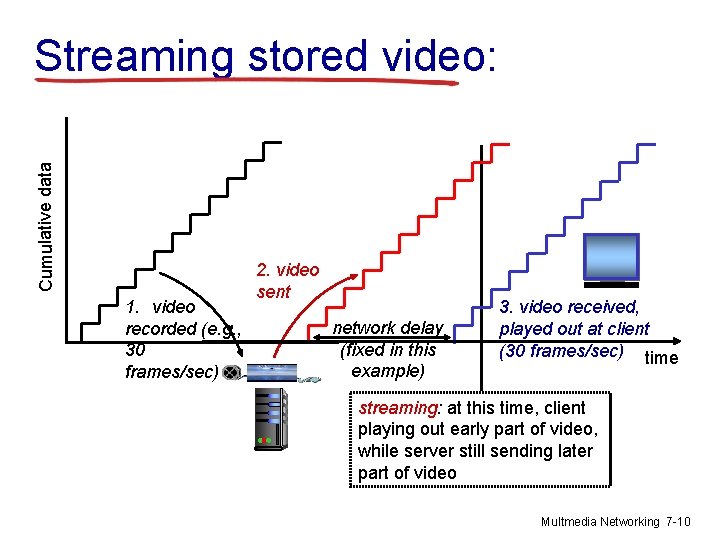
Cumulative data Streaming stored video: 1. video recorded (e. g. , 30 frames/sec) 2. video sent network delay (fixed in this example) 3. video received, played out at client (30 frames/sec) time streaming: at this time, client playing out early part of video, while server still sending later part of video Multmedia Networking 7 -10
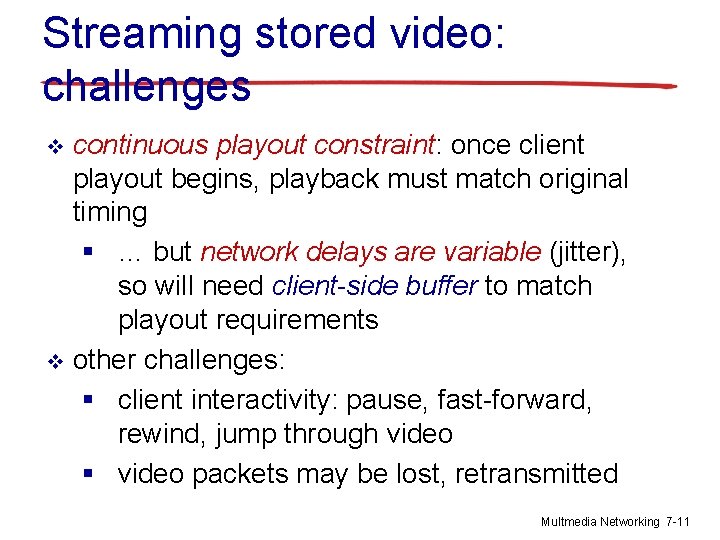
Streaming stored video: challenges continuous playout constraint: once client playout begins, playback must match original timing § … but network delays are variable (jitter), so will need client-side buffer to match playout requirements v other challenges: § client interactivity: pause, fast-forward, rewind, jump through video § video packets may be lost, retransmitted v Multmedia Networking 7 -11
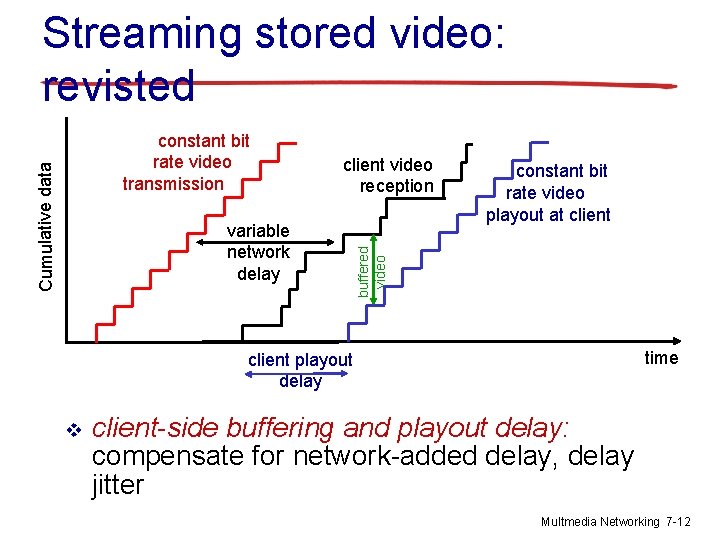
Streaming stored video: revisted client video reception variable network delay constant bit rate video playout at client buffered video Cumulative data constant bit rate video transmission time client playout delay v client-side buffering and playout delay: compensate for network-added delay, delay jitter Multmedia Networking 7 -12
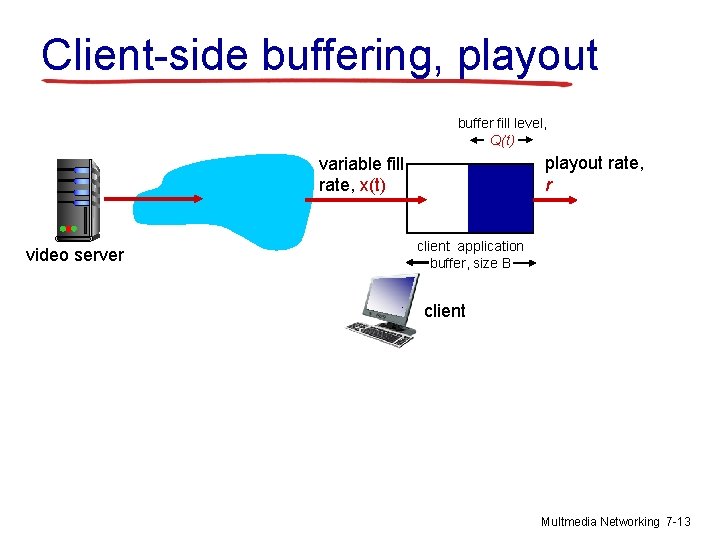
Client-side buffering, playout buffer fill level, Q(t) playout rate, r variable fill rate, x(t) video server client application buffer, size B client Multmedia Networking 7 -13
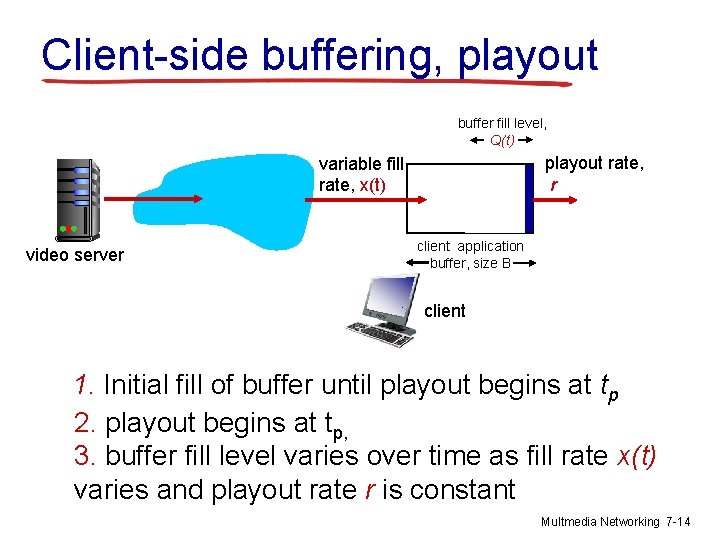
Client-side buffering, playout buffer fill level, Q(t) variable fill rate, x(t) video server � playout rate, r client application buffer, size B client 1. Initial fill of buffer until playout begins at tp 2. playout begins at tp, 3. buffer fill level varies over time as fill rate x(t) varies and playout rate r is constant Multmedia Networking 7 -14
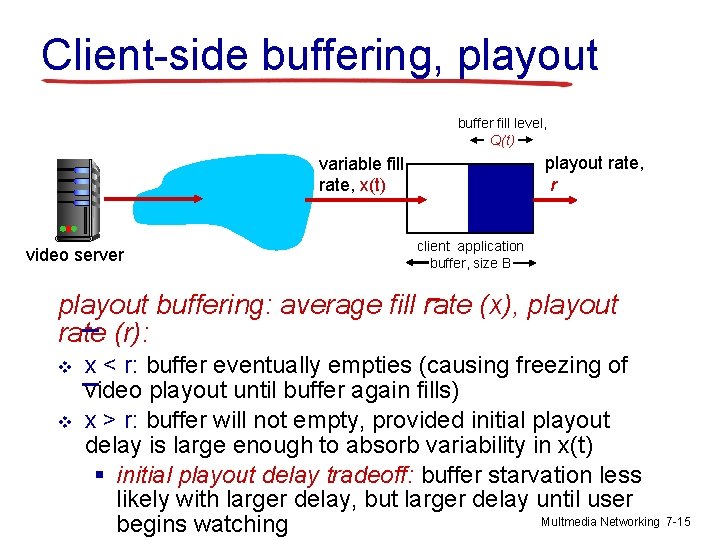
Client-side buffering, playout buffer fill level, Q(t) playout rate, r variable fill rate, x(t) video server client application buffer, size B playout buffering: average fill rate (x), playout rate (r): v v x < r: buffer eventually empties (causing freezing of video playout until buffer again fills) x > r: buffer will not empty, provided initial playout delay is large enough to absorb variability in x(t) § initial playout delay tradeoff: buffer starvation less likely with larger delay, but larger delay until user Multmedia Networking 7 -15 begins watching
Streaming multimedia: UDP v v server sends at rate appropriate for client § often: send rate = encoding rate = constant rate § transmission rate can be oblivious to congestion levels short playout delay (2 -5 seconds) to remove network jitter error recovery: application-level, time permitting UDP may not go through firewalls Multmedia Networking 7 -16
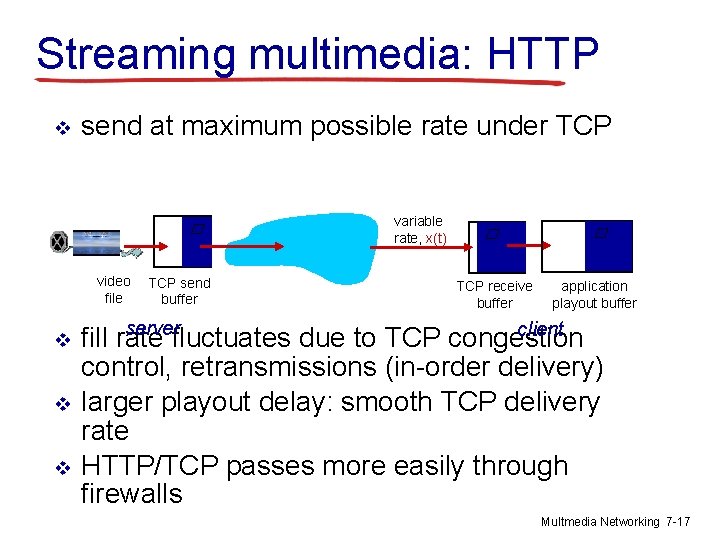
Streaming multimedia: HTTP v send at maximum possible rate under TCP � video file v v v TCP send buffer variable rate, x(t) � TCP receive buffer � application playout buffer server client fill rate fluctuates due to TCP congestion control, retransmissions (in-order delivery) larger playout delay: smooth TCP delivery rate HTTP/TCP passes more easily through firewalls Multmedia Networking 7 -17
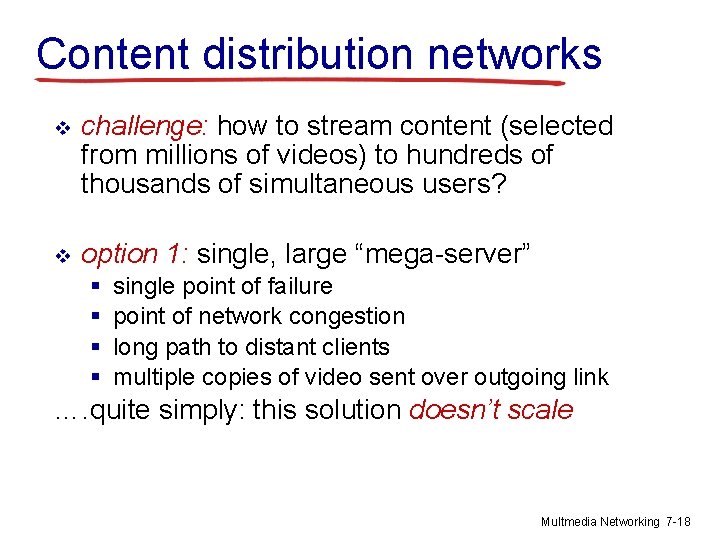
Content distribution networks v challenge: how to stream content (selected from millions of videos) to hundreds of thousands of simultaneous users? v option 1: single, large “mega-server” § § single point of failure point of network congestion long path to distant clients multiple copies of video sent over outgoing link …. quite simply: this solution doesn’t scale Multmedia Networking 7 -18
Content distribution networks v challenge: how to stream content (selected from millions of videos) to hundreds of thousands of simultaneous users? v option 2: store/serve multiple copies of videos at multiple geographically distributed sites (CDN) Multmedia Networking 7 -19
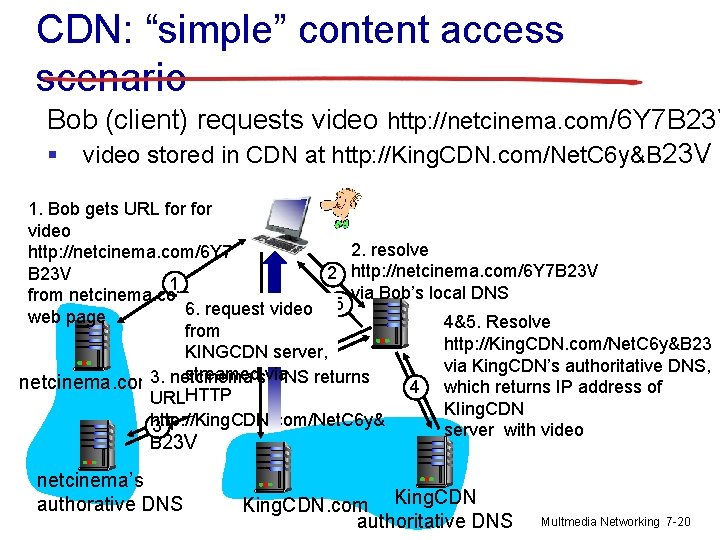
CDN: “simple” content access scenario Bob (client) requests video http: //netcinema. com/6 Y 7 B 23 V § video stored in CDN at http: //King. CDN. com/Net. C 6 y&B 23 V 1. Bob gets URL for video 2. resolve http: //netcinema. com/6 Y 7 2 http: //netcinema. com/6 Y 7 B 23 V 1 via Bob’s local DNS from netcinema. com 5 6. request video web page 4&5. Resolve from http: //King. CDN. com/Net. C 6 y&B 23 KINGCDN server, via King. CDN’s authoritative DNS, streamed via 3. netcinema’s DNS returns netcinema. com 4 which returns IP address of URLHTTP KIing. CDN http: //King. CDN. com/Net. C 6 y& 3 server with video B 23 V netcinema’s authorative DNS King. CDN. com King. CDN authoritative DNS Multmedia Networking 7 -20
CDN cluster selection strategy v challenge: how does CDN DNS select “good” CDN node to stream to client § pick CDN node geographically closest to client § pick CDN node with shortest delay (or min # hops) to client (CDN nodes periodically ping access ISPs, reporting results to CDN DNS) v alternative: let client decide - give client a list of several CDN servers § client pings servers, picks “best” Multmedia Networking 7 -21
Case study: Netflix v Informal homework: figure out how netflix outsources content delivery. Multmedia Networking 7 -22
Multimedia networking: outline 7. 1 multimedia networking applications 7. 2 streaming stored video 7. 3 voice-over-IP 7. 4 protocols for real-time conversational applications 7. 5 network support for multimedia Multmedia Networking 7 -23
Voice-over-IP (Vo. IP) v Vo. IP end-delay requirement: needed to maintain “conversational” aspect § § v v v higher delays noticeable, impair interactivity < 150 msec: good > 400 msec bad includes application-level (packetization, playout), network delays session initialization: how does callee advertise IP address, port number, encoding algorithms? value-added services: call forwarding, screening, recording emergency services: 911 Multmedia Networking 7 -24
Vo. IP characteristics v speaker’s audio: alternating talk spurts, silent periods. § 64 kbps during talk spurt § pkts generated only during talk spurts in chunks (app layer) v v chunk+header encapsulated into UDP or TCP segment application sends segment into socket every 20 msec during talkspurt Multmedia Networking 7 -25
Vo. IP: packet loss, delay v v network loss: IP datagram lost due to network congestion (router buffer overflow) delay loss: IP datagram arrives too late for playout at receiver § delays: processing, queueing in network; endsystem (sender, receiver) delays § typical maximum tolerable delay: 400 ms v loss tolerance: depending on voice encoding, loss concealment, packet loss rates between 1% and 10% can be tolerated Multmedia Networking 7 -26
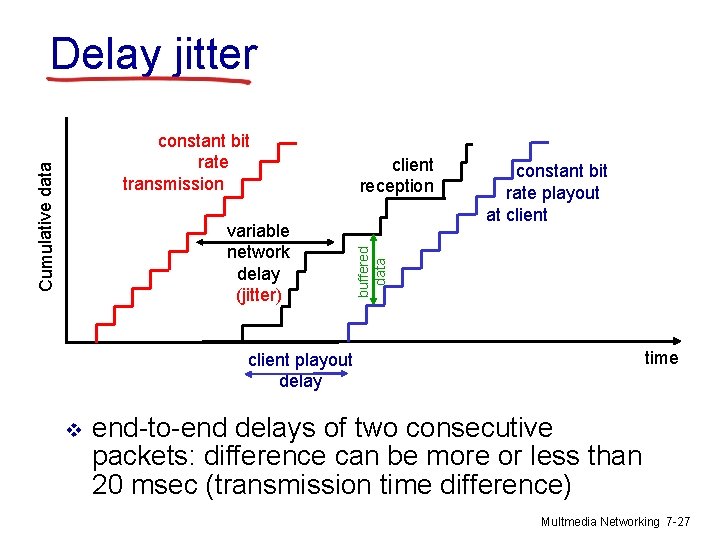
Delay jitter variable network delay (jitter) client reception constant bit rate playout at client buffered data Cumulative data constant bit rate transmission time client playout delay v end-to-end delays of two consecutive packets: difference can be more or less than 20 msec (transmission time difference) Multmedia Networking 7 -27
Vo. IP: fixed playout delay v v receiver attempts to playout each chunk exactly q msecs after chunk was generated. § chunk has time stamp t: play out chunk at t+q § chunk arrives after t+q: data arrives too late for playout: data “lost” tradeoff in choosing q: § large q: less packet loss § small q: better interactive experience Multmedia Networking 7 -28
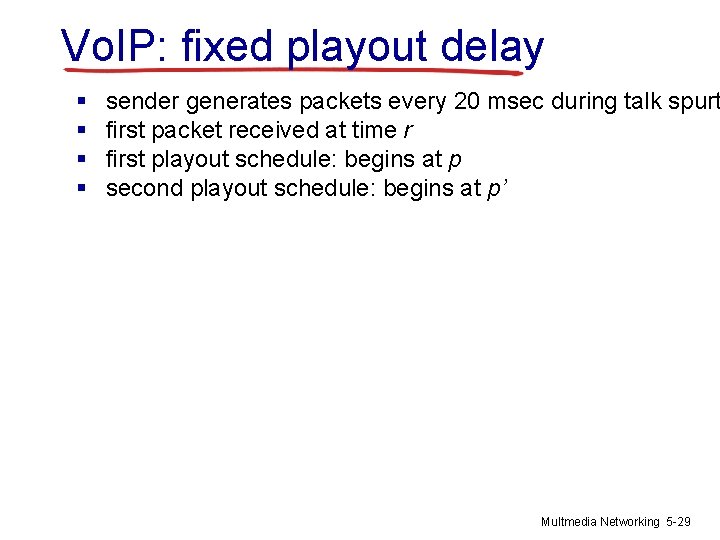
Vo. IP: fixed playout delay § § sender generates packets every 20 msec during talk spurt first packet received at time r first playout schedule: begins at p second playout schedule: begins at p’ Multmedia Networking 5 -29
Voi. P: recovery from packet loss (1) Challenge: recover from packet loss given small tolerable delay between original transmission and playout v v each ACK/NAK takes ~ one RTT alternative: Forward Error Correction (FEC) § send enough bits to allow recovery without retransmission (recall two-dimensional parity in Ch. 5) Multmedia Networking 7 -30
Multimedia networking: outline 7. 1 multimedia networking applications 7. 2 streaming stored video 7. 3 voice-over-IP 7. 4 protocols for real-time conversational applications: RTP, SIP 7. 5 network support for multimedia Multmedia Networking 7 -31
Multimedia networking: outline 7. 1 multimedia networking applications 7. 2 streaming stored video 7. 3 voice-over-IP 7. 4 protocols for real-time conversational applications 7. 5 network support for multimedia Multmedia Networking 7 -32
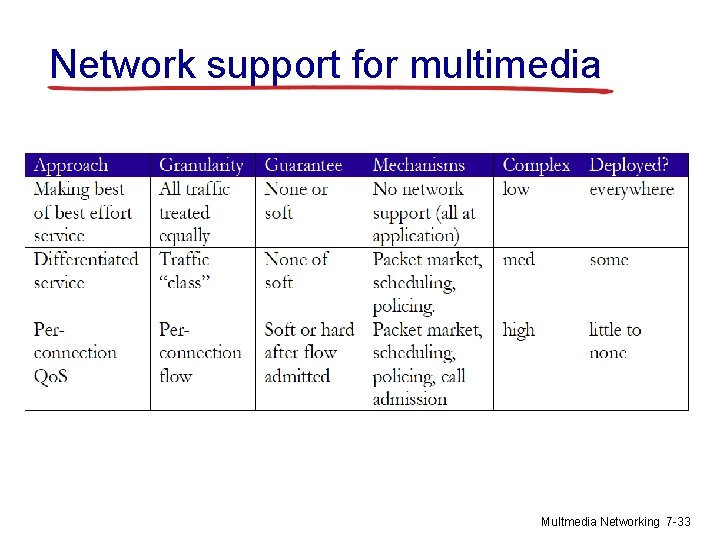
Network support for multimedia Multmedia Networking 7 -33
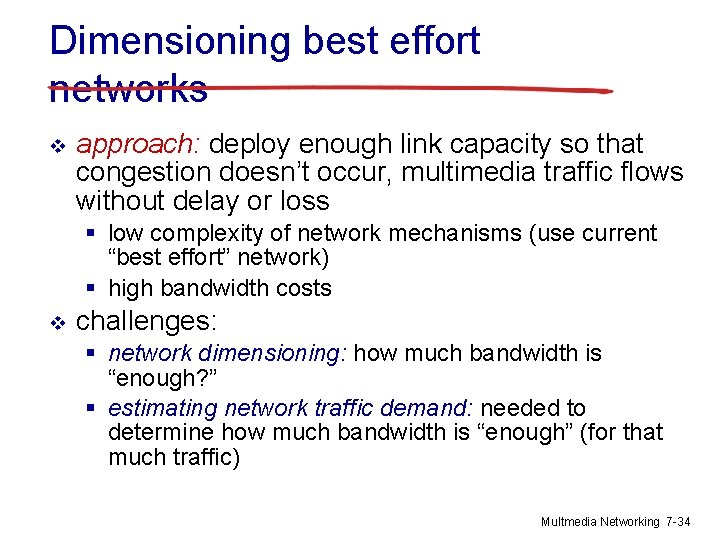
Dimensioning best effort networks v approach: deploy enough link capacity so that congestion doesn’t occur, multimedia traffic flows without delay or loss § low complexity of network mechanisms (use current “best effort” network) § high bandwidth costs v challenges: § network dimensioning: how much bandwidth is “enough? ” § estimating network traffic demand: needed to determine how much bandwidth is “enough” (for that much traffic) Multmedia Networking 7 -34
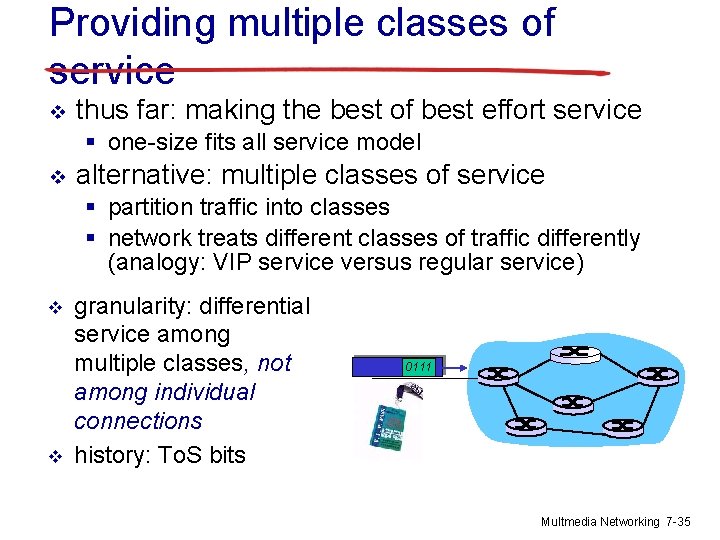
Providing multiple classes of service v thus far: making the best of best effort service § one-size fits all service model v alternative: multiple classes of service § partition traffic into classes § network treats different classes of traffic differently (analogy: VIP service versus regular service) v v granularity: differential service among multiple classes, not among individual connections history: To. S bits 0111 Multmedia Networking 7 -35
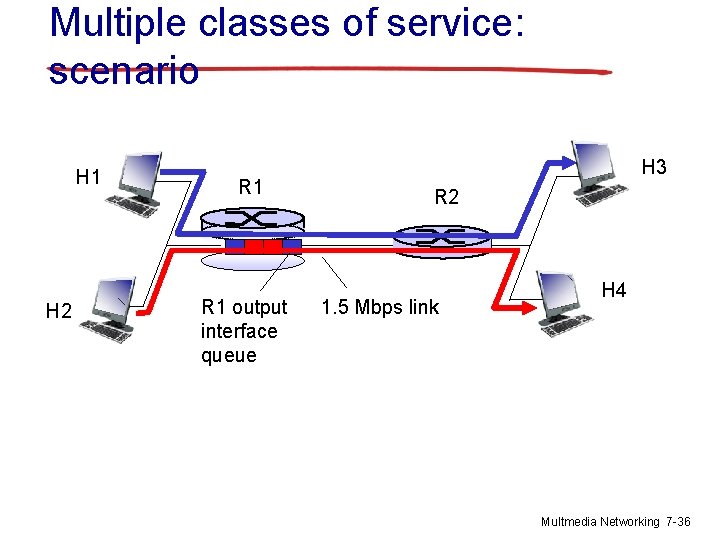
Multiple classes of service: scenario H 1 H 2 R 1 output interface queue H 3 R 2 1. 5 Mbps link H 4 Multmedia Networking 7 -36
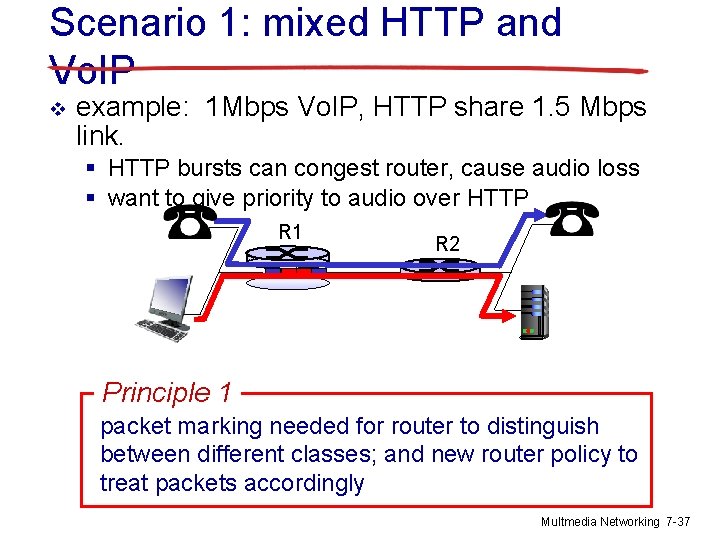
Scenario 1: mixed HTTP and Vo. IP v example: 1 Mbps Vo. IP, HTTP share 1. 5 Mbps link. § HTTP bursts can congest router, cause audio loss § want to give priority to audio over HTTP R 1 R 2 Principle 1 packet marking needed for router to distinguish between different classes; and new router policy to treat packets accordingly Multmedia Networking 7 -37
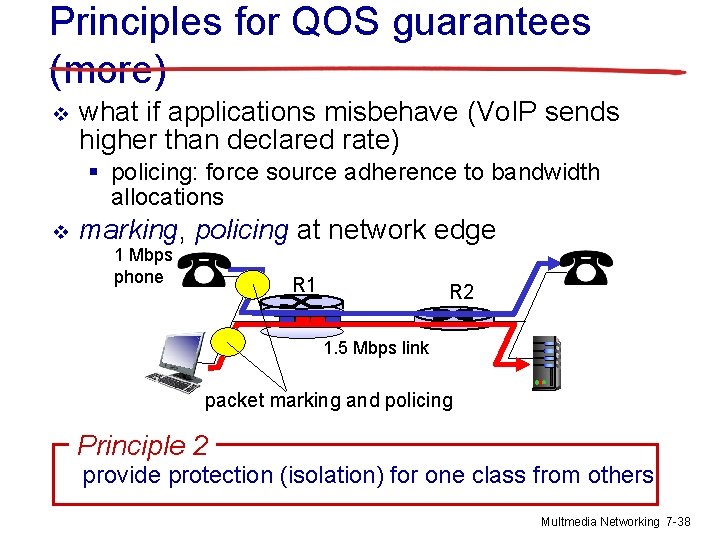
Principles for QOS guarantees (more) v what if applications misbehave (Vo. IP sends higher than declared rate) § policing: force source adherence to bandwidth allocations v marking, policing at network edge 1 Mbps phone R 1 R 2 1. 5 Mbps link packet marking and policing Principle 2 provide protection (isolation) for one class from others Multmedia Networking 7 -38
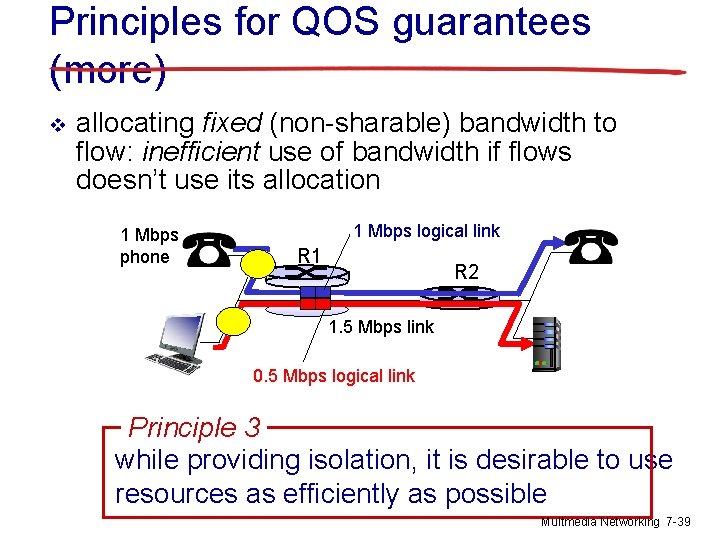
Principles for QOS guarantees (more) v allocating fixed (non-sharable) bandwidth to flow: inefficient use of bandwidth if flows doesn’t use its allocation 1 Mbps phone 1 Mbps logical link R 1 R 2 1. 5 Mbps link 0. 5 Mbps logical link Principle 3 while providing isolation, it is desirable to use resources as efficiently as possible Multmedia Networking 7 -39
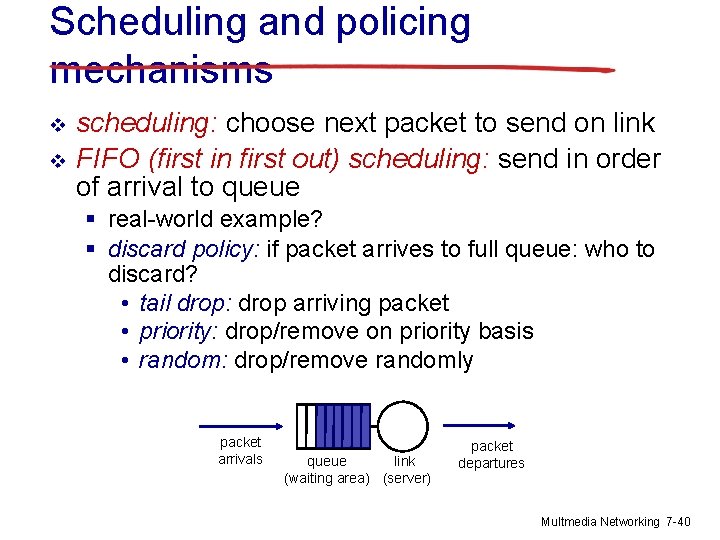
Scheduling and policing mechanisms v v scheduling: choose next packet to send on link FIFO (first in first out) scheduling: send in order of arrival to queue § real-world example? § discard policy: if packet arrives to full queue: who to discard? • tail drop: drop arriving packet • priority: drop/remove on priority basis • random: drop/remove randomly packet arrivals queue link (waiting area) (server) packet departures Multmedia Networking 7 -40
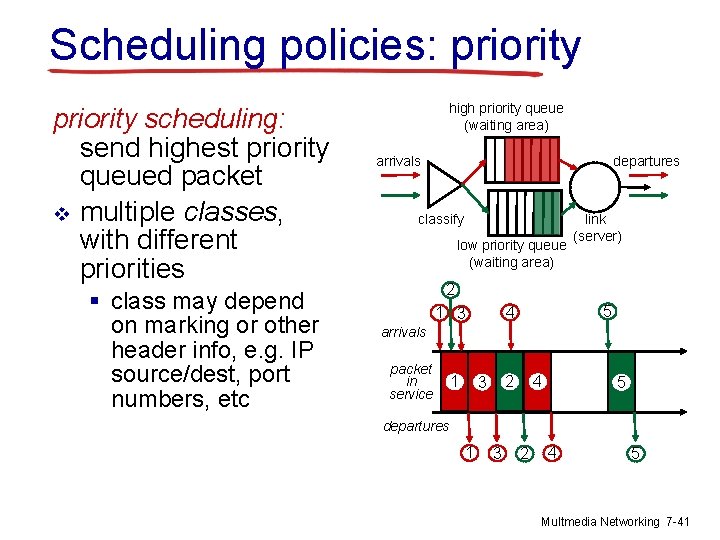
Scheduling policies: priority scheduling: send highest priority queued packet v multiple classes, with different priorities § class may depend on marking or other header info, e. g. IP source/dest, port numbers, etc high priority queue (waiting area) arrivals departures classify low priority queue (waiting area) link (server) 2 5 4 1 3 arrivals packet in service 1 4 2 3 5 departures 1 3 2 4 5 Multmedia Networking 7 -41
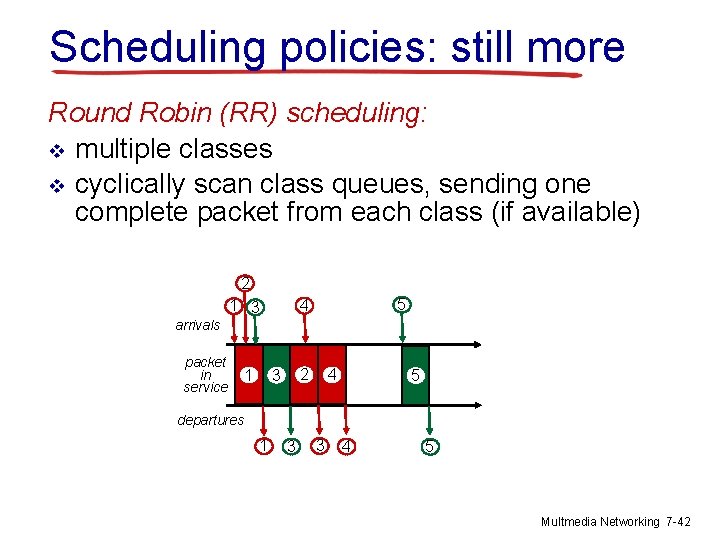
Scheduling policies: still more Round Robin (RR) scheduling: v multiple classes v cyclically scan class queues, sending one complete packet from each class (if available) 2 5 4 1 3 arrivals packet in service 1 2 3 4 5 departures 1 3 3 4 5 Multmedia Networking 7 -42
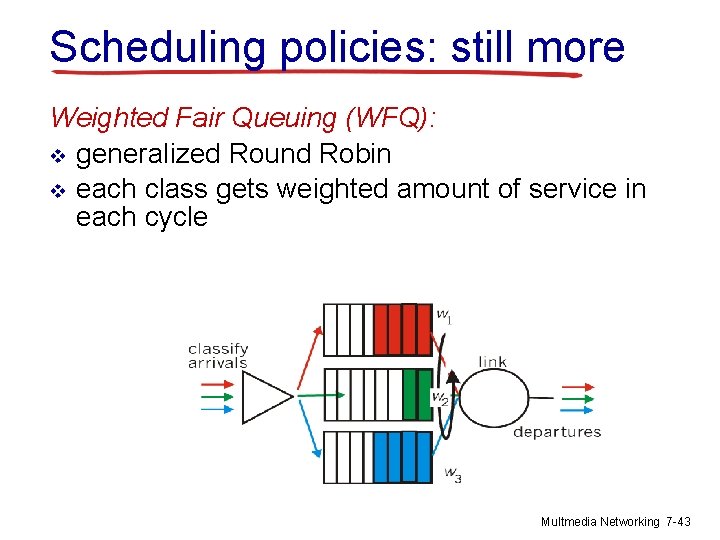
Scheduling policies: still more Weighted Fair Queuing (WFQ): v generalized Round Robin v each class gets weighted amount of service in each cycle Multmedia Networking 7 -43
Policing mechanisms goal: limit traffic to not exceed declared parameters Three common-used criteria: v (long term) average rate: how many pkts can be sent per unit time (in the long run) § crucial question: what is the interval length: 100 packets per sec or 6000 packets per min have same average! v v peak rate: e. g. , 6000 pkts per min (ppm) avg. ; 1500 ppm peak rate (max. ) burst size: max number of pkts sent consecutively (with no intervening idle) Multmedia Networking 7 -44
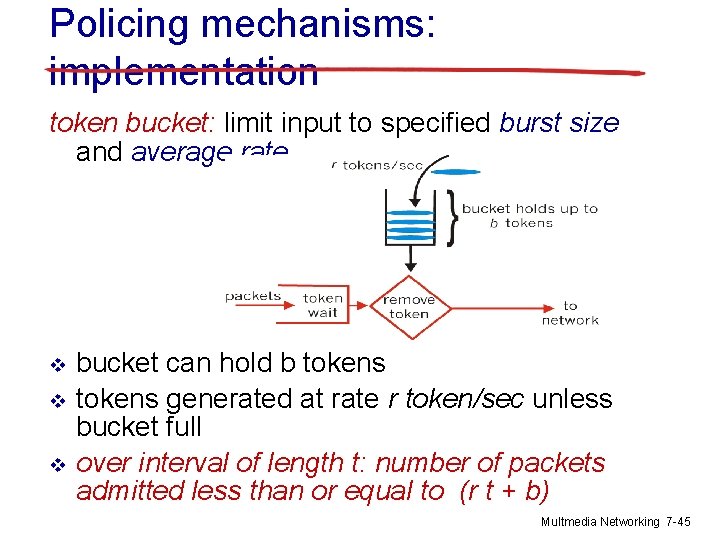
Policing mechanisms: implementation token bucket: limit input to specified burst size and average rate v v v bucket can hold b tokens generated at rate r token/sec unless bucket full over interval of length t: number of packets admitted less than or equal to (r t + b) Multmedia Networking 7 -45
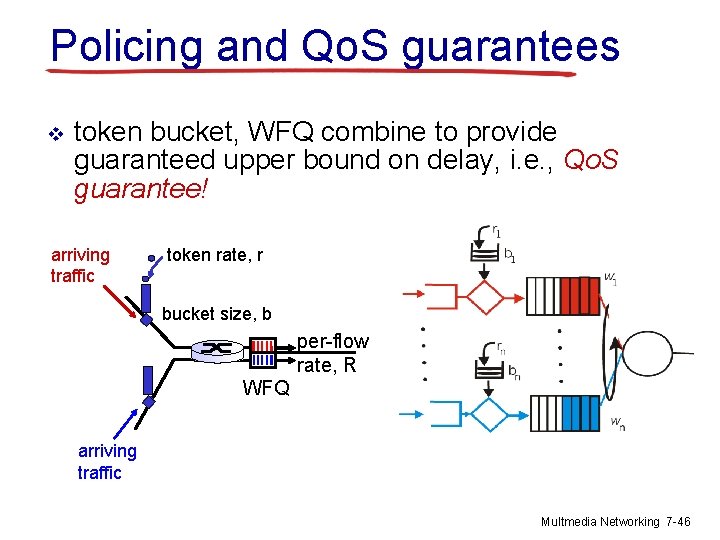
Policing and Qo. S guarantees v token bucket, WFQ combine to provide guaranteed upper bound on delay, i. e. , Qo. S guarantee! arriving traffic token rate, r bucket size, b per-flow rate, R WFQ arriving traffic Multmedia Networking 7 -46
Differentiated services v want “qualitative” service classes § “behaves like a wire” § relative service distinction: Platinum, Gold, Silver v scalability: simple functions in network core, relatively complex functions at edge routers (or hosts) § signaling, maintaining per-flow router state difficult with large number of flows Multmedia Networking 7 -47
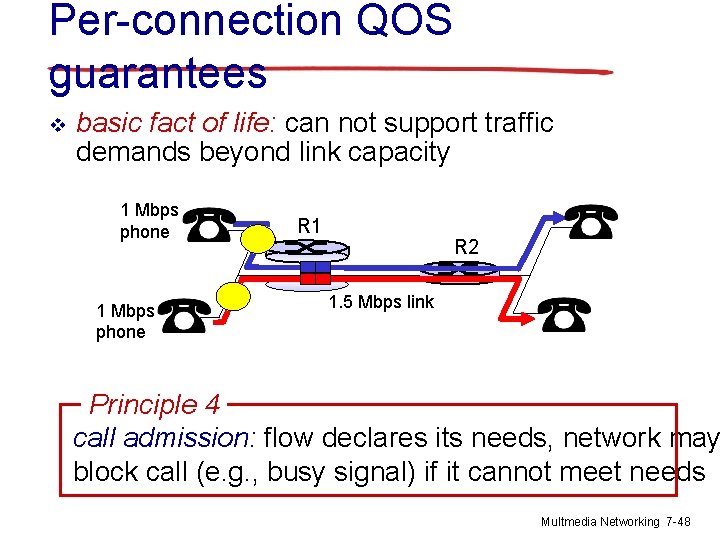
Per-connection QOS guarantees v basic fact of life: can not support traffic demands beyond link capacity 1 Mbps phone R 1 R 2 1. 5 Mbps link Principle 4 call admission: flow declares its needs, network may block call (e. g. , busy signal) if it cannot meet needs Multmedia Networking 7 -48
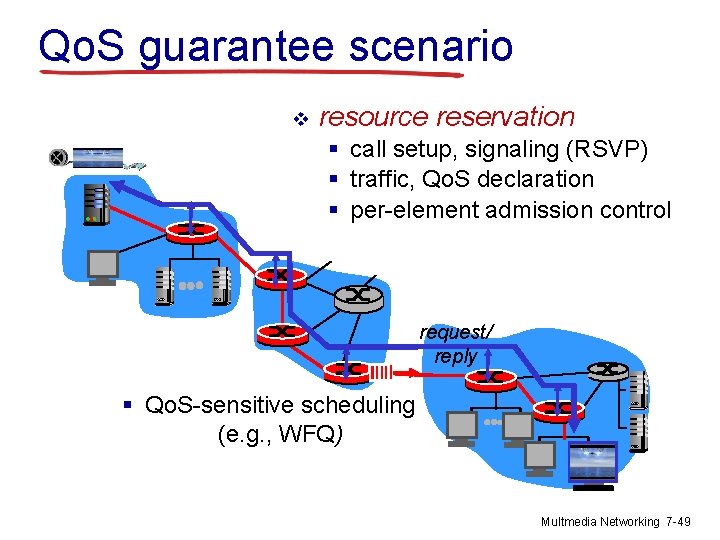
Qo. S guarantee scenario v resource reservation § call setup, signaling (RSVP) § traffic, Qo. S declaration § per-element admission control request/ reply § Qo. S-sensitive scheduling (e. g. , WFQ) Multmedia Networking 7 -49