
Chapter 7 Motivation Learning outcomes You should learn





- Slides: 74
Chapter 7 Motivation
Learning outcomes You should learn to: – Define the motivation process – Describe early motivation theories – Explain how goals motivate people – Identify ways to design motivating jobs – Explain how goal-setting theory impacts performance & rewards.
Learning outcomes – Describe the motivational implications of equity theory, expectancy theory & self-efficacy theory. – Describe current motivation issues facing managers – Identify management practices that are likely to lead to more motivated employees
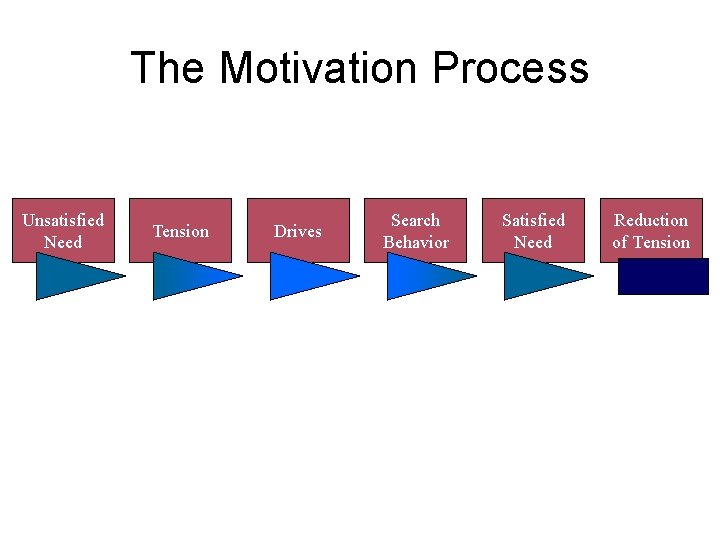
What is Motivation? – the processes that account for an individual's intensity, direction, and persistence of effort towards attaining a goal. • Intensity- how hard a person tries • direction - efforts should be channeled in a direction that benefits the organizational goals. • Persistence- determines how long a person can maintain effort. Unsatisfied needs creates tension that stimulates drive which leads to search behavior.
The Motivation Process Unsatisfied Need Tension Drives Search Behavior Satisfied Need Reduction of Tension
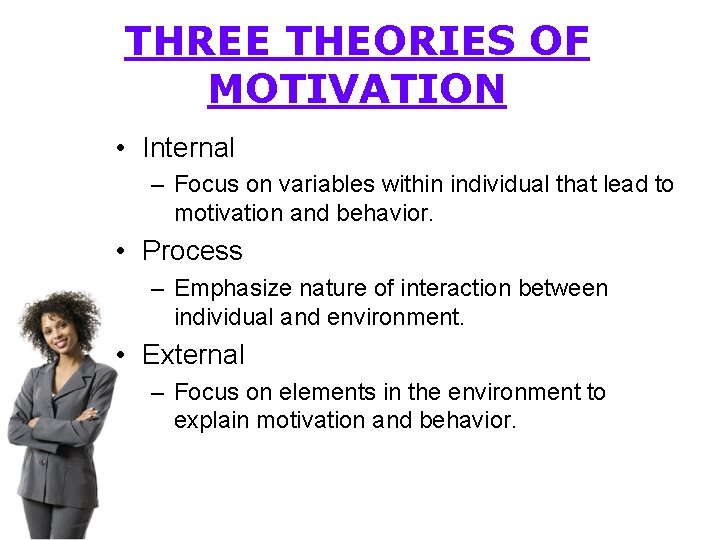
THREE THEORIES OF MOTIVATION • Internal – Focus on variables within individual that lead to motivation and behavior. • Process – Emphasize nature of interaction between individual and environment. • External – Focus on elements in the environment to explain motivation and behavior.
Early Theories Of Motivation Maslow’s Hierarchy of Needs Theory • each level in hierarchy must be satisfied before the next is activated • once a need is substantially satisfied it no longer motivates behavior – theory received wide recognition – little research support for the validity of theory
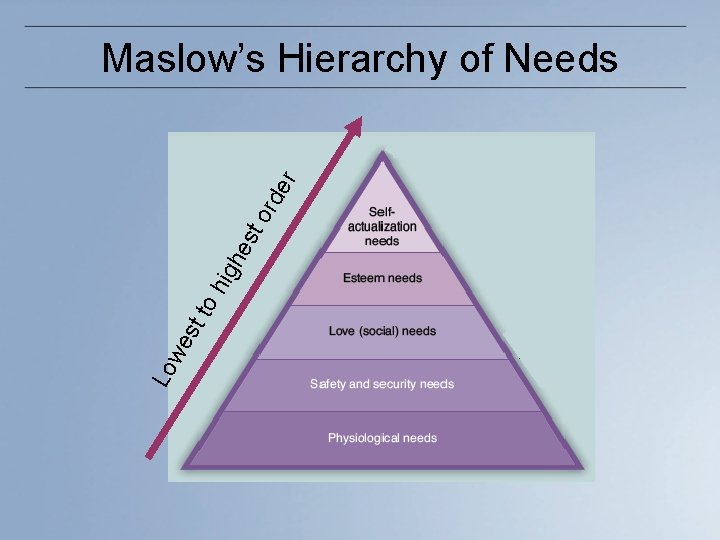
Maslow’s Hierarchy of Needs Theory Lower-order needs - largely satisfied externally • physiological - food, drink, shelter, sexual satisfaction • safety - security and protection from physical and emotional harm – assurance that physiological needs will be satisfied Higher-order needs - largely satisfied internally • social - affection, belongingness, acceptance • esteem - internal factors like self-respect, autonomy – external factors like status, recognition, attention • self-actualization - achieving one’s potential
Lo we st to h igh es t ord er Maslow’s Hierarchy of Needs
Mc. Gregor’s Theory X and Theory Y Theory X - assumes that workers have little ambition, dislike work, want to avoid responsibility, and need to be closely controlled • assumed that lower-order needs dominated Theory Y - assumes that workers can exercise self -direction, accept and actually seek out responsibility, and consider work to be a natural activity • assumed that higher-order needs dominated – no evidence that either set of assumptions is valid – no evidence that managing on the basis of Theory Y makes employees more motivated
Theory X/Y • Theory X: Workers are costs • Theory Y: Workers are assets
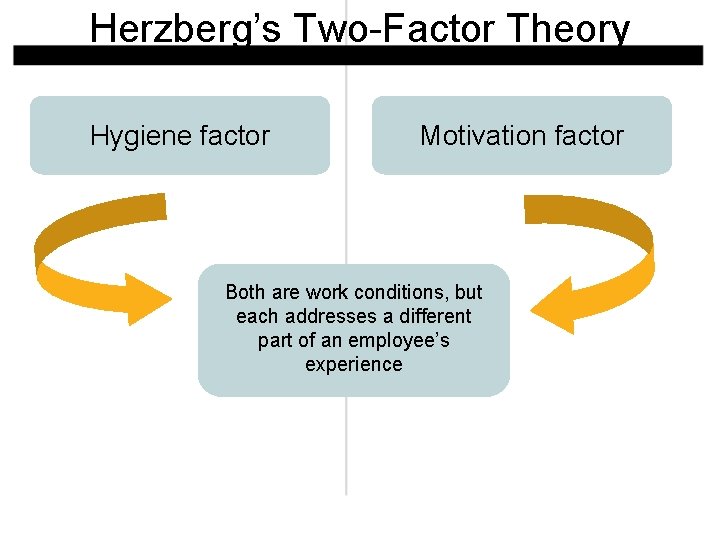
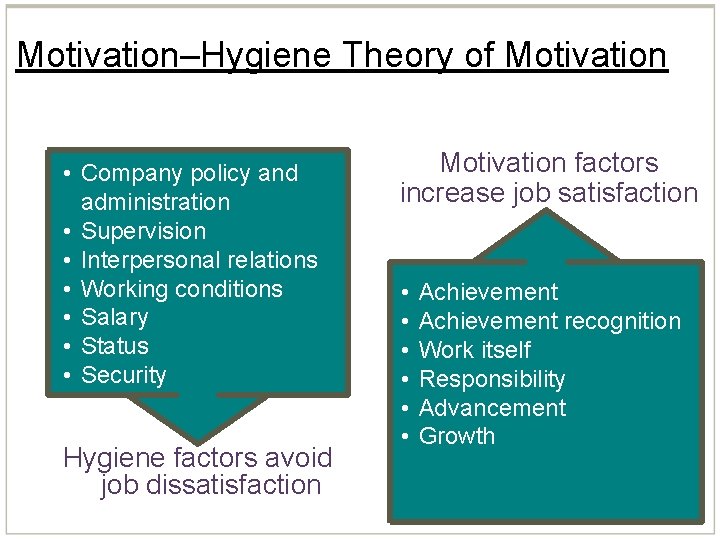
Herzberg’s Two-Factor Theory Hygiene factor Motivation factor Both are work conditions, but each addresses a different part of an employee’s experience
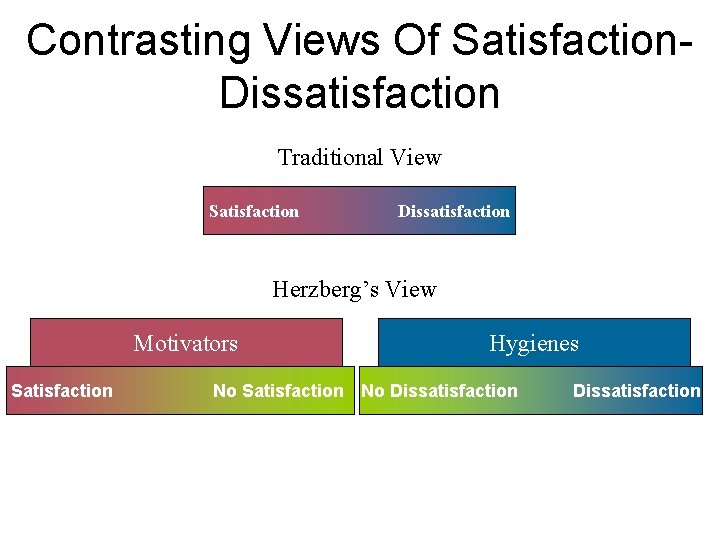
Herzberg’s Motivation-Hygiene Theory – intrinsic characteristics consistently related to job satisfaction • motivator factors energize employees – extrinsic characteristics consistently related to job dissatisfaction • hygiene factors don’t motivate employees – proposed dual continua for satisfaction and dissatisfaction – theory enjoyed wide popularity • influenced job design
Motivation–Hygiene Theory of Motivation • Company policy and administration • Supervision • Interpersonal relations • Working conditions • Salary • Status • Security Hygiene factors avoid job dissatisfaction Motivation factors increase job satisfaction • • • Achievement recognition Work itself Responsibility Advancement Growth
Contrasting Views Of Satisfaction. Dissatisfaction Traditional View Satisfaction Dissatisfaction Herzberg’s View Motivators Satisfaction Hygienes No Satisfaction No Dissatisfaction
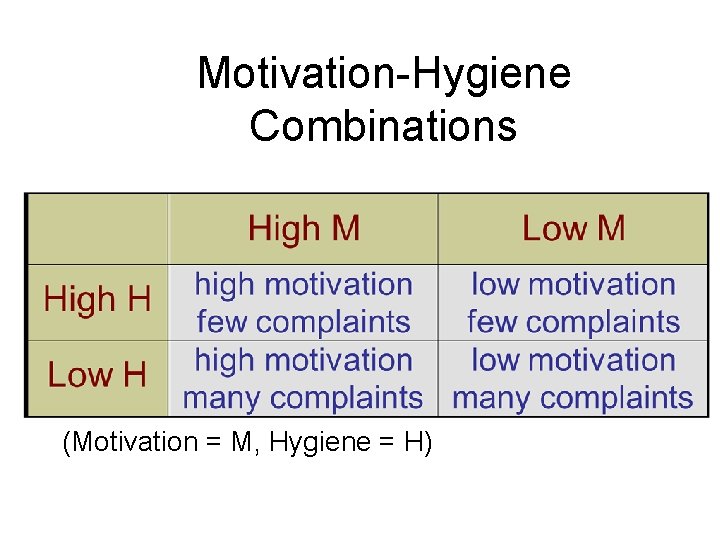
Motivation-Hygiene Combinations (Motivation = M, Hygiene = H)
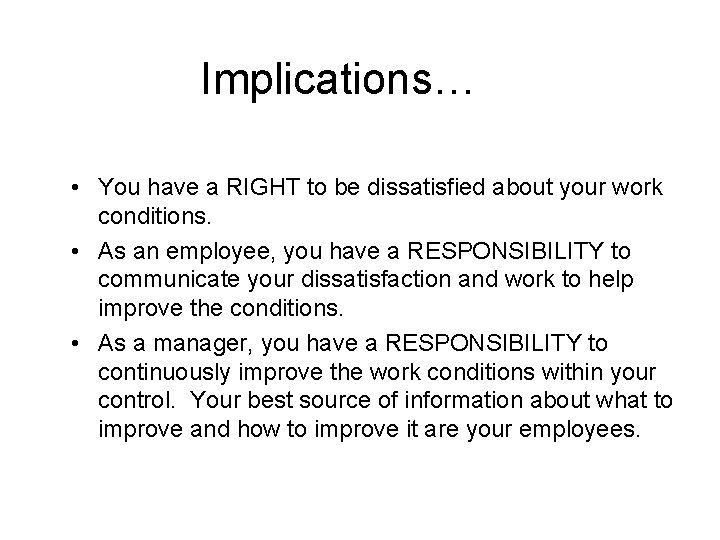
Implications… • You have a RIGHT to be dissatisfied about your work conditions. • As an employee, you have a RESPONSIBILITY to communicate your dissatisfaction and work to help improve the conditions. • As a manager, you have a RESPONSIBILITY to continuously improve the work conditions within your control. Your best source of information about what to improve and how to improve it are your employees.
Mc. Clelland’s Theory 3 categories of needs • Achievement • Power • Affiliation
Three-Needs Theory - Mc. Clelland – need for achievement (n. Ach) - drive to excel, to achieve in relation to a set of standards, and to strive to succeed • • do not strive for trappings and rewards of success prefer jobs that offer personal responsibility want rapid and unambiguous feedback set moderately challenging goals – avoid very easy or very difficult tasks • high achievers don’t necessarily make good managers – focus on their own accomplishments » good managers emphasize helping others to accomplish their goals
– need for power (n. Pow) • Desire to control other persons, to influence their behavior, or to be responsible for other people. • Personal power versus social power. – People high in (n. Power) prefer work that: • Involves control over other persons. • Has an impact on people and events. • Brings public recognition and attention.
need for affiliation (n. Aff): desire for friendly and close interpersonal relationships. People high in (n. Aff) prefer work that: • Involves interpersonal relationships. • Provides for companionship • Brings social approval.
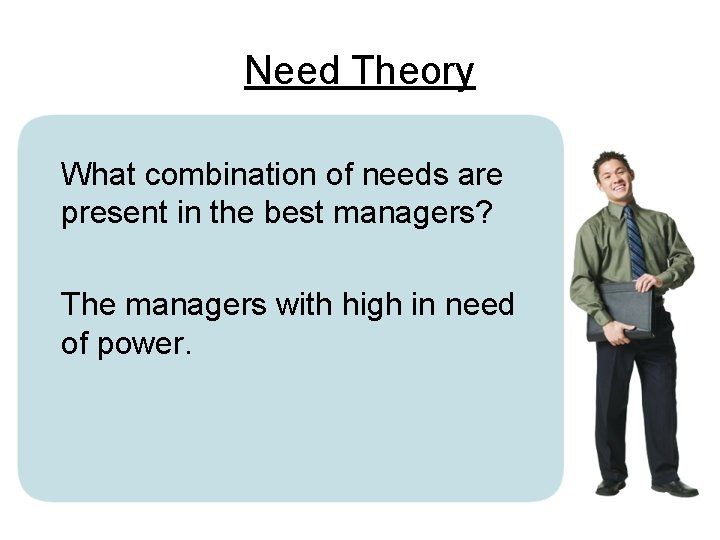
Need Theory What combination of needs are present in the best managers? The managers with high in need of power.
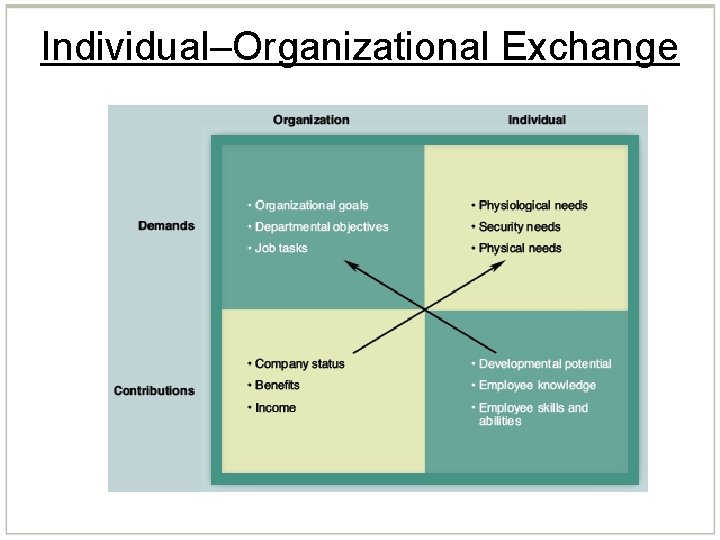
Individual–Organizational Exchange
CONTEMPORARY THEORIES OF MOTIVATION
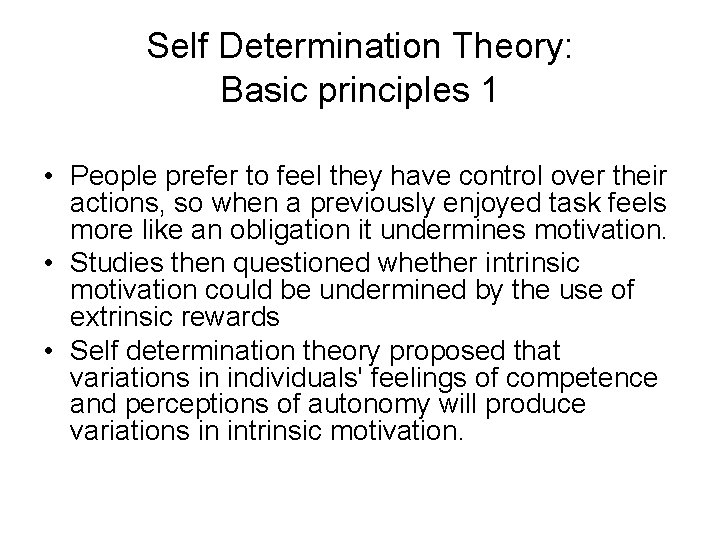
Self Determination Theory: Basic principles 1 • People prefer to feel they have control over their actions, so when a previously enjoyed task feels more like an obligation it undermines motivation. • Studies then questioned whether intrinsic motivation could be undermined by the use of extrinsic rewards • Self determination theory proposed that variations in individuals' feelings of competence and perceptions of autonomy will produce variations in intrinsic motivation.
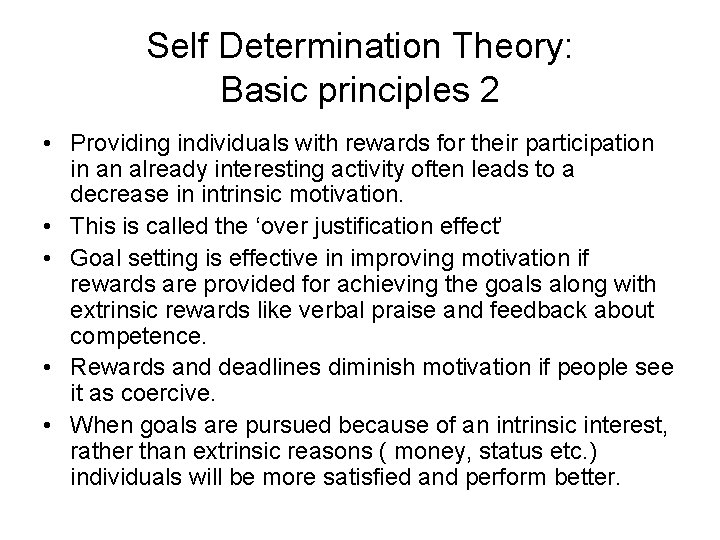
Self Determination Theory: Basic principles 2 • Providing individuals with rewards for their participation in an already interesting activity often leads to a decrease in intrinsic motivation. • This is called the ‘over justification effect’ • Goal setting is effective in improving motivation if rewards are provided for achieving the goals along with extrinsic rewards like verbal praise and feedback about competence. • Rewards and deadlines diminish motivation if people see it as coercive. • When goals are pursued because of an intrinsic interest, rather than extrinsic reasons ( money, status etc. ) individuals will be more satisfied and perform better.
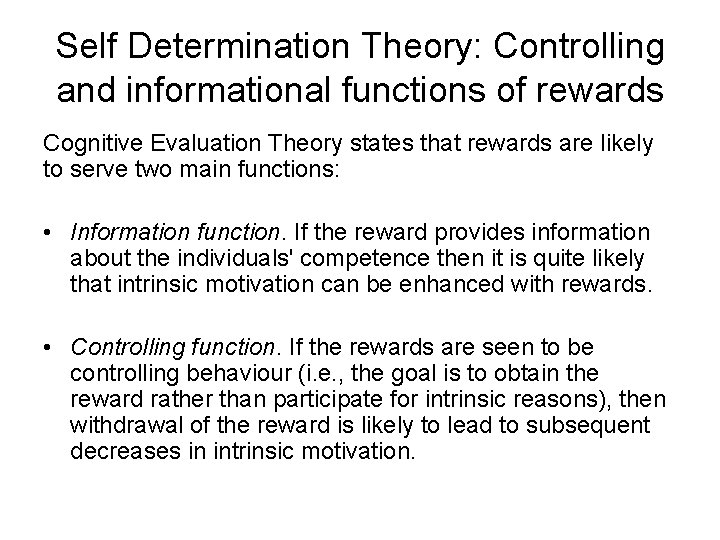
Self Determination Theory: Controlling and informational functions of rewards Cognitive Evaluation Theory states that rewards are likely to serve two main functions: • Information function. If the reward provides information about the individuals' competence then it is quite likely that intrinsic motivation can be enhanced with rewards. • Controlling function. If the rewards are seen to be controlling behaviour (i. e. , the goal is to obtain the reward rather than participate for intrinsic reasons), then withdrawal of the reward is likely to lead to subsequent decreases in intrinsic motivation.
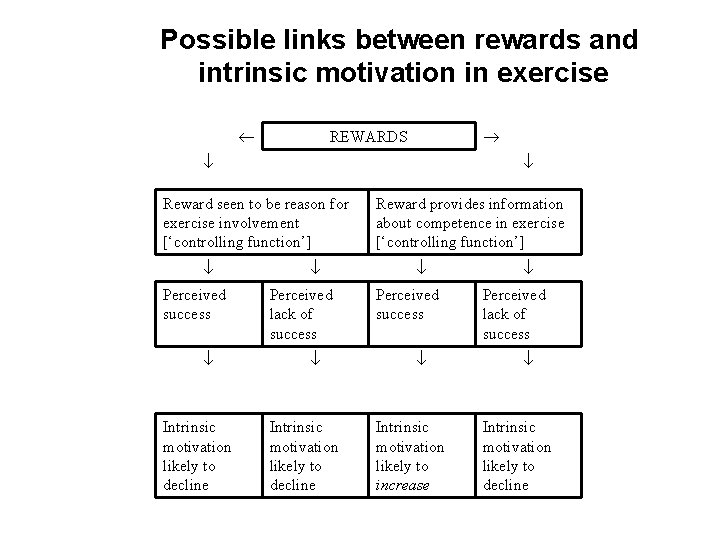
Possible links between rewards and intrinsic motivation in exercise REWARDS Reward seen to be reason for exercise involvement [‘controlling function’] Perceived success Intrinsic motivation likely to decline Perceived lack of success Intrinsic motivation likely to decline Reward provides information about competence in exercise [‘controlling function’] Perceived success Intrinsic motivation likely to increase Perceived lack of success Intrinsic motivation likely to decline
Goals: Definition and Background • Goal – what an individual is trying to accomplish • Management by objectives – management system incorporating participation in decision making, goal setting, and feedback.
Goal Setting Read an article by Latham and Locke on : “Goal Setting-A Motivational Technique that Works”
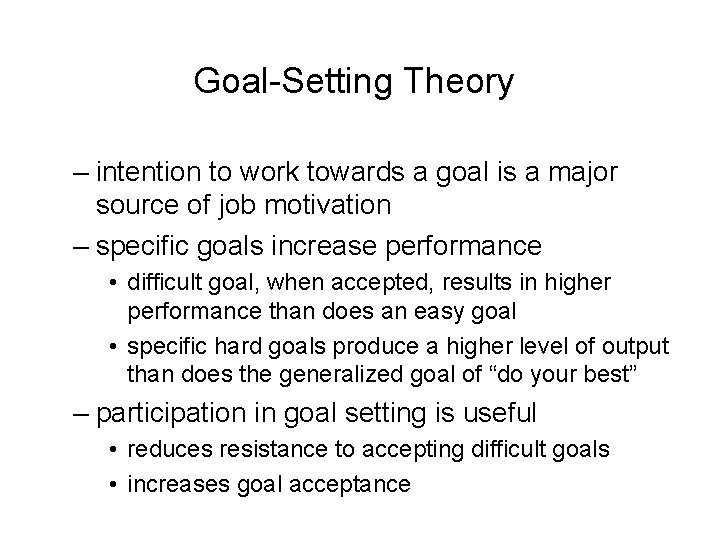
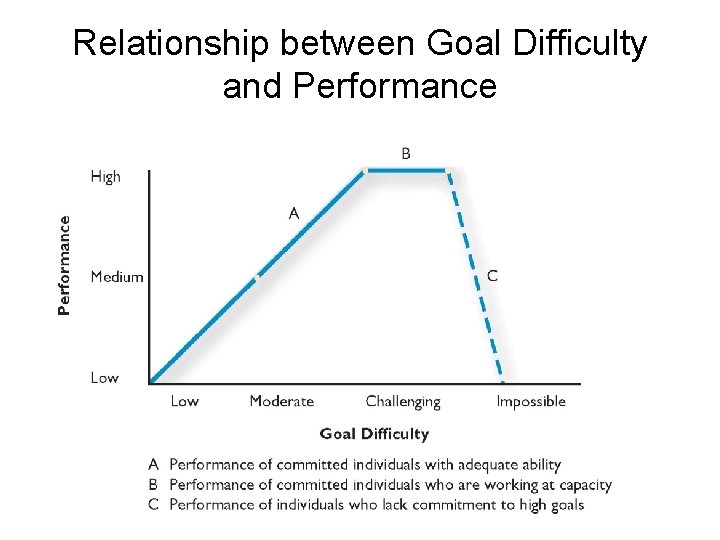
Goal-Setting Theory – intention to work towards a goal is a major source of job motivation – specific goals increase performance • difficult goal, when accepted, results in higher performance than does an easy goal • specific hard goals produce a higher level of output than does the generalized goal of “do your best” – participation in goal setting is useful • reduces resistance to accepting difficult goals • increases goal acceptance
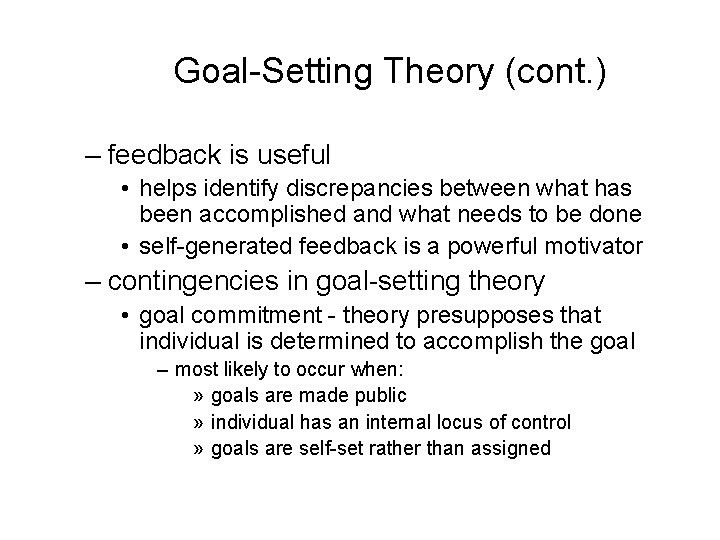
Goal-Setting Theory (cont. ) – feedback is useful • helps identify discrepancies between what has been accomplished and what needs to be done • self-generated feedback is a powerful motivator – contingencies in goal-setting theory • goal commitment - theory presupposes that individual is determined to accomplish the goal – most likely to occur when: » goals are made public » individual has an internal locus of control » goals are self-set rather than assigned
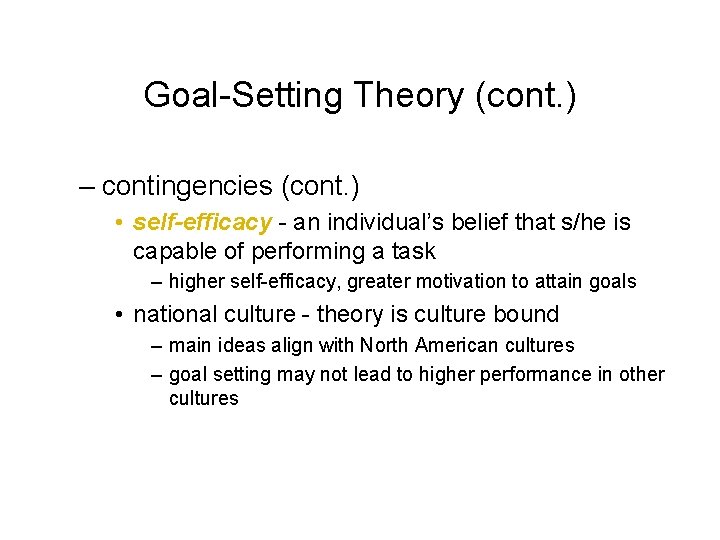
Goal-Setting Theory (cont. ) – contingencies (cont. ) • self-efficacy - an individual’s belief that s/he is capable of performing a task – higher self-efficacy, greater motivation to attain goals • national culture - theory is culture bound – main ideas align with North American cultures – goal setting may not lead to higher performance in other cultures
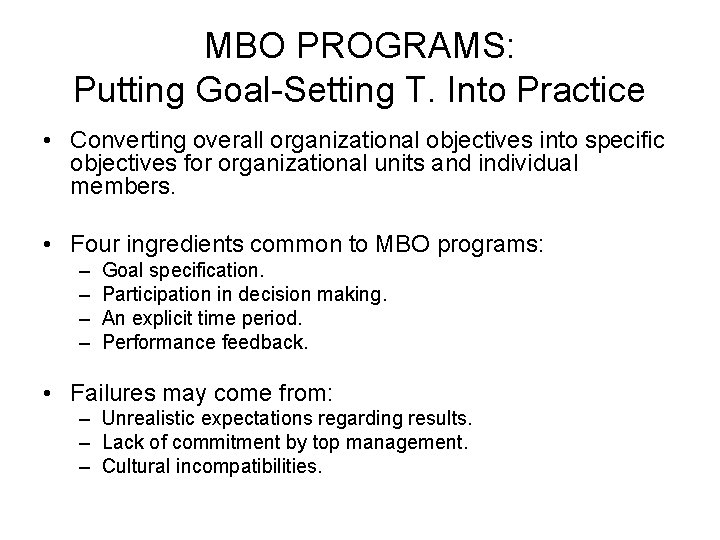
MBO PROGRAMS: Putting Goal-Setting T. Into Practice • Converting overall organizational objectives into specific objectives for organizational units and individual members. • Four ingredients common to MBO programs: – – Goal specification. Participation in decision making. An explicit time period. Performance feedback. • Failures may come from: – Unrealistic expectations regarding results. – Lack of commitment by top management. – Cultural incompatibilities.
Relationship between Goal Difficulty and Performance
Guidelines for Job Redesign
Managerial Actions for Enhancing Goal Commitment 1. 2. Provide valued outcomes for goal accomplishment. Raise employees’self-efficacy about meeting goals by: a) Providing adequate training b) Role modeling desired behaviors and actions c) Persuasively communicating confidence in the employees ability to attain the goal.
Managerial Actions for Enhancing Goal Commitment 3. 4. 5 Have employees make a public commitment to the goal. Communicate an inspiring vision and explain how individual goals relate to accomplishing the vision. Allow employees to participate in setting the goals.
Managerial Actions for Enhancing Goal Commitment 6. 7. 8. Behave supportively rather than punitively. Break a long-term goal (i. e. , a yearly goal) into short-term sub-goals. Ensure that employees have the resources required to accomplish the goal.
Self–Efficacy Theory. . . Bandura Self–Efficacy The perception of one’s ability to perform a task successfully is really a situation-specific form of self-confidence.
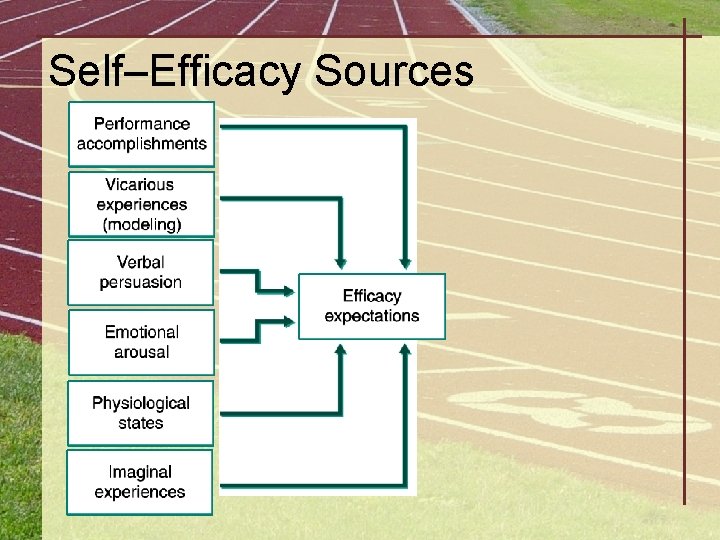
Self–Efficacy Sources
Expectancy Theory explains motivation in terms of an individual’s perception of the performance process.
Two Basic Notions of Expectancy Theory People expect certain outcomes of behavior and performance. People believe that the effort they put forth is related to the performance they achieve and the outcomes they receive.
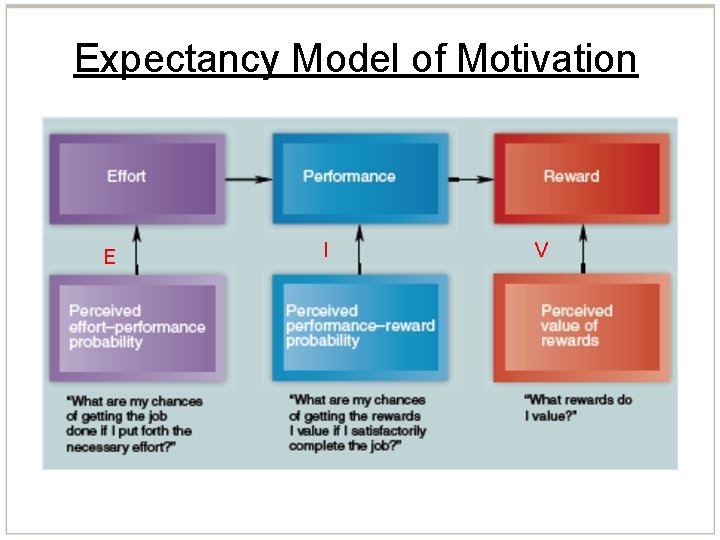
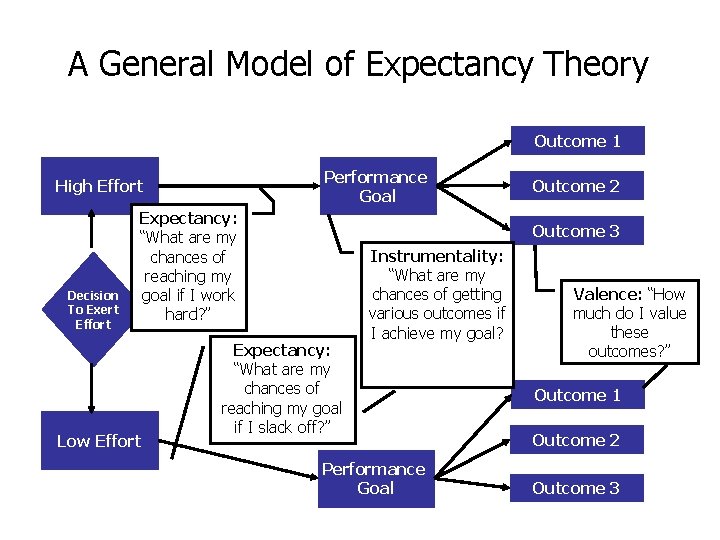
Key Constructs of Expectancy Theory Valence – value or importance placed on a particular reward Expectancy – belief that effort leads to performance Instrumentality – belief that performance is related to rewards
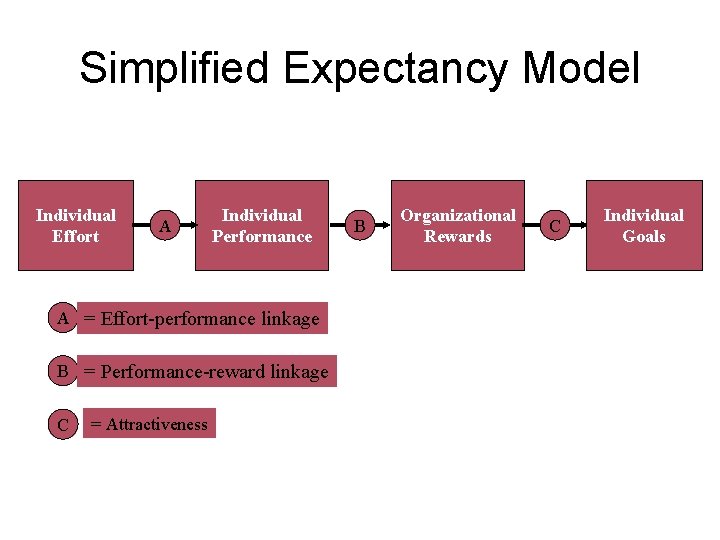
Expectancy Theory states that an individual tends to act in a certain way based on the expectation that the act will be followed by a given outcome and on the attractiveness of that outcome to the individual • Expectancy (effort-performance linkage) perceived probability that exerting a given amount of effort will lead to a certain level of performance • Instrumentality (performance-reward linkage) strength of belief that performing at a particular level is instrumental in attaining an outcome • Valence - attractiveness or importance of the potential outcome
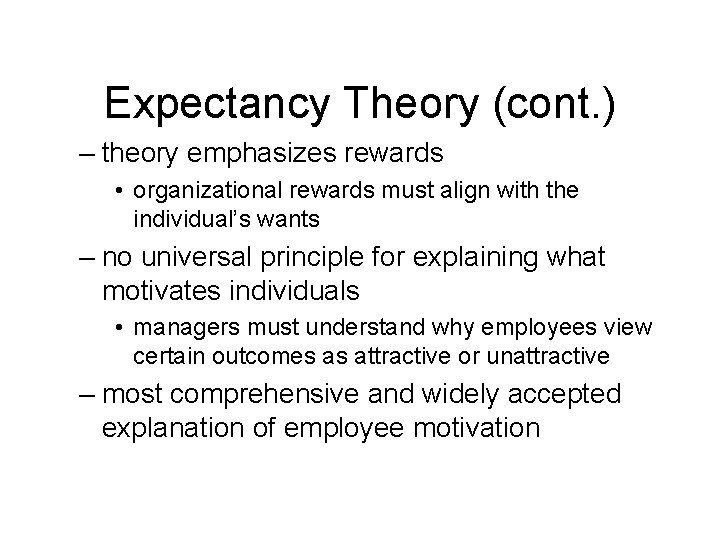
Expectancy Theory (cont. ) – theory emphasizes rewards • organizational rewards must align with the individual’s wants – no universal principle for explaining what motivates individuals • managers must understand why employees view certain outcomes as attractive or unattractive – most comprehensive and widely accepted explanation of employee motivation
Expectancy Model of Motivation E I V
A General Model of Expectancy Theory Outcome 1 Performance Goal High Effort Decision To Exert Effort Expectancy: “What are my chances of reaching my goal if I work hard? ” Low Effort Outcome 2 Outcome 3 Expectancy: “What are my chances of reaching my goal if I slack off? ” Instrumentality: “What are my chances of getting various outcomes if I achieve my goal? Performance Goal Valence: “How much do I value these outcomes? ” Outcome 1 Outcome 2 Outcome 3
Simplified Expectancy Model Individual Effort A Individual Performance A = Effort-performance linkage B = Performance-reward linkage C = Attractiveness B Organizational Rewards C Individual Goals
Adam’s Theory of Inequity People are motivated when they find themselves in situations of inequity or unfairness. To look for inequity, people consider their inputs and their outcomes.
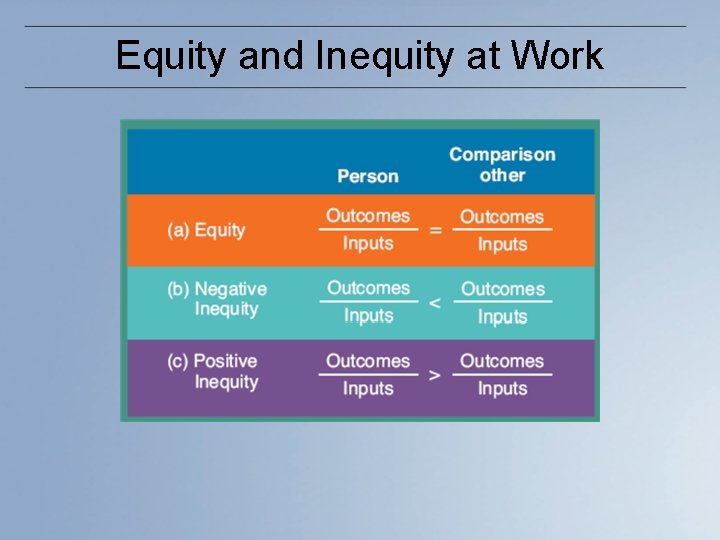
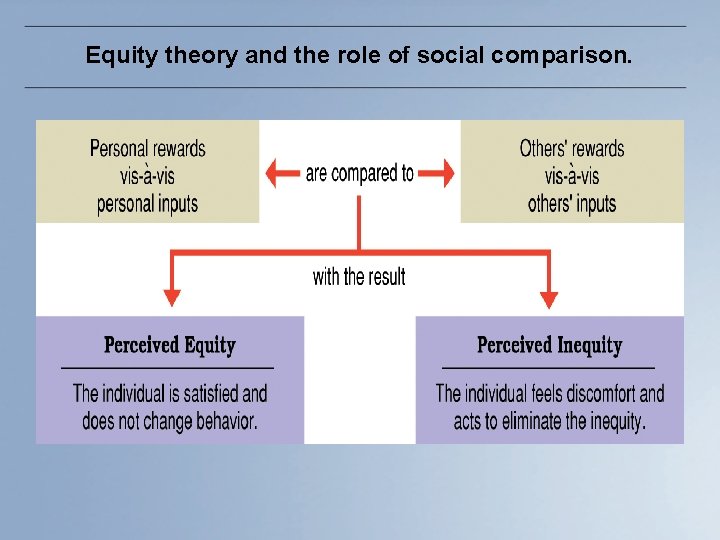
Equity Theory – proposes that employees perceive what they get from a job (outcomes) in relation to what they put into it (inputs) – input/outcome ratio compared with the ratios of relevant others • equity - ratio is equal to that of relevant others • inequity - ratio is unequal to that of relevant others – referent (relevant other) may be: • other - individuals with similar jobs • a system - includes organizational pay policies and administrative systems • self - past personal experiences and contacts
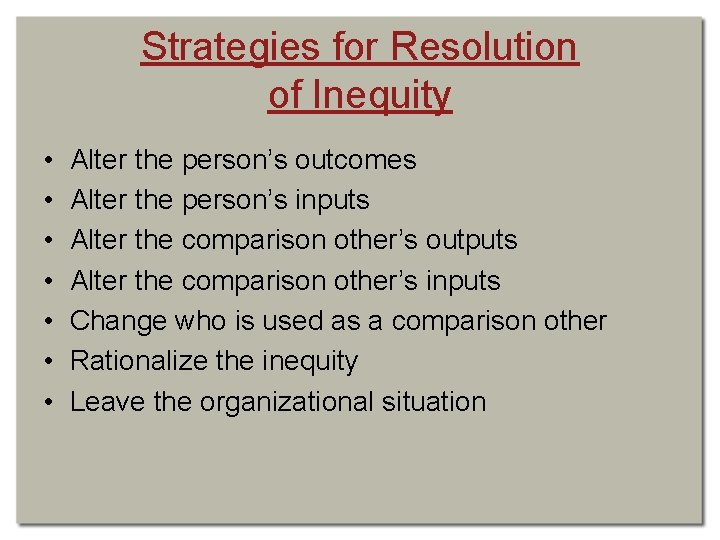
Equity Theory (cont. ) – when inequities are perceived, employees act to correct the situation • distort either their own or others’ inputs or outputs • behave in a way to induce others to change their inputs or outputs • behave in a way to change their own inputs or outputs • choose a different comparison person • quit their jobs – theory leaves some issues unclear
Equity and Inequity at Work
Equity theory and the role of social comparison.
Strategies for Resolution of Inequity • • Alter the person’s outcomes Alter the person’s inputs Alter the comparison other’s outputs Alter the comparison other’s inputs Change who is used as a comparison other Rationalize the inequity Leave the organizational situation
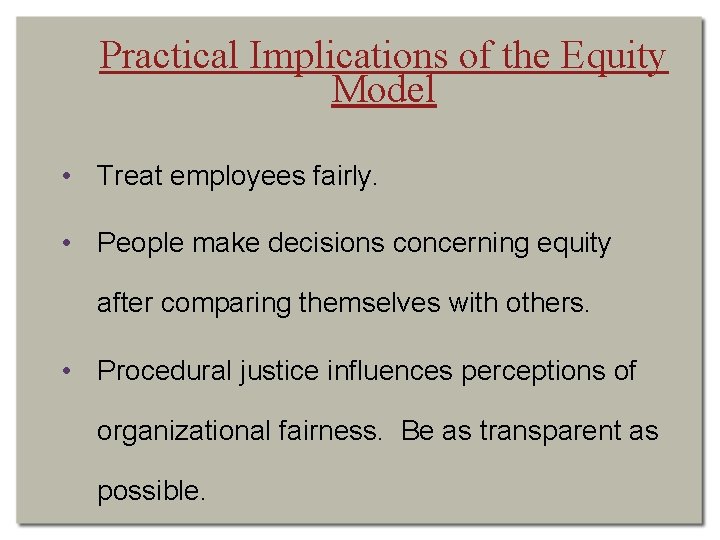
Practical Implications of the Equity Model • Treat employees fairly. • People make decisions concerning equity after comparing themselves with others. • Procedural justice influences perceptions of organizational fairness. Be as transparent as possible.
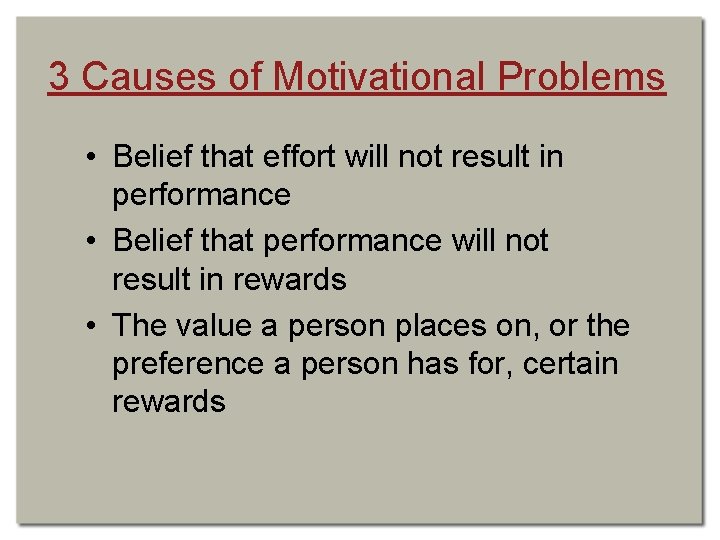
3 Causes of Motivational Problems • Belief that effort will not result in performance • Belief that performance will not result in rewards • The value a person places on, or the preference a person has for, certain rewards
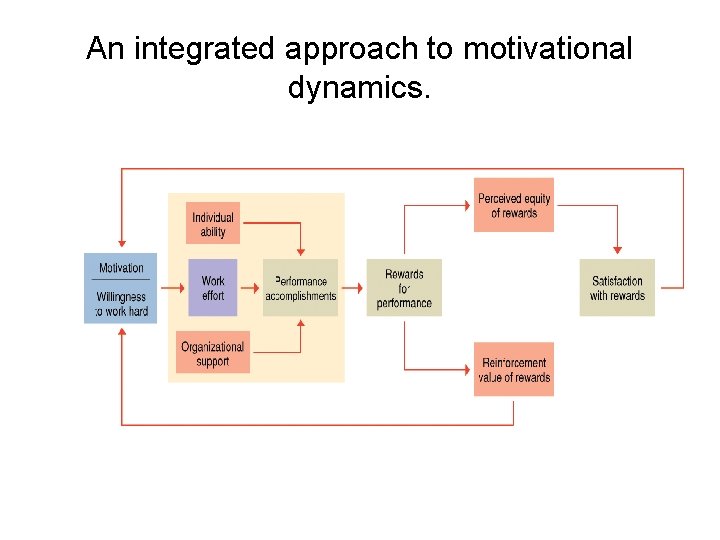
An integrated approach to motivational dynamics.
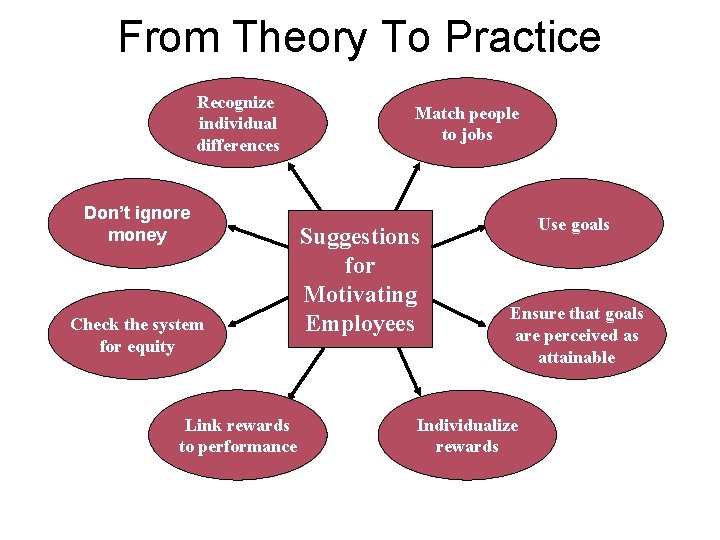
From Theory To Practice Recognize individual differences Don’t ignore money Check the system for equity Link rewards to performance Match people to jobs Suggestions for Motivating Employees Use goals Ensure that goals are perceived as attainable Individualize rewards
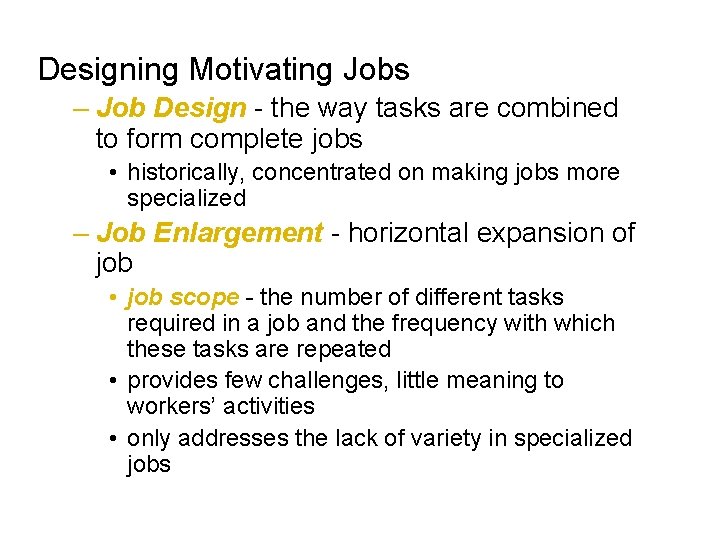
Designing Motivating Jobs – Job Design - the way tasks are combined to form complete jobs • historically, concentrated on making jobs more specialized – Job Enlargement - horizontal expansion of job • job scope - the number of different tasks required in a job and the frequency with which these tasks are repeated • provides few challenges, little meaning to workers’ activities • only addresses the lack of variety in specialized jobs
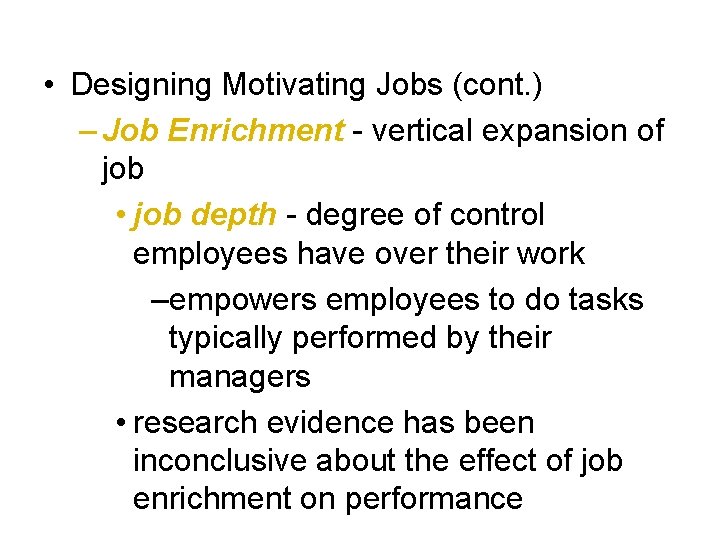
• Designing Motivating Jobs (cont. ) – Job Enrichment - vertical expansion of job • job depth - degree of control employees have over their work –empowers employees to do tasks typically performed by their managers • research evidence has been inconclusive about the effect of job enrichment on performance
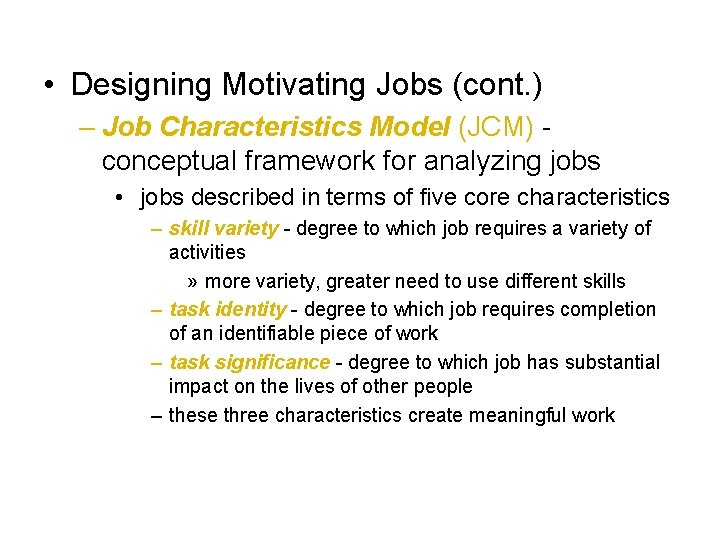
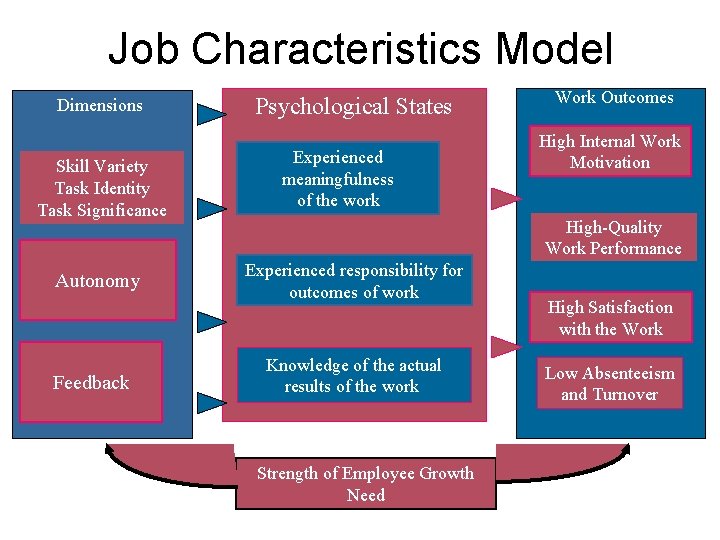
• Designing Motivating Jobs (cont. ) – Job Characteristics Model (JCM) conceptual framework for analyzing jobs • jobs described in terms of five core characteristics – skill variety - degree to which job requires a variety of activities » more variety, greater need to use different skills – task identity - degree to which job requires completion of an identifiable piece of work – task significance - degree to which job has substantial impact on the lives of other people – these three characteristics create meaningful work
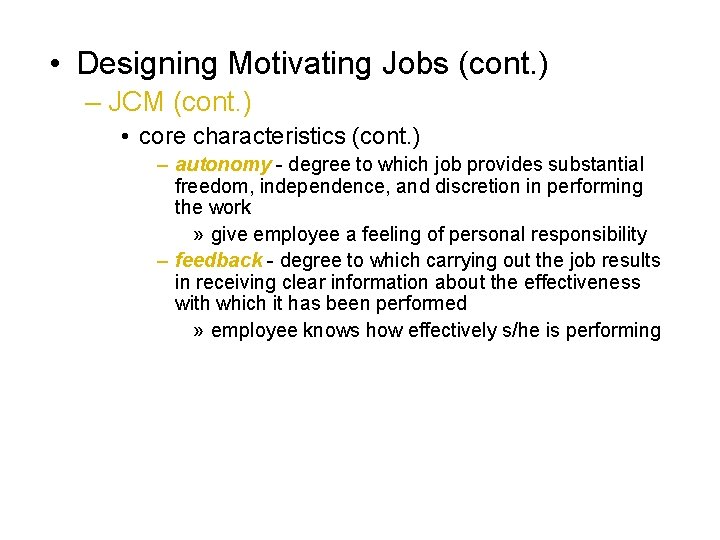
• Designing Motivating Jobs (cont. ) – JCM (cont. ) • core characteristics (cont. ) – autonomy - degree to which job provides substantial freedom, independence, and discretion in performing the work » give employee a feeling of personal responsibility – feedback - degree to which carrying out the job results in receiving clear information about the effectiveness with which it has been performed » employee knows how effectively s/he is performing
Job Characteristics Model Personal and Critical Core Job Dimensions Skill Variety Task Identity Task Significance Autonomy Feedback Psychological States Experienced meaningfulness of the work Work Outcomes High Internal Work Motivation High-Quality Work Performance Experienced responsibility for outcomes of work Knowledge of the actual results of the work Strength of Employee Growth Need High Satisfaction with the Work Low Absenteeism and Turnover
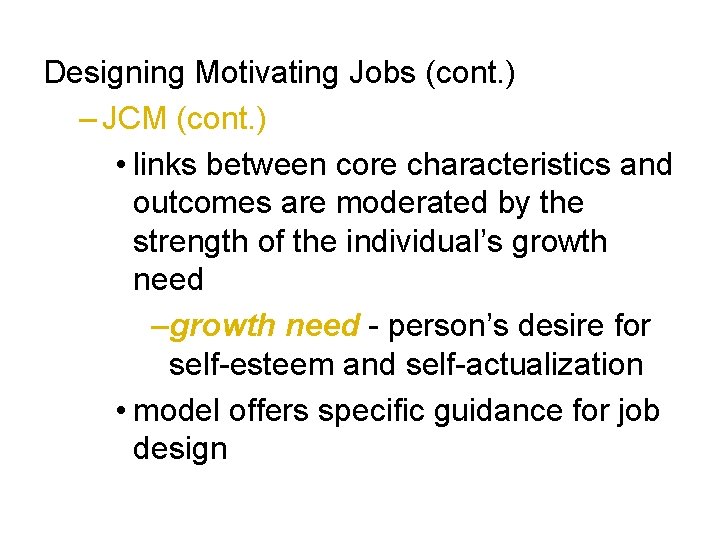
Designing Motivating Jobs (cont. ) – JCM (cont. ) • links between core characteristics and outcomes are moderated by the strength of the individual’s growth need –growth need - person’s desire for self-esteem and self-actualization • model offers specific guidance for job design
Current Issues In Motivation • Motivating a Diverse Workforce – flexibility is the key to motivating a diverse workforce • diverse array of rewards necessary to satisfy diverse personal needs and goals – Flexible Working Schedule • compressed workweek - employees work longer hours per day but fewer days per week
• Motivating a Diverse Workforce (cont. ) – Flexible Working Schedule (cont. ) • flexible work hours (flextime) - employees required to work a specific number of hours a week but are free to vary those hours within certain limits – system entails common core hours when all employees are required to be on the job – starting, ending, and lunch-hour times are flexible • job sharing - two or more people split a full-time job • telecommuting - employees work at home and are linked to the workplace by computer and modem
• Motivating a Diverse Workforce (cont. ) – Cultural Differences in Motivation • motivation theories developed in the U. S. and validated with American workers • may be some cross-cultural consistencies • Pay-for-Performance – instead of paying for time on the job, pay is adjusted to reflect some performance measure – compatible with expectancy theory • imparts strong performance-reward linkage – programs are gaining in popularity • research suggests that programs affect performance
• Open-Book Management – involve employees in workplace decisions by opening up the financial statements – workers treated as business partners – get workers to think like an owner – may also provide bonuses based on profit improvements • Motivating the “New Workforce” – Motivating Professionals - professionals tend to derive intrinsic satisfaction from their work and receive high pay • more loyal to their profession than their employer • value challenging jobs and support for their work
• Motivating the “New Workforce” (cont. ) – Motivating Contingent Workers - part-time, contract, or temporary workers • less security and stability than permanent employees – receive fewer benefits • display little identification or commitment to their employers • hard to motivate contingent workers – opportunity to become a permanent employee – opportunity for training • repercussions of mixing permanent and contingent workers when pay differentials are significant
• Motivating the “New Workforce” (cont. ) – Motivating Low-Skilled, Minimum-Wage Employees • difficult challenge to keep performance levels high • employee recognition programs – highlight employees whose work performance has been good – encourage others to perform better – power of praise • in service industries, empower front-line employees to address customers’ problems – tie compensation to customer satisfaction
What are the challenges of motivation in the new workplace? Ø Pay for performance – Paying people for performance is consistent with: • Equity theory. • Expectancy theory. • Reinforcement theory. – Merit pay • Awards a pay increase in proportion to individual performance contributions. • Provides performance contingent reinforcement. • May not succeed due to weakness in performance appraisal system or lack of consistency in application.
What are the challenges of motivation in the new workplace? Ø Incentive compensation systems: – Skill-based pay. • Links pay to the number of job-relevant skills an employee masters. – Bonus pay plans. • One-time or lump-sum payments based on the accomplishment of specific performance targets or some extraordinary contribution.
What are the challenges of motivation in the new workplace? Ø Incentive compensation systems: – Profit-sharing plans. • Some or all employees receive a proportion of net profits earned by the organization. – Gain-sharing plans. • Groups of employees share in any savings realized through their efforts to reduce costs and increase productivity. – Employee stock ownership plans. • Employees own stock in the company that employs them.