
Chapter 7 Motivation From Concepts to Applications 7

- Slides: 23
Chapter 7 Motivation: From Concepts to Applications 7 -0
Chapter Learning Objectives Ø After studying this chapter, you should be able to: – Describe the Job Characteristics Model and evaluate the way it motivates by changing the work environment. – Compare and contrast the three main ways jobs can be redesigned. – Identify three alternative work arrangements and show they might motive employees. – Give examples of employee involvement measures and show they can motivate employees. – Demonstrate how the different types of variable-pay programs can increase employee motivation. – Show flexible benefits turn benefits into motivators. – Identify the motivational benefits of intrinsic rewards. 7 -1
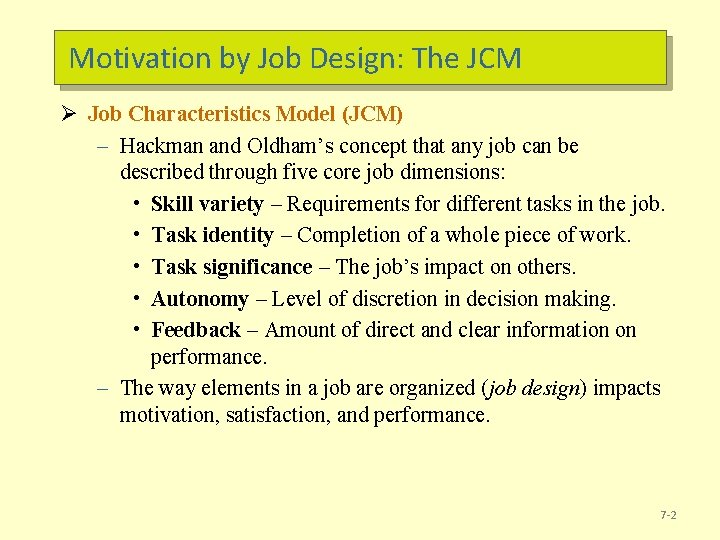
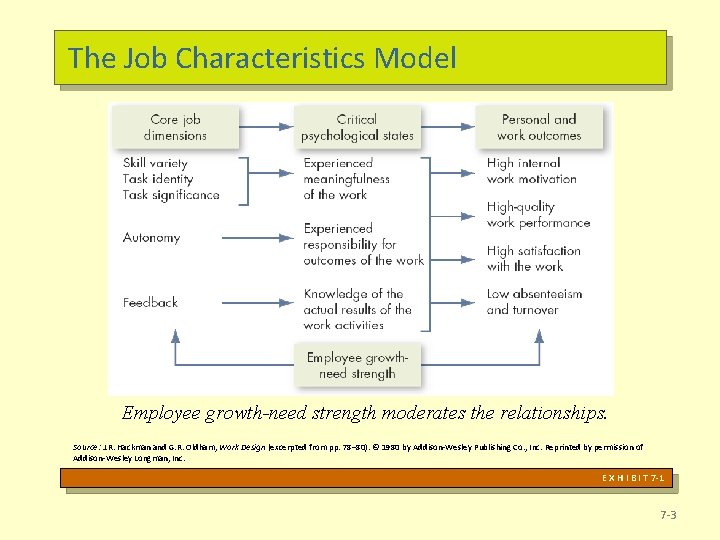
Motivation by Job Design: The JCM Ø Job Characteristics Model (JCM) – Hackman and Oldham’s concept that any job can be described through five core job dimensions: • Skill variety – Requirements for different tasks in the job. • Task identity – Completion of a whole piece of work. • Task significance – The job’s impact on others. • Autonomy – Level of discretion in decision making. • Feedback – Amount of direct and clear information on performance. – The way elements in a job are organized (job design) impacts motivation, satisfaction, and performance. 7 -2
The Job Characteristics Model Employee growth-need strength moderates the relationships. Source: J. R. Hackman and G. R. Oldham, Work Design (excerpted from pp. 78– 80). © 1980 by Addison-Wesley Publishing Co. , Inc. Reprinted by permission of Addison-Wesley Longman, Inc. E X H I B I T 7 -1 7 -3
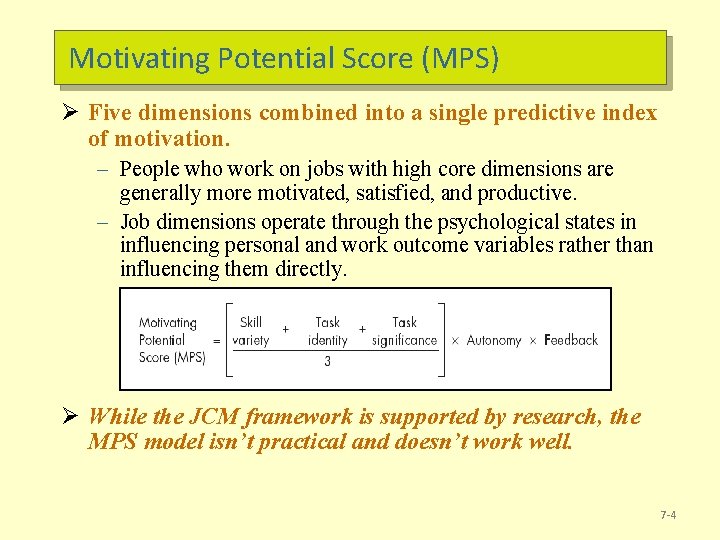
Motivating Potential Score (MPS) Ø Five dimensions combined into a single predictive index of motivation. – People who work on jobs with high core dimensions are generally more motivated, satisfied, and productive. – Job dimensions operate through the psychological states in influencing personal and work outcome variables rather than influencing them directly. Ø While the JCM framework is supported by research, the MPS model isn’t practical and doesn’t work well. 7 -4
How Can Jobs Be Redesigned? Ø Job Rotation – The periodic shifting of a worker from one task to another Ø Job Enlargement – The horizontal expansion of jobs Ø Job Enrichment – The vertical expansion of jobs 7 -5
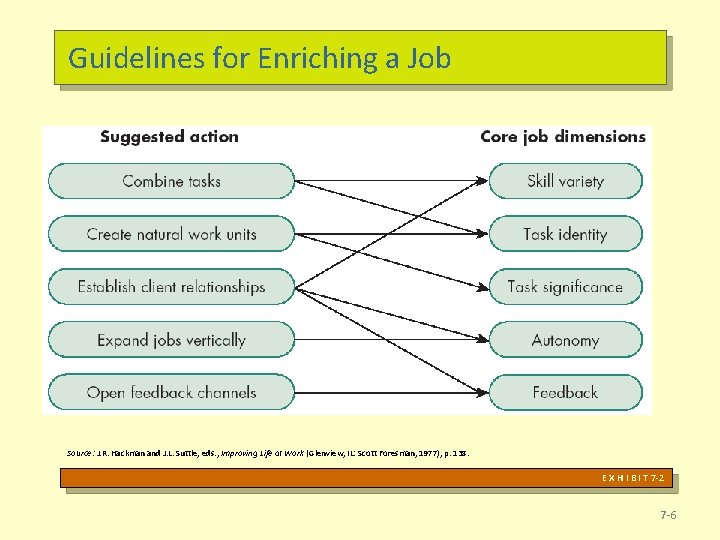
Guidelines for Enriching a Job Source: J. R. Hackman and J. L. Suttle, eds. , Improving Life at Work (Glenview, IL: Scott Foresman, 1977), p. 138. E X H I B I T 7 -2 7 -6
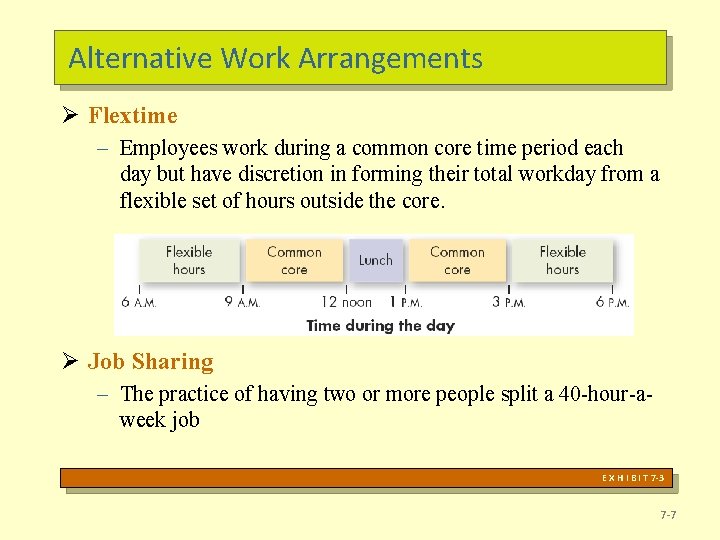
Alternative Work Arrangements Ø Flextime – Employees work during a common core time period each day but have discretion in forming their total workday from a flexible set of hours outside the core. Ø Job Sharing – The practice of having two or more people split a 40 -hour-aweek job E X H I B I T 7 -3 7 -7
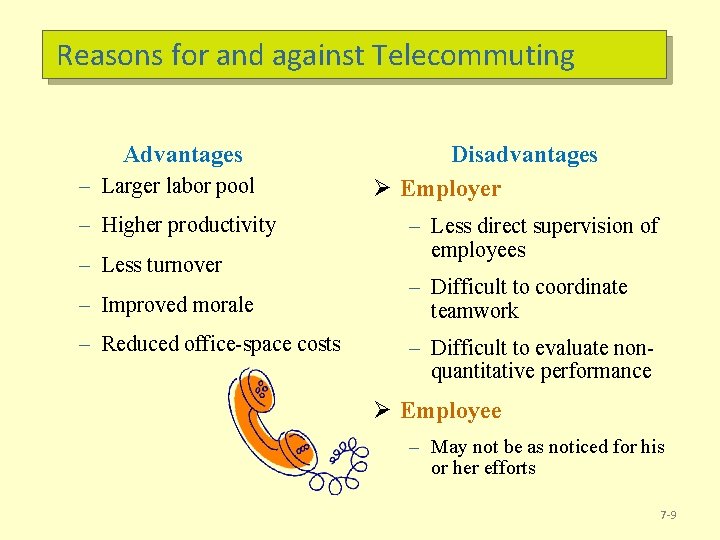
Another Alternative: Telecommuting Ø Telecommuting – Employees do their work at home at least two days a week on a computer that is linked to their office. Ø The Virtual Office – Employees work out of their home on a relatively permanent basis. Ø Typical Telecommuting Jobs – Professional and other knowledge-related tasks – Routine information-handling tasks – Mobile activities 7 -8
Reasons for and against Telecommuting Advantages – Larger labor pool – Higher productivity – Less turnover – Improved morale – Reduced office-space costs Disadvantages Ø Employer – Less direct supervision of employees – Difficult to coordinate teamwork – Difficult to evaluate nonquantitative performance Ø Employee – May not be as noticed for his or her efforts 7 -9
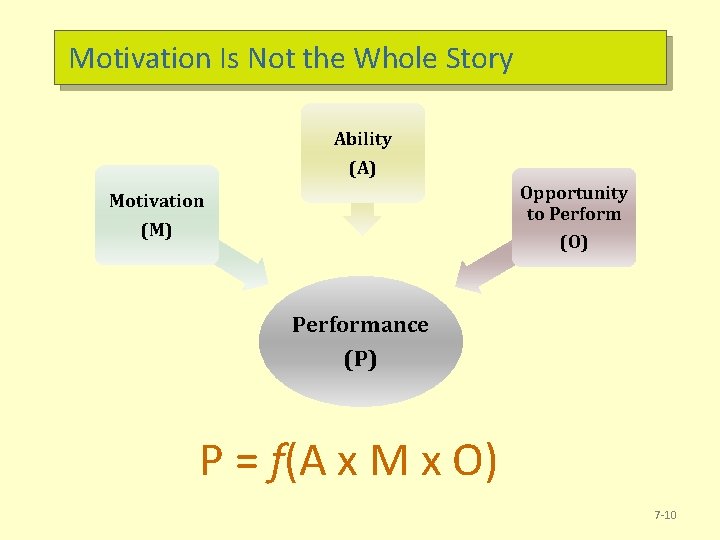
Motivation Is Not the Whole Story Ability (A) Opportunity to Perform Motivation (M) (O) Performance (P) P = f(A x M x O) 7 -10
Employee Involvement A participative process that uses the input of employees to increase their commitment to the organization’s success. ØBy increasing worker autonomy and control over work lives (involvement), organizations: – – Increase employee motivation Gain greater organizational commitment Experience greater worker productivity Observe higher levels of job satisfaction 7 -11
Types of Employee Involvement Programs Ø Participative Management – Subordinates share a significant degree of decision-making power with their immediate superiors Ø Representative Participation – Works councils • Groups of nominated or elected employees who must be consulted for any personnel decisions – Board representative • An employee sits on a company’s board of directors and represents the interests of the firm’s employees Ø Quality Circle – A work group of employees who meet regularly to discuss their quality problems, investigate causes, recommend solutions, and take corrective actions 7 -12
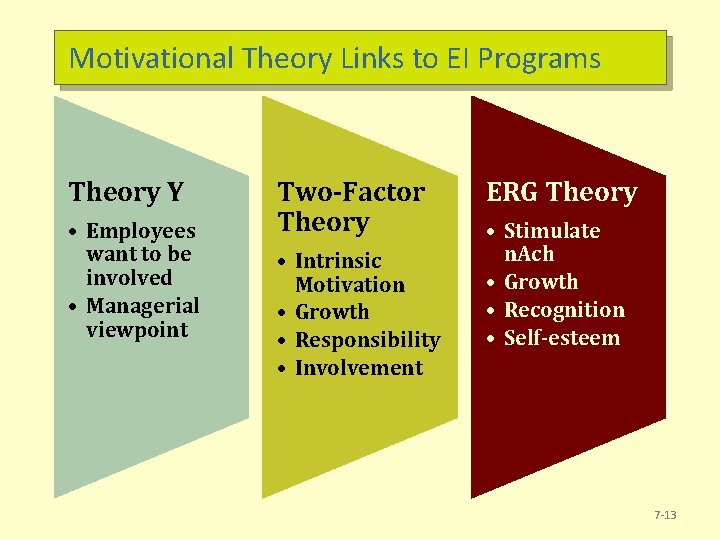
Motivational Theory Links to EI Programs Theory Y • Employees want to be involved • Managerial viewpoint Two-Factor Theory • Intrinsic Motivation • Growth • Responsibility • Involvement ERG Theory • Stimulate n. Ach • Growth • Recognition • Self-esteem 7 -13
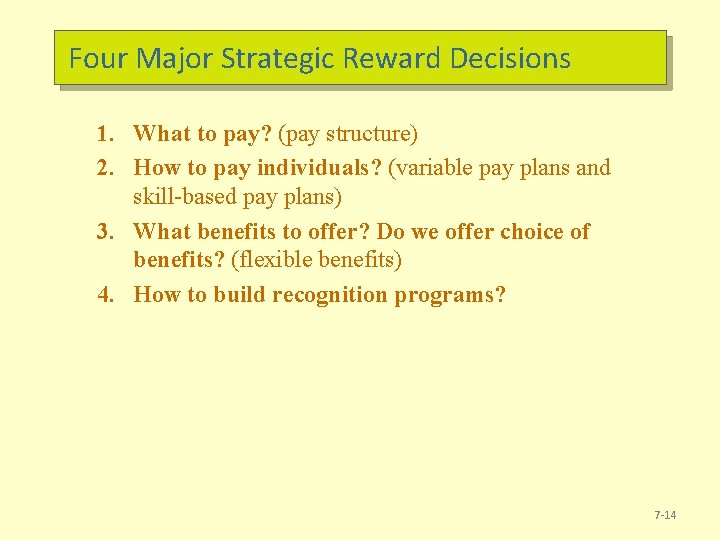
Four Major Strategic Reward Decisions 1. What to pay? (pay structure) 2. How to pay individuals? (variable pay plans and skill-based pay plans) 3. What benefits to offer? Do we offer choice of benefits? (flexible benefits) 4. How to build recognition programs? 7 -14
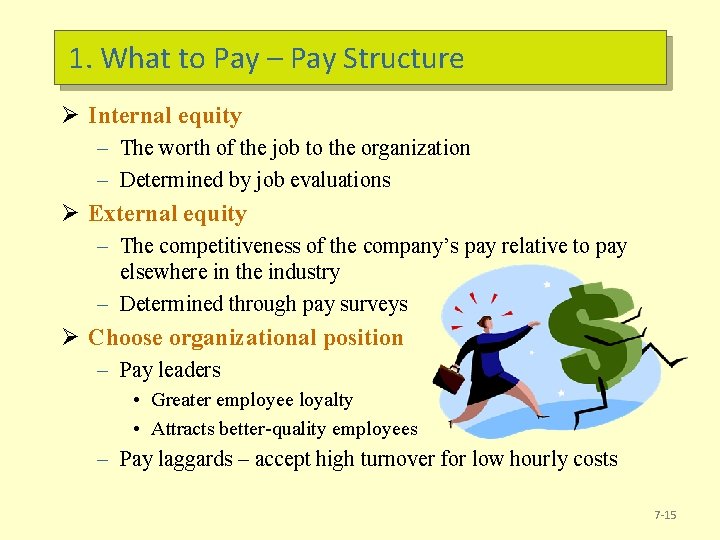
1. What to Pay – Pay Structure Ø Internal equity – The worth of the job to the organization – Determined by job evaluations Ø External equity – The competitiveness of the company’s pay relative to pay elsewhere in the industry – Determined through pay surveys Ø Choose organizational position – Pay leaders • Greater employee loyalty • Attracts better-quality employees – Pay laggards – accept high turnover for low hourly costs 7 -15
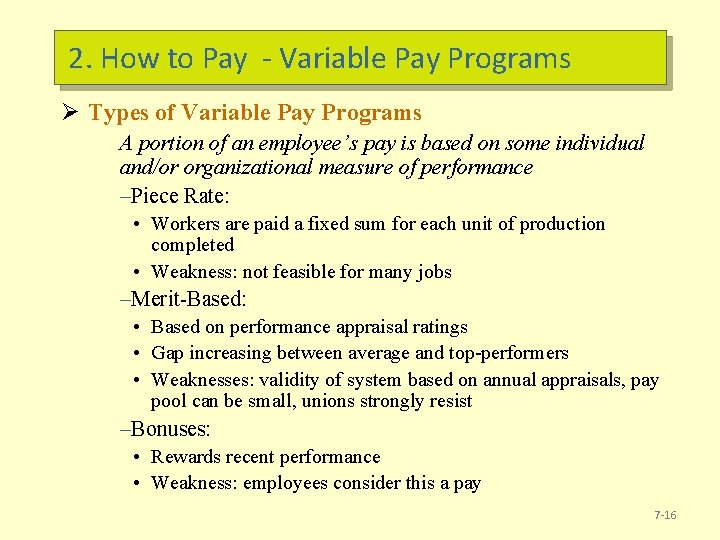
2. How to Pay - Variable Pay Programs Ø Types of Variable Pay Programs A portion of an employee’s pay is based on some individual and/or organizational measure of performance –Piece Rate: • Workers are paid a fixed sum for each unit of production completed • Weakness: not feasible for many jobs –Merit-Based: • Based on performance appraisal ratings • Gap increasing between average and top-performers • Weaknesses: validity of system based on annual appraisals, pay pool can be small, unions strongly resist –Bonuses: • Rewards recent performance • Weakness: employees consider this a pay 7 -16
2. How to Pay - Skill-Based Pay Programs Ø Types of Skill-Based Programs: Also known as competency- or knowledge-based pay - sets pay based on skills or number of jobs an employee can perform –Profit Sharing: • Organization-wide programs that distribute compensation based on some established formula designed around a company’s profitability –Gain Sharing: • An incentive plan in which improvements in group productivity determine the total amount of money that is allocated –Employee Stock Ownership Plans (ESOPs) • Company-established benefit plans in which employees acquire stock as part of their benefits 7 -17
Evaluation of Variable and Skill-based Pay To some extent, variable pay does increase motivation and productivity ØBenefits of Skill-based Pay Plans – – – Provide staffing flexibility Facilitate communication across the organization Lessen “protection of territory” behaviors Meet the needs of employees for advancement Lead to performance improvements ØDrawbacks: – Lack of additional learning opportunities – Continuing to pay employees for obsolete skills – Paying for skills of no immediate use to the organization – Paying for a skill, not for performance of the skill 7 -18
3. What Benefits to Offer - Flexible Benefits Employees tailor their benefit program to meet their personal need by picking and choosing from a menu of benefit options. ØModular Plans – Predesigned benefits packages for specific groups of employees ØCore-Plus Plans – A core of essential benefits and a menu-like selection of other benefit options ØFlexible Spending Plans – Allow employees to use their tax-free benefit dollars to purchase benefits and pay service premiums 7 -19
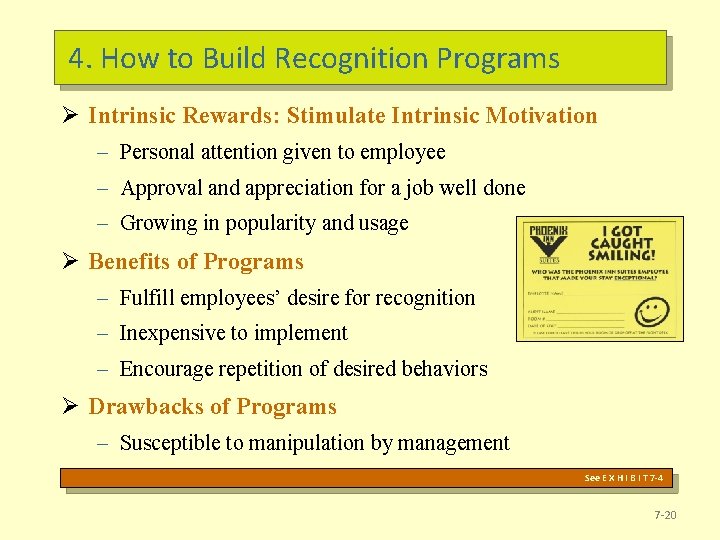
4. How to Build Recognition Programs Ø Intrinsic Rewards: Stimulate Intrinsic Motivation – Personal attention given to employee – Approval and appreciation for a job well done – Growing in popularity and usage Ø Benefits of Programs – Fulfill employees’ desire for recognition – Inexpensive to implement – Encourage repetition of desired behaviors Ø Drawbacks of Programs – Susceptible to manipulation by management See E X H I B I T 7 -4 7 -20
Global Implications Ø Job Characteristics and Job Enrichment – Inconsistent results across cultures Ø Telecommuting – U. S. does this more, but EU workers are interested in it Ø Variable Pay – Not much research available, but some possible hypotheses on relationships Ø Flexible Benefits – This concept is becoming more prevalent globally Ø Employee Benefits – Practices must be modified to match culture 7 -21
Summary and Managerial Implications Ø To Motivate Employees – Recognize individual differences – Use goals and feedback – Allow employees to participate in decisions that affect them – Link rewards to performance – Check the reward system for equity 7 -22