
Chapter 7 Memory Essentials of Psychology 5 th
- Slides: 25
Chapter 7: Memory Essentials of Psychology, 5 th Edition Stephen L. Franzoi © 2014 BVT Publishing Better textbooks, better prices.
Chapter Outline The Nature of Memory What Constitutes Long -Term Memory How Does Forgetting Occur? What Is the Biological Basis for Memories? How Do We Retrieve Information from Memory? Essentials of Psychology, 5 th Edition Stephen L. Franzoi © 2014 BVT Publishing Better textbooks, better prices.
Learning Objectives Understand the different models of memory. Understand how longterm memory is organized. Essentials of Psychology, 5 th Edition Stephen L. Franzoi © 2014 Understand some of the causes of memory retrieval can cause difficulties. Understand how and why forgetting can occur. BVT Publishing Better textbooks, better prices.
Definition of Memory is the mental process by which information is encoded and stored in the brain and later retrieved. How much do you think human memory can hold? Essentials of Psychology, 5 th Edition Stephen L. Franzoi © 2014 BVT Publishing Better textbooks, better prices.
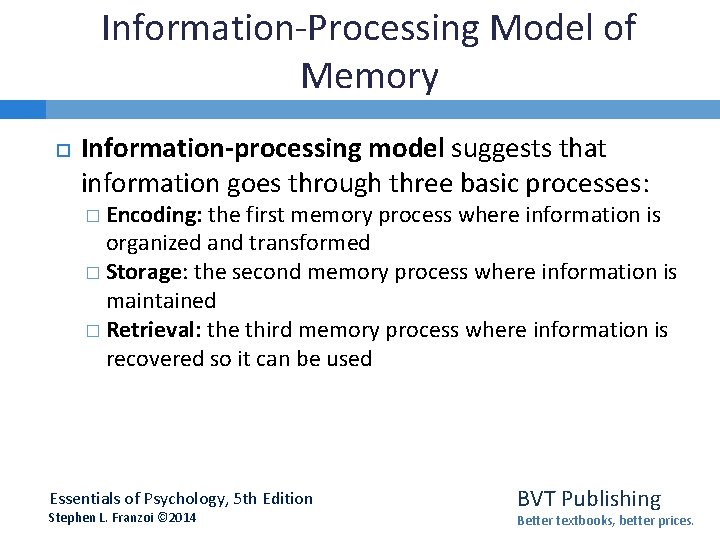
Information-Processing Model of Memory Information-processing model suggests that information goes through three basic processes: � Encoding: the first memory process where information is organized and transformed � Storage: the second memory process where information is maintained � Retrieval: the third memory process where information is recovered so it can be used Essentials of Psychology, 5 th Edition Stephen L. Franzoi © 2014 BVT Publishing Better textbooks, better prices.
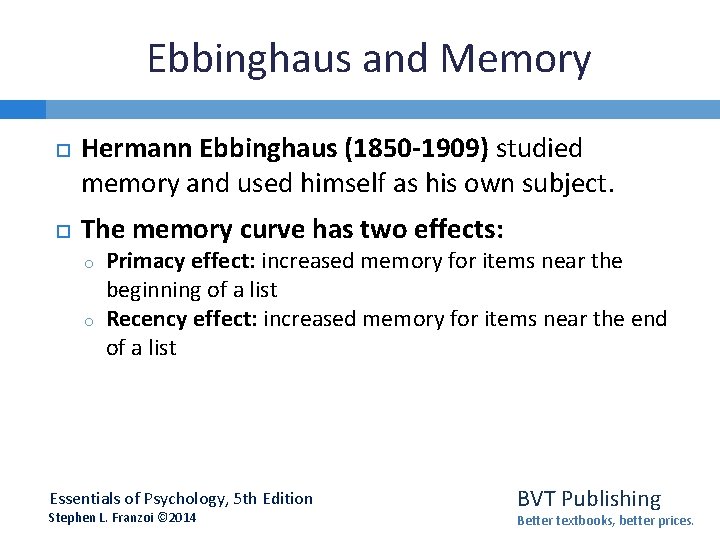
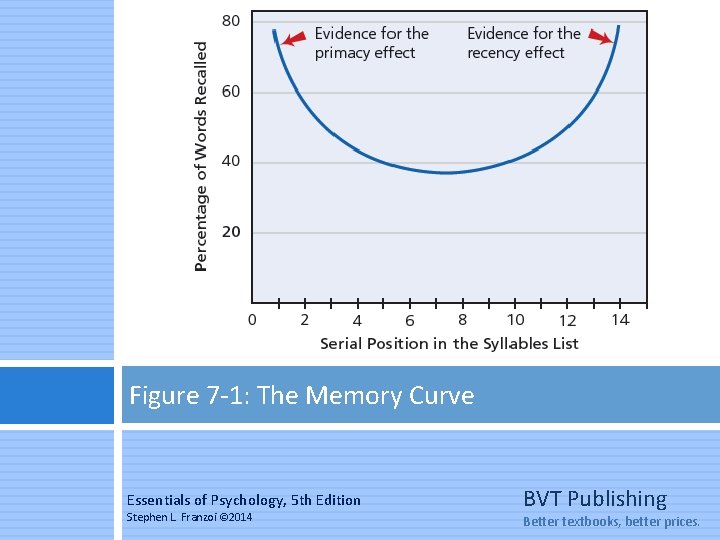
Ebbinghaus and Memory Hermann Ebbinghaus (1850 -1909) studied memory and used himself as his own subject. The memory curve has two effects: o o Primacy effect: increased memory for items near the beginning of a list Recency effect: increased memory for items near the end of a list Essentials of Psychology, 5 th Edition Stephen L. Franzoi © 2014 BVT Publishing Better textbooks, better prices.
Figure 7 -1: The Memory Curve Essentials of Psychology, 5 th Edition Stephen L. Franzoi © 2014 BVT Publishing Better textbooks, better prices.
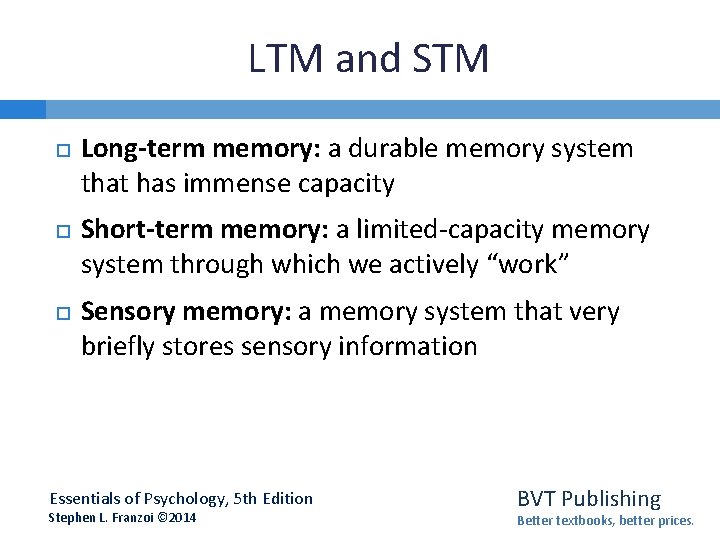
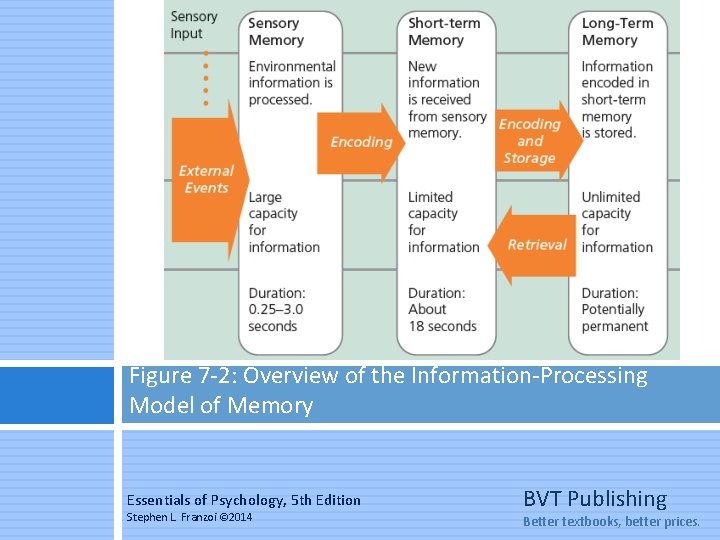
LTM and STM Long-term memory: a durable memory system that has immense capacity Short-term memory: a limited-capacity memory system through which we actively “work” Sensory memory: a memory system that very briefly stores sensory information Essentials of Psychology, 5 th Edition Stephen L. Franzoi © 2014 BVT Publishing Better textbooks, better prices.
Figure 7 -2: Overview of the Information-Processing Model of Memory Essentials of Psychology, 5 th Edition Stephen L. Franzoi © 2014 BVT Publishing Better textbooks, better prices.
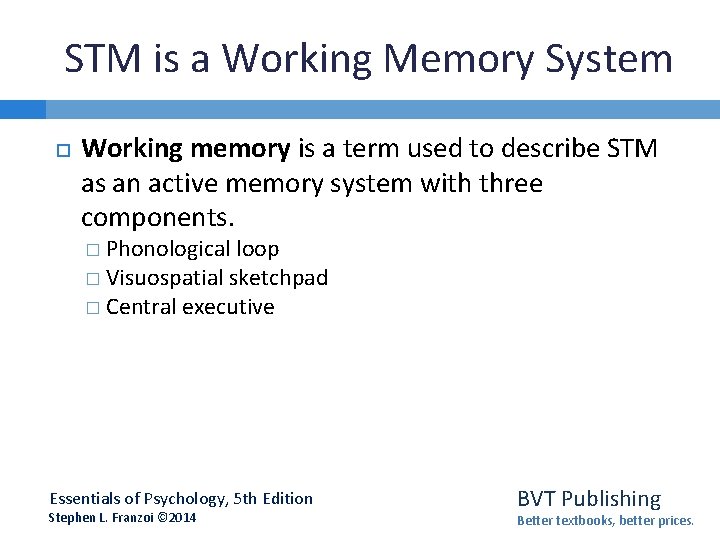
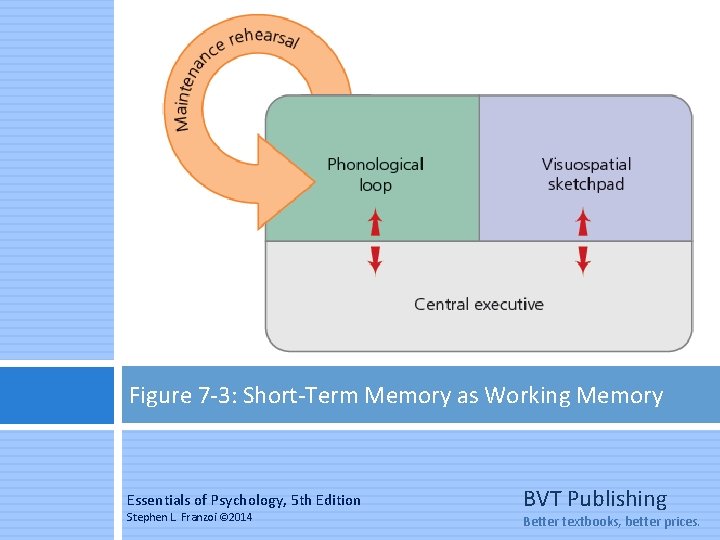
STM is a Working Memory System Working memory is a term used to describe STM as an active memory system with three components. � Phonological loop � Visuospatial sketchpad � Central executive Essentials of Psychology, 5 th Edition Stephen L. Franzoi © 2014 BVT Publishing Better textbooks, better prices.
Figure 7 -3: Short-Term Memory as Working Memory Essentials of Psychology, 5 th Edition Stephen L. Franzoi © 2014 BVT Publishing Better textbooks, better prices.
Memory and Rehearsal Maintenance rehearsal is the process of repetitively verbalizing or thinking about information past the 18 th-second duration of STM. Elaborative rehearsal involves thinking about how new information relates to information already stored in LTM. Essentials of Psychology, 5 th Edition Stephen L. Franzoi © 2014 BVT Publishing Better textbooks, better prices.
Shallow vs. Deep Processing Shallow processing involves encoding information superficially. Deep processing involves encoding information in terms of its meaning. Do you memorize words or try to make meaning of them? Essentials of Psychology, 5 th Edition Stephen L. Franzoi © 2014 BVT Publishing Better textbooks, better prices.
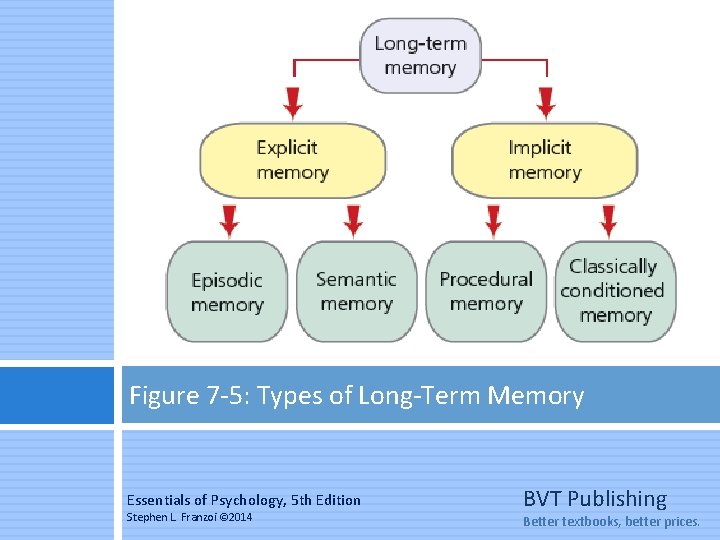
Explicit Memory Explicit memory is memory of previous experiences that one can consciously recollect. Episodic memory is memory for factual information, acquired at a specific time and place (e. g. , vacation). Semantic memory is memory for general knowledge about the world that is not associated with a time and place when the information was learned (e. g. , the first president of the U. S. ). Essentials of Psychology, 5 th Edition Stephen L. Franzoi © 2014 BVT Publishing Better textbooks, better prices.
Implicit Memory Implicit memory is memory of previous experiences without conscious recollection (e. g. , feeling uneasy). Priming is activating implicit memories in which a recently presented bit of information primes responses. Procedural memory is memory of how to perform skilled motor activities that have become welllearned (e. g. , cooking). Essentials of Psychology, 5 th Edition Stephen L. Franzoi © 2014 BVT Publishing Better textbooks, better prices.
Figure 7 -5: Types of Long-Term Memory Essentials of Psychology, 5 th Edition Stephen L. Franzoi © 2014 BVT Publishing Better textbooks, better prices.
Semantic Network Model Semantic network model describes concepts in LTM organized in a complex network of associations. Concept is a a cluster of objects, ideas, or events that share common properties and are linked to to other concepts in memory (e. g. , snow and winter). Essentials of Psychology, 5 th Edition Stephen L. Franzoi © 2014 BVT Publishing Better textbooks, better prices.
Parallel Distributed-Processing Model Parallel distributed-processing model is a model in which a large network of interconnected neurons distributed throughout the brain simultaneously work on different memory tasks. Processing units are a large network of interconnected neurons. Essentials of Psychology, 5 th Edition Stephen L. Franzoi © 2014 BVT Publishing Better textbooks, better prices.
Memory Retrieval (Slide 1 of 2) Recall is a measure of explicit memory in which a person must retrieve and reproduce information from memory. Recognition is a measure of explicit memory in which a person need only decide whether or not something has been previously encountered. Tip-of-the-tongue phenomenon is the temporary inability to remember something you know with the feeling that it is beyond your conscious state. Essentials of Psychology, 5 th Edition Stephen L. Franzoi © 2014 BVT Publishing Better textbooks, better prices.
Memory Retrieval (Slide 2 of 2) Retrieval cue is a stimulus that allows us to more easily recall information from LTM. State- dependent memory is the tendency for retrieval from memory to be better when our state of mind during retrieval matches our state during encoding. Encoding specificity principle states that retrieving information from LTM occurs most often when the conditions at retrieval match original learning conditions. Essentials of Psychology, 5 th Edition Stephen L. Franzoi © 2014 BVT Publishing Better textbooks, better prices.
Flashbulb Memories Flashbulb memories are detailed and vivid memories of surprising and emotion-provoking events. Can you think of an example of a flashbulb memory? Essentials of Psychology, 5 th Edition Stephen L. Franzoi © 2014 BVT Publishing Better textbooks, better prices.
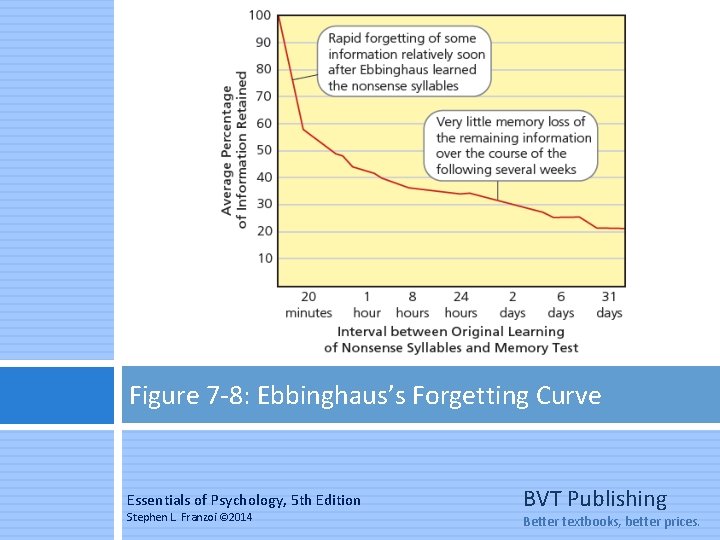
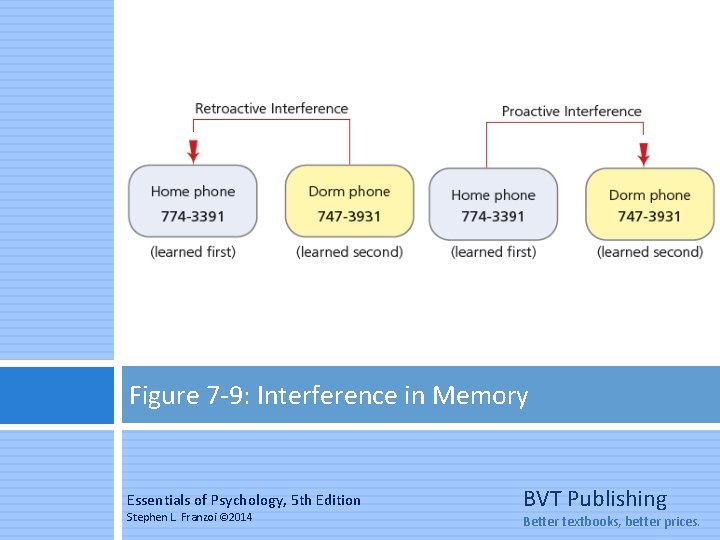
Forgetting due to Interference Decay is forgetting due to the passage of time. Retroactive interference is forgetting due to interference from newly learned information. Proactive interference is forgetting due to interference from previously learned information. Essentials of Psychology, 5 th Edition Stephen L. Franzoi © 2014 BVT Publishing Better textbooks, better prices.
Figure 7 -8: Ebbinghaus’s Forgetting Curve Essentials of Psychology, 5 th Edition Stephen L. Franzoi © 2014 BVT Publishing Better textbooks, better prices.
Figure 7 -9: Interference in Memory Essentials of Psychology, 5 th Edition Stephen L. Franzoi © 2014 BVT Publishing Better textbooks, better prices.
Amnesia Anterograde amnesia is the inability to form longterm memories due to physical injury to the brain. � Hippocampus is critical for LTM formation Retrograde amnesia is the loss of information previously stored in LTM due to physical injury to the brain. Infantile amnesia the inability to remember events that occurred before 3 years of age. Essentials of Psychology, 5 th Edition Stephen L. Franzoi © 2014 BVT Publishing Better textbooks, better prices.