
Chapter 7 Memory Copyright Allyn Bacon 2007 What
Chapter 7 Memory Copyright © Allyn & Bacon 2007
What is Memory? Human memory is an information processing system that works constructively to encode, store, and retrieve information Copyright © Allyn & Bacon 2007
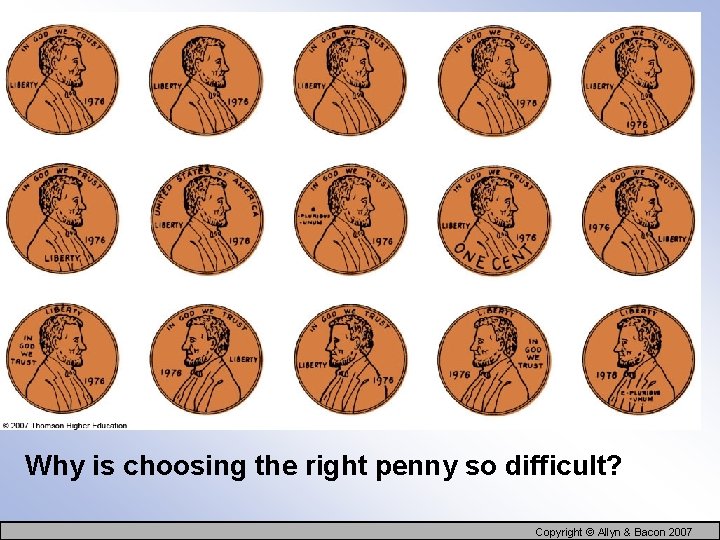
Why is choosing the right penny so difficult? Copyright © Allyn & Bacon 2007
It’s difficult because. . . 1. We haven’t encoded that info. 2. We haven’t stored that info. 3. Therefore, we cannot retrieve it easily. Copyright © Allyn & Bacon 2007
What is pseudoforgetting? Pseudoforgetting (false forgetting) is a failure to encode the information. You didn’t forget; you just never cared enough to pay attention! (pseudo = false) Copyright © Allyn & Bacon 2007
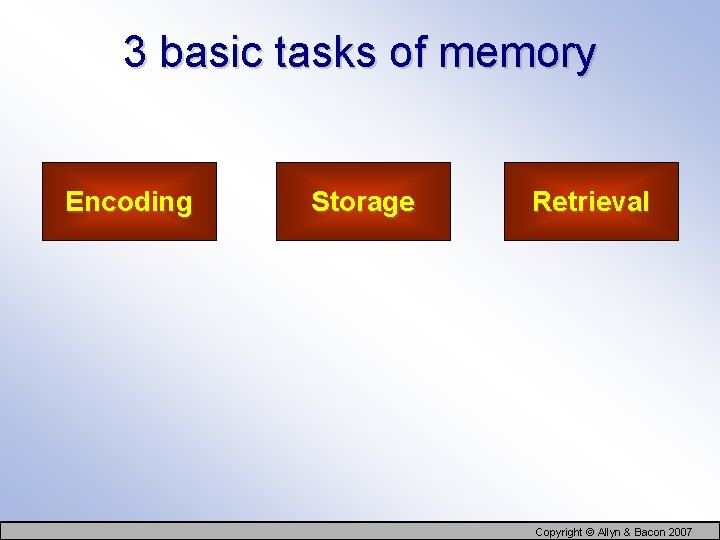
3 basic tasks of memory Encoding Storage Retrieval Copyright © Allyn & Bacon 2007
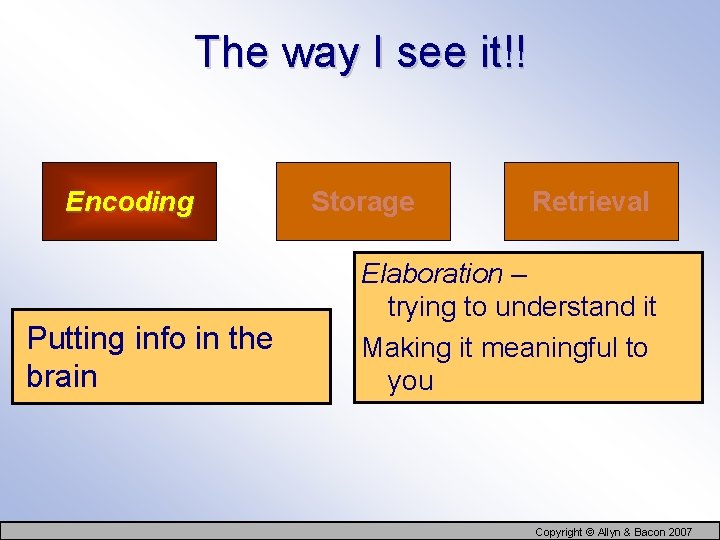
The way I see it!! Encoding Putting info in the brain Storage Retrieval Elaboration – trying to understand it Making it meaningful to you Copyright © Allyn & Bacon 2007
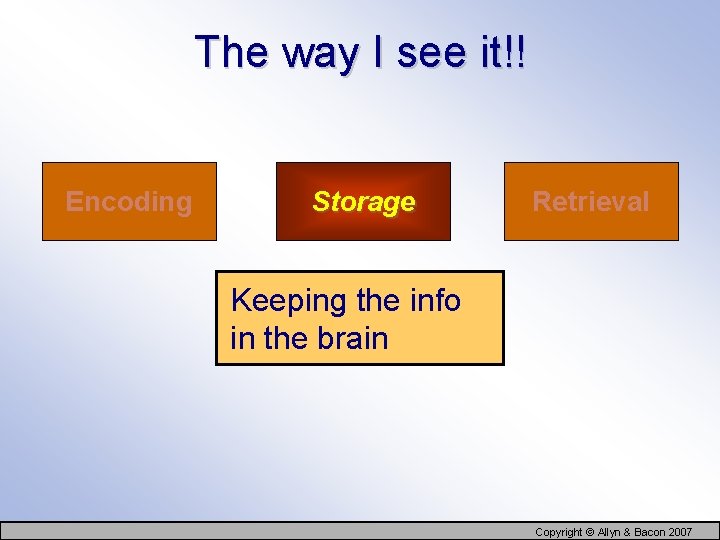
The way I see it!! Encoding Storage Retrieval Keeping the info in the brain Copyright © Allyn & Bacon 2007
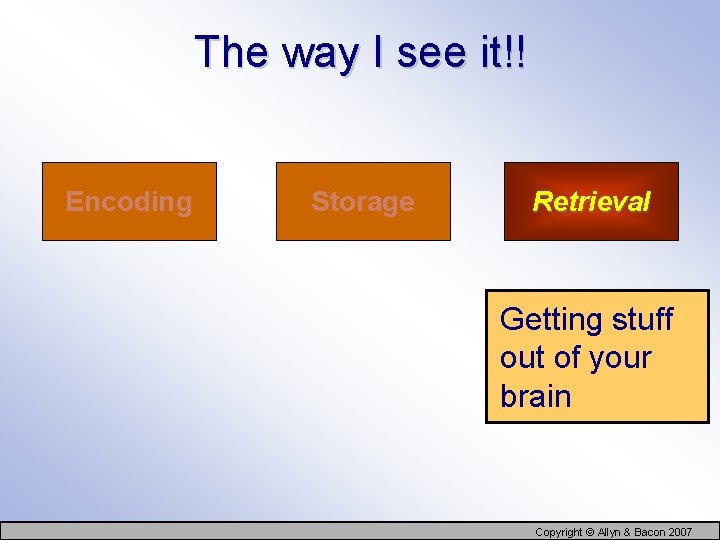
The way I see it!! Encoding Storage Retrieval Getting stuff out of your brain Copyright © Allyn & Bacon 2007

Now, use computer terminology to describe the levels of processes (of memory)! Copyright © Allyn & Bacon 2007
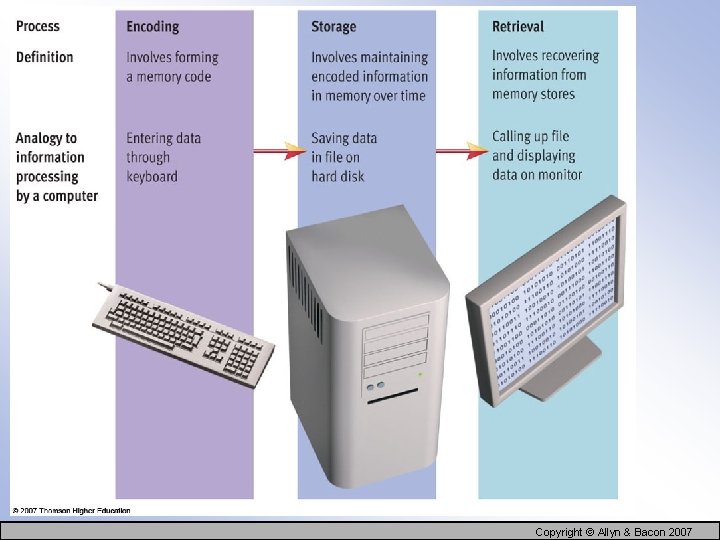
Copyright © Allyn & Bacon 2007
Review Getting information into the brain is called _____; getting information out of memory is called ______. a. storage; retrieval b. Encoding; storage c. Encoding; retrieval d. Storage; encoding Copyright © Allyn & Bacon 2007
Let’s talk about encoding. Copyright © Allyn & Bacon 2007
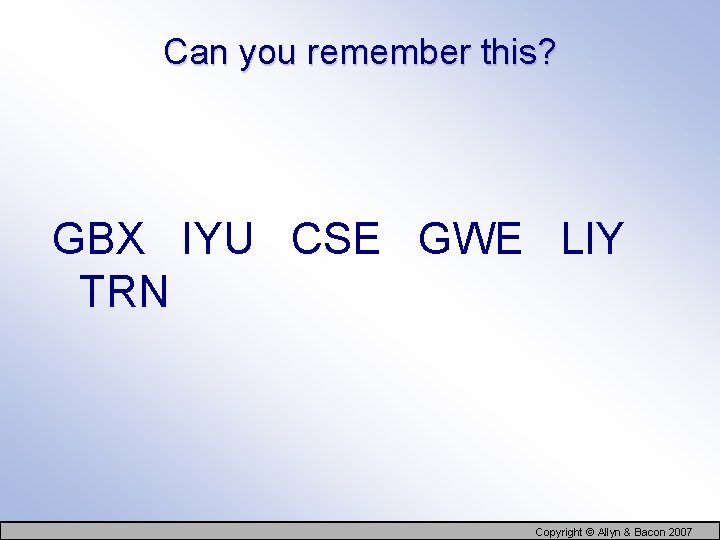
Can you remember this? GBX IYU CSE GWE LIY TRN Copyright © Allyn & Bacon 2007
It’s tough. You might remember the structure (all capital letters). That’s structural encoding. Copyright © Allyn & Bacon 2007
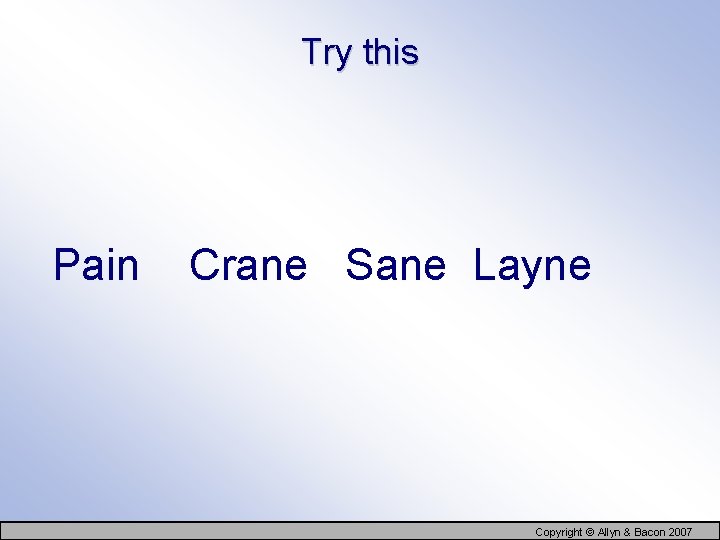
Try this Pain Crane Sane Layne Copyright © Allyn & Bacon 2007
Phonemic or acoustic Encoding That was easier because they all rhymed. Remembering sounds is easier than remembering structure. Copyright © Allyn & Bacon 2007
Semantic encoding “Semantic” means meaning. We remember stuff that has meaning better than their structure and sounds. Copyright © Allyn & Bacon 2007

Try this. Apples are grown in Washington. Copyright © Allyn & Bacon 2007
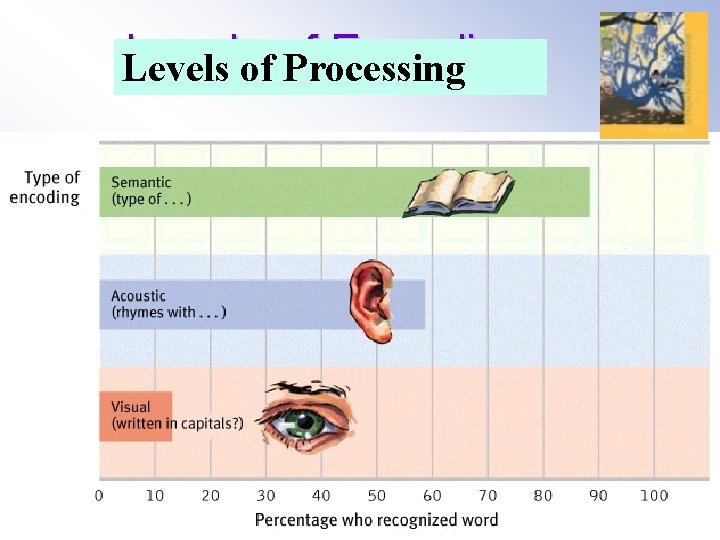
Levels of Encoding Levels of Processing Copyright © Allyn & Bacon 2007
Review The word “big” is flashed on the screen. A mental picture of the word big represents a ______ code; the definition “large in size” represents a ______ code; “sounds like pig” represents a _______ code. a. structural; phonemic; semantic b. Phonemic; semantic; structural c. Structural; semantic; phonemic d. Phonemic; structural; semantic Copyright © Allyn & Bacon 2007
In a memory study, the experimenter reads the same list of words to two groups. She asks group A to count the letters in each word, and she asks group B to focus on the meaning of each word for a later memory quiz. During a recall test, participants in group B recall significantly more words than participants in group A. Memory researchers attribute this effect to differences in (A) priming (B) levels of processing (C) proactive interference (D) procedural memory (E) episodic memory Copyright © Allyn & Bacon 2007
A memory code that emphasizes the meaning of the verbal input is called a) a structural code b) a phonemic code c) a semantic code d) an episodic code Copyright © Allyn & Bacon 2007
According to the levels of processing theory of memory a) we remember items that are repeated again and again b) maintenance rehearsal will encode items into our long-term memory c) deep processing involves elaborative rehearsal, ensuring encoding into long-term memory d) input, output, and storage are three levels Copyright © Allyn & Bacon 2007
What is serial positioning effect? Imagine a grocery list: milk, eggs, butter, bread, celery, chocolate, Big Red, Beans, chips. We most likely will remember the first few items and the last few. Copyright © Allyn & Bacon 2007
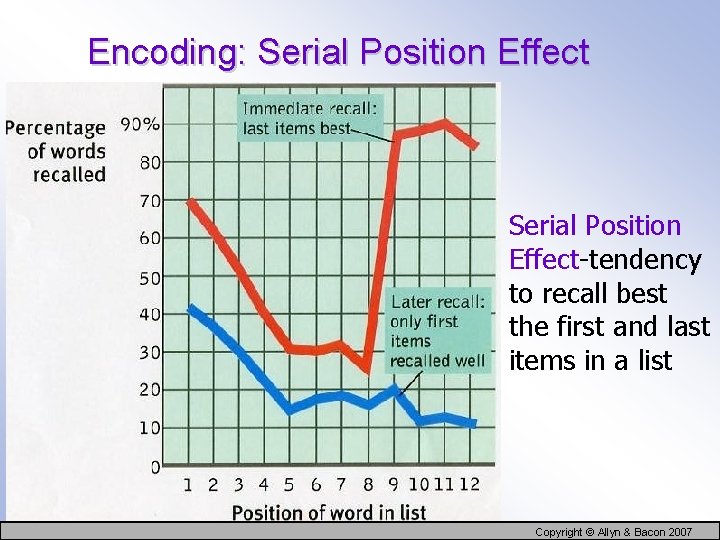
Encoding: Serial Position Effect-tendency to recall best the first and last items in a list Copyright © Allyn & Bacon 2007
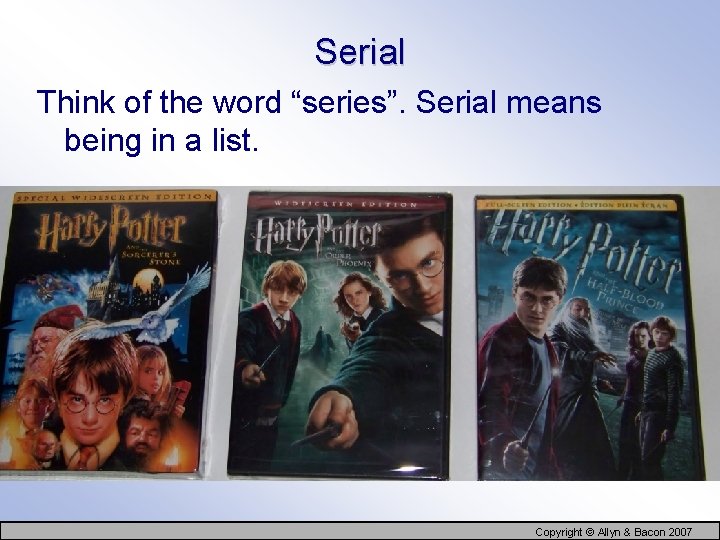
Serial Think of the word “series”. Serial means being in a list. Copyright © Allyn & Bacon 2007
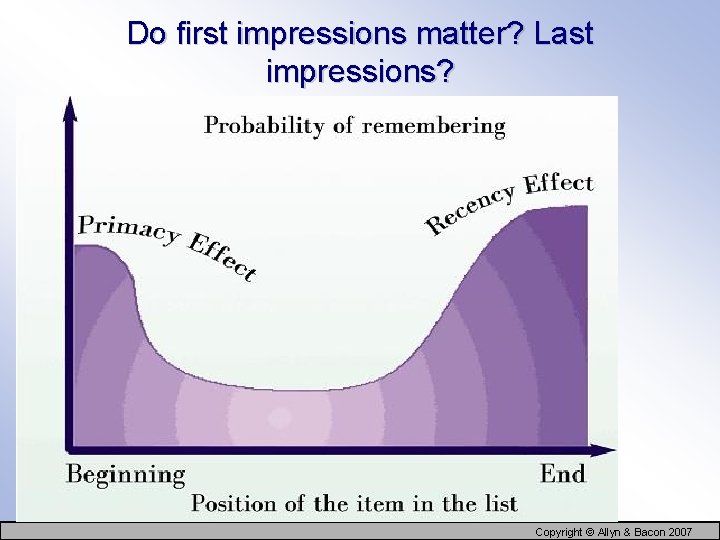
Do first impressions matter? Last impressions? Copyright © Allyn & Bacon 2007
When Sue memorized her shopping list, she got to the store and forgot many items from the middle of the list. This is due to the a. Inappropriate encoding b. Retrograde amnesia c. Proactive interference d. The serial-position effect Copyright © Allyn & Bacon 2007
3. Doug wrote a grocery list of 10 items, but leaves it at home. The list included in order: peas, corn, squash, onions, apples, pears, bananas, flour, milk, and eggs. If the law of primacy holds, which of the following is Doug most likely to remember when he gets to the store? a) peas, pears, eggs b) banana, flour, peas c) apples, pears, bananas d) peas, corn, squash Copyright © Allyn & Bacon 2007
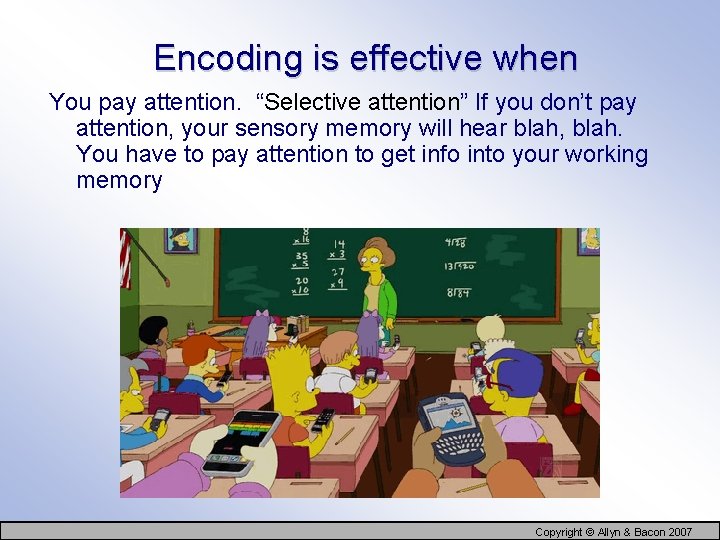
Encoding is effective when You pay attention. “Selective attention” If you don’t pay attention, your sensory memory will hear blah, blah. You have to pay attention to get info into your working memory Copyright © Allyn & Bacon 2007
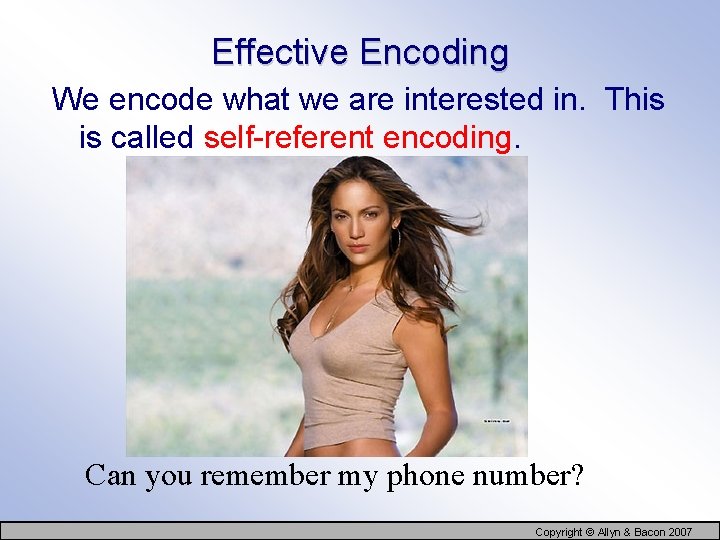
Effective Encoding We encode what we are interested in. This is called self-referent encoding. Can you remember my phone number? Copyright © Allyn & Bacon 2007
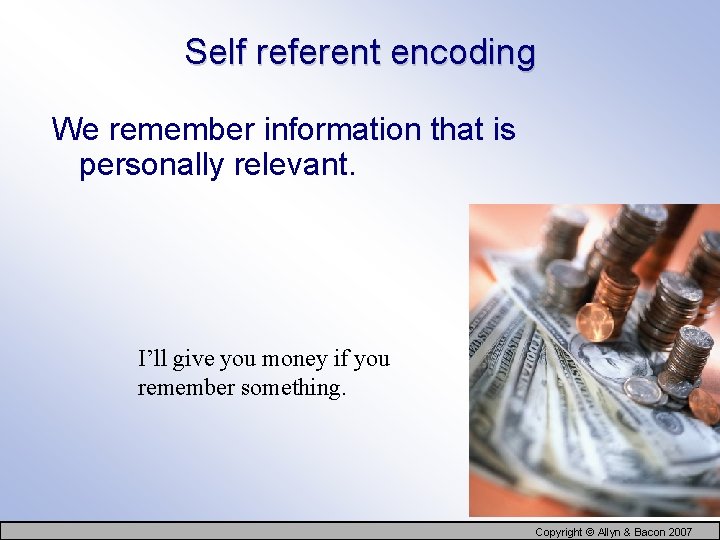
Self referent encoding We remember information that is personally relevant. I’ll give you money if you remember something. Copyright © Allyn & Bacon 2007
State dependent memory and mood congruence We remember things better when tested when we are in the same mood or state of mind as we were when we encoded the information. Copyright © Allyn & Bacon 2007
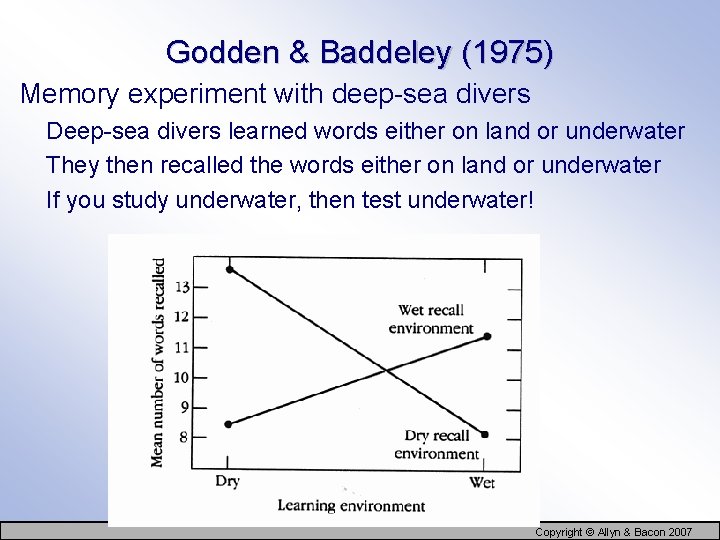
Godden & Baddeley (1975) Memory experiment with deep-sea divers Deep-sea divers learned words either on land or underwater They then recalled the words either on land or underwater If you study underwater, then test underwater! Copyright © Allyn & Bacon 2007
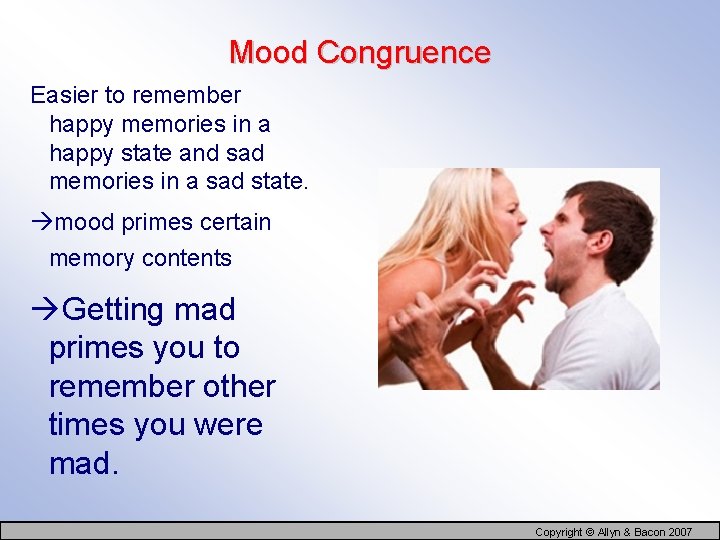
Mood Congruence Easier to remember happy memories in a happy state and sad memories in a sad state. àmood primes certain memory contents àGetting mad primes you to remember other times you were mad. Copyright © Allyn & Bacon 2007
If a subject is asked to remember this list of numbers in 10 seconds: 48, 31, 45, 76, 97, 84, 26, 12, 67, which numbers will she most likely remember? a. 84, 45 b. 48, 67 c. 12, 31 d. 97, 76 Copyright © Allyn & Bacon 2007
Dan was drunk, so his girlfriend convinced him to get out of his car, and she drove him home in her car. He could not remember where his car was parked when he got up the next morning, but after drinking some liquor, Dan remembered where he left his car. This phenomenon best illustrates: a) the misinformation effect b) mood-congruent memory c) the framing effect d) state-dependent memory Copyright © Allyn & Bacon 2007
Now let’s talk about storage Each of the three memory stages encodes and stores memories in a different way, but they work together to transform sensory experience into a lasting record that has a pattern of meaning Copyright © Allyn & Bacon 2007
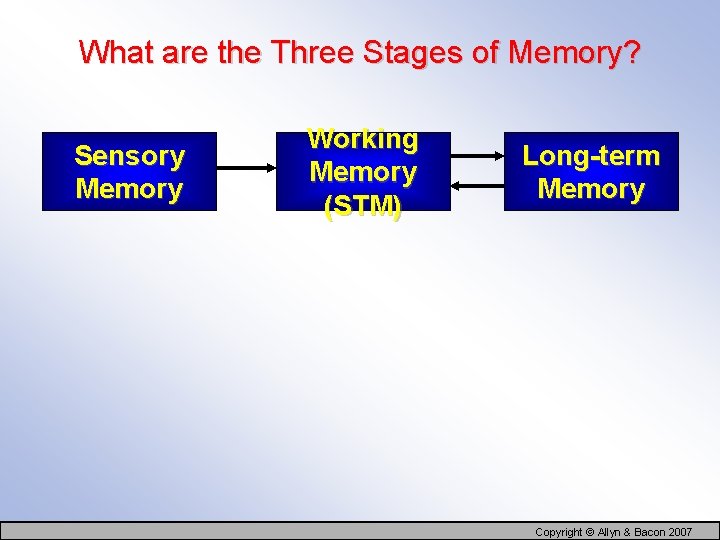
What are the Three Stages of Memory? Sensory Memory Working Memory (STM) Long-term Memory Copyright © Allyn & Bacon 2007
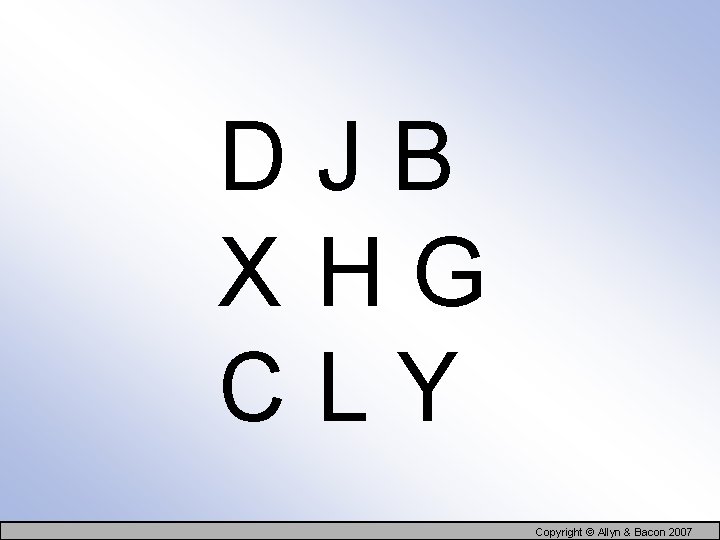
The First Stage: Sensory Memory On the next slide, you will see a series of letters for one second Try to remember as many letters as you can Copyright © Allyn & Bacon 2007
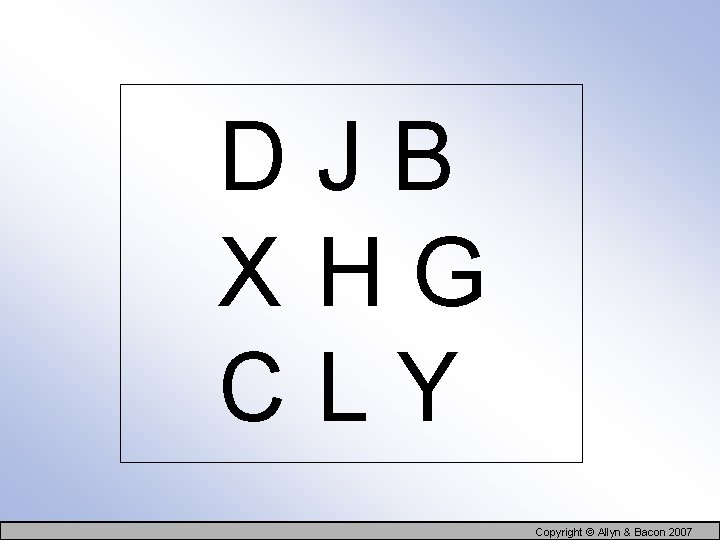
D J B X H G C L Y Copyright © Allyn & Bacon 2007
The First Stage: Sensory Memory How many can you recall? Copyright © Allyn & Bacon 2007
D J B X H G C L Y Copyright © Allyn & Bacon 2007
Sensory memory lasts no more than 2 seconds. The precise length of different types of sensory memories differs (e. g. , visual sensory memory is shorter than auditory). Copyright © Allyn & Bacon 2007
Sensory Memory Sensory memory traces fade fairly rapidly. We simply lose the information UNLESS we do something further with it. Did you remember when I clapped earlier? Copyright © Allyn & Bacon 2007
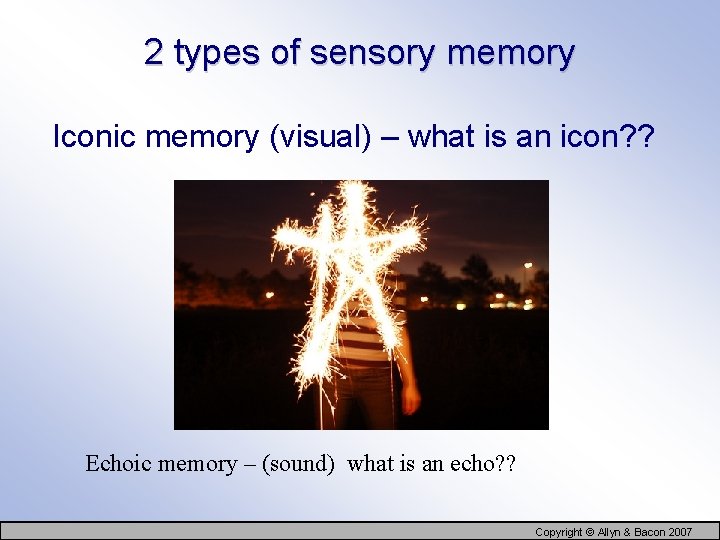
2 types of sensory memory Iconic memory (visual) – what is an icon? ? Echoic memory – (sound) what is an echo? ? Copyright © Allyn & Bacon 2007
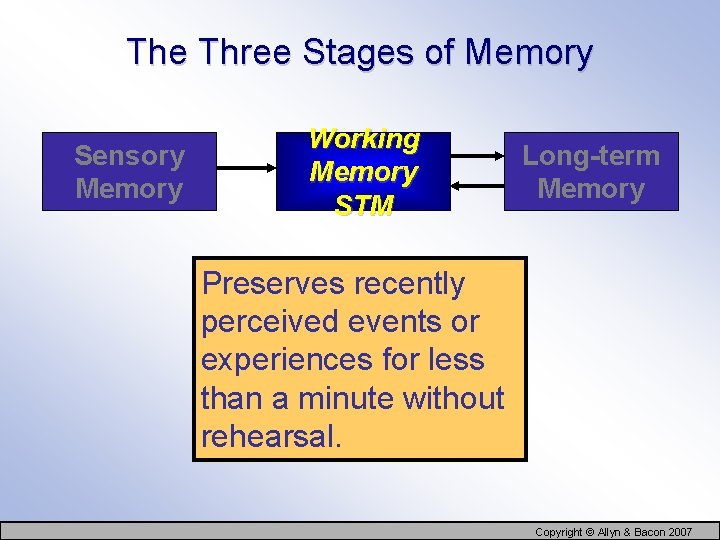
The Three Stages of Memory Sensory Memory Working Memory STM Long-term Memory Preserves recently perceived events or experiences for less than a minute without rehearsal. Copyright © Allyn & Bacon 2007
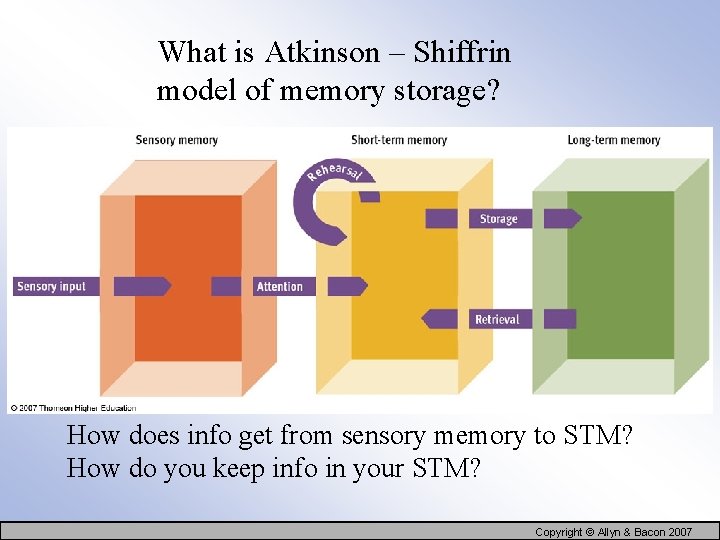
What is Atkinson – Shiffrin model of memory storage? How does info get from sensory memory to STM? How do you keep info in your STM? Copyright © Allyn & Bacon 2007
Short Term Memory (working) STM can hold unrehearsed information up to 20 seconds. STM can hold 7 items +/- 2, according to some theories. Copyright © Allyn & Bacon 2007
Maintenance rehearsal – Process in which information is repeated or reviewed to keep it from fading while in working memory Copyright © Allyn & Bacon 2007
Maintenance Rehearsal JLo says, “My phone Number is 469 -2595968” You then repeat it to yourself until you can write it down somewhere. Copyright © Allyn & Bacon 2007
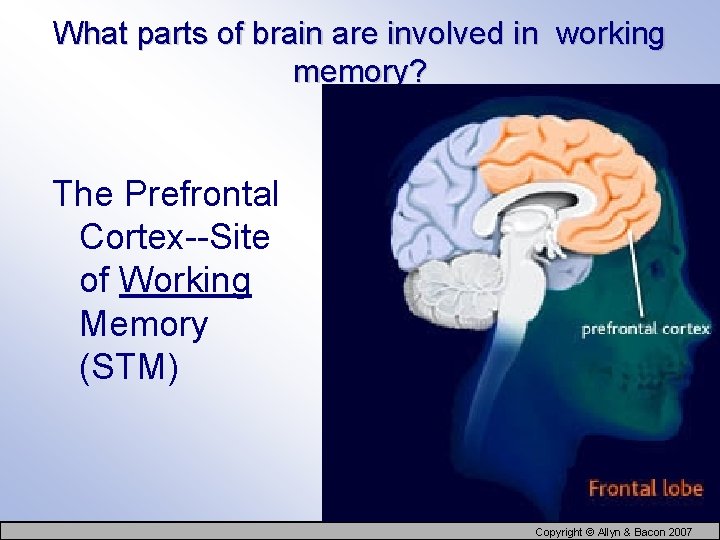
What parts of brain are involved in working memory? The Prefrontal Cortex--Site of Working Memory (STM) Copyright © Allyn & Bacon 2007
The capacity of STM (working memory) is a. About 50, 000 words b. Unlimited c. About 25 stimuli d. About 7 “chunks” of information Copyright © Allyn & Bacon 2007
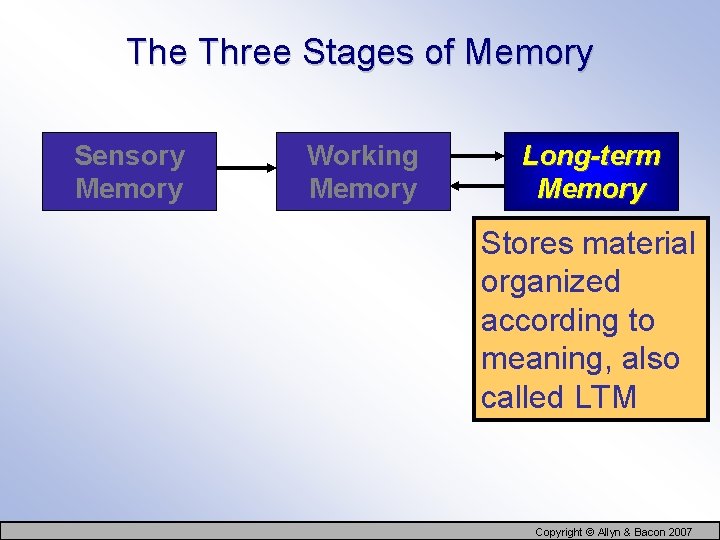
The Three Stages of Memory Sensory Memory Working Memory Long-term Memory Stores material organized according to meaning, also called LTM Copyright © Allyn & Bacon 2007
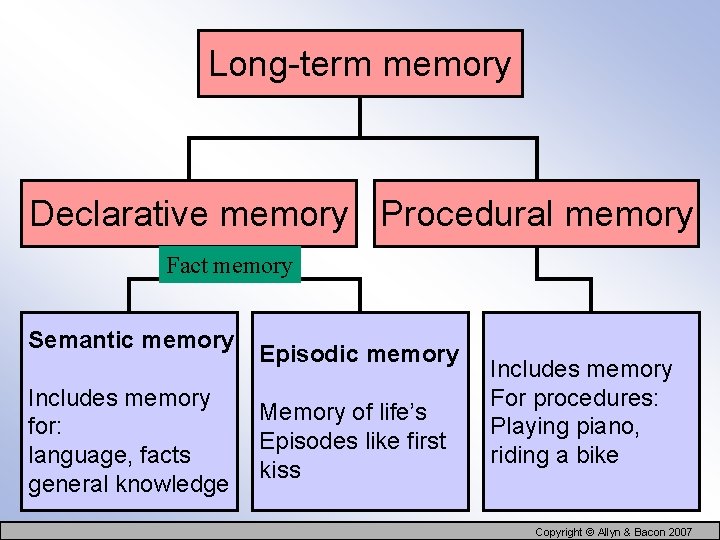
Long-term memory Declarative memory Procedural memory Fact memory Semantic memory Includes memory for: language, facts general knowledge Episodic memory Memory of life’s Episodes like first kiss Includes memory For procedures: Playing piano, riding a bike Copyright © Allyn & Bacon 2007
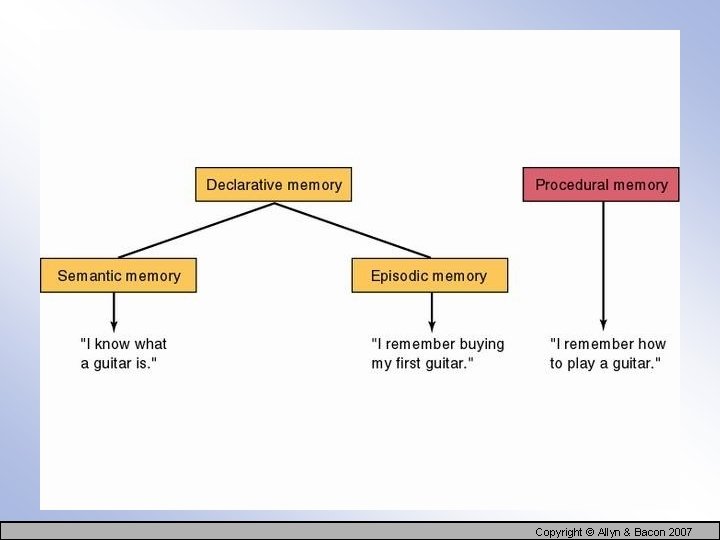
Copyright © Allyn & Bacon 2007
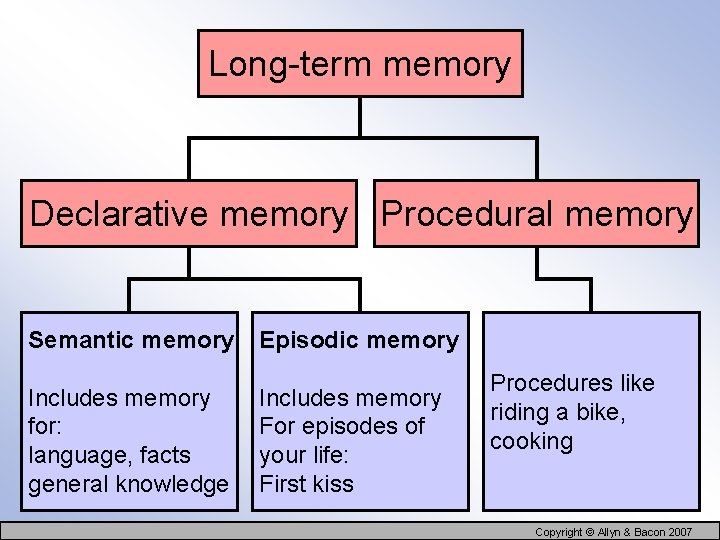
Long-term memory Declarative memory Procedural memory Semantic memory Includes memory for: language, facts general knowledge Episodic memory Includes memory For episodes of your life: First kiss Procedures like riding a bike, cooking Copyright © Allyn & Bacon 2007
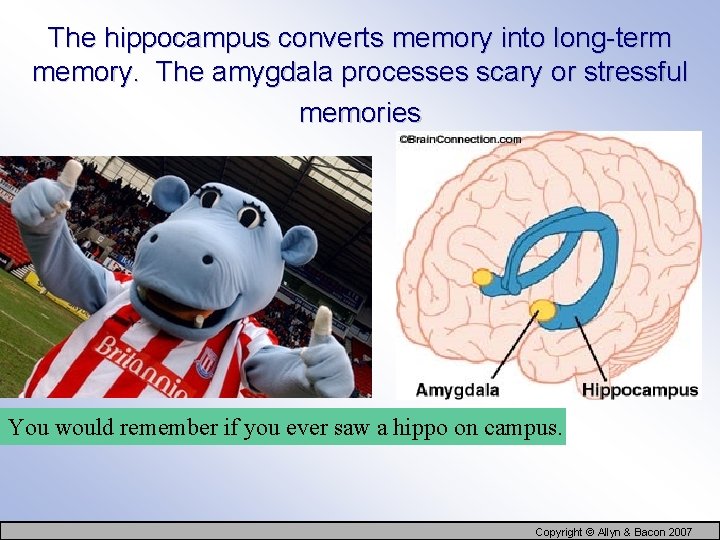
The hippocampus converts memory into long-term memory. The amygdala processes scary or stressful memories You would remember if you ever saw a hippo on campus. Copyright © Allyn & Bacon 2007
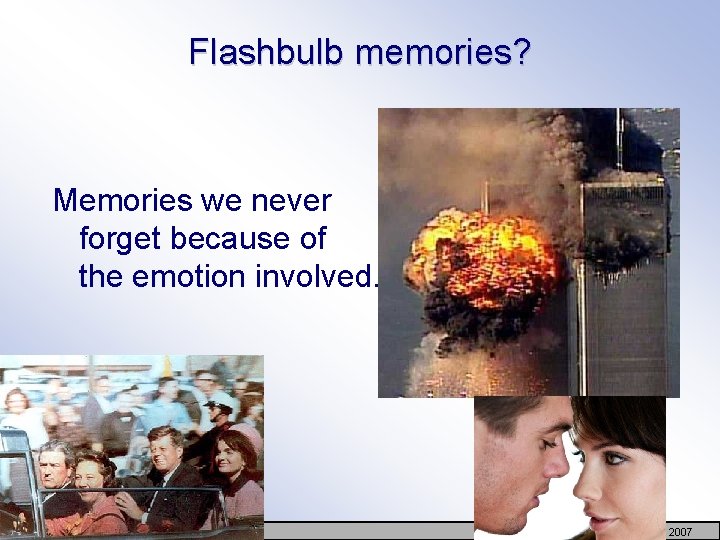
Flashbulb memories? Memories we never forget because of the emotion involved. Copyright © Allyn & Bacon 2007
Your memory of how to brush your teeth is contained in your ______ memory. a. Declarative b. Procedural c. Structural d. episodic Copyright © Allyn & Bacon 2007
Your knowledge that birds fly, that the sun rises in the east, and that 2+2=4 is contained in your ______ memory. a. Structural b. Procedural c. Implicit d. semantic Copyright © Allyn & Bacon 2007
2. Which of the following examples best illustrates episodic memory? a) telling someone how to tie a shoe b) answering correctly that the Battle of Hastings was in 1066 c) knowing that the word for black in French is noir d) remembering that a clown was at your fifth birthday party Copyright © Allyn & Bacon 2007
Why do we forget? Copyright © Allyn & Bacon 2007
Decay theory? We simply forget over time due to lost neuronal connections. Copyright © Allyn & Bacon 2007
Motivated forgetting AKA “repression” We want to forget awful things. Copyright © Allyn & Bacon 2007
3 types of amnesia? Infantile amnesia – stuff we don’t remember as babies Anterograde amnesia – Inability to form memories for new information Retrograde amnesia – Inability to remember information previously stored in memory Note: procedural memory seems unaffected! Copyright © Allyn & Bacon 2007
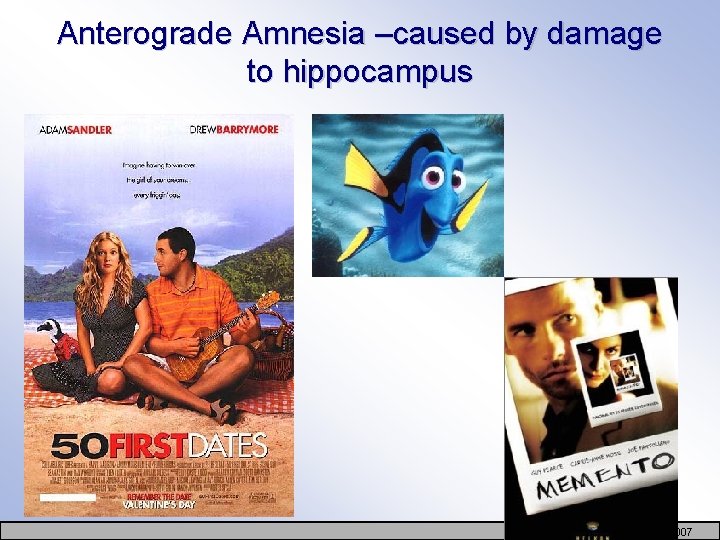
Anterograde Amnesia –caused by damage to hippocampus Copyright © Allyn & Bacon 2007
Retrograde amnesia Any soap opera where someone can’t remember who they are, where they live, etc. Quarterbacks who can’t remember games when they got concussions. Copyright © Allyn & Bacon 2007
Which of the following terms is synonymous with “motivated forgetting”? a) regression b) repression c) sublimation d) rationalization Copyright © Allyn & Bacon 2007
LTM Consolidation – The process by which short-term memories are changed to long-term memories Our ultimate goal as students!!!!! We want to remember this stuff on May 7! Copyright © Allyn & Bacon 2007
How do we consolidate? Make it meaningful. Put notes in your own words. Relate stuff to your own experience. See it, smell it, taste it, touch it, sing it, make a joke about it (preferably a dirty one). Copyright © Allyn & Bacon 2007
If decay theory is correct: a. Information can never be permanently lost from long-term memory b. Forgetting is simply a case of retrieval failure c. The principal cause of forgetting should be the passage of time d. All of the above Copyright © Allyn & Bacon 2007
Many amnesiacs demonstrate _____ memory, even though their ______ memory is extremely impaired. a. declarative; procedural b. Conscious; unconscious c. Implicit; explicit d. Semantic; episodic Copyright © Allyn & Bacon 2007
Copyright © Allyn & Bacon 2007
Retrieval Cues Retrieval cues – Stimuli that are used to bring a memory to consciousness or into behavior Example: hints that a teacher gives you during a test without giving you the answer. A good treatment for amnesiacs is to send them home, for that’s where the retrieval cues are. Copyright © Allyn & Bacon 2007
Retrieval Cues What is Priming? – Technique for retrieving memories by providing cues that stimulate a memory without awareness of the connection between the cue and the retrieved memory. Giving hints to remember. Copyright © Allyn & Bacon 2007

Name the Seven Dwarves Copyright © Allyn & Bacon 2007
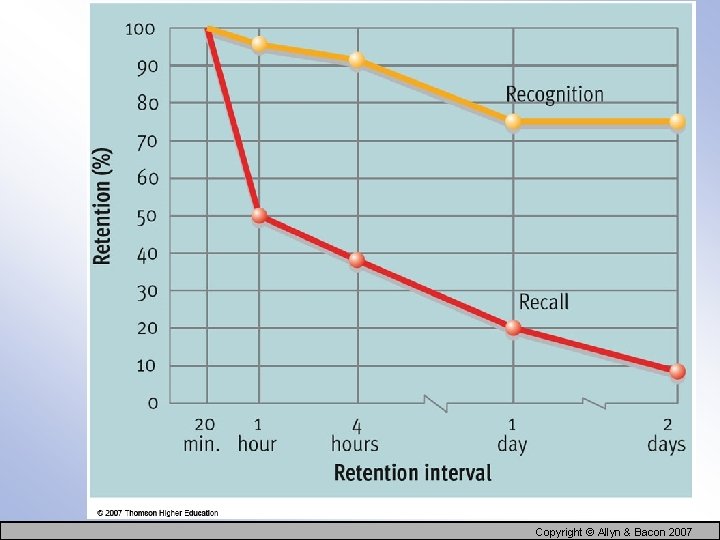
Remembering off the top of your head is recall. Copyright © Allyn & Bacon 2007
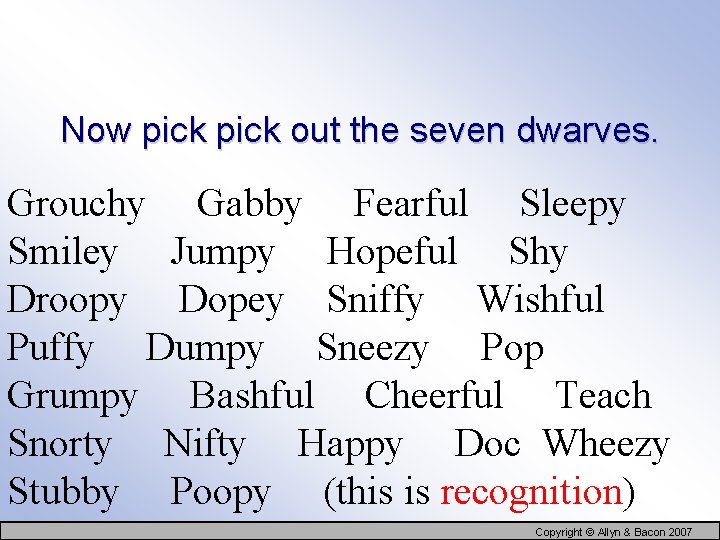
Now pick out the seven dwarves. Grouchy Gabby Fearful Sleepy Smiley Jumpy Hopeful Shy Droopy Dopey Sniffy Wishful Puffy Dumpy Sneezy Pop Grumpy Bashful Cheerful Teach Snorty Nifty Happy Doc Wheezy Stubby Poopy (this is recognition) Copyright © Allyn & Bacon 2007
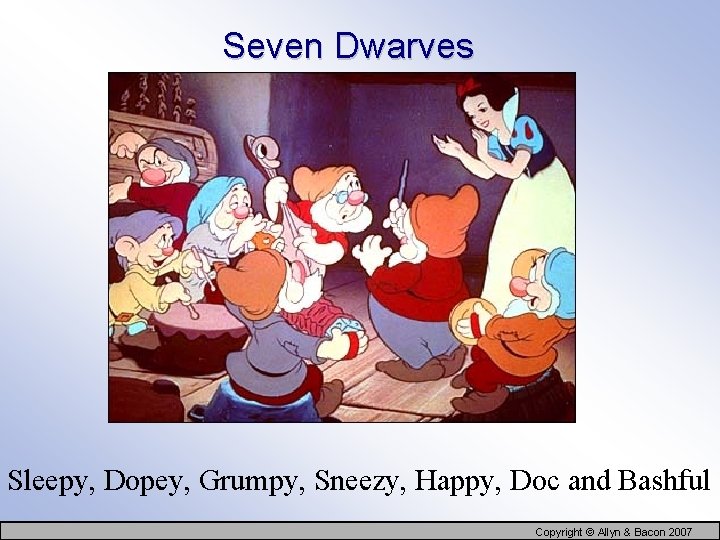
Seven Dwarves Sleepy, Dopey, Grumpy, Sneezy, Happy, Doc and Bashful Copyright © Allyn & Bacon 2007
What is Recall and Recognition? Recall – Technique for retrieving explicit memories in which one must reproduce previously presented information (fill in blank) remember without priming Recognition – Technique for retrieving explicit memories in which one must identify present stimuli as having been previously presented (multiple choice) remember with priming Copyright © Allyn & Bacon 2007
Copyright © Allyn & Bacon 2007
TOT (tip of the tongue) phenomenon? – The inability to recall a word, while knowing that it is in memory Copyright © Allyn & Bacon 2007
The three stages of Atkinson-Shiffrin process of memory are: a) iconic, echoic, encoding b) sensory, short term, long term c) shallow, medium, and deep processing d) semantic, episodic, procedural Copyright © Allyn & Bacon 2007
11. If you were attempting to recall a memory, the memory process you would be using is a) encoding b) storage c) retrieval d) acquisition Copyright © Allyn & Bacon 2007
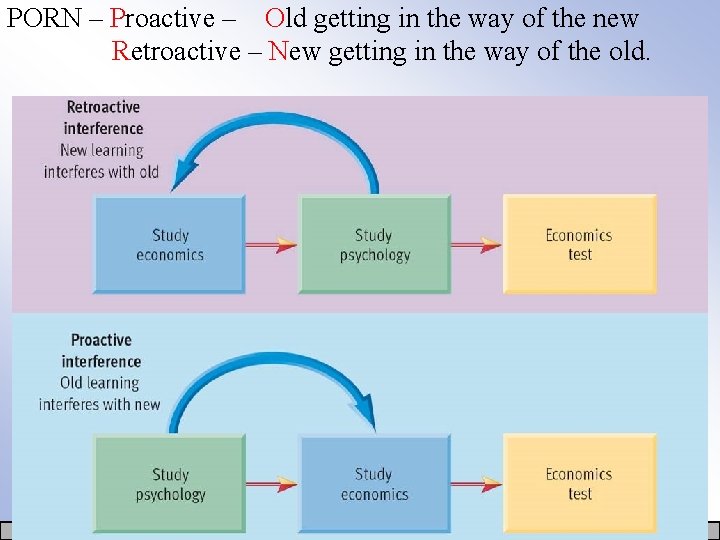
PORN – Proactive – Old getting in the way of the new Retroactive – New getting in the way of the old. Copyright © Allyn & Bacon 2007
Proactive or retroactive? I’ve used my locker combination for years. One day I had to learn a new one for just one day. Now I can’t remember my old one. I keep calling my new girlfriend by my old girlfriend’s name! Copyright © Allyn & Bacon 2007
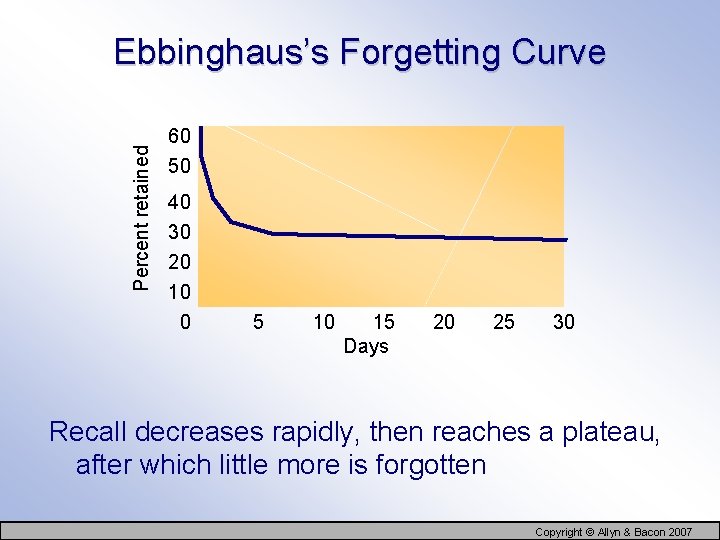
Percent retained Ebbinghaus’s Forgetting Curve 60 50 40 30 20 10 0 5 10 15 Days 20 25 30 Recall decreases rapidly, then reaches a plateau, after which little more is forgotten Copyright © Allyn & Bacon 2007
What is spacing effect? Memory is better for repeated information if repetitions occur spaced over time than if they occur massed, one after another. No cramming! Why? 1. distributed practice (instead of massed practice) reduces retroactive and proactive interference. 2. REM sleep helps memory. So study Tuesday, sleep, study Wednesday, sleep. You’ll do better. 3. Distributed practice may cause you to encode it in different ways and in different moods. Melton & Schulman, 1970 Copyright © Allyn & Bacon 2007
Factors Affecting the Accuracy of Eyewitnesses: Recollections are less influenced by leading questions if possibility of memory bias is forewarned Passage of time leads to increase in misremembering information (JFK assassination) Age of the witness matters Confidence in memory is not a sign of accuracy Copyright © Allyn & Bacon 2007
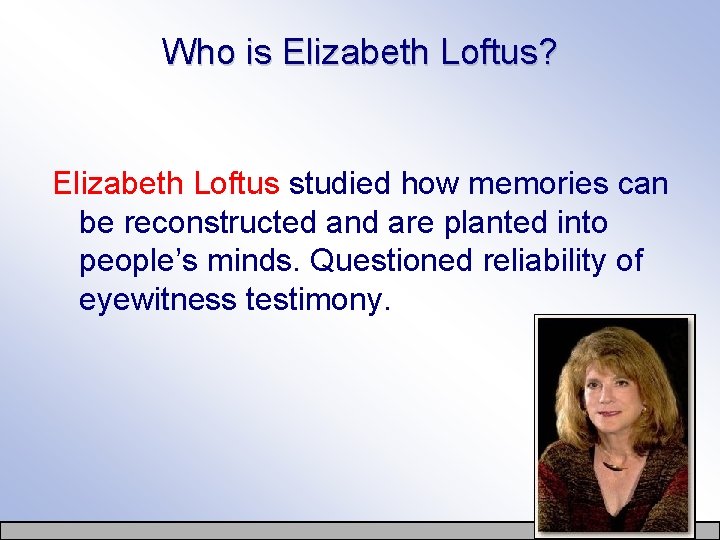
Who is Elizabeth Loftus? Elizabeth Loftus studied how memories can be reconstructed and are planted into people’s minds. Questioned reliability of eyewitness testimony. Copyright © Allyn & Bacon 2007
Collided Smashed Bumped Hit Contacted Copyright © Allyn & Bacon 2007
In the first study forty-five students from the University of Washington were shown seven film clips of car accidents. The clips ranged from five to thirty seconds long. After viewing each clip the students were asked to write a report on what they had seen. They were asked a series of questions about the videos. The critical question in this study was "At what speed was the car traveling? " The five categories of students were asked this question but with a different verb. Loftus wanted to see if the verb influenced the students' (eye witnesses') answers. About how fast were the cars going when they collided with each other? About how fast were the cars going when they smashed into each other? About how fast were the cars going when they bumped into each other? About how fast were the cars going when they hit each other? About how fast were the cars going when they contacted each other? Copyright © Allyn & Bacon 2007
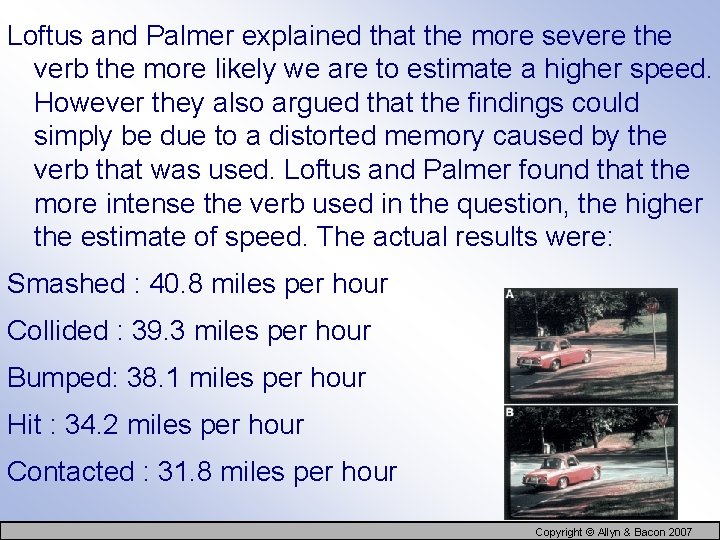
Loftus and Palmer explained that the more severe the verb the more likely we are to estimate a higher speed. However they also argued that the findings could simply be due to a distorted memory caused by the verb that was used. Loftus and Palmer found that the more intense the verb used in the question, the higher the estimate of speed. The actual results were: Smashed : 40. 8 miles per hour Collided : 39. 3 miles per hour Bumped: 38. 1 miles per hour Hit : 34. 2 miles per hour Contacted : 31. 8 miles per hour Copyright © Allyn & Bacon 2007
- Slides: 95