
Chapter 7 Membrane Structure and Function The plasma
Chapter 7 Membrane Structure and Function
– The plasma membrane is located at the boundary of every cell – It functions as a selective barrier – It allows the passage of nutrients, oxygen and waste u u The membrane is made up of phospholipids Phospholipids are amphipathic – i. e. . It has both the hydrophobic and hydrophilic regions u Fluid mosaic: a term used to describe the structure of plasma membrane with freedom of movement of molecules within the membrane u Cholesterol molecules: strengthens the fluid mosaic and makes it more stable u Proteins: determine which particles can pass across the membrane – Some protein serves as enzyme – Some serve as markers involved in disease fighting
Traffic across the membrane u u u Plasma membrane serves as a communication media between a cell and it’s environment In addition to regulation of gas exchange, it also regulates the concentration of inorganic ions – Na+, K+, Ca+ and Cl. It allows the passage of certain molecules and prohibits others – selective permeability Hydrophobic core impedes transportation of ions and polar molecules Hydrophobic as hydrocarbons – CO 2 and O 2 can dissolve and pass with ease Hydrophilic substances avoid contact with the lipid bi-layer by passing through the transport protein (selective) u u Passive transport Diffusion: the net movement of particles from area of high concentration to area of low concentration – As a result of random movement of particles
Passive transport u Diffusion: the net movement of particles from area of high concentration to area of low concentration – As a result of random movement of particle u Diffusion depends on concentration gradients – Concentration gradient is the difference in the concentration of substances across a space u Dynamic Equilibrium: a continuous movement but no overall change
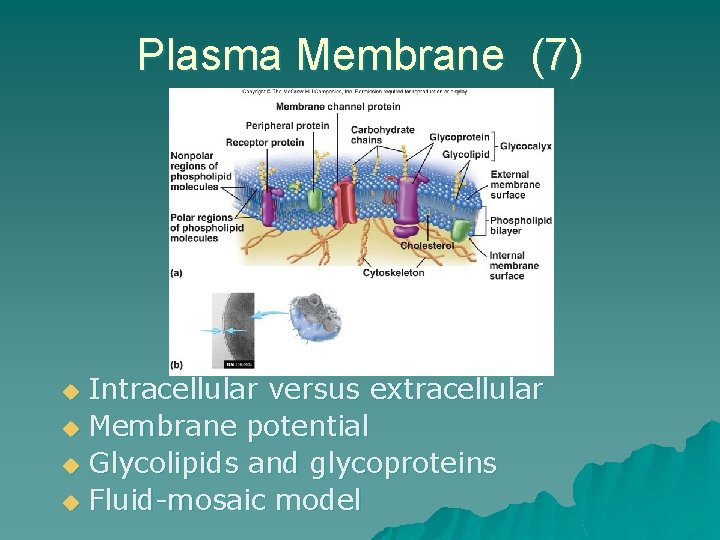
Plasma Membrane (7) Intracellular versus extracellular u Membrane potential u Glycolipids and glycoproteins u Fluid-mosaic model u
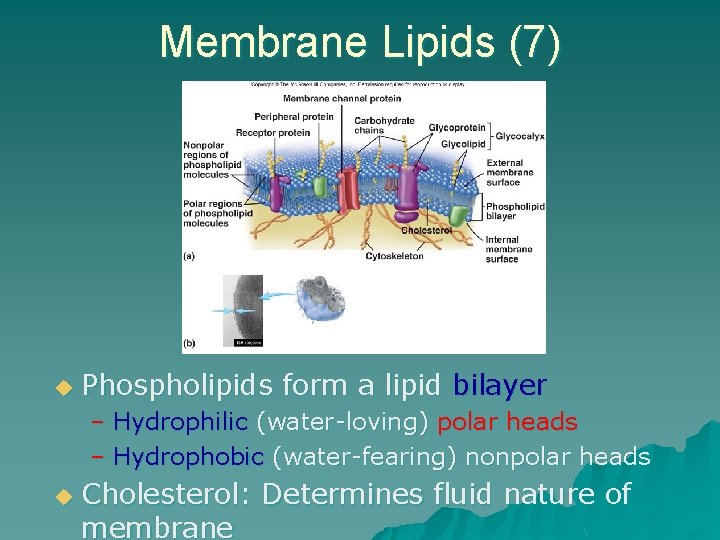
Membrane Lipids (7) u Phospholipids form a lipid bilayer – Hydrophilic (water-loving) polar heads – Hydrophobic (water-fearing) nonpolar heads u Cholesterol: Determines fluid nature of membrane
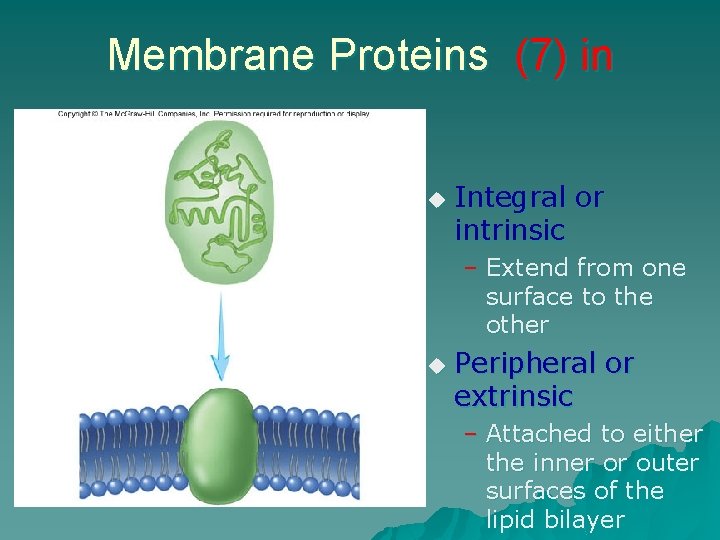
Membrane Proteins (7) in u Integral or intrinsic – Extend from one surface to the other u Peripheral or extrinsic – Attached to either the inner or outer surfaces of the lipid bilayer
Movement through the Plasma Membrane u Passive Transport – Diffusion – Osmosis – Filtration u Mediated transport mechanisms – Facilitated diffusion – Active transport – Secondary active transport
Diffusion u Movement of solutes from an area of higher concentration to lower concentration in solution – Concentration or density gradient u Difference between two points – Viscosity: - the state of being thick, sticky, and semifluid in consistency, due to internal friction. u Oil is more viscous than water
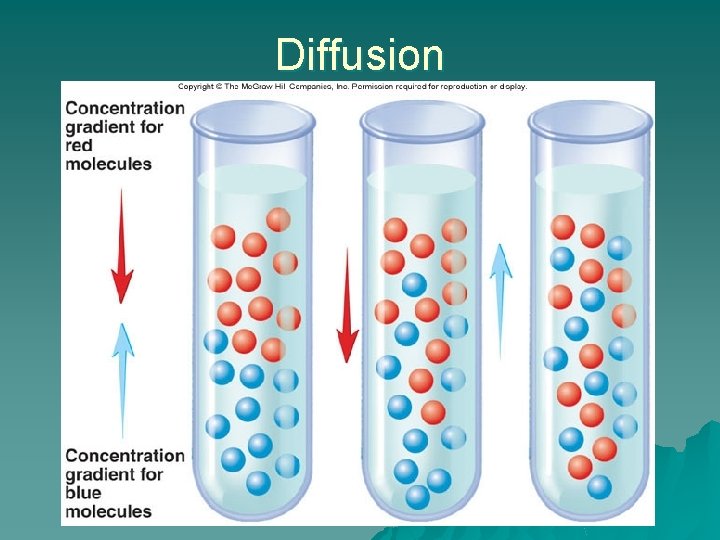
Diffusion
u Diffusion Osmosis of water (solvent) across a selectively permeable membrane u Important because large volume changes caused by water movement disrupt normal cell function u Cell shrinkage or swelling – Isotonic: cell neither shrinks nor swells – Hypertonic: cell shrinks (crenation) – Hypotonic: cell swells (lysis)
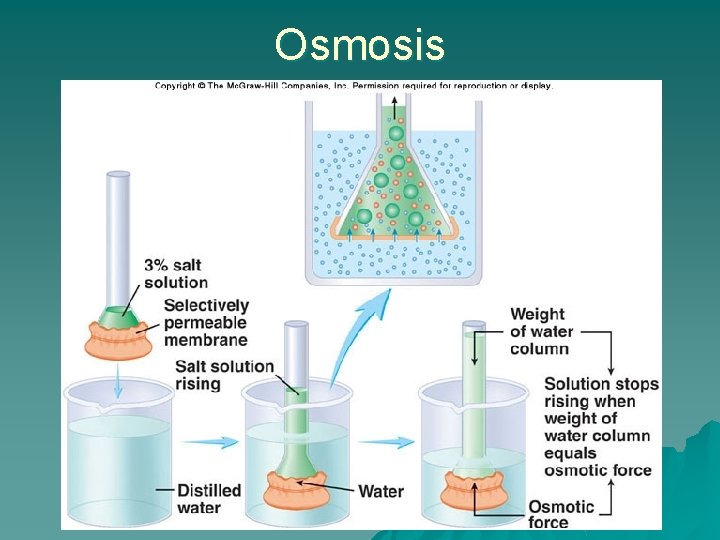
Osmosis
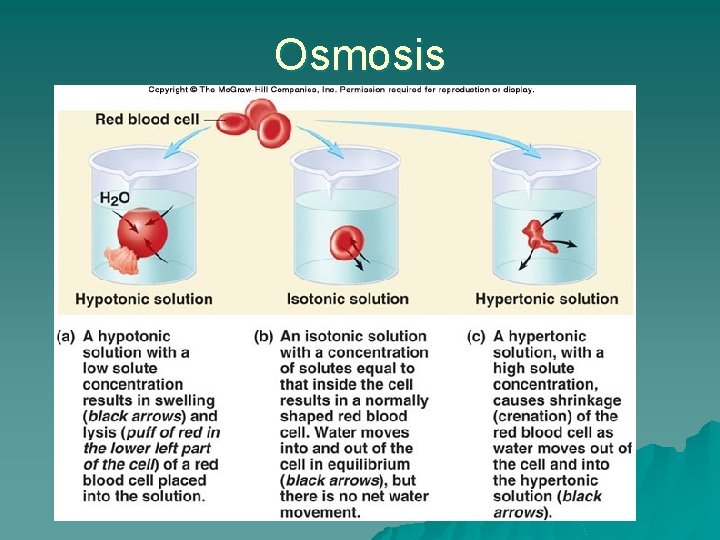
Osmosis
Filtration u Works like a sieve u Depends on pressure difference on either side of partition u Moves from side of greater pressure to lower – Example: In kidneys in urine formation
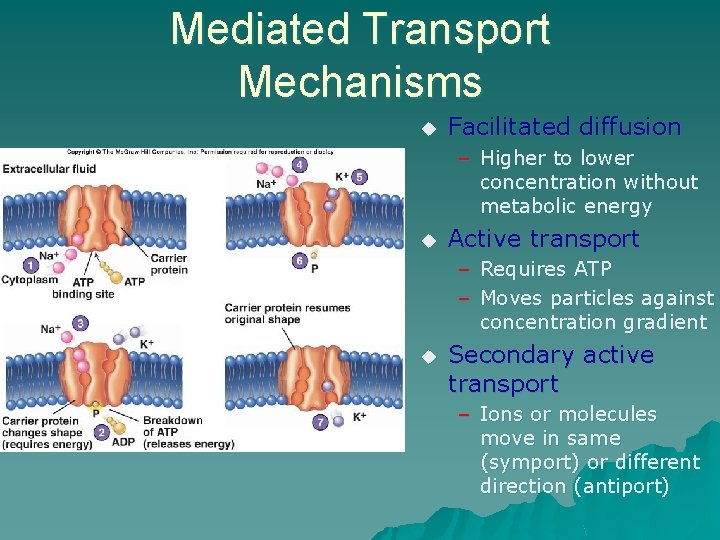
Mediated Transport Mechanisms u Facilitated diffusion – Higher to lower concentration without metabolic energy u Active transport – Requires ATP – Moves particles against concentration gradient u Secondary active transport – Ions or molecules move in same (symport) or different direction (antiport)
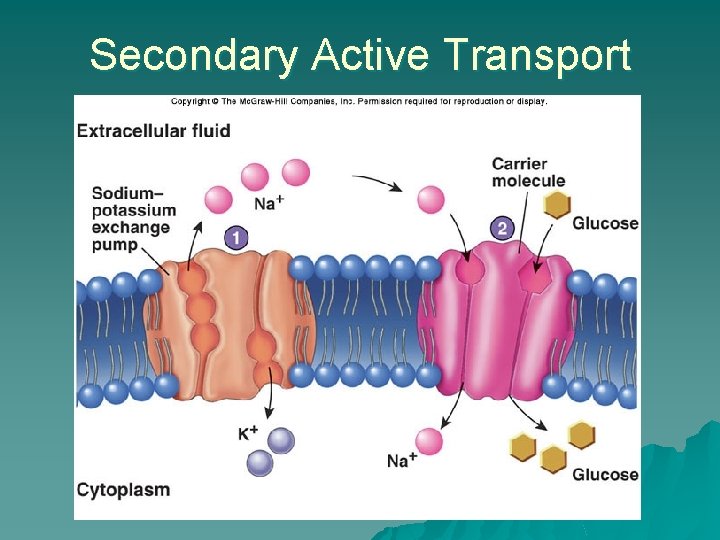
Secondary Active Transport
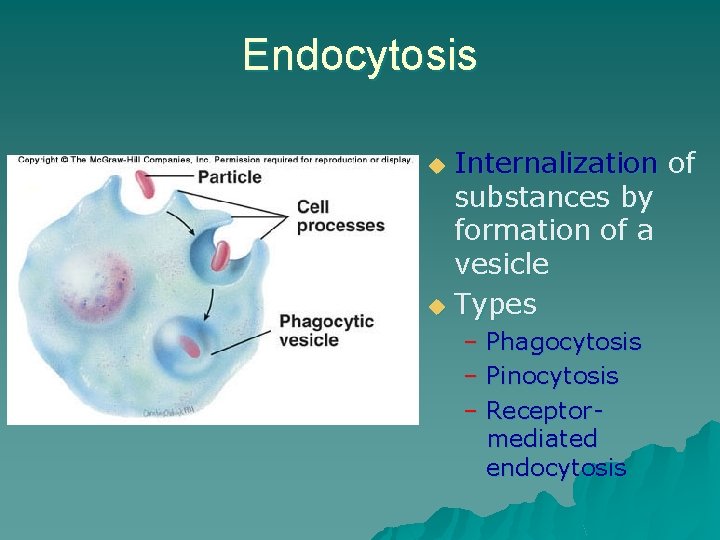
Endocytosis Internalization of substances by formation of a vesicle u Types u – Phagocytosis – Pinocytosis – Receptormediated endocytosis
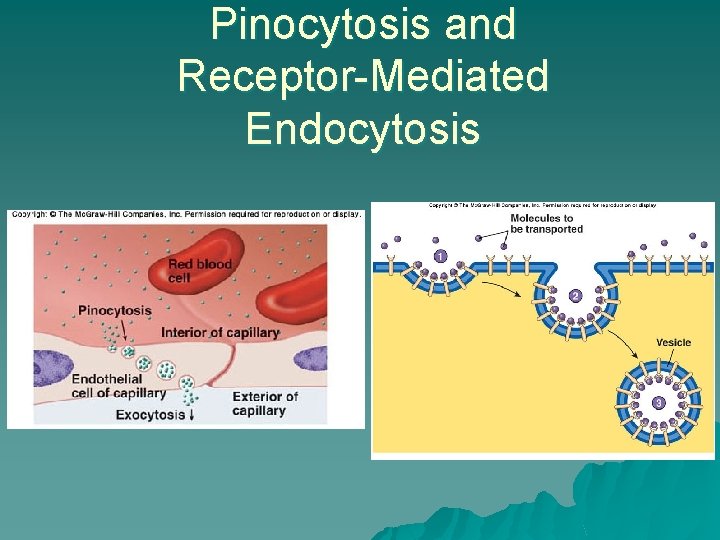
Pinocytosis and Receptor-Mediated Endocytosis
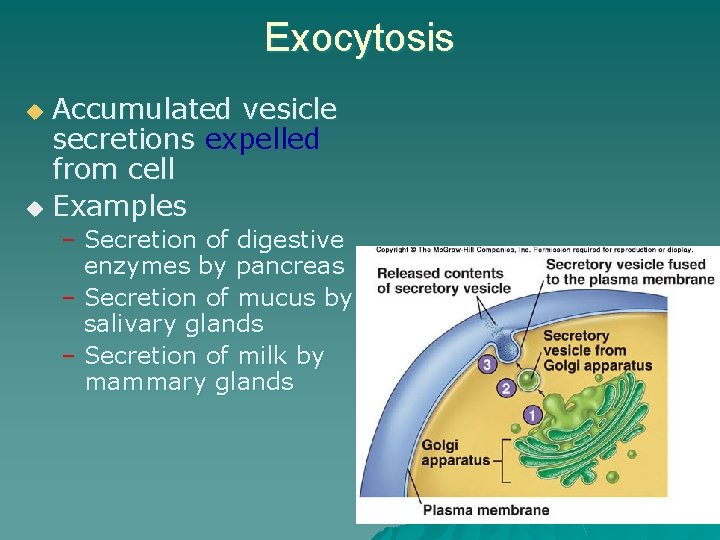
Exocytosis Accumulated vesicle secretions expelled from cell u Examples u – Secretion of digestive enzymes by pancreas – Secretion of mucus by salivary glands – Secretion of milk by mammary glands

The End
- Slides: 20