
Chapter 7 Membrane Structure and Function Power Point
Chapter 7 Membrane Structure and Function Power. Point® Lecture Presentations for Biology Eighth Edition Neil Campbell and Jane Reece Lectures by Chris Romero, updated by Erin Barley with contributions from Joan Sharp Copyright © 2008 Pearson Education, Inc. , publishing as Pearson Benjamin Cummings
Overview: Life at the Edge • The plasma membrane is the boundary that separates the living cell from its surroundings. • The plasma membrane exhibits selective permeability, allowing some substances to cross it more easily than others. Copyright © 2008 Pearson Education, Inc. , publishing as Pearson Benjamin Cummings

Cellular membranes are fluid mosaics of lipids and proteins • Phospholipids are the most abundant lipid in the plasma membrane • Phospholipids are amphipathic molecules, containing hydrophobic and hydrophilic regions • The fluid mosaic model states that a membrane is a fluid structure with a “mosaic” of various proteins embedded in it Copyright © 2008 Pearson Education, Inc. , publishing as Pearson Benjamin Cummings
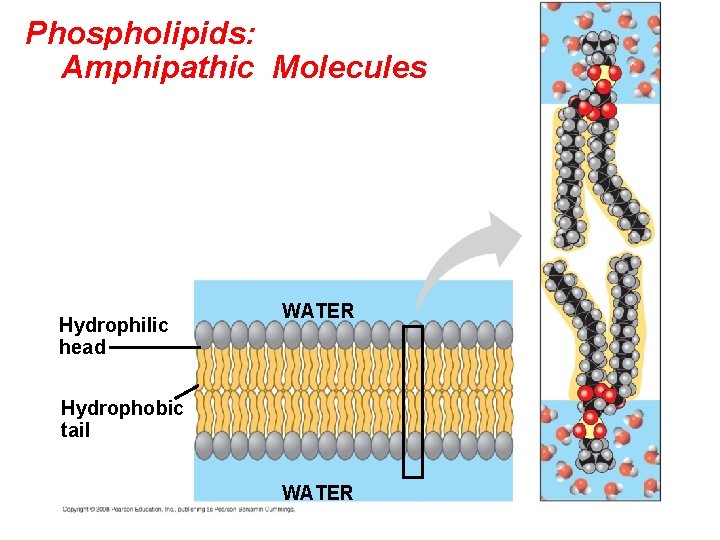
Phospholipids: Amphipathic Molecules Hydrophilic head WATER Hydrophobic tail WATER

• In 1935, Hugh Davson and James Danielli proposed a sandwich model in which the phospholipid bilayer lies between two layers of globular proteins. • Later studies found problems with this model, particularly the placement of membrane proteins, which have hydrophilic and hydrophobic regions. • In 1972, J. Singer and G. Nicolson proposed that the membrane is a mosaic of proteins dispersed within the bilayer, with only the hydrophilic regions exposed to water. Copyright © 2008 Pearson Education, Inc. , publishing as Pearson Benjamin Cummings
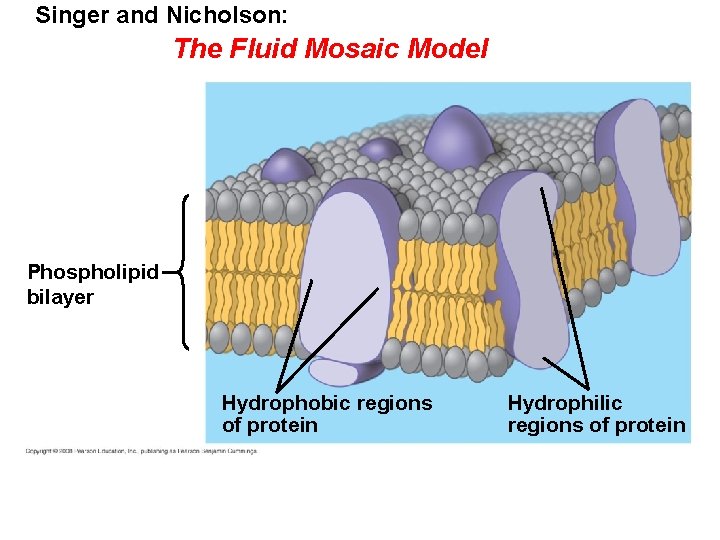
Singer and Nicholson: The Fluid Mosaic Model Phospholipid bilayer Hydrophobic regions of protein Hydrophilic regions of protein
• Freeze-fracture studies of the plasma membrane supported the fluid mosaic model. • Freeze-fracture is a specialized preparation technique that splits a membrane along the middle of the phospholipid bilayer. Copyright © 2008 Pearson Education, Inc. , publishing as Pearson Benjamin Cummings
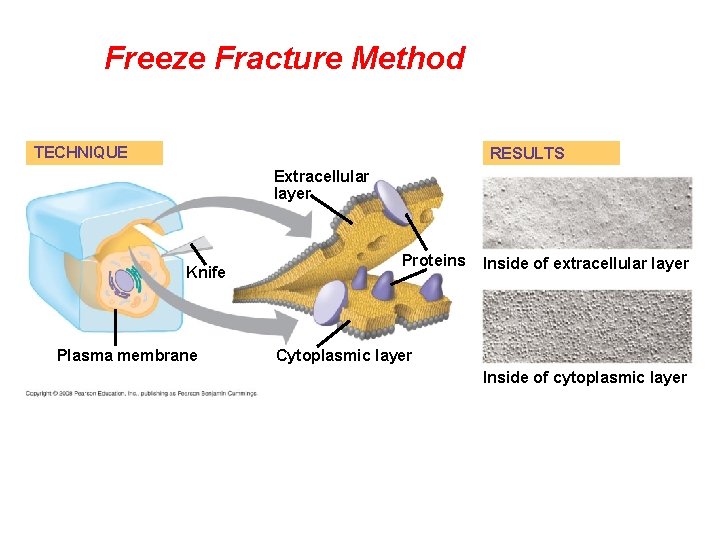
Freeze Fracture Method TECHNIQUE RESULTS Extracellular layer Knife Plasma membrane Proteins Inside of extracellular layer Cytoplasmic layer Inside of cytoplasmic layer
The Fluidity of Membranes • Phospholipids in the plasma membrane can move within the bilayer. • Most of the lipids, and some proteins, drift laterally. • Rarely does a molecule flip-flop transversely across the membrane/ Copyright © 2008 Pearson Education, Inc. , publishing as Pearson Benjamin Cummings
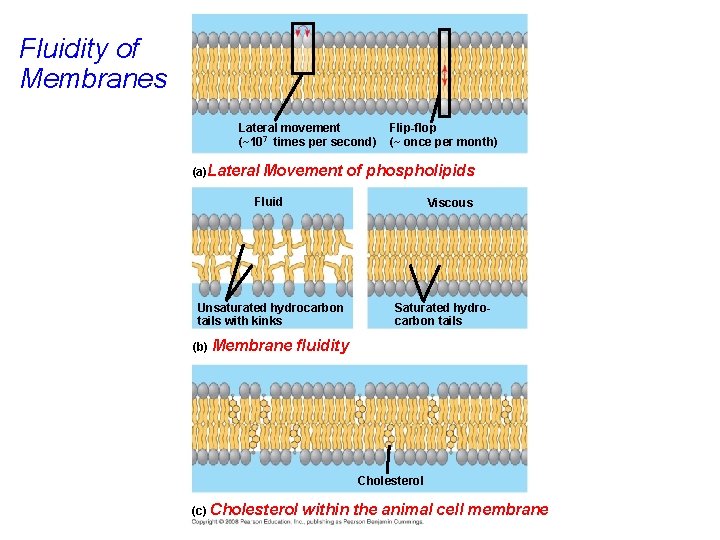
Fluidity of Membranes Lateral movement (~107 times per second) (a)Lateral Movement Flip-flop (~ once per month) of phospholipids Fluid Viscous Unsaturated hydrocarbon tails with kinks (b) Membrane Saturated hydrocarbon tails fluidity Cholesterol (c) Cholesterol within the animal cell membrane
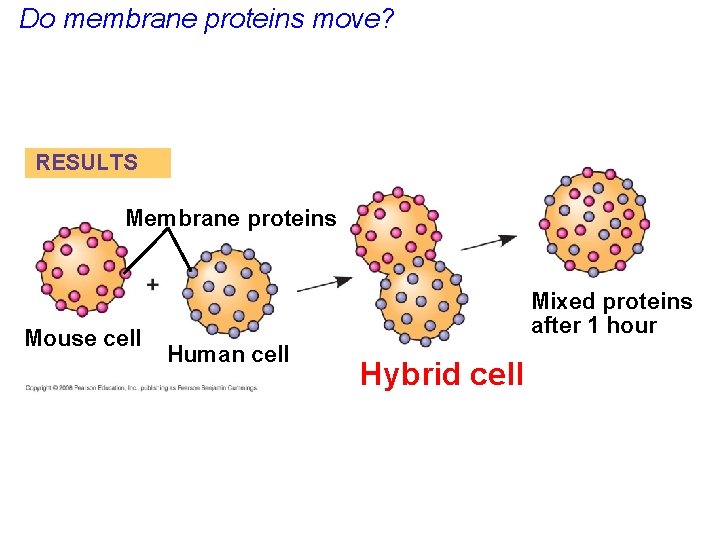
Do membrane proteins move? RESULTS Membrane proteins Mouse cell Mixed proteins after 1 hour Human cell Hybrid cell
• As temperatures cool, membranes switch from a fluid state to a solid state. • The temperature at which a membrane solidifies depends on the types of lipids. • Membranes rich in unsaturated fatty acids are more fluid that those rich in saturated fatty acids. • Membranes must be fluid to work properly; they are usually about as fluid as salad oil. Copyright © 2008 Pearson Education, Inc. , publishing as Pearson Benjamin Cummings

Fluidity of Membranes Fluid Unsaturated hydrocarbon tails with kinks (b) Membrane fluidity Viscous Saturated hydrocarbon tails

• The steroid cholesterol provides BOTH membrane fluidity and stability. • Cholesterol has different effects on membrane fluidity at different temperatures. • At warm temperatures (such as 37°C), cholesterol restrains movement of phospholipids. • At cool temperatures, it maintains fluidity by preventing tight packing. Copyright © 2008 Pearson Education, Inc. , publishing as Pearson Benjamin Cummings
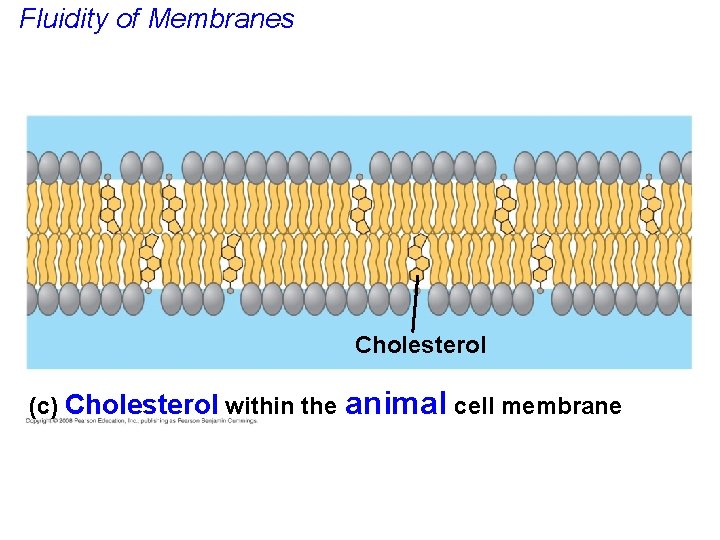
Fluidity of Membranes Cholesterol (c) Cholesterol within the animal cell membrane
Membrane Proteins and Their Functions • A membrane is composed of different proteins embedded in the fluid matrix of the phospholipid bilayer. • Membrane proteins determine most of the membrane’s specific functions. Copyright © 2008 Pearson Education, Inc. , publishing as Pearson Benjamin Cummings
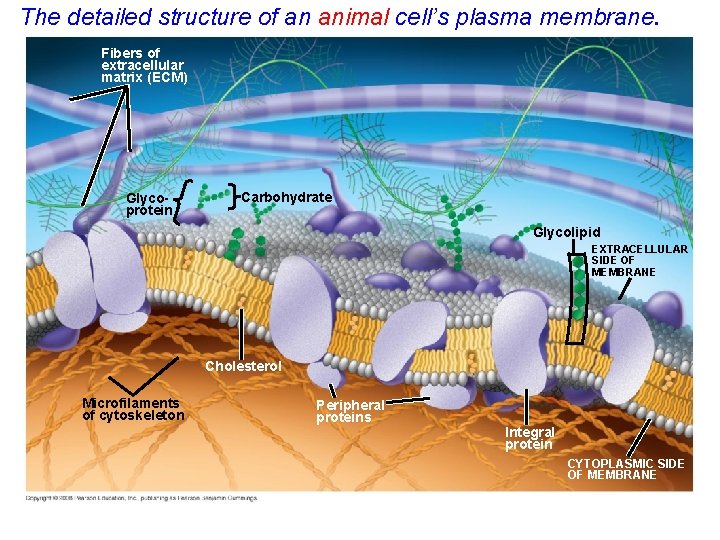
The detailed structure of an animal cell’s plasma membrane. 7 -7 Fibers of extracellular matrix (ECM) Glycoprotein Carbohydrate Glycolipid EXTRACELLULAR SIDE OF MEMBRANE Cholesterol Microfilaments of cytoskeleton Peripheral proteins Integral protein CYTOPLASMIC SIDE OF MEMBRANE
• Peripheral proteins are bound to the surface of the membrane. • Integral proteins penetrate the hydrophobic core. • Integral proteins that span the membrane are called transmembrane proteins. • The hydrophobic regions of an integral protein consist of one or more stretches of nonpolar amino acids, often coiled into alpha helices. Copyright © 2008 Pearson Education, Inc. , publishing as Pearson Benjamin Cummings
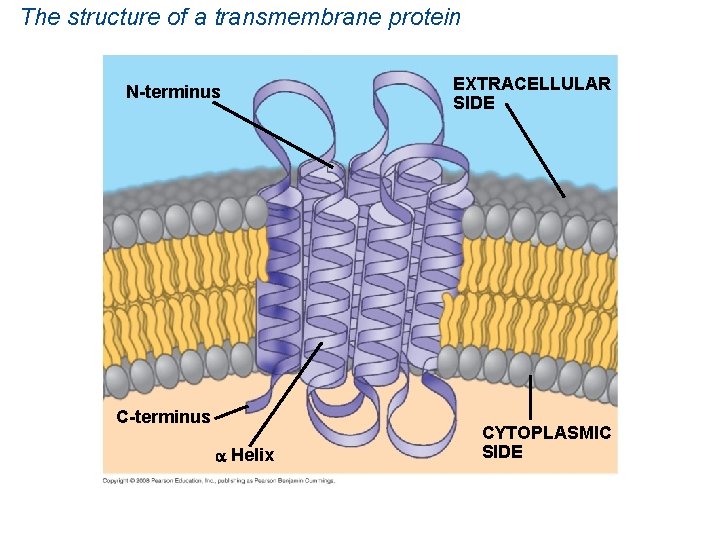
The structure of a transmembrane protein N-terminus C-terminus Helix EXTRACELLULAR SIDE CYTOPLASMIC SIDE
• Six major functions of membrane proteins: – Transport – Enzymatic activity – Signal transduction – Cell-cell recognition – Intercellular joining – Attachment to the cytoskeleton and extracellular matrix (ECM) Copyright © 2008 Pearson Education, Inc. , publishing as Pearson Benjamin Cummings
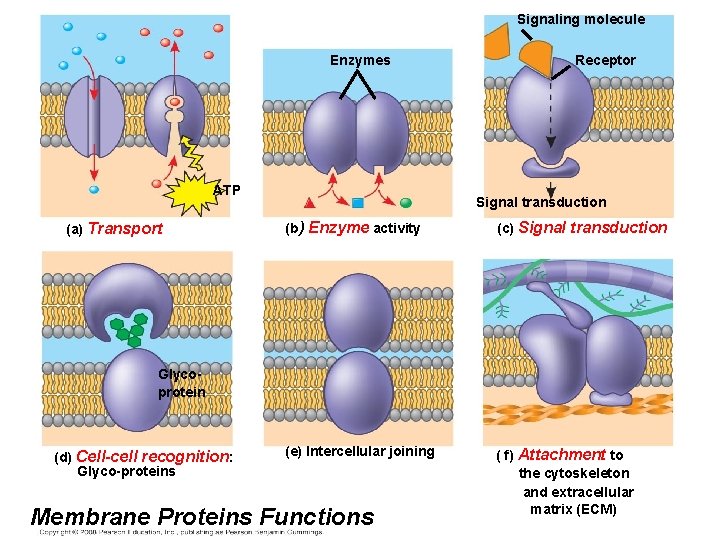
Signaling molecule Enzymes ATP (a) Transport Receptor Signal transduction (b) Enzyme activity (c) Signal transduction (e) Intercellular joining ( f) Attachment to the cytoskeleton and extracellular matrix (ECM) Glycoprotein (d) Cell-cell recognition: Glyco-proteins Membrane Proteins Functions
The Role of Membrane Carbohydrates in Cell-to-Cell Recognition: • Cells recognize each other by binding to surface molecules, often carbohydrates, on the plasma membrane ECM. • Membrane carbohydrates may be covalently bonded to lipids (forming glycolipids) or more commonly to proteins (forming glycoproteins) • Oligosaccharides are short carbohydrate chains on the external side of the plasma membrane. • These vary among species, individuals, and even cell types in an individual. Copyright © 2008 Pearson Education, Inc. , publishing as Pearson Benjamin Cummings
Synthesis and Sidedness of Membranes • Membranes have distinct inside and outside faces. • The asymmetrical distribution of proteins, lipids, and associated carbohydrates in the plasma membrane is determined when the membrane is built by the ER and Golgi apparatus. Copyright © 2008 Pearson Education, Inc. , publishing as Pearson Benjamin Cummings
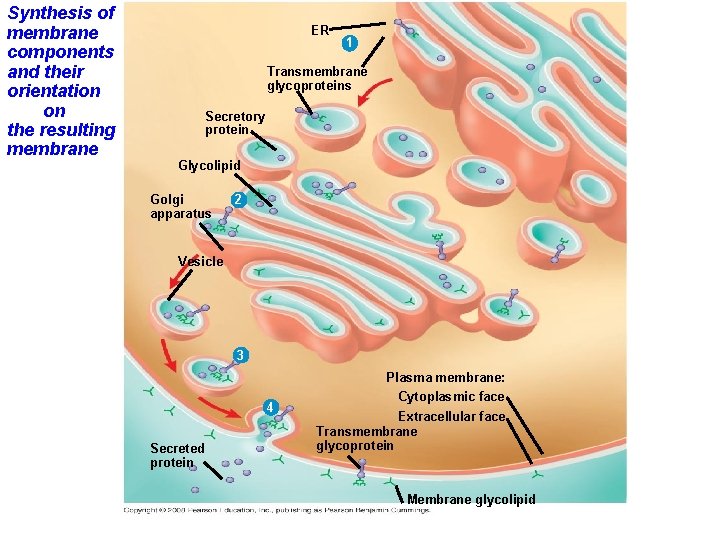
Synthesis of membrane components and their orientation on the resulting membrane ER 1 Transmembrane glycoproteins Secretory protein Glycolipid Golgi apparatus 2 Vesicle 3 4 Secreted protein Plasma membrane: Cytoplasmic face Extracellular face Transmembrane glycoprotein Membrane glycolipid
Membrane structure results in selective permeability • A cell must exchange materials with its surroundings, a process controlled by the plasma membrane. • Plasma membranes are selectively permeable, regulating the cell’s molecular traffic in order to maintain homeostasis. Copyright © 2008 Pearson Education, Inc. , publishing as Pearson Benjamin Cummings
The Permeability of the Lipid Bilayer • Hydrophobic (nonpolar) molecules, such as hydrocarbons, can dissolve in the lipid bilayer and pass through the membrane rapidly. • Polar molecules, such as sugars, do not cross the membrane easily. Copyright © 2008 Pearson Education, Inc. , publishing as Pearson Benjamin Cummings
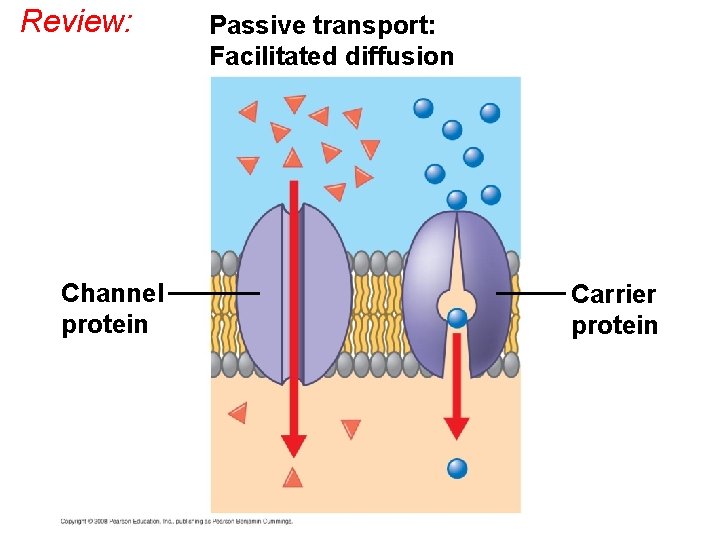
Transport Proteins • Transport proteins allow passage of hydrophilic substances across the membrane. • Some transport proteins, called channel proteins, have a hydrophilic channel that certain molecules or ions can use as a tunnel. • Channel proteins called aquaporins facilitate the passage of water. Copyright © 2008 Pearson Education, Inc. , publishing as Pearson Benjamin Cummings
• Other transport proteins, called carrier proteins, bind to molecules and change shape to shuttle them across the membrane. • A transport protein is specific for the substance it moves. Copyright © 2008 Pearson Education, Inc. , publishing as Pearson Benjamin Cummings
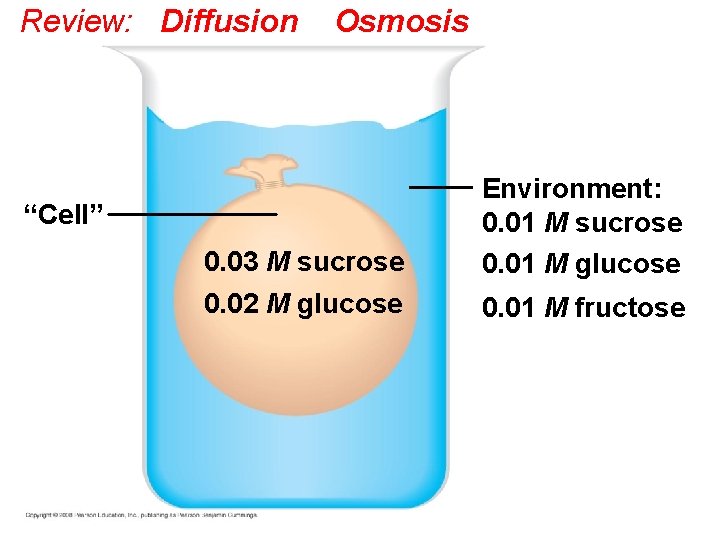
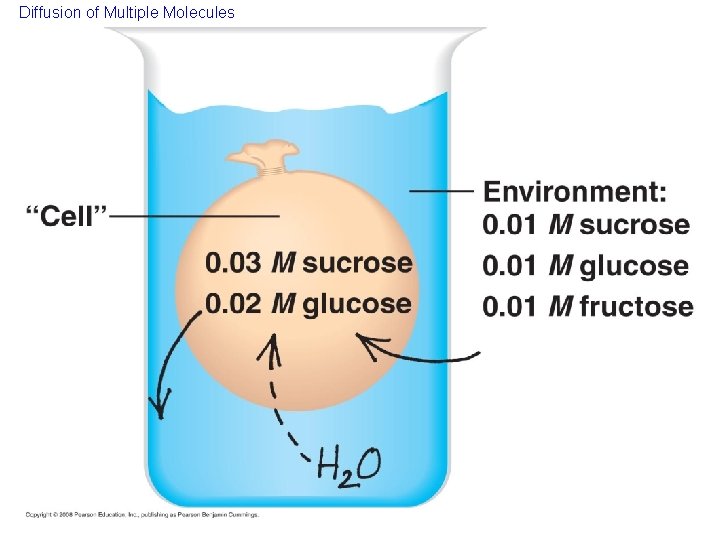
Passive transport is diffusion of a substance across a membrane with no energy investment • Diffusion is the tendency for molecules to spread out evenly into the available space: from High to Low concentrations • Although each molecule moves randomly, diffusion of a population of molecules may exhibit a net movement in one direction until dynamic equilibrium is reached. • At dynamic equilibrium, as many molecules cross one way as cross in the other direction. There is movement, but no net change. Copyright © 2008 Pearson Education, Inc. , publishing as Pearson Benjamin Cummings
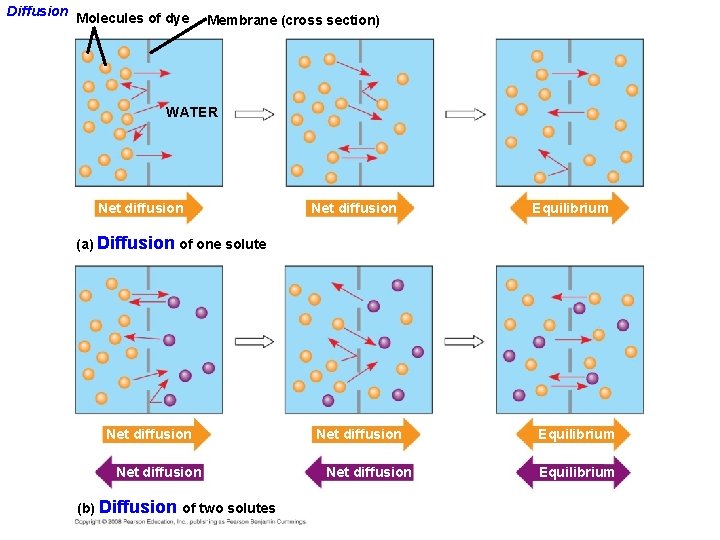
Diffusion Molecules of dye Membrane (cross section) WATER Net diffusion Equilibrium (a) Diffusion of one solute Net diffusion (b) Diffusion of two solutes Net diffusion Equilibrium
• Substances diffuse down their concentration gradient, the difference in concentration of a substance from one area to another • No work must be done to move substances down the concentration gradient • The diffusion of a substance across a biological membrane is passive transport because it requires no cell energy. Copyright © 2008 Pearson Education, Inc. , publishing as Pearson Benjamin Cummings
Effects of Osmosis on Water Balance • Osmosis is the diffusion of water across a selectively permeable membrane. • Water diffuses across a membrane from the region of lower solute concentration to the region of higher solute concentration. • Water flows down its concentration gradient. • More solute means less (solvent) water in that area. Copyright © 2008 Pearson Education, Inc. , publishing as Pearson Benjamin Cummings
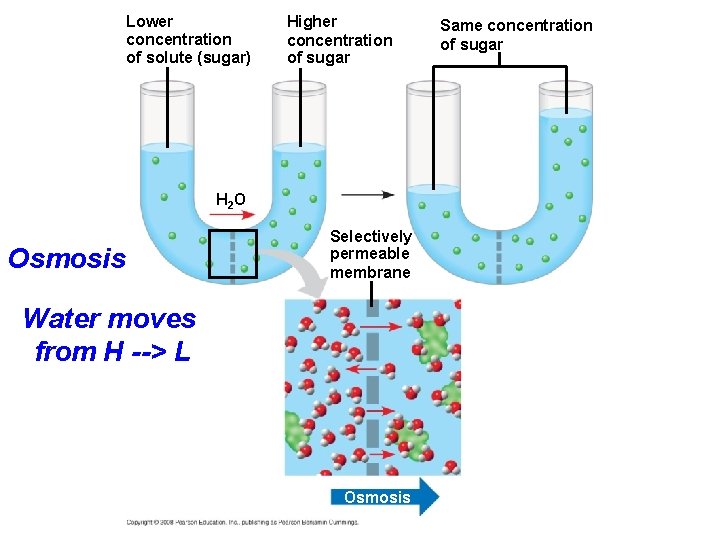
Lower concentration of solute (sugar) Higher concentration of sugar H 2 O Osmosis Selectively permeable membrane Water moves from H --> L Osmosis Same concentration of sugar
Water Balance of Cells Without Walls • Tonicity (solute concentration) is the ability of a solution to cause a cell to gain or lose water. • Isotonic solution: Solute concentration is the same as that inside the cell; no net water movement across the plasma membrane. • Hypertonic solution: Solute concentration is greater than that inside the cell; cell loses water. Cell shrinks. • Hypotonic solution: Solute concentration is less than that inside the cell; cell gains water. Copyright © 2008 Pearson Education, Inc. , publishing as Pearson Benjamin Cummings
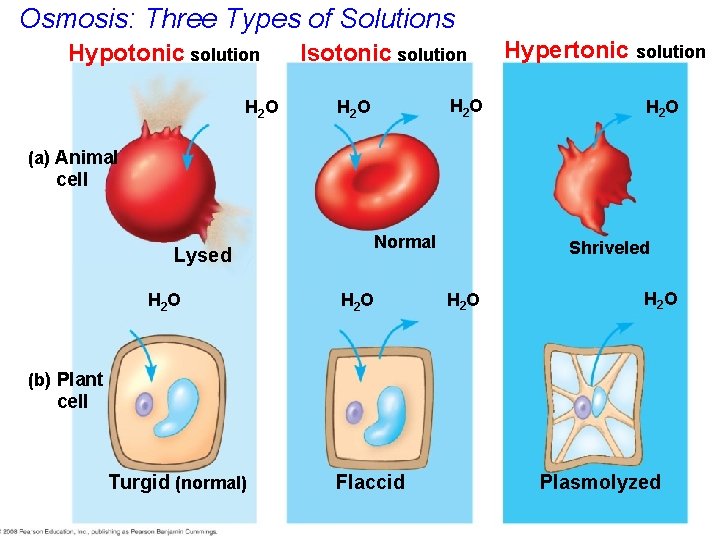
Osmosis: Three Types of Solutions Hypotonic solution H 2 O Isotonic solution H 2 O Hypertonic solution H 2 O (a) Animal cell Lysed H 2 O Normal H 2 O Shriveled H 2 O (b) Plant cell Turgid (normal) Flaccid Plasmolyzed
• Hypertonic or hypotonic environments create osmotic problems for organisms. • Osmoregulation, the control of water balance, is a necessary adaptation for life in such environments. • The protist Paramecium, which is hypertonic to its freshwater environment, has an adaptation: a contractile vacuole that acts as a water pump. Copyright © 2008 Pearson Education, Inc. , publishing as Pearson Benjamin Cummings
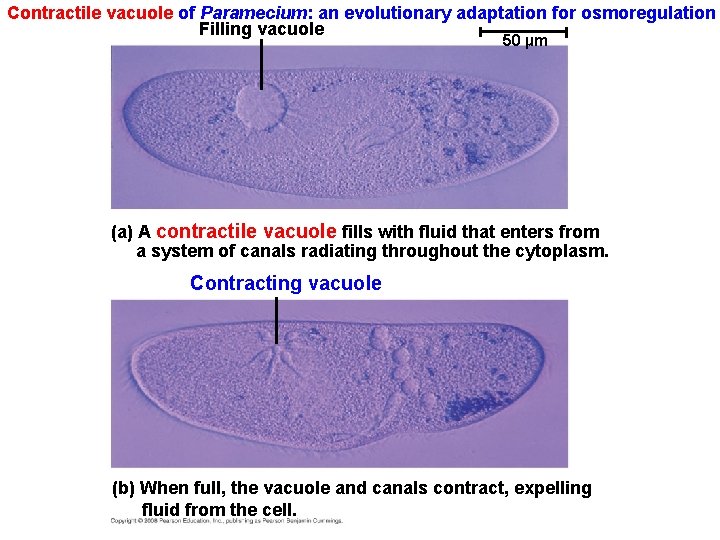
Contractile vacuole of Paramecium: an evolutionary adaptation for osmoregulation Filling vacuole 50 µm (a) A contractile vacuole fills with fluid that enters from a system of canals radiating throughout the cytoplasm. Contracting vacuole (b) When full, the vacuole and canals contract, expelling fluid from the cell.
Water Balance of Cells with Walls • Cell walls help maintain water balance. • A plant cell in a hypotonic solution swells until the cell wall opposes uptake; the cell experiences turgor (firm). • If a plant cell and its surroundings are isotonic, there is no net movement of water into the cell; the cell becomes flaccid (limp). • In a hypertonic solution, the plant cell looses water, shrivels and experiences plasmolysis. Copyright © 2008 Pearson Education, Inc. , publishing as Pearson Benjamin Cummings
Facilitated Diffusion: Passive Transport Aided by Proteins • In facilitated diffusion, transport proteins speed the passive movement of molecules across the plasma membrane. • Channel proteins provide corridors that allow a specific molecule or ion to cross the membrane. • Channel proteins include – Aquaporins, for facilitated diffusion of water – Ion channels that open or close in response to a stimulus (gated channels). Copyright © 2008 Pearson Education, Inc. , publishing as Pearson Benjamin Cummings
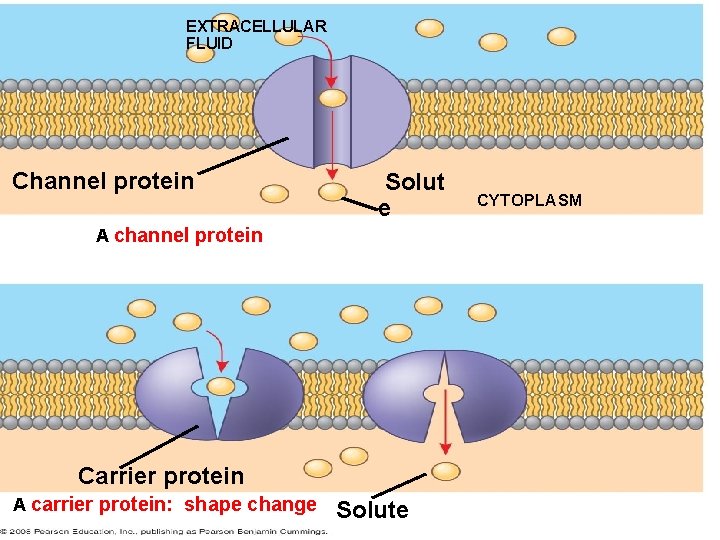
EXTRACELLULAR FLUID Channel protein Solut e A channel protein Carrier protein A carrier protein: shape change Solute CYTOPLASM
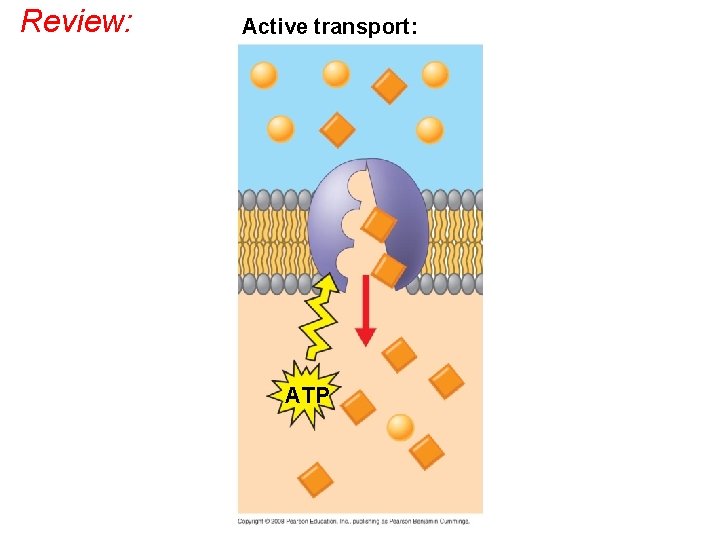
Active transport uses cell energy to move solutes against their gradients • Facilitated diffusion is still passive because the solute moves down its concentration gradient from a High to Low concentration. • BUT some transport proteins use cell energy to move solutes against their concentration gradients; from a Low to High concentration. • This uphill move is called active transport. • L --> H pumps solutes. Copyright © 2008 Pearson Education, Inc. , publishing as Pearson Benjamin Cummings
The Need for Energy in Active Transport • Active transport moves substances against their concentration gradient / uphill. • Active transport requires energy, usually in the form of ATP • Active transport is performed by specific membrane carrier proteins that use ATP energy to change shape, thereby pumping the solute across the membrane. Copyright © 2008 Pearson Education, Inc. , publishing as Pearson Benjamin Cummings
• Active transport allows cells to maintain concentration gradients that differ from their surroundings. • The sodium-potassium pump is one type of active transport system. Copyright © 2008 Pearson Education, Inc. , publishing as Pearson Benjamin Cummings
![EXTRACELLULAR FLUID [Na+] high [K+] low Na+ Na+ CYTOPLASM Na+ [Na+] low [K+] high](http://slidetodoc.com/presentation_image_h2/cc64b6adf6e907a287e3b46b169e0b5a/image-44.jpg "EXTRACELLULAR FLUID [Na+] high [K+] low Na+ Na+ CYTOPLASM Na+ [Na+] low [K+] high")
EXTRACELLULAR FLUID [Na+] high [K+] low Na+ Na+ CYTOPLASM Na+ [Na+] low [K+] high P ADP 2 1 ATP P 3 Carrier Proteins: Active Transport K+ K+ K+ + K K+ P K+ 6 5 4 P
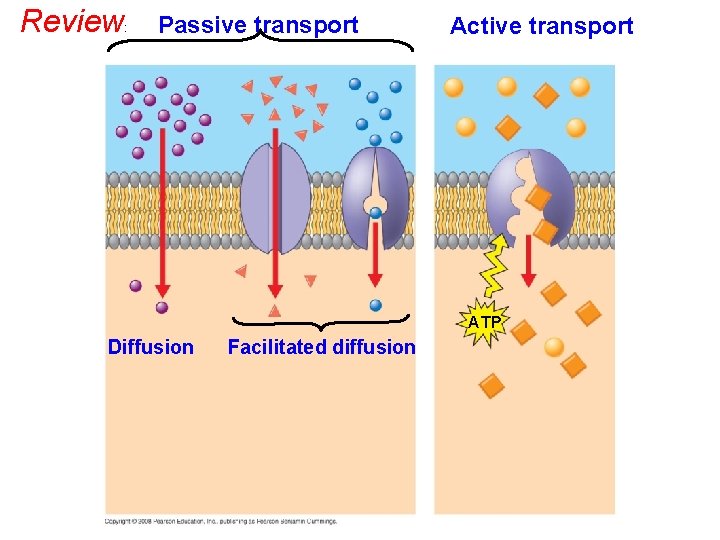
Review : Passive transport Active transport ATP Diffusion Facilitated diffusion
How Ion Pumps Maintain Membrane Potential • Membrane potential is the voltage difference across a membrane. • Voltage is created by differences in the distribution of positive + and negative - ions on the two sides of the membrane. Copyright © 2008 Pearson Education, Inc. , publishing as Pearson Benjamin Cummings
• Two combined forces, collectively called the electrochemical gradient, drive the diffusion of ions across a membrane: – A chemical force (the ion’s concentration gradient) – An electrical force (the effect of the membrane potential on the ion’s movement) Copyright © 2008 Pearson Education, Inc. , publishing as Pearson Benjamin Cummings
• An electrogenic pump is a transport protein that generates voltage across a membrane. • The sodium-potassium pump (Na+K+ pump) is the major electrogenic pump of animal cells. • A key electrogenic pump driving chemiosmosis in many cells is a proton pump. Copyright © 2008 Pearson Education, Inc. , publishing as Pearson Benjamin Cummings
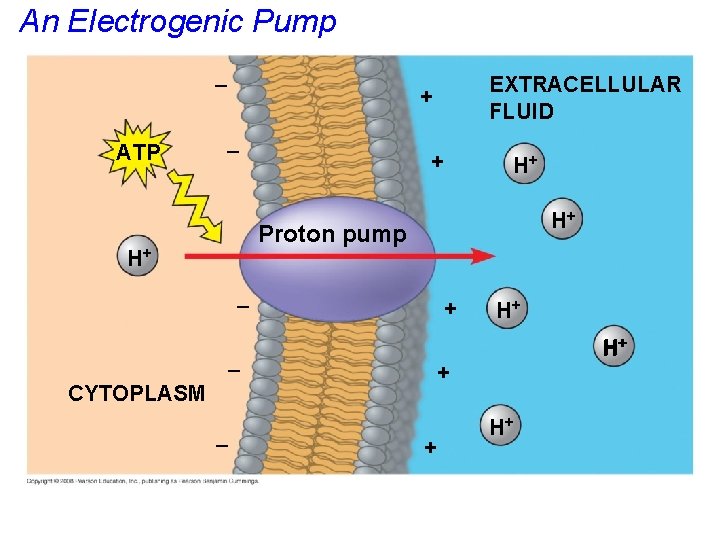
An Electrogenic Pump – ATP – + H+ H+ Proton pump H+ – CYTOPLASM EXTRACELLULAR FLUID + + – – H+ H+ + + H+
Cotransport: Coupled Transport by a Membrane Protein • Cotransport occurs when active transport of a solute indirectly drives the transport of another solute. • Plants commonly use the gradient of hydrogen ions generated by proton pumps to drive active transport of nutrients into the cell. Copyright © 2008 Pearson Education, Inc. , publishing as Pearson Benjamin Cummings
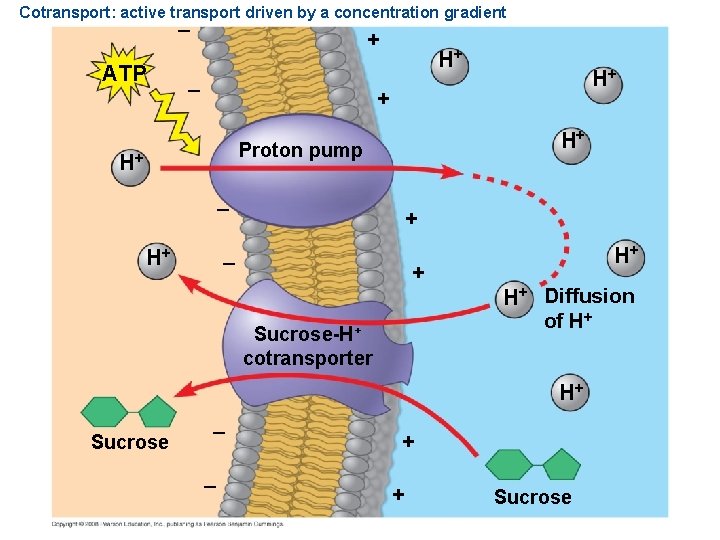
Cotransport: active transport driven by a concentration gradient – ATP + – H+ H+ Proton pump H+ – H+ + – + Sucrose-H+ cotransporter H+ H+ Diffusion of H+ H+ Sucrose – – + + Sucrose
Bulk transport across the plasma membrane occurs by exocytosis and endocytosis • Small molecules and water enter or leave the cell through the lipid bilayer or by transport proteins. • Large molecules, such as polysaccharides and proteins, cross the membrane in bulk via vesicles. • Bulk transport requires energy. Copyright © 2008 Pearson Education, Inc. , publishing as Pearson Benjamin Cummings
Exocytosis: LARGE molecules OUT • In exocytosis, transport vesicles migrate to the membrane, fuse with it, and release their contents outside the cell. • Many secretory cells use exocytosis to export their products. Copyright © 2008 Pearson Education, Inc. , publishing as Pearson Benjamin Cummings
Endocytosis: LARGE molecules IN • In endocytosis, the cell takes in macromolecules by forming vesicles from the plasma membrane. • Endocytosis is a reversal of exocytosis, involving different proteins. • There are three types of endocytosis: – Phagocytosis (“cellular eating”) – Pinocytosis (“cellular drinking”) – Receptor-mediated endocytosis Copyright © 2008 Pearson Education, Inc. , publishing as Pearson Benjamin Cummings
• In phagocytosis a cell engulfs a particle as the plasma membrane projects pseudopods which surround the particle, forming a vacuole. • The vacuole then fuses with a lysosome to digest the particle. Copyright © 2008 Pearson Education, Inc. , publishing as Pearson Benjamin Cummings
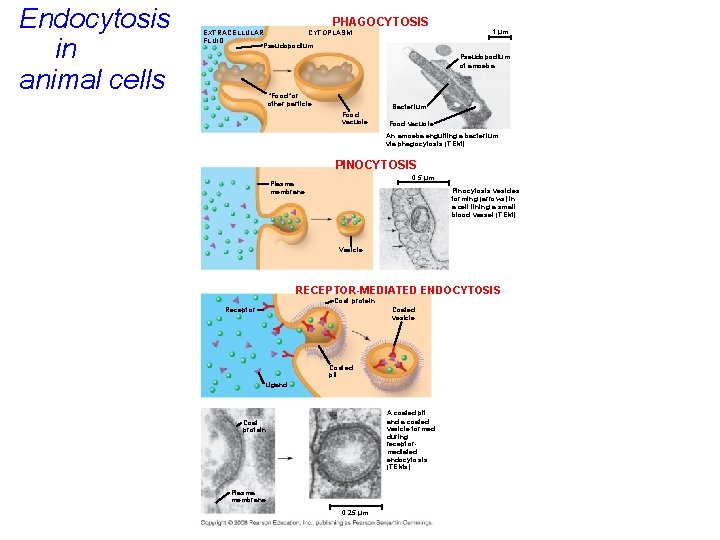
Endocytosis in animal cells PHAGOCYTOSIS EXTRACELLULAR CYTOPLASM FLUID Pseudopodium 1 µm Pseudopodium of amoeba “Food”or other particle Bacterium Food vacuole An amoeba engulfing a bacterium via phagocytosis (TEM) PINOCYTOSIS 0. 5 µm Plasma membrane Pinocytosis vesicles forming (arrows) in a cell lining a small blood vessel (TEM) Vesicle RECEPTOR-MEDIATED ENDOCYTOSIS Coat protein Receptor Coated vesicle Coated pit Ligand A coated pit and a coated vesicle formed during receptormediated endocytosis (TEMs) Coat protein Plasma membrane 0. 25 µm
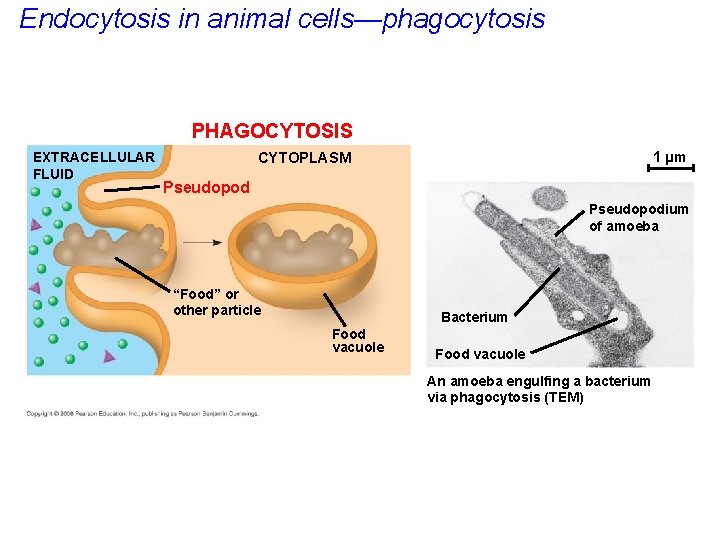
Endocytosis in animal cells—phagocytosis PHAGOCYTOSIS EXTRACELLULAR FLUID 1 µm CYTOPLASM Pseudopodium of amoeba “Food” or other particle Bacterium Food vacuole An amoeba engulfing a bacterium via phagocytosis (TEM)
• In pinocytosis, molecules are taken in when extracellular fluid is “gulped, ” surrounded by plasma membrane forming tiny vesicles. • Pinocytosis is referred to as “cell drinking. ” Copyright © 2008 Pearson Education, Inc. , publishing as Pearson Benjamin Cummings
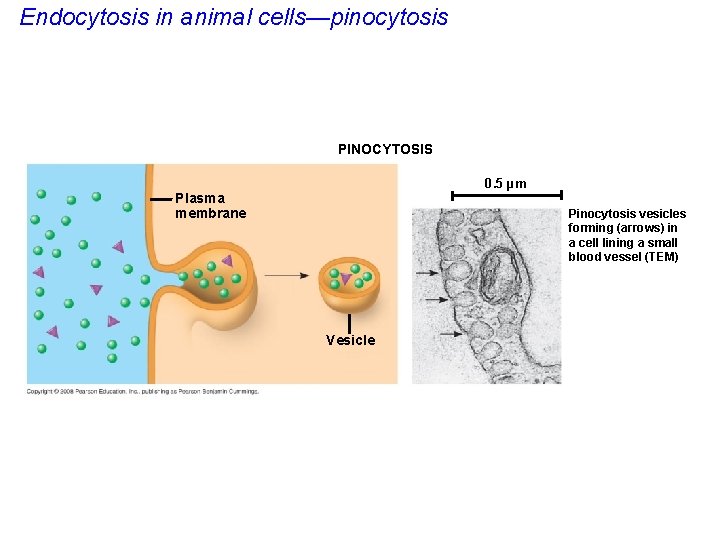
Endocytosis in animal cells—pinocytosis PINOCYTOSIS 0. 5 µm Plasma membrane Pinocytosis vesicles forming (arrows) in a cell lining a small blood vessel (TEM) Vesicle
• In receptor-mediated endocytosis, binding of ligands to receptors triggers vesicle formation. • A ligand is any molecule that binds specifically to a receptor site of another molecule using shape match. Copyright © 2008 Pearson Education, Inc. , publishing as Pearson Benjamin Cummings
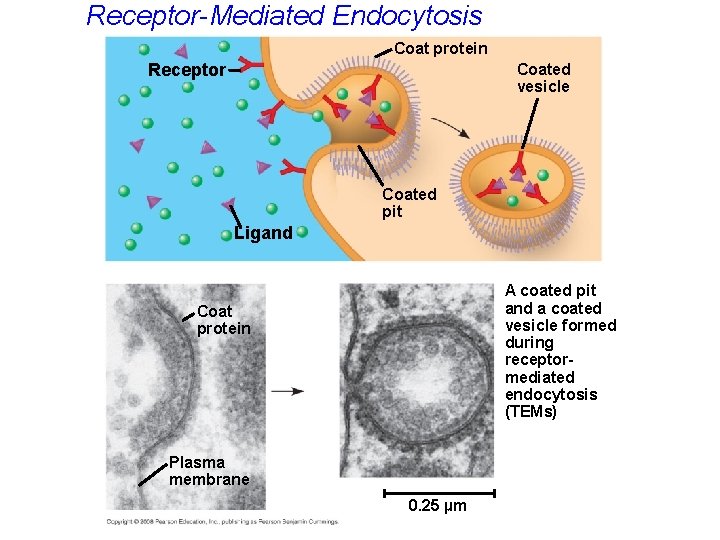
Receptor-Mediated Endocytosis Coat protein Receptor Coated vesicle Coated pit Ligand A coated pit and a coated vesicle formed during receptormediated endocytosis (TEMs) Coat protein Plasma membrane 0. 25 µm
Review: Channel protein Passive transport: Facilitated diffusion Carrier protein
Review: Active transport: ATP
Review: Diffusion Osmosis “Cell” 0. 03 M sucrose 0. 02 M glucose Environment: 0. 01 M sucrose 0. 01 M glucose 0. 01 M fructose
Diffusion of Multiple Molecules
You should now be able to: 1. Define the following terms: amphipathic molecules, aquaporins, diffusion. 2. Explain how membrane fluidity is influenced by temperature and membrane composition. 3. Distinguish between the following pairs or sets of terms: peripheral and integral membrane proteins; channel and carrier proteins; osmosis, facilitated diffusion, and active transport; hypertonic, hypotonic, and isotonic solutions. Copyright © 2008 Pearson Education, Inc. , publishing as Pearson Benjamin Cummings
4. Explain how transport proteins facilitate diffusion. 5. Explain how an electrogenic pump creates voltage across a membrane, and name two electrogenic pumps. 6. Explain how large molecules are transported across a cell membrane. Copyright © 2008 Pearson Education, Inc. , publishing as Pearson Benjamin Cummings
- Slides: 67