
Chapter 7 Membrane Structure and Function Part A
Chapter 7 Membrane Structure and Function Part A Copyright © 2005 Pearson Education, Inc. publishing as Benjamin Cummings
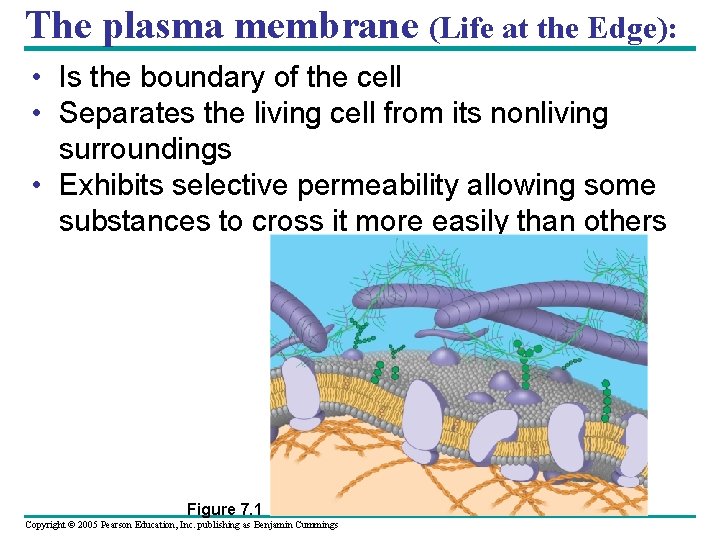
The plasma membrane (Life at the Edge): • Is the boundary of the cell • Separates the living cell from its nonliving surroundings • Exhibits selective permeability allowing some substances to cross it more easily than others Figure 7. 1 Copyright © 2005 Pearson Education, Inc. publishing as Benjamin Cummings
Membrane Components: • Cellular membranes are fluid mosaics of lipids and proteins • Phospholipids – Are the most abundant lipid in the plasma membrane – Are amphipathic, containing both: • Hydrophobic regions, and • Hydrophilic regions Copyright © 2005 Pearson Education, Inc. publishing as Benjamin Cummings
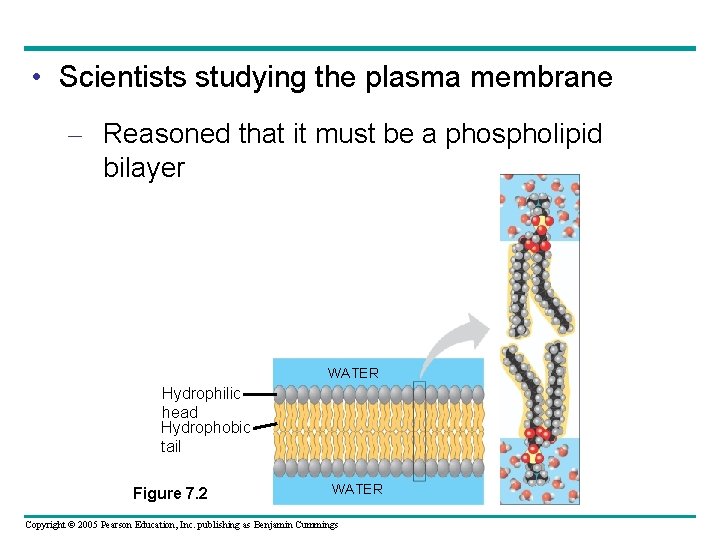
• Scientists studying the plasma membrane – Reasoned that it must be a phospholipid bilayer WATER Hydrophilic head Hydrophobic tail Figure 7. 2 WATER Copyright © 2005 Pearson Education, Inc. publishing as Benjamin Cummings
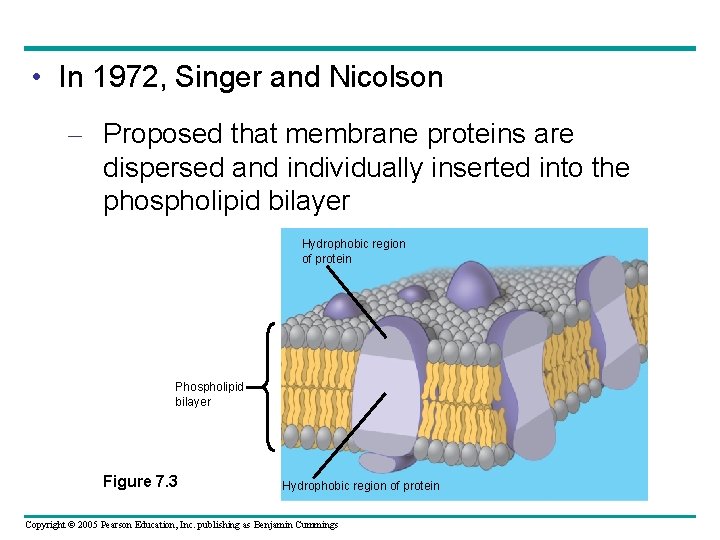
• In 1972, Singer and Nicolson – Proposed that membrane proteins are dispersed and individually inserted into the phospholipid bilayer Hydrophobic region of protein Phospholipid bilayer Figure 7. 3 Hydrophobic region of protein Copyright © 2005 Pearson Education, Inc. publishing as Benjamin Cummings
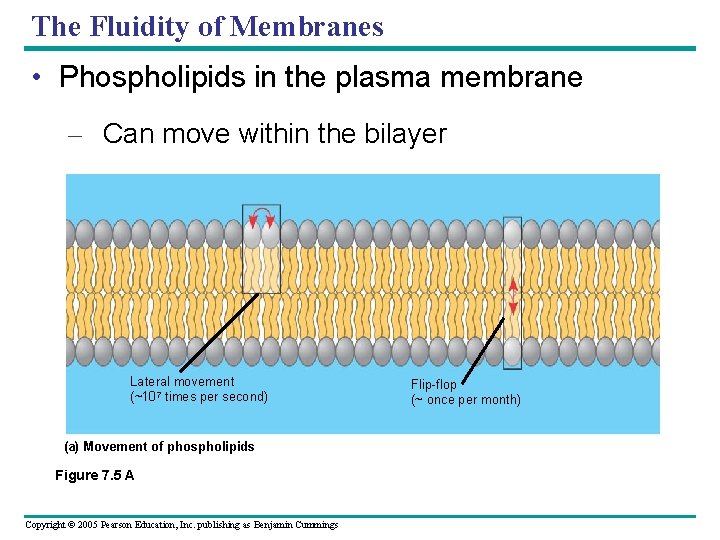
The Fluidity of Membranes • Phospholipids in the plasma membrane – Can move within the bilayer Lateral movement (~107 times per second) (a) Movement of phospholipids Figure 7. 5 A Copyright © 2005 Pearson Education, Inc. publishing as Benjamin Cummings Flip-flop (~ once per month)
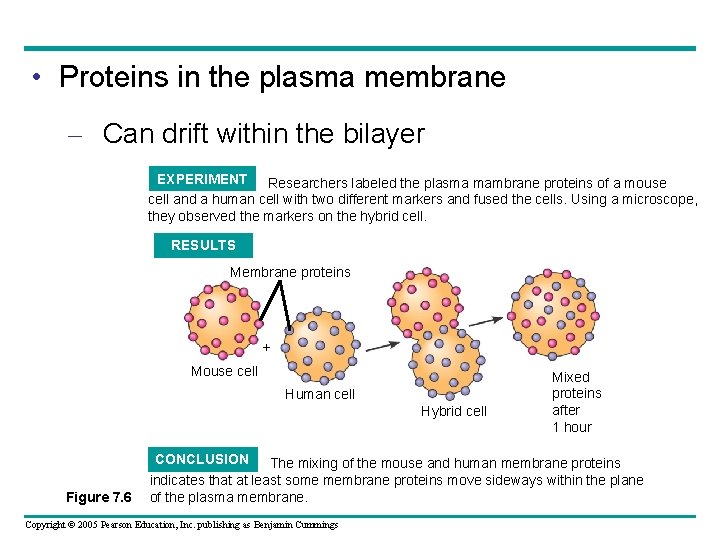
• Proteins in the plasma membrane – Can drift within the bilayer EXPERIMENT Researchers labeled the plasma mambrane proteins of a mouse cell and a human cell with two different markers and fused the cells. Using a microscope, they observed the markers on the hybrid cell. RESULTS Membrane proteins + Mouse cell Human cell Hybrid cell Figure 7. 6 Mixed proteins after 1 hour CONCLUSION The mixing of the mouse and human membrane proteins indicates that at least some membrane proteins move sideways within the plane of the plasma membrane. Copyright © 2005 Pearson Education, Inc. publishing as Benjamin Cummings
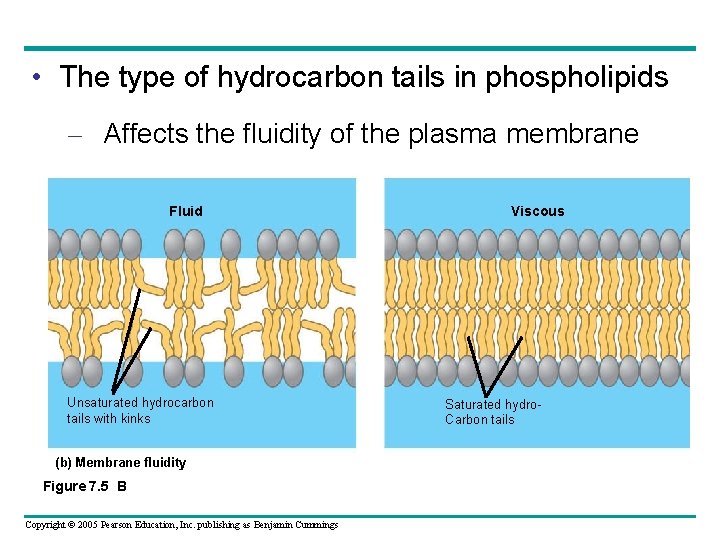
• The type of hydrocarbon tails in phospholipids – Affects the fluidity of the plasma membrane Fluid Unsaturated hydrocarbon tails with kinks (b) Membrane fluidity Figure 7. 5 B Copyright © 2005 Pearson Education, Inc. publishing as Benjamin Cummings Viscous Saturated hydro. Carbon tails
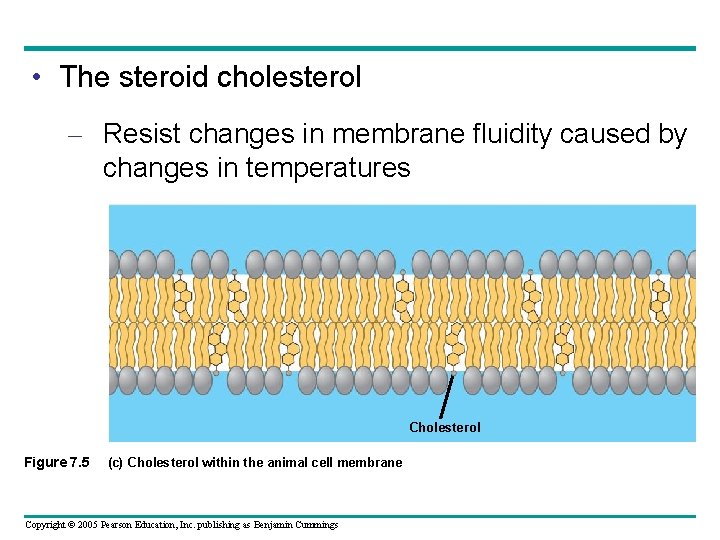
• The steroid cholesterol – Resist changes in membrane fluidity caused by changes in temperatures Cholesterol Figure 7. 5 (c) Cholesterol within the animal cell membrane Copyright © 2005 Pearson Education, Inc. publishing as Benjamin Cummings
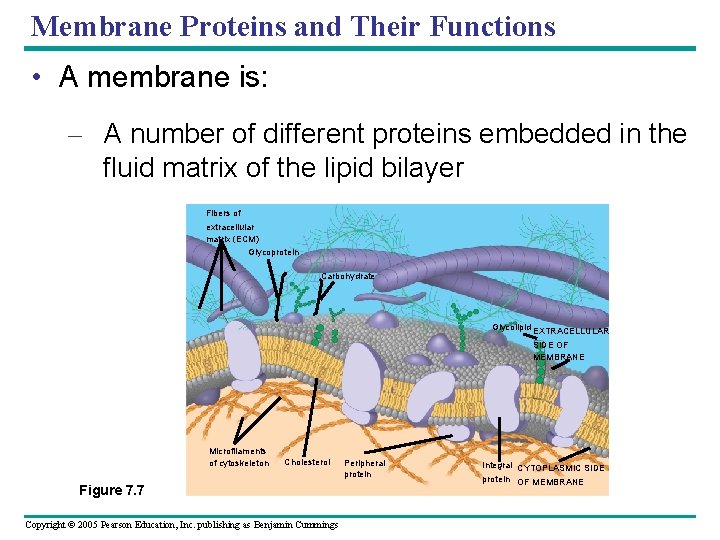
Membrane Proteins and Their Functions • A membrane is: – A number of different proteins embedded in the fluid matrix of the lipid bilayer Fibers of extracellular matrix (ECM) Glycoprotein Carbohydrate Glycolipid EXTRACELLULAR SIDE OF MEMBRANE Microfilaments of cytoskeleton Cholesterol Figure 7. 7 Copyright © 2005 Pearson Education, Inc. publishing as Benjamin Cummings Peripheral protein Integral CYTOPLASMIC SIDE protein OF MEMBRANE
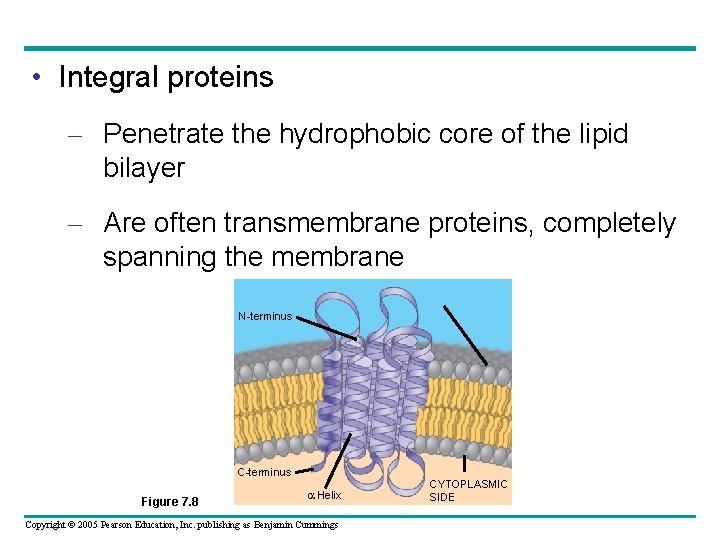
• Integral proteins – Penetrate the hydrophobic core of the lipid bilayer – Are often transmembrane proteins, completely spanning the membrane EXTRACELLULAR SIDE N-terminus C-terminus Figure 7. 8 a Helix Copyright © 2005 Pearson Education, Inc. publishing as Benjamin Cummings CYTOPLASMIC SIDE
• Peripheral proteins – Are appendages – Loosely bound to the surface of the membrane Copyright © 2005 Pearson Education, Inc. publishing as Benjamin Cummings
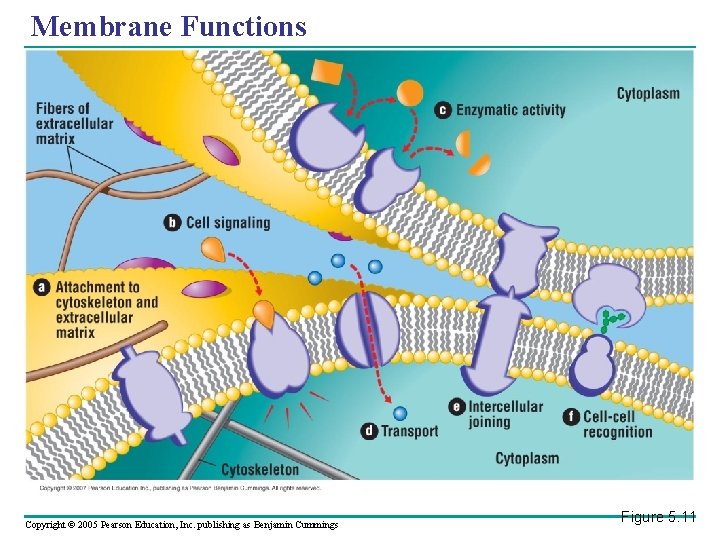
Membrane Functions Copyright © 2005 Pearson Education, Inc. publishing as Benjamin Cummings Figure 5. 11
The Role of Membrane Carbohydrates in Cell-Cell Recognition • Cell-cell recognition – Is a cell’s ability to distinguish one type of neighboring cell from another • Membrane carbohydrates – Interact with the surface molecules of other cells, facilitating cell-cell recognition Copyright © 2005 Pearson Education, Inc. publishing as Benjamin Cummings
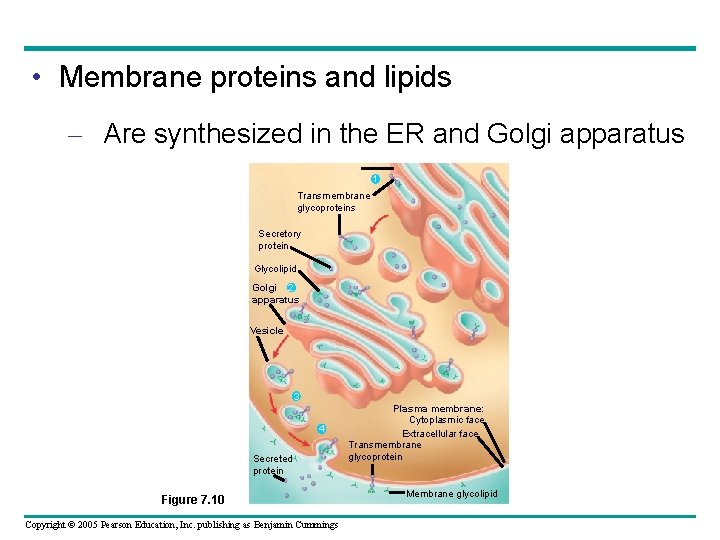
• Membrane proteins and lipids – Are synthesized in the ER and Golgi apparatus ER 1 Transmembrane glycoproteins Secretory protein Glycolipid Golgi 2 apparatus Vesicle 3 4 Secreted protein Figure 7. 10 Copyright © 2005 Pearson Education, Inc. publishing as Benjamin Cummings Plasma membrane: Cytoplasmic face Extracellular face Transmembrane glycoprotein Membrane glycolipid
Membrane Permeability Membrane structure results in selective permeability • A cell must exchange materials with its surroundings • A process controlled by the plasma membrane Copyright © 2005 Pearson Education, Inc. publishing as Benjamin Cummings
The Permeability of the Lipid Bilayer • Hydrophobic molecules – Are lipid soluble – Can pass through the membrane rapidly • Polar molecules – Do not cross the membrane rapidly Copyright © 2005 Pearson Education, Inc. publishing as Benjamin Cummings
Transport Proteins & Passive Transport: • Transport proteins – Allow passage of hydrophilic substances across the membrane • Passive transport: – Is diffusion of a substance across a membrane with no energy investment Copyright © 2005 Pearson Education, Inc. publishing as Benjamin Cummings
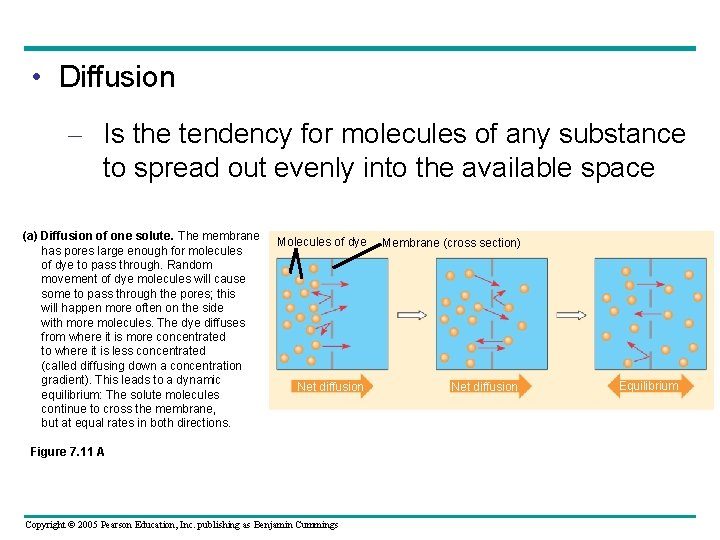
• Diffusion – Is the tendency for molecules of any substance to spread out evenly into the available space (a) Diffusion of one solute. The membrane has pores large enough for molecules of dye to pass through. Random movement of dye molecules will cause some to pass through the pores; this will happen more often on the side with more molecules. The dye diffuses from where it is more concentrated to where it is less concentrated (called diffusing down a concentration gradient). This leads to a dynamic equilibrium: The solute molecules continue to cross the membrane, but at equal rates in both directions. Molecules of dye Membrane (cross section) Net diffusion Figure 7. 11 A Copyright © 2005 Pearson Education, Inc. publishing as Benjamin Cummings Equilibrium
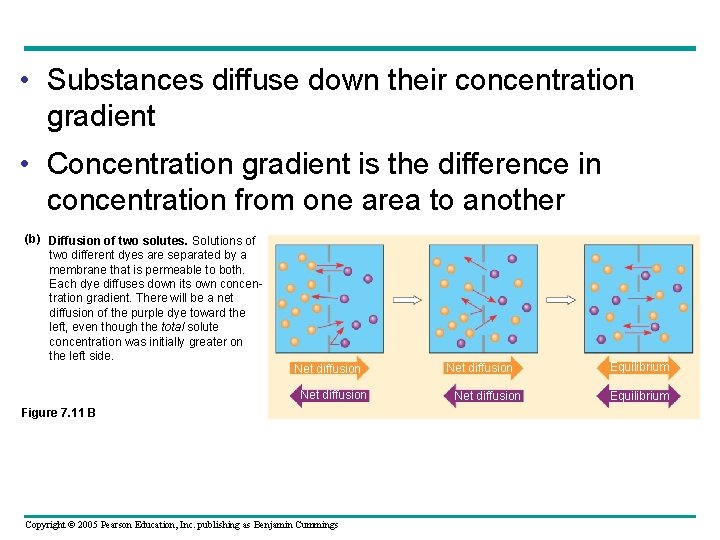
• Substances diffuse down their concentration gradient • Concentration gradient is the difference in concentration from one area to another (b) Diffusion of two solutes. Solutions of two different dyes are separated by a membrane that is permeable to both. Each dye diffuses down its own concentration gradient. There will be a net diffusion of the purple dye toward the left, even though the total solute concentration was initially greater on the left side. Net diffusion Figure 7. 11 B Copyright © 2005 Pearson Education, Inc. publishing as Benjamin Cummings Net diffusion Equilibrium
Effects of Osmosis on Water Balance • Facilitated diffusion: – Another type of passive transport – Involves specific transport proteins that act as selective corridors. • Osmosis – Is the movement of water across a semipermeable membrane – Water moves from the low concentrated solution toward the high concentrated one Copyright © 2005 Pearson Education, Inc. publishing as Benjamin Cummings
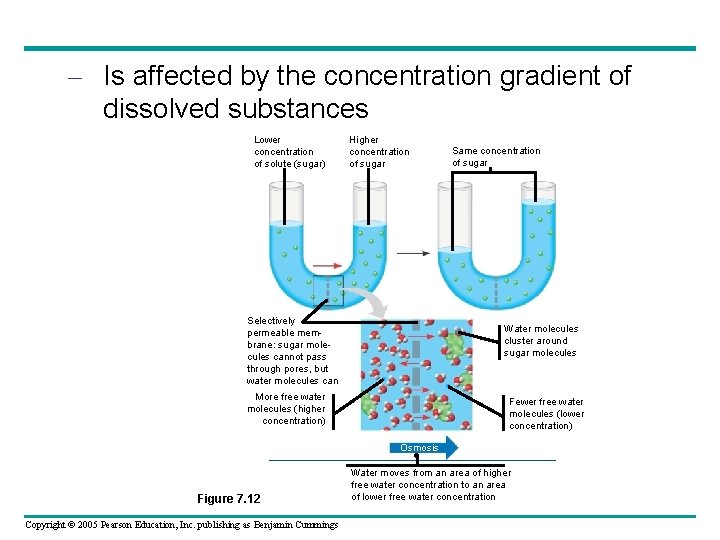
– Is affected by the concentration gradient of dissolved substances Lower concentration of solute (sugar) Higher concentration of sugar Same concentration of sugar Selectively permeable membrane: sugar molecules cannot pass through pores, but water molecules can Water molecules cluster around sugar molecules More free water molecules (higher concentration) Fewer free water molecules (lower concentration) Osmosis Figure 7. 12 Copyright © 2005 Pearson Education, Inc. publishing as Benjamin Cummings Water moves from an area of higher free water concentration to an area of lower free water concentration
- Slides: 22