
Chapter 7 Meiosis and Sexual Reproduction This picture
- Slides: 39
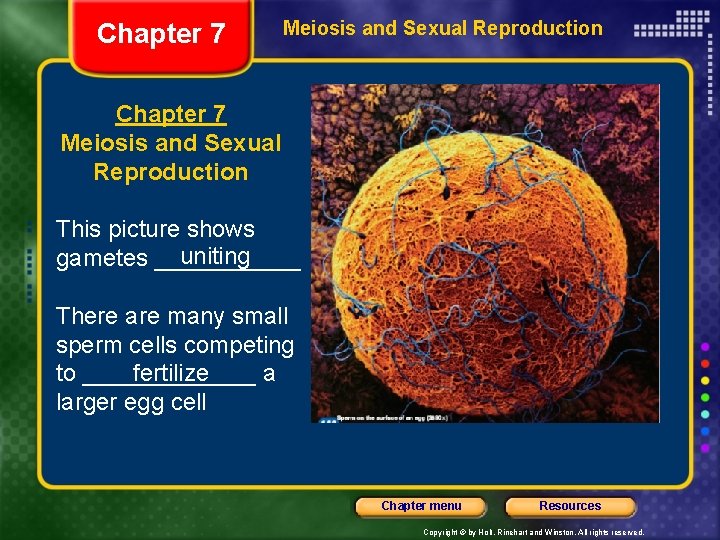
Chapter 7 Meiosis and Sexual Reproduction This picture shows uniting gametes ______ There are many small sperm cells competing fertilize to _______ a larger egg cell Chapter menu Resources Copyright © by Holt, Rinehart and Winston. All rights reserved.
Chapter 7 Section 1 Meiosis Objectives • Summarize the events that occur during meiosis. • Relate crossing-over, independent assortment, and random fertilization to genetic variation. • Compare spermatogenesis and oogenesis. Chapter menu Resources Copyright © by Holt, Rinehart and Winston. All rights reserved.
7. 1 Vocabulary • • Meiosis Crossing over Independent assortment Spermatogenesis Sperm Oogenesis ovum Chapter menu Resources Copyright © by Holt, Rinehart and Winston. All rights reserved.
Chapter 7 Formation of Haploid Cells • Meiosis is a form of cell division that _____ halves the number of chromosomes when forming gametes specialized reproductive cells, such as _____ spores or _______ haploids – These specialized cells are ________ • Since the chromosome number is being reduced _______ by half, this process is often called reduction cell _________ Chapter menu Resources Copyright © by Holt, Rinehart and Winston. All rights reserved.
• What are the two types of human gametes? Sperm and egg cells • What do gametes do? They fuse to create a fertilized zygote • Why is it important that they contain half the number of chromosomes as found in a diploid cell? So that they create a diploid cell when they fuse Chapter menu Resources Copyright © by Holt, Rinehart and Winston. All rights reserved.
• Meiosis involves two divisions of the nucleus called… Meiosis I – _________ Meiosis II – _________ • These divisions are very similar to the process of mitosis _________, but with a few changes • Before meiosis begins, the DNA of the original cell interphase must be copied during ________ diploid – This original cell is a _________ cell Chapter menu Resources Copyright © by Holt, Rinehart and Winston. All rights reserved.
• Meiosis I includes…. – Prophase ___ I I – Metaphase ___ I – Anaphase ___ – Telophase ___ I • Meiosis II includes II – Prophase ____ – Metaphase ____ II II – Anaphase ____ II – Telophase ____ Chapter menu Resources Copyright © by Holt, Rinehart and Winston. All rights reserved.
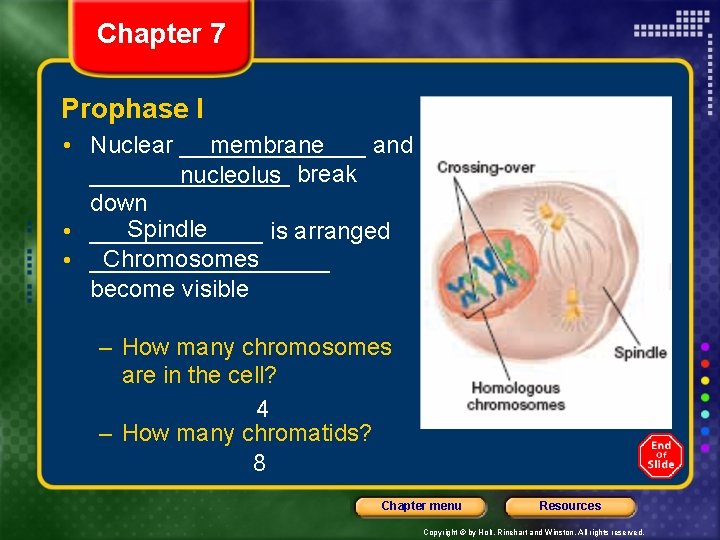
Chapter 7 Prophase I • Nuclear _______ membrane and ________ nucleolus break down Spindle • _______ is arranged Chromosomes • _________ become visible – How many chromosomes are in the cell? 4 – How many chromatids? 8 Chapter menu Resources Copyright © by Holt, Rinehart and Winston. All rights reserved.
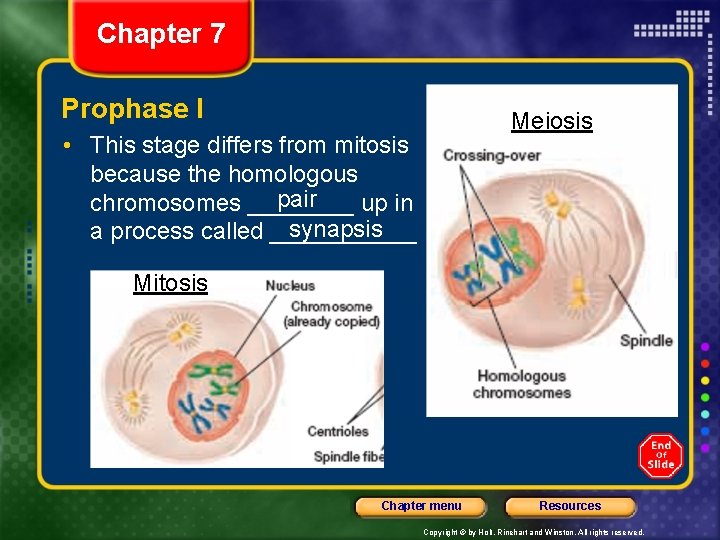
Chapter 7 Prophase I Meiosis • This stage differs from mitosis because the homologous pair chromosomes ____ up in synapsis a process called ______ Mitosis Chapter menu Resources Copyright © by Holt, Rinehart and Winston. All rights reserved.
• Review. . . what are homologous chromosomes? – They are a pair of chromosomes that are similar in ________ and that also contain genes for the structure same ______ traits mom and one from ______ dad – You inherit one from ______ identical – They are not ________ • For example…dad’s chromosome may have a _____ gene while mom’s has a _____ gene tall short Chapter menu Resources Copyright © by Holt, Rinehart and Winston. All rights reserved.
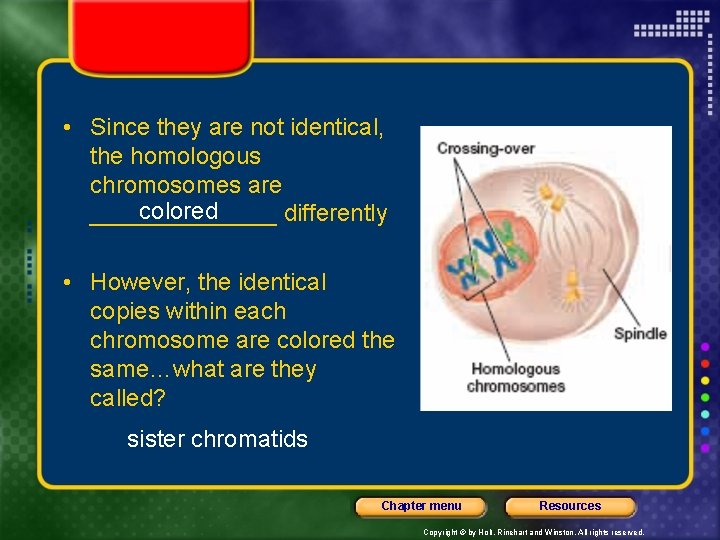
• Since they are not identical, the homologous chromosomes are colored _______ differently • However, the identical copies within each chromosome are colored the same…what are they called? sister chromatids Chapter menu Resources Copyright © by Holt, Rinehart and Winston. All rights reserved.
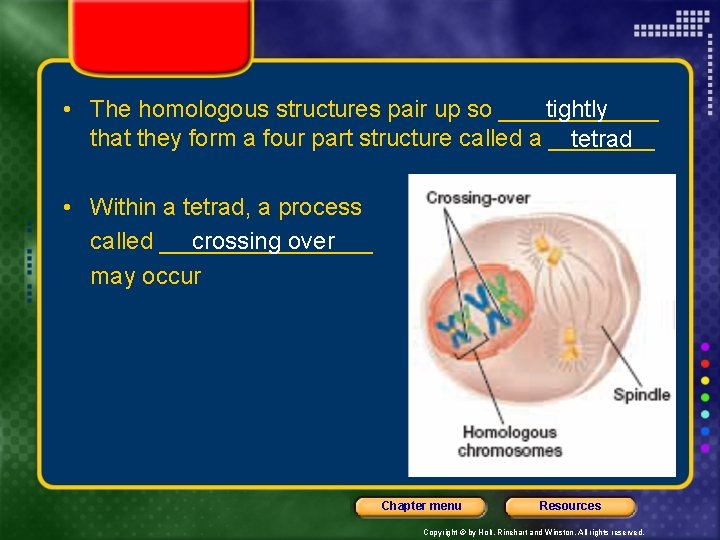
tightly • The homologous structures pair up so ______ that they form a four part structure called a ____ tetrad • Within a tetrad, a process crossing over called ________ may occur Chapter menu Resources Copyright © by Holt, Rinehart and Winston. All rights reserved.
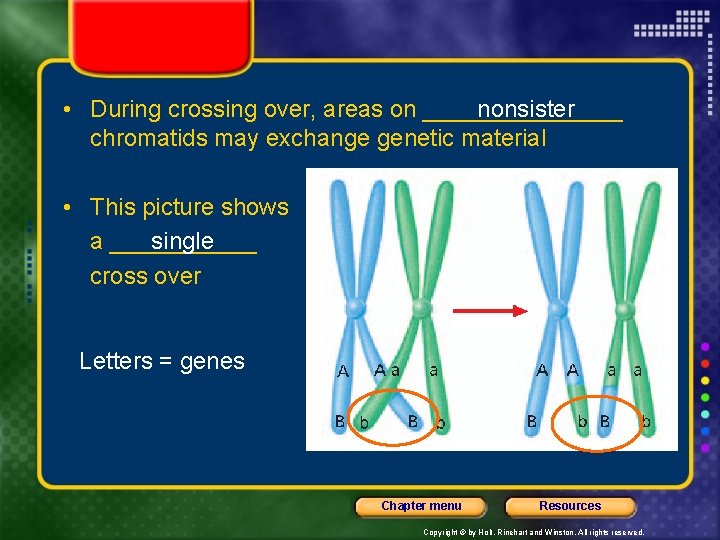
nonsister • During crossing over, areas on ________ chromatids may exchange genetic material • This picture shows single a ______ cross over Letters = genes Chapter menu Resources Copyright © by Holt, Rinehart and Winston. All rights reserved.
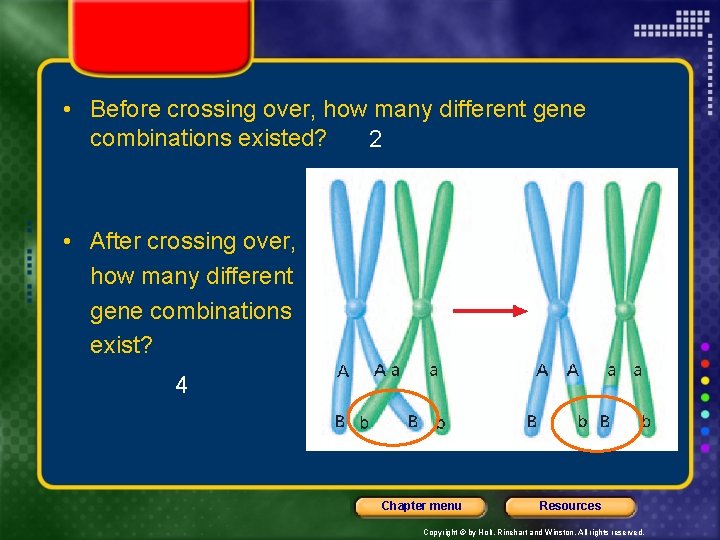
• Before crossing over, how many different gene combinations existed? 2 • After crossing over, how many different gene combinations exist? 4 Chapter menu Resources Copyright © by Holt, Rinehart and Winston. All rights reserved.
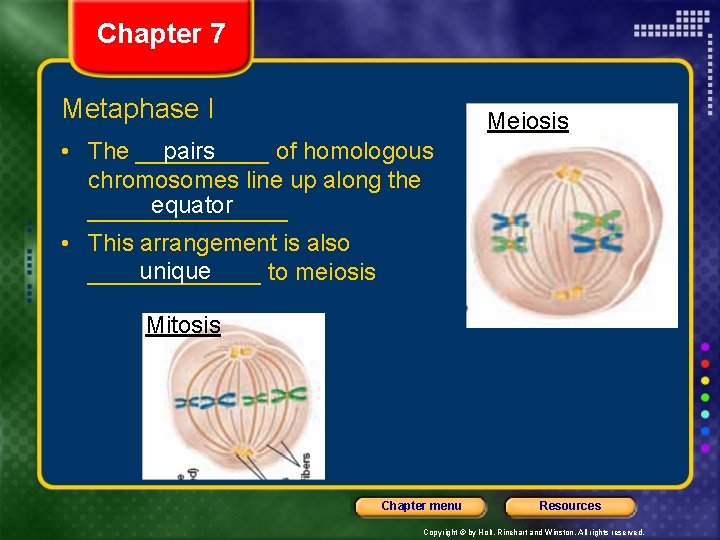
Chapter 7 Metaphase I Meiosis • The _____ pairs of homologous chromosomes line up along the equator ________ • This arrangement is also unique _______ to meiosis Mitosis Chapter menu Resources Copyright © by Holt, Rinehart and Winston. All rights reserved.
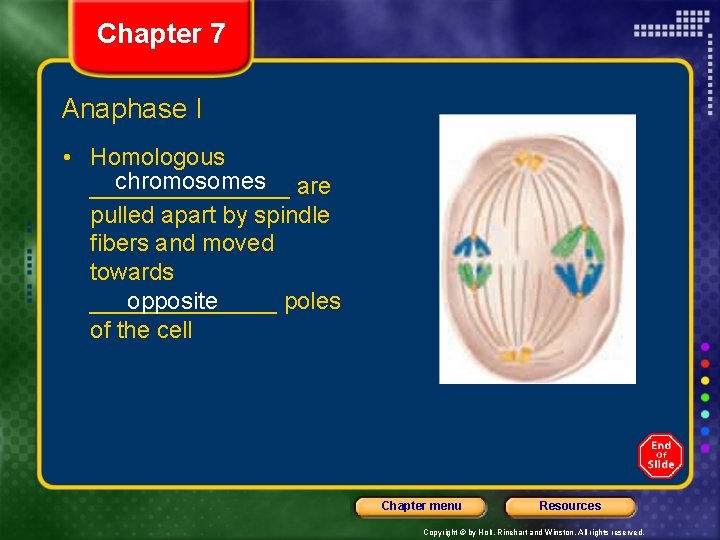
Chapter 7 Anaphase I • Homologous chromosomes are ________ pulled apart by spindle fibers and moved towards opposite _______ poles of the cell Chapter menu Resources Copyright © by Holt, Rinehart and Winston. All rights reserved.
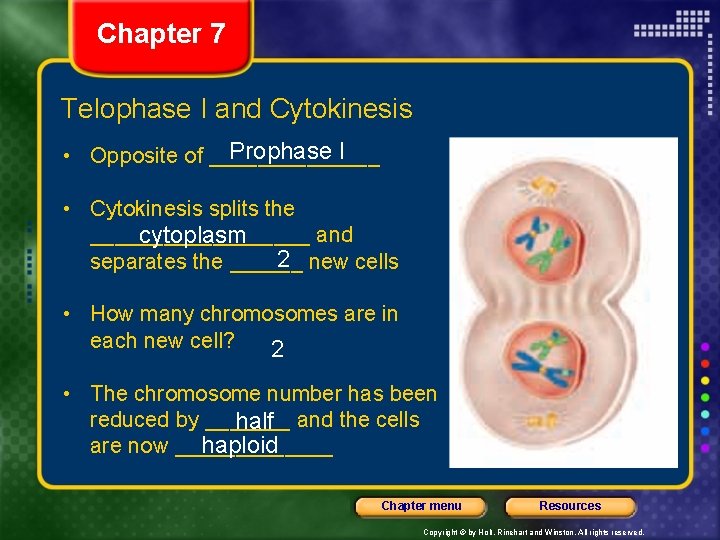
Chapter 7 Telophase I and Cytokinesis Prophase I • Opposite of _______ • Cytokinesis splits the _________ and cytoplasm 2 new cells separates the ______ • How many chromosomes are in each new cell? 2 • The chromosome number has been reduced by _______ half and the cells haploid are now _______ Chapter menu Resources Copyright © by Holt, Rinehart and Winston. All rights reserved.
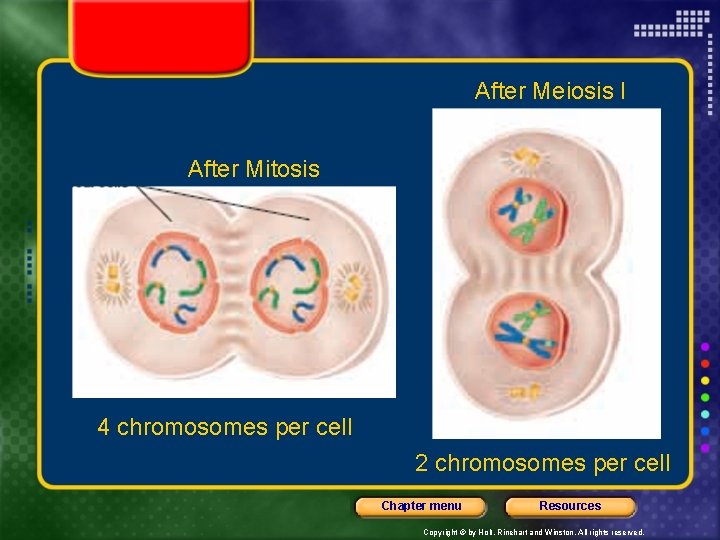
After Meiosis I After Mitosis 4 chromosomes per cell 2 chromosomes per cell Chapter menu Resources Copyright © by Holt, Rinehart and Winston. All rights reserved.
VERY IMPORTANT!!!! • These two cells do NOT enter ________ interphase again and do NOT copy their ____ DNA again! II • They both proceed with meiosis ____. Chapter menu Resources Copyright © by Holt, Rinehart and Winston. All rights reserved.
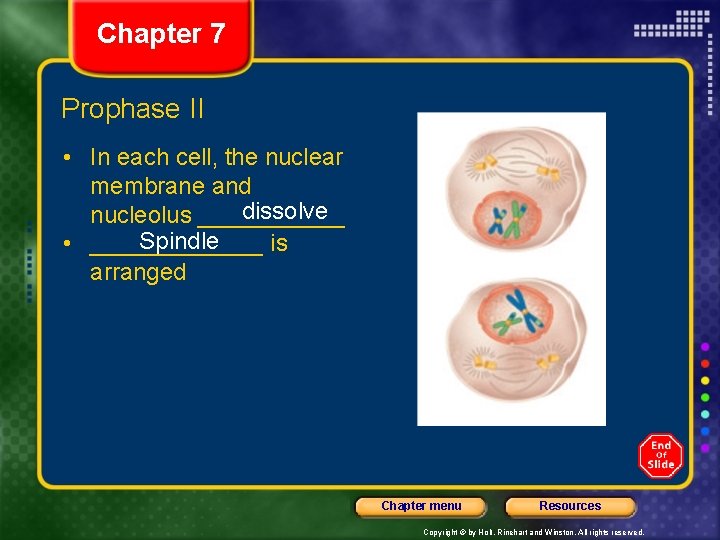
Chapter 7 Prophase II • In each cell, the nuclear membrane and dissolve nucleolus ______ Spindle • _______ is arranged Chapter menu Resources Copyright © by Holt, Rinehart and Winston. All rights reserved.
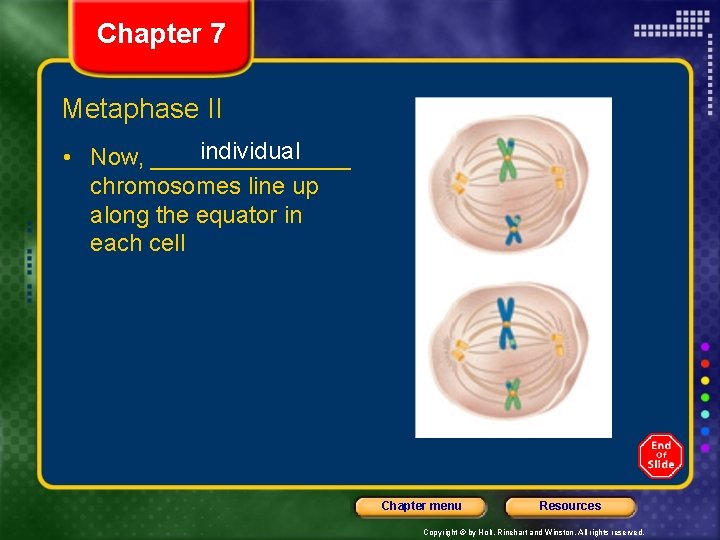
Chapter 7 Metaphase II individual • Now, ________ chromosomes line up along the equator in each cell Chapter menu Resources Copyright © by Holt, Rinehart and Winston. All rights reserved.
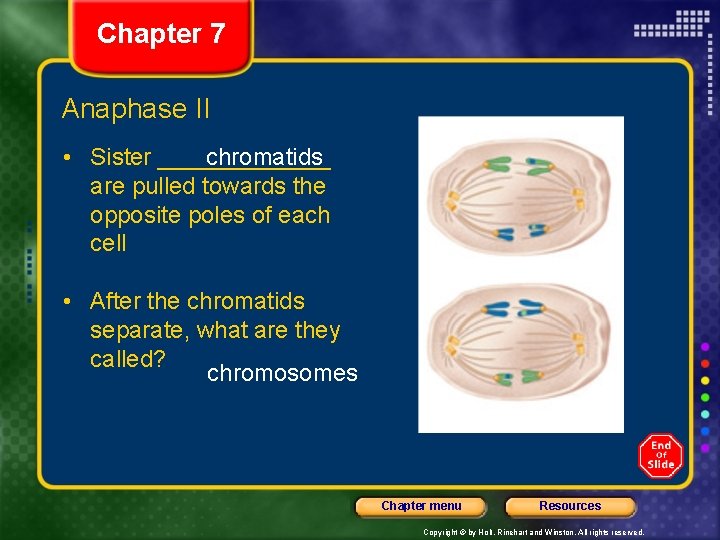
Chapter 7 Anaphase II • Sister _______ chromatids are pulled towards the opposite poles of each cell • After the chromatids separate, what are they called? chromosomes Chapter menu Resources Copyright © by Holt, Rinehart and Winston. All rights reserved.
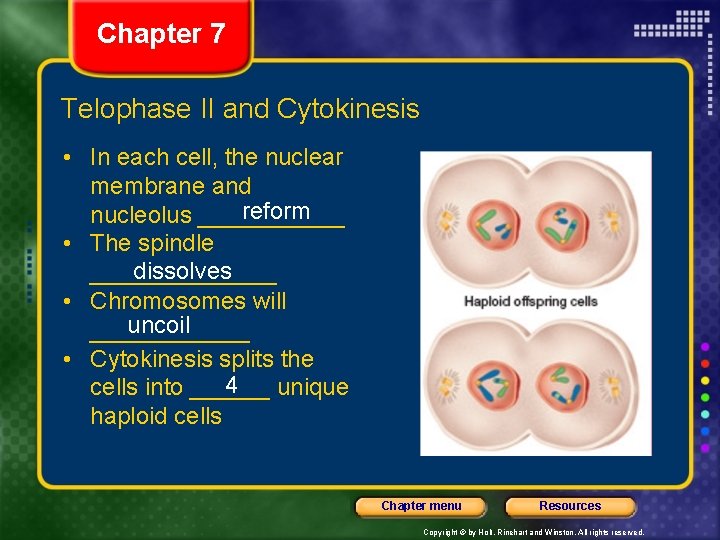
Chapter 7 Telophase II and Cytokinesis • In each cell, the nuclear membrane and reform nucleolus ______ • The spindle dissolves _______ • Chromosomes will uncoil ______ • Cytokinesis splits the 4 cells into ______ unique haploid cells Chapter menu Resources Copyright © by Holt, Rinehart and Winston. All rights reserved.
Chapter 7 Meiosis and Genetic Variation • Meiosis is an important process that allows for the rapid generation of new genetic ________. combinations • Three mechanisms make key contributions to this genetic variation: Independent Assortment – _____________ Random fertilization – _____________ Crossing over – _____________ Chapter menu Resources Copyright © by Holt, Rinehart and Winston. All rights reserved.
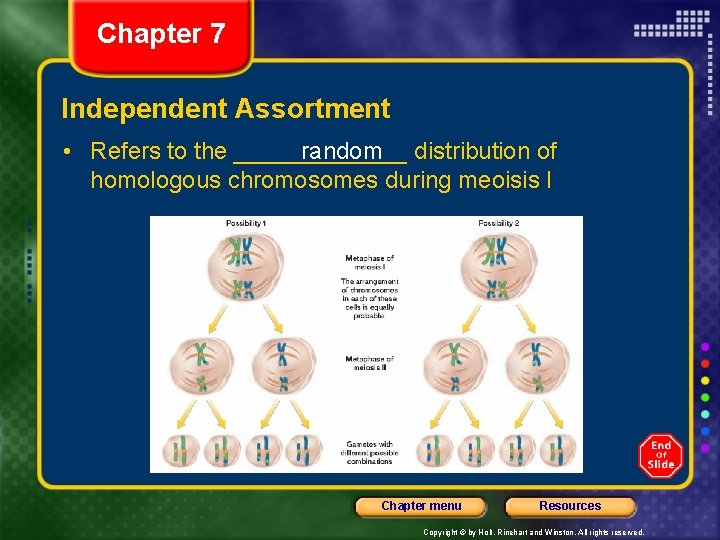
Chapter 7 Independent Assortment • Refers to the _______ random distribution of homologous chromosomes during meoisis I Chapter menu Resources Copyright © by Holt, Rinehart and Winston. All rights reserved.
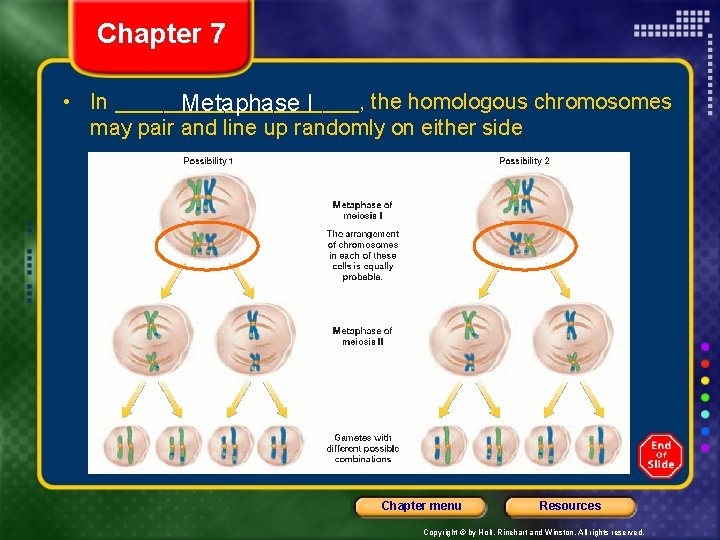
Chapter 7 • In __________, the homologous chromosomes Metaphase I may pair and line up randomly on either side Chapter menu Resources Copyright © by Holt, Rinehart and Winston. All rights reserved.
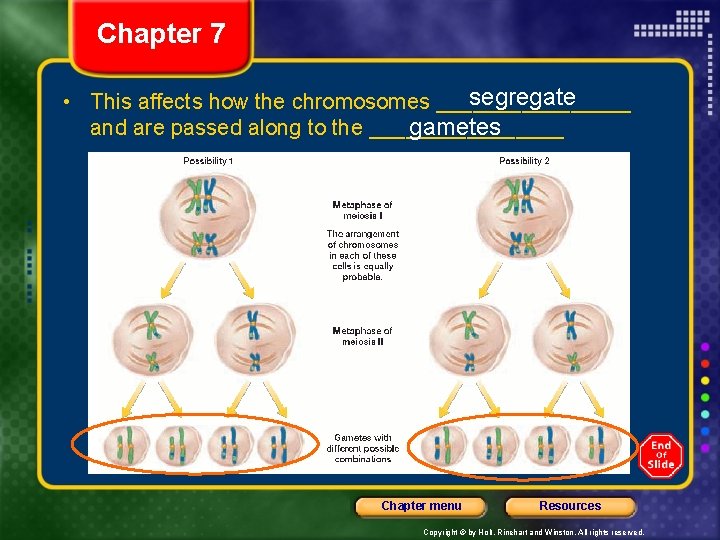
Chapter 7 segregate • This affects how the chromosomes ________ gametes and are passed along to the ________ Chapter menu Resources Copyright © by Holt, Rinehart and Winston. All rights reserved.
• Since humans have 23 pairs of homologous chromosomes…each pair has ____ 2 ways it may face while lining up • Mathematically, the total number of possible gametes formed is… 2 n or 223 = 8, 388, 608 gametes Chapter menu Resources Copyright © by Holt, Rinehart and Winston. All rights reserved.
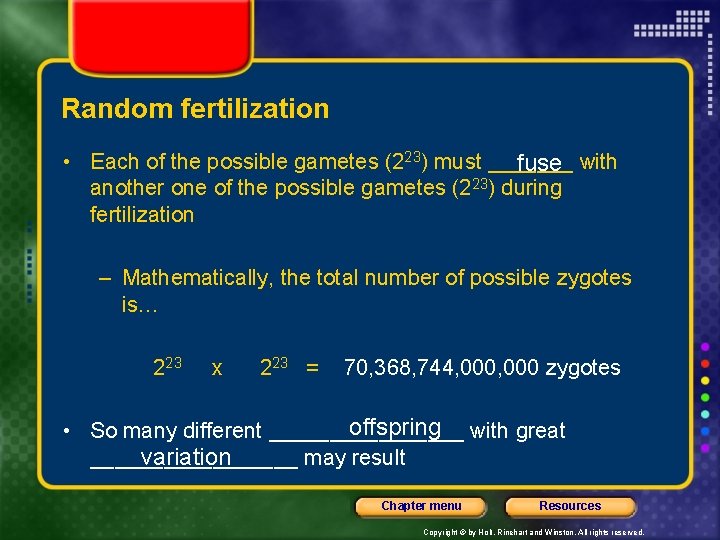
Random fertilization • Each of the possible gametes (223) must _______ fuse with another one of the possible gametes (223) during fertilization – Mathematically, the total number of possible zygotes is… 223 x 223 = 70, 368, 744, 000 zygotes offspring with great • So many different _________________ may result variation Chapter menu Resources Copyright © by Holt, Rinehart and Winston. All rights reserved.
Crossing over • Since homologous chromosomes may _____ exchange genetic information within a tetrad, the number of possible gametes and zygotes is actually unlimited __________ Chapter menu Resources Copyright © by Holt, Rinehart and Winston. All rights reserved.
Chapter 7 Importance of Genetic Variation • Meiosis and the joining of gametes are essential to evolution _________ • The pace of evolution is sped up by genetic recombination ________. – Each offspring contains a combination of genes different that is ________ from each parent Chapter menu Resources Copyright © by Holt, Rinehart and Winston. All rights reserved.
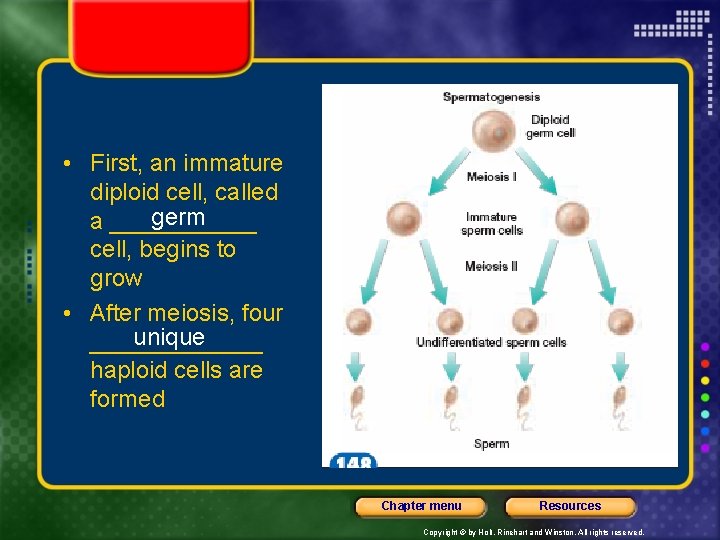
Chapter 7 Gamete Formation in Males and Females Meiosis in Males • The process by which sperm are produced in male spermatogenesis animals is called ____________ • Spermatogenesis occurs in the male reproductive testes organ, called the ________ Chapter menu Resources Copyright © by Holt, Rinehart and Winston. All rights reserved.
• First, an immature diploid cell, called germ a ______ cell, begins to grow • After meiosis, four unique _______ haploid cells are formed Chapter menu Resources Copyright © by Holt, Rinehart and Winston. All rights reserved.
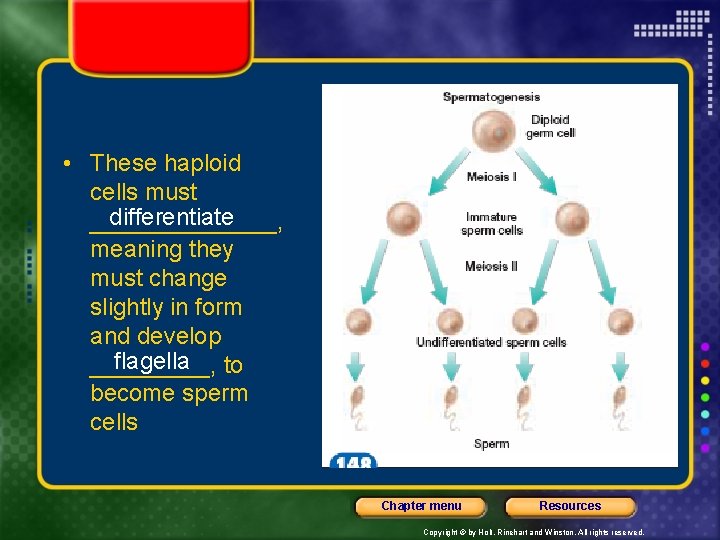
• These haploid cells must differentiate _______, meaning they must change slightly in form and develop flagella to _____, become sperm cells Chapter menu Resources Copyright © by Holt, Rinehart and Winston. All rights reserved.
Chapter 7 Meiosis in Females • The process by which gametes are produced in oogenesis female animals is called __________ • Oogenesis occurs in the female reproductive organs, ovaries called ________ and produces female ova gametes called eggs or ____ (ovum – singular) Chapter menu Resources Copyright © by Holt, Rinehart and Winston. All rights reserved.
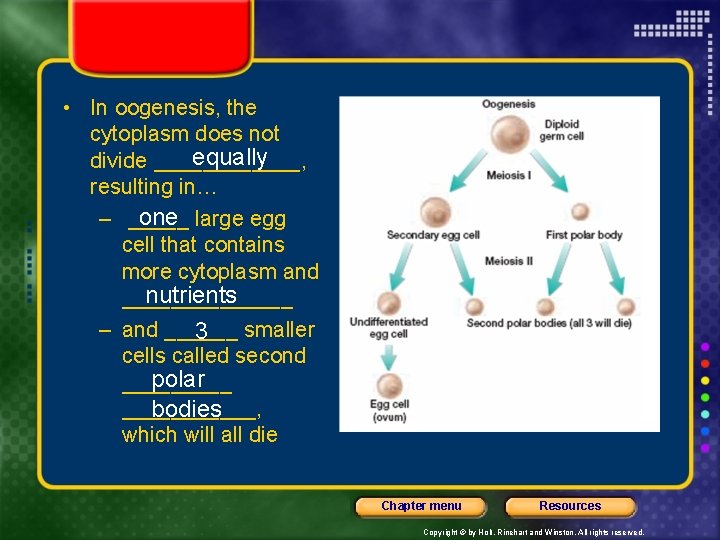
• In oogenesis, the cytoplasm does not equally divide ______, resulting in… one large egg – _____ cell that contains more cytoplasm and nutrients _______ – and ______ 3 smaller cells called second polar ___________, bodies which will all die Chapter menu Resources Copyright © by Holt, Rinehart and Winston. All rights reserved.
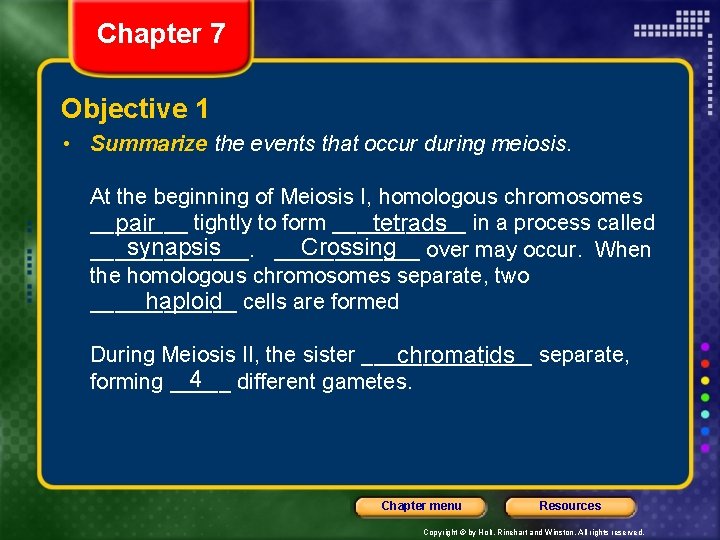
Chapter 7 Objective 1 • Summarize the events that occur during meiosis. At the beginning of Meiosis I, homologous chromosomes ____ tightly to form ______ pair tetrads in a process called synapsis Crossing over may occur. When _______ the homologous chromosomes separate, two haploid cells are formed ______ During Meiosis II, the sister _______ chromatids separate, 4 different gametes. forming _____ Chapter menu Resources Copyright © by Holt, Rinehart and Winston. All rights reserved.
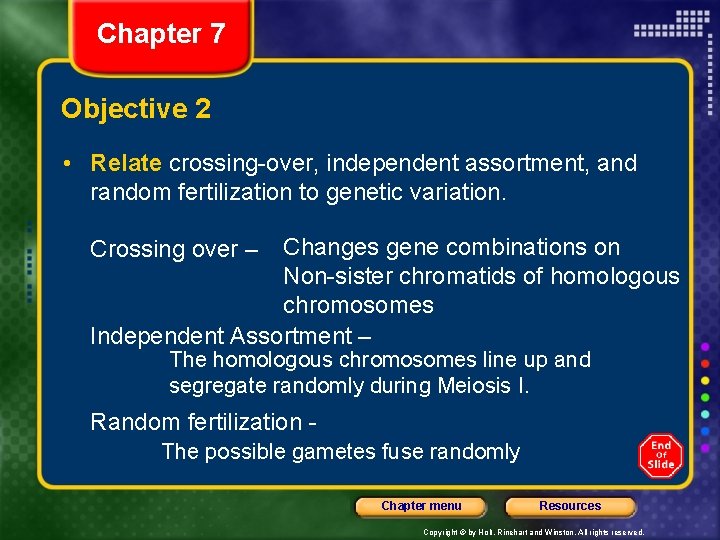
Chapter 7 Objective 2 • Relate crossing-over, independent assortment, and random fertilization to genetic variation. Changes gene combinations on Non-sister chromatids of homologous chromosomes Independent Assortment – Crossing over – The homologous chromosomes line up and segregate randomly during Meiosis I. Random fertilization The possible gametes fuse randomly Chapter menu Resources Copyright © by Holt, Rinehart and Winston. All rights reserved.
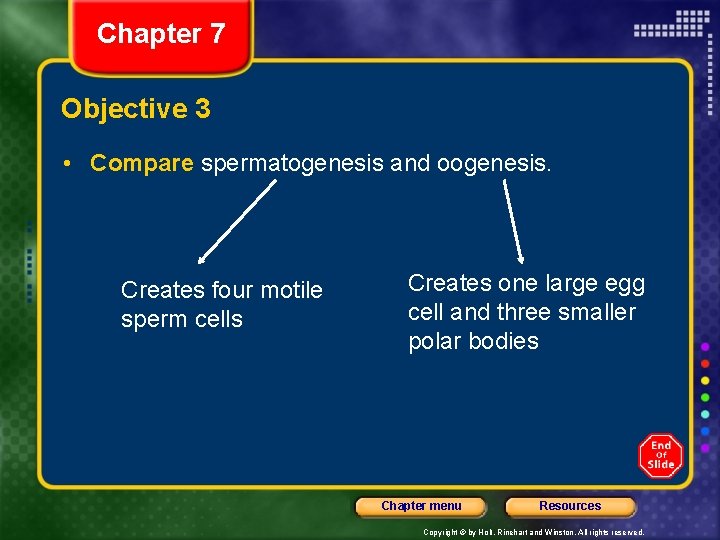
Chapter 7 Objective 3 • Compare spermatogenesis and oogenesis. Creates four motile sperm cells Creates one large egg cell and three smaller polar bodies Chapter menu Resources Copyright © by Holt, Rinehart and Winston. All rights reserved.