
CHAPTER 7 MEASUREMENT OF HIGH VOLTAGE AND CURRENTS
- Slides: 28
CHAPTER 7 MEASUREMENT OF HIGH VOLTAGE AND CURRENTS 7. 2 MEASUREMENT OF HIGH ALTERNATING VOLTAGES • 7. 3 MEASUREMENT OF IMPULSE VOLTAGE & CURRENT •
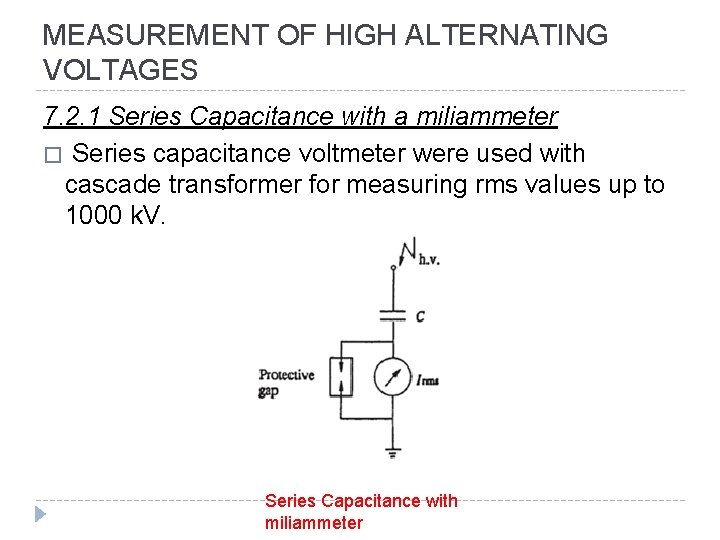
MEASUREMENT OF HIGH ALTERNATING VOLTAGES 7. 2. 1 Series Capacitance with a miliammeter � Series capacitance voltmeter were used with cascade transformer for measuring rms values up to 1000 k. V. Series Capacitance with miliammeter
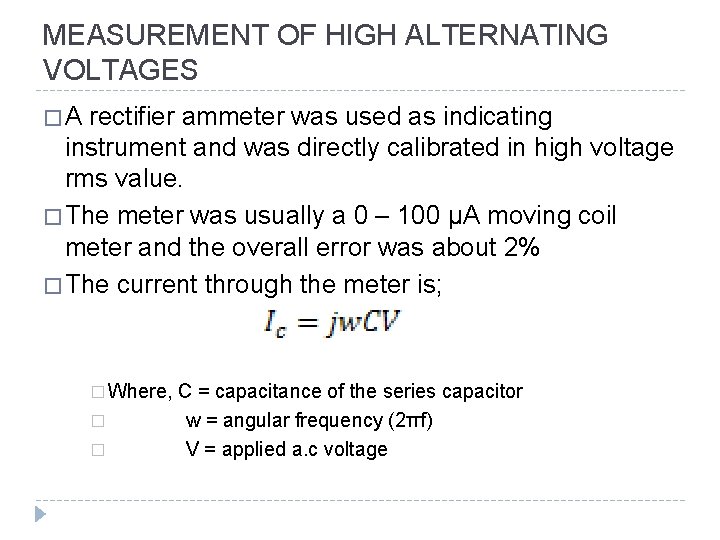
MEASUREMENT OF HIGH ALTERNATING VOLTAGES �A rectifier ammeter was used as indicating instrument and was directly calibrated in high voltage rms value. � The meter was usually a 0 – 100 μA moving coil meter and the overall error was about 2% � The current through the meter is; � Where, � � C = capacitance of the series capacitor w = angular frequency (2πf) V = applied a. c voltage
MEASUREMENT OF HIGH ALTERNATING VOLTAGES � This method is not recommended when ac voltages are not pure sinusoidal waves but contain considerable harmonics. � Series capacitance voltmeters were used with cascade transformers for measuring rms values up to 1000 k. V.
MEASUREMENT OF HIGH ALTERNATING VOLTAGES 7. 2. 2 Capacitive Voltage Transformer (CVT) � Consists of a capacitive divider used in conjunction with a conventional auxiliary transformer which steps further down the divider output voltage, typically, about 10 k. V, to the desired secondary value � In contrast to simple capacitance divider which requires a high impedance meter, a CVT can be connected to a low impedance device like a wattmeter pressure coil or a relay coil.
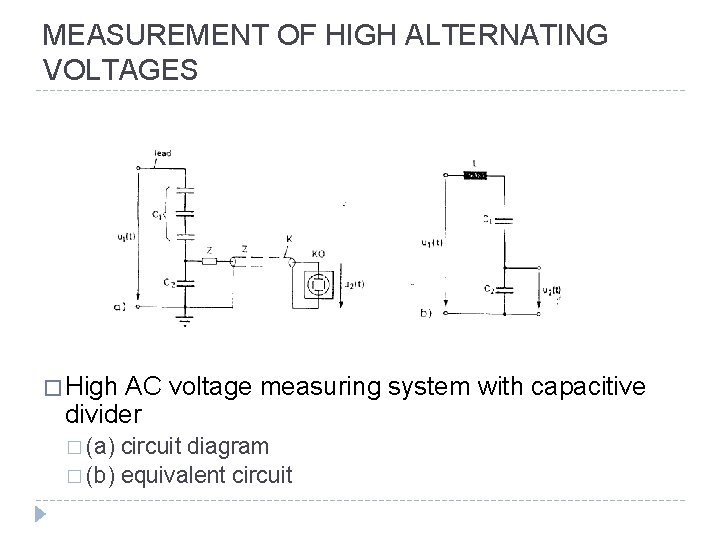
MEASUREMENT OF HIGH ALTERNATING VOLTAGES � High AC voltage measuring system with capacitive divider � (a) circuit diagram � (b) equivalent circuit
MEASUREMENT OF HIGH ALTERNATING VOLTAGES � Cm : capacitance of the meter and the connecting cable and the leads � C 1 and C 2 comprise the capacitance voltage divider. � C 1 is usually made of a few units of high voltage capacitors connected in series. The total capacitance is of the order of 10 -9 F � C 2 is chosen such that the voltage across C 2 is about 10 to 20 k. V.
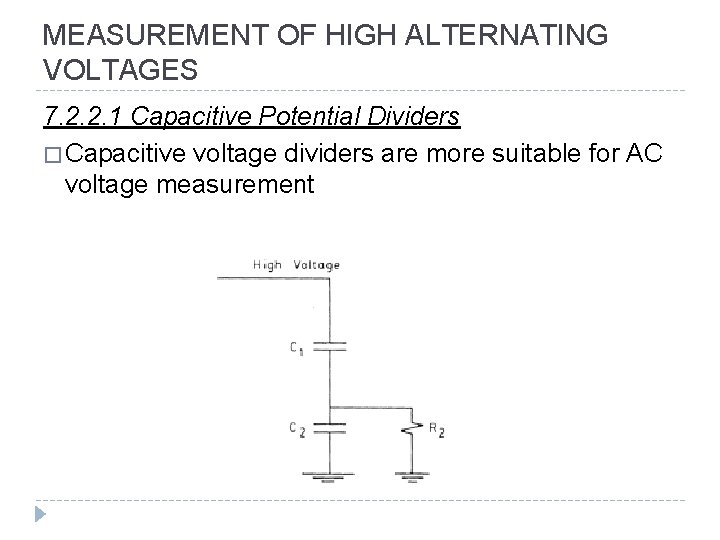
MEASUREMENT OF HIGH ALTERNATING VOLTAGES 7. 2. 2. 1 Capacitive Potential Dividers � Capacitive voltage dividers are more suitable for AC voltage measurement
MEASUREMENT OF HIGH ALTERNATING VOLTAGES � C 2 must be large than C 1, so that we can measure VL(t) � With the measuring of VL(t), we can also know the VH(t), the voltage across C 1 and C 2. � We use the large C 2 because we can connected to low impedance devices such as voltmeter.
Exercise It is required to measure 100 k. V rms AC voltage using a capacitive voltage divider together with a 100 volt rms voltmeter. Design and determine the values of the elements in the voltage divider. State any assumptions made. Given f=50 Hz and I=1 m. A.
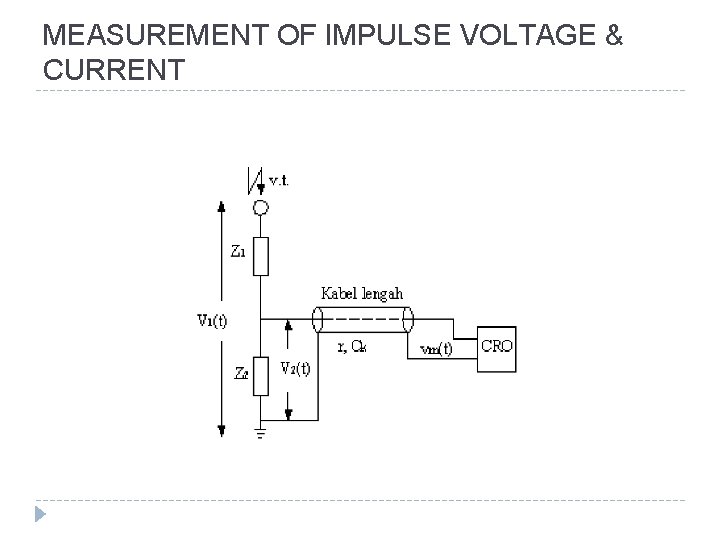
MEASUREMENT OF IMPULSE VOLTAGE & CURRENT 7. 3 Introduction � Impulse voltages are periodic and are of short duration. � It is not possible to measure such voltages using an indicating instrument as in the case of high dc or high ac voltages. � The peak value of an impulse voltage may be measured by a sphere gap. � Another way of measurement of impulse voltages is to use a voltage divider. � The low voltage output of which is connected either to a oscilloscope (CRO) for tracing the wave or to an electronic device to measure the peak value.
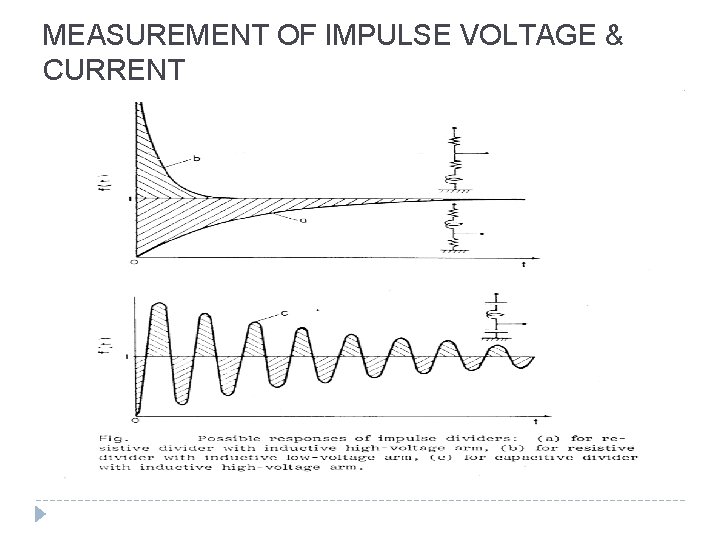
MEASUREMENT OF IMPULSE VOLTAGE & CURRENT 7. 3. 1 Dividers for Impulse Voltages � With impulse voltages, the complete waveform is to be recorded � Both the divider and the connection leads must be considered � Diagram shows possible response of impulse dividers
MEASUREMENT OF IMPULSE VOLTAGE & CURRENT
MEASUREMENT OF IMPULSE VOLTAGE & CURRENT � Two criteria are used to evaluate the response of the whole measuring system: � 1. The total response time must be as small as possible � 2. The response should settle down to the correct value in a time much shorter than the rise time of the voltage wave to be measured
MEASUREMENT OF IMPULSE VOLTAGE & CURRENT
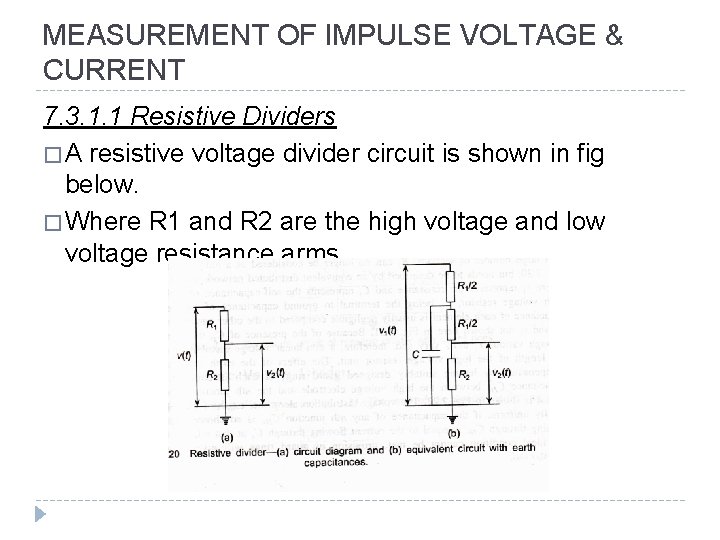
MEASUREMENT OF IMPULSE VOLTAGE & CURRENT 7. 3. 1. 1 Resistive Dividers � A resistive voltage divider circuit is shown in fig below. � Where R 1 and R 2 are the high voltage and low voltage resistance arms.
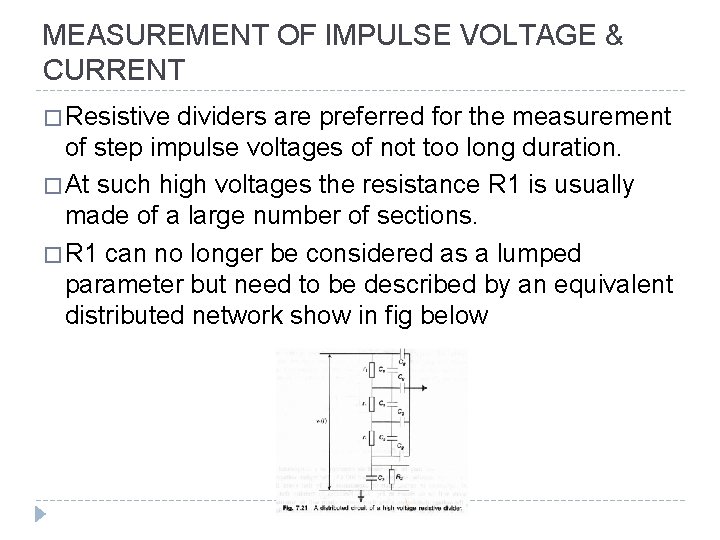
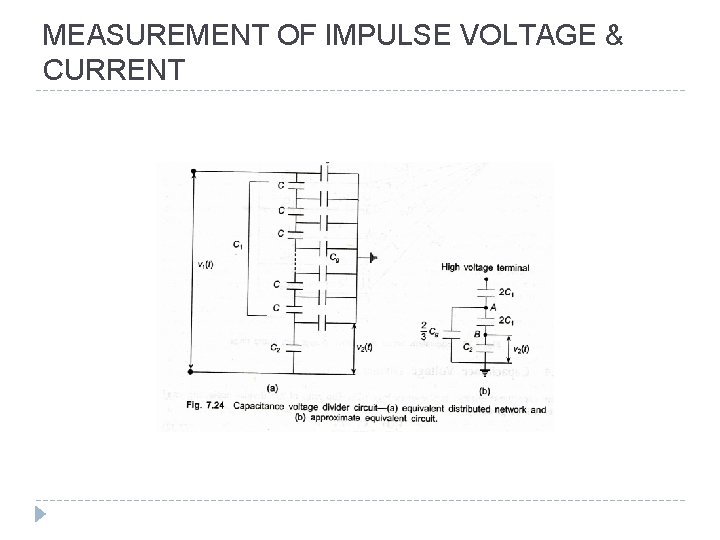
MEASUREMENT OF IMPULSE VOLTAGE & CURRENT � Resistive dividers are preferred for the measurement of step impulse voltages of not too long duration. � At such high voltages the resistance R 1 is usually made of a large number of sections. � R 1 can no longer be considered as a lumped parameter but need to be described by an equivalent distributed network show in fig below
MEASUREMENT OF IMPULSE VOLTAGE & CURRENT � Where r 1 represents the resistance � Cs represents the self-capacitance of each unit of the high voltage resistor � Cg being the terminal to ground capacitance of each element
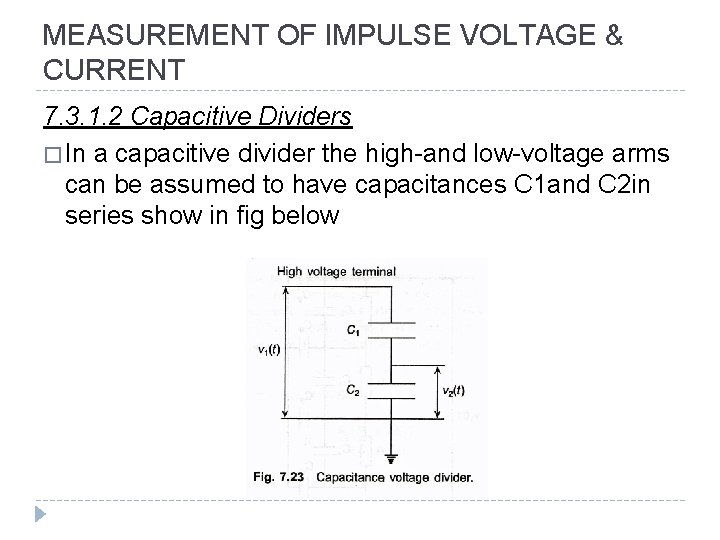
MEASUREMENT OF IMPULSE VOLTAGE & CURRENT 7. 3. 1. 2 Capacitive Dividers � In a capacitive divider the high-and low-voltage arms can be assumed to have capacitances C 1 and C 2 in series show in fig below
MEASUREMENT OF IMPULSE VOLTAGE & CURRENT � The capacitor C 1<C 2 and may be a standard air capacitor or a compressed gas capacitor for measurement for high impulse voltages of about 500 k. V. � For higher voltages, C 1 consists of a number of capacitors in series, each of the capacitance C. � In that event the equivalent distributed network will be as shown in fig below.
MEASUREMENT OF IMPULSE VOLTAGE & CURRENT
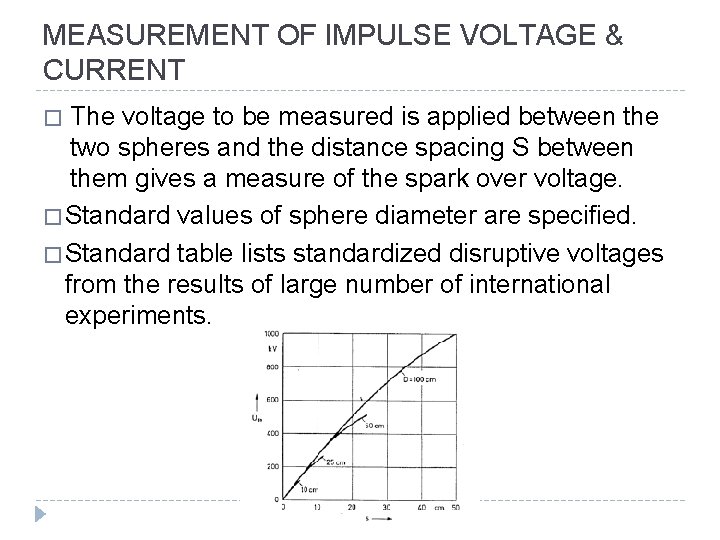
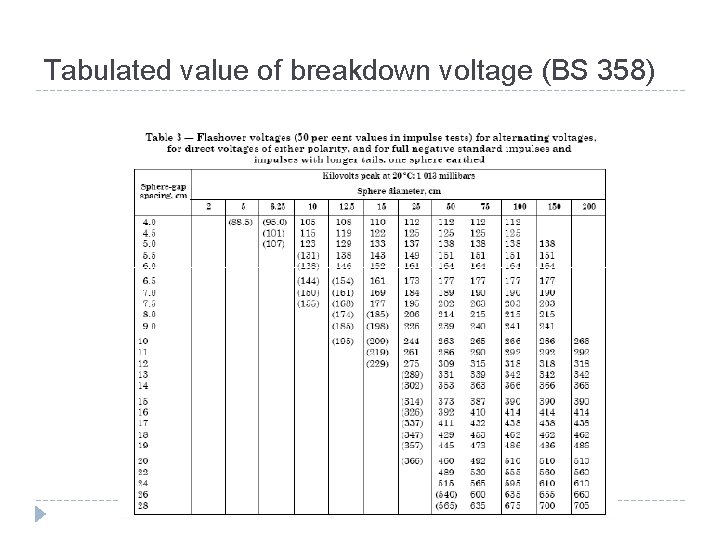
MEASUREMENT OF IMPULSE VOLTAGE & CURRENT Sphere Gap � Sphere gaps technique are reliable only for certain gap configurations. � Normally, only sphere gaps are used. In certain cases uniform field gaps and rod gaps are also used, but their accuracy is less. � IEC-Publ. 52 -1960, BS 358 shows the tabulated breakdown voltages for standard conditions and various sphere diameters as a function of the gap spacing.
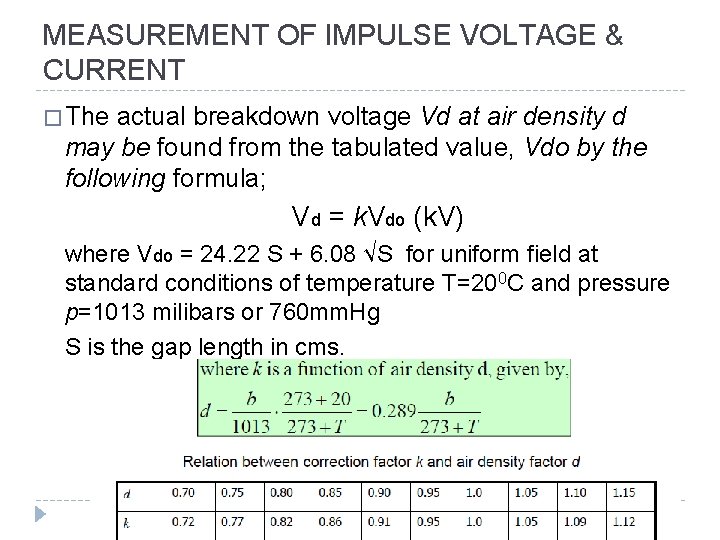
MEASUREMENT OF IMPULSE VOLTAGE & CURRENT � The actual breakdown voltage Vd at air density d may be found from the tabulated value, Vdo by the following formula; Vd = k. Vdo (k. V) where Vdo = 24. 22 S + 6. 08 √S for uniform field at standard conditions of temperature T=200 C and pressure p=1013 milibars or 760 mm. Hg S is the gap length in cms.
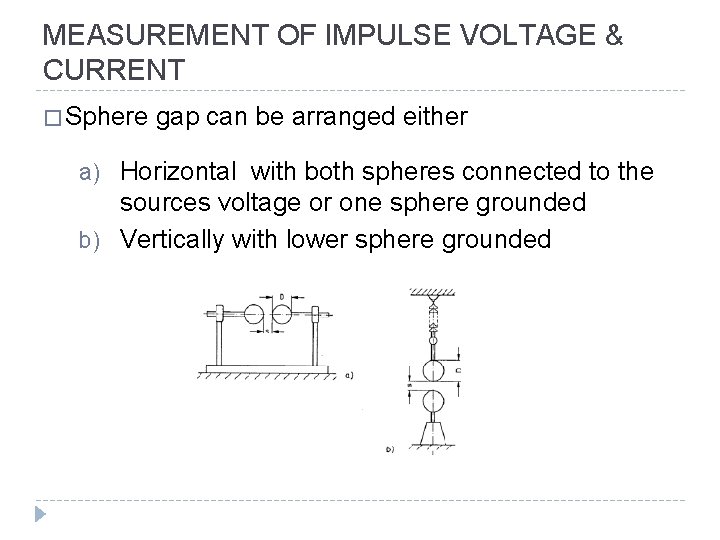
MEASUREMENT OF IMPULSE VOLTAGE & CURRENT � Sphere gap can be arranged either a) Horizontal with both spheres connected to the sources voltage or one sphere grounded b) Vertically with lower sphere grounded
MEASUREMENT OF IMPULSE VOLTAGE & CURRENT The voltage to be measured is applied between the two spheres and the distance spacing S between them gives a measure of the spark over voltage. � Standard values of sphere diameter are specified. � Standard table lists standardized disruptive voltages from the results of large number of international experiments. �
Tabulated value of breakdown voltage (BS 358)
MEASUREMENT OF IMPULSE VOLTAGE & CURRENT Exercise Determine the breakdown voltage for air gaps of 5 mm and 15 mm lengths under uniform field and standard atmospheric conditions. Also, determine the voltage if the atmospheric pressure is 750 mm Hg and temperature 35°C.
MEASUREMENT OF IMPULSE VOLTAGE & CURRENT