
Chapter 7 Marriage From Social Institution to Private







- Slides: 48
Chapter 7 Marriage: From Social Institution to Private Relationship
Chapter Outline § § Marital Status: The Changing Picture The Time-Honored Marriage Premise: Permanence and Sexual Exclusivity From “Yoke Mates” to “Soul Mates” - A Changing Marriage Premise Deinstitutionalized Marriage
Chapter Outline § § Individualized Marriage and the Postmodern Family - Decline or Inevitable Change? Valuing Marriage- The Policy Debate Happiness and Life Satisfaction: How Does Marriage Matter? Marital Satisfaction and Choices Throughout Life
Marital Status: The Changing Picture § § The proportion of Americans age 18 and over who are married has declined significantly in the last 50 years-from 72 percent in 1960 to between 51 and 56 percent in 2010. People are also much more likely to be older at age of first marriage. Two major reasons account for this shift: economic conditions and an increasing desire to find love in a marriage relationship.
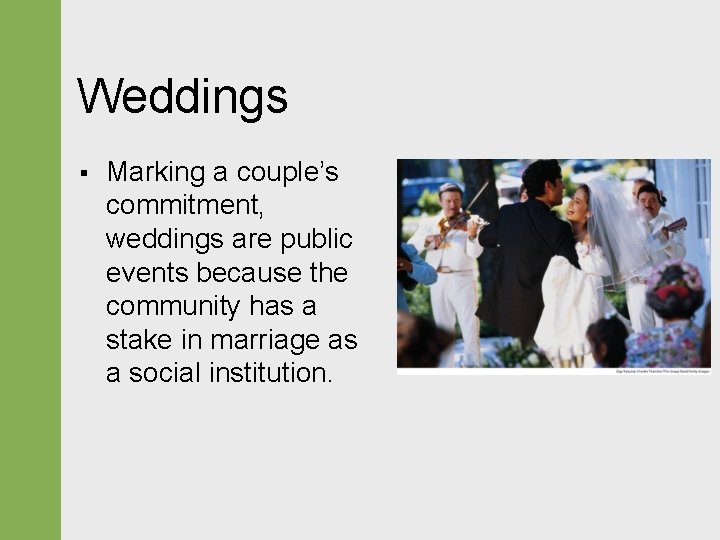
Weddings § Marking a couple’s commitment, weddings are public events because the community has a stake in marriage as a social institution.
The Time-Honored Marriage Premise: Permanence and Sexual Exclusivity § § § Expectations of permanence derive from the fact that historically marriage was a practical institution. In the United States today, marriage seldom involves merging two families’ properties. Providing love and ongoing emotional support has become key for most people.
The Time-Honored Marriage Premise: Permanence and Sexual Exclusivity § § Marriage in the United States legally requires monogamy, along with expectations of sexual exclusivity, in which spouses promise to have sexual relations only with each other. Expectations of sexual exclusivity have broadened to include expectations of emotional centrality, or putting one’s partner first.
Issues for Thought: Three Very Different Subcultures with Norms Contrary to Sexual Exclusivity § § § Polygamy: having more than 1 spouse Polyamory: “many loves” Swinging: exchange partners for sex
Polygamy § § § Polygamy has been illegal in the United States since 1878, when the U. S. Supreme Court ruled that freedom to practice the Mormon religion did not extend to having multiple wives. The Church of Jesus Christ of Latter-Day Saints no longer permits polygamy. Some dissident Mormons follow the traditional teachings and take multiple wives.
Polyamory § § § Polyamory refers to marriages in which one or both spouses retain the option to sexually love others in addition to their spouse. Polyamorous spouses agree to openly acknowledge sexual relationships with others while keeping the marriage relationship primary. The Polyamory Society’s Children Educational Branch offers advice for polyamorous parents and maintains a Poly. Family scholarship fund.
Swinging § § Swinging is a marriage arrangement in which couples exchange partners in order to engage in purely recreational sex. It has been estimated that there are now about 3 million married swingers in the United States, an increase of about one million since 1990.
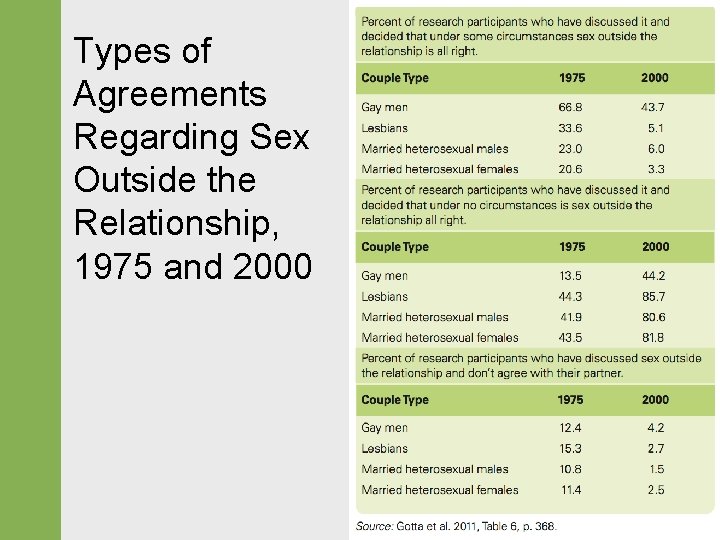
Types of Agreements Regarding Sex Outside the Relationship, 1975 and 2000
From “Yoke Mates” to “Soul Mates” — A Changing Marriage Premise Individualism and Collectivism § In individualistic societies, one’s own selfactualization and interests are a valid concern. § In collectivist societies, people identify with and conform to the expectations of their extended kin.
From “Yoke Mates” to “Soul Mates” — A Changing Marriage Premise Individualist Orientation and Marriage § With regard to marriage, an individualist orientation resulted in three developments: 1. The authority of kin and extended family weakened. 2. Individuals began to find their own marriage partners. 3. Romantic love came to be associated with marriage.
From “Yoke Mates” to “Soul Mates” — A Changing Marriage Premise Weakened Kinship Authority § Kin includes parents and other relatives, such as in-laws, grandparents, aunts and uncles, and cousins. § In Western societies, kinship authority is weak. § Sociologist Talcott Parsons noted that in the American kinship system married people are members of their family of orientation and their family of procreation.
From “Yoke Mates” to “Soul Mates” — A Changing Marriage Premise § § Arranged marriage has characterized collectivist societies. It is only recently that love has become associated with marriage, especially with the newly developing middle classes.
Deinstitutionalization of Marriage § § § A situation in which time-honored family definitions and social norms count for far less than in the past. E. g. , childbearing outside of marriage Marriages have shifted from institutional to compassionate to individualized
Institutional Marriage § § Institutional marriage: A social institution based on dutiful adherence to the time honored marriage premise, particularly the norm of permanence Family organized around economic production, kinship network, community connections, the father’s authority, and marriage as a functional partnership
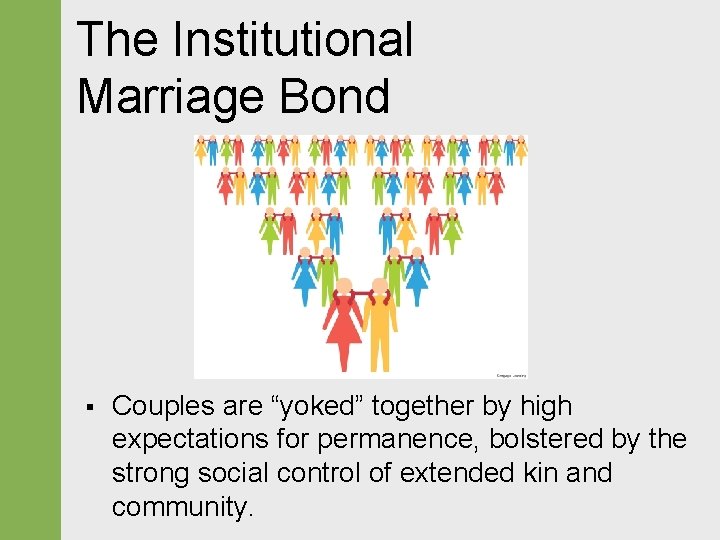
The Institutional Marriage Bond § Couples are “yoked” together by high expectations for permanence, bolstered by the strong social control of extended kin and community.
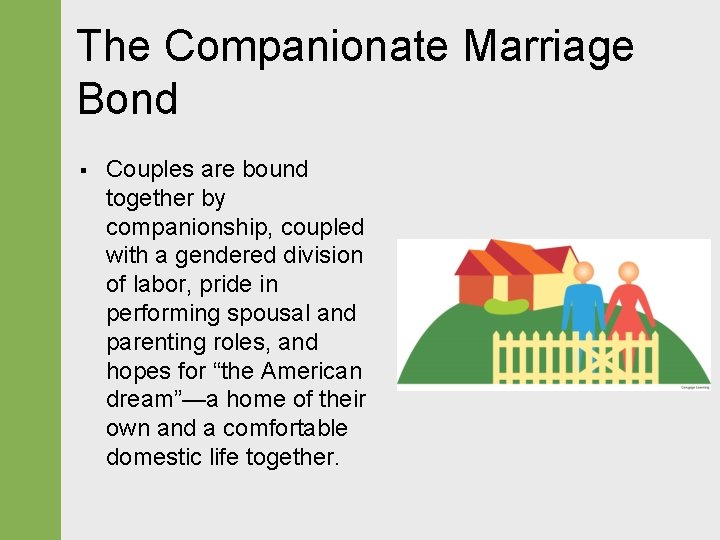
The Companionate Marriage Bond § Couples are bound together by companionship, coupled with a gendered division of labor, pride in performing spousal and parenting roles, and hopes for “the American dream”—a home of their own and a comfortable domestic life together.
Individualized Marriage § Four interrelated characteristics distinguish individualized marriage: 1. It is optional. 2. Spouses’ roles are flexible—negotiable and renegotiable. 3. Its expected rewards involve love, communication and emotional intimacy. 4. It exists in conjunction with a vast diversity of family forms.
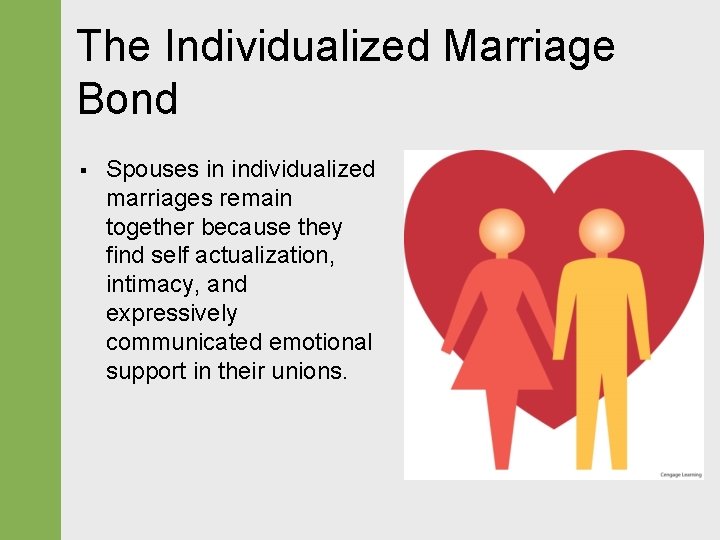
The Individualized Marriage Bond § Spouses in individualized marriages remain together because they find self actualization, intimacy, and expressively communicated emotional support in their unions.
Individualized Marriage and the Postmodern Family— Decline or Inevitable Change? A Decline View § Individualism has caused moral weakening and self-indulgence and as a result are less likely to choose marriage, are more likely to divorce, and are less child-centered
Individualized Marriage and the Postmodern Family— Decline or Inevitable Change? A Change View § Nostalgia about the “good old days” leads to incorrect assumptions. § For example, large families with many children and higher death rates for parents with young children meant many children were not raised in two-parent households.
Deinstitutionalized Marriage: Examining the Consequences § Demographer Linda Waite compared married and unmarried households and reported that spouses: 1. Had greater wealth and assets. 2. Earned higher wages. 3. Had more frequent and better sex. 4. Had overall better health.
Deinstitutionalized Marriage: Examining the Consequences § Demographer Linda Waite reported that spouses: 5. Were less likely to engage in risk-taking. 6. Had fewer alcohol-related problems. 7. Had lower rates of marijuana use. 8. Were more likely to engage in healthy behaviors.
Deinstitutionalized Marriage: Examining the Consequences Waite found that children in married families: § Were about half as likely to drop out of high school. § Reported more frequent contact and betterquality relationships with their parents. § Were significantly less likely to live in poverty.
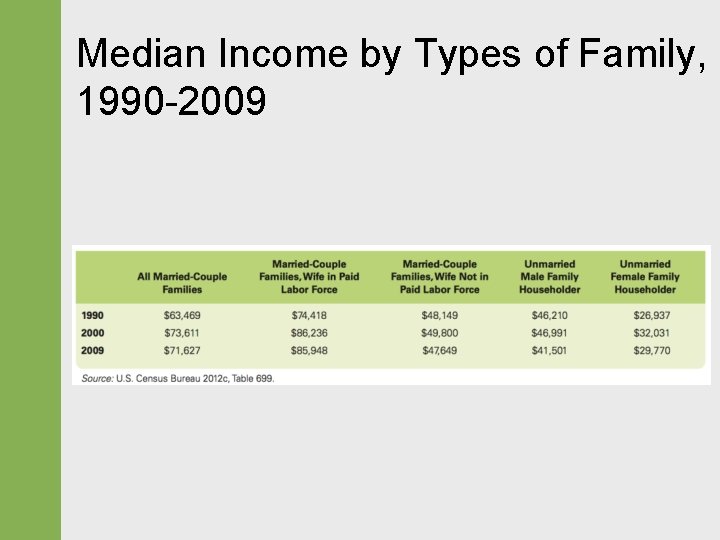
Median Income by Types of Family, 1990 -2009
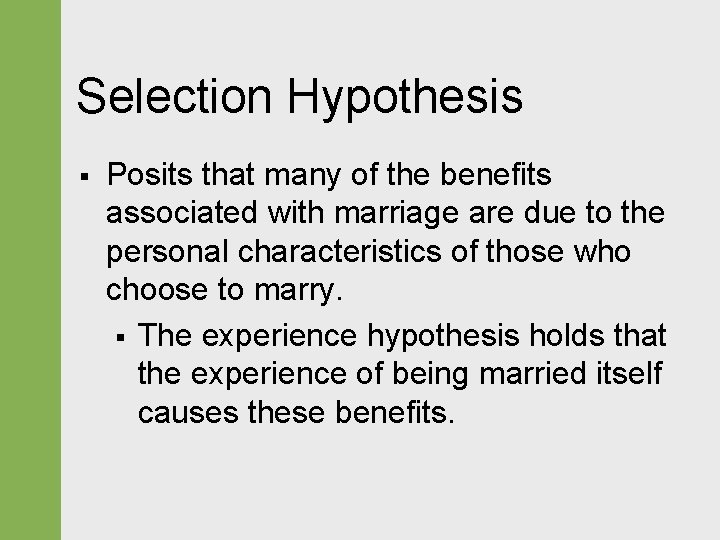
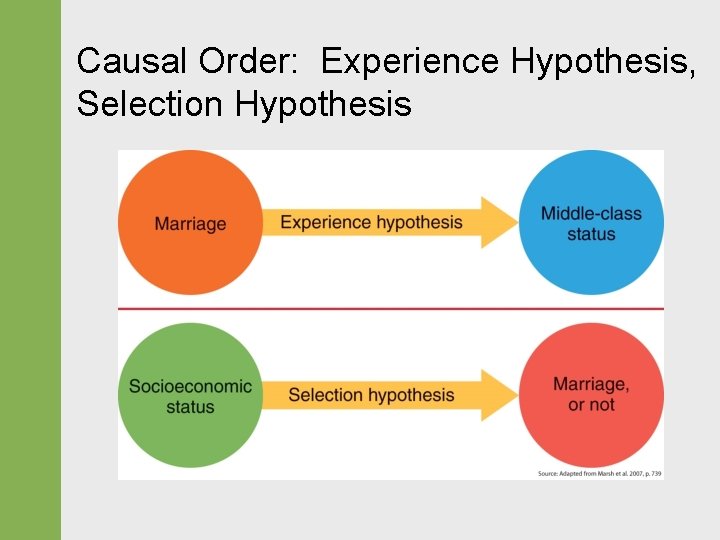
Selection Hypothesis § Posits that many of the benefits associated with marriage are due to the personal characteristics of those who choose to marry. § The experience hypothesis holds that the experience of being married itself causes these benefits.
Causal Order: Experience Hypothesis, Selection Hypothesis
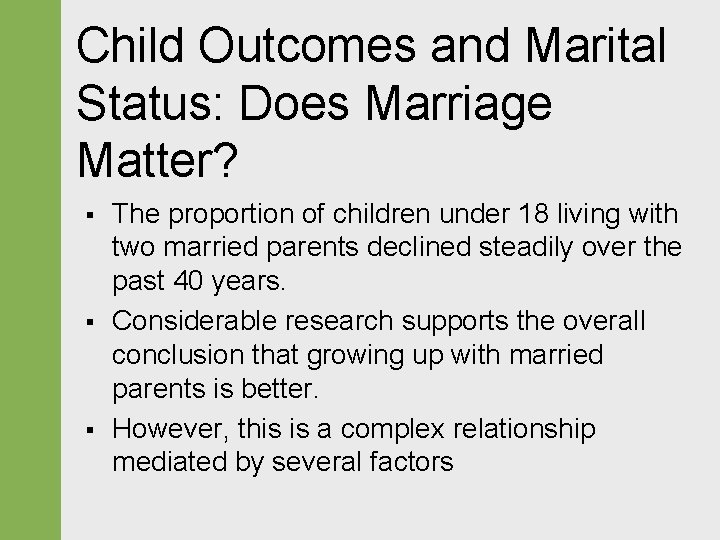
Child Outcomes and Marital Status: Does Marriage Matter? § § § The proportion of children under 18 living with two married parents declined steadily over the past 40 years. Considerable research supports the overall conclusion that growing up with married parents is better. However, this is a complex relationship mediated by several factors
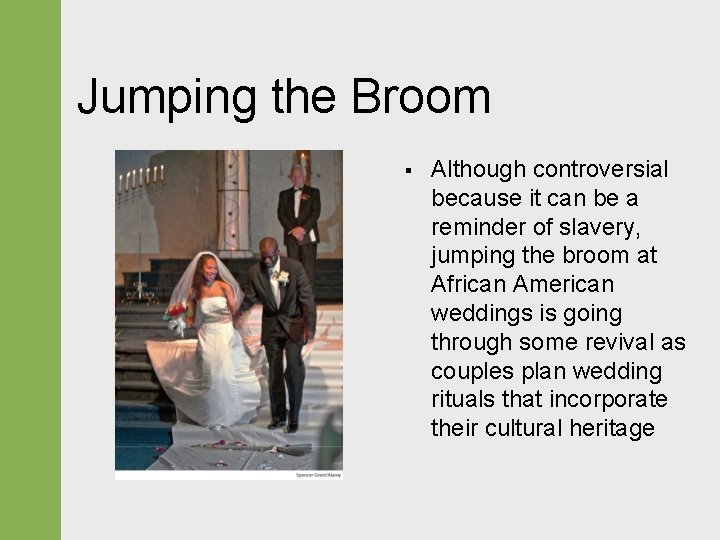
Jumping the Broom § Although controversial because it can be a reminder of slavery, jumping the broom at African American weddings is going through some revival as couples plan wedding rituals that incorporate their cultural heritage
A Closer Look at Diversity § § § With 43% of black men and 36% of black women currently married—African Americans are less likely to be wed than are other U. S. racial/ethnic groups. The reasons for these low rates are structural-cultural in nature. African American families are increasingly divided between a middle class that has benefited from the civil rights movement and a sector that remains disadvantaged.
Valuing Marriage — The Policy Debate § § From a change perspective, policy advocates view poverty as causing environments with negative consequences From a decline perspective, there are concerns about “family breakdown” which includes the amount of money spent on “welfare for povertylevel single mothers, along with the irresponsible socialization of children”
Policies from a Decline Perspective: Covenant Marriage § § § A type of legal marriage in which partners agree to be bound by a marriage “covenant” Three states have enacted covenant marriage laws — Louisiana, Arizona, and Arkansas. Couples are required to get premarital counseling and may divorce only after being separated for two years or if imprisonment, desertion for one year, adultery, or domestic abuse is proved in court.
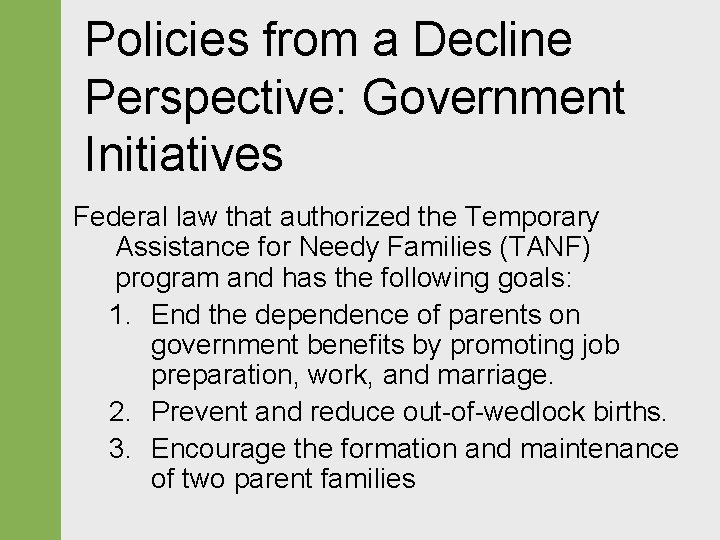
Policies from a Decline Perspective: Government Initiatives Federal law that authorized the Temporary Assistance for Needy Families (TANF) program and has the following goals: 1. End the dependence of parents on government benefits by promoting job preparation, work, and marriage. 2. Prevent and reduce out-of-wedlock births. 3. Encourage the formation and maintenance of two parent families
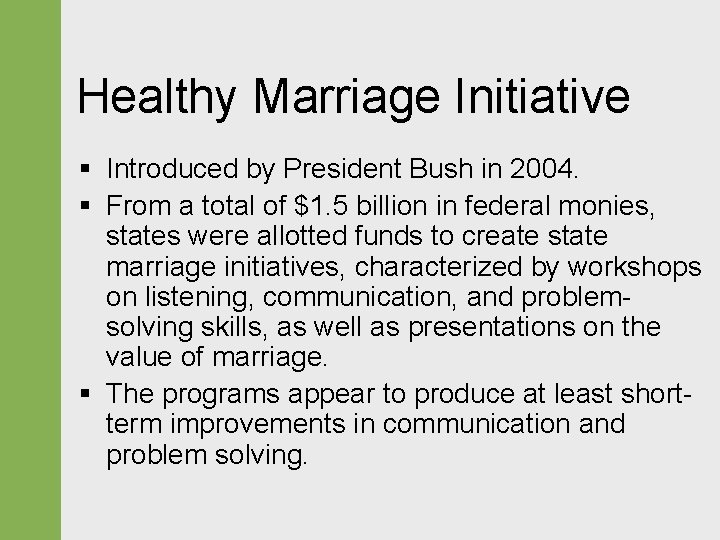
Healthy Marriage Initiative § Introduced by President Bush in 2004. § From a total of $1. 5 billion in federal monies, states were allotted funds to create state marriage initiatives, characterized by workshops on listening, communication, and problemsolving skills, as well as presentations on the value of marriage. § The programs appear to produce at least shortterm improvements in communication and problem solving.
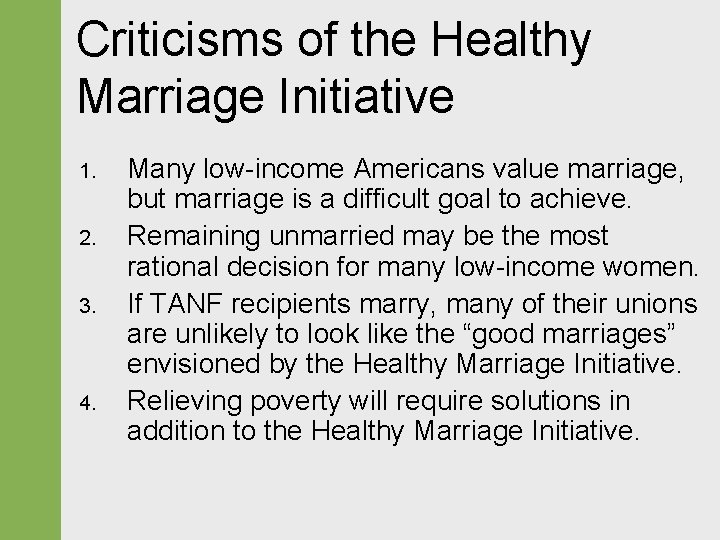
Criticisms of the Healthy Marriage Initiative 1. 2. 3. 4. Many low-income Americans value marriage, but marriage is a difficult goal to achieve. Remaining unmarried may be the most rational decision for many low-income women. If TANF recipients marry, many of their unions are unlikely to look like the “good marriages” envisioned by the Healthy Marriage Initiative. Relieving poverty will require solutions in addition to the Healthy Marriage Initiative.
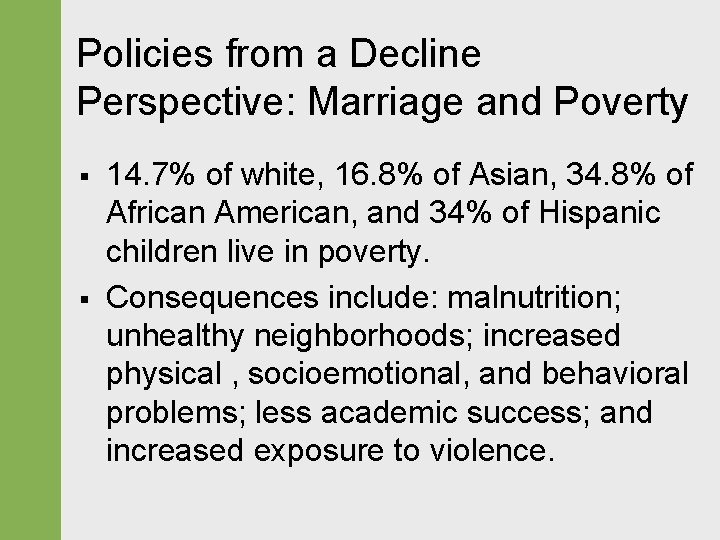
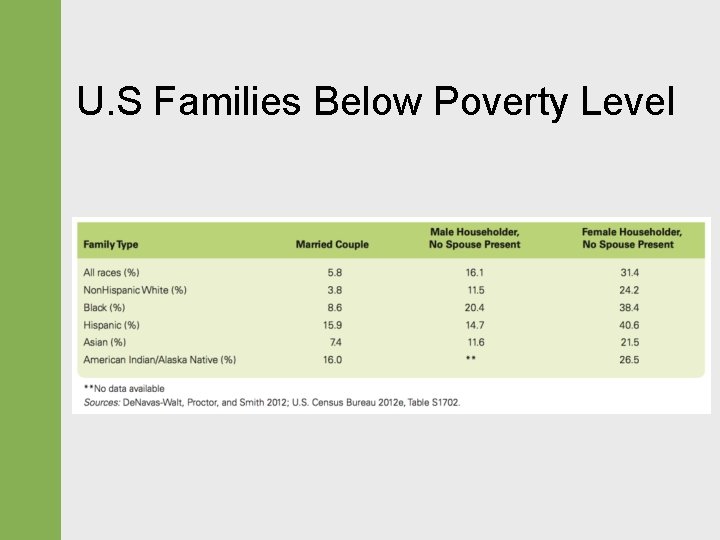
Policies from a Decline Perspective: Marriage and Poverty § § 14. 7% of white, 16. 8% of Asian, 34. 8% of African American, and 34% of Hispanic children live in poverty. Consequences include: malnutrition; unhealthy neighborhoods; increased physical , socioemotional, and behavioral problems; less academic success; and increased exposure to violence.
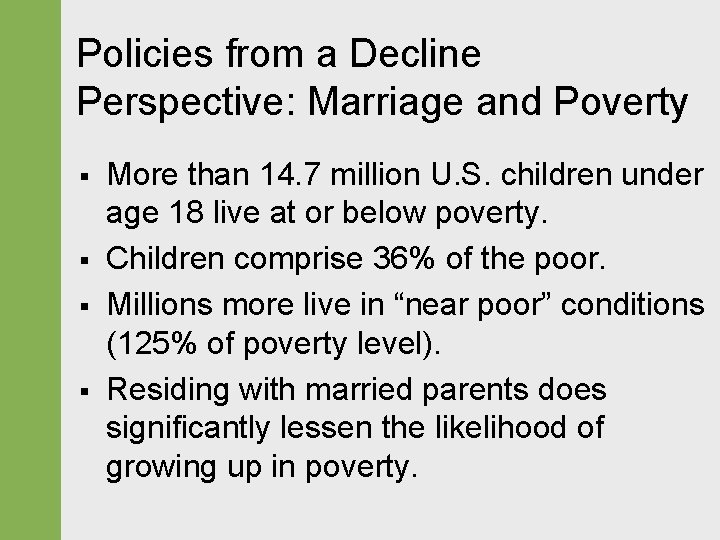
Policies from a Decline Perspective: Marriage and Poverty § § More than 14. 7 million U. S. children under age 18 live at or below poverty. Children comprise 36% of the poor. Millions more live in “near poor” conditions (125% of poverty level). Residing with married parents does significantly lessen the likelihood of growing up in poverty.
U. S Families Below Poverty Level
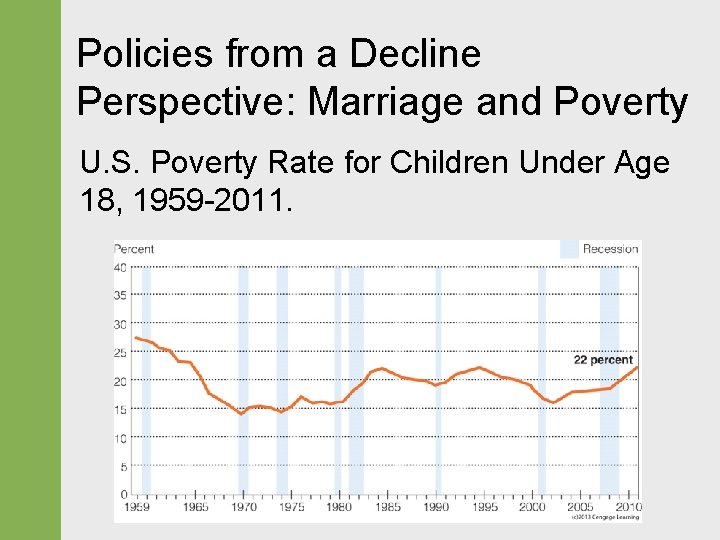
Policies from a Decline Perspective: Marriage and Poverty U. S. Poverty Rate for Children Under Age 18, 1959 -2011.
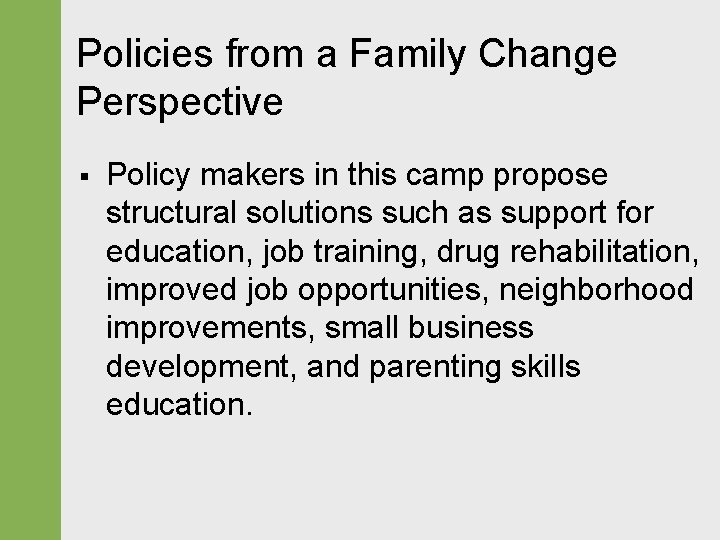
Policies from a Family Change Perspective § Policy makers in this camp propose structural solutions such as support for education, job training, drug rehabilitation, improved job opportunities, neighborhood improvements, small business development, and parenting skills education.
Happiness, Well-Being, and Life Satisfaction: How Does Marriage Matter? § § Both husbands and wives are far more likely than others to say they are “very happy” Reasons for this include: § Economy of scale § Enhanced social support § Offered continuity
Marital Satisfaction and Choices Throughout Life § Preparation for Marriage § Family life courses and premarital counseling provide guidance and skills for marriage and family § Research shows they do improve communication skills and relationship quality at least in the short term § Success also depends on the personality traits of the individual and the couple characteristics
Age at Marriage, Marital Stability, and Satisfaction § § Median age at first marriage today is about 26 for women and 28 for men. Odds of marital stability increase with age at marriage. Marriages occurring today, when spouses are between ages of 22 and 25, are most likely to be not only stable but also happy. Spouses who first married after age 30 reported lower marital satisfaction.
The First Years of Marriage § § First years of marriage tend to be the happiest, with gradual declines in marital satisfaction afterward. Three main, potentially problematic topics for couples in first marriages: § Money § Sexual frequency § Agreeing on how to spend time together
Creating Couple Connection § § § Keep relationship a high priority. Marriage is happier when both spouses work. Supportive and positive communication. Enjoy leisure activities together. Consciously and continuously strive to maintain intimacy.