
Chapter 7 Market Structures Perfect Competition What type


- Slides: 26
Chapter 7: Market Structures Perfect Competition
What type of economic systems have we talked about so far? What type of economic system does the U. S. have? What is an industry? What are some different industries in the U. S. ? How do businesses compete against each other? Lets look at competition in the Electronics industry.
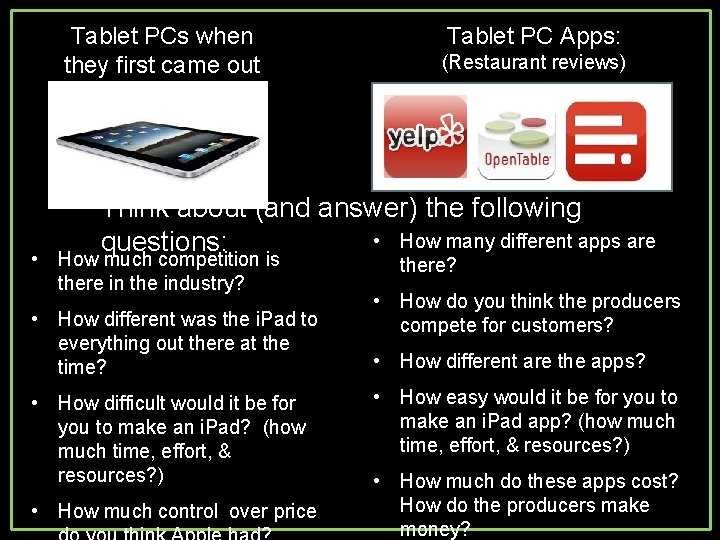
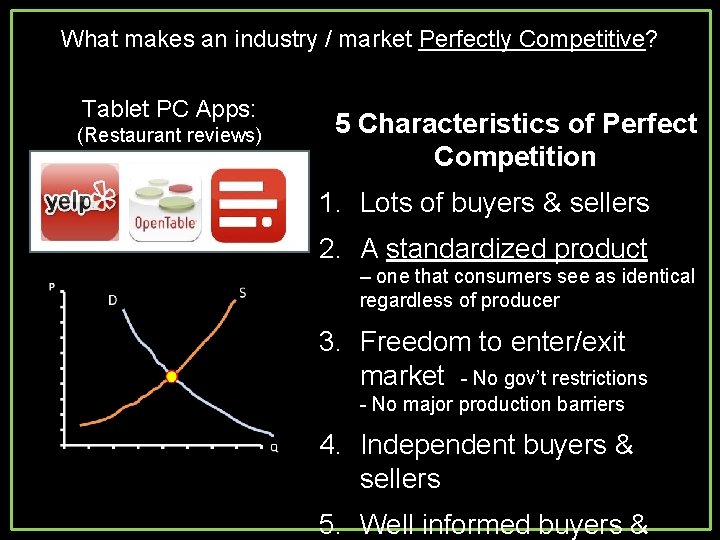
Tablet PCs when they first came out (i. Pads) Tablet PC Apps: (Restaurant reviews) Think about (and answer) the following • How many different apps are questions: • How much competition is there in the industry? • How different was the i. Pad to everything out there at the time? • How difficult would it be for you to make an i. Pad? (how much time, effort, & resources? ) • How much control over price there? • How do you think the producers compete for customers? • How different are the apps? • How easy would it be for you to make an i. Pad app? (how much time, effort, & resources? ) • How much do these apps cost? How do the producers make money?
What we just did was analyze Market Structures: which are economic models of competition among businesses in the same industry. Tablet PC Apps: (Restaurant reviews) There’s a lot of competition among app producers. This type of market / industry would be considered *almost* Perfect Competition “The ideal model of a market economy”
What makes an industry / market Perfectly Competitive? Tablet PC Apps: (Restaurant reviews) 5 Characteristics of Perfect Competition 1. Lots of buyers & sellers 2. A standardized product – one that consumers see as identical regardless of producer 3. Freedom to enter/exit market - No gov’t restrictions - No major production barriers 4. Independent buyers & sellers 5. Well informed buyers &
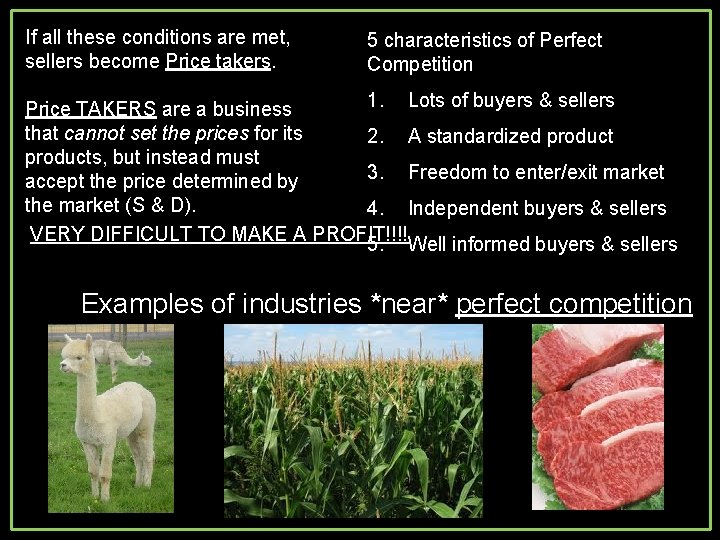
If all these conditions are met, sellers become Price takers. 5 characteristics of Perfect Competition 1. Lots of buyers & sellers Price TAKERS are a business that cannot set the prices for its 2. A standardized products, but instead must 3. Freedom to enter/exit market accept the price determined by the market (S & D). 4. Independent buyers & sellers VERY DIFFICULT TO MAKE A PROFIT!!!! 5. Well informed buyers & sellers Examples of industries *near* perfect competition
Are there any industries in which there is perfect competition? 5 characteristics of Perfect Competition 1. Lots of buyers & sellers Nope. 2. A standardized product In the real world, all markets and industries lack one of the conditions needed for perfect competition. This is called imperfect competition. 3. Freedom to enter/exit market 4. Independent buyers & sellers 5. Well informed buyers & sellers Examples of industries *near* perfect competition
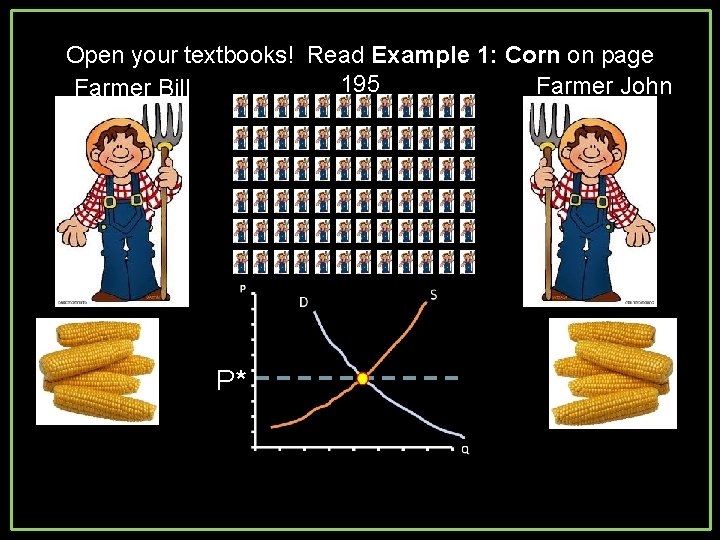
Open your textbooks! Read Example 1: Corn on page 195 Farmer John Farmer Bill P*
Chapter 7: Market Structures Monopoly
Monopoly! How do you play? What is the goal? How do you win?
1. When a Monopoly There is only one seller occurs: 2. There is a restricted, regulated market. • Barriers to entry – Make it hard for a new business to enter the market – gov’t regulations, scale of operations, etc. 3. The Monopolist can control the prices • They are Price MAKERS – don’t have to consider competition when setting the price.
Objective: Learn about other forms of market structures What is perfect competition? What are the characteristics of a perfectly competitive market? What are some examples of perfectly competitive industries? What is a Monopoly? (Not the board game) What are the characteristics of a monopoly?
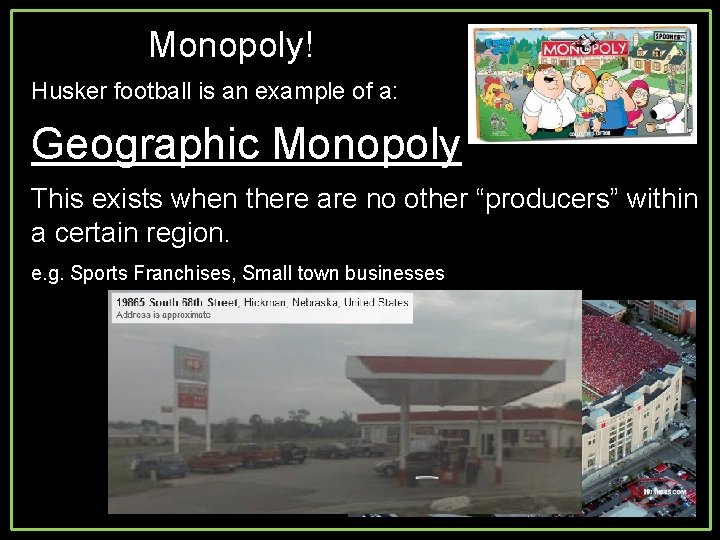
Monopoly! Husker football is an example of a: Geographic Monopoly This exists when there are no other “producers” within a certain region. e. g. Sports Franchises, Small town businesses
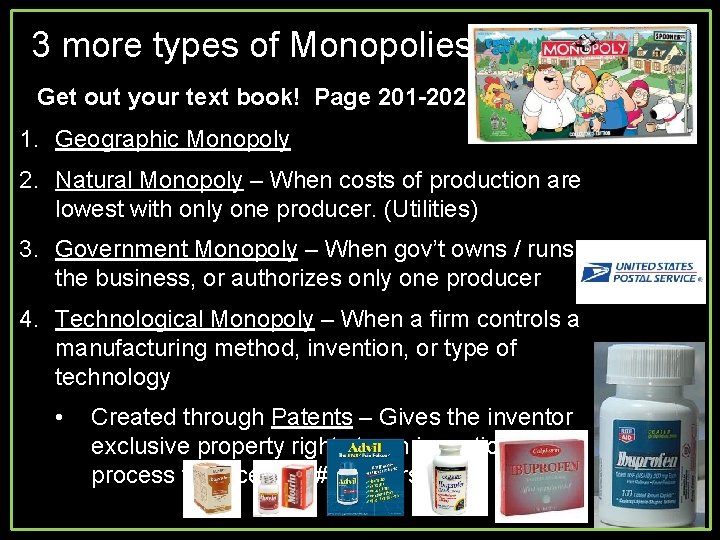
3 more types of Monopolies Get out your text book! Page 201 -202 1. Geographic Monopoly 2. Natural Monopoly – When costs of production are lowest with only one producer. (Utilities) 3. Government Monopoly – When gov’t owns / runs the business, or authorizes only one producer 4. Technological Monopoly – When a firm controls a manufacturing method, invention, or type of technology • Created through Patents – Gives the inventor exclusive property rights to an invention or process for a certain # of years.
Chapter 7: Market Structures Monopolistic Competition
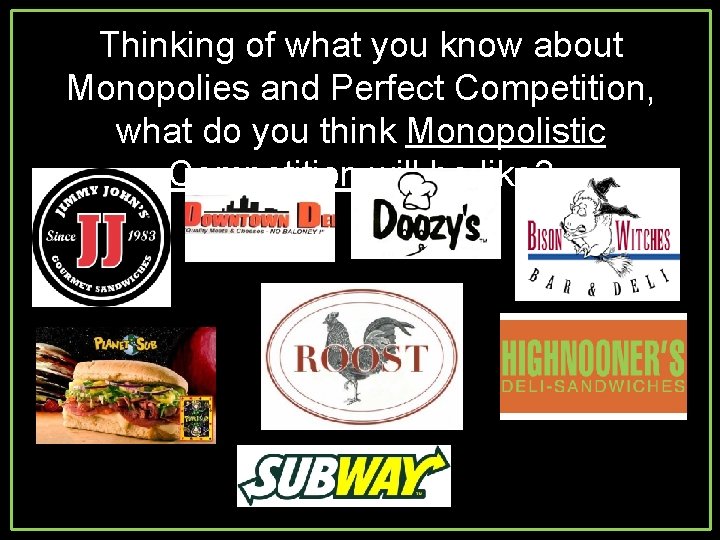
Thinking of what you know about Monopolies and Perfect Competition, what do you think Monopolistic Competition will be like?
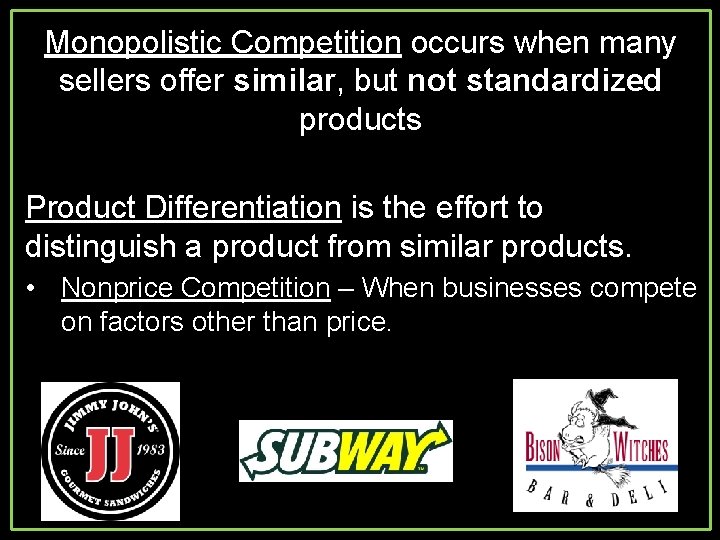
Monopolistic Competition occurs when many sellers offer similar, but not standardized products Product Differentiation is the effort to distinguish a product from similar products. • Nonprice Competition – When businesses compete on factors other than price.
Monopolistic Competition How much control over prices do these sandwich shops have? Limited $5. 00 $6. 00 $8. 00 $15. 00
Monopolistic Competition How easy do you think it would be to enter the sandwich market? Holkawi ches Pretty Easy!
Monopolistic Competition Other industries with Monopolistic Competition Restaurants T-shirt printers
Chapter 7: Market Structures Oligopoly
What the heck is an Oligopoly? What are some different brands of cola? In Oligopolies, there are few sellers
Oligopolies What’s different about these products? Not much: Standardized/differentiated products
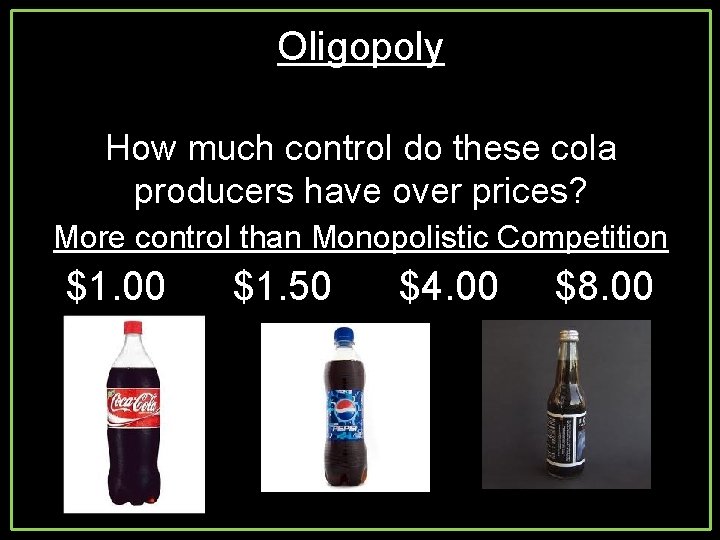
Oligopoly How much control do these cola producers have over prices? More control than Monopolistic Competition $1. 00 $1. 50 $4. 00 $8. 00
Oligopolies Finally, how easy do you think it would it be to enter the cola market? Possible, but very difficult. Holk a Cola!
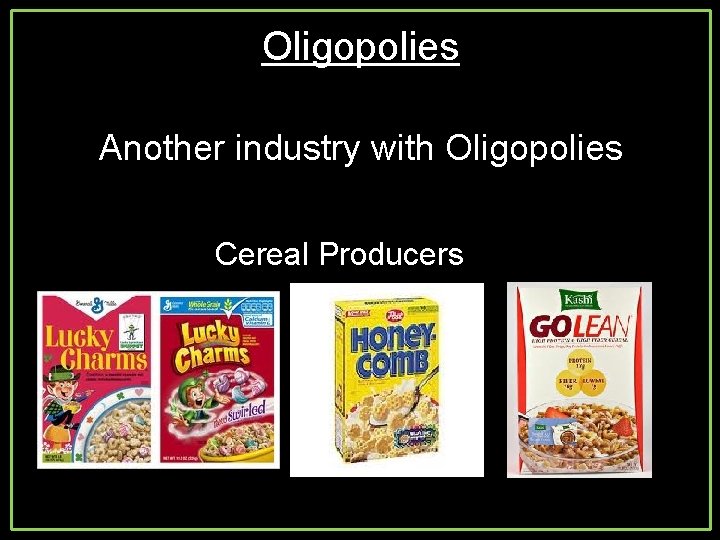
Oligopolies Another industry with Oligopolies Cereal Producers