
Chapter 7 Market Structures How are markets classified
- Slides: 23
Chapter 7 Market Structures
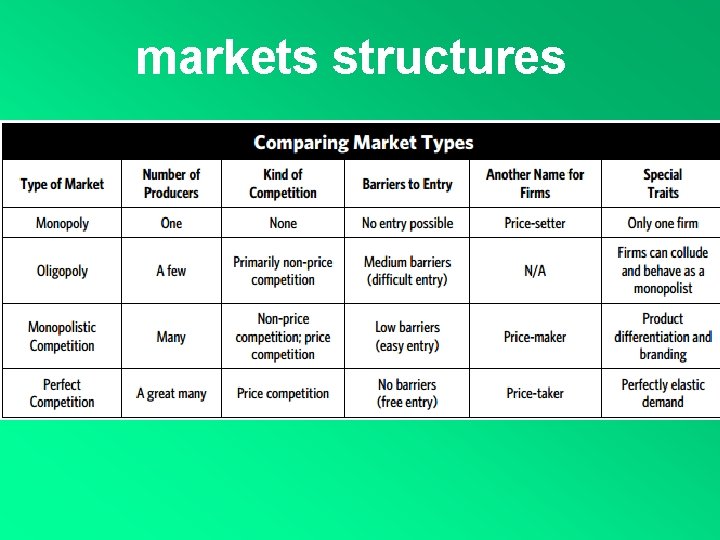
How are markets classified? • • • How many suppliers are there? How large is each supplier? Do the firms have any influence over price? How much competition exists between firms? What kind of economic product is involved? Are all firms in the market selling exactly the same product, or simply similar ones? • Is it easy or difficult for firms to enter the market?
Market structure- the type and amount of competition between firms operating in the same industry. Number of firms in the industry – are there many firms with equal share and unable to set the price, like pizza places, or is it dominated by a large firm like Wal-Mart? Nature of the product – is it homogeneous, which no one will pay a premium for like salt, or like Gucci or Coach
Barriers to entry – are there low start up and maintenance cost, such as a roadside stand, or does it require lots of funding Can the firms control the price? – pharmaceutical companies can control the price (for a set time) because of patents, farmers have no control and have to accept the world price.
markets structures
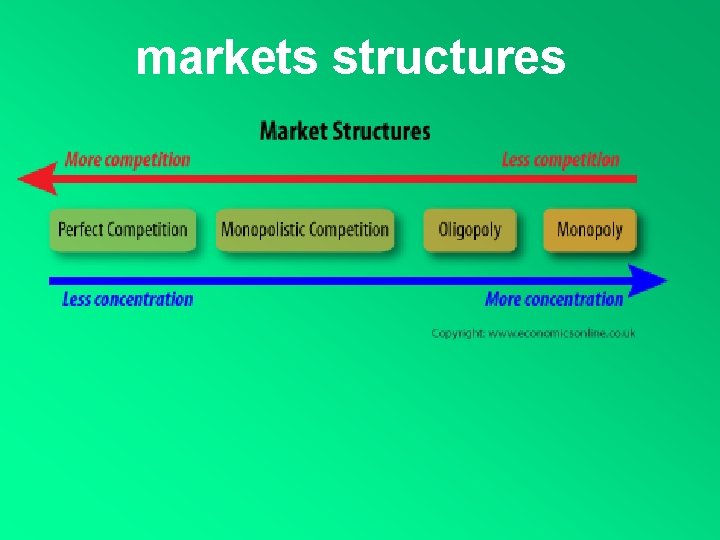
markets structures
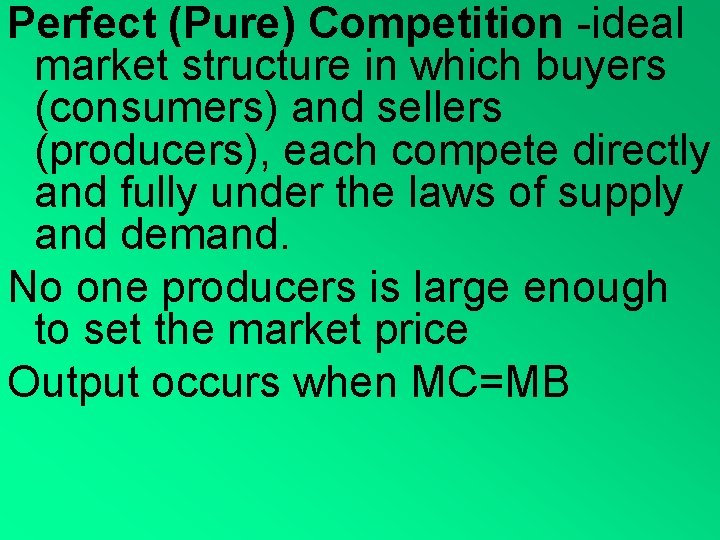
Perfect (Pure) Competition -ideal market structure in which buyers (consumers) and sellers (producers), each compete directly and fully under the laws of supply and demand. No one producers is large enough to set the market price Output occurs when MC=MB
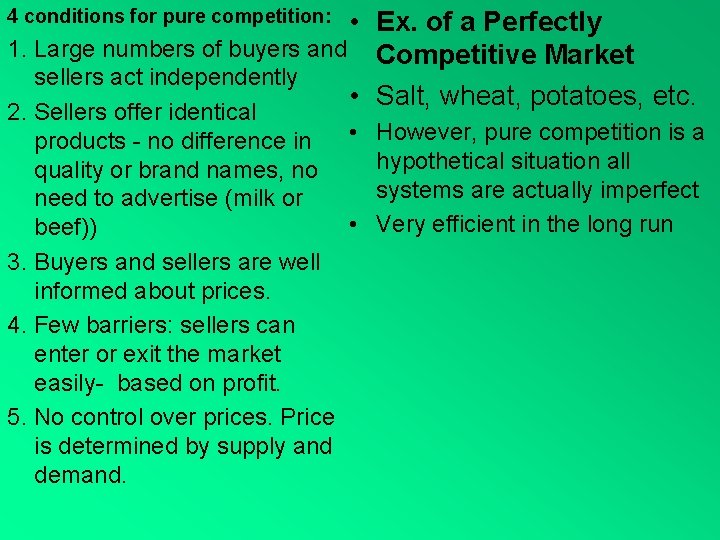
4 conditions for pure competition: • Ex. of a Perfectly 1. Large numbers of buyers and Competitive Market sellers act independently • Salt, wheat, potatoes, etc. 2. Sellers offer identical • However, pure competition is a products - no difference in hypothetical situation all quality or brand names, no systems are actually imperfect need to advertise (milk or • Very efficient in the long run beef)) 3. Buyers and sellers are well informed about prices. 4. Few barriers: sellers can enter or exit the market easily- based on profit. 5. No control over prices. Price is determined by supply and demand.
In Perfect Competition: 1. Each sellers controls a very small % of the market (because there are so many sellers) 2. Each seller can make independent decisions because their actions will not affect others 3. Since it is exactly the same product, it is highly elastic (lots of substitutes) 4. Firms can’t control the price (too many firms) 5. It is easy to enter or leave the market, so few barriers to entry
Monopolistic Competition Four Conditions: • Many Firms • Few barriers to entry • Slight control over price • Differentiation- Sellers offer similar rather than identical products. Not perfect substitutes: (NONPRICE COMPETITION) store location, store design, manner of payment, delivery, decorations, service, etc EXAMPLES: • Software • Fast food burgers • Computer games • Soft drinks • Toothbrushes • Can you think of more?
In Monopolistic Competition: 1. Each sellers controls a very small % of the market (because there are so many sellers) 2. Same product but differentiated in some way 3. Since it is almost the same product, it is highly elastic (lots of substitutes) 4. Non-price competition 5. Limited control over price (too many firms) 6. It is easy to enter or leave the market, so few barriers to entry
Why are consumers willing to pay more for one product than they are for a similar one? Fad/brand loyalty
Oligopoly • use interdependent pricing to respond to the prices of competitors • Ex. NFL or Russian oil and gas producers. 3 Conditions of Oligopolies: 1. Only a few large sellers. – very interdependent, so most complicated 2. Sellers offer: Identical products - oil Differentiated products - cars 3. Other seller cannot easily enter the market. (this is due to start-up costs, government regulation, consumer loyalty to established products)
In Oligopoly: 1. 2. 3. 4. Very few firms Mutually interdependent decisions Substantial barriers to entry Potential for long-run profits (brand name is important) 5. Shared market power 6. Considerable control over prices
How oligopolies control prices-legally 1. Price leadership- one of the largest sellers in the market takes the lead by setting a price. Others can then set prices and control all the prices. 2. Price war- sellers undercut each other’s prices to try to capture market share.
How oligopolies control price illegally 3. Collusion- secretly agree to set production levels or prices for products. Is illegal and carries heavy penalties and fines. 4. Cartels- create artificially high prices and reduce quantity to maximize profits. *** illegal in the U. S. but not in other countries- oil and diamonds have cartels- De. Beers
Why do Monopolies exist? Monopolies exist when the following is true of a market: 1. One seller of a unique product 2. No adequate substitutes available 3. Others cannot easily enter the market b/c of entry-barriers 4. Companies have complete control over price
4 Types of Monopolies Natural Monopolies Geographic Monopolies • One seller is most efficient due • to economies of scale • Economies of scale- size of seller allows them to use resources more efficiently and economically than many different firms could • Ex. Utilities, electric company, cable services Remote areas: the potential for profit is so small that only one seller chooses to enter a market
Technological Monopoly Government Monopoly • 1 company invents or • provide basic necessities like public utilities—water changes a product & and sewer services, roads, they have a monopoly bridges, canals b/c they are the only • In U. S. : monopolized by ones with this state and federal technology. (Patent) governments
In Monopoly: 1. 2. 3. 4. 5. 6. One firm No close substitute Almost impossible to enter the market Potential for long-run profits Substantial market share Absolute control over prices
Franchise • A contract issued by a local authority that gives a single firm the right to sell its goods within an exclusive market. Ex. SCHS having Coca Cola vending machines. • An individual can also enter into contract with a company to open and operate a store/location under the companies guidelines.
• Trusts: large companies like Antitrust a monopoly. They Legislation dominated Steel, Oil, T. Roosevelt battling Sugar, Coal, Sugar, the Railroad trust meatpacking, etc. • 1880 s: gov’t began regulating big business, to prevent monopolies from forming, and broke- up existing monopolies. Presidents Teddy Roosevelt & Taft
Market Regulation • Laissez-Faire: Prior to the 1880 s this was the relationship between business and the U. S. government