
Chapter 7 Market Structures Hello Market Structure Market



- Slides: 46
Chapter 7 Market Structures Hello!
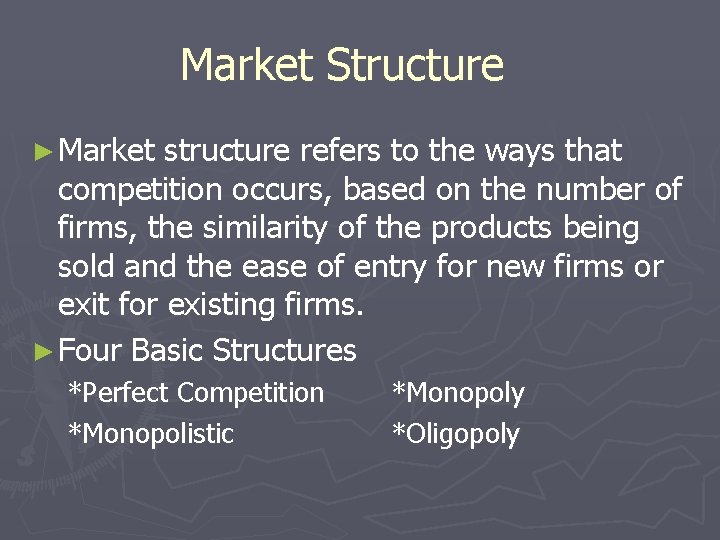
Market Structure ► Market structure refers to the ways that competition occurs, based on the number of firms, the similarity of the products being sold and the ease of entry for new firms or exit for existing firms. ► Four Basic Structures *Perfect Competition *Monopolistic *Monopoly *Oligopoly
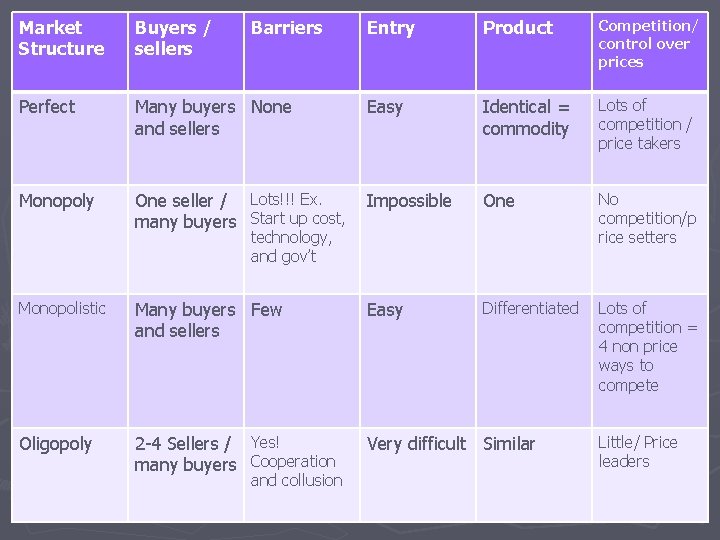
Market Structure Buyers / sellers Perfect Monopoly Barriers Entry Product Competition/ control over prices Many buyers None and sellers Easy Identical = commodity Lots of competition / price takers One seller / Lots!!! Ex. many buyers Start up cost, Impossible One No competition/p rice setters Monopolistic Many buyers Few and sellers Easy Differentiated Lots of competition = 4 non price ways to compete Oligopoly 2 -4 Sellers / Yes! many buyers Cooperation Very difficult Similar technology, and gov’t and collusion Little/ Price leaders
Barriers to Entry ►Barriers – factors that make it difficult for new firms to enter a market ►Barriers lead to imperfect competition
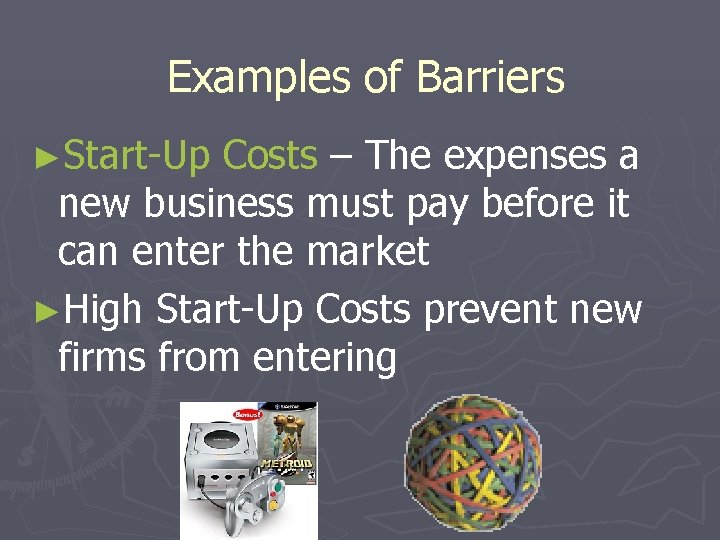
Examples of Barriers ►Start-Up Costs – The expenses a new business must pay before it can enter the market ►High Start-Up Costs prevent new firms from entering
Examples of Barriers ►Technology – how much training does it take to enter the market?
Examples of Barriers ►Government – may require licensing, certification, approval, etc.
Perfect Competition ►Perfect Competition – a market where a large number of firms are all producing essentially the same product
Conditions Perfect Competition ►Many buyers and sellers participate ►Sellers offer identical products ►Products that are the same no matter who makes or sells them are commodities
Perfect Competition § Buyers and sellers are well informed about products § Sellers are able to enter and exit the market freely
Price and Output ►A perfectly competitive market produces the lowest sustainable prices possible ►With many firms competing, each firm lowers its prices to the point of just covering their costs
Monopoly ►Monopoly – Barriers prevent firms from entering a market that has a single supplier
Factors that Create a Monopoly ► 1. Economies of Scale – average cost of production always drops, never increases ► 2. Natural Monopoly – market runs most effectively when one large firm provides all output
Factors that Create a Monopoly ►Natural Monopolies are usually given special status by the government, but the government is allowed to control their prices ►New technologies can destroy a natural monopoly
Government Monopolies ►Government Monopoly – a monopoly created by the government
Typical High School Boy Questions? Wait… what’s a government monopoly?
Government Monopolies ►Government Monopoly – a monopoly created by the government § There are 3 types of government monopolies, each with a different reason for being formed
Three Kinds of Government Monopoly ►Technological Monopoly – government issues a patent § Patent – exclusive rights to sell a good or service for a specific period of time
Three Kinds of Government Monopoly ►Franchises and Licenses § Franchises – government allows company to create an exclusive market for their brand name and products
Three Kinds of Government Monopoly ►Franchises and Licenses § Licenses – government grants a firm the right to operate a business
Three Kinds of Government Monopoly ►Industrial Organizations – government allows companies in an industry to restrict the number of firms in the market
Output Decisions ►Do you emphasize price or output? § Price-Takers – in a competitive market, businesses have no control over their own prices § Price-Setters – in a noncompetitive market, business can choose what price to charge
Price Discrimination ►Do you think monopolies usually charge the same price to all of their customers?
Price Discrimination
Price Discrimination ►Price Discrimination – dividing consumers into different groups and charging different prices to each group
Price Discrimination ►Monopolies are not the only companies that do this ►Any company with market power, the ability to control prices and output, can use discrimination
Price Discrimination ►The easiest way to maximize profit for a monopoly is to identify consumers who will not pay full price, and offer them a “discount” ►These are called targeted discounts – think of airline fares, manufacturers rebates, student discounts
Limits to Price Discrimination ► 1. Firm must have some market power ► 2. There must be distinct consumer groups ► 3. It must be difficult for consumers to resell the product
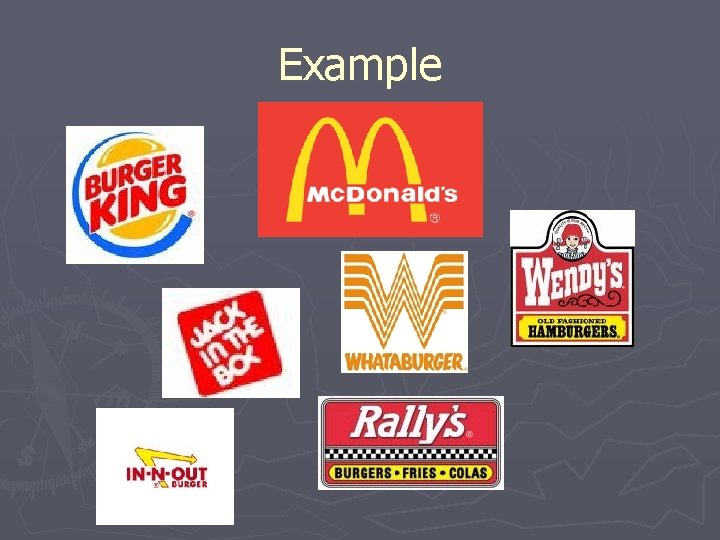
Monopolistic Competition ►Monopolistic Competition – many companies compete in an open market, but sell products that are slightly different from one another
Example
4 Characteristics of Monopolistic Competition ► 1. Many Firms ► 2. Few Artificial Barriers to Entry ► 3. Slight Control Over Prices ► 4. Differentiated Products
Other Means of Competition ►In a Monopolistic Competition, firms compete in a variety of ways other than prices § Physical Characteristics § Location § Service Level/Quality § Advertising and Image
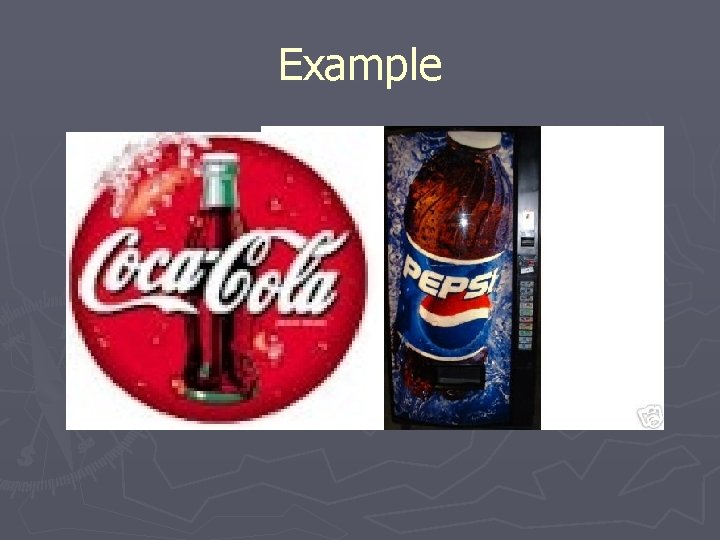
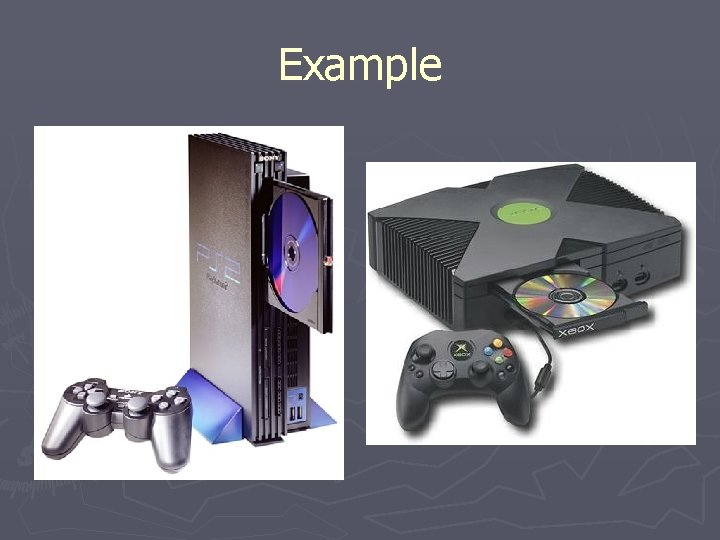
Oligopoly ►Oligopoly – a market dominated by a few large, profitable firms ►If 4 of the largest firms can claim 70% or more of the market share, it is an oligopoly
Example
Example
Characteristics of Oligopoly ► 1. Many Barriers to Entry ► 2. Cooperation and Collusion § Price Leadership – market leader raises prices, other firms follow suit (can also cause price war, though)
Characteristics of Oligopoly ► 1. Many Barriers to Entry ► 2. Cooperation and Collusion § Collusion – an agreement among members of an oligopoly to set prices and production levels
Characteristics of Oligopoly ► 1. Many Barriers to Entry ► 2. Cooperation and Collusion § Collusion causes price fixing, where firms agree to sell at the same or similar prices § It’s illegal, by the way
Characteristics of Oligopoly ► 1. Many Barriers to Entry ► 2. Cooperation and Collusion § Cartels – an agreement by producers to coordinate prices and production § Legal in some countries, not here
Regulation and Deregulation ►What might a firm do to increase its market power? § Form a cartel § Merge with competitors § Predatory Pricing - Temporarily lower prices to put others out of business
Regulation and Deregulation ►Government has Antitrust Laws in place to prevent such practices ►Trust – a business combination similar to a cartel ►Began with Sherman Antitrust Act in 1890
Fair or Unfair? ►Nike is one of the world’s largest and most popular shoe manufacturers ►Once Nike introduced clothing, it forced companies that wanted to buy its shoes to buy its clothes as well
Fair or Unfair? ►Disney, ABC, AOL, and Time. Warner have merged together ►They now control the Disney Channel, Cartoon Network, and the WB, which is a basic monopoly on children's programming
Regulation and Deregulation ►Government can step in and break up monopolies based on the Sherman Antitrust Act ►Famous examples: John D. Rockefeller’s Standard Oil (1911), AT&T (1982)
Regulation and Deregulation ►Government can also block mergers from happening ►Merger – when one company joins with another ►Government uses research to see whether the merger will help or hurt consumers
Regulation and Deregulation ►The Republican Party has typically supported deregulation – when the government stops making decisions about what businesses can and cannot do ►Government uses regulation and deregulation for the same purpose – to promote competition