
CHAPTER 7 MANUFACTURING PROCESSES LO 7 1 Understand

- Slides: 33
CHAPTER 7: MANUFACTURING PROCESSES LO 7– 1: Understand what a manufacturing process is. LO 7– 2: Explain how manufacturing processes are organized. LO 7– 3: Analyze simple manufacturing processes. Mc. Graw-Hill/Irwin Copyright © 2017 Mc. Graw-Hill Education. All rights reserved.
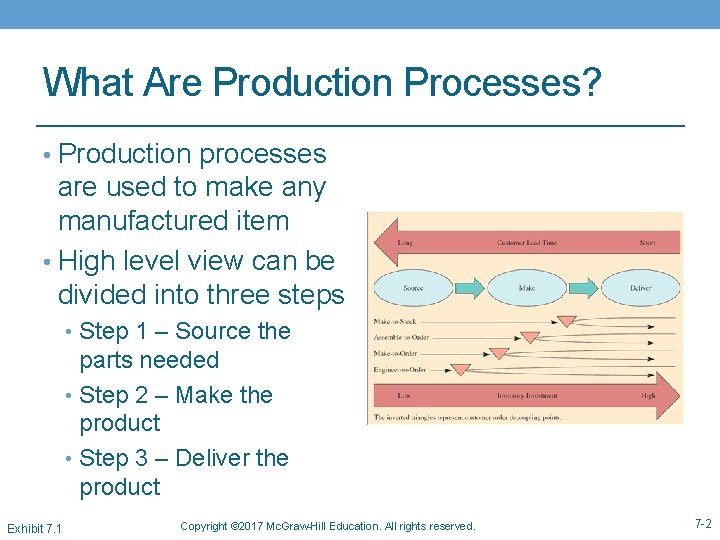
What Are Production Processes? • Production processes are used to make any manufactured item • High level view can be divided into three steps • Step 1 – Source the parts needed • Step 2 – Make the product • Step 3 – Deliver the product Exhibit 7. 1 Copyright © 2017 Mc. Graw-Hill Education. All rights reserved. 7 -2
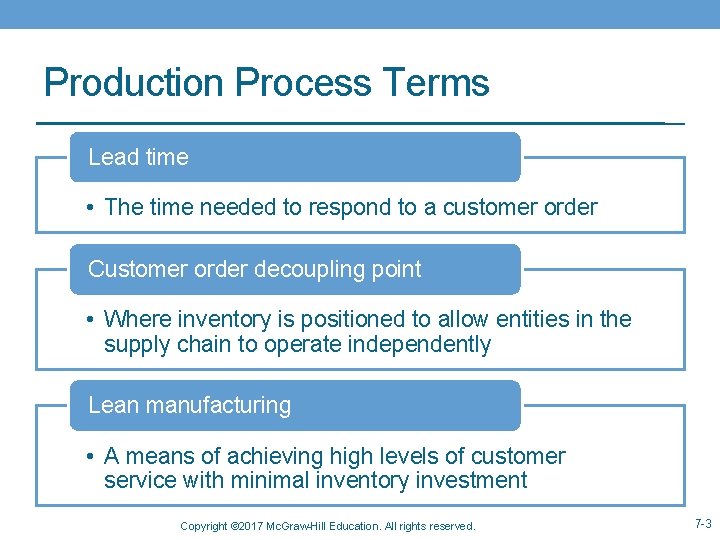
Production Process Terms Lead time • The time needed to respond to a customer order Customer order decoupling point • Where inventory is positioned to allow entities in the supply chain to operate independently Lean manufacturing • A means of achieving high levels of customer service with minimal inventory investment Copyright © 2017 Mc. Graw-Hill Education. All rights reserved. 7 -3
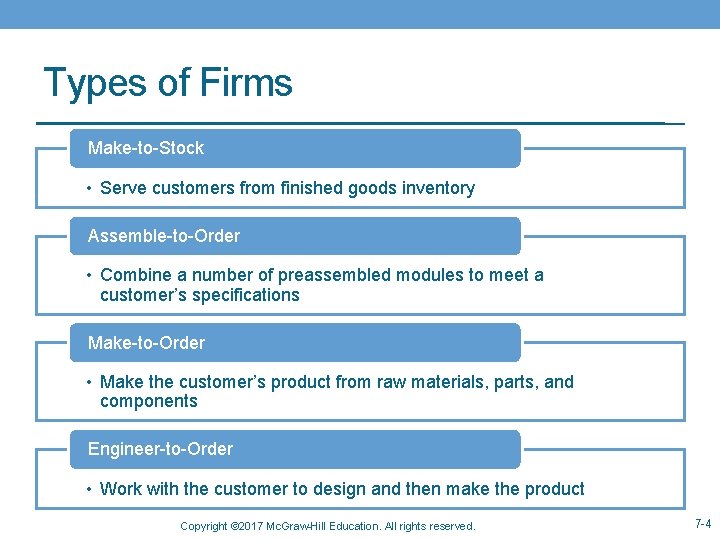
Types of Firms Make-to-Stock • Serve customers from finished goods inventory Assemble-to-Order • Combine a number of preassembled modules to meet a customer’s specifications Make-to-Order • Make the customer’s product from raw materials, parts, and components Engineer-to-Order • Work with the customer to design and then make the product Copyright © 2017 Mc. Graw-Hill Education. All rights reserved. 7 -4
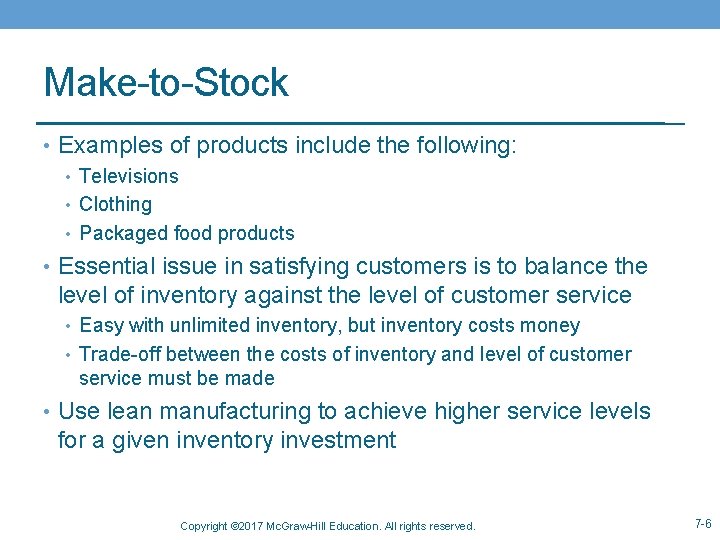
Make-to-Stock • Examples of products include the following: • Televisions • Clothing • Packaged food products • Essential issue in satisfying customers is to balance the level of inventory against the level of customer service • Easy with unlimited inventory, but inventory costs money • Trade-off between the costs of inventory and level of customer service must be made • Use lean manufacturing to achieve higher service levels for a given inventory investment Copyright © 2017 Mc. Graw-Hill Education. All rights reserved. 7 -6
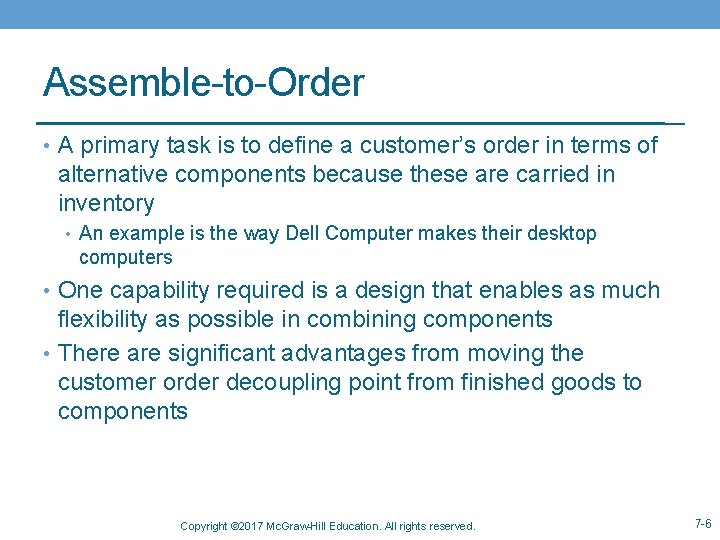
Assemble-to-Order • A primary task is to define a customer’s order in terms of alternative components because these are carried in inventory • An example is the way Dell Computer makes their desktop computers • One capability required is a design that enables as much flexibility as possible in combining components • There are significant advantages from moving the customer order decoupling point from finished goods to components Copyright © 2017 Mc. Graw-Hill Education. All rights reserved. 7 -6
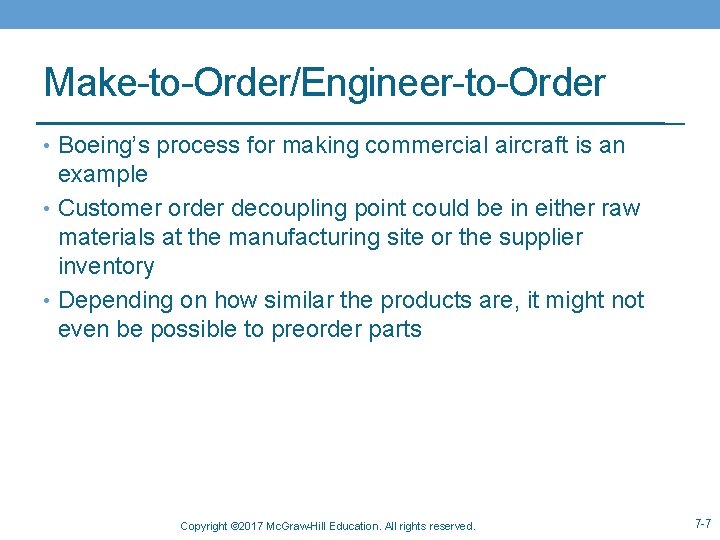
Make-to-Order/Engineer-to-Order • Boeing’s process for making commercial aircraft is an example • Customer order decoupling point could be in either raw materials at the manufacturing site or the supplier inventory • Depending on how similar the products are, it might not even be possible to preorder parts Copyright © 2017 Mc. Graw-Hill Education. All rights reserved. 7 -7
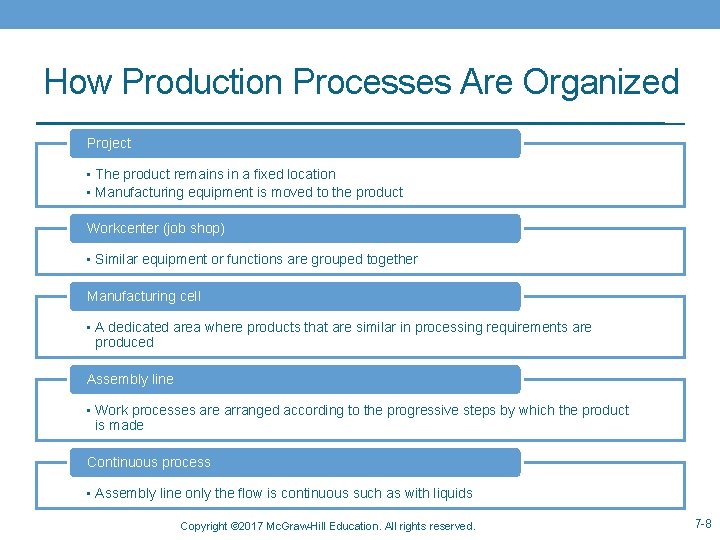
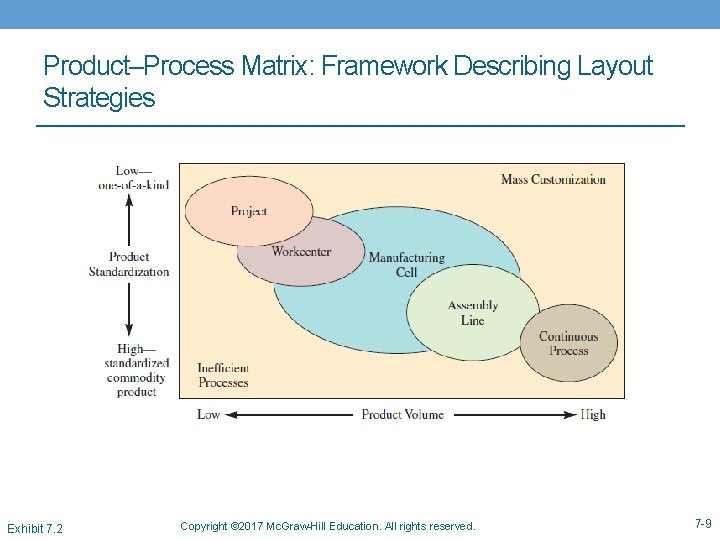
How Production Processes Are Organized Project • The product remains in a fixed location • Manufacturing equipment is moved to the product Workcenter (job shop) • Similar equipment or functions are grouped together Manufacturing cell • A dedicated area where products that are similar in processing requirements are produced Assembly line • Work processes are arranged according to the progressive steps by which the product is made Continuous process • Assembly line only the flow is continuous such as with liquids Copyright © 2017 Mc. Graw-Hill Education. All rights reserved. 7 -8
Product–Process Matrix: Framework Describing Layout Strategies Exhibit 7. 2 Copyright © 2017 Mc. Graw-Hill Education. All rights reserved. 7 -9
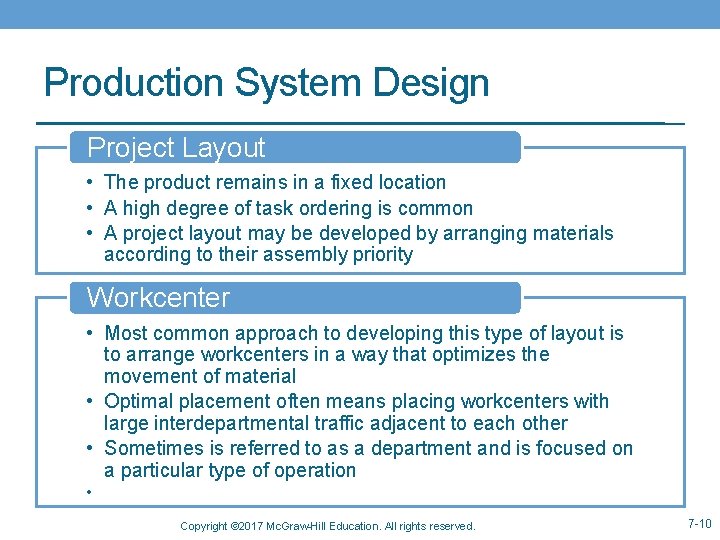
Production System Design Project Layout • The product remains in a fixed location • A high degree of task ordering is common • A project layout may be developed by arranging materials according to their assembly priority Workcenter • Most common approach to developing this type of layout is to arrange workcenters in a way that optimizes the movement of material • Optimal placement often means placing workcenters with large interdepartmental traffic adjacent to each other • Sometimes is referred to as a department and is focused on a particular type of operation • Copyright © 2017 Mc. Graw-Hill Education. All rights reserved. 7 -10
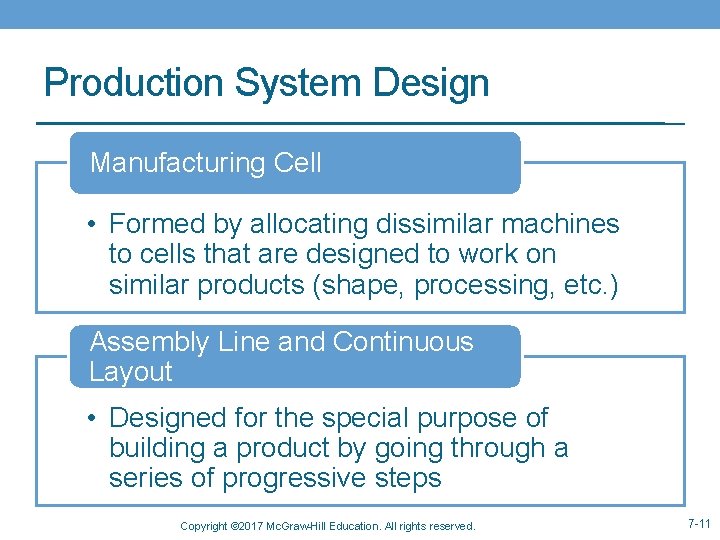
Production System Design Manufacturing Cell • Formed by allocating dissimilar machines to cells that are designed to work on similar products (shape, processing, etc. ) Assembly Line and Continuous Layout • Designed for the special purpose of building a product by going through a series of progressive steps Copyright © 2017 Mc. Graw-Hill Education. All rights reserved. 7 -11
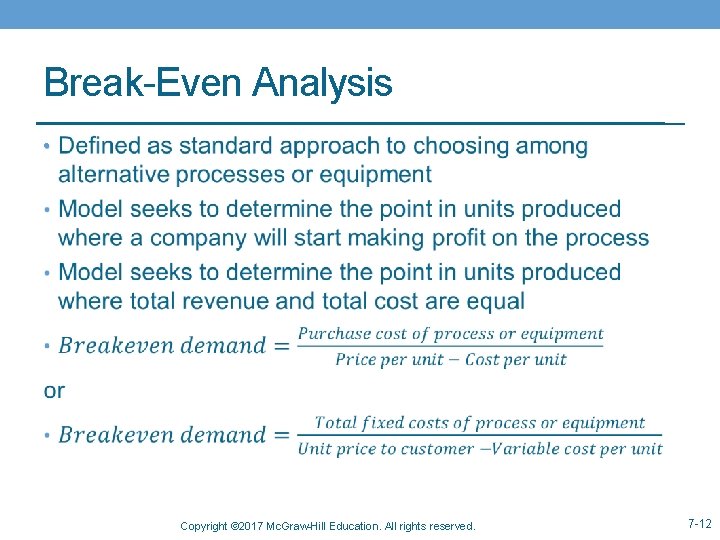
Break-Even Analysis • Copyright © 2017 Mc. Graw-Hill Education. All rights reserved. 7 -12
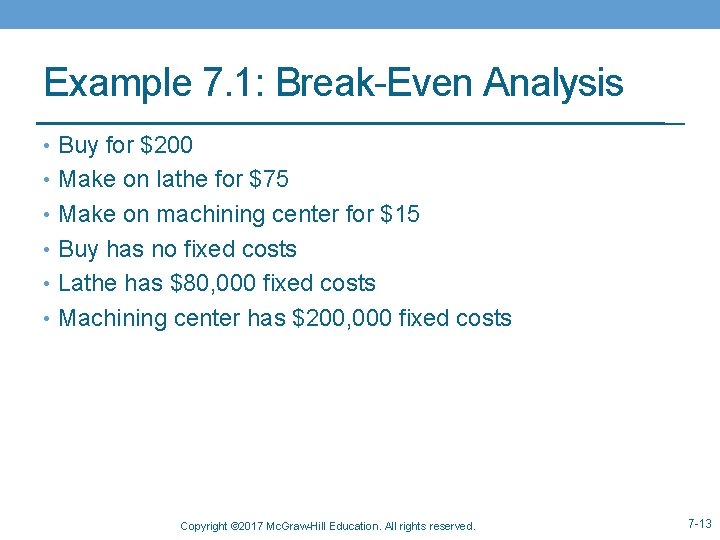
Example 7. 1: Break-Even Analysis • Buy for $200 • Make on lathe for $75 • Make on machining center for $15 • Buy has no fixed costs • Lathe has $80, 000 fixed costs • Machining center has $200, 000 fixed costs Copyright © 2017 Mc. Graw-Hill Education. All rights reserved. 7 -13
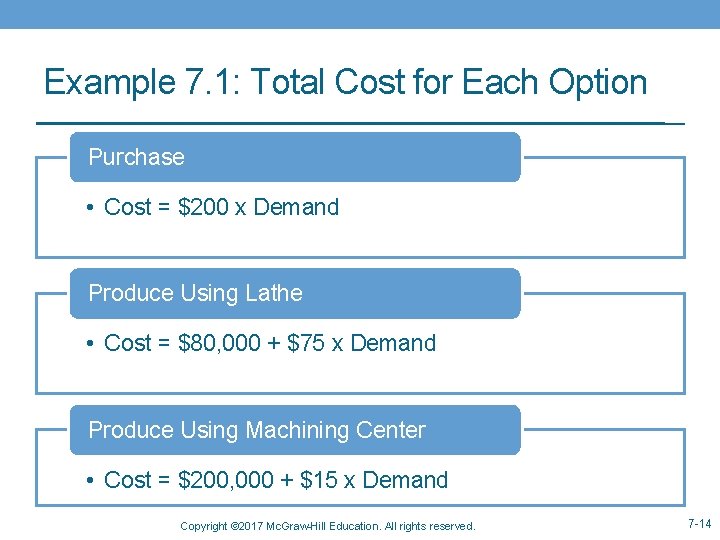
Example 7. 1: Total Cost for Each Option Purchase • Cost = $200 x Demand Produce Using Lathe • Cost = $80, 000 + $75 x Demand Produce Using Machining Center • Cost = $200, 000 + $15 x Demand Copyright © 2017 Mc. Graw-Hill Education. All rights reserved. 7 -14
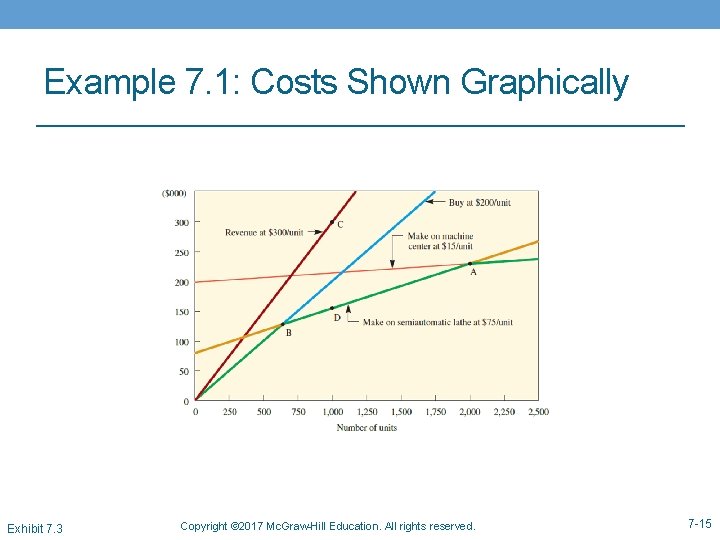
Example 7. 1: Costs Shown Graphically Exhibit 7. 3 Copyright © 2017 Mc. Graw-Hill Education. All rights reserved. 7 -15
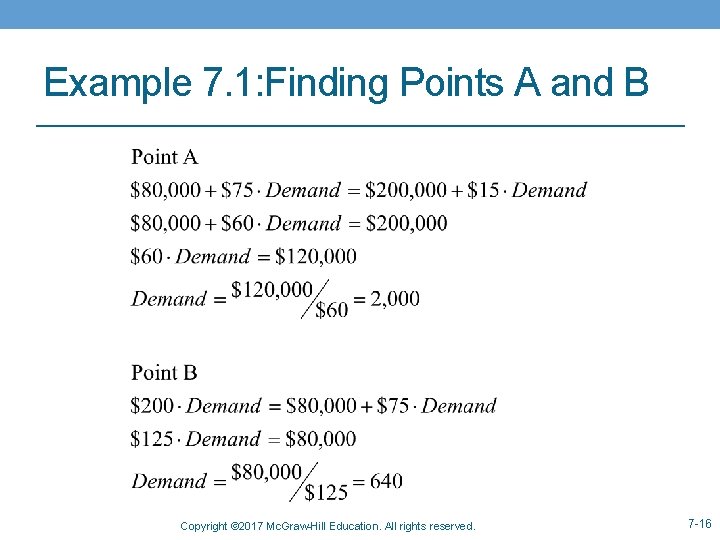
Example 7. 1: Finding Points A and B Copyright © 2017 Mc. Graw-Hill Education. All rights reserved. 7 -16
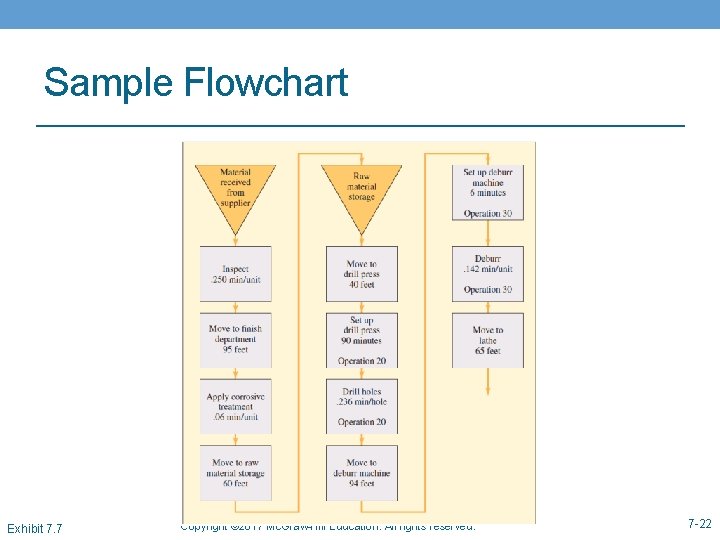
Manufacturing Process Flow Design • Manufacturing process flow design: a method to evaluate the specific processes that material follow as they move through the plant • Common tools are assembly drawings, assembly charts, route sheets, and flow process charts • Focus should be on the identification of activities that can be minimized or eliminated • Movement and storage • The fewer the moves, delays, and storage, the better the flow Copyright © 2017 Mc. Graw-Hill Education. All rights reserved. 7 -17
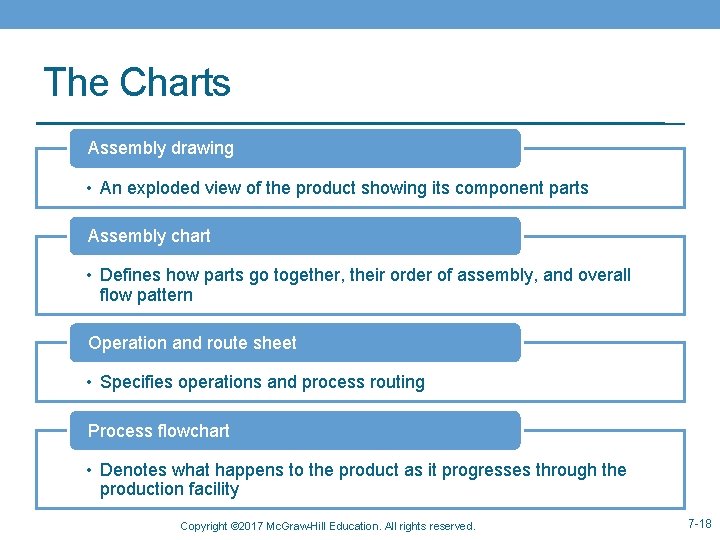
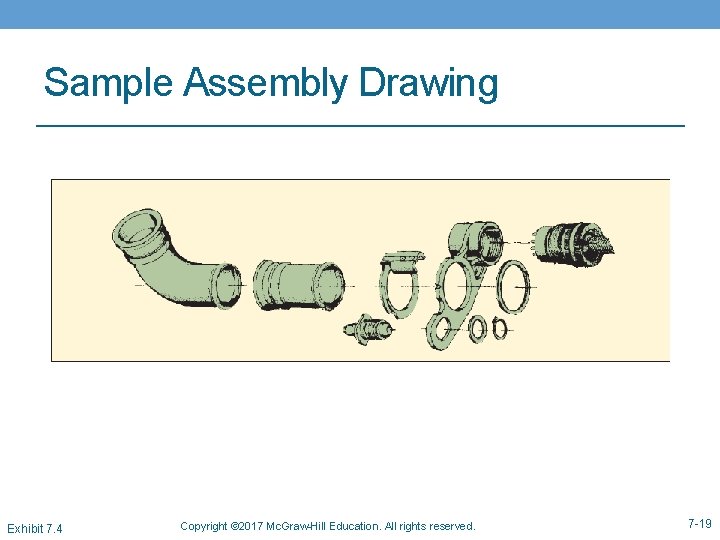
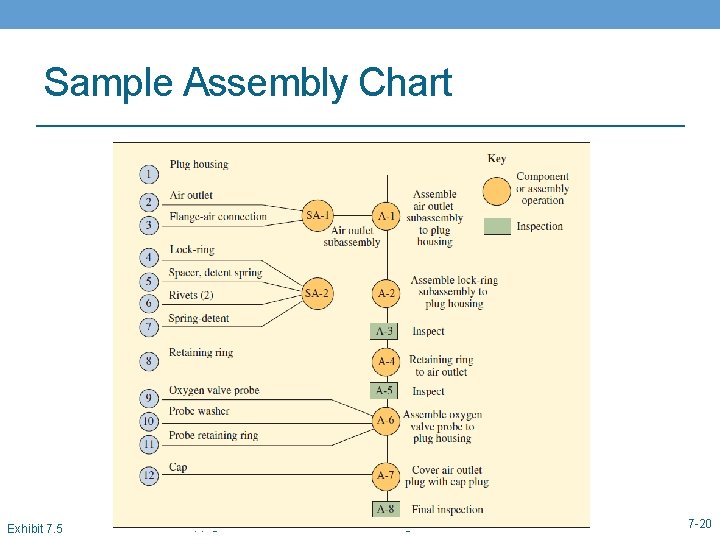
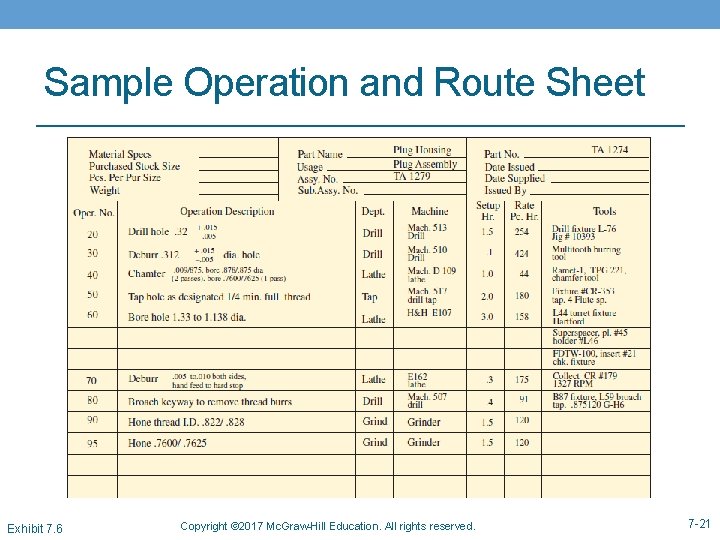
The Charts Assembly drawing • An exploded view of the product showing its component parts Assembly chart • Defines how parts go together, their order of assembly, and overall flow pattern Operation and route sheet • Specifies operations and process routing Process flowchart • Denotes what happens to the product as it progresses through the production facility Copyright © 2017 Mc. Graw-Hill Education. All rights reserved. 7 -18
Sample Assembly Drawing Exhibit 7. 4 Copyright © 2017 Mc. Graw-Hill Education. All rights reserved. 7 -19
Sample Assembly Chart Exhibit 7. 5 Copyright © 2017 Mc. Graw-Hill Education. All rights reserved. 7 -20
Sample Operation and Route Sheet Exhibit 7. 6 Copyright © 2017 Mc. Graw-Hill Education. All rights reserved. 7 -21
Sample Flowchart Exhibit 7. 7 Copyright © 2017 Mc. Graw-Hill Education. All rights reserved. 7 -22
Example 7. 2: Manufacturing Process Analysis • 15 workers, eight-hour shift • Assembly line moves at the rate of 150 components per hour • Incentive pay of 30¢ per good part • Can hire 15 more workers for second shift if needed • All but molding from outside vender Copyright © 2017 Mc. Graw-Hill Education. All rights reserved. 7 -23
Example 7. 2: Molding • 11 Machines • One usually down • One operator per machine • 25 parts per hour • Paid 20¢ per good part • Overtime is 30¢ per part • Employment is flexible • Currently 6 employees • 4 more available Copyright © 2017 Mc. Graw-Hill Education. All rights reserved. 7 -24
Example 7. 2: Remaining Costs • Raw materials are 10¢ per part • Electricity is 2¢ per part • Purchased parts cost 30¢ per component • Other weekly expenses • Rent is $100 • Other employees receive $1, 000 • Accounting depreciation is $50 Copyright © 2017 Mc. Graw-Hill Education. All rights reserved. 7 -25
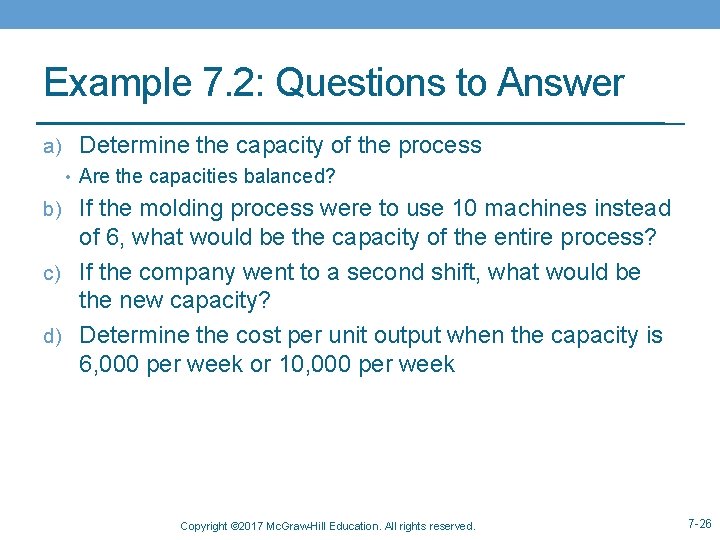
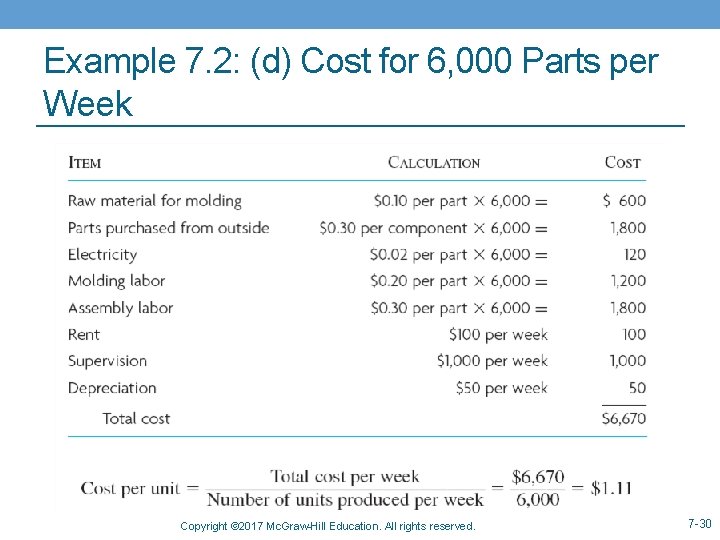
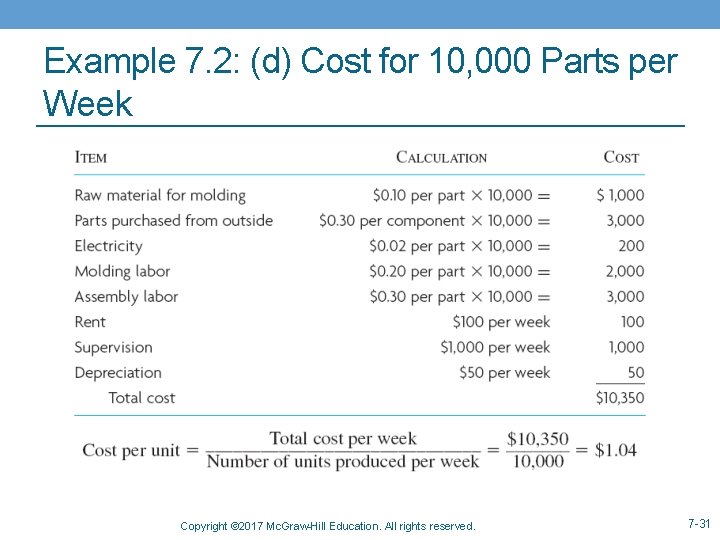
Example 7. 2: Questions to Answer a) Determine the capacity of the process • Are the capacities balanced? b) If the molding process were to use 10 machines instead of 6, what would be the capacity of the entire process? c) If the company went to a second shift, what would be the new capacity? d) Determine the cost per unit output when the capacity is 6, 000 per week or 10, 000 per week Copyright © 2017 Mc. Graw-Hill Education. All rights reserved. 7 -26
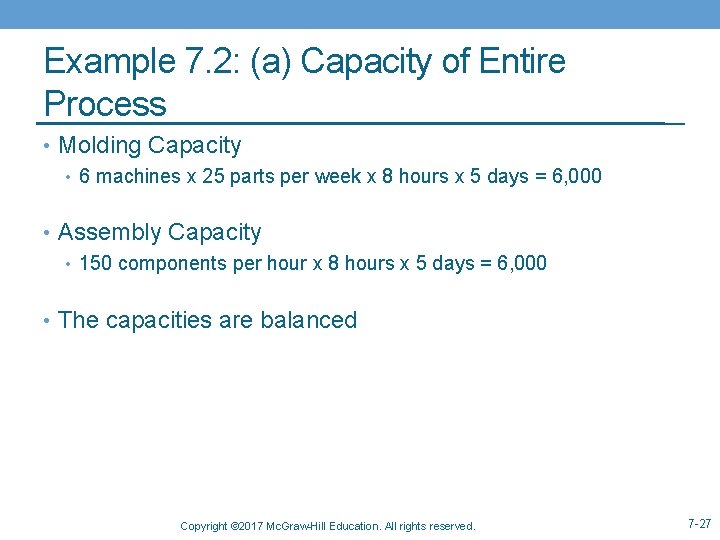
Example 7. 2: (a) Capacity of Entire Process • Molding Capacity • 6 machines x 25 parts per week x 8 hours x 5 days = 6, 000 • Assembly Capacity • 150 components per hour x 8 hours x 5 days = 6, 000 • The capacities are balanced Copyright © 2017 Mc. Graw-Hill Education. All rights reserved. 7 -27
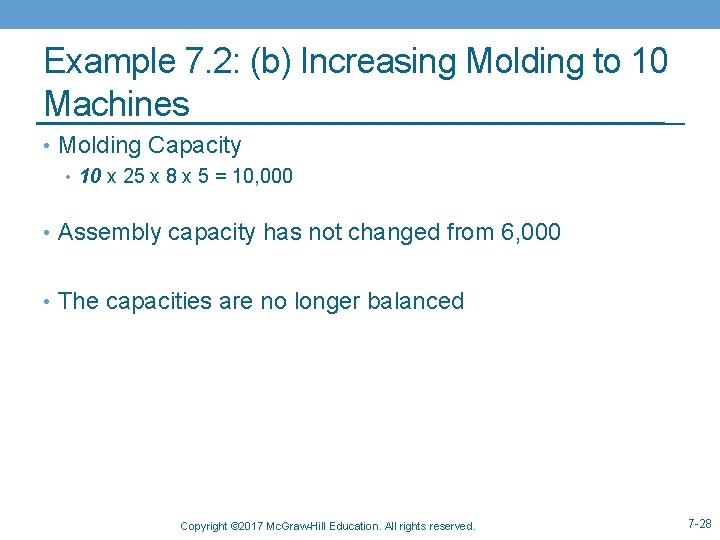
Example 7. 2: (b) Increasing Molding to 10 Machines • Molding Capacity • 10 x 25 x 8 x 5 = 10, 000 • Assembly capacity has not changed from 6, 000 • The capacities are no longer balanced Copyright © 2017 Mc. Graw-Hill Education. All rights reserved. 7 -28
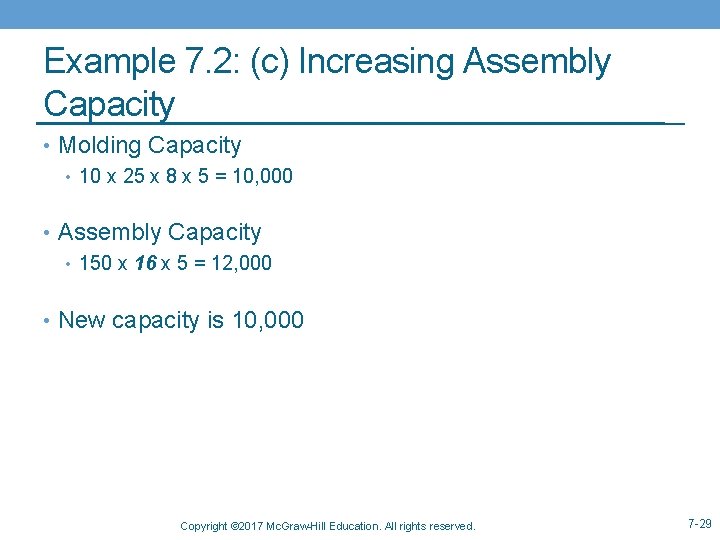
Example 7. 2: (c) Increasing Assembly Capacity • Molding Capacity • 10 x 25 x 8 x 5 = 10, 000 • Assembly Capacity • 150 x 16 x 5 = 12, 000 • New capacity is 10, 000 Copyright © 2017 Mc. Graw-Hill Education. All rights reserved. 7 -29
Example 7. 2: (d) Cost for 6, 000 Parts per Week Copyright © 2017 Mc. Graw-Hill Education. All rights reserved. 7 -30
Example 7. 2: (d) Cost for 10, 000 Parts per Week Copyright © 2017 Mc. Graw-Hill Education. All rights reserved. 7 -31
Summary • Manufacturing processes are used to make tangible items • Sourcing parts, making the item, sending it to the customer • To allow parts of the process to operate independently, • • • inventory is strategically positioned in the process Positioning the decoupling points has an impact on speed, flexibility, and many other trade-offs Manufacturing layouts are designed based on the nature of the product, the volume needed to meet demand, and the cost of equipment Break-even analysis is useful for understanding the cost tradeoffs between alternative equipment choices Visual charts can be used to document manufacturing process flows Flowcharts provide a simple but insightful analysis of capacity and variable cost Copyright © 2017 Mc. Graw-Hill Education. All rights reserved. 32
Practice Exam 1. 2. 3. 4. 5. 6. A firm that makes predesigned products directly to fill customer orders has this type of production environment A point where inventory is positioned to allow the production process to operate independently of the customer order delivery process A firm that designs and builds products from scratch according to customer specifications would have this type of production environment If a production process makes a unit every two hours and it takes 42 hours for the unit to go through the entire process, what is the expected work-in-process equal to This is a production layout where similar products are made. Typically, it is scheduled on an as-needed basis in response to current customer demand The relationship between how different layout structures are best suited depending on volume and product variety characteristics is depicted on this type of graph Copyright © 2017 Mc. Graw-Hill Education. All rights reserved. 33