
Chapter 7 Managing Conflict 2007 by Prentice Hall
Chapter 7: Managing Conflict © 2007 by Prentice Hall 7 -1
Learning Objectives • Diagnose the focus and source of conflicts • Utilize appropriate conflict management strategies • Resolve interpersonal confrontations through collaborations © 2007 by Prentice Hall 7 -2
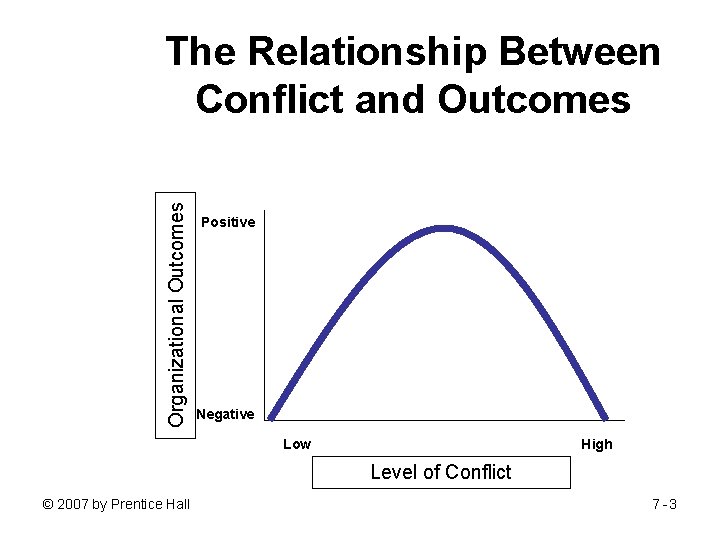
Organizational Outcomes The Relationship Between Conflict and Outcomes Positive Negative Low High Level of Conflict © 2007 by Prentice Hall 7 -3
Rules of Engagement • Work with more information • Focus on the facts • Develop multiple alternatives • Share agreed-upon goals • Inject humor • Maintain a balanced power structure • Resolve issues without forcing consensus © 2007 by Prentice Hall 7 -4
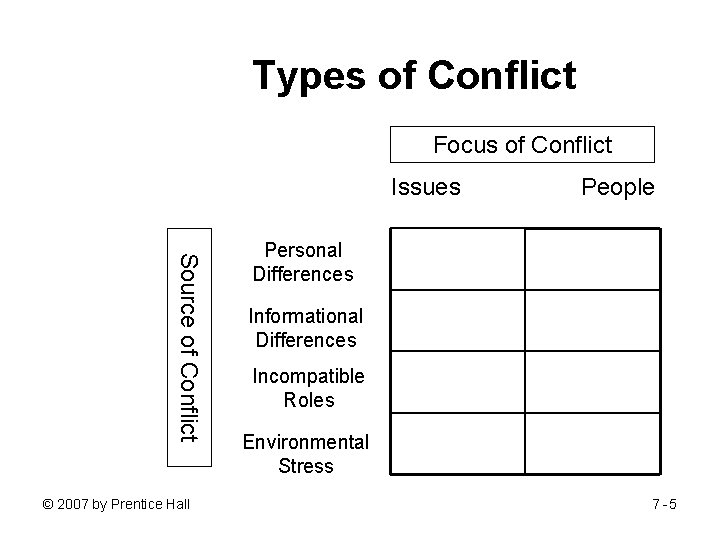
Types of Conflict Focus of Conflict Issues Source of Conflict © 2007 by Prentice Hall People Personal Differences Informational Differences Incompatible Roles Environmental Stress 7 -5
Conflict Focus People-focused: “In-your-face” confrontations in which emotions are fueled by moral indignation Issue-focused: negotiations in which participants agree how to allocate scarce resources © 2007 by Prentice Hall 7 -6
Four Sources of Interpersonal Conflict Personal Differences: Conflicts stem from personal values and needs © 2007 by Prentice Hall 7 -7
Four Sources of Interpersonal Conflict Informational Deficiencies: Conflicts evolve from misinformation and misunderstanding © 2007 by Prentice Hall 7 -8
Four Sources of Interpersonal Conflict Role Incompatibility: From the perception that assigned goals and responsibilities compete with those of others. © 2007 by Prentice Hall 7 -9
Four Sources of Interpersonal Conflict Environmentally Induced Stress: Results from the stressful events of the organizational environment. © 2007 by Prentice Hall 7 -10
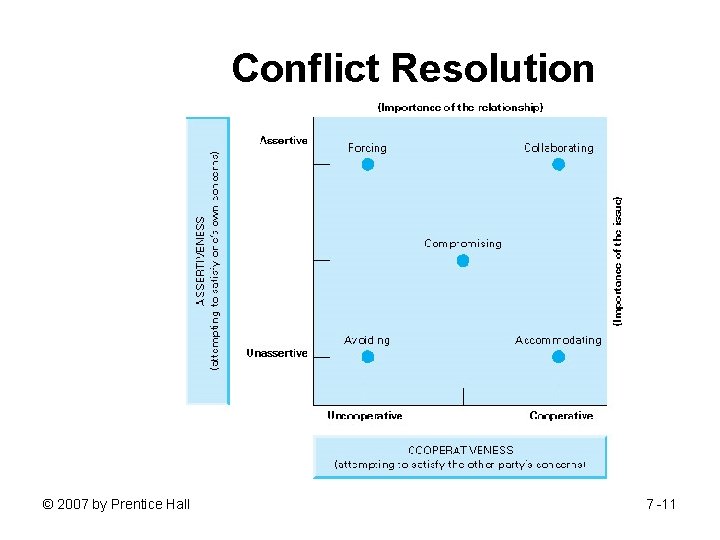
Conflict Resolution Insert figure 7. 3 © 2007 by Prentice Hall 7 -11
Approaches and Objectives Forcing: To get your way Avoiding: Avoid having to deal with conflict Compromise: Reach an agreement quickly © 2007 by Prentice Hall 7 -12
Approaches and Objectives Accommodating: Don’t upset the other person Collaborating: Solving the problem together © 2007 by Prentice Hall 7 -13
Selecting the Right Strategy Two Perspectives on Negotiation: Distributive: “Dividing up a fixed pie” Integrative: “Expanding the pie” © 2007 by Prentice Hall 7 -14
Selection Factors • Personal Preference – Ethnicity – Gender – Personality © 2007 by Prentice Hall 7 -15
While we are predisposed to one approach, no single approach is the best. Effective managers use a variety of approaches © 2007 by Prentice Hall 7 -16
Situational Considerations The approach that is used may depend upon, • Issue importance • Relationship importance • Relative power • Time constraints © 2007 by Prentice Hall 7 -17
A ‘Default Strategy’ Of all the approaches, collaboration is the best. However, it is the difficult to implement. © 2007 by Prentice Hall 7 -18
Framework for Collaborative Problem Solving • Establish superordinate goals • Separate the people from the problem • Focus on interests, not positions © 2007 by Prentice Hall 7 -19
Framework for Collaborative Problem Solving (con’t) • Invent options for mutual gains • Use objective criteria for evaluating alternatives • Define success in terms of real gains, not imaginary losses © 2007 by Prentice Hall 7 -20
Four Phases of Collaborative Problem Solving 1. Problem Identification 2. Solution Generation 3. Action Plan Formulation and Agreement 4. Implementation and Follow. Up © 2007 by Prentice Hall 7 -21
Phase 1: Problem Identification Initiator • Maintain personal ownership of problem • Describe problem in terms of behaviors, consequences, and feelings • Avoid drawing conclusions and attributing motives • Persist until understood • Encourage two-way discussion © 2007 by Prentice Hall 7 -22
Phase 2: Solution Generation Initiator Focus on commonalities as the basis for requesting a change © 2007 by Prentice Hall 7 -23
Phase 1: Problem Identification Responder • Establish a climate for joint problem solving • Seek additional information by asking questions • Agree with some aspect of the complaint © 2007 by Prentice Hall 7 -24
Phase 2: Solution Generation Responder Ask for suggestions of acceptable alternatives © 2007 by Prentice Hall 7 -25
Phase 1: Problem Identification Mediator’s Role • Establish a problem solving framework • Maintain a neutral posture regarding the disputants • Serve as facilitator, not judge • Insure discussion to ensure fairness © 2007 by Prentice Hall 7 -26
Phase 2: Solution Generation Mediator Explore options by focusing on interests; creates agreement on action plan and follow-up © 2007 by Prentice Hall 7 -27
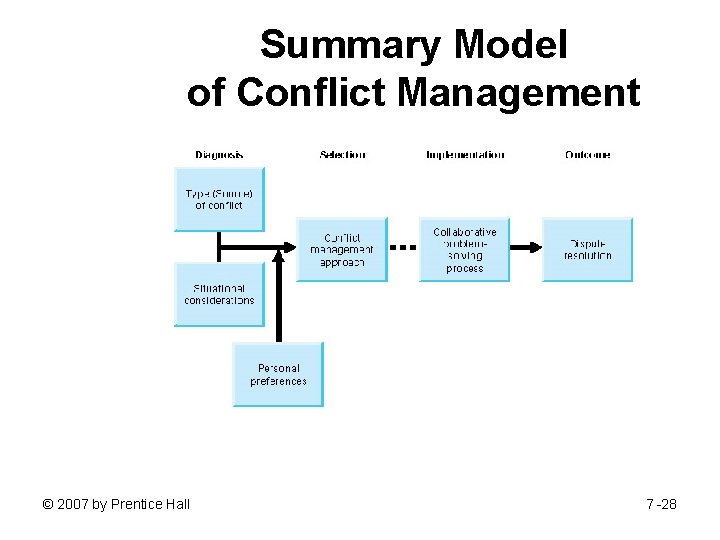
Summary Model of Conflict Management Insert figure 7. 6 © 2007 by Prentice Hall 7 -28
Behavioral Guidelines • Collect information on the sources of conflict • Examine relevant situational considerations © 2007 by Prentice Hall 7 -29
Behavioral Guidelines • Take into consideration your personal preferences for using the conflict management approaches • Utilize the collaborative approach unless conditions dictate the use of an alterative approach © 2007 by Prentice Hall 7 -30
- Slides: 30